Discrete Mathematical
Structures
(RRDMS)
May–August 2016
Research & Reviews:
ISSN 2394-1979 (Online)
www.stmjournals.com
STM JOURNALS
Scientific Technical Medical
STM Journals, a strong initiative by Consortium E-Learning Network Private Ltd. (established 2006), was
launched in the year 2010 under the support and guidance by our esteemed Editorial and Advisory Board
Membersfromrenownedinstitutes.
Objectives:
 Promotion of Scientific, Technical and Medical research.
 Publication of Original Research/Review, Short Articles and Case Studies through
Peer Review process.
 Publishing Special Issues on Conferences.
 Preparing online platform for print journals.
 Empowering the libraries with online and print Journals in Scientific, Technical
and Medical domains.
 Publishing and distribution of books on various subjects in the category of Nanotechnology,
Scientific and Technical Writing, and Environment, Health and Safety.
SalientFeatures:
 A bouquet of 100+ Journals that fall under Science, Technical and Medical domains.
 Employs Open Journals System (OJS)—a journal management and publishing system.
 The first and one of the fastest growing publication website in India as well as in abroad
for its quality and coverage.
 Rapid online submission and publication of papers, soon after their formal
acceptance/finalization.
 Facilitates linking with the other authors or professionals.
 Worldwide circulation and visibility.
Research & Reviews: Discrete Mathematical Structures
ISSN: 2394-1979(online)
Focus and Scope Covers
 Mathematicalinduction
 LogicandBooleanalgebra
 Settheory
 Relationsandfunctions
 Sequencesandseries
 Algorithmsandtheoryofcomputation
 Numbertheory
Research & Reviews: Discrete Mathematical Structures is published (frequency: three times a year) in India by STM
Journals (division of Consortium e-Learning Network Private Ltd. Pvt.) The views expressed in the articles do not
necessarily reflect of the Publisher. The publisher does not endorse the quality or value of the advertised/sponsored
products described therein. Please consult full prescribing information before issuing a prescription for any products
mentionedinthispublication.
No part of this publication may be reproduced, stored in retrieval system or transmitted in any from without written
permissionof thepublisher.
To cite any of the material contained in this Journal, in English or translation, please use the full English reference at the
beginningof eacharticle.Toreuseanyofthematerial,pleasecontactSTM Journals (info@stmjournals.com)
STM Journals
STM Journals (division of Consortium e-Learning Network Private Ltd. ) having its Marketing office located at Office
No. 4, First Floor, CSC pocket E Market, Mayur Vihar Phase II, New Delhi-110091, India is the Publisher of Journal.
Statements and opinions expressed in the Journal reflect the views of the author(s) and are not the opinion of STM
Journals unless so stated.
Subscription Information and Order:
 NationalSubscription:
Print-Rs 3750/-perJournal( includes3printissues), SingleIssue copypurchase:Rs 1500.
Online - Rs 3750/- per Journal inclusive Service Tax ( includes 3 online issues), Single Issue purchase: Rs 1500
inclusiveServiceTax
Print+Online-Rs 5000/-perJournalinclusiveServiceTax( includes3print&onlineissues).
 International Subscription:
 Online Only- $199, Print Only-$299 (includes 3 print issues)
 Online + Print-$399 (includes 3 print issues + online access of published back volumes )
To purchase print compilation of back issues please send your query at info@stmjournals.com
Subscription must be prepaid. Rates outside of India includes delivery. Prices subject to change without notice.
Mode of Payment: At par cheque, Demand draft, and RTGS (payment to be made in favor of
Consortium E-Learning Network. Pvt. ltd., payable at Delhi/New Delhi.
Online Access Policy
A). For Authors:
In order to provide maximum citation and wide publicity to the authors work, STM Journals also have Open Access
Policy, authors who would like to get their work open access can opt for Optional Open Access publication at
nominal cost as follows
India, SARC and African Countries: INR 2500 or 100 USD including single hard copy of Author's Journal.
Other Countries: USD 200 including single hard copy of Author's Journal.
B). For Subscribers:
 Online access will be activated within 72 hours of receipt of the payment (working days), subject to receipt of
correct information on user details/Static IP address of the subscriber.
 The access will be blocked:
 If the user requests for the same and furnishes valid reasons for blocking.
 Due to technical issue.
 Misuse of the access rights as per the access policy.
Advertising and Commercial Reprint Inquiries: STM Journals with wide circulation and visibility offer an excellent
media for showcasing/promotion of your products/services and the events-namely, Conferences, Symposia/Seminars
etc. These journals have very high potential to deliver the message across the targeted audience regularly with each
published issue. The advertisements on bulk subscriptions, gift subscriptions or reprint purchases for distribution etc. are
alsoverywelcome.
Lost Issue Claims: Please note the following when applying for lost or missing issues:
 Claims for print copies lost will be honored only after 45 days of the dispatch date and before publication of the
next issue as per the frequency.
 Tracking id for the speed post will be provided to all our subscribers and the claims for the missing Journals will
be entertained only with the proofs which will be verified at both the ends.
 Claims filed due to insufficient (or no notice) of change of address will not be honored.
 Change of Address of Dispatch should be intimated to STM Journals at least 2 months prior to the dispatch
schedule as per the frequency by mentioning subscriber id and the subscription id.
 Refund requests will not be entertained.
Legal Disputes
All the legal disputes are subjected to Delhi Jurisdiction only. If you have any questions, please contact the Publication
Management Team: info@stmjournals.com; Tel : +91 0120-4781211.
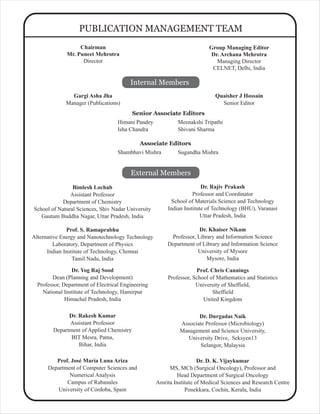
Gargi Asha Jha
Manager (Publications)
PUBLICATION MANAGEMENT TEAM
Internal Members
External Members
Bimlesh Lochab
Assistant Professor
Department of Chemistry
School of Natural Sciences, Shiv Nadar University
Gautam Buddha Nagar, Uttar Pradesh, India
Dr. Rajiv Prakash
Professor and Coordinator
School of Materials Science and Technology
Indian Institute of Technology (BHU), Varanasi
Uttar Pradesh, India
Dr. Rakesh Kumar
Assistant Professor
Department of Applied Chemistry
BIT Mesra, Patna,
Bihar, India
Prof. S. Ramaprabhu
Alternative Energy and Nanotechnology Technology
Laboratory, Department of Physics
Indian Institute of Technology, Chennai
Tamil Nadu, India
Himani Pandey
Isha Chandra
Senior Associate Editors
Dr. Yog Raj Sood
Dean (Planning and Development)
Professor, Department of Electrical Engineering
National Institute of Technology, Hamirpur
Himachal Pradesh, India
Prof. Chris Cannings
Professor, School of Mathematics and Statistics
University of Sheffield,
Sheffield
United Kingdom
Dr. D. K. Vijaykumar
MS, MCh (Surgical Oncology), Professor and
Head Department of Surgical Oncology
Amrita Institute of Medical Sciences and Research Centre
Ponekkara, Cochin, Kerala, India
Dr. Durgadas Naik
Associate Professor (Microbiology)
Management and Science University,
University Drive, Seksyen13
Selangor, Malaysia
Prof. José María Luna Ariza
Department of Computer Sciences and
Numerical Analysis
Campus of Rabanales
University of Córdoba, Spain
Dr. Khaiser Nikam
Professor, Library and Information Science
Department of Library and Information Science
University of Mysore
Mysore, India
Quaisher J Hossain
Senior Editor
Group Managing Editor
Dr. Archana Mehrotra
Managing Director
CELNET, Delhi, India
Meenakshi Tripathi
Shivani Sharma
Chairman
Mr. Puneet Mehrotra
Director
Shambhavi Mishra
Associate Editors
Sugandha Mishra
Prof. Priyavrat Thareja
Director Principal
Rayat Institute of Engineering and
Information Technology
Punjab, India
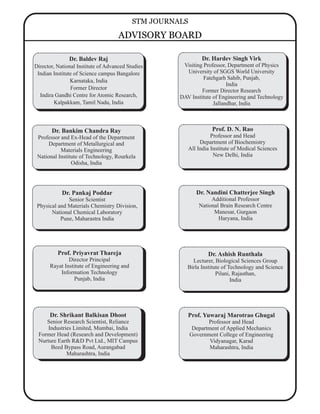
Dr. Baldev Raj
Director, National Institute of Advanced Studies
Indian Institute of Science campus Bangalore
Karnataka, India
Former Director
Indira Gandhi Centre for Atomic Research,
Kalpakkam, Tamil Nadu, India
Dr. Pankaj Poddar
Senior Scientist
Physical and Materials Chemistry Division,
National Chemical Laboratory
Pune, Maharastra India
Prof. D. N. Rao
Professor and Head
Department of Biochemistry
All India Institute of Medical Sciences
New Delhi, India
Dr. Nandini Chatterjee Singh
Additional Professor
National Brain Research Centre
Manesar, Gurgaon
Haryana, India
Dr. Ashish Runthala
Lecturer, Biological Sciences Group
Birla Institute of Technology and Science
Pilani, Rajasthan,
India
Dr. Bankim Chandra Ray
Professor and Ex-Head of the Department
Department of Metallurgical and
Materials Engineering
National Institute of Technology, Rourkela
Odisha, India
Prof. Yuwaraj Marotrao Ghugal
Professor and Head
Department of Applied Mechanics
Government College of Engineering
Vidyanagar, Karad
Maharashtra, India
Dr. Hardev Singh Virk
Visiting Professor, Department of Physics
University of SGGS World University
Fatehgarh Sahib, Punjab,
India
Former Director Research
DAV Institute of Engineering and Technology
Jallandhar, India
Dr. Shrikant Balkisan Dhoot
Senior Research Scientist, Reliance
Industries Limited, Mumbai, India
Former Head (Research and Development)
Nurture Earth R&D Pvt Ltd., MIT Campus
Beed Bypass Road, Aurangabad
Maharashtra, India
STM JOURNALS
ADVISORY BOARD
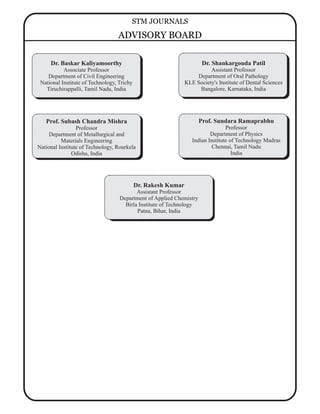
Dr. Rakesh Kumar
Assistant Professor
Department of Applied Chemistry
Birla Institute of Technology
Patna, Bihar, India
Prof. Subash Chandra Mishra
Professor
Department of Metallurgical and
Materials Engineering
National Institute of Technology, Rourkela
Odisha, India
Dr. Shankargouda Patil
Assistant Professor
Department of Oral Pathology
KLE Society's Institute of Dental Sciences
Bangalore, Karnataka, India
Prof. Sundara Ramaprabhu
Professor
Department of Physics
Indian Institute of Technology Madras
Chennai, Tamil Nadu
India
Dr. Baskar Kaliyamoorthy
Associate Professor
Department of Civil Engineering
National Institute of Technology, Trichy
Tiruchirappalli, Tamil Nadu, India
STM JOURNALS
ADVISORY BOARD
Editorial Board
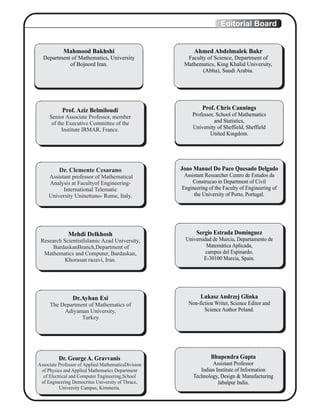
Mahmood Bakhshi
Department of Mathematics, University
of Bojnord Iran.
Prof. Aziz Belmiloudi
Senior Associate Professor, member
of the Executive Committee of the
Institute IRMAR, France.
Dr. Clemente Cesarano
Assistant professor of Mathematical
Analysis at Facultyof Engineering-
International Telematic
University Uninettuno- Rome, Italy.
Joao Manuel Do Paco Quesado Delgado
Assistant Researcher Centro de Estudos da
Construcao in Department of Civil
Engineering of the Faculty of Engineering of
the University of Porto, Portugal.
Prof. Chris Cannings
Professor, School of Mathematics
and Statistics,
University of Sheffield, Sheffield
United Kingdom.
Ahmed Abdelmalek Bakr
Faculty of Science, Department of
Mathematics, King Khalid University,
(Abha), Saudi Arabia.
Mehdi Delkhosh
Research ScientistIslamic Azad University,
BardaskanBranch,Department of
Mathematics and Computer, Bardaskan,
Khorasan razavi, Iran.
Sergio Estrada Dominguez
Universidad de Murcia, Departamento de
Matemática Aplicada,
campus del Espinardo,
E-30100 Murcia, Spain.
Dr.Ayhan Esi
The Department of Mathematics of
Adiyaman University,
Turkey.
Lukasz Andrzej Glinka
Non-fiction Writer, Science Editor and
Science Author Poland.
Dr. George A. Gravvanis
Associate Professor of Applied MathematicsDivision
of Physics and Applied Mathematics Department
of Electrical and Computer Engineering,School
of Engineering Democritus University of Thrace,
University Campus, Kimmeria.
Bhupendra Gupta
Assistant Professor
Indian Institute of Information
Technology, Design & Manufacturing
Jabalpur India.
Editorial Board
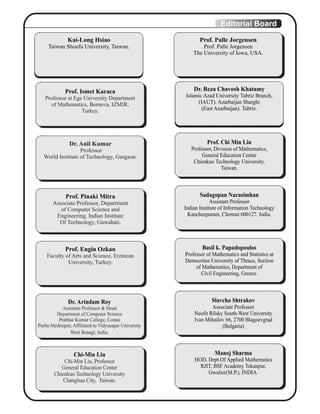
Kai-Long Hsiao
Taiwan Shoufu University, Taiwan.
Prof. Ismet Karaca
Professor at Ege University Department
of Mathematics, Bornova, IZMIR,
Turkey.
Dr. Anil Kumar
Professor
World Institute of Technology, Gurgaon.
Prof. Chi Min Liu
Professor, Division of Mathematics,
General Education Center
Chienkuo Technology University,
Taiwan.
Dr. Reza Chavosh Khatamy
Islamic Azad University Tabriz Branch,
(IAUT). Azarbaijan Sharghi
(East Azarbaijan). Tabriz.
Prof. Palle Jorgensen
The University of Iowa, USA.
Prof. Pinaki Mitra
Associate Professor, Department
of Computer Science and
Engineering, Indian Institute
Of Technology, Guwahati.
Sadagopan Narasimhan
Assistant Professor
Indian Institute of Information Technology
Kancheepuram, Chennai 600127. India.
Prof. Engin Ozkan
Faculty of Arts and Science, Erzincan
University, Turkey.
Basil k. Papadopoulos
Professor of Mathematics and Statistics at
Democritus University of Thrace, Section
of Mathematics, Department of
Civil Engineering, Greece.
Dr. Arindam Roy
Assistant Professor & Head
Department of Computer Science
Prabhat Kumar College, Contai
Purba Medinipur, Affiliated to Vidyasagar University
West Benagl, India.
Slavcho Shtrakov
Associate Professor
Neofit Rilsky South-West University
Ivan Mihailov 66, 2700 Blagoevgrad
(Bulgaria)
Chi-Min Liu
Chi-Min Liu, Professor
General Education Center
Chienkuo Technology University
Changhua City, Taiwan.
Manoj Sharma
HOD, Dept.Of Applied Mathematics
RJIT, BSF Academy Tekanpur,
Gwalior(M.P.), INDIA.
Prof. Hari M. Srivastava
Professor Emeritus,
Department of Mathematics and
Statistics, University of Victoria, Victoria,
British Columbia V8W 3R4, Canada
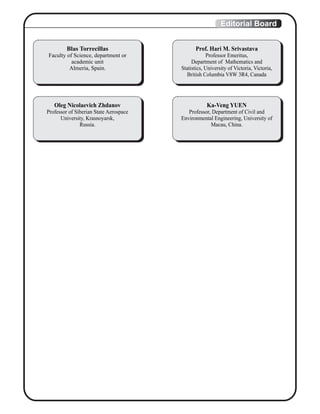
Blas Torrecillas
Faculty of Science, department or
academic unit
Almeria, Spain.
Ka-Veng YUEN
Professor, Department of Civil and
Environmental Engineering, University of
Macau, China.
Oleg Nicolaevich Zhdanov
Professor of Siberian State Aerospace
University, Krasnoyarsk,
Russia.
Editorial Board
It is my privilege to present the print version of the [Volume 3; Issue 3] of our Research & Reviews:
Discrete Mathematical Structures, 2016. The intension of RRDMS is to create an atmosphere that
stimulatesvision,researchandgrowth intheareaofDiscreteMathematics.
Timely publication, honest communication, comprehensive editing and trust with authors and
readers have been the hallmark of our journals. STM Journals provide a platform for scholarly
research articles to be published in journals of international standards. STM journals strive to publish
qualitypaperinrecordtime,makingitaleaderinserviceandbusiness offerings.
The aim and scope of STM Journals is to provide an academic medium and an important reference
for the advancement and dissemination of research results that support high level learning, teaching
andresearchinalltheScientific,TechnicalandMedicaldomains.
Finally, I express my sincere gratitude to our Editorial/ Reviewer board, Authors and publication
team for their continued support and invaluable contributions and suggestions in the form of
authoring writeups/reviewing and providing constructive comments for the advancement of the
journals.With regards to their due continuous support and co-operation, we have been able to publish
qualityResearch/Reviewsfindingsfor our customersbase.
Ihopeyouwillenjoyreadingthisissue andwewelcomeyourfeedbackonanyaspectof theJournal.
Dr.ArchanaMehrotra
ManagingDirector
STM Journals
Director's Desk
STM JOURNALS
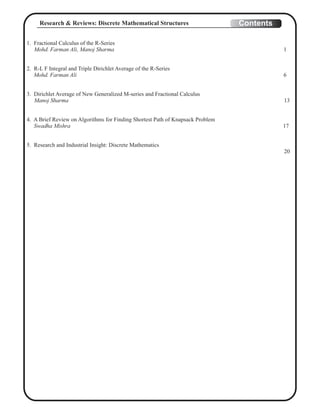
1. Fractional Calculus of the R-Series
Mohd. Farman Ali, Manoj Sharma 1
2. R-L F Integral and Triple Dirichlet Average of the R-Series
Mohd. Farman Ali 6
3. Dirichlet Average of New Generalized M-series and Fractional Calculus
Manoj Sharma 13
4. A Brief Review on Algorithms for Finding Shortest Path of Knapsack Problem
Swadha Mishra 17
5. Research and Industrial Insight: Discrete Mathematics
20
ContentsResearch & Reviews: Discrete Mathematical Structures
RRDMS (2016) 1-5 © STM Journals 2016. All Rights Reserved Page 1
Research & Reviews: Discrete Mathematical Structures
ISSN: 2394-1979(online)
Volume 3, Issue 3
www.stmjournals.com
Fractional Calculus of the R-Series
Mohd. Farman Ali1,
*, Manoj Sharma2
1
Department of Mathematics, Madhav University, Sirohi, Rajasthan, India
2
Department of Mathematics, Rustamji Institute of Technology, BSF Academy, Tekanpur, Gwalior,
Madhya Pradesh, India
Abstract
The present paper creates a special function called as R-series. This is a special case of H-
function given by Inayat Hussain. The Hypergeometric function, Mainardi function and M-
series follow R-series and these functions have recently found essential applications in solving
problems in physics, biology, bio-science, engineering and applied science etc.
Mathematics Subject Classification—26A33, 33C60, 44A15
Keywords: Fractional calculus operators, R−series, Mellin-Barnes integral, special functions
INTRODUCTION TO THE H-FUNCTION
The H- function of Inayat Hussain, is a generalization of the familiar H-function of Fox, defined in
terms of Mellin-Barnes contour integral [1], as
𝐻 𝑝,𝑞
𝑚,𝑛
[𝑧(𝛽 𝑗, 𝐵 𝑗)1,𝑚 ,(𝛽 𝑗, 𝐵 𝑗; 𝑏 𝑗 ) 𝑚+1,𝑞
(𝛼 𝑗, 𝐴 𝑗;𝛼 𝑗)1,𝑛 ,(𝛼 𝑗, 𝐴 𝑗; 𝛼 𝑗) 𝑛+1,𝑝
] =
1
2𝜋𝑖
∫ 𝜃(𝑠)𝑧 𝑠
𝑑𝑠
+𝑖∞
−𝑖∞
(1)
Where the integrand (or Mellin transform of the H-function)
𝜃(𝑠) =
∏ Γ(𝛽 𝑗− 𝐵 𝑗 𝑠) ∏ [Γ(1=𝛼 𝑗+𝐴 𝑗 𝑠)]
𝛼 𝑗𝑛
𝑗=1
𝑚
𝑗=1
∏ [Γ(1=𝛽𝑗+𝐵 𝑗 𝑠)]
𝑏 𝑗𝑛
𝑗=𝑚+1 ∏ Γ
𝑝
𝑗=𝑛+1 (𝛼 𝑗− 𝐴 𝑗 𝑠)
(2)
Contains fractional powers of some of the involved Γ −functions. Here 𝛼𝑗(1𝑒𝑟𝑒𝑝) and 𝛽𝑗(1𝑛𝑑 𝑞) are
complex parameters; 𝐴𝑗 > 0 ( 10𝑟𝑒𝑝 ), 𝐵𝑗 > 0(1 … … … 𝑞) ; and exponents; 𝑎𝑗(𝑗 = 1 … … … 𝑛) and
𝑏𝑗(𝑗 = 1 … … … 𝑞) can take noninteger values. Evidently, when all the exponent 𝑎𝑗 and 𝑏𝑗 take integer
values only, the H-function reduces to the familiar H-function of Fox, [1–3]. The sufficient conditions
for the absolute convergence of the contour integral (1), as given by Buschman and Srivastava, are as
follows [3]:
Ω = 𝐵𝑗
𝑚
𝑗=1 + 𝑎𝑗 𝐴 𝑗 −𝑛
𝑗=1 𝑏𝑗 𝐵𝑗
𝑝
𝑗=𝑚+1 − 𝐴𝑗
𝑞
𝑗=𝑛+1 > 0 and arg(𝑧) <
1
2
𝜋 Ω
THE R-SERIES
The R- series is
𝑅 𝑞
𝛼,𝛽
𝑝
0
(𝑎1 . . . . 𝑎 𝑝; , 𝑏1 . . . . 𝑏 𝑞; 𝑧0
) = 𝑅 𝑞
𝛼,𝛽
𝑝
0
(𝑧)
𝑅 𝑞
𝛼,𝛽
𝑝
0
(𝑧) =
(𝑎1) 𝑘 . . . . .(𝑎 𝑝)
𝑘
(𝑏1) 𝑘 . . . . .(𝑏 𝑞)
𝑘
∞
𝑘=𝑜
𝑧 𝑘
Γ(𝛼𝑘+𝛽)𝑘!
(3)
Here, 𝑝 upper parameters 𝑎1, 𝑎2, . . . . 𝑎 𝑝 and 𝑞 lower parameters 𝑏1, 𝑏2, . . . . 𝑏 𝑞 , 𝛼𝜖𝐶 , 𝑅(𝛼) >
0, 𝑚 > 0 and (𝑎𝑗) 𝑘 (𝑏𝑗) 𝑘
RRDMS (2016) 6-12 © STM Journals 2016. All Rights Reserved Page 6
Research & Reviews: Discrete Mathematical Structures
ISSN: 2394-1979(online)
Volume 3, Issue 3
www.stmjournals.com
R-L F Integral and Triple Dirichlet Average of the
R-Series
Mohd. Farman Ali
Department of Mathematics, Madhav University, Sirohi, Rajasthan, India
Abstract
In this article, we establish the relation between some results of triple Dirichlet average of the
R-series and fractional operators. We use a new special function called as R-series, which is a
special case of H-function given by Inayat Hussain. In this article, the solution is obtained in
compact form of triple Dirichlet average of R-series as well as conversion into single
Dirichlet average of R-series, using fractional integral.
Keywords: Dirichlet averages, special functions, R-series and Riemann-Liouville fractional
integral
Mathematics Subject Classification: 2000: Primary: 33E12, 26A33; Secondary: 33C20,
33C65.
INTRODUCTION
The Dirichlet average of a function is a certain kind integral average with respect to Dirichlet
measure. The concept of Dirichlet average was introduced by Carlson in 1977. Carlson has defined
Dirichlet averages of functions, which represent certain types of integral average with respect to
Dirichlet measure [1–4]. He showed that various important special functions could be derived as
Dirichlet averages for the ordinary simple functions like 𝑥 𝑡
,𝑒 𝑥
etc. He has also pointed out that the
hidden symmetry of all special functions, which provided their various transformations can be
obtained by averaging 𝑥 𝑛
,𝑒 𝑥
etc. [5, 6]. Thus, he established a unique process towards the unification
of special functions by averaging a limited number of ordinary functions [7].
Gupta and Agarwal found that averaging process is not altogether new but directly connected with the
old theory of fractional derivative [8, 9]. Carlson overlooked this connection whereas he has applied
fractional derivative in so many cases during his entire work. Deora and Banerji have found the
double Dirichlet average of ex
by using fractional derivatives and they have also found the triple
Dirichlet average of xt
by using fractional derivatives [10, 11].
Sharma and Jain obtained double Dirichlet average of trigonometry function cos 𝑥 using fractional
derivative and they have also found the triple Dirichlet average of ex
by using fractional calculus
[12–15].
Recently, Kilbas and Kattuveetti established a correlation among Dirichlet averages of the generalized
Mittag-Leffler function with Riemann-Liouville fractional integrals and of the hyper-geometric
functions of many variables [16].
DEFINITIONS AND PRELIMINARIES
Some definitions are necessary in the preparation of this paper.
Standard Simplex in 𝑹 𝒌
, 𝒌 ≥ 𝟏:
The standard simplex in 𝑅 𝑘
, 𝑘 ≥ 1 by [1].
𝐸 = 𝐸 𝑘 = {𝑆(𝑢1, 𝑢2, … 𝑢 𝑘) ∶ 𝑢1 ≥ 0, … 𝑢 𝑘 ≥ 0, 𝑢1 + 𝑢2 + ⋯ + 𝑢 𝑘 ≤ 1}
RRDMS (2016) 13-16 © STM Journals 2016. All Rights Reserved Page 13
Research & Reviews: Discrete Mathematical Structures
ISSN: 2394-1979(online)
Volume 3, Issue 3
www.stmjournals.com
Dirichlet Average of New Generalized
M-series and Fractional Calculus
Manoj Sharma
Department of Mathematics, Rustamji Institute of Technology, BSF Academy, Tekanpur,
Gwalior, Madhya Pradesh, India
Abstract
We know that every analytic function can be measured as a Dirichlet average and connected
with fractional calculus. In this note, we set up a relation between Dirichlet average of new
generalized M-series, and fractional derivative. Fractional derivative is a derivative of
arbitrary order i.e. may be real, complex, integer or fractional order.
Mathematics Subject Classification: 26A33, 33A30, 33A25 and 83C99.
Keywords: Dirichlet average new generalized M-series, fractional derivative, fractional
calculus operators
INTRODUCTION
Carlson has defined Dirichlet average of functions which represents certain types of integral average
with respect to Dirichlet measure [1–5]. He showed that various important special functions can be
derived as Dirichlet averages for the ordinary simple functions like𝑥 𝑡
,𝑒 𝑥
etc. He has also pointed out
that the hidden symmetry of all special functions which provided their various transformations can be
obtained by averaging 𝑥 𝑛
,𝑒 𝑥
etc. [6, 7]. Thus he established a unique process towards the unification
of special functions by averaging a limited number of ordinary functions. Almost all known special
functions and their well-known properties have been derived by this process.
In this paper, the Dirichlet average of new generalized M-series has been obtained.
DEFINITIONS
We give below some of the definitions which are necessary in the preparation of this paper:
Standard Simplex in 𝑹 𝒏
, 𝒏 ≥ 𝟏:
We denote the standard simplex in 𝑅 𝑛
, 𝑛 ≥ 1 by Carlson [1].
𝐸 = 𝐸 𝑛 = {𝑆(𝑢1, 𝑢2, … … . . 𝑢 𝑛) ∶ 𝑢1 ≥ 0, … … … . 𝑢 𝑛 ≥ 0, 𝑢1 + 𝑢2 + ⋯ … … + 𝑢 𝑛 ≤ 1} (1)
Dirichlet Measure
Let 𝑏 ∈ 𝐶 𝑘
, 𝑘 ≥ 2 and let 𝐸 = 𝐸 𝑘−1 be the standard simplex in 𝑅 𝑘−1
. The complex measure 𝜇 𝑏 is
defined by 𝐸[1].
𝑑𝜇 𝑏(𝑢) =
1
𝐵(𝑏)
𝑢1
𝑏1−1
… … … … … . 𝑢 𝑘−1
𝑏 𝑘−1−1
(1 − 𝑢1 − ⋯ … … … − 𝑢 𝑘−1)𝑏 𝑘
−1
𝑑𝑢1 … … … … . 𝑑𝑢 𝑘−1 (2)
It will be called a Dirichlet measure.
Here,
𝐵(𝑏) = 𝐵(𝑏1, … … … . 𝑏𝑘) =
Γ(𝑏1) … … … … … . . Γ(𝑏 𝑘)
Γ(𝑏1 + ⋯ … … . . +𝑏 𝑘)
,
𝐶> = {𝑧 ∈ 𝑧: 𝑧 ≠ 0, |𝑝ℎ 𝑧| < 𝜋
2⁄ },
Open right half plane and 𝐶>k is the 𝑘 𝑡ℎ
Cartesian power of 𝐶>.
RRDMS (2016) 17-19 © STM Journals 2016. All Rights Reserved Page 17
Research & Reviews: Discrete Mathematical Structures
ISSN: 2394-1979(online)
Volume 3, Issue 3
www.stmjournals.com
A Brief Review on Algorithms for Finding Shortest Path
of Knapsack Problem
Swadha Mishra*
Department of Computer Applications, Invertis University, Bareilly, Uttar Pradesh, India
Abstract
The gathering knapsack and knapsack problems are summed up to briefest way issue in a
class of graphs. An effective calculation is used for finding briefest ways that bend lengths are
non-negative. A more effective calculation is portrayed for the non-cyclic which incorporates
the knapsack issue.
Keywords: knapsack problem, rucksack problem
INTRODUCTION
The knapsack problem or rucksack problem is
an issue in combinatorial enhancement: Given
an arrangement of things, each with a weight
and an esteem, decide the number of
everything to incorporate into an accumulation
so that the aggregate weight is not exactly or
equivalent to a given point of confinement and
the aggregate esteem is as expansive as could
reasonably be expected.
Group knapsack problem has been given to:
Minimise ∑ 𝑐𝑛
𝑗=1 jjxj (1)
Subject to ∑ 𝑐𝑛
𝑗=1 jgj=g0 (2)
Where, x1,…, xn non-negative integers.
g0,…, gn are the subset of the elements of a
finite additive abelian group H and c1,…,cn are
non-negative reals.
This algorithm for solving this problem has
been described by Gomory [1], Shapiro [2, 3],
Hu [4] and others. It can be formulated as a
shortest path problem in the following way.
Let G1 be the graph with node H and arc of the
form (h, h+gj) h an arbitrary element of H and
j=1,…, n. The length of such an arc is cj. Let P
be the from 0 to g0 in G1 then if xj is the
number of arcs of the form (h, h+gj) in P then
(x1,…, xn) is a solution to Eq. (2) and the
length of P is Eq. (1). Conversely, if (xn,…, xn)
satisfied Eq. (2), then one may construct paths
from 0 to g0. Now a new algorithm is given in
this paper to solve this problem [5].
The name knapsack problem applies to:
Maximize ∑ 𝑐𝑛
𝑗=0 jjxj (3)
Subject to ∑ 𝑤𝑛
𝑗=0 jxj=W, (4)
Where, x0, xi,…, xn non-negative integers.
Where, c0=0, c1,…, cn are positive reals, w0=1
and w1,…, wn, W are positive integers.
One can formulate a knapsack problem as a
longest path problem defining the graph G2
with nodes 0, 1,…, W and arcs of the form (w,
w+wj) of length cj. The knapsack problem is
then equivalent to that of finding a longest
path from 0 to W [6].
ALGORITHM
The graph G1 and G2 of the previous section
are examples of a class of graphs which for the
purposes of this paper, we call knapsack
graphs.
Definition
A graph G with nodes N and arcs A is a
knapsack graph if,
(1) The arcs A can be partitioned into n
disjoint sets A1,…,AN;
(2) The length of each arc belonging to Aj is lj;
(3) Let P=(i0, i1,...,ip) be a path between an
arbitrary pair of nodes i0, ip.
Suppose that (it-1, it)∈Amt, for t=1,…., p.
Then for any re-ordering, n1,…., np of the
indices m1,…, mp, there exist a path
Q=(j0,j1,…, jp), where j0=i0, jp=ip and (jt-1=jt)
∈Ant for t=1,…., p.
For shortest path problems with non-negative
RRDMS (2016) 20-26 © STM Journals 2016. All Rights Reserved Page 20
Research & Reviews: Discrete Mathematical Structures
ISSN: 2394-1979(online)
Volume 3, Issue 3
www.stmjournals.com
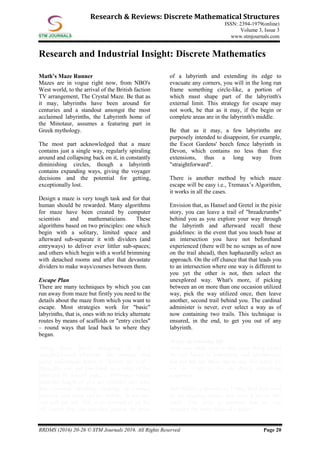
Research and Industrial Insight: Discrete Mathematics
Math’s Maze Runner
Mazes are in vogue right now, from NBO's
West world, to the arrival of the British faction
TV arrangement, The Crystal Maze. Be that as
it may, labyrinths have been around for
centuries and a standout amongst the most
acclaimed labyrinths, the Labyrinth home of
the Minotaur, assumes a featuring part in
Greek mythology.
The most part acknowledged that a maze
contains just a single way, regularly spiraling
around and collapsing back on it, in constantly
diminishing circles, though a labyrinth
contains expanding ways, giving the voyager
decisions and the potential for getting,
exceptionally lost.
Design a maze is very tough task and for that
human should be rewarded. Many algorithms
for maze have been created by computer
scientists and mathematicians. These
algorithms based on two principles: one which
begin with a solitary, limited space and
afterward sub-separate it with dividers (and
entryways) to deliver ever littler sub-spaces;
and others which begin with a world brimming
with detached rooms and after that devastate
dividers to make ways/courses between them.
Escape Plan
There are many techniques by which you can
run away from maze but firstly you need to the
details about the maze from which you want to
escape. Most strategies work for "basic"
labyrinths, that is, ones with no tricky alternate
routes by means of scaffolds or "entry circles"
– round ways that lead back to where they
began.
Along these lines, accepting it is a
straightforward labyrinth, the strategy that
many individuals know is "follow the wall”.
Basically, you put one hand on a mass of the
labyrinth (it doesn't make a difference which
hand the length of you are reliable) and after
that continue strolling, keeping up contact
between your hand and the divider. In the end,
you will get out. This is on account of on the
off chance that you envision getting the mass
of a labyrinth and extending its edge to
evacuate any corners, you will in the long run
frame something circle-like, a portion of
which must shape part of the labyrinth's
external limit. This strategy for escape may
not work, be that as it may, if the begin or
complete areas are in the labyrinth's middle.
Be that as it may, a few labyrinths are
purposely intended to disappoint, for example,
the Escot Gardens' beech fence labyrinth in
Devon, which contains no less than five
extensions, thus a long way from
"straightforward".
There is another method by which maze
escape will be easy i.e., Tremaux’s Algorithm,
it works in all the cases.
Envision that, as Hansel and Gretel in the pixie
story, you can leave a trail of "breadcrumbs"
behind you as you explore your way through
the labyrinth and afterward recall these
guidelines: in the event that you touch base at
an intersection you have not beforehand
experienced (there will be no scraps as of now
on the trail ahead), then haphazardly select an
approach. On the off chance that that leads you
to an intersection where one way is different to
you yet the other is not, then select the
unexplored way. What's more, if picking
between an on more than one occasion utilized
way, pick the way utilized once, then leave
another, second trail behind you. The cardinal
administer is never, ever select a way as of
now containing two trails. This technique is
ensured, in the end, to get you out of any
labyrinth.
Mazes in everyday life
Now you think how is this maze thing useful
for us? Maze is interesting and adventurous
but not for our daily day-to-day life when we
are on work or we are doing something
important.
Bill Hillier, a theorist in 1980s, find that most
of the housing estates that have a layout like
maze. This reise q question that we can
measure the maze-iness of a house?
Discrete Mathematical
Structures
(RRDMS)
May–August 2016
Research & Reviews:
ISSN 2394-1979 (Online)
www.stmjournals.com
STM JOURNALS
Scientific Technical Medical

Research & Reviews Discrete Mathematical Structures vol 3 issue 3

  • 1.
    Discrete Mathematical Structures (RRDMS) May–August 2016 Research& Reviews: ISSN 2394-1979 (Online) www.stmjournals.com STM JOURNALS Scientific Technical Medical
  • 2.
    STM Journals, astrong initiative by Consortium E-Learning Network Private Ltd. (established 2006), was launched in the year 2010 under the support and guidance by our esteemed Editorial and Advisory Board Membersfromrenownedinstitutes. Objectives:  Promotion of Scientific, Technical and Medical research.  Publication of Original Research/Review, Short Articles and Case Studies through Peer Review process.  Publishing Special Issues on Conferences.  Preparing online platform for print journals.  Empowering the libraries with online and print Journals in Scientific, Technical and Medical domains.  Publishing and distribution of books on various subjects in the category of Nanotechnology, Scientific and Technical Writing, and Environment, Health and Safety. SalientFeatures:  A bouquet of 100+ Journals that fall under Science, Technical and Medical domains.  Employs Open Journals System (OJS)—a journal management and publishing system.  The first and one of the fastest growing publication website in India as well as in abroad for its quality and coverage.  Rapid online submission and publication of papers, soon after their formal acceptance/finalization.  Facilitates linking with the other authors or professionals.  Worldwide circulation and visibility. Research & Reviews: Discrete Mathematical Structures ISSN: 2394-1979(online) Focus and Scope Covers  Mathematicalinduction  LogicandBooleanalgebra  Settheory  Relationsandfunctions  Sequencesandseries  Algorithmsandtheoryofcomputation  Numbertheory Research & Reviews: Discrete Mathematical Structures is published (frequency: three times a year) in India by STM Journals (division of Consortium e-Learning Network Private Ltd. Pvt.) The views expressed in the articles do not necessarily reflect of the Publisher. The publisher does not endorse the quality or value of the advertised/sponsored products described therein. Please consult full prescribing information before issuing a prescription for any products mentionedinthispublication. No part of this publication may be reproduced, stored in retrieval system or transmitted in any from without written permissionof thepublisher. To cite any of the material contained in this Journal, in English or translation, please use the full English reference at the beginningof eacharticle.Toreuseanyofthematerial,pleasecontactSTM Journals (info@stmjournals.com) STM Journals
  • 3.
    STM Journals (divisionof Consortium e-Learning Network Private Ltd. ) having its Marketing office located at Office No. 4, First Floor, CSC pocket E Market, Mayur Vihar Phase II, New Delhi-110091, India is the Publisher of Journal. Statements and opinions expressed in the Journal reflect the views of the author(s) and are not the opinion of STM Journals unless so stated. Subscription Information and Order:  NationalSubscription: Print-Rs 3750/-perJournal( includes3printissues), SingleIssue copypurchase:Rs 1500. Online - Rs 3750/- per Journal inclusive Service Tax ( includes 3 online issues), Single Issue purchase: Rs 1500 inclusiveServiceTax Print+Online-Rs 5000/-perJournalinclusiveServiceTax( includes3print&onlineissues).  International Subscription:  Online Only- $199, Print Only-$299 (includes 3 print issues)  Online + Print-$399 (includes 3 print issues + online access of published back volumes ) To purchase print compilation of back issues please send your query at info@stmjournals.com Subscription must be prepaid. Rates outside of India includes delivery. Prices subject to change without notice. Mode of Payment: At par cheque, Demand draft, and RTGS (payment to be made in favor of Consortium E-Learning Network. Pvt. ltd., payable at Delhi/New Delhi. Online Access Policy A). For Authors: In order to provide maximum citation and wide publicity to the authors work, STM Journals also have Open Access Policy, authors who would like to get their work open access can opt for Optional Open Access publication at nominal cost as follows India, SARC and African Countries: INR 2500 or 100 USD including single hard copy of Author's Journal. Other Countries: USD 200 including single hard copy of Author's Journal. B). For Subscribers:  Online access will be activated within 72 hours of receipt of the payment (working days), subject to receipt of correct information on user details/Static IP address of the subscriber.  The access will be blocked:  If the user requests for the same and furnishes valid reasons for blocking.  Due to technical issue.  Misuse of the access rights as per the access policy. Advertising and Commercial Reprint Inquiries: STM Journals with wide circulation and visibility offer an excellent media for showcasing/promotion of your products/services and the events-namely, Conferences, Symposia/Seminars etc. These journals have very high potential to deliver the message across the targeted audience regularly with each published issue. The advertisements on bulk subscriptions, gift subscriptions or reprint purchases for distribution etc. are alsoverywelcome. Lost Issue Claims: Please note the following when applying for lost or missing issues:  Claims for print copies lost will be honored only after 45 days of the dispatch date and before publication of the next issue as per the frequency.  Tracking id for the speed post will be provided to all our subscribers and the claims for the missing Journals will be entertained only with the proofs which will be verified at both the ends.  Claims filed due to insufficient (or no notice) of change of address will not be honored.  Change of Address of Dispatch should be intimated to STM Journals at least 2 months prior to the dispatch schedule as per the frequency by mentioning subscriber id and the subscription id.  Refund requests will not be entertained. Legal Disputes All the legal disputes are subjected to Delhi Jurisdiction only. If you have any questions, please contact the Publication Management Team: info@stmjournals.com; Tel : +91 0120-4781211.
  • 4.
    Gargi Asha Jha Manager(Publications) PUBLICATION MANAGEMENT TEAM Internal Members External Members Bimlesh Lochab Assistant Professor Department of Chemistry School of Natural Sciences, Shiv Nadar University Gautam Buddha Nagar, Uttar Pradesh, India Dr. Rajiv Prakash Professor and Coordinator School of Materials Science and Technology Indian Institute of Technology (BHU), Varanasi Uttar Pradesh, India Dr. Rakesh Kumar Assistant Professor Department of Applied Chemistry BIT Mesra, Patna, Bihar, India Prof. S. Ramaprabhu Alternative Energy and Nanotechnology Technology Laboratory, Department of Physics Indian Institute of Technology, Chennai Tamil Nadu, India Himani Pandey Isha Chandra Senior Associate Editors Dr. Yog Raj Sood Dean (Planning and Development) Professor, Department of Electrical Engineering National Institute of Technology, Hamirpur Himachal Pradesh, India Prof. Chris Cannings Professor, School of Mathematics and Statistics University of Sheffield, Sheffield United Kingdom Dr. D. K. Vijaykumar MS, MCh (Surgical Oncology), Professor and Head Department of Surgical Oncology Amrita Institute of Medical Sciences and Research Centre Ponekkara, Cochin, Kerala, India Dr. Durgadas Naik Associate Professor (Microbiology) Management and Science University, University Drive, Seksyen13 Selangor, Malaysia Prof. José María Luna Ariza Department of Computer Sciences and Numerical Analysis Campus of Rabanales University of Córdoba, Spain Dr. Khaiser Nikam Professor, Library and Information Science Department of Library and Information Science University of Mysore Mysore, India Quaisher J Hossain Senior Editor Group Managing Editor Dr. Archana Mehrotra Managing Director CELNET, Delhi, India Meenakshi Tripathi Shivani Sharma Chairman Mr. Puneet Mehrotra Director Shambhavi Mishra Associate Editors Sugandha Mishra
  • 5.
    Prof. Priyavrat Thareja DirectorPrincipal Rayat Institute of Engineering and Information Technology Punjab, India Dr. Baldev Raj Director, National Institute of Advanced Studies Indian Institute of Science campus Bangalore Karnataka, India Former Director Indira Gandhi Centre for Atomic Research, Kalpakkam, Tamil Nadu, India Dr. Pankaj Poddar Senior Scientist Physical and Materials Chemistry Division, National Chemical Laboratory Pune, Maharastra India Prof. D. N. Rao Professor and Head Department of Biochemistry All India Institute of Medical Sciences New Delhi, India Dr. Nandini Chatterjee Singh Additional Professor National Brain Research Centre Manesar, Gurgaon Haryana, India Dr. Ashish Runthala Lecturer, Biological Sciences Group Birla Institute of Technology and Science Pilani, Rajasthan, India Dr. Bankim Chandra Ray Professor and Ex-Head of the Department Department of Metallurgical and Materials Engineering National Institute of Technology, Rourkela Odisha, India Prof. Yuwaraj Marotrao Ghugal Professor and Head Department of Applied Mechanics Government College of Engineering Vidyanagar, Karad Maharashtra, India Dr. Hardev Singh Virk Visiting Professor, Department of Physics University of SGGS World University Fatehgarh Sahib, Punjab, India Former Director Research DAV Institute of Engineering and Technology Jallandhar, India Dr. Shrikant Balkisan Dhoot Senior Research Scientist, Reliance Industries Limited, Mumbai, India Former Head (Research and Development) Nurture Earth R&D Pvt Ltd., MIT Campus Beed Bypass Road, Aurangabad Maharashtra, India STM JOURNALS ADVISORY BOARD
  • 6.
    Dr. Rakesh Kumar AssistantProfessor Department of Applied Chemistry Birla Institute of Technology Patna, Bihar, India Prof. Subash Chandra Mishra Professor Department of Metallurgical and Materials Engineering National Institute of Technology, Rourkela Odisha, India Dr. Shankargouda Patil Assistant Professor Department of Oral Pathology KLE Society's Institute of Dental Sciences Bangalore, Karnataka, India Prof. Sundara Ramaprabhu Professor Department of Physics Indian Institute of Technology Madras Chennai, Tamil Nadu India Dr. Baskar Kaliyamoorthy Associate Professor Department of Civil Engineering National Institute of Technology, Trichy Tiruchirappalli, Tamil Nadu, India STM JOURNALS ADVISORY BOARD
  • 7.
    Editorial Board Mahmood Bakhshi Departmentof Mathematics, University of Bojnord Iran. Prof. Aziz Belmiloudi Senior Associate Professor, member of the Executive Committee of the Institute IRMAR, France. Dr. Clemente Cesarano Assistant professor of Mathematical Analysis at Facultyof Engineering- International Telematic University Uninettuno- Rome, Italy. Joao Manuel Do Paco Quesado Delgado Assistant Researcher Centro de Estudos da Construcao in Department of Civil Engineering of the Faculty of Engineering of the University of Porto, Portugal. Prof. Chris Cannings Professor, School of Mathematics and Statistics, University of Sheffield, Sheffield United Kingdom. Ahmed Abdelmalek Bakr Faculty of Science, Department of Mathematics, King Khalid University, (Abha), Saudi Arabia. Mehdi Delkhosh Research ScientistIslamic Azad University, BardaskanBranch,Department of Mathematics and Computer, Bardaskan, Khorasan razavi, Iran. Sergio Estrada Dominguez Universidad de Murcia, Departamento de Matemática Aplicada, campus del Espinardo, E-30100 Murcia, Spain. Dr.Ayhan Esi The Department of Mathematics of Adiyaman University, Turkey. Lukasz Andrzej Glinka Non-fiction Writer, Science Editor and Science Author Poland. Dr. George A. Gravvanis Associate Professor of Applied MathematicsDivision of Physics and Applied Mathematics Department of Electrical and Computer Engineering,School of Engineering Democritus University of Thrace, University Campus, Kimmeria. Bhupendra Gupta Assistant Professor Indian Institute of Information Technology, Design & Manufacturing Jabalpur India.
  • 8.
    Editorial Board Kai-Long Hsiao TaiwanShoufu University, Taiwan. Prof. Ismet Karaca Professor at Ege University Department of Mathematics, Bornova, IZMIR, Turkey. Dr. Anil Kumar Professor World Institute of Technology, Gurgaon. Prof. Chi Min Liu Professor, Division of Mathematics, General Education Center Chienkuo Technology University, Taiwan. Dr. Reza Chavosh Khatamy Islamic Azad University Tabriz Branch, (IAUT). Azarbaijan Sharghi (East Azarbaijan). Tabriz. Prof. Palle Jorgensen Prof. Palle Jorgensen The University of Iowa, USA. Prof. Pinaki Mitra Associate Professor, Department of Computer Science and Engineering, Indian Institute Of Technology, Guwahati. Sadagopan Narasimhan Assistant Professor Indian Institute of Information Technology Kancheepuram, Chennai 600127. India. Prof. Engin Ozkan Faculty of Arts and Science, Erzincan University, Turkey. Basil k. Papadopoulos Professor of Mathematics and Statistics at Democritus University of Thrace, Section of Mathematics, Department of Civil Engineering, Greece. Dr. Arindam Roy Assistant Professor & Head Department of Computer Science Prabhat Kumar College, Contai Purba Medinipur, Affiliated to Vidyasagar University West Benagl, India. Slavcho Shtrakov Associate Professor Neofit Rilsky South-West University Ivan Mihailov 66, 2700 Blagoevgrad (Bulgaria) Chi-Min Liu Chi-Min Liu, Professor General Education Center Chienkuo Technology University Changhua City, Taiwan. Manoj Sharma HOD, Dept.Of Applied Mathematics RJIT, BSF Academy Tekanpur, Gwalior(M.P.), INDIA.
  • 9.
    Prof. Hari M.Srivastava Professor Emeritus, Department of Mathematics and Statistics, University of Victoria, Victoria, British Columbia V8W 3R4, Canada Blas Torrecillas Faculty of Science, department or academic unit Almeria, Spain. Ka-Veng YUEN Professor, Department of Civil and Environmental Engineering, University of Macau, China. Oleg Nicolaevich Zhdanov Professor of Siberian State Aerospace University, Krasnoyarsk, Russia. Editorial Board
  • 10.
    It is myprivilege to present the print version of the [Volume 3; Issue 3] of our Research & Reviews: Discrete Mathematical Structures, 2016. The intension of RRDMS is to create an atmosphere that stimulatesvision,researchandgrowth intheareaofDiscreteMathematics. Timely publication, honest communication, comprehensive editing and trust with authors and readers have been the hallmark of our journals. STM Journals provide a platform for scholarly research articles to be published in journals of international standards. STM journals strive to publish qualitypaperinrecordtime,makingitaleaderinserviceandbusiness offerings. The aim and scope of STM Journals is to provide an academic medium and an important reference for the advancement and dissemination of research results that support high level learning, teaching andresearchinalltheScientific,TechnicalandMedicaldomains. Finally, I express my sincere gratitude to our Editorial/ Reviewer board, Authors and publication team for their continued support and invaluable contributions and suggestions in the form of authoring writeups/reviewing and providing constructive comments for the advancement of the journals.With regards to their due continuous support and co-operation, we have been able to publish qualityResearch/Reviewsfindingsfor our customersbase. Ihopeyouwillenjoyreadingthisissue andwewelcomeyourfeedbackonanyaspectof theJournal. Dr.ArchanaMehrotra ManagingDirector STM Journals Director's Desk STM JOURNALS
  • 11.
    1. Fractional Calculusof the R-Series Mohd. Farman Ali, Manoj Sharma 1 2. R-L F Integral and Triple Dirichlet Average of the R-Series Mohd. Farman Ali 6 3. Dirichlet Average of New Generalized M-series and Fractional Calculus Manoj Sharma 13 4. A Brief Review on Algorithms for Finding Shortest Path of Knapsack Problem Swadha Mishra 17 5. Research and Industrial Insight: Discrete Mathematics 20 ContentsResearch & Reviews: Discrete Mathematical Structures
  • 12.
    RRDMS (2016) 1-5© STM Journals 2016. All Rights Reserved Page 1 Research & Reviews: Discrete Mathematical Structures ISSN: 2394-1979(online) Volume 3, Issue 3 www.stmjournals.com Fractional Calculus of the R-Series Mohd. Farman Ali1, *, Manoj Sharma2 1 Department of Mathematics, Madhav University, Sirohi, Rajasthan, India 2 Department of Mathematics, Rustamji Institute of Technology, BSF Academy, Tekanpur, Gwalior, Madhya Pradesh, India Abstract The present paper creates a special function called as R-series. This is a special case of H- function given by Inayat Hussain. The Hypergeometric function, Mainardi function and M- series follow R-series and these functions have recently found essential applications in solving problems in physics, biology, bio-science, engineering and applied science etc. Mathematics Subject Classification—26A33, 33C60, 44A15 Keywords: Fractional calculus operators, R−series, Mellin-Barnes integral, special functions INTRODUCTION TO THE H-FUNCTION The H- function of Inayat Hussain, is a generalization of the familiar H-function of Fox, defined in terms of Mellin-Barnes contour integral [1], as 𝐻 𝑝,𝑞 𝑚,𝑛 [𝑧(𝛽 𝑗, 𝐵 𝑗)1,𝑚 ,(𝛽 𝑗, 𝐵 𝑗; 𝑏 𝑗 ) 𝑚+1,𝑞 (𝛼 𝑗, 𝐴 𝑗;𝛼 𝑗)1,𝑛 ,(𝛼 𝑗, 𝐴 𝑗; 𝛼 𝑗) 𝑛+1,𝑝 ] = 1 2𝜋𝑖 ∫ 𝜃(𝑠)𝑧 𝑠 𝑑𝑠 +𝑖∞ −𝑖∞ (1) Where the integrand (or Mellin transform of the H-function) 𝜃(𝑠) = ∏ Γ(𝛽 𝑗− 𝐵 𝑗 𝑠) ∏ [Γ(1=𝛼 𝑗+𝐴 𝑗 𝑠)] 𝛼 𝑗𝑛 𝑗=1 𝑚 𝑗=1 ∏ [Γ(1=𝛽𝑗+𝐵 𝑗 𝑠)] 𝑏 𝑗𝑛 𝑗=𝑚+1 ∏ Γ 𝑝 𝑗=𝑛+1 (𝛼 𝑗− 𝐴 𝑗 𝑠) (2) Contains fractional powers of some of the involved Γ −functions. Here 𝛼𝑗(1𝑒𝑟𝑒𝑝) and 𝛽𝑗(1𝑛𝑑 𝑞) are complex parameters; 𝐴𝑗 > 0 ( 10𝑟𝑒𝑝 ), 𝐵𝑗 > 0(1 … … … 𝑞) ; and exponents; 𝑎𝑗(𝑗 = 1 … … … 𝑛) and 𝑏𝑗(𝑗 = 1 … … … 𝑞) can take noninteger values. Evidently, when all the exponent 𝑎𝑗 and 𝑏𝑗 take integer values only, the H-function reduces to the familiar H-function of Fox, [1–3]. The sufficient conditions for the absolute convergence of the contour integral (1), as given by Buschman and Srivastava, are as follows [3]: Ω = 𝐵𝑗 𝑚 𝑗=1 + 𝑎𝑗 𝐴 𝑗 −𝑛 𝑗=1 𝑏𝑗 𝐵𝑗 𝑝 𝑗=𝑚+1 − 𝐴𝑗 𝑞 𝑗=𝑛+1 > 0 and arg(𝑧) < 1 2 𝜋 Ω THE R-SERIES The R- series is 𝑅 𝑞 𝛼,𝛽 𝑝 0 (𝑎1 . . . . 𝑎 𝑝; , 𝑏1 . . . . 𝑏 𝑞; 𝑧0 ) = 𝑅 𝑞 𝛼,𝛽 𝑝 0 (𝑧) 𝑅 𝑞 𝛼,𝛽 𝑝 0 (𝑧) = (𝑎1) 𝑘 . . . . .(𝑎 𝑝) 𝑘 (𝑏1) 𝑘 . . . . .(𝑏 𝑞) 𝑘 ∞ 𝑘=𝑜 𝑧 𝑘 Γ(𝛼𝑘+𝛽)𝑘! (3) Here, 𝑝 upper parameters 𝑎1, 𝑎2, . . . . 𝑎 𝑝 and 𝑞 lower parameters 𝑏1, 𝑏2, . . . . 𝑏 𝑞 , 𝛼𝜖𝐶 , 𝑅(𝛼) > 0, 𝑚 > 0 and (𝑎𝑗) 𝑘 (𝑏𝑗) 𝑘
  • 13.
    RRDMS (2016) 6-12© STM Journals 2016. All Rights Reserved Page 6 Research & Reviews: Discrete Mathematical Structures ISSN: 2394-1979(online) Volume 3, Issue 3 www.stmjournals.com R-L F Integral and Triple Dirichlet Average of the R-Series Mohd. Farman Ali Department of Mathematics, Madhav University, Sirohi, Rajasthan, India Abstract In this article, we establish the relation between some results of triple Dirichlet average of the R-series and fractional operators. We use a new special function called as R-series, which is a special case of H-function given by Inayat Hussain. In this article, the solution is obtained in compact form of triple Dirichlet average of R-series as well as conversion into single Dirichlet average of R-series, using fractional integral. Keywords: Dirichlet averages, special functions, R-series and Riemann-Liouville fractional integral Mathematics Subject Classification: 2000: Primary: 33E12, 26A33; Secondary: 33C20, 33C65. INTRODUCTION The Dirichlet average of a function is a certain kind integral average with respect to Dirichlet measure. The concept of Dirichlet average was introduced by Carlson in 1977. Carlson has defined Dirichlet averages of functions, which represent certain types of integral average with respect to Dirichlet measure [1–4]. He showed that various important special functions could be derived as Dirichlet averages for the ordinary simple functions like 𝑥 𝑡 ,𝑒 𝑥 etc. He has also pointed out that the hidden symmetry of all special functions, which provided their various transformations can be obtained by averaging 𝑥 𝑛 ,𝑒 𝑥 etc. [5, 6]. Thus, he established a unique process towards the unification of special functions by averaging a limited number of ordinary functions [7]. Gupta and Agarwal found that averaging process is not altogether new but directly connected with the old theory of fractional derivative [8, 9]. Carlson overlooked this connection whereas he has applied fractional derivative in so many cases during his entire work. Deora and Banerji have found the double Dirichlet average of ex by using fractional derivatives and they have also found the triple Dirichlet average of xt by using fractional derivatives [10, 11]. Sharma and Jain obtained double Dirichlet average of trigonometry function cos 𝑥 using fractional derivative and they have also found the triple Dirichlet average of ex by using fractional calculus [12–15]. Recently, Kilbas and Kattuveetti established a correlation among Dirichlet averages of the generalized Mittag-Leffler function with Riemann-Liouville fractional integrals and of the hyper-geometric functions of many variables [16]. DEFINITIONS AND PRELIMINARIES Some definitions are necessary in the preparation of this paper. Standard Simplex in 𝑹 𝒌 , 𝒌 ≥ 𝟏: The standard simplex in 𝑅 𝑘 , 𝑘 ≥ 1 by [1]. 𝐸 = 𝐸 𝑘 = {𝑆(𝑢1, 𝑢2, … 𝑢 𝑘) ∶ 𝑢1 ≥ 0, … 𝑢 𝑘 ≥ 0, 𝑢1 + 𝑢2 + ⋯ + 𝑢 𝑘 ≤ 1}
  • 14.
    RRDMS (2016) 13-16© STM Journals 2016. All Rights Reserved Page 13 Research & Reviews: Discrete Mathematical Structures ISSN: 2394-1979(online) Volume 3, Issue 3 www.stmjournals.com Dirichlet Average of New Generalized M-series and Fractional Calculus Manoj Sharma Department of Mathematics, Rustamji Institute of Technology, BSF Academy, Tekanpur, Gwalior, Madhya Pradesh, India Abstract We know that every analytic function can be measured as a Dirichlet average and connected with fractional calculus. In this note, we set up a relation between Dirichlet average of new generalized M-series, and fractional derivative. Fractional derivative is a derivative of arbitrary order i.e. may be real, complex, integer or fractional order. Mathematics Subject Classification: 26A33, 33A30, 33A25 and 83C99. Keywords: Dirichlet average new generalized M-series, fractional derivative, fractional calculus operators INTRODUCTION Carlson has defined Dirichlet average of functions which represents certain types of integral average with respect to Dirichlet measure [1–5]. He showed that various important special functions can be derived as Dirichlet averages for the ordinary simple functions like𝑥 𝑡 ,𝑒 𝑥 etc. He has also pointed out that the hidden symmetry of all special functions which provided their various transformations can be obtained by averaging 𝑥 𝑛 ,𝑒 𝑥 etc. [6, 7]. Thus he established a unique process towards the unification of special functions by averaging a limited number of ordinary functions. Almost all known special functions and their well-known properties have been derived by this process. In this paper, the Dirichlet average of new generalized M-series has been obtained. DEFINITIONS We give below some of the definitions which are necessary in the preparation of this paper: Standard Simplex in 𝑹 𝒏 , 𝒏 ≥ 𝟏: We denote the standard simplex in 𝑅 𝑛 , 𝑛 ≥ 1 by Carlson [1]. 𝐸 = 𝐸 𝑛 = {𝑆(𝑢1, 𝑢2, … … . . 𝑢 𝑛) ∶ 𝑢1 ≥ 0, … … … . 𝑢 𝑛 ≥ 0, 𝑢1 + 𝑢2 + ⋯ … … + 𝑢 𝑛 ≤ 1} (1) Dirichlet Measure Let 𝑏 ∈ 𝐶 𝑘 , 𝑘 ≥ 2 and let 𝐸 = 𝐸 𝑘−1 be the standard simplex in 𝑅 𝑘−1 . The complex measure 𝜇 𝑏 is defined by 𝐸[1]. 𝑑𝜇 𝑏(𝑢) = 1 𝐵(𝑏) 𝑢1 𝑏1−1 … … … … … . 𝑢 𝑘−1 𝑏 𝑘−1−1 (1 − 𝑢1 − ⋯ … … … − 𝑢 𝑘−1)𝑏 𝑘 −1 𝑑𝑢1 … … … … . 𝑑𝑢 𝑘−1 (2) It will be called a Dirichlet measure. Here, 𝐵(𝑏) = 𝐵(𝑏1, … … … . 𝑏𝑘) = Γ(𝑏1) … … … … … . . Γ(𝑏 𝑘) Γ(𝑏1 + ⋯ … … . . +𝑏 𝑘) , 𝐶> = {𝑧 ∈ 𝑧: 𝑧 ≠ 0, |𝑝ℎ 𝑧| < 𝜋 2⁄ }, Open right half plane and 𝐶>k is the 𝑘 𝑡ℎ Cartesian power of 𝐶>.
  • 15.
    RRDMS (2016) 17-19© STM Journals 2016. All Rights Reserved Page 17 Research & Reviews: Discrete Mathematical Structures ISSN: 2394-1979(online) Volume 3, Issue 3 www.stmjournals.com A Brief Review on Algorithms for Finding Shortest Path of Knapsack Problem Swadha Mishra* Department of Computer Applications, Invertis University, Bareilly, Uttar Pradesh, India Abstract The gathering knapsack and knapsack problems are summed up to briefest way issue in a class of graphs. An effective calculation is used for finding briefest ways that bend lengths are non-negative. A more effective calculation is portrayed for the non-cyclic which incorporates the knapsack issue. Keywords: knapsack problem, rucksack problem INTRODUCTION The knapsack problem or rucksack problem is an issue in combinatorial enhancement: Given an arrangement of things, each with a weight and an esteem, decide the number of everything to incorporate into an accumulation so that the aggregate weight is not exactly or equivalent to a given point of confinement and the aggregate esteem is as expansive as could reasonably be expected. Group knapsack problem has been given to: Minimise ∑ 𝑐𝑛 𝑗=1 jjxj (1) Subject to ∑ 𝑐𝑛 𝑗=1 jgj=g0 (2) Where, x1,…, xn non-negative integers. g0,…, gn are the subset of the elements of a finite additive abelian group H and c1,…,cn are non-negative reals. This algorithm for solving this problem has been described by Gomory [1], Shapiro [2, 3], Hu [4] and others. It can be formulated as a shortest path problem in the following way. Let G1 be the graph with node H and arc of the form (h, h+gj) h an arbitrary element of H and j=1,…, n. The length of such an arc is cj. Let P be the from 0 to g0 in G1 then if xj is the number of arcs of the form (h, h+gj) in P then (x1,…, xn) is a solution to Eq. (2) and the length of P is Eq. (1). Conversely, if (xn,…, xn) satisfied Eq. (2), then one may construct paths from 0 to g0. Now a new algorithm is given in this paper to solve this problem [5]. The name knapsack problem applies to: Maximize ∑ 𝑐𝑛 𝑗=0 jjxj (3) Subject to ∑ 𝑤𝑛 𝑗=0 jxj=W, (4) Where, x0, xi,…, xn non-negative integers. Where, c0=0, c1,…, cn are positive reals, w0=1 and w1,…, wn, W are positive integers. One can formulate a knapsack problem as a longest path problem defining the graph G2 with nodes 0, 1,…, W and arcs of the form (w, w+wj) of length cj. The knapsack problem is then equivalent to that of finding a longest path from 0 to W [6]. ALGORITHM The graph G1 and G2 of the previous section are examples of a class of graphs which for the purposes of this paper, we call knapsack graphs. Definition A graph G with nodes N and arcs A is a knapsack graph if, (1) The arcs A can be partitioned into n disjoint sets A1,…,AN; (2) The length of each arc belonging to Aj is lj; (3) Let P=(i0, i1,...,ip) be a path between an arbitrary pair of nodes i0, ip. Suppose that (it-1, it)∈Amt, for t=1,…., p. Then for any re-ordering, n1,…., np of the indices m1,…, mp, there exist a path Q=(j0,j1,…, jp), where j0=i0, jp=ip and (jt-1=jt) ∈Ant for t=1,…., p. For shortest path problems with non-negative
  • 16.
    RRDMS (2016) 20-26© STM Journals 2016. All Rights Reserved Page 20 Research & Reviews: Discrete Mathematical Structures ISSN: 2394-1979(online) Volume 3, Issue 3 www.stmjournals.com Research and Industrial Insight: Discrete Mathematics Math’s Maze Runner Mazes are in vogue right now, from NBO's West world, to the arrival of the British faction TV arrangement, The Crystal Maze. Be that as it may, labyrinths have been around for centuries and a standout amongst the most acclaimed labyrinths, the Labyrinth home of the Minotaur, assumes a featuring part in Greek mythology. The most part acknowledged that a maze contains just a single way, regularly spiraling around and collapsing back on it, in constantly diminishing circles, though a labyrinth contains expanding ways, giving the voyager decisions and the potential for getting, exceptionally lost. Design a maze is very tough task and for that human should be rewarded. Many algorithms for maze have been created by computer scientists and mathematicians. These algorithms based on two principles: one which begin with a solitary, limited space and afterward sub-separate it with dividers (and entryways) to deliver ever littler sub-spaces; and others which begin with a world brimming with detached rooms and after that devastate dividers to make ways/courses between them. Escape Plan There are many techniques by which you can run away from maze but firstly you need to the details about the maze from which you want to escape. Most strategies work for "basic" labyrinths, that is, ones with no tricky alternate routes by means of scaffolds or "entry circles" – round ways that lead back to where they began. Along these lines, accepting it is a straightforward labyrinth, the strategy that many individuals know is "follow the wall”. Basically, you put one hand on a mass of the labyrinth (it doesn't make a difference which hand the length of you are reliable) and after that continue strolling, keeping up contact between your hand and the divider. In the end, you will get out. This is on account of on the off chance that you envision getting the mass of a labyrinth and extending its edge to evacuate any corners, you will in the long run frame something circle-like, a portion of which must shape part of the labyrinth's external limit. This strategy for escape may not work, be that as it may, if the begin or complete areas are in the labyrinth's middle. Be that as it may, a few labyrinths are purposely intended to disappoint, for example, the Escot Gardens' beech fence labyrinth in Devon, which contains no less than five extensions, thus a long way from "straightforward". There is another method by which maze escape will be easy i.e., Tremaux’s Algorithm, it works in all the cases. Envision that, as Hansel and Gretel in the pixie story, you can leave a trail of "breadcrumbs" behind you as you explore your way through the labyrinth and afterward recall these guidelines: in the event that you touch base at an intersection you have not beforehand experienced (there will be no scraps as of now on the trail ahead), then haphazardly select an approach. On the off chance that that leads you to an intersection where one way is different to you yet the other is not, then select the unexplored way. What's more, if picking between an on more than one occasion utilized way, pick the way utilized once, then leave another, second trail behind you. The cardinal administer is never, ever select a way as of now containing two trails. This technique is ensured, in the end, to get you out of any labyrinth. Mazes in everyday life Now you think how is this maze thing useful for us? Maze is interesting and adventurous but not for our daily day-to-day life when we are on work or we are doing something important. Bill Hillier, a theorist in 1980s, find that most of the housing estates that have a layout like maze. This reise q question that we can measure the maze-iness of a house?
  • 17.
    Discrete Mathematical Structures (RRDMS) May–August 2016 Research& Reviews: ISSN 2394-1979 (Online) www.stmjournals.com STM JOURNALS Scientific Technical Medical