Research Process:
A Quick Glance
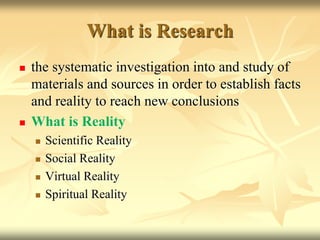
What is Research
 the systematic investigation into and study of
materials and sources in order to establish facts
and reality to reach new conclusions
 What is Reality
 Scientific Reality
 Social Reality
 Virtual Reality
 Spiritual Reality
Research Process
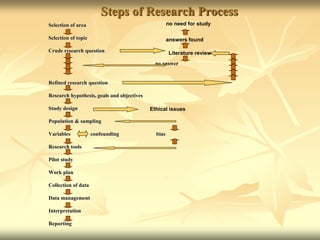
Steps of Research Process
Selection of area
Selection of topic
Crude research question
no answer
Refined research question
Research hypothesis, goals and objectives
Study design
Population & sampling
Variables confounding bias
Research tools
Pilot study
Work plan
Collection of data
Data management
Interpretation
Reporting
no need for study
answers found
Literature review
Ethical issues
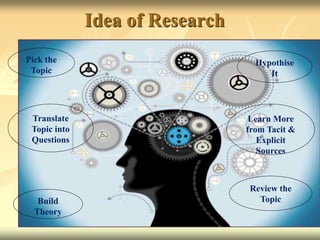
Idea of Research
Hypothise
It
Translate
Topic into
Questions
Pick the
Topic
Build
Theory
Review the
Topic
Learn More
from Tacit &
Explicit
Sources
Characteristics of good topics?
 Interesting – keeps the researcher interested in it throughout the
research process
 Researchable – can be investigated through the collection and
analysis of data
 Significant – contributes to the improvement and understanding
of educational theory and practice
 Manageable – fits the level of researcher’s level of research
skills, needed resources, and time restrictions
 Ethical – does not embarrass or harm participants
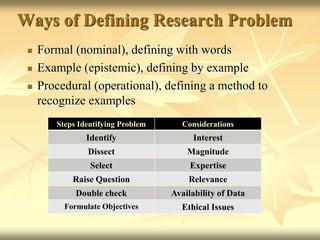
 Formal (nominal), defining with words
 Example (epistemic), defining by example
 Procedural (operational), defining a method to
recognize examples
Ways of Defining Research Problem
Steps Identifying Problem Considerations
Identify Interest
Dissect Magnitude
Select Expertise
Raise Question Relevance
Double check Availability of Data
Formulate Objectives Ethical Issues
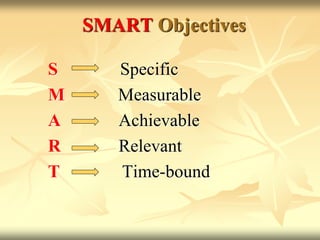
S Specific
M Measurable
A Achievable
R Relevant
T Time-bound
SMART Objectives
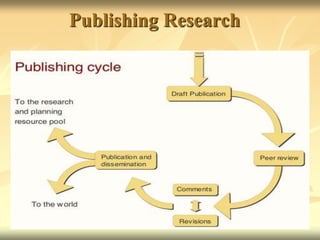
Publishing Research

Research Process Revised lecture 1 (1).pptx

  • 1.
  • 2.
    What is Research the systematic investigation into and study of materials and sources in order to establish facts and reality to reach new conclusions  What is Reality  Scientific Reality  Social Reality  Virtual Reality  Spiritual Reality
  • 3.
  • 4.
    Steps of ResearchProcess Selection of area Selection of topic Crude research question no answer Refined research question Research hypothesis, goals and objectives Study design Population & sampling Variables confounding bias Research tools Pilot study Work plan Collection of data Data management Interpretation Reporting no need for study answers found Literature review Ethical issues
  • 5.
    Idea of Research Hypothise It Translate Topicinto Questions Pick the Topic Build Theory Review the Topic Learn More from Tacit & Explicit Sources
  • 7.
    Characteristics of goodtopics?  Interesting – keeps the researcher interested in it throughout the research process  Researchable – can be investigated through the collection and analysis of data  Significant – contributes to the improvement and understanding of educational theory and practice  Manageable – fits the level of researcher’s level of research skills, needed resources, and time restrictions  Ethical – does not embarrass or harm participants
  • 8.
     Formal (nominal),defining with words  Example (epistemic), defining by example  Procedural (operational), defining a method to recognize examples Ways of Defining Research Problem Steps Identifying Problem Considerations Identify Interest Dissect Magnitude Select Expertise Raise Question Relevance Double check Availability of Data Formulate Objectives Ethical Issues
  • 9.
    S Specific M Measurable AAchievable R Relevant T Time-bound SMART Objectives
  • 11.