IMPACTS OF UNBALANCED SLEEP PATTERNS ON
ACADEMIC PERFORMANCE OF IBAJAY INTEGRATED
SCHOOL HUMSS STUDENTS DURING SCHOOLYEAR
2023-2024
Hassan V. Fulgencio
Ben Morys Alfred S. Tiaga
Kim Ashley Artiaga
Mardy Flores
Cindy Masula
Genesis Sunico
Nathaniel Soliva
Grade 11 - HUMSS Magbanua
May 2024
By:
BACKGROUND OF THE STUDY
• Importance of sleep in students academic success.
• Factors related with maintaining healthy sleep
routines.
• Investigating impacts on HUMSS students' academic
performance.
• Investigates correlation between sleep and
academic success.
• Involves surveys and questionnaires for data
colection.
• Seeks to provide insights into healthy sleep.
• Analysis for meaningful conclusions on sleep's
impact.
STATEMENT OF THE
PROBLEM
• Sleep imbalance affects HUMSS students' academic
success.
• Cognitive function declines with irregular sleep
patterns.
• Mood, motivation, and emotional well-being suffer.
• Irregular sleep hinder concentration related to
academic.
• Physical and mental health risks may increase.
• Investigate correlation between sleep and academic
performance.
• Develop interventions for healthier sleep routine
habits.
RESEARCH QUESTIONS &
OBJECTIVES
General Question:
What are the impacts of unbalanced sleep on the academic
performance of HUMSS students?
Specific questions:
1.What are the factors contributing to their unbalanced sleep?
2.What are the health consequences associated with the
unbalanced sleep?
3.Specific factors contributing to unbalanced sleep?
Objectives:
1.To identify the factors contributing to the unbalanced sleep
2.To explore the health consequences associated with the
unbalanced sleep
3. To identify specific factors contributing to unbalanced sleep
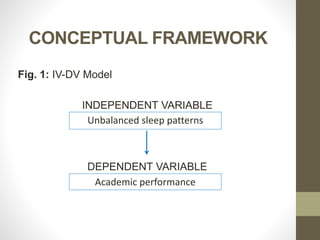
CONCEPTUAL FRAMEWORK
Fig. 1: IV-DV Model
INDEPENDENT VARIABLE
DEPENDENT VARIABLE
Unbalanced sleep patterns
Academic performance
THEORETICAL FRAMEWORK
• Oswalds Restoration Theory
• Dr. Ian Oswald proposes that sleep plays a crucial
role in replenishing our bodies and minds after a day
of activity. According to this theory, sleep aids in
repairing and revitalizing physiological processes
and mental functions that are depleted during waking
hours. It suggests that different stages of sleep serve
distinct purposes: non-REM sleep assists in
restoring the body, while REM sleep aids in
refreshing the mind.
•Energy Conservation Theory
According to Brinkman et al., (2023), sleep serves
as a mechanism to optimize energy allocation
across various biological functions. It allows the
body to prioritize essential processes while reducing
energy expenditure during periods of low activity,
contributing to overall metabolic balance and
resource management. This broader perspective
emphasizes the adaptive role of sleep in maximizing
physiological efficiency and sustaining optimal
functioning across different environmental contexts.
SCOPE & DELIMITATION
• Focuses on HUMSS students sleep patterns
impacts
• Limited only to Ibajay Integrated School HUMSS
• Method uses survey questionnaires for data
gathering
• Excludes focus on medical and psychological
conditions
• Narrow focus on their academic performance
implications
• Findings may not be generalized
SIGNIFICANCE OF THE STUDY
• Department of Education
• School Administration
• Teachers
• Parents
• Students
• Future researchers
DEFINITION OF TERMS
• Academic performance
• Circadian rhythms
• HUMSS
• Impact
• NREM
• REM
• Sleep patterns.
• Unbalanced
REVIEW OF RELATED
LITERATURE
According to a study by Alnawwar et al.,(2023) research
indicates that both short-term and the regular exercise can
enhance our circadian rhythms. Engaging in physical
activity, like walking or sports, can improve sleep quality
and reduce sleep disorder symptoms by promoting
relaxation and lowering stress levels. Those who exercise
for at least 30 minutes daily tend to sleep an average of 15
minutes longer compared to those who don't exercise (NIH,
2023).
Lifestyle Choices and its Impact on Sleep Patterns
However, excessively frequent and intense
physical activities, performed six or more times a
week, were found to be linked with difficulty
initiating sleep, potentially posing as risk factors
for insomnia (NIH ,2023).
Sleep Deprivation and its Impacts on Academic
Performance
According to a study by Jorge II et al., (2020) about
the correlation of sleepiness with academic
performance in a State University-run Medical
School in the Philippines, 326 of them had complete
grade point averages (GPAs) and were included in
the final analysis.
Regarding the correlation between sleepiness and
academic performance, no significant difference was
found in academic performance between excessively
sleepy students and those who are not.
However, according to a study on Sleep duration and
academic performance among 364 student
pharmacists by the National Library of Medicine
(2015), they’ve concluded that a majority of student
pharmacists have less than 7 hours of sleep on a
typical school week especially on the night prior to an
examination. They found out that higher course
grades and semester Grade Point Average (GPA) are
associated with longer duration of sleep on nights
prior to examinations.
RESPONDENTS OF THE
STUDY
• The study's respondents are HUMSS students
from Ibajay Integrated School during the
academic year 2023-2024, offering valuable
insights and perspectives that significantly
contribute to understanding the research topic
within their academic environment.
RESEARCH DESIGN
The research will use a descriptive design to
explore collected information. It aims to
investigate irregular sleep patterns among
HUMSS students, understanding disparities in
their routines.
RESEARCH INSTRUMENT
• Survey questionnaires used for data collection
• Each answer is crucial for topic understanding
• Responses reveal patterns and insights
• Deeper understanding of perspectives and
experiences
• Analysis of answers uncovers connections
• Every response contributes to study findings
• Crucial for building a clear research picture
SAMPLING TECHNIQUE AND
PROCEDURE
• The study will use purposive sampling technique
• Target specific population with defined criteria.
• Select participants based on relevant characteristics.
• Directly focus on research question's requirements.
• Ensure sample represents desired attributes
accurately.
• Gather data relevant to study objectives.
DATA GATHERING
PROCEDURE
• Survey focused on HUMSS students at Ibajay
Integrated School
• Purposive sampling technique for data collection
• Preparation of survey questionnaires for students
• Allowing time for answering and addressing
clarifications
• Ensures credible and accurate data gathering
process
• Organized data collection for reliable information
DATA ANALYSIS
• Qualitative analysis for deeper insights and
understanding
• Explores underlying reasons, opinions, and
motivations
• Provides subjective data through survey
questionnaires

Research-Presentation-Guidelines-Format-1-1.pptx

  • 1.
    IMPACTS OF UNBALANCEDSLEEP PATTERNS ON ACADEMIC PERFORMANCE OF IBAJAY INTEGRATED SCHOOL HUMSS STUDENTS DURING SCHOOLYEAR 2023-2024 Hassan V. Fulgencio Ben Morys Alfred S. Tiaga Kim Ashley Artiaga Mardy Flores Cindy Masula Genesis Sunico Nathaniel Soliva Grade 11 - HUMSS Magbanua May 2024 By:
  • 2.
    BACKGROUND OF THESTUDY • Importance of sleep in students academic success. • Factors related with maintaining healthy sleep routines. • Investigating impacts on HUMSS students' academic performance. • Investigates correlation between sleep and academic success. • Involves surveys and questionnaires for data colection. • Seeks to provide insights into healthy sleep. • Analysis for meaningful conclusions on sleep's impact.
  • 3.
    STATEMENT OF THE PROBLEM •Sleep imbalance affects HUMSS students' academic success. • Cognitive function declines with irregular sleep patterns. • Mood, motivation, and emotional well-being suffer. • Irregular sleep hinder concentration related to academic. • Physical and mental health risks may increase. • Investigate correlation between sleep and academic performance. • Develop interventions for healthier sleep routine habits.
  • 4.
    RESEARCH QUESTIONS & OBJECTIVES GeneralQuestion: What are the impacts of unbalanced sleep on the academic performance of HUMSS students? Specific questions: 1.What are the factors contributing to their unbalanced sleep? 2.What are the health consequences associated with the unbalanced sleep? 3.Specific factors contributing to unbalanced sleep? Objectives: 1.To identify the factors contributing to the unbalanced sleep 2.To explore the health consequences associated with the unbalanced sleep 3. To identify specific factors contributing to unbalanced sleep
  • 5.
    CONCEPTUAL FRAMEWORK Fig. 1:IV-DV Model INDEPENDENT VARIABLE DEPENDENT VARIABLE Unbalanced sleep patterns Academic performance
  • 6.
    THEORETICAL FRAMEWORK • OswaldsRestoration Theory • Dr. Ian Oswald proposes that sleep plays a crucial role in replenishing our bodies and minds after a day of activity. According to this theory, sleep aids in repairing and revitalizing physiological processes and mental functions that are depleted during waking hours. It suggests that different stages of sleep serve distinct purposes: non-REM sleep assists in restoring the body, while REM sleep aids in refreshing the mind.
  • 7.
    •Energy Conservation Theory Accordingto Brinkman et al., (2023), sleep serves as a mechanism to optimize energy allocation across various biological functions. It allows the body to prioritize essential processes while reducing energy expenditure during periods of low activity, contributing to overall metabolic balance and resource management. This broader perspective emphasizes the adaptive role of sleep in maximizing physiological efficiency and sustaining optimal functioning across different environmental contexts.
  • 8.
    SCOPE & DELIMITATION •Focuses on HUMSS students sleep patterns impacts • Limited only to Ibajay Integrated School HUMSS • Method uses survey questionnaires for data gathering • Excludes focus on medical and psychological conditions • Narrow focus on their academic performance implications • Findings may not be generalized
  • 9.
    SIGNIFICANCE OF THESTUDY • Department of Education • School Administration • Teachers • Parents • Students • Future researchers
  • 10.
    DEFINITION OF TERMS •Academic performance • Circadian rhythms • HUMSS • Impact • NREM • REM • Sleep patterns. • Unbalanced
  • 11.
    REVIEW OF RELATED LITERATURE Accordingto a study by Alnawwar et al.,(2023) research indicates that both short-term and the regular exercise can enhance our circadian rhythms. Engaging in physical activity, like walking or sports, can improve sleep quality and reduce sleep disorder symptoms by promoting relaxation and lowering stress levels. Those who exercise for at least 30 minutes daily tend to sleep an average of 15 minutes longer compared to those who don't exercise (NIH, 2023). Lifestyle Choices and its Impact on Sleep Patterns
  • 12.
    However, excessively frequentand intense physical activities, performed six or more times a week, were found to be linked with difficulty initiating sleep, potentially posing as risk factors for insomnia (NIH ,2023).
  • 13.
    Sleep Deprivation andits Impacts on Academic Performance According to a study by Jorge II et al., (2020) about the correlation of sleepiness with academic performance in a State University-run Medical School in the Philippines, 326 of them had complete grade point averages (GPAs) and were included in the final analysis. Regarding the correlation between sleepiness and academic performance, no significant difference was found in academic performance between excessively sleepy students and those who are not.
  • 14.
    However, according toa study on Sleep duration and academic performance among 364 student pharmacists by the National Library of Medicine (2015), they’ve concluded that a majority of student pharmacists have less than 7 hours of sleep on a typical school week especially on the night prior to an examination. They found out that higher course grades and semester Grade Point Average (GPA) are associated with longer duration of sleep on nights prior to examinations.
  • 15.
    RESPONDENTS OF THE STUDY •The study's respondents are HUMSS students from Ibajay Integrated School during the academic year 2023-2024, offering valuable insights and perspectives that significantly contribute to understanding the research topic within their academic environment.
  • 16.
    RESEARCH DESIGN The researchwill use a descriptive design to explore collected information. It aims to investigate irregular sleep patterns among HUMSS students, understanding disparities in their routines.
  • 17.
    RESEARCH INSTRUMENT • Surveyquestionnaires used for data collection • Each answer is crucial for topic understanding • Responses reveal patterns and insights • Deeper understanding of perspectives and experiences • Analysis of answers uncovers connections • Every response contributes to study findings • Crucial for building a clear research picture
  • 18.
    SAMPLING TECHNIQUE AND PROCEDURE •The study will use purposive sampling technique • Target specific population with defined criteria. • Select participants based on relevant characteristics. • Directly focus on research question's requirements. • Ensure sample represents desired attributes accurately. • Gather data relevant to study objectives.
  • 19.
    DATA GATHERING PROCEDURE • Surveyfocused on HUMSS students at Ibajay Integrated School • Purposive sampling technique for data collection • Preparation of survey questionnaires for students • Allowing time for answering and addressing clarifications • Ensures credible and accurate data gathering process • Organized data collection for reliable information
  • 20.
    DATA ANALYSIS • Qualitativeanalysis for deeper insights and understanding • Explores underlying reasons, opinions, and motivations • Provides subjective data through survey questionnaires