i
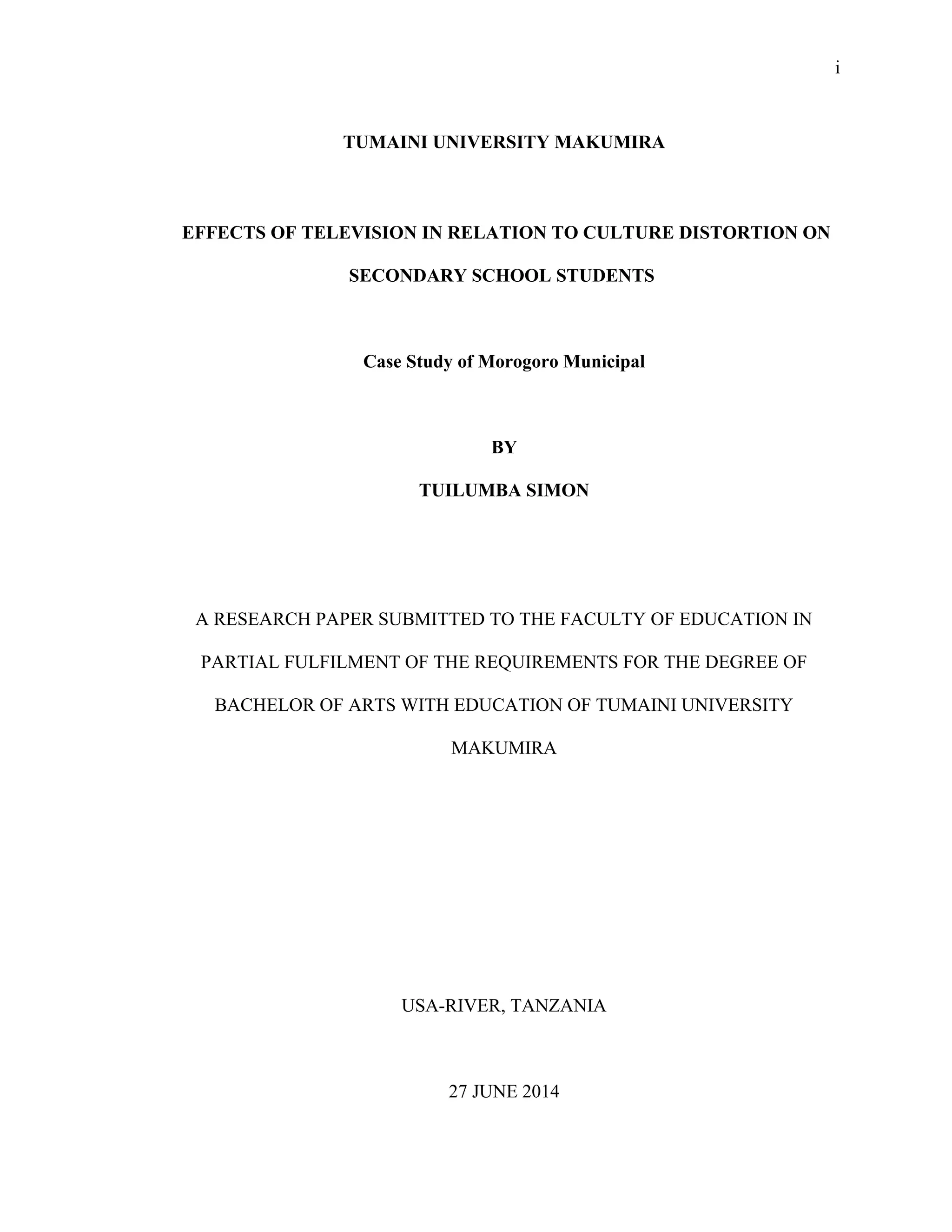
TUMAINI UNIVERSITY MAKUMIRA
EFFECTS OF TELEVISION IN RELATION TO CULTURE DISTORTION ON
SECONDARY SCHOOL STUDENTS
Case Study of Morogoro Municipal
BY
TUILUMBA SIMON
A RESEARCH PAPER SUBMITTED TO THE FACULTY OF EDUCATION IN
PARTIAL FULFILMENT OF THE REQUIREMENTS FOR THE DEGREE OF
BACHELOR OF ARTS WITH EDUCATION OF TUMAINI UNIVERSITY
MAKUMIRA
USA-RIVER, TANZANIA
27 JUNE 2014
ii
DECLARATION
I, Tuilumba Simon, declare that this research paper is my original work for
Tumain University Makumira and it has not been presented to any other University or
College for a similar award.
Signature………………………… Registration Number ……………………….
Date…………………….. ………
iii
DEDICATION
I dedicate this work to my dearest parents Mr. and Mrs. Simon Loko for their love
and support to me in all ways ensuring that I get all needs in order to perform well in
my studies. I thank them a lot and may God protect them.
iv
ACKNOWLEDGEMENTS
First I would to thank God for his guidance all the way to this moment for giving
me courage and energy to do my work accordingly.
I would like to express my sincere gratitude to the Tumain University Makumira,
for granting me the chance to pursue a degree in education. My sincere thanks goes to the
teachers and Student of educare secondary, Kihonda secondary and Presbyterian
seminary schools for their willingness and enthusiasm in responding to the questionnaires
that were given to them, and the parents of those schools for their willingness to respond
the interviews and sharing their experiences.
I also extend my sincere appreciation to my supervisor, Mr. Kanaael Mbise for
his sympathetic support, sharing of ideas as well as intellectual advice that he has given
me from the beginning of the selection of the topic, till the completion of my research
paper.
v
TABLE OF CONTENTS
DECLARATION.................................................................................................................ii
DEDICATION....................................................................................................................iii
I dedicate this work to my dearest parents Mr. and Mrs. Simon Loko for their love and
support to me in all ways ensuring that I get all needs in order to perform well in my
studies. I thank them a lot and may God protect them.......................................................iii
ACKNOWLEDGEMENTS................................................................................................iv
TABLE OF CONTENTS.....................................................................................................v
LIST OF TABLES..............................................................................................................vi
ABSTRACT......................................................................................................................vii
CHAPTER ONE..................................................................................................................1
INTRODUCTION...............................................................................................................1
1.1 Background of the Problem......................................................................................1
1.2 Statement of Research Problem................................................................................3
1.3 Purpose of the Study..................................................................................................4
1.4 Specific Objectives....................................................................................................4
1.6 Significance of the Study...........................................................................................5
1.8 Limitations of the Study.............................................................................................6
LITERATURE REVIEW....................................................................................................7
2.1 Introduction................................................................................................................7
2.2 Television watching to Youth....................................................................................7
2.3 Effects of Watching TV to Children or Youth...........................................................9
RESEARCH METHODOLOGY.......................................................................................12
Introduction....................................................................................................................12
3.1Research Design........................................................................................................12
3.4 Research Methodology:..........................................................................................13
3.7 Sampling..................................................................................................................13
CHAPTER FOUR..............................................................................................................15
DATA ANALSIS AND DISCUSSION............................................................................15
4.1 Television Result to Moral Decay...........................................................................15
4.2.1 Television is an Obstacle to Academic Performance...........................................16
4.3 Television also Keeps Children Aware of Current Events and News Related Items
........................................................................................................................................17
4.4 Watching Educational Programs on Television Help the Students Use it
Effectively, as a Complement to School Education.......................................................18
CHAPTER FIVE...............................................................................................................20
COUNCLUSION AND RECOMMENDATIONS............................................................20
5.1 Conclusion...................................................................................................................20
5.2 Recommendations....................................................................................................21
REFERENCES..................................................................................................................23
APPENDICES...................................................................................................................26
APPENDEX A...................................................................................................................26
Dodosa kwa Walimu......................................................................................................26
APPENDEX B...................................................................................................................29
APPENDEX C...................................................................................................................32
vi
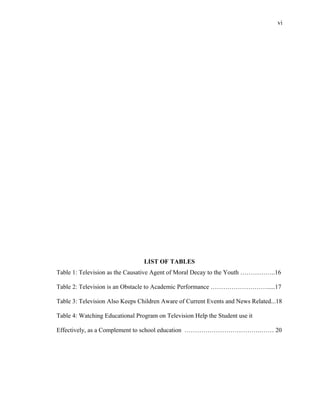
LIST OF TABLES
Table 1: Television as the Causative Agent of Moral Decay to the Youth ……………..16
Table 2: Television is an Obstacle to Academic Performance ……………………….....17
Table 3: Television Also Keeps Children Aware of Current Events and News Related...18
Table 4: Watching Educational Program on Television Help the Student use it
Effectively, as a Complement to school education ……………………………….…… 20
vii
ABSTRACT
The aim of this study was to find out the effects of Television in relation to
culture distortion in Morogoro Municipal. The data was collected from three (3) different
secondary schools through structured questionnaire and interviews. The total of 70
respondents was involved in the study, and selection of the sampling was through simple
random sampling based on the gender differences. The data was finally analyzed by both
qualitative and quantitative using frequencies, and percentages. The study revealed that,
poor control of parents on television to children and society are unaware on effects of
television to youth were the main findings observed in this study.
viii
The recommendations include, teacher should play an important role in growing
up of the youth in society due to the fact that they spent much time with these children
than their parents. Teachers should act as the middle man because they are close with
parents and children it easy for them to identify bad behavioral change of students and
punish them. Also secondary students should be given on the negative impacts on
watching television, parents and guardians can help kids become less susceptible to the
bad effects of watching violent TV.
1
CHAPTER ONE
INTRODUCTION
1.1 Background of the Problem
Television is the most powerful and influential medium of communication around
the globe. Due to its powerful effect, most advertisers rely on television for advertisement
of their products to attract the teenagers as they are their target audience in most of the
cases. This is due to the fact that teenagers are easy to be persuaded to buy any particular
product which is being advertised on television. In the same manner, overall television
viewing influences the life style of adolescents in different manners. The adolescents in
America spend on the average 28 hours per week in watching television (UNESCO,
2000).
Thus television is the most powerful medium which affects through its content
i.e., infotainment. The purpose of this study is to explore the effect of T.V programs and
ads on attitude, behavior and life style of adolescents. An ideal advertising is aimed at
providing positive information in order to gain commercial benefits through a stylish,
attractive and refined way, which can persuade and compel the users, to buy the product
which is being advertised (Kotler & Armstrong, 1993). T.V ads are very vital in
expansion of business, especially in marketing. As television is the most popular medium
due to its sound with picture, it is the best tool for selling brands and services. It is often
said that a picture can tell more than thousand words, that’s why television
advertisements are the best to demonstrate the product in an attractive manner.
Television contents saved in the minds of viewers with jingles and voices of
different characters, which seem to be attached with a particular product, being
2
advertised. Positive and negative impact of television contents may vary from child to
child. It might be harmful for one and useful for other (Cantor, 1998).
By the late 1920s, when electromechanical television was still being introduced,
several inventors were already working separately on versions of all-electronic
transmitting tubes, including Philo Farnsworth and Vladimir Zworykin in the United
States, and Kálmán Tihanyi in Hungary (techproductions,2014).
On December 25, 1926, Kenjiro Takayanagi demonstrated a television system
with a 40-line resolution that employed a CRT display at Hamamatsu Industrial High
School in Japan. This prototype is still on display at the Takayanagi Memorial Museum
in Shizuoka University, Hamamatsu Campus. His research in creating a production
model was halted by the US after Japan lost World War II. This was the first working
example of a fully electronic television receiver (techproductions, 2014).
The first national live television broadcast in the U.S. took place on September 4,
1951 when President Harry Truman's speech at the Japanese Peace Treaty Conference in
San Francisco, California was transmitted over AT&T's transcontinental cable and
microwave radio relay system to broadcast stations in local markets (techproductions,
2014).
The development of cable and satellite television in the 1970s allowed for more
channels and encouraged businessmen to target programming toward specific audiences.
It also enabled the rise of subscription television channels, such as Home Box Office
(HBO) and Showtime in the U.S., and Sky Television in the U.K (techproductions,
2014).
3
Throughout the 1960s, television sets used exclusively vacuum tube electronics.
This resulted in relatively heavy and unreliable TVs. In addition, vacuum tubes were
poorly suited to color television, as it required a large amount of tubes which caused
further reliability problems. Because vacuum tubes only allowed for very simple
NTSC/PAL filtering, the picture quality of early color sets was rather poor
(techproductions, 2014).
TV viewing among kids is at an eight-year high. On average, children ages 2-5
spend 32 hours a week in front of a TV—watching television, DVDs, DVR and videos,
and using a game console. Kids ages 6-11 spend about 28 hours a week in front of the
TV. The vast majority of this viewing (97%) is of live TV. 71% of 8- to 18-year-olds
have a TV in their bedroom; 54% have a DVD/VCR player, 37% have cable/satellite TV,
and 20% have premium channels (Liebert, Robert & Sprafkin, 1988).
1.2 Statement of Research Problem
There are a lot of television stations in our country but still local television stations
broadcast more Western programs than local programs which lead to increase of Western
culture in our country. The research problem focused on how television affects secondary
school student in relation to culture distortion. Television has a negative impact on
Secondary school students due to the fact that most of the youth in our country develop a
mentality that everything from Western is good and they forget about norms and
traditions of African culture. Secondary students are in position of adopting easily
Western culture because of mob psychology. They adopt what they observe in television,
4
at the end they start to put into practice what they see and hear through imitation. This
makes it difficult for our country to observe our culture.
1.3 Purpose of the Study
The purpose of this research was to create awareness to the society about the effect of
television to young generation.
1.4 Specific Objectives
ι. To Examine the Reasons for the Changes in behavior to Secondary School
Students after watching TV.
ιι. To Assess the Effects of Television to Secondary School Students.
ιιι. To find out the Level of Awareness of Society about the Effects of Television to
their Culture.
ιϖ. To determine whether Parents or Guardians are Responsible to educate their
Children about the Effect of Television.
1.5 Research Questions
i. What are the Reasons for Changes in behavior to Secondary School students after
watching Television?
ii. What are the Effects of television to Secondary school Students?
iii. Is the Society aware about the Effects of Television?
iv. Are parents and guardians Responsible to educate their Children about the Effects of
Television
5
1.6 Significance of the Study
This research would help the whole society in Tanzania to be aware about the
cultural change which is brought by Western television programs aired by local television
stations and the impact of Western culture to youth and to the home culture.
This study is important because would help parents and guardians to educate their
children to behave in good ways and not to adopt bad culture which brought by
Westerners. This study would alert the government of Tanzania to formulate policies that
push local television stations to broadcast more local programs than Western programs in
order to maintain our culture. This study would also help Secondary students to know the
effects of watching television and to behave in good ways and respect people. This
research aimed at benefiting scholarship and also policy and practice in Tanzania. The
researcher assumed that the effects of television to Secondary students are as following:
Television result to Moral Decay. Television also keeps youth aware of current events
and news related items. Watching educational programs on television help the youth use
if effectively, as a complement to school education.
1.7 Scope of the Study
The study was conducted in Morogoro Municipal which is one of three districts in
Morogoro, Tanzania. According to 2002 National Tanzania Census the Municipal has
total number of 332,224 populations. Particularly in urban ward in Morogoro region, the
study involved the following schools Educare secondary, Kihonda secondary and
Presbyterian seminary school, all schools found in morogoro municipal.
6
1.8 Limitations of the Study
The researcher encountered the following obstacles during the conducting of the
study,
Financial problem, since the researcher is non Higher Education Students Loan
Board beneficiaries he had to use his own money which was not enough to do all the
research works in time, hence caused some difficulties in the study.
Poor cooperation from respondents, some respondents were not cooperative in the
provision of information, some even dared to demand money for their information’s.
Time constrain, the time indicated for the research proposal and report was very
limited, this caused the researcher to miss some of the lectures in order to conduct the
research effectively.
Transport problem, also the researcher faced the problem of transport since, this
study conducted in rural areas data was collected during the rain season in which most of
roads were not passable, this caused the researcher to go on foot and spent much time for
data collection.
Despite the above mentioned obstacles and challenges that researcher faced, he
managed to struggle to his level best to overcome them, and finally finish the study in
time.
7
CHAPTER TWO
LITERATURE REVIEW
2.1 Introduction
Literature review analyzed the available knowledge with a view to identify the
rucliments for a theoretical framework to guide this study. It is conventional that a
scholarly study must be informed by some theoretical ideas in order to deepen
understanding of the phenomenon under investigation. The key variables in this study
were television and secondary school students. Through literature the researcher
discovered that different people at different places respond different messages and
change their behavior. The group which adopts easily new things are children’s and most
of them are in secondary schools.
2.2 Television watching to Youth
Most of the researchers found that there is small but consistent relation between
the amount of hours spent on television and aggressive behavior displayed by children
(aimhg, 2014)
Most of children and youth from 15 to 18 years are easily fooled about the
distinction between reality and false appearance. Most of the 7 to 17 years old children
fail to differentiate between wrong and right which they watch from television, They
adopt any action associated with violence, especially when violence in the story is
exciting and feel real justified particularly where a violent actor is not criticized for his
behavior. “Television viewing is a major activity and influence on youth and Secondary
school students. Youth in the United States watch an average of three to four hours. By
the time of high school graduation, they spent more time watching television than they
8
have in the classroom. While television can entertain, inform and give the youth
company, it may also influence them in undesirable ways” (AACAP, 2001).
Television has even worse impacts on youth and causes them to lose their traditional
cultural practices, making them adopt a Western lifestyle as their own life and practice it
(Mander, 1991).
Surveys indicated that 7-17 years old students spend between 25 – 30 hours per
week viewing television, while some pre-scholars may be viewing up to 60 hrs/wk. In
1971 average viewing time for pre-school children was 34hrs/wk: most recent figures
suggest 54hrs/wk. This means that in many instances, the majority of some child’s
waking hours are spent with the TV on. Surveys further indicate that by the time children
graduate from high school, they spent more hours in TV viewing than in school.
Assuming an average of 3 hrs/day youth view 20,000 commercials a year. By age 16
they witnessed 200,000 violent acts, including 33,000 murders. (aimh, 2014)
Buckingham argues that the socialization theory is ‘a functional approach that
regards youth as passive recipients of external social forces rather that active participants
in the construction of their own social lives and identities’ (Buckingham, 1993).
However, the approaches to socialization vary from the anthropological point of view to
the more Freudian are. The first refers to the process as enculturation, which consists in
the individual’s internalization of ‘all aspects of their culture’ such as traditions, language
and common discourses (DeFleur & Ball-Rokeach, 1989).
The media has its importance in this view, for it can teach the youth about the nature of
his or her social order. On the other hand, psychologists see socialization as an inner
9
process that one must acquire in order to control inborn drives that ‘would lead to
socially unacceptable behavior’ (DeFleur & Ball-Rokeach, 1989)
2.3 Effects of Watching TV to Children or Youth
TV viewing numbers your kid’s mind as it prevents your child from exercising
initiative, being intellectually challenged, thinking analytically, and using his imagination
(Comstock, 1991). TV viewing takes away time from reading and improving reading
skills through practice (Comstock, 19991), Kids watching cartoons and entertainment
television during pre-school years have poorer pre-reading skills at age 5 (Macbeth,
1996) Also, kids who watch entertainment TV are also less likely to read books and
other print media (Wright & Huston, 1995). Youth who watch a lot of TV have trouble
paying attention to teachers because they are accustomed to the fast-paced visual
stimulation on TV. Youth who watch TV more than they talk to their family have a
difficult time adjusting from being visual learners to aural learness (learning by
listening). They also have shorter attention spans (Macbeth, 1996).
School kids who watch too much TV also tend to work less on their homework.
When doing homework with TV on the background, youth tend to retain less skill and
information. When they lose sleep because of TV, they become less alert during the day
and these results in poor school performance (Macbeth, 1996). TV exposes your kid to
negative influences and promotes negative behavior. TV shows and commercials usually
show violence, alcohol, drug use and sex in a positive light. The mind of your kid is like
clay. It forms early impressions on what it seas and these early impressions determine
how he sees the world and affect his grown-up behavior. For instance, twenty years of
research has shown that children who are more exposed to media violence behave more
aggressively as kids and when they are older. They are taught by TV that violence is the
10
way to resolve conflict – as when a TV hero beats up a bad guy to subdue him (Wright &
Huston, 1995).
Youth who watch too much TV is usually overweight, according to the American
Medical Association. Kids often snack on junk food while watching TV. They are also
influenced by commercials to consume unhealthy food. Also, they are not running,
jumping or doing activities that burn calories and increase metabolism. Obese kids,
unless they change their habits, tend to be obese when they become adults (Wright &
Huston, 1995).
2.4 Television in Relation to Student
Television (TV) has its good side. It can be entertaining and educational,
and can open up new worlds for children’s, giving them a chance to travel the globe,
learn about different cultures, and gain exposure to ideas they may never encounter in
their own community. Shows with a pro-social message can have a positive effect on
youth’s behavior; programs with positive role models can influence viewers to make
positive lifestyle changes. However, the reverse can also be true, youth are likely to learn
things from TV that parents don’t want them to learn. TV can affect youth health,
behavior and family life in negative ways, it’s worthwhile for parents to think about what
role they want TV to play in their family (Kyla Boyse, 2010)
A great deal is known about children and television, because there have been
thousands of studies on the subject. Researchers have studied how TV affects kids' sleep,
weight, grades, behavior, and more. It’s worth looking at what the research says when
deciding how to manage television in your family (Kyla Boyse, 2010). Spending time
11
watching TV can take time away from healthy activities like active play outside with
friends, eating dinner together as a family, or reading. TV time also takes away from
participating in sports, music, art or other activities that require practice to become
skillful (Boyse K, 2010).
2.5 Effect of TV Watching on Culture Distortion
Violence in television programs and movies is creating social problems as many
children tend to follow those violent and dreadful contents which are not acceptable and
recognized by society and their families because their families follow somewhat
traditional life style. It’s almost impossible that the childhood purity and innocence can
become intact, if children are exposed to violent and adult contents which are being
presented in T.V programs (Josephson, 1995).
12
CHAPTER THREE
RESEARCH METHODOLOGY
Introduction
3.1 Research Design
Research design is considered as a “blueprint” for research, dealing with at least four
problems: which questions to study which data are relevant what data to collect and how to
analyze the results the best design depends on the research question as well as the orientation of
the researcher and can be divided into fixed and flexible research designs (Robson, 1993). The
researcher used qualitative research design because large data were found in books, interviews,
internet and journals and it did not include any mathematical calculations.
3.2 Design of the Study
According to (Kumar, 2004) methods of data collection can define as the whole process
of gathering information about the situation, person, problem or phenomena. Both primary and
secondary sources were used but primary data was the main approach because data were
collected through interviews, questionnaires and focus group discussions.
3.3 Area of the Study
The study conducted at Mororgoro urban districts is one of six districts of Mororgoro region
of Tanzania it contained the city Morogoro, capital of the Morogoro region and no villages.
Morogoro urban district is administratively divided into nineteen wards but the study will be
conducted into Kihonda and kilakala ward. Because of easy access to the place minimized the
cost of the study and the researcher accumulated relevant information needed for the study.
13
3.4 Research Methodology:
According to (Kumar, 2004), methods of data collection can define as the whole process
of gathering information about the situation, person, problem or phenomena.
Both primary and secondary sources used, but primary data was main approach because data was
collected through interviews, questionnaires and focus group discussions.
3.5 Interviews
Interview is a conversation between two people (the interviewer and interviewee
(Kothari, 2000). The researcher used face to face interview by asking questions and interview
answered the questions. The researcher used structured and unstructured questions.
3.6 Questionnaire
A questionnaire is a devices consisting of a series of questions given to an individual with
the objective of obtaining data with regard to some problems under investigation (Koul
1984:149). Questionnaire involved the use of writing down items to which pupils and teachers
were responded in writing. The method was simple for researcher to get data easily and at low
cost
3.7 Sampling
Sampling is the process of obtaining information about an entire population by examining
only a part of it (Kothari, 2000).
The researcher used non probability sampling because the researcher chose respondent
random in order to answer the questions the researcher prepared and the respondent gave the
answers correctly. The sample size consisted of 80 people; 50 students from Secondary schools,
10 parents from ten different homes, and 10 teachers from one school. It also includes 5
secondary schools, which were school, Educare Secondary school, Kihonda secondary school
and Presbyterian seminary school. The researcher choose these schools because many students in
14
these schools focus much on watching television rather than studying which cause to change
their behavior. Also these schools provided a lot of information concerning the effects of
television to Secondary school students.
3.8 Plan of Analysis
The researcher analyzed the data of the research by using qualitative methods because the
data did not include any mathematical calculations. The researcher collected data by talking to
people especially students, teachers and parents. Also the information and data were from
different books, internet and journals.
15
CHAPTER FOUR
DATA ANALSIS AND DISCUSSION
This chapter draws inferences from the data collected. In general sense, it
persuades the reader that, sufficient evidence exists to support the assertion made and that
the patterns of evidence do exist and indeed are valid. It is a search for broader meaning
of research findings (Kothari, 2000)
This research had the following hypothesis (as listed below) which were tested
and proven true. Television result to Moral Decay, Television is an obstacle to academic
performance, Television also keeps youth aware of current events and news related items,
watching educational programs on television help the youth use it effectively, as a
complement to school education. As the research discovers from the data collected from
different sources below.
4.1 Television Result to Moral Decay
81.4% of the respondents agreed that television result to moral decay. Students
agreed that, television take them on the path of drugs, alcohol, fornication, disrespect,
confrontation, modernism and many other evils which are not our culture. And they
agreed that, they spend too much time on watching television which cause them to adopt
and imitate things from television and take them as true life because they want to live like
Westerners. Parents also agreed that television may result moral decay because their
children change their behaviors after watching Western programs such as use abusive
language; use drugs become rudeness and engage themselves in relationship. Parents
also agreed that, they failed to control the behaviors of their children because most of
them stayed at work for long hours and do not give limit to their children on watching
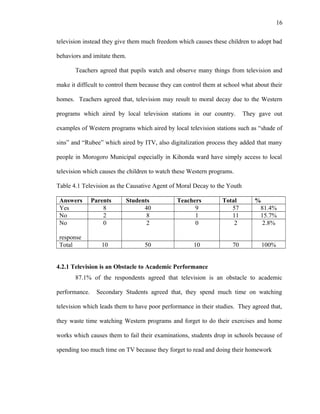
16
television instead they give them much freedom which causes these children to adopt bad
behaviors and imitate them.
Teachers agreed that pupils watch and observe many things from television and
make it difficult to control them because they can control them at school what about their
homes. Teachers agreed that, television may result to moral decay due to the Western
programs which aired by local television stations in our country. They gave out
examples of Western programs which aired by local television stations such as “shade of
sins” and “Rubee” which aired by ITV, also digitalization process they added that many
people in Morogoro Municipal especially in Kihonda ward have simply access to local
television which causes the children to watch these Western programs.
Table 4.1 Television as the Causative Agent of Moral Decay to the Youth
Answers Parents Students Teachers Total %
Yes 8 40 9 57 81.4%
No 2 8 1 11 15.7%
No
response
0 2 0 2 2.8%
Total 10 50 10 70 100%
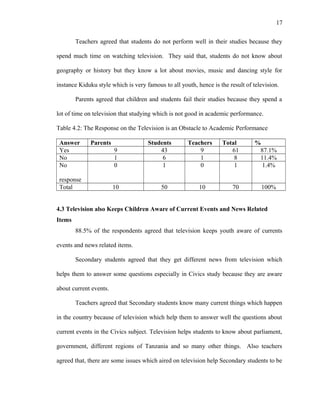
4.2.1 Television is an Obstacle to Academic Performance
87.1% of the respondents agreed that television is an obstacle to academic
performance. Secondary Students agreed that, they spend much time on watching
television which leads them to have poor performance in their studies. They agreed that,
they waste time watching Western programs and forget to do their exercises and home
works which causes them to fail their examinations, students drop in schools because of
spending too much time on TV because they forget to read and doing their homework
17
Teachers agreed that students do not perform well in their studies because they
spend much time on watching television. They said that, students do not know about
geography or history but they know a lot about movies, music and dancing style for
instance Kiduku style which is very famous to all youth, hence is the result of television.
Parents agreed that children and students fail their studies because they spend a
lot of time on television that studying which is not good in academic performance.
Table 4.2: The Response on the Television is an Obstacle to Academic Performance
Answer Parents Students Teachers Total %
Yes 9 43 9 61 87.1%
No 1 6 1 8 11.4%
No
response
0 1 0 1 1.4%
Total 10 50 10 70 100%
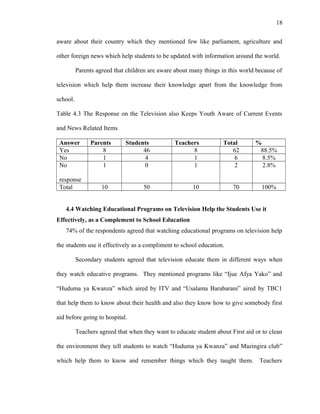
4.3 Television also Keeps Children Aware of Current Events and News Related
Items
88.5% of the respondents agreed that television keeps youth aware of currents
events and news related items.
Secondary students agreed that they get different news from television which
helps them to answer some questions especially in Civics study because they are aware
about current events.
Teachers agreed that Secondary students know many current things which happen
in the country because of television which help them to answer well the questions about
current events in the Civics subject. Television helps students to know about parliament,
government, different regions of Tanzania and so many other things. Also teachers
agreed that, there are some issues which aired on television help Secondary students to be
18
aware about their country which they mentioned few like parliament, agriculture and
other foreign news which help students to be updated with information around the world.
Parents agreed that children are aware about many things in this world because of
television which help them increase their knowledge apart from the knowledge from
school.
Table 4.3 The Response on the Television also Keeps Youth Aware of Current Events
and News Related Items
Answer Parents Students Teachers Total %
Yes 8 46 8 62 88.5%
No 1 4 1 6 8.5%
No
response
1 0 1 2 2.8%
Total 10 50 10 70 100%
4.4 Watching Educational Programs on Television Help the Students Use it
Effectively, as a Complement to School Education
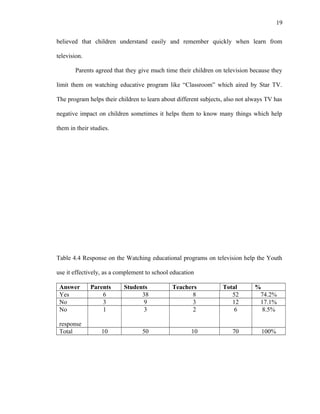
74% of the respondents agreed that watching educational programs on television help
the students use it effectively as a compliment to school education.
Secondary students agreed that television educate them in different ways when
they watch educative programs. They mentioned programs like “Ijue Afya Yako” and
“Huduma ya Kwanza” which aired by ITV and “Usalama Barabarani” aired by TBC1
that help them to know about their health and also they know how to give somebody first
aid before going to hospital.
Teachers agreed that when they want to educate student about First aid or to clean
the environment they tell students to watch “Huduma ya Kwanza” and Mazingira club”
which help them to know and remember things which they taught them. Teachers
19
believed that children understand easily and remember quickly when learn from
television.
Parents agreed that they give much time their children on television because they
limit them on watching educative program like “Classroom” which aired by Star TV.
The program helps their children to learn about different subjects, also not always TV has
negative impact on children sometimes it helps them to know many things which help
them in their studies.
Table 4.4 Response on the Watching educational programs on television help the Youth
use it effectively, as a complement to school education
Answer Parents Students Teachers Total %
Yes 6 38 8 52 74.2%
No 3 9 3 12 17.1%
No
response
1 3 2 6 8.5%
Total 10 50 10 70 100%
20
CHAPTER FIVE
COUNCLUSION AND RECOMMENDATIONS
5.1 Conclusion
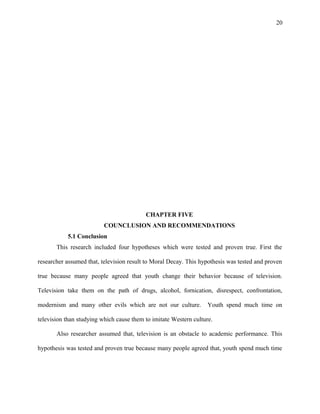
This research included four hypotheses which were tested and proven true. First the
researcher assumed that, television result to Moral Decay. This hypothesis was tested and proven
true because many people agreed that youth change their behavior because of television.
Television take them on the path of drugs, alcohol, fornication, disrespect, confrontation,
modernism and many other evils which are not our culture. Youth spend much time on
television than studying which cause them to imitate Western culture.
Also researcher assumed that, television is an obstacle to academic performance. This
hypothesis was tested and proven true because many people agreed that, youth spend much time
21
on watching television which lead them to have poor performance in their studies because they
forget to do their exercises and home works which causes them to fail their examinations.
Researcher assumed that, television also keeps youth aware of current events and news
related items. This hypothesis was tested and proven true because a lot of people agreed that,
students get different news from television which help them to answer some questions especially
in Civics subject because they are aware about politics and current events.
Researcher also assumed that, watching educational programs on television help many of
the youth us it effectively, as a complement to school education.
This hypothesis was tested and proven true because people agreed that, television educate
youth in different ways when they watch educative programs. They mentioned programs like
“Ijue Afya Yako” and “Huduma ya Kwanza” which aired by ITV that, help student to know
about health and give somebody first aid before going to hospital. Also another educative
program “Classrooms” which aired by Star TV it helps student to learn about different subjects.
Television stations in Tanzania broadcast more Western programs because many people
love watching them and this is good to them because of the competition with others. Also
sponsors, like to sponsor Western programs that Tanzanian programs and this cause them to air
more foreign programs that local programs.
Government should introduce the subject on how to use the media particularly television
and make sure these television air local programs especially educative programs in order to give
knowledge to the children and maintain Tanzanian culture.
5.2 Recommendations
Teachers play a very important role in the growing up of the youth in the society due to
the fact that they spend much time with these children than their parents. Teachers act as the
22
middleman because they are so close with parents and children so it is very easy for them to
identify bad behavioral change of the students and punish them to be in good manners. Teachers
should use their skills and knowledge to guide students to be in good behaviors.
Teachers should work closely and share information with the parents about the children
so as to make sure that children are growing up in African cultural foundations in order to rescue
the well being of future African generation particularly Tanzanians.
Secondary students should be given education on the negative impact of television to
their daily life. Secondary students should not spend much time on watching television instead
they have to focus in their studies if they want to pass their examinations.
Parents and guardians can help kids become less susceptible to the bad effects of
watching violent TV. Some studies have shown that kids who received media education had less
violent behavior after watching violent programs. Teach your children to be media savvy. Find
out more about media literacy.
Watch with your children (parental control), so if the programming turns violent, you can
discuss what happened to put it in a context you want your kids to learn. Know what your kids
are watching. Decide what programs are appropriate for their age and personality and stick to
your rules.
To minimize peer pressure to watch violent shows, you may want to talk to the parents of
your child’s friends and agree to similar rules.
The government in the sector of education should introduce the subject on how to use the
media particularly television. The government should make sure that, people particularly youth
are given good education about the African culture and the value of their own culture to make
sure that people respect and love their original culture.
23
The government must have defined laws and regulations which will prevent television stations as
well as any media in the country not to publish or air any foreign materials or programs without
making any changes or editing so as to be suitable for Tanzanian culture.
Journalists should make sure that, they broadcast educative programs that will be seen by
both youth and adult so as to help this society to be the good society.
Journalists need to air more local programs than Western programs so as to maintain Tanzanian
culture.
REFERENCES
Anderson, D. R & Collins, P .A (1988). The impact on children's education: Television's
influence on cognitive development
Clark, R.E (1992) Media use in education ;Encyclopedia of Educational Research. New York:
Macmillan.
Cantor, J. (1998). “Mommy I am scared”: how T.V and movies frighten children and what we
can do to protect them. San Diego: Hardcourt.
Comstock, G., & Paik (1991). Television and the American child. San Diego, CA: Academic
Press.
24
De Vaney, A. (Ed.). “Watching Channel One” The Convergence of Students, technology, and
private business. Alban, NY: SUNY Press.
Dorr, A & Alkin (Ed.). Encyclopedia of Educational Research. New York: Macmillan.
Gunter, Barrie, and Jill L. McAleer. (1990). Children and Television: The One Eyed
Monster? New York: Routledge,.
Josephson, W.L. (1995). Television violence: a review of the effects on children of different ages.
Ottawa: National Clearinghouse on Family Violence.
Kommers, P. & Jonassen, D. H. & Mayes. (Ed.) (1992). Cognitive Tool for Learning. Berlin:
Springer Verlag.
Kotler, P. & Armstrong, G. (1993). Marketing: an introduction. Engle Wood Cliffs:
Prentice-Hall.
Kothari. C. R, (2004). Research Methodology, Methods and Techniques.New Age International
(p) Ltd.
Liebert, Robert M., and Joyce Sprafkin. The Early Window: Effects of Television on
Children and Youth. New York: Pergamon, 1973; 3rd edition, 1988. McLuhan, M. (1964):
Understanding Media. New York: Mentor
National Institute for Mental Health (NIMH) (1992): Television and Behavior, Ten years
of scientific progress and implications for the eighties; DHHS Publications No. 82- 1195,
Rochville, MD.
25
Neuman, S.B (1995): Literacy in the Television Age, The myth of the TV effect, Norwood,
NJ:Ablex.
Postman, .N. & Knopf .A. Alfred (1995). The end of education: Redifining the value of school.
New York.
Signorielli, Nancy. (1990). A Sourcebook on Children and Television. New York: Greenwood.
Stone, R. (1997): New way to teach using cable television: Astep-by-step guide, Thousand
Oaks, CA: Corwin Press
Van Evra, Judith. (1990) Television and Child Development. Hillsdale, New Jersey:
Erlbaum.
26
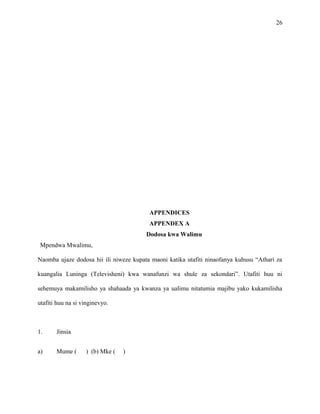
APPENDICES
APPENDEX A
Dodosa kwa Walimu
Mpendwa Mwalimu,
Naomba ujaze dodosa hii ili niweze kupata maoni katika utafiti ninaofanya kuhusu “Athari za
kuangalia Luninga (Televisheni) kwa wanafunzi wa shule za sekondari”. Utafiti huu ni
sehemuya makamilisho ya shahaada ya kwanza ya ualimu nitatumia majibu yako kukamilisha
utafiti huu na si vinginevyo.
1. Jinsia
a) Mume ( ) (b) Mke ( )
27
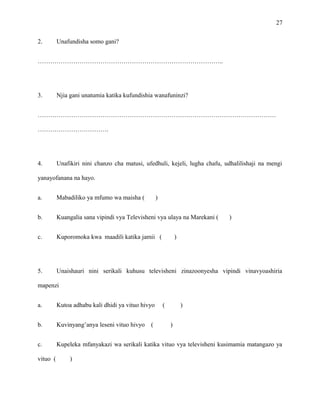
2. Unafundisha somo gani?
……………………………………………………………………………..
3. Njia gani unatumia katika kufundishia wanafuninzi?
……………………………………………………………………………………………………
…………………………….
4. Unafikiri nini chanzo cha matusi, ufedhuli, kejeli, lugha chafu, udhalilishaji na mengi
yanayofanana na hayo.
a. Mabadiliko ya mfumo wa maisha ( )
b. Kuangalia sana vipindi vya Televisheni vya ulaya na Marekani ( )
c. Kuporomoka kwa maadili katika jamii ( )
5. Unaishauri nini serikali kuhusu televisheni zinazoonyesha vipindi vinavyoashiria
mapenzi
a. Kutoa adhabu kali dhidi ya vituo hivyo ( )
b. Kuvinyang’anya leseni vituo hivyo ( )
c. Kupeleka mfanyakazi wa serikali katika vituo vya televisheni kusimamia matangazo ya
vituo ( )
28
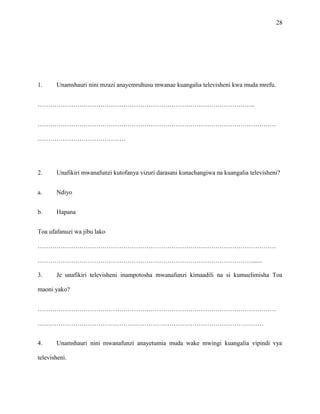
1. Unamshauri nini mzazi anayemruhusu mwanae kuangalia televisheni kwa muda mrefu.
…………………………………………………………………………………………..
……………………………………………………………………………………………………
……………………………………
2. Unafikiri mwanafunzi kutofanya vizuri darasani kunachangiwa na kuangalia televisheni?
a. Ndiyo
b. Hapana
Toa ufafanuzi wa jibu lako
……………………………………………………………………………………………………
………………………………………………………………………………………….......
3. Je unafikiri televisheni inampotosha mwanafunzi kimaadili na si kumuelimisha Toa
maoni yako?
……………………………………………………………………………………………………
………………………………………………………………………………………………
4. Unamshauri nini mwanafunzi anayetumia muda wake mwingi kuangalia vipindi vya
televisheni.
29
……………………………………………………………………………………………………
……………………………………………………………………………………………………
………………………………
APPENDEX B
Dodoso Kwa Wazazi/Mlezi
Ndugu Mzazi/Mlezi,
Naomba ujaze dodoso hii ili niweze kupata maoni katika utafiti ninaofanya kuhusu “Athari za
kuangalia televisheni kwa Wanafunzi wa shule za sekondarii”. Utafiti huu ni sehemu ya
makamilisho ya Shahada ya kwanza ya Ualimu, nitatumia majibu yako kwa ajili hiyo.
30
1. Jinsia
a. Kiume [ ]
b. Kike [ ]
2. Unawatoto wangapi?
a. 1-2 [ ]
b. 3-4 [ ]
c. 5-6 [ ]
3. Unatelevision nyumbani kwako!?
Ndio [ ] Hapana [ ]
4. Watoto wako wanatumia muda gani kuangalia televisioni?
……………………………………………………………………………………………………
……………………………….
5. Vipindi wanavyoangalia watoto wako, unadhani ni vizuri kwa maadili au vibaya!?
{B} Na Kama vibaya havifai kwa maadili ya Taifa unachukua hatua gani wewe kama mzazi?
……………………………………………………………………………………………………
……………………………………………………………………………………………………
……………
6. Unafikiri vipindi vya televisheni vya nje ya nchi vinafaa kwa utamaduni wa Mtanzania?
31
a. Ndiyo [ ]
b. Hapana [ ]
7. Mabadiliko gani ungependa kuyaona ili kulinda utamaduni wa Kitanzania kuharibiwa na
utamaaduni wa kigeni?
……………………………………………………………………………………………………
……………………………………………………………………………………………………
……………………………………………………………………………………………
8. Unafikiri lugha chafu na tabia mbaya miongoni mwa wanafunzi/watoto wa shule za
sekondari matokeo ya kuangalia vipindi vya televisheni vya Ulaya?
a. Ndiyo [ ]
b. Hapana [ ]
Kama ndiyo unafikiri ni kwanini
……………………………………………………………………………………………………
………………………………………………………………………………
Na kama Hapana taja sababu nyingine.
……………………………………………………………………………………………………
9. Ni kweli televisheni za hapa nyumbani zinarusha zaidi vipindi vya nje kuliko vya hapa
ndani?
a. Ndiyo [ ]
b. Hapana [ ]
32
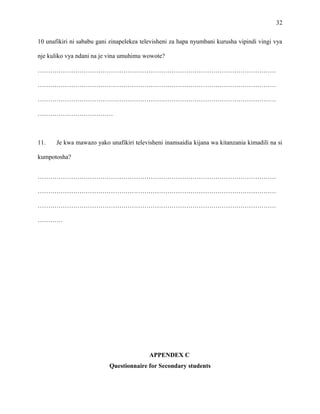
10 unafikiri ni sababu gani zinapelekea televisheni za hapa nyumbani kurusha vipindi vingi vya
nje kuliko vya ndani na je vina umuhimu wowote?
……………………………………………………………………………………………………
……………………………………………………………………………………………………
……………………………………………………………………………………………………
………………………………
11. Je kwa mawazo yako unafikiri televisheni inamsaidia kijana wa kitanzania kimadili na si
kumpotosha?
……………………………………………………………………………………………………
……………………………………………………………………………………………………
……………………………………………………………………………………………………
…………
APPENDEX C
Questionnaire for Secondary students
33
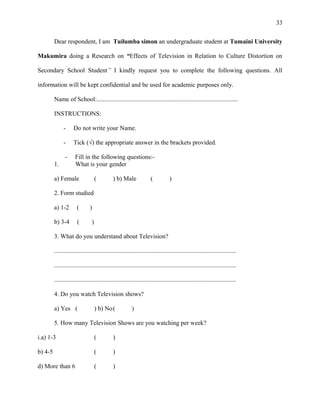
Dear respondent, I am Tuilumba simon an undergraduate student at Tumaini University
Makumira doing a Research on “Effects of Television in Relation to Culture Distortion on
Secondary School Student” I kindly request you to complete the following questions. All
information will be kept confidential and be used for academic purposes only.
Name of School:..........................................................................................
INSTRUCTIONS:
- Do not write your Name.
- Tick (√) the appropriate answer in the brackets provided.
- Fill in the following questions:-
1. What is your gender
a) Female ( ) b) Male ( )
2. Form studied
a) 1-2 ( )
b) 3-4 ( )
3. What do you understand about Television?
....................................................................................................................
....................................................................................................................
....................................................................................................................
4. Do you watch Television shows?
a) Yes ( ) b) No( )
5. How many Television Shows are you watching per week?
i.a) 1-3 ( )
b) 4-5 ( )
d) More than 6 ( )
34
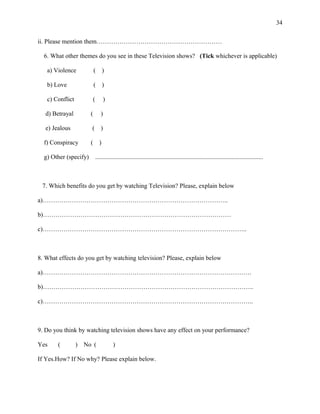
ii. Please mention them……………………………………………………
6. What other themes do you see in these Television shows? (Tick whichever is applicable)
a) Violence ( )
b) Love ( )
c) Conflict ( )
d) Betrayal ( )
e) Jealous ( )
f) Conspiracy ( )
g) Other (specify) ...........................................................................................................
7. Which benefits do you get by watching Television? Please, explain below
a)……………………………………………………………………………..
b)………………………………………………………………………………
c)……………………………………………………………………………………..
8. What effects do you get by watching television? Please, explain below
a)……………………………………………………………………………………….
b)………………………………………………………………………………………..
c)………………………………………………………………………………………..
9. Do you think by watching television shows have any effect on your performance?
Yes ( ) No ( )
If Yes.How? If No why? Please explain below.
35
a)………………………………………………………………………………………..
b)………………………………………………………………………………………..
Thank you!!

research on effect of television on culture

  • 1.
    i TUMAINI UNIVERSITY MAKUMIRA EFFECTSOF TELEVISION IN RELATION TO CULTURE DISTORTION ON SECONDARY SCHOOL STUDENTS Case Study of Morogoro Municipal BY TUILUMBA SIMON A RESEARCH PAPER SUBMITTED TO THE FACULTY OF EDUCATION IN PARTIAL FULFILMENT OF THE REQUIREMENTS FOR THE DEGREE OF BACHELOR OF ARTS WITH EDUCATION OF TUMAINI UNIVERSITY MAKUMIRA USA-RIVER, TANZANIA 27 JUNE 2014
  • 2.
    ii DECLARATION I, Tuilumba Simon,declare that this research paper is my original work for Tumain University Makumira and it has not been presented to any other University or College for a similar award. Signature………………………… Registration Number ………………………. Date…………………….. ………
  • 3.
    iii DEDICATION I dedicate thiswork to my dearest parents Mr. and Mrs. Simon Loko for their love and support to me in all ways ensuring that I get all needs in order to perform well in my studies. I thank them a lot and may God protect them.
  • 4.
    iv ACKNOWLEDGEMENTS First I wouldto thank God for his guidance all the way to this moment for giving me courage and energy to do my work accordingly. I would like to express my sincere gratitude to the Tumain University Makumira, for granting me the chance to pursue a degree in education. My sincere thanks goes to the teachers and Student of educare secondary, Kihonda secondary and Presbyterian seminary schools for their willingness and enthusiasm in responding to the questionnaires that were given to them, and the parents of those schools for their willingness to respond the interviews and sharing their experiences. I also extend my sincere appreciation to my supervisor, Mr. Kanaael Mbise for his sympathetic support, sharing of ideas as well as intellectual advice that he has given me from the beginning of the selection of the topic, till the completion of my research paper.
  • 5.
    v TABLE OF CONTENTS DECLARATION.................................................................................................................ii DEDICATION....................................................................................................................iii Idedicate this work to my dearest parents Mr. and Mrs. Simon Loko for their love and support to me in all ways ensuring that I get all needs in order to perform well in my studies. I thank them a lot and may God protect them.......................................................iii ACKNOWLEDGEMENTS................................................................................................iv TABLE OF CONTENTS.....................................................................................................v LIST OF TABLES..............................................................................................................vi ABSTRACT......................................................................................................................vii CHAPTER ONE..................................................................................................................1 INTRODUCTION...............................................................................................................1 1.1 Background of the Problem......................................................................................1 1.2 Statement of Research Problem................................................................................3 1.3 Purpose of the Study..................................................................................................4 1.4 Specific Objectives....................................................................................................4 1.6 Significance of the Study...........................................................................................5 1.8 Limitations of the Study.............................................................................................6 LITERATURE REVIEW....................................................................................................7 2.1 Introduction................................................................................................................7 2.2 Television watching to Youth....................................................................................7 2.3 Effects of Watching TV to Children or Youth...........................................................9 RESEARCH METHODOLOGY.......................................................................................12 Introduction....................................................................................................................12 3.1Research Design........................................................................................................12 3.4 Research Methodology:..........................................................................................13 3.7 Sampling..................................................................................................................13 CHAPTER FOUR..............................................................................................................15 DATA ANALSIS AND DISCUSSION............................................................................15 4.1 Television Result to Moral Decay...........................................................................15 4.2.1 Television is an Obstacle to Academic Performance...........................................16 4.3 Television also Keeps Children Aware of Current Events and News Related Items ........................................................................................................................................17 4.4 Watching Educational Programs on Television Help the Students Use it Effectively, as a Complement to School Education.......................................................18 CHAPTER FIVE...............................................................................................................20 COUNCLUSION AND RECOMMENDATIONS............................................................20 5.1 Conclusion...................................................................................................................20 5.2 Recommendations....................................................................................................21 REFERENCES..................................................................................................................23 APPENDICES...................................................................................................................26 APPENDEX A...................................................................................................................26 Dodosa kwa Walimu......................................................................................................26 APPENDEX B...................................................................................................................29 APPENDEX C...................................................................................................................32
  • 6.
    vi LIST OF TABLES Table1: Television as the Causative Agent of Moral Decay to the Youth ……………..16 Table 2: Television is an Obstacle to Academic Performance ……………………….....17 Table 3: Television Also Keeps Children Aware of Current Events and News Related...18 Table 4: Watching Educational Program on Television Help the Student use it Effectively, as a Complement to school education ……………………………….…… 20
  • 7.
    vii ABSTRACT The aim ofthis study was to find out the effects of Television in relation to culture distortion in Morogoro Municipal. The data was collected from three (3) different secondary schools through structured questionnaire and interviews. The total of 70 respondents was involved in the study, and selection of the sampling was through simple random sampling based on the gender differences. The data was finally analyzed by both qualitative and quantitative using frequencies, and percentages. The study revealed that, poor control of parents on television to children and society are unaware on effects of television to youth were the main findings observed in this study.
  • 8.
    viii The recommendations include,teacher should play an important role in growing up of the youth in society due to the fact that they spent much time with these children than their parents. Teachers should act as the middle man because they are close with parents and children it easy for them to identify bad behavioral change of students and punish them. Also secondary students should be given on the negative impacts on watching television, parents and guardians can help kids become less susceptible to the bad effects of watching violent TV.
  • 9.
    1 CHAPTER ONE INTRODUCTION 1.1 Backgroundof the Problem Television is the most powerful and influential medium of communication around the globe. Due to its powerful effect, most advertisers rely on television for advertisement of their products to attract the teenagers as they are their target audience in most of the cases. This is due to the fact that teenagers are easy to be persuaded to buy any particular product which is being advertised on television. In the same manner, overall television viewing influences the life style of adolescents in different manners. The adolescents in America spend on the average 28 hours per week in watching television (UNESCO, 2000). Thus television is the most powerful medium which affects through its content i.e., infotainment. The purpose of this study is to explore the effect of T.V programs and ads on attitude, behavior and life style of adolescents. An ideal advertising is aimed at providing positive information in order to gain commercial benefits through a stylish, attractive and refined way, which can persuade and compel the users, to buy the product which is being advertised (Kotler & Armstrong, 1993). T.V ads are very vital in expansion of business, especially in marketing. As television is the most popular medium due to its sound with picture, it is the best tool for selling brands and services. It is often said that a picture can tell more than thousand words, that’s why television advertisements are the best to demonstrate the product in an attractive manner. Television contents saved in the minds of viewers with jingles and voices of different characters, which seem to be attached with a particular product, being
  • 10.
    2 advertised. Positive andnegative impact of television contents may vary from child to child. It might be harmful for one and useful for other (Cantor, 1998). By the late 1920s, when electromechanical television was still being introduced, several inventors were already working separately on versions of all-electronic transmitting tubes, including Philo Farnsworth and Vladimir Zworykin in the United States, and Kálmán Tihanyi in Hungary (techproductions,2014). On December 25, 1926, Kenjiro Takayanagi demonstrated a television system with a 40-line resolution that employed a CRT display at Hamamatsu Industrial High School in Japan. This prototype is still on display at the Takayanagi Memorial Museum in Shizuoka University, Hamamatsu Campus. His research in creating a production model was halted by the US after Japan lost World War II. This was the first working example of a fully electronic television receiver (techproductions, 2014). The first national live television broadcast in the U.S. took place on September 4, 1951 when President Harry Truman's speech at the Japanese Peace Treaty Conference in San Francisco, California was transmitted over AT&T's transcontinental cable and microwave radio relay system to broadcast stations in local markets (techproductions, 2014). The development of cable and satellite television in the 1970s allowed for more channels and encouraged businessmen to target programming toward specific audiences. It also enabled the rise of subscription television channels, such as Home Box Office (HBO) and Showtime in the U.S., and Sky Television in the U.K (techproductions, 2014).
  • 11.
    3 Throughout the 1960s,television sets used exclusively vacuum tube electronics. This resulted in relatively heavy and unreliable TVs. In addition, vacuum tubes were poorly suited to color television, as it required a large amount of tubes which caused further reliability problems. Because vacuum tubes only allowed for very simple NTSC/PAL filtering, the picture quality of early color sets was rather poor (techproductions, 2014). TV viewing among kids is at an eight-year high. On average, children ages 2-5 spend 32 hours a week in front of a TV—watching television, DVDs, DVR and videos, and using a game console. Kids ages 6-11 spend about 28 hours a week in front of the TV. The vast majority of this viewing (97%) is of live TV. 71% of 8- to 18-year-olds have a TV in their bedroom; 54% have a DVD/VCR player, 37% have cable/satellite TV, and 20% have premium channels (Liebert, Robert & Sprafkin, 1988). 1.2 Statement of Research Problem There are a lot of television stations in our country but still local television stations broadcast more Western programs than local programs which lead to increase of Western culture in our country. The research problem focused on how television affects secondary school student in relation to culture distortion. Television has a negative impact on Secondary school students due to the fact that most of the youth in our country develop a mentality that everything from Western is good and they forget about norms and traditions of African culture. Secondary students are in position of adopting easily Western culture because of mob psychology. They adopt what they observe in television,
  • 12.
    4 at the endthey start to put into practice what they see and hear through imitation. This makes it difficult for our country to observe our culture. 1.3 Purpose of the Study The purpose of this research was to create awareness to the society about the effect of television to young generation. 1.4 Specific Objectives ι. To Examine the Reasons for the Changes in behavior to Secondary School Students after watching TV. ιι. To Assess the Effects of Television to Secondary School Students. ιιι. To find out the Level of Awareness of Society about the Effects of Television to their Culture. ιϖ. To determine whether Parents or Guardians are Responsible to educate their Children about the Effect of Television. 1.5 Research Questions i. What are the Reasons for Changes in behavior to Secondary School students after watching Television? ii. What are the Effects of television to Secondary school Students? iii. Is the Society aware about the Effects of Television? iv. Are parents and guardians Responsible to educate their Children about the Effects of Television
  • 13.
    5 1.6 Significance ofthe Study This research would help the whole society in Tanzania to be aware about the cultural change which is brought by Western television programs aired by local television stations and the impact of Western culture to youth and to the home culture. This study is important because would help parents and guardians to educate their children to behave in good ways and not to adopt bad culture which brought by Westerners. This study would alert the government of Tanzania to formulate policies that push local television stations to broadcast more local programs than Western programs in order to maintain our culture. This study would also help Secondary students to know the effects of watching television and to behave in good ways and respect people. This research aimed at benefiting scholarship and also policy and practice in Tanzania. The researcher assumed that the effects of television to Secondary students are as following: Television result to Moral Decay. Television also keeps youth aware of current events and news related items. Watching educational programs on television help the youth use if effectively, as a complement to school education. 1.7 Scope of the Study The study was conducted in Morogoro Municipal which is one of three districts in Morogoro, Tanzania. According to 2002 National Tanzania Census the Municipal has total number of 332,224 populations. Particularly in urban ward in Morogoro region, the study involved the following schools Educare secondary, Kihonda secondary and Presbyterian seminary school, all schools found in morogoro municipal.
  • 14.
    6 1.8 Limitations ofthe Study The researcher encountered the following obstacles during the conducting of the study, Financial problem, since the researcher is non Higher Education Students Loan Board beneficiaries he had to use his own money which was not enough to do all the research works in time, hence caused some difficulties in the study. Poor cooperation from respondents, some respondents were not cooperative in the provision of information, some even dared to demand money for their information’s. Time constrain, the time indicated for the research proposal and report was very limited, this caused the researcher to miss some of the lectures in order to conduct the research effectively. Transport problem, also the researcher faced the problem of transport since, this study conducted in rural areas data was collected during the rain season in which most of roads were not passable, this caused the researcher to go on foot and spent much time for data collection. Despite the above mentioned obstacles and challenges that researcher faced, he managed to struggle to his level best to overcome them, and finally finish the study in time.
  • 15.
    7 CHAPTER TWO LITERATURE REVIEW 2.1Introduction Literature review analyzed the available knowledge with a view to identify the rucliments for a theoretical framework to guide this study. It is conventional that a scholarly study must be informed by some theoretical ideas in order to deepen understanding of the phenomenon under investigation. The key variables in this study were television and secondary school students. Through literature the researcher discovered that different people at different places respond different messages and change their behavior. The group which adopts easily new things are children’s and most of them are in secondary schools. 2.2 Television watching to Youth Most of the researchers found that there is small but consistent relation between the amount of hours spent on television and aggressive behavior displayed by children (aimhg, 2014) Most of children and youth from 15 to 18 years are easily fooled about the distinction between reality and false appearance. Most of the 7 to 17 years old children fail to differentiate between wrong and right which they watch from television, They adopt any action associated with violence, especially when violence in the story is exciting and feel real justified particularly where a violent actor is not criticized for his behavior. “Television viewing is a major activity and influence on youth and Secondary school students. Youth in the United States watch an average of three to four hours. By the time of high school graduation, they spent more time watching television than they
  • 16.
    8 have in theclassroom. While television can entertain, inform and give the youth company, it may also influence them in undesirable ways” (AACAP, 2001). Television has even worse impacts on youth and causes them to lose their traditional cultural practices, making them adopt a Western lifestyle as their own life and practice it (Mander, 1991). Surveys indicated that 7-17 years old students spend between 25 – 30 hours per week viewing television, while some pre-scholars may be viewing up to 60 hrs/wk. In 1971 average viewing time for pre-school children was 34hrs/wk: most recent figures suggest 54hrs/wk. This means that in many instances, the majority of some child’s waking hours are spent with the TV on. Surveys further indicate that by the time children graduate from high school, they spent more hours in TV viewing than in school. Assuming an average of 3 hrs/day youth view 20,000 commercials a year. By age 16 they witnessed 200,000 violent acts, including 33,000 murders. (aimh, 2014) Buckingham argues that the socialization theory is ‘a functional approach that regards youth as passive recipients of external social forces rather that active participants in the construction of their own social lives and identities’ (Buckingham, 1993). However, the approaches to socialization vary from the anthropological point of view to the more Freudian are. The first refers to the process as enculturation, which consists in the individual’s internalization of ‘all aspects of their culture’ such as traditions, language and common discourses (DeFleur & Ball-Rokeach, 1989). The media has its importance in this view, for it can teach the youth about the nature of his or her social order. On the other hand, psychologists see socialization as an inner
  • 17.
    9 process that onemust acquire in order to control inborn drives that ‘would lead to socially unacceptable behavior’ (DeFleur & Ball-Rokeach, 1989) 2.3 Effects of Watching TV to Children or Youth TV viewing numbers your kid’s mind as it prevents your child from exercising initiative, being intellectually challenged, thinking analytically, and using his imagination (Comstock, 1991). TV viewing takes away time from reading and improving reading skills through practice (Comstock, 19991), Kids watching cartoons and entertainment television during pre-school years have poorer pre-reading skills at age 5 (Macbeth, 1996) Also, kids who watch entertainment TV are also less likely to read books and other print media (Wright & Huston, 1995). Youth who watch a lot of TV have trouble paying attention to teachers because they are accustomed to the fast-paced visual stimulation on TV. Youth who watch TV more than they talk to their family have a difficult time adjusting from being visual learners to aural learness (learning by listening). They also have shorter attention spans (Macbeth, 1996). School kids who watch too much TV also tend to work less on their homework. When doing homework with TV on the background, youth tend to retain less skill and information. When they lose sleep because of TV, they become less alert during the day and these results in poor school performance (Macbeth, 1996). TV exposes your kid to negative influences and promotes negative behavior. TV shows and commercials usually show violence, alcohol, drug use and sex in a positive light. The mind of your kid is like clay. It forms early impressions on what it seas and these early impressions determine how he sees the world and affect his grown-up behavior. For instance, twenty years of research has shown that children who are more exposed to media violence behave more aggressively as kids and when they are older. They are taught by TV that violence is the
  • 18.
    10 way to resolveconflict – as when a TV hero beats up a bad guy to subdue him (Wright & Huston, 1995). Youth who watch too much TV is usually overweight, according to the American Medical Association. Kids often snack on junk food while watching TV. They are also influenced by commercials to consume unhealthy food. Also, they are not running, jumping or doing activities that burn calories and increase metabolism. Obese kids, unless they change their habits, tend to be obese when they become adults (Wright & Huston, 1995). 2.4 Television in Relation to Student Television (TV) has its good side. It can be entertaining and educational, and can open up new worlds for children’s, giving them a chance to travel the globe, learn about different cultures, and gain exposure to ideas they may never encounter in their own community. Shows with a pro-social message can have a positive effect on youth’s behavior; programs with positive role models can influence viewers to make positive lifestyle changes. However, the reverse can also be true, youth are likely to learn things from TV that parents don’t want them to learn. TV can affect youth health, behavior and family life in negative ways, it’s worthwhile for parents to think about what role they want TV to play in their family (Kyla Boyse, 2010) A great deal is known about children and television, because there have been thousands of studies on the subject. Researchers have studied how TV affects kids' sleep, weight, grades, behavior, and more. It’s worth looking at what the research says when deciding how to manage television in your family (Kyla Boyse, 2010). Spending time
  • 19.
    11 watching TV cantake time away from healthy activities like active play outside with friends, eating dinner together as a family, or reading. TV time also takes away from participating in sports, music, art or other activities that require practice to become skillful (Boyse K, 2010). 2.5 Effect of TV Watching on Culture Distortion Violence in television programs and movies is creating social problems as many children tend to follow those violent and dreadful contents which are not acceptable and recognized by society and their families because their families follow somewhat traditional life style. It’s almost impossible that the childhood purity and innocence can become intact, if children are exposed to violent and adult contents which are being presented in T.V programs (Josephson, 1995).
  • 20.
    12 CHAPTER THREE RESEARCH METHODOLOGY Introduction 3.1Research Design Research design is considered as a “blueprint” for research, dealing with at least four problems: which questions to study which data are relevant what data to collect and how to analyze the results the best design depends on the research question as well as the orientation of the researcher and can be divided into fixed and flexible research designs (Robson, 1993). The researcher used qualitative research design because large data were found in books, interviews, internet and journals and it did not include any mathematical calculations. 3.2 Design of the Study According to (Kumar, 2004) methods of data collection can define as the whole process of gathering information about the situation, person, problem or phenomena. Both primary and secondary sources were used but primary data was the main approach because data were collected through interviews, questionnaires and focus group discussions. 3.3 Area of the Study The study conducted at Mororgoro urban districts is one of six districts of Mororgoro region of Tanzania it contained the city Morogoro, capital of the Morogoro region and no villages. Morogoro urban district is administratively divided into nineteen wards but the study will be conducted into Kihonda and kilakala ward. Because of easy access to the place minimized the cost of the study and the researcher accumulated relevant information needed for the study.
  • 21.
    13 3.4 Research Methodology: Accordingto (Kumar, 2004), methods of data collection can define as the whole process of gathering information about the situation, person, problem or phenomena. Both primary and secondary sources used, but primary data was main approach because data was collected through interviews, questionnaires and focus group discussions. 3.5 Interviews Interview is a conversation between two people (the interviewer and interviewee (Kothari, 2000). The researcher used face to face interview by asking questions and interview answered the questions. The researcher used structured and unstructured questions. 3.6 Questionnaire A questionnaire is a devices consisting of a series of questions given to an individual with the objective of obtaining data with regard to some problems under investigation (Koul 1984:149). Questionnaire involved the use of writing down items to which pupils and teachers were responded in writing. The method was simple for researcher to get data easily and at low cost 3.7 Sampling Sampling is the process of obtaining information about an entire population by examining only a part of it (Kothari, 2000). The researcher used non probability sampling because the researcher chose respondent random in order to answer the questions the researcher prepared and the respondent gave the answers correctly. The sample size consisted of 80 people; 50 students from Secondary schools, 10 parents from ten different homes, and 10 teachers from one school. It also includes 5 secondary schools, which were school, Educare Secondary school, Kihonda secondary school and Presbyterian seminary school. The researcher choose these schools because many students in
  • 22.
    14 these schools focusmuch on watching television rather than studying which cause to change their behavior. Also these schools provided a lot of information concerning the effects of television to Secondary school students. 3.8 Plan of Analysis The researcher analyzed the data of the research by using qualitative methods because the data did not include any mathematical calculations. The researcher collected data by talking to people especially students, teachers and parents. Also the information and data were from different books, internet and journals.
  • 23.
    15 CHAPTER FOUR DATA ANALSISAND DISCUSSION This chapter draws inferences from the data collected. In general sense, it persuades the reader that, sufficient evidence exists to support the assertion made and that the patterns of evidence do exist and indeed are valid. It is a search for broader meaning of research findings (Kothari, 2000) This research had the following hypothesis (as listed below) which were tested and proven true. Television result to Moral Decay, Television is an obstacle to academic performance, Television also keeps youth aware of current events and news related items, watching educational programs on television help the youth use it effectively, as a complement to school education. As the research discovers from the data collected from different sources below. 4.1 Television Result to Moral Decay 81.4% of the respondents agreed that television result to moral decay. Students agreed that, television take them on the path of drugs, alcohol, fornication, disrespect, confrontation, modernism and many other evils which are not our culture. And they agreed that, they spend too much time on watching television which cause them to adopt and imitate things from television and take them as true life because they want to live like Westerners. Parents also agreed that television may result moral decay because their children change their behaviors after watching Western programs such as use abusive language; use drugs become rudeness and engage themselves in relationship. Parents also agreed that, they failed to control the behaviors of their children because most of them stayed at work for long hours and do not give limit to their children on watching
  • 24.
    16 television instead theygive them much freedom which causes these children to adopt bad behaviors and imitate them. Teachers agreed that pupils watch and observe many things from television and make it difficult to control them because they can control them at school what about their homes. Teachers agreed that, television may result to moral decay due to the Western programs which aired by local television stations in our country. They gave out examples of Western programs which aired by local television stations such as “shade of sins” and “Rubee” which aired by ITV, also digitalization process they added that many people in Morogoro Municipal especially in Kihonda ward have simply access to local television which causes the children to watch these Western programs. Table 4.1 Television as the Causative Agent of Moral Decay to the Youth Answers Parents Students Teachers Total % Yes 8 40 9 57 81.4% No 2 8 1 11 15.7% No response 0 2 0 2 2.8% Total 10 50 10 70 100% 4.2.1 Television is an Obstacle to Academic Performance 87.1% of the respondents agreed that television is an obstacle to academic performance. Secondary Students agreed that, they spend much time on watching television which leads them to have poor performance in their studies. They agreed that, they waste time watching Western programs and forget to do their exercises and home works which causes them to fail their examinations, students drop in schools because of spending too much time on TV because they forget to read and doing their homework
  • 25.
    17 Teachers agreed thatstudents do not perform well in their studies because they spend much time on watching television. They said that, students do not know about geography or history but they know a lot about movies, music and dancing style for instance Kiduku style which is very famous to all youth, hence is the result of television. Parents agreed that children and students fail their studies because they spend a lot of time on television that studying which is not good in academic performance. Table 4.2: The Response on the Television is an Obstacle to Academic Performance Answer Parents Students Teachers Total % Yes 9 43 9 61 87.1% No 1 6 1 8 11.4% No response 0 1 0 1 1.4% Total 10 50 10 70 100% 4.3 Television also Keeps Children Aware of Current Events and News Related Items 88.5% of the respondents agreed that television keeps youth aware of currents events and news related items. Secondary students agreed that they get different news from television which helps them to answer some questions especially in Civics study because they are aware about current events. Teachers agreed that Secondary students know many current things which happen in the country because of television which help them to answer well the questions about current events in the Civics subject. Television helps students to know about parliament, government, different regions of Tanzania and so many other things. Also teachers agreed that, there are some issues which aired on television help Secondary students to be
  • 26.
    18 aware about theircountry which they mentioned few like parliament, agriculture and other foreign news which help students to be updated with information around the world. Parents agreed that children are aware about many things in this world because of television which help them increase their knowledge apart from the knowledge from school. Table 4.3 The Response on the Television also Keeps Youth Aware of Current Events and News Related Items Answer Parents Students Teachers Total % Yes 8 46 8 62 88.5% No 1 4 1 6 8.5% No response 1 0 1 2 2.8% Total 10 50 10 70 100% 4.4 Watching Educational Programs on Television Help the Students Use it Effectively, as a Complement to School Education 74% of the respondents agreed that watching educational programs on television help the students use it effectively as a compliment to school education. Secondary students agreed that television educate them in different ways when they watch educative programs. They mentioned programs like “Ijue Afya Yako” and “Huduma ya Kwanza” which aired by ITV and “Usalama Barabarani” aired by TBC1 that help them to know about their health and also they know how to give somebody first aid before going to hospital. Teachers agreed that when they want to educate student about First aid or to clean the environment they tell students to watch “Huduma ya Kwanza” and Mazingira club” which help them to know and remember things which they taught them. Teachers
  • 27.
    19 believed that childrenunderstand easily and remember quickly when learn from television. Parents agreed that they give much time their children on television because they limit them on watching educative program like “Classroom” which aired by Star TV. The program helps their children to learn about different subjects, also not always TV has negative impact on children sometimes it helps them to know many things which help them in their studies. Table 4.4 Response on the Watching educational programs on television help the Youth use it effectively, as a complement to school education Answer Parents Students Teachers Total % Yes 6 38 8 52 74.2% No 3 9 3 12 17.1% No response 1 3 2 6 8.5% Total 10 50 10 70 100%
  • 28.
    20 CHAPTER FIVE COUNCLUSION ANDRECOMMENDATIONS 5.1 Conclusion This research included four hypotheses which were tested and proven true. First the researcher assumed that, television result to Moral Decay. This hypothesis was tested and proven true because many people agreed that youth change their behavior because of television. Television take them on the path of drugs, alcohol, fornication, disrespect, confrontation, modernism and many other evils which are not our culture. Youth spend much time on television than studying which cause them to imitate Western culture. Also researcher assumed that, television is an obstacle to academic performance. This hypothesis was tested and proven true because many people agreed that, youth spend much time
  • 29.
    21 on watching televisionwhich lead them to have poor performance in their studies because they forget to do their exercises and home works which causes them to fail their examinations. Researcher assumed that, television also keeps youth aware of current events and news related items. This hypothesis was tested and proven true because a lot of people agreed that, students get different news from television which help them to answer some questions especially in Civics subject because they are aware about politics and current events. Researcher also assumed that, watching educational programs on television help many of the youth us it effectively, as a complement to school education. This hypothesis was tested and proven true because people agreed that, television educate youth in different ways when they watch educative programs. They mentioned programs like “Ijue Afya Yako” and “Huduma ya Kwanza” which aired by ITV that, help student to know about health and give somebody first aid before going to hospital. Also another educative program “Classrooms” which aired by Star TV it helps student to learn about different subjects. Television stations in Tanzania broadcast more Western programs because many people love watching them and this is good to them because of the competition with others. Also sponsors, like to sponsor Western programs that Tanzanian programs and this cause them to air more foreign programs that local programs. Government should introduce the subject on how to use the media particularly television and make sure these television air local programs especially educative programs in order to give knowledge to the children and maintain Tanzanian culture. 5.2 Recommendations Teachers play a very important role in the growing up of the youth in the society due to the fact that they spend much time with these children than their parents. Teachers act as the
  • 30.
    22 middleman because theyare so close with parents and children so it is very easy for them to identify bad behavioral change of the students and punish them to be in good manners. Teachers should use their skills and knowledge to guide students to be in good behaviors. Teachers should work closely and share information with the parents about the children so as to make sure that children are growing up in African cultural foundations in order to rescue the well being of future African generation particularly Tanzanians. Secondary students should be given education on the negative impact of television to their daily life. Secondary students should not spend much time on watching television instead they have to focus in their studies if they want to pass their examinations. Parents and guardians can help kids become less susceptible to the bad effects of watching violent TV. Some studies have shown that kids who received media education had less violent behavior after watching violent programs. Teach your children to be media savvy. Find out more about media literacy. Watch with your children (parental control), so if the programming turns violent, you can discuss what happened to put it in a context you want your kids to learn. Know what your kids are watching. Decide what programs are appropriate for their age and personality and stick to your rules. To minimize peer pressure to watch violent shows, you may want to talk to the parents of your child’s friends and agree to similar rules. The government in the sector of education should introduce the subject on how to use the media particularly television. The government should make sure that, people particularly youth are given good education about the African culture and the value of their own culture to make sure that people respect and love their original culture.
  • 31.
    23 The government musthave defined laws and regulations which will prevent television stations as well as any media in the country not to publish or air any foreign materials or programs without making any changes or editing so as to be suitable for Tanzanian culture. Journalists should make sure that, they broadcast educative programs that will be seen by both youth and adult so as to help this society to be the good society. Journalists need to air more local programs than Western programs so as to maintain Tanzanian culture. REFERENCES Anderson, D. R & Collins, P .A (1988). The impact on children's education: Television's influence on cognitive development Clark, R.E (1992) Media use in education ;Encyclopedia of Educational Research. New York: Macmillan. Cantor, J. (1998). “Mommy I am scared”: how T.V and movies frighten children and what we can do to protect them. San Diego: Hardcourt. Comstock, G., & Paik (1991). Television and the American child. San Diego, CA: Academic Press.
  • 32.
    24 De Vaney, A.(Ed.). “Watching Channel One” The Convergence of Students, technology, and private business. Alban, NY: SUNY Press. Dorr, A & Alkin (Ed.). Encyclopedia of Educational Research. New York: Macmillan. Gunter, Barrie, and Jill L. McAleer. (1990). Children and Television: The One Eyed Monster? New York: Routledge,. Josephson, W.L. (1995). Television violence: a review of the effects on children of different ages. Ottawa: National Clearinghouse on Family Violence. Kommers, P. & Jonassen, D. H. & Mayes. (Ed.) (1992). Cognitive Tool for Learning. Berlin: Springer Verlag. Kotler, P. & Armstrong, G. (1993). Marketing: an introduction. Engle Wood Cliffs: Prentice-Hall. Kothari. C. R, (2004). Research Methodology, Methods and Techniques.New Age International (p) Ltd. Liebert, Robert M., and Joyce Sprafkin. The Early Window: Effects of Television on Children and Youth. New York: Pergamon, 1973; 3rd edition, 1988. McLuhan, M. (1964): Understanding Media. New York: Mentor National Institute for Mental Health (NIMH) (1992): Television and Behavior, Ten years of scientific progress and implications for the eighties; DHHS Publications No. 82- 1195, Rochville, MD.
  • 33.
    25 Neuman, S.B (1995):Literacy in the Television Age, The myth of the TV effect, Norwood, NJ:Ablex. Postman, .N. & Knopf .A. Alfred (1995). The end of education: Redifining the value of school. New York. Signorielli, Nancy. (1990). A Sourcebook on Children and Television. New York: Greenwood. Stone, R. (1997): New way to teach using cable television: Astep-by-step guide, Thousand Oaks, CA: Corwin Press Van Evra, Judith. (1990) Television and Child Development. Hillsdale, New Jersey: Erlbaum.
  • 34.
    26 APPENDICES APPENDEX A Dodosa kwaWalimu Mpendwa Mwalimu, Naomba ujaze dodosa hii ili niweze kupata maoni katika utafiti ninaofanya kuhusu “Athari za kuangalia Luninga (Televisheni) kwa wanafunzi wa shule za sekondari”. Utafiti huu ni sehemuya makamilisho ya shahaada ya kwanza ya ualimu nitatumia majibu yako kukamilisha utafiti huu na si vinginevyo. 1. Jinsia a) Mume ( ) (b) Mke ( )
  • 35.
    27 2. Unafundisha somogani? …………………………………………………………………………….. 3. Njia gani unatumia katika kufundishia wanafuninzi? …………………………………………………………………………………………………… ……………………………. 4. Unafikiri nini chanzo cha matusi, ufedhuli, kejeli, lugha chafu, udhalilishaji na mengi yanayofanana na hayo. a. Mabadiliko ya mfumo wa maisha ( ) b. Kuangalia sana vipindi vya Televisheni vya ulaya na Marekani ( ) c. Kuporomoka kwa maadili katika jamii ( ) 5. Unaishauri nini serikali kuhusu televisheni zinazoonyesha vipindi vinavyoashiria mapenzi a. Kutoa adhabu kali dhidi ya vituo hivyo ( ) b. Kuvinyang’anya leseni vituo hivyo ( ) c. Kupeleka mfanyakazi wa serikali katika vituo vya televisheni kusimamia matangazo ya vituo ( )
  • 36.
    28 1. Unamshauri ninimzazi anayemruhusu mwanae kuangalia televisheni kwa muda mrefu. ………………………………………………………………………………………….. …………………………………………………………………………………………………… …………………………………… 2. Unafikiri mwanafunzi kutofanya vizuri darasani kunachangiwa na kuangalia televisheni? a. Ndiyo b. Hapana Toa ufafanuzi wa jibu lako …………………………………………………………………………………………………… …………………………………………………………………………………………....... 3. Je unafikiri televisheni inampotosha mwanafunzi kimaadili na si kumuelimisha Toa maoni yako? …………………………………………………………………………………………………… ……………………………………………………………………………………………… 4. Unamshauri nini mwanafunzi anayetumia muda wake mwingi kuangalia vipindi vya televisheni.
  • 37.
    29 …………………………………………………………………………………………………… …………………………………………………………………………………………………… ……………………………… APPENDEX B Dodoso KwaWazazi/Mlezi Ndugu Mzazi/Mlezi, Naomba ujaze dodoso hii ili niweze kupata maoni katika utafiti ninaofanya kuhusu “Athari za kuangalia televisheni kwa Wanafunzi wa shule za sekondarii”. Utafiti huu ni sehemu ya makamilisho ya Shahada ya kwanza ya Ualimu, nitatumia majibu yako kwa ajili hiyo.
  • 38.
    30 1. Jinsia a. Kiume[ ] b. Kike [ ] 2. Unawatoto wangapi? a. 1-2 [ ] b. 3-4 [ ] c. 5-6 [ ] 3. Unatelevision nyumbani kwako!? Ndio [ ] Hapana [ ] 4. Watoto wako wanatumia muda gani kuangalia televisioni? …………………………………………………………………………………………………… ………………………………. 5. Vipindi wanavyoangalia watoto wako, unadhani ni vizuri kwa maadili au vibaya!? {B} Na Kama vibaya havifai kwa maadili ya Taifa unachukua hatua gani wewe kama mzazi? …………………………………………………………………………………………………… …………………………………………………………………………………………………… …………… 6. Unafikiri vipindi vya televisheni vya nje ya nchi vinafaa kwa utamaduni wa Mtanzania?
  • 39.
    31 a. Ndiyo [] b. Hapana [ ] 7. Mabadiliko gani ungependa kuyaona ili kulinda utamaduni wa Kitanzania kuharibiwa na utamaaduni wa kigeni? …………………………………………………………………………………………………… …………………………………………………………………………………………………… …………………………………………………………………………………………… 8. Unafikiri lugha chafu na tabia mbaya miongoni mwa wanafunzi/watoto wa shule za sekondari matokeo ya kuangalia vipindi vya televisheni vya Ulaya? a. Ndiyo [ ] b. Hapana [ ] Kama ndiyo unafikiri ni kwanini …………………………………………………………………………………………………… ……………………………………………………………………………… Na kama Hapana taja sababu nyingine. …………………………………………………………………………………………………… 9. Ni kweli televisheni za hapa nyumbani zinarusha zaidi vipindi vya nje kuliko vya hapa ndani? a. Ndiyo [ ] b. Hapana [ ]
  • 40.
    32 10 unafikiri nisababu gani zinapelekea televisheni za hapa nyumbani kurusha vipindi vingi vya nje kuliko vya ndani na je vina umuhimu wowote? …………………………………………………………………………………………………… …………………………………………………………………………………………………… …………………………………………………………………………………………………… ……………………………… 11. Je kwa mawazo yako unafikiri televisheni inamsaidia kijana wa kitanzania kimadili na si kumpotosha? …………………………………………………………………………………………………… …………………………………………………………………………………………………… …………………………………………………………………………………………………… ………… APPENDEX C Questionnaire for Secondary students
  • 41.
    33 Dear respondent, Iam Tuilumba simon an undergraduate student at Tumaini University Makumira doing a Research on “Effects of Television in Relation to Culture Distortion on Secondary School Student” I kindly request you to complete the following questions. All information will be kept confidential and be used for academic purposes only. Name of School:.......................................................................................... INSTRUCTIONS: - Do not write your Name. - Tick (√) the appropriate answer in the brackets provided. - Fill in the following questions:- 1. What is your gender a) Female ( ) b) Male ( ) 2. Form studied a) 1-2 ( ) b) 3-4 ( ) 3. What do you understand about Television? .................................................................................................................... .................................................................................................................... .................................................................................................................... 4. Do you watch Television shows? a) Yes ( ) b) No( ) 5. How many Television Shows are you watching per week? i.a) 1-3 ( ) b) 4-5 ( ) d) More than 6 ( )
  • 42.
    34 ii. Please mentionthem…………………………………………………… 6. What other themes do you see in these Television shows? (Tick whichever is applicable) a) Violence ( ) b) Love ( ) c) Conflict ( ) d) Betrayal ( ) e) Jealous ( ) f) Conspiracy ( ) g) Other (specify) ........................................................................................................... 7. Which benefits do you get by watching Television? Please, explain below a)…………………………………………………………………………….. b)……………………………………………………………………………… c)…………………………………………………………………………………….. 8. What effects do you get by watching television? Please, explain below a)………………………………………………………………………………………. b)……………………………………………………………………………………….. c)……………………………………………………………………………………….. 9. Do you think by watching television shows have any effect on your performance? Yes ( ) No ( ) If Yes.How? If No why? Please explain below.
  • 43.