RESEARCH OBJECTIVES
Dr . Hinda Hassan Khideer Mahmood
MBBS(U of K),MRCP,Nephrology Fellowship(SMSB)
 Incidence rate the number of NEWcases
occurring in a defined population at risk
during a specific period of time (for acute
conditions)
 Prevalence ratio :the number of all cases,
OLD &NEW ,in a defined population at risk
during a specific period of time (incidence x
duration of illness)
Objectives
 The objectives of a research project
summarize what to be achieved by the study.
 The objectives answer three main questions:
what , where and why
Functions of objectives
 Help to focus the study
 Avoid collection of unnecessary & irrelevant
data
 Organize the study in defined parts or phases
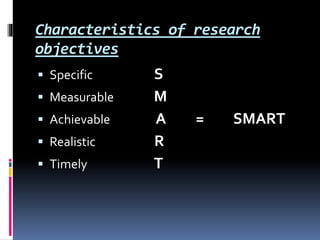
Characteristics of research
objectives
 Specific S
 Measurable M
 Achievable A = SMART
 Realistic R
 Timely T
Classifications of
Objectives
 General Objectives
 Specific Objectives
General Objectives
 States what is expected to be achieved by the
end of study in general terms .
Specific Objectives
 States what is expected to be achieved in
specific terms (in details)
 It breaks down what is to be achieved by the
study into smaller logical components
 Each specific objective must closely relate to
general objective
 Last objective should focus on how the
results will be used
Specific Objectives
 Properly formulated specific objectives will
help in,
- Developing the research methodology
- Collection, interpretation, analysis and
utilization of data
- Evaluation of the project
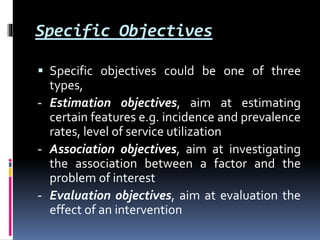
Specific Objectives
 Specific objectives could be one of three
types,
- Estimation objectives, aim at estimating
certain features e.g. incidence and prevalence
rates, level of service utilization
- Association objectives, aim at investigating
the association between a factor and the
problem of interest
- Evaluation objectives, aim at evaluation the
effect of an intervention
 Use ACTIONVERBS,
- Calculate
- Determine
- Compare
- Verify
- Establish
Stating the Objectives
 Avoid the VAGUE NON-ACTIONVERBS
- Appreciate
- Understand
- Study
- Notice
- Observe
Example
General Objective:
To assess the prevalence of hypertension in patients with ESRD
receiving erythropoietin Khartoum dialysis centre from Jan to
May 2009
Specific Objectives:
 To determine the prevalence of hypertension in ESRD patient
receiving erythropoietin
 To determine the relationship between the dose and the
severity of hypertension
 To asses the patient knowledge about this side effect of
erythropoietin and their attitudes towards blood pressure
checking
TITLE OF THE STUDY
 When objectives are well defined , the title
can be easily generated.
 Criteria for the title:
 1-aim specific
 2-place specific
 3-time specific
THANKS

Research Objectives

  • 1.
    RESEARCH OBJECTIVES Dr .Hinda Hassan Khideer Mahmood MBBS(U of K),MRCP,Nephrology Fellowship(SMSB)
  • 2.
     Incidence ratethe number of NEWcases occurring in a defined population at risk during a specific period of time (for acute conditions)  Prevalence ratio :the number of all cases, OLD &NEW ,in a defined population at risk during a specific period of time (incidence x duration of illness)
  • 3.
    Objectives  The objectivesof a research project summarize what to be achieved by the study.  The objectives answer three main questions: what , where and why
  • 4.
    Functions of objectives Help to focus the study  Avoid collection of unnecessary & irrelevant data  Organize the study in defined parts or phases
  • 5.
    Characteristics of research objectives Specific S  Measurable M  Achievable A = SMART  Realistic R  Timely T
  • 6.
    Classifications of Objectives  GeneralObjectives  Specific Objectives
  • 7.
    General Objectives  Stateswhat is expected to be achieved by the end of study in general terms .
  • 8.
    Specific Objectives  Stateswhat is expected to be achieved in specific terms (in details)  It breaks down what is to be achieved by the study into smaller logical components  Each specific objective must closely relate to general objective  Last objective should focus on how the results will be used
  • 9.
    Specific Objectives  Properlyformulated specific objectives will help in, - Developing the research methodology - Collection, interpretation, analysis and utilization of data - Evaluation of the project
  • 10.
    Specific Objectives  Specificobjectives could be one of three types, - Estimation objectives, aim at estimating certain features e.g. incidence and prevalence rates, level of service utilization - Association objectives, aim at investigating the association between a factor and the problem of interest - Evaluation objectives, aim at evaluation the effect of an intervention
  • 11.
     Use ACTIONVERBS, -Calculate - Determine - Compare - Verify - Establish
  • 12.
    Stating the Objectives Avoid the VAGUE NON-ACTIONVERBS - Appreciate - Understand - Study - Notice - Observe
  • 13.
    Example General Objective: To assessthe prevalence of hypertension in patients with ESRD receiving erythropoietin Khartoum dialysis centre from Jan to May 2009 Specific Objectives:  To determine the prevalence of hypertension in ESRD patient receiving erythropoietin  To determine the relationship between the dose and the severity of hypertension  To asses the patient knowledge about this side effect of erythropoietin and their attitudes towards blood pressure checking
  • 14.
  • 15.
     When objectivesare well defined , the title can be easily generated.
  • 16.
     Criteria forthe title:  1-aim specific  2-place specific  3-time specific
  • 17.