@judeenright
HOW?
Child Protection Officer
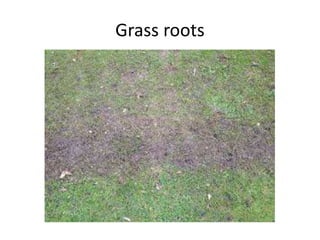
Grass roots
Grass roots
Top down
The open road to research success
RESEARCH SUCCESS
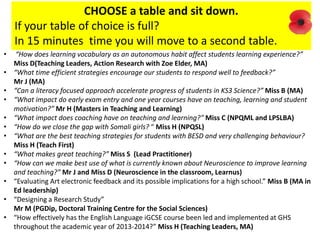
CHOOSE a table and sit down.
If your table of choice is full?
In 15 minutes time you will move to a second table.
• “How does learning vocabulary as an autonomous habit affect students learning experience?”
Miss D(Teaching Leaders, Action Research with Zoe Elder, MA)
• “What time efficient strategies encourage our students to respond well to feedback?”
Mr J (MA)
• “Can a literacy focused approach accelerate progress of students in KS3 Science?” Miss B (MA)
• “What impact do early exam entry and one year courses have on teaching, learning and student
motivation?” Mr H (Masters in Teaching and Learning)
• “What impact does coaching have on teaching and learning?” Miss C (NPQML and LPSLBA)
• “How do we close the gap with Somali girls? “ Miss H (NPQSL)
• “What are the best teaching strategies for students with BESD and very challenging behaviour?
Miss H (Teach First)
• “What makes great teaching?” Miss S (Lead Practitioner)
• “How can we make best use of what is currently known about Neuroscience to improve learning
and teaching?” Mr J and Miss D (Neuroscience in the classroom, Learnus)
• “Evaluating Art electronic feedback and its possible implications for a high school.” Miss B (MA in
Ed leadership)
• “Designing a Research Study”
Mr M (PGDip, Doctoral Training Centre for the Social Sciences)
• “How effectively has the English Language iGCSE course been led and implemented at GHS
throughout the academic year of 2013-2014?” Miss H (Teaching Leaders, MA)
Trying to avoid being zombies
• What works?
• Why?
• What doesn’t work?
• Why?
Researching teachers
work smarter, not harder
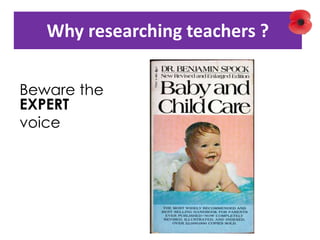
Why researching teachers ?
Beware the
EXPERT
voice
Why researching teachers ?
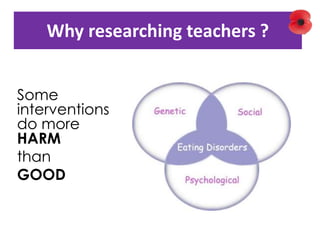
Some
interventions
do more
HARM
than
GOOD
Some interventions do more harm than good
Is it safe, as school leaders, to rely on a lone expert voice?
Systematic reviews help avoid complacency so we do more good than harm
“If advice as apparently innocuous and ‘theoretically sound’ as recommending a
baby’s sleeping position can be lethal, there is clearly no room for complacency
among professionals about their potential for harming those whom they purport to
help.”(Chalmers,2005)
Should our teenagers at risk of offending visit a Prison ?
Systematic reviews evaluate the impact of well intentioned interventions
“..would [a reader] really want [their son] exposed to a ‘Scared Straight’ programme
based on the conclusions of many poorly controlled before and after observational
studies suggesting that it would be helpful, rather than the systematic review of the
controlled trials suggesting that the programme increases subsequent involvement in
crime?” (Chalmers, 2005 citing Petrosino et al, 2003).
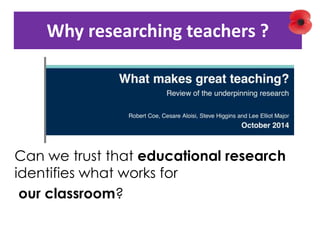
Can we trust that findings of educational research identify what will work for us?
Systematic reviews use scientific methods to discern causal relationships
“Much [educational research] has used experimental or quasi-experimental method, but
the results do not suggest (to say the least) that simple causal relations can be found”
(Hammersly,2005)
Campbell , cited by Pearson (2007), advocated experimental approach because of its
strength in discerning causal relationships between phenomena .
Why researching teachers ?
Can we trust that educational research
identifies what works for
our classroom?
How can I be a researching
teacher?
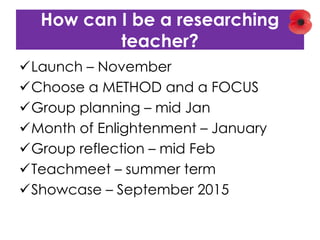
Launch – November
Choose a METHOD and a FOCUS
Group planning – mid Jan
Month of Enlightenment – January
Group reflection – mid Feb
Teachmeet – summer term
Showcase – September 2015
January
Month of enlightenment
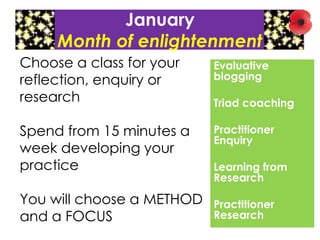
Evaluative
blogging
Triad coaching
Practitioner
Enquiry
Learning from
Research
Practitioner
Research
Choose a class for your
reflection, enquiry or
research
Spend from 15 minutes a
week developing your
practice
You will choose a METHOD
and a FOCUS
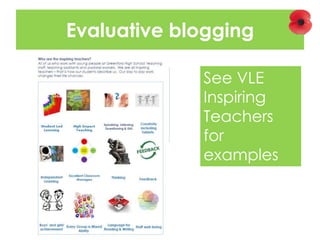
Evaluative blogging
See VLE
Inspiring
Teachers
for
examples
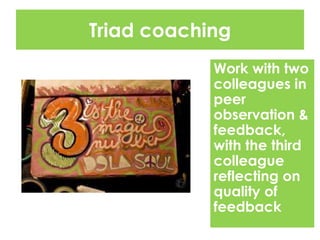
Triad coaching
Work with two
colleagues in
peer
observation &
feedback,
with the third
colleague
reflecting on
quality of
feedback
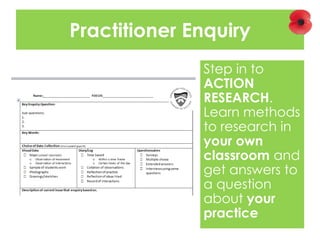
Practitioner Enquiry
Step in to
ACTION
RESEARCH.
Learn methods
to research in
your own
classroom and
get answers to
a question
about your
practice
Results – Assessment feedback sheets
What do you like
about the current
feedback sheets?
Number of
responses
Easy to
read/understand
25
Organised 1
Layout 16
Shows you what
you have done well
and what you need
to improve on
15
What could be improved?
• Include sentence starters for each
level
• Simpler language
• Fewer bullet points per level
• Include Literacy targets
• Space for the LR approved sticker
• Change wording to WWW and EBI
• Different layout
• Include a teacher comments box
• Larger font
• Bigger LR box
Students interviews – original feedback sheets
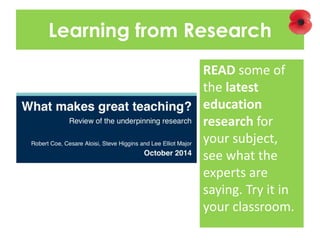
Learning from Research
READ some of
the latest
education
research for
your subject,
see what the
experts are
saying. Try it in
your classroom.
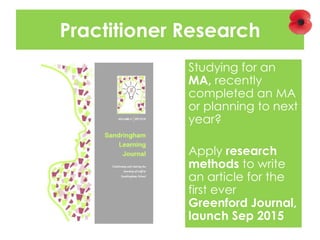
Practitioner Research
Studying for an
MA, recently
completed an MA
or planning to next
year?
Apply research
methods to write
an article for the
first ever
Greenford Journal,
launch Sep 2015
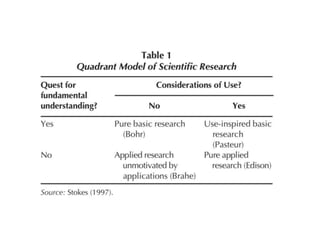
Assumptions
We are engaging in research because we want
to draw on a greater wisdom to improve student
learning.
We have buy in from our Headteacher, and
some limited resources: money, staff, time.
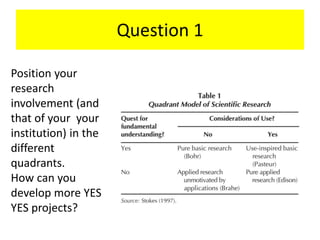
Question 1
Position your
research
involvement (and
that of your your
institution) in the
different
quadrants.
How can you
develop more YES
YES projects?
Question 2
How will the wisdom generated by
research in your institution be used?
…in your institution? …beyond?
Question 2
How will the wisdom generated by
research in your institution be used?
…in your institution? …beyond?
How do you know that your
wisdom is relevant to someone
else’s context?

Research leads #rEDCamb March 15th 2015

  • 1.
  • 2.
  • 3.
  • 4.
  • 5.
  • 6.
  • 9.
    The open roadto research success RESEARCH SUCCESS
  • 11.
    CHOOSE a tableand sit down. If your table of choice is full? In 15 minutes time you will move to a second table. • “How does learning vocabulary as an autonomous habit affect students learning experience?” Miss D(Teaching Leaders, Action Research with Zoe Elder, MA) • “What time efficient strategies encourage our students to respond well to feedback?” Mr J (MA) • “Can a literacy focused approach accelerate progress of students in KS3 Science?” Miss B (MA) • “What impact do early exam entry and one year courses have on teaching, learning and student motivation?” Mr H (Masters in Teaching and Learning) • “What impact does coaching have on teaching and learning?” Miss C (NPQML and LPSLBA) • “How do we close the gap with Somali girls? “ Miss H (NPQSL) • “What are the best teaching strategies for students with BESD and very challenging behaviour? Miss H (Teach First) • “What makes great teaching?” Miss S (Lead Practitioner) • “How can we make best use of what is currently known about Neuroscience to improve learning and teaching?” Mr J and Miss D (Neuroscience in the classroom, Learnus) • “Evaluating Art electronic feedback and its possible implications for a high school.” Miss B (MA in Ed leadership) • “Designing a Research Study” Mr M (PGDip, Doctoral Training Centre for the Social Sciences) • “How effectively has the English Language iGCSE course been led and implemented at GHS throughout the academic year of 2013-2014?” Miss H (Teaching Leaders, MA)
  • 12.
    Trying to avoidbeing zombies • What works? • Why? • What doesn’t work? • Why? Researching teachers work smarter, not harder
  • 13.
    Why researching teachers? Beware the EXPERT voice
  • 14.
    Why researching teachers? Some interventions do more HARM than GOOD
  • 15.
    Some interventions domore harm than good Is it safe, as school leaders, to rely on a lone expert voice? Systematic reviews help avoid complacency so we do more good than harm “If advice as apparently innocuous and ‘theoretically sound’ as recommending a baby’s sleeping position can be lethal, there is clearly no room for complacency among professionals about their potential for harming those whom they purport to help.”(Chalmers,2005) Should our teenagers at risk of offending visit a Prison ? Systematic reviews evaluate the impact of well intentioned interventions “..would [a reader] really want [their son] exposed to a ‘Scared Straight’ programme based on the conclusions of many poorly controlled before and after observational studies suggesting that it would be helpful, rather than the systematic review of the controlled trials suggesting that the programme increases subsequent involvement in crime?” (Chalmers, 2005 citing Petrosino et al, 2003). Can we trust that findings of educational research identify what will work for us? Systematic reviews use scientific methods to discern causal relationships “Much [educational research] has used experimental or quasi-experimental method, but the results do not suggest (to say the least) that simple causal relations can be found” (Hammersly,2005) Campbell , cited by Pearson (2007), advocated experimental approach because of its strength in discerning causal relationships between phenomena .
  • 16.
    Why researching teachers? Can we trust that educational research identifies what works for our classroom?
  • 17.
    How can Ibe a researching teacher? Launch – November Choose a METHOD and a FOCUS Group planning – mid Jan Month of Enlightenment – January Group reflection – mid Feb Teachmeet – summer term Showcase – September 2015
  • 18.
    January Month of enlightenment Evaluative blogging Triadcoaching Practitioner Enquiry Learning from Research Practitioner Research Choose a class for your reflection, enquiry or research Spend from 15 minutes a week developing your practice You will choose a METHOD and a FOCUS
  • 19.
  • 20.
    Triad coaching Work withtwo colleagues in peer observation & feedback, with the third colleague reflecting on quality of feedback
  • 21.
    Practitioner Enquiry Step into ACTION RESEARCH. Learn methods to research in your own classroom and get answers to a question about your practice
  • 22.
    Results – Assessmentfeedback sheets What do you like about the current feedback sheets? Number of responses Easy to read/understand 25 Organised 1 Layout 16 Shows you what you have done well and what you need to improve on 15 What could be improved? • Include sentence starters for each level • Simpler language • Fewer bullet points per level • Include Literacy targets • Space for the LR approved sticker • Change wording to WWW and EBI • Different layout • Include a teacher comments box • Larger font • Bigger LR box Students interviews – original feedback sheets
  • 23.
    Learning from Research READsome of the latest education research for your subject, see what the experts are saying. Try it in your classroom.
  • 24.
    Practitioner Research Studying foran MA, recently completed an MA or planning to next year? Apply research methods to write an article for the first ever Greenford Journal, launch Sep 2015
  • 28.
    Assumptions We are engagingin research because we want to draw on a greater wisdom to improve student learning. We have buy in from our Headteacher, and some limited resources: money, staff, time.
  • 29.
    Question 1 Position your research involvement(and that of your your institution) in the different quadrants. How can you develop more YES YES projects?
  • 30.
    Question 2 How willthe wisdom generated by research in your institution be used? …in your institution? …beyond?
  • 31.
    Question 2 How willthe wisdom generated by research in your institution be used? …in your institution? …beyond? How do you know that your wisdom is relevant to someone else’s context?

Editor's Notes

  • #11 Quest for fundamental scientific understanding vs consideration of use Bohr Theoretical Physicist, quantum theory, campaigned against atomic bombs "An expert is a man who has made all the mistakes which can be made, in a very narrow field." Brahe decided to dedicate his life and considerable resources to recording planetary positions ten times more accurately than the best previous work His aim was to confirm his own picture of the universe Edison “I have not failed. I've just found 10,000 ways that won't work.” As Dean of Faculty of Science, Pasteur encouraged his students to do practical work in industry before pursuing industrial careers.