FROM ITT TO CPD
Research as a process for school improvement

Kevin Hollins
Principal
Knutsford Academy and Studio School
Cheshire
Knutsford Academy



Size



Intake



Ability profile



Staffing



Innovation


A Royal College of Teaching



Royal College of Surgeons



An evidence (and therefore researchbased)profession



80% of teachers agree!
Extent of research : Secondary
Headteacher‟s Digest, November 2013









Assisted places

Educational attainment
English grading
Exercise

„Facilitating‟ subjects
Subject study
Top jobs
What should schools and teachers be researching?
A. School effectiveness
School effectiveness research confirms the need to focus on
processes that touch directly on teaching and learning. This
may be expressed in terms of the greater important of
“proximal” as opposed to “distal” factors influencing
achievement, as in:
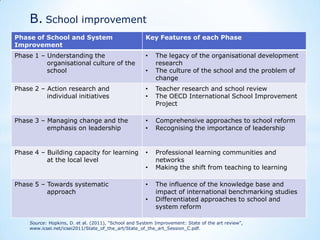
B. School improvement
Phase of School and System
Improvement

Key Features of each Phase

Phase 1 – Understanding the
organisational culture of the
school

•

Phase 2 – Action research and
individual initiatives

•
•

Teacher research and school review
The OECD International School Improvement
Project

Phase 3 – Managing change and the
emphasis on leadership

•
•

Comprehensive approaches to school reform
Recognising the importance of leadership

Phase 4 – Building capacity for learning
at the local level

•

Professional learning communities and
networks
Making the shift from teaching to learning

•

•
Phase 5 – Towards systematic
approach

•

•

The legacy of the organisational development
research
The culture of the school and the problem of
change

The influence of the knowledge base and
impact of international benchmarking studies
Differentiated approaches to school and
system reform

Source: Hopkins, D. et al. (2011), “School and System Improvement: State of the art review”,
www.icsei.net/icsei2011/State_of_the_art/State_of_the_art_Session_C.pdf.
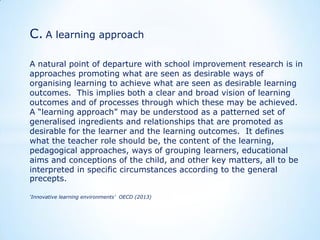
C. A learning approach
A natural point of departure with school improvement research is in
approaches promoting what are seen as desirable ways of
organising learning to achieve what are seen as desirable learning
outcomes. This implies both a clear and broad vision of learning
outcomes and of processes through which these may be achieved.
A “learning approach” may be understood as a patterned set of
generalised ingredients and relationships that are promoted as
desirable for the learner and the learning outcomes. It defines
what the teacher role should be, the content of the learning,
pedagogical approaches, ways of grouping learners, educational
aims and conceptions of the child, and other key matters, all to be
interpreted in specific circumstances according to the general
precepts.
‘Innovative learning environments’ OECD (2013)
D. Learning environments
Our understanding of a “learning environment” is as an organic,
holistic concept that embraces the learning taking place as well
as the setting: an eco-system of learning that includes the activity
and outcomes of the learning. It recognises that context is
essential in the contemporary understanding of learning (De Corte,
2010). A “learning environment” already defines the immediate
context in which the learning takes place. More broadly, instead of
context being understood as necessarily external, context can
usefully be viewed as integral to the main environment players and
variables, most obviously the learners who enter in already with
particular social profiles, family experiences, knowledge and
expectations, and cultural experience in values. These are all
importantly formed in wider family, community and social settings
but they are made manifest within the educational setting.
The notion of “environment” also importantly stresses time –
interplay and interaction take time as does learning that does not
happen in instantaneous episodes. The holistic cumulative
perspective allows mix to come to the fore – the mix of learning
approaches, experiences, and settings. This enable avoidance of
dualistic simplifications such as the supposed contrasting choice
between direct instruction and discovery as if everything will be
done in one way or not at all. The organic “eco-system” that is a
learning environment means that blended approaches and mixes
are understood to be the norm. Endorsement of mixed approaches
and repertoires is also supported by the most recent OECD/TALIS
report (Vieluf, S., et al. (2012).

‘Innovative learning environments’ OECD (2013)
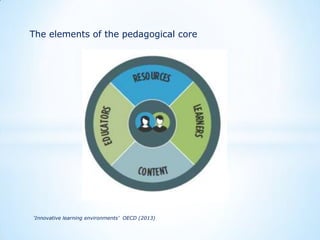
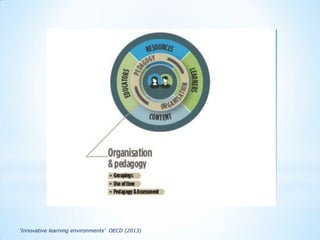
The elements of the pedagogical core

‘Innovative learning environments’ OECD (2013)
From what perspectives







Whole school

Classroom
Leaders
Teachers
Students

Or all?
Some views from the classroom
Teacher 1 -

My Masters programme has involved two research projects:

· the use of blended learning to raise achievement
· identifying and addressing the barriers to girls progressing to A-level physics

From the blended learning research I gained a deeper understanding of current
thinking regarding the use of the Internet and email to support students and
enhance classroom teaching. This linked well with the on-going development
of how we use our VLE to support students and provide access to resources.
The most noticeable impact of the project so far has been the increasing
amount of use of email by A-level students to ask for help with work outside of
normal school hours.
I started my „girls in physics‟ project this academic year and hence there are
no conclusions yet. However, the detailed literature review has been eyeopening and has helped me gain a thorough understanding of the range of
factors that influence girls in progressing to A-level physics. The project has
helped me understand different research methods in more detail and the
theory behind designing and running multi-method research projects.
Furthermore, the research has helped me develop my awareness of the ethical
issues when undertaking research.
Some views from the classroom
Teacher 2 - I thoroughly enjoyed the fact my masters study gave

me the opportunity to discuss/chat educational aspects with staff
from other learning centres. I found this very inspiring and I took a
lot of this inspiration and encouragement into my classroom
practice.
The masters programme also allowed me to study for a coaching
award from which I should receive merits. I have found the skills I
developed on my coaching classes very useful when mentoring my
sixth form students in my role as form tutor.
I am currently working on my thesis and am looking at Number
Acuity. I am interested in doing an investigation /survey with our
students to see how strong the correlation is between number acuity
and maths ability.
The masters programme has opened me up to studying and reading
about aspects of education I would never had time to discover
during a busy school week.
Some views from the classroom
Teacher 3 - With the exception of some early credits due to my
experiences gained in teaching, I aimed to combine the academic
research with real issues I face in my professional role.

In my research and consultation with other colleagues, I was able to
consider wider thinking than my own, reflect on previous practice and
find alternative and innovative solutions to problems my own and other
schools face in the 21st century.
I also tried where possible to link my work to my own developmental
plan and that of the team I manage. In my role, it is possible to suggest
that the outcomes of the research and actions taken can have a positive
effect on results for the school and individual students outlook on their
school experience.
Some views from the classroom
Teacher 4 - I thoroughly enjoyed the rigour of Masters level study

and it made me question my own preconceptions and beliefs about
teaching, learning and leadership and empowered me to innovate and
try new ideas, all of which directly benefits the Music department. The
conclusions of my research and activities I have developed through my
research projects have become embedded within the practice of the
Music department.

Teacher 5 - The research I undertook was to find out whether the

teaching of pupils by gender had a positive impact on the achievement
of boys in secondary schools. This was of particular interest as at the
time of the research I was teaching a group of year 11 boys, who were
on track to achieve considerably higher than their predicted grade and
was interested in whether the fact that it was solely a group of boys
was a contributory factor.
Some practical issues – a personal
perspective










Time
Resourcing
Confidentiality
Ethics
Utility
Dissemination
Link with school priorities?
The place of professional judgement?
Value of research-based practice – based on
no research evidence!



Breadth of perspective



Promotes innovation



Quality of pedagogy



Quality of leadership
Research principles



Understand research methods



Clarify the focus and approach



Provide time



Determine a dissemination strategy



Promote development



Promote career progression

From ITT to CPD: research as a process for school improvement - Kevin Hollins

  • 1.
    FROM ITT TOCPD Research as a process for school improvement Kevin Hollins Principal Knutsford Academy and Studio School Cheshire
  • 2.
  • 3.
     A Royal Collegeof Teaching  Royal College of Surgeons  An evidence (and therefore researchbased)profession  80% of teachers agree!
  • 4.
    Extent of research: Secondary Headteacher‟s Digest, November 2013        Assisted places Educational attainment English grading Exercise „Facilitating‟ subjects Subject study Top jobs
  • 5.
    What should schoolsand teachers be researching? A. School effectiveness School effectiveness research confirms the need to focus on processes that touch directly on teaching and learning. This may be expressed in terms of the greater important of “proximal” as opposed to “distal” factors influencing achievement, as in:
  • 6.
    B. School improvement Phaseof School and System Improvement Key Features of each Phase Phase 1 – Understanding the organisational culture of the school • Phase 2 – Action research and individual initiatives • • Teacher research and school review The OECD International School Improvement Project Phase 3 – Managing change and the emphasis on leadership • • Comprehensive approaches to school reform Recognising the importance of leadership Phase 4 – Building capacity for learning at the local level • Professional learning communities and networks Making the shift from teaching to learning • • Phase 5 – Towards systematic approach • • The legacy of the organisational development research The culture of the school and the problem of change The influence of the knowledge base and impact of international benchmarking studies Differentiated approaches to school and system reform Source: Hopkins, D. et al. (2011), “School and System Improvement: State of the art review”, www.icsei.net/icsei2011/State_of_the_art/State_of_the_art_Session_C.pdf.
  • 7.
    C. A learningapproach A natural point of departure with school improvement research is in approaches promoting what are seen as desirable ways of organising learning to achieve what are seen as desirable learning outcomes. This implies both a clear and broad vision of learning outcomes and of processes through which these may be achieved. A “learning approach” may be understood as a patterned set of generalised ingredients and relationships that are promoted as desirable for the learner and the learning outcomes. It defines what the teacher role should be, the content of the learning, pedagogical approaches, ways of grouping learners, educational aims and conceptions of the child, and other key matters, all to be interpreted in specific circumstances according to the general precepts. ‘Innovative learning environments’ OECD (2013)
  • 8.
    D. Learning environments Ourunderstanding of a “learning environment” is as an organic, holistic concept that embraces the learning taking place as well as the setting: an eco-system of learning that includes the activity and outcomes of the learning. It recognises that context is essential in the contemporary understanding of learning (De Corte, 2010). A “learning environment” already defines the immediate context in which the learning takes place. More broadly, instead of context being understood as necessarily external, context can usefully be viewed as integral to the main environment players and variables, most obviously the learners who enter in already with particular social profiles, family experiences, knowledge and expectations, and cultural experience in values. These are all importantly formed in wider family, community and social settings but they are made manifest within the educational setting.
  • 9.
    The notion of“environment” also importantly stresses time – interplay and interaction take time as does learning that does not happen in instantaneous episodes. The holistic cumulative perspective allows mix to come to the fore – the mix of learning approaches, experiences, and settings. This enable avoidance of dualistic simplifications such as the supposed contrasting choice between direct instruction and discovery as if everything will be done in one way or not at all. The organic “eco-system” that is a learning environment means that blended approaches and mixes are understood to be the norm. Endorsement of mixed approaches and repertoires is also supported by the most recent OECD/TALIS report (Vieluf, S., et al. (2012). ‘Innovative learning environments’ OECD (2013)
  • 10.
    The elements ofthe pedagogical core ‘Innovative learning environments’ OECD (2013)
  • 11.
  • 12.
    From what perspectives      Wholeschool Classroom Leaders Teachers Students Or all?
  • 13.
    Some views fromthe classroom Teacher 1 - My Masters programme has involved two research projects: · the use of blended learning to raise achievement · identifying and addressing the barriers to girls progressing to A-level physics From the blended learning research I gained a deeper understanding of current thinking regarding the use of the Internet and email to support students and enhance classroom teaching. This linked well with the on-going development of how we use our VLE to support students and provide access to resources. The most noticeable impact of the project so far has been the increasing amount of use of email by A-level students to ask for help with work outside of normal school hours. I started my „girls in physics‟ project this academic year and hence there are no conclusions yet. However, the detailed literature review has been eyeopening and has helped me gain a thorough understanding of the range of factors that influence girls in progressing to A-level physics. The project has helped me understand different research methods in more detail and the theory behind designing and running multi-method research projects. Furthermore, the research has helped me develop my awareness of the ethical issues when undertaking research.
  • 14.
    Some views fromthe classroom Teacher 2 - I thoroughly enjoyed the fact my masters study gave me the opportunity to discuss/chat educational aspects with staff from other learning centres. I found this very inspiring and I took a lot of this inspiration and encouragement into my classroom practice. The masters programme also allowed me to study for a coaching award from which I should receive merits. I have found the skills I developed on my coaching classes very useful when mentoring my sixth form students in my role as form tutor. I am currently working on my thesis and am looking at Number Acuity. I am interested in doing an investigation /survey with our students to see how strong the correlation is between number acuity and maths ability. The masters programme has opened me up to studying and reading about aspects of education I would never had time to discover during a busy school week.
  • 15.
    Some views fromthe classroom Teacher 3 - With the exception of some early credits due to my experiences gained in teaching, I aimed to combine the academic research with real issues I face in my professional role. In my research and consultation with other colleagues, I was able to consider wider thinking than my own, reflect on previous practice and find alternative and innovative solutions to problems my own and other schools face in the 21st century. I also tried where possible to link my work to my own developmental plan and that of the team I manage. In my role, it is possible to suggest that the outcomes of the research and actions taken can have a positive effect on results for the school and individual students outlook on their school experience.
  • 16.
    Some views fromthe classroom Teacher 4 - I thoroughly enjoyed the rigour of Masters level study and it made me question my own preconceptions and beliefs about teaching, learning and leadership and empowered me to innovate and try new ideas, all of which directly benefits the Music department. The conclusions of my research and activities I have developed through my research projects have become embedded within the practice of the Music department. Teacher 5 - The research I undertook was to find out whether the teaching of pupils by gender had a positive impact on the achievement of boys in secondary schools. This was of particular interest as at the time of the research I was teaching a group of year 11 boys, who were on track to achieve considerably higher than their predicted grade and was interested in whether the fact that it was solely a group of boys was a contributory factor.
  • 17.
    Some practical issues– a personal perspective         Time Resourcing Confidentiality Ethics Utility Dissemination Link with school priorities? The place of professional judgement?
  • 18.
    Value of research-basedpractice – based on no research evidence!  Breadth of perspective  Promotes innovation  Quality of pedagogy  Quality of leadership
  • 19.
    Research principles  Understand researchmethods  Clarify the focus and approach  Provide time  Determine a dissemination strategy  Promote development  Promote career progression