Runninghead:ARECEREALS MAKING A COMEBACK? 1
Are Cereals Making a Comeback?
Group 4: Kristy Allan, Tasha Huggins, Katie Lee, Ashley Lewenberg, Brittany Watson
Humber College
ARE CEREALS MAKING A COMEBACK? 2
Table of Contents
Executive Summary ...................................................................................................................... 3
Introduction................................................................................................................................... 4
Background and Objectives ..................................................................................................... 4
Methodology .................................................................................................................................. 5
Results ............................................................................................................................................ 6
Discussion....................................................................................................................................... 8
Implications................................................................................................................................ 8
Limitations ............................................................................................................................... 10
Sample and survey limitations............................................................................................ 10
Research limitations. ........................................................................................................... 10
Conclusions and Recommendations.......................................................................................... 11
References.................................................................................................................................... 14
Appendix A .................................................................................................................................. 15
Appendix B .................................................................................................................................. 20
Appendix C .................................................................................................................................. 25
ARE CEREALS MAKING A COMEBACK? 3
Executive Summary
ResearchObjectives Overview
The main objective of this study was to examine the decline in Kellogg’s breakfast cereal
sales over the years by understanding the target consumer market’s attitudes towards the brand,
its competitors and their overall perception of healthy food. The research sub-objectives for this
study focused on examining the current perceived problems with Kellogg’s and its available
products as well as looking into targeting Young Educated Millennial Moms (YEMMies) as the
consumer base for healthier breakfast cereal products. This would be achieved through looking
into their nutritional preferences and finding out where they find information about new products
and reformulated foods. The research also seeks to gain insight into how consumers in general
assess the healthiness of certain food products.
Methods
In addition to secondary research through academic journals, news articles and consumer
reports, primary research was conducted through survey research. The survey was conducted to
gain more direct information about people’s overall perception of breakfast cereal, their general
eating habits and how they gauge nutritional value in products.
Results and Recommendations
The main findings of the study show that consumers look for health benefits over any
other element of breakfast cereal. The recommendations for Kellogg’s in terms of increasing
their cereal sales would be to create products that contain more natural ingredients and begin
tailoring their products towards YEMMies as a potential target market.
ARE CEREALS MAKING A COMEBACK? 4
Are Cereals Making a Comeback?
Introduction
Background and Objectives
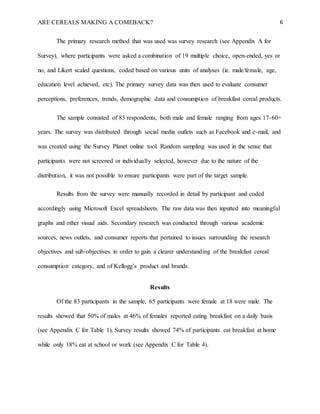
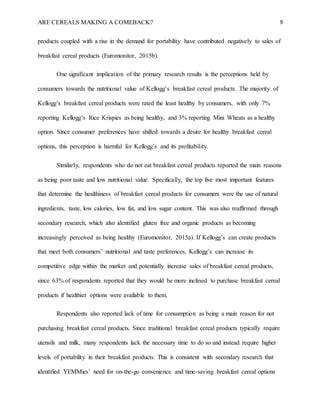
Marketing trends show that as an overall category, sales figures for breakfast cereals in
Canada are on the decline. Specifically, retail sales have declined by 1% in volume and 2% in
value (Euromonitor, 2015b). The current value of the breakfast cereal product category sits at
$1.4 billion CAD, and is projected to shrink to $1.3 billion CAD by 2020 (Euromonitor, 2015).
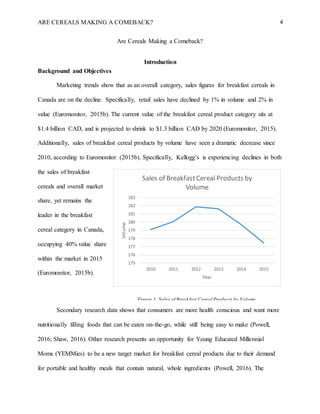
Additionally, sales of breakfast cereal products by volume have seen a dramatic decrease since
2010, according to Euromonitor (2015b). Specifically, Kellogg’s is experiencing declines in both
the sales of breakfast
cereals and overall market
share, yet remains the
leader in the breakfast
cereal category in Canada,
occupying 40% value share
within the market in 2015
(Euromonitor, 2015b).
Secondary research data shows that consumers are more health conscious and want more
nutritionally filling foods that can be eaten on-the-go, while still being easy to make (Powell,
2016; Shaw, 2016). Other research presents an opportunity for Young Educated Millennial
Moms (YEMMies) to be a new target market for breakfast cereal products due to their demand
for portable and healthy meals that contain natural, whole ingredients (Powell, 2016). The
175
176
177
178
179
180
181
182
183
2010 2011 2012 2013 2014 2015
Volume
Year
Sales of BreakfastCereal Products by
Volume
Figure 1: Sales of Breakfast Cereal Products by Volume
ARE CEREALS MAKING A COMEBACK? 5
current research study seeks to gain a better understanding of the causes of these issues, and
determine whether or not Kellogg’s can increase breakfast cereal sales by targeting health-
conscious consumers through the reformulation of nutritional value for current breakfast cereal
products, and through the introduction of a new health-conscious product line.
The main research objective is to understand Kellogg’s target market usage and attitudes
towards the brand, its competitors, and the target market’s perceptions of healthy food. The
research sub-objectives are as follows:
1) What are the current perceived problems with Kellogg’s breakfast cereal products that are
currently available?
2) What are YEMMies’ nutritional preferences?
3) Where do YEMMies’ get information about new and reformulated breakfast cereal
products?
4) How do consumers assess the healthiness of breakfast cereal products?
Methodology
The research that will be discussed is exploratory research, as a decrease in Kellogg’s
cereal sales was identified, while causes were undetermined. The purpose of the current study
was to understand the target market and how their perceptions of healthy foods aligned with their
attitudes towards Kellogg’s as a brand. Both primary and secondary research was conducted in
order to examine these consumer trends and attitudes, and both were used to make
recommendations on how Kellogg’s should proceed with its current line of breakfast cereals and
potential new product introductions.
ARE CEREALS MAKING A COMEBACK? 6
The primary research method that was used was survey research (see Appendix A for
Survey), where participants were asked a combination of 19 multiple choice, open-ended, yes or
no, and Likert scaled questions, coded based on various units of analyses (ie. male/female, age,
education level achieved, etc). The primary survey data was then used to evaluate consumer
perceptions, preferences, trends, demographic data and consumption of breakfast cereal products.
The sample consisted of 83 respondents, both male and female ranging from ages 17-60+
years. The survey was distributed through social media outlets such as Facebook and e-mail, and
was created using the Survey Planet online tool. Random sampling was used in the sense that
participants were not screened or individually selected, however due to the nature of the
distribution, it was not possible to ensure participants were part of the target sample.
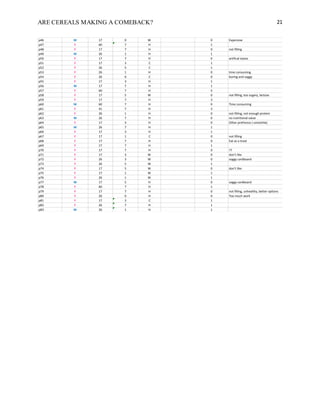
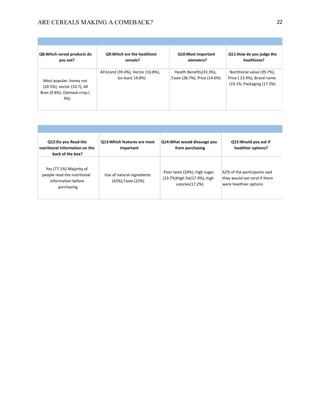
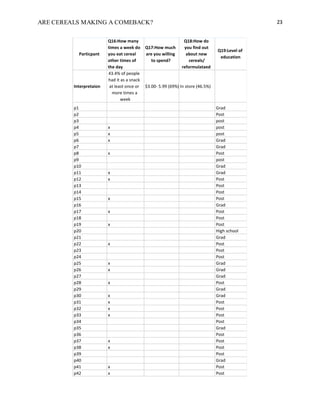
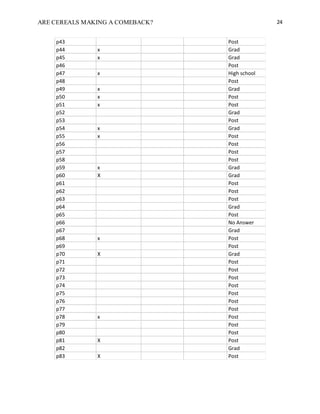
Results from the survey were manually recorded in detail by participant and coded
accordingly using Microsoft Excel spreadsheets. The raw data was then inputted into meaningful
graphs and other visual aids. Secondary research was conducted through various academic
sources, news outlets, and consumer reports that pertained to issues surrounding the research
objectives and sub-objectives in order to gain a clearer understanding of the breakfast cereal
consumption category, and of Kellogg’s product and brands.
Results
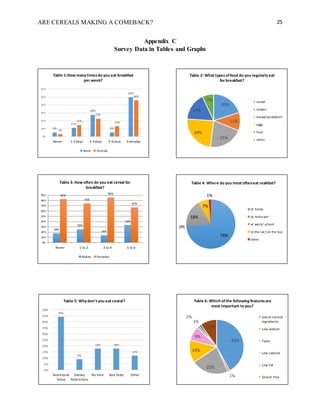
Of the 83 participants in the sample, 65 participants were female at 18 were male. The
results showed that 50% of males at 46% of females reported eating breakfast on a daily basis
(see Appendix C for Table 1). Survey results showed 74% of participants eat breakfast at home
while only 18% eat at school or work (see Appendix C for Table 4).
ARE CEREALS MAKING A COMEBACK? 7
Within the context of breakfast cereals as a product category, 83% of females responded
saying they eat cereal 5-6 days a week, compared to 33% of males (see Appendix C for Table 3).
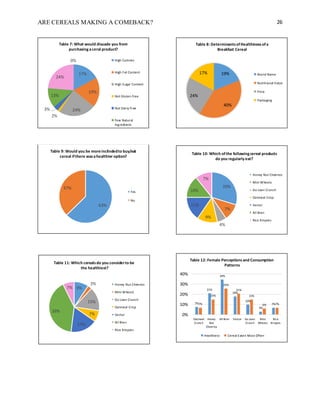
Female respondents were more likely to eat Honey Nut Cheerios, All Bran, and Vector.
Additionally, these products were perceived to be the healthiest breakfast cereals. Consistent
with these results, Honey Nut Cheerios was the largest consumed breakfast cereal product, with
20% of respondents reporting regular consumption, followed by Vector at 11%, and 10% of
respondents who reported eating All Bran (see Appendix C for Table 12).
Aside from All Bran and Vector, Kellogg’s cereal products were rated the least healthy
by respondents. Only 7% of survey respondents reported that Rice Krispies were healthy, while
only 3% reported that Mini Wheats had any health benefits (see Appendix C for Table 11).
When respondents were asked why they do not eat breakfast cereal, the most common
response was attributable to consumers’ perceptions of breakfast cereal having poor nutritional
value, followed by poor taste (see Appendix C for Table 7). Participants also stated that they ate
breakfast cereal less frequently because they did not have time, or due to dietary restrictions
(most commonly not being able to drink milk) (see Appendix C for Table 7). However, 63% of
participants stated that they would be more inclined to eat breakfast cereal if there was a
healthier option available to them (see Appendix C for Table 9).
One of the most important elements that participants looked for when purchasing cereals
was nutritional value (see Appendix C for Table 7). When purchasing breakfast cereal products,
77% of participants indicated that they read the label at the back of the box prior to buying the
product. Participants specifically wanted products that contain natural ingredients, are low in
sugar and calories, but still taste good (see Appendix C for Table 6). Participants judged the
healthiness of breakfast cereal not only by the nutritional value (40%) on the box, but also based
ARE CEREALS MAKING A COMEBACK? 8
off of the price (24%) and brand name (19%) of the products (see Appendix C for Table 8). The
average price that participants were willing to pay for a 350g. box of breakfast cereal was
between $3.00-$5.99. When asking participants what they usually eat for breakfast, 42%
responded that they ate eggs, 21% ate bread, and 20% ate breakfast cereal products (see
Appendix C for Table 2).
Discussion
Implications
The results from the primary and secondary research support the research objective by
identifying various potential target markets for Kellogg’s, and what their attitudes and
consumption behaviours are towards the brand and its breakfast cereal products that are currently
available. From the results, it was identified that almost half of the sample eats breakfast on a
daily basis. Additionally, more than two thirds of female respondents matching the YEMMies
target market reported that they specifically eat breakfast cereal products between 5-6 days per
week. These respondents were also more likely to perceive cereal brands such as All Bran,
Honey Nut Cheerios and Vector as being healthier options. These results are consistent with
secondary research data, which reported that Kellogg’s target market, YEMMies’, preferences
are shifting towards healthier options.
Additionally, with such a high rate of daily breakfast consumption reported by
respondents, there is significant growth potential for Kellogg’s line of breakfast cereal. Given the
fact that Kellogg’s currently occupies 40% of the value share within the breakfast cereal
category, it already has a strong consumer base that would likely remain loyal to brand names.
However, it was found through secondary research that an increasing variety of breakfast
ARE CEREALS MAKING A COMEBACK? 9
products coupled with a rise in the demand for portability have contributed negatively to sales of
breakfast cereal products (Euromonitor, 2015b).
One significant implication of the primary research results is the perceptions held by
consumers towards the nutritional value of Kellogg’s breakfast cereal products. The majority of
Kellogg’s breakfast cereal products were rated the least healthy by consumers, with only 7%
reporting Kellogg’s Rice Krispies as being healthy, and 3% reporting Mini Wheats as a healthy
option. Since consumer preferences have shifted towards a desire for healthy breakfast cereal
options, this perception is harmful for Kellogg’s and its profitability.
Similarly, respondents who do not eat breakfast cereal products reported the main reasons
as being poor taste and low nutritional value. Specifically, the top five most important features
that determine the healthiness of breakfast cereal products for consumers were the use of natural
ingredients, taste, low calories, low fat, and low sugar content. This was also reaffirmed through
secondary research, which also identified gluten free and organic products as becoming
increasingly perceived as being healthy (Euromonitor, 2015a). If Kellogg’s can create products
that meet both consumers’ nutritional and taste preferences, Kellogg’s can increase its
competitive edge within the market and potentially increase sales of breakfast cereal products,
since 63% of respondents reported that they would be more inclined to purchase breakfast cereal
products if healthier options were available to them.
Respondents also reported lack of time for consumption as being a main reason for not
purchasing breakfast cereal products. Since traditional breakfast cereal products typically require
utensils and milk, many respondents lack the necessary time to do so and instead require higher
levels of portability in their breakfast products. This is consistent with secondary research that
identified YEMMies’ need for on-the-go convenience and time-saving breakfast cereal options
ARE CEREALS MAKING A COMEBACK? 10
(Euromonitor, 2015b). Despite these barriers, Kellogg’s has growth potential within the breakfast
cereal category if it is able to create products that address these issues.
Consistent with secondary research data, 77% of participants reported looking at the
nutritional value of breakfast cereal products prior to purchasing. Primary research results
support the secondary research data, which reported YEMMies’ preference for natural and whole
ingredients, low sugar, low calorie contents and exceptional taste. Since 20% of respondents
indicated that they eat cereal most often for breakfast, then there is significant room for growth if
Kellogg’s can create a breakfast cereal product that is adapted to their target market’s nutritional
and taste preferences.
Limitations
Sample and survey limitations. Limitations arose through sample size and survey
distribution. Efforts were made to distribute the survey to our target sample, but since surveys
were completed voluntarily online and distributed through social media, the sample was limited
by the fact that participants needed internet access to complete the survey, and participants could
not be screened beforehand to ensure they were the target sample. As such, data gathered showed
a disproportionate number of male to female participants. Of the female participants, the
majority of them were in the appropriate age range to be considered as a YEMMie, a potential
YEMMie in the next few years, which could influence an increase of health cereal sales (Powell,
2016). This did not have much of an effect on the research findings, but for future research more
detailed questions may be needed for a more thorough screening process to ensure a more
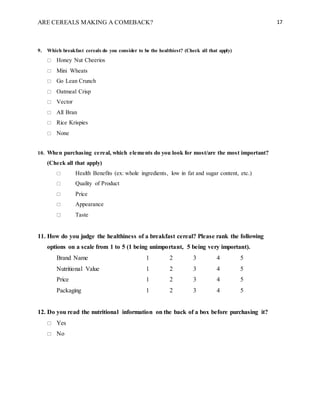
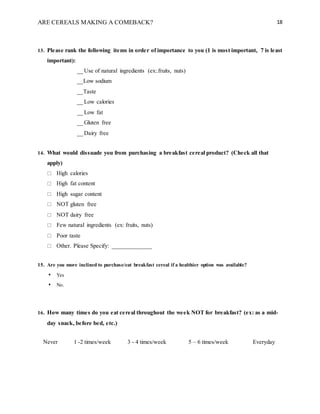
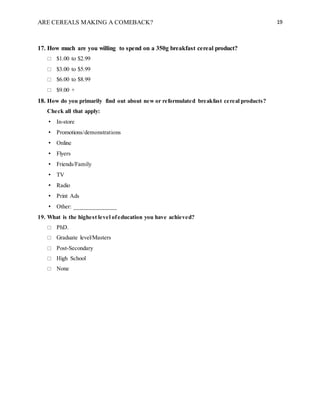
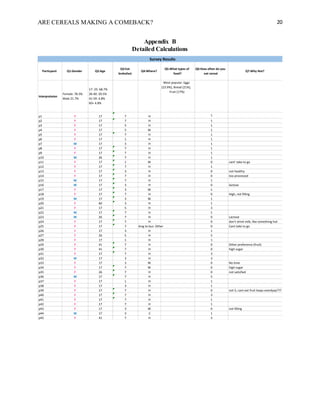
representative split of males and females who are breakfast cereal consumers.
Researchlimitations. In terms of the secondary research, the majority of available
research was based on samples collected in countries located in Europe and the United Kingdom,
ARE CEREALS MAKING A COMEBACK? 11
making it difficult to find research relevant to Canada. Using international research also yielded
some information that was written in a different language and translated poorly, making it
somewhat difficult to interpret. Another limitation was not having access to sources that were
current within the past 5 years, meaning some of the data was outdated and not relevant to the
current study.
Conclusions and Recommendations
Overall, the research results show that the declining trend in breakfast cereal sales is
negatively correlated with the health food trend. Participants indicate that the main reason for not
being an avid breakfast cereal product consumer is due to its lack of nutritional value. Contrary
to secondary research that suggests consumers are increasingly purchasing breakfast products
from fast-service restaurants like Tim Hortons, survey data collected suggest respondents eat
breakfast at home more than on-the-go (Euromonitor, 2015b). This discrepancy is likely
attributable to the small sample size used in the current study, making it not representative of a
larger population. Although consumers still want portable meals that can be made quickly and
easily, the product value for consumers lies within the health benefits.
Given this information, Kellogg’s may be able to increase its sales in breakfast cereal
products by creating a new line of products that incorporates consumers’ demands for higher
nutritional value and portability requirements. Currently, retail sales figures for biscuits, snack
bars, and hot breakfast cereal products are increasing (Euromonitor, 2015a; Euromonitor,
2015b). Specifically, the product category of savoury biscuits and granola bars saw a dramatic
increase in 2015 in value share of 4% within the market (Euromonitor, 2015a). As a category,
hot cereal breakfast products saw positive growth within the 2015 breakfast cereals market
(Euromonitor, 2015b). Despite these growths in various breakfast cereal product categories,
ARE CEREALS MAKING A COMEBACK? 12
average unit prices have seen moderate rises which are attributable to rising costs of raw
materials used in their production, such as, cocoa powder (Euromonitor, 2015a). This may have a
negative impact on breakfast cereal product sales for Kellogg’s, as survey data shows that
consumers are generally unwilling to pay more than $5.99 for a 350g. breakfast cereal product.
In order to grow sales and market share within the breakfast cereal market, it is
recommended that Kellogg’s take into consideration the target market’s desire for portability and
nutritional value when reformulating and creating new breakfast cereal products. Younger
generations, including YEMMies, typically enjoy busier lifestyles and are less inclined to sit
down to scheduled meals; rather, they tend to enjoy more frequent snacking on small-sized,
portable biscuit and snack bar products throughout their days (Euromonitor, 2015a; Euromonitor,
2015b). Additionally, YEMMies are highly concerned with the healthiness of breakfast cereal
products, citing health benefits as the most important factor in their perceptions on nutritional
value. In particular, the most important factors that dissuade YEMMies from purchasing
breakfast cereal products include, high sugar, fat, and calorie content, along with few natural
ingredients.
Thus, Kellogg’s should focus less on traditional breakfast cereal products, as this market
is projected to have negative growth in the coming years. Instead, Kellogg’s should shift its
focus towards reformulating its current breakfast cereal snack bar and biscuit products, such as
Special K and All Bran Bars, to include lower sugar, calorie, and fat content, more natural and
whole ingredients, and increase product portability. Additionally, secondary research found that
there is increasing growth potential in the categories of gluten and dairy free breakfast cereal
products, as consumers are becoming increasingly health-conscious (Euromonitor, 2015b).
Therefore, it is suggested that Kellogg’s further penetrate the breakfast cereal product market by
ARE CEREALS MAKING A COMEBACK? 13
also creating new innovative breakfast cereal biscuit and snack bar products that align with these
consumer taste, nutrition, and lifestyle preferences. Similarly, by further pursuing YEMMies as a
target market, Kellogg’s may be able to grow its breakfast cereal product market share by
catering to the needs of this large and growing demographic that will have significant increases
in spending power within the coming years.
ARE CEREALS MAKING A COMEBACK? 14
References
Euromonitor International. (2015a, October 12). Biscuits and Snack Bars in Canada: Category
Briefing. Retrieved from
http://www.portal.euromonitor.com.eztest.ocls.ca/portal/analysis/tab
Euromonitor International. (2015b, October 12). Breakfast Cereals in Canada: Category
Briefing. Retrieved from
http://www.portal.euromonitor.com.eztest.ocls.ca/portal/analysis/tab
Powell, C. (2016). IPSOS Identifies New Consumer Group for Food Companies. Retrieved from
http://www.marketingmag.ca/consumer/ipsos-identifies-new-consumer-group-for-food-
companies-165953
Shaw, H. (2016). Breakonomics: How our abandonment of breakfast cereal is shaking up the
economy. Retrieved from http://www.nationalpost.com/breakonomics abandonment
breakfast cereal shaking economy/11624651/story.html
ARE CEREALS MAKING A COMEBACK? 15
Appendix A
Survey
The information gathered in this survey will be used as part of a ResearchMethods project
for our Marketing Management program that aims to understand breakfast cereal usage
among consumers. The purpose of this survey is to understand the eating habits of
consumers to try to better meet their evolving needs. Participation in this survey is
completely voluntary, and results will be kept anonymous. Participants may choose to
discontinue filling out the survey at any time. There are no harms that will befall the
participants of this survey.
1. What is your gender?
 Male
 Female
2. How old are you?
 Under 10
 10 to 16
 17 to 25
 26 to 40
 41 to 59
 60+
3. How many times do you eat breakfast per week?
Never 1 - 2 days 3 - 4 days 5 - 6 days Everyday
4. Where do you most often eat breakfast?
 At home
 At a restaurant
 At work/school
 In the car/on the bus
 Other (please specify):_______________
ARE CEREALS MAKING A COMEBACK? 16
5. What type of foods do you regularly eat for breakfast? (Check all that apply) .
 Cereal
 Shakes
 Bread/Sandwich
 Eggs
 Fruit
 Other (please specify) _____________
6. How often do you specifically eat cereal for breakfast?
Never 1 -2 times/week 3 - 4 times/week 5 – 6 times/week Everyday
7. If you answered “Never”, why don’t you eat cereal? Please explain.
___________________________________________________________________________
8. Which of the following cereal products do you regularly eat? (Check all that apply)
 Honey Nut Cheerios
 Mini Wheats
 Go Lean Crunch
 Oatmeal Crisp
 Vector
 All Bran
 Rice Krispies
 None
ARE CEREALS MAKING A COMEBACK? 17
9. Which breakfast cereals do you consider to be the healthiest? (Check all that apply)
 Honey Nut Cheerios
 Mini Wheats
 Go Lean Crunch
 Oatmeal Crisp
 Vector
 All Bran
 Rice Krispies
 None
10. When purchasing cereal, which elements do you look for most/are the most important?
(Check all that apply)
 Health Benefits (ex: whole ingredients, low in fat and sugar content, etc.)
 Quality of Product
 Price
 Appearance
 Taste
11. How do you judge the healthiness of a breakfast cereal? Please rank the following
options on a scale from 1 to 5 (1 being unimportant, 5 being very important).
Brand Name 1 2 3 4 5
Nutritional Value 1 2 3 4 5
Price 1 2 3 4 5
Packaging 1 2 3 4 5
12. Do you read the nutritional information on the back of a box before purchasing it?
 Yes
 No
ARE CEREALS MAKING A COMEBACK? 18
13. Please rank the following items in order of importance to you (1 is most important, 7 is least
important):
__ Use of natural ingredients (ex:.fruits, nuts)
__Low sodium
__Taste
__ Low calories
__ Low fat
__ Gluten free
__ Dairy free
14. What would dissuade you from purchasing a breakfast cereal product? (Check all that
apply)
 High calories
 High fat content
 High sugar content
 NOT gluten free
 NOT dairy free
 Few natural ingredients (ex: fruits, nuts)
 Poor taste
 Other. Please Specify: _____________
15. Are you more inclined to purchase/eat breakfast cereal if a healthier option was available?
• Yes
• No.
16. How many times do you eat cereal throughout the week NOT for breakfast? (ex: as a mid-
day snack, before bed, etc.)
Never 1 -2 times/week 3 - 4 times/week 5 – 6 times/week Everyday
ARE CEREALS MAKING A COMEBACK? 19
17. How much are you willing to spend on a 350g breakfast cereal product?
 $1.00 to $2.99
 $3.00 to $5.99
 $6.00 to $8.99
 $9.00 +
18. How do you primarily find out about new or reformulated breakfast cereal products?
Check all that apply:
• In-store
• Promotions/demonstrations
• Online
• Flyers
• Friends/Family
• TV
• Radio
• Print Ads
• Other: ______________
19. What is the highest level ofeducation you have achieved?
 PhD.
 Graduate level/Masters
 Post-Secondary
 High School
 None
ARE CEREALS MAKING A COMEBACK? 20
Appendix B
Detailed Calculations
Particpant Q1:Gender Q2:Age
Q3:Eat
brekafast
Q4:Where?
Q5:What types of
food?
Q6:How often do you
eat cereal
Q7:Why Not?
Interpretaion
Female: 78.3%
Male 21.7%
17- 25: 68.7%
26-40: 20.5%
41-59: 4.8%
60+ 4.8%
Most popular: Eggs
(23.9%), Bread (21%),
Fruit (17%)
p1 F 17 7 H 1
p2 F 17 7 H 1
p3 F 17 5 H 1
p4 F 17 5 W 1
p5 F 17 7 H 1
p6 F 17 1 H 1
p7 M 17 3 H 1
p8 F 17 7 H 1
p9 F 17 7 H 1
p10 M 26 7 H 1
p11 F 17 1 W 0 cant' take to go
p12 F 17 7 H 1
p13 F 17 3 H 0 not healthy
p14 F 17 7 H 0 too processed
p15 M 17 7 H 1
p16 M 17 3 H 0 lactose
p17 F 17 3 W 1
p18 F 17 7 H 0 High, not filling
p19 M 17 3 W 1
p20 F 60 3 H 1
p21 F 17 5 H 3
p22 M 17 7 H 1
p23 M 26 7 H 0 Lactose
p24 F 17 7 H 0 don’t drink milk, like something hot
p25 F 17 7 Walking to bus- Other 0 Cant take to go
p26 F 17 3 H 1
p27 F 26 5 H 5
p28 F 17 1 H 1
p29 F 41 7 H 0 Other preference (fruit)
p30 F 41 7 H 0 high sugar
p31 F 17 7 H 3
p32 M 17 3 H 3
p33 F 17 3 W 0 No time
p34 F 17 7 W 0 high sugar
p35 F 26 7 H 0 not satisfied
p36 M 17 7 H 5
p37 F 17 1 H 1
p38 F 17 3 H 1
p39 F 17 7 H 0 not 5, cant eat fruit loops everdyay???
p40 F 17 7 H 3
p41 F 17 7 H 1
p42 F 17 7 H 1
p43 F 17 3 W 0 not filling
p44 M 17 3 C 1
p45 F 41 7 H 3
Survey Results
ARE CEREALS MAKING A COMEBACK? 21
p45 F 41 7 H 3
p46 M 17 0 W 0 Expensive
p47 F 60 7 H 1
p48 F 17 7 H 0 not filling
p49 M 26 1 H 1
p50 F 17 7 H 0 artifical tastes
p51 F 17 3 C 1
p52 F 26 5 C 1
p53 F 26 1 H 0 time consuming
p54 F 26 0 C 0 boring and soggy
p55 F 17 3 H 1
p56 M 17 7 H 1
p57 F 60 7 H 5
p58 F 17 5 W 0 not filling, too sugary, lactose
p59 F 17 7 H 3
p60 M 60 7 H 0 Time consuming
p61 F 41 7 H 3
p62 F 26 1 H 0 not filling, not enough protein
p63 M 26 7 H 0 no nutritional value
p64 F 17 3 H 0 Other prefrence ( smoothie)
p65 M 26 7 H 1
p66 F 17 3 H 1
p67 F 17 1 C 0 not filling
p68 F 17 7 H 0 Eat as a treat
p69 F 17 7 H 1
p70 F 17 7 H 0 ??
p71 F 17 3 W 0 don’t like
p72 F 26 3 W 0 soggy cardboard
p73 F 26 5 W 1
p74 F 17 5 W 0 don’t like
p75 F 17 1 W 1
p76 F 26 1 W 1
p77 M 17 5 H 0 soggy cardboard
p78 F 60 7 H 1
p79 F 17 7 H 0 not filling, unhealthy, better options
p80 F 26 0 H 0 Too much work
p81 F 17 3 C 1
p82 F 26 7 H 1
p83 M 26 1 H 1
ARE CEREALS MAKING A COMEBACK? 22
Why Not?
Q8:Which cereal products do
you eat?
Q9:Which are the healthiest
cereals?
Q10:Most important
elemetns?
Q11:How do you judge the
healthines?
Most popular: honey nut
(20.5%), vector (10.7), All
Bran (9.8%), Oatmeal crisp (
9%)
All brand (39.4%), Vector (16.8%),
Go lean( 14.8%)
Health Benefits(33.3%),
,Taste (28.7%), Price (14.6%)
Nutritional value (39.7%),
Price ( 23.9%), Brand name
(19.1%, Packaging (17.3%)
w do you judge the
healthines?
Q12:Do you Read the
nutritional information on the
back of the box?
Q13:Which features are most
important
Q14:What would dissuage you
from purchasing
Q15:Would you eat if
healthier options?
nal value (39.7%),
.9%), Brand name
Packaging (17.3%)
Yes (77.1%) Majority of
people read the nutritional
information before
purchasing
Use of natural ingredients
(42%),Taste (22%)
Poor taste (24%), high sugar
(23.7%)High fat(17.9%), high
calories(17.2%)
62% of the participants said
they would eat ceral if there
were healthier options
ARE CEREALS MAKING A COMEBACK? 23
Particpant
Q16:How many
times a week do
you eat cereal
other times of
the day
Q17:How much
are you willing
to spend?
Q18:How do
you find out
about new
cereals/
reformulataed
Q19:Level of
education
Interpretaion
43.4% of people
had it as a snack
at least once or
more times a
week
$3.00- 5.99 (69%) In store (46.5%)
p1 Grad
p2 Post
p3 post
p4 x post
p5 x post
p6 x Grad
p7 Grad
p8 x Post
p9 post
p10 Grad
p11 x Grad
p12 x Post
p13 Post
p14 Post
p15 x Post
p16 Grad
p17 x Post
p18 Post
p19 x Post
p20 High school
p21 Grad
p22 x Post
p23 Post
p24 Post
p25 x Grad
p26 x Grad
p27 Grad
p28 x Post
p29 Grad
p30 x Grad
p31 x Post
p32 x Post
p33 x Post
p34 Post
p35 Grad
p36 Post
p37 x Post
p38 x Post
p39 Post
p40 Grad
p41 x Post
p42 x Post
Survey Results
ARE CEREALS MAKING A COMEBACK? 24
p42 x Post
p43 Post
p44 x Grad
p45 x Grad
p46 Post
p47 x High school
p48 Post
p49 x Grad
p50 x Post
p51 x Post
p52 Grad
p53 Post
p54 x Grad
p55 x Post
p56 Post
p57 Post
p58 Post
p59 x Grad
p60 X Grad
p61 Post
p62 Post
p63 Post
p64 Grad
p65 Post
p66 No Answer
p67 Grad
p68 x Post
p69 Post
p70 X Grad
p71 Post
p72 Post
p73 Post
p74 Post
p75 Post
p76 Post
p77 Post
p78 x Post
p79 Post
p80 Post
p81 X Post
p82 Grad
p83 X Post
ARE CEREALS MAKING A COMEBACK? 25
Appendix C
Survey Data in Tables and Graphs
6%
11%
28%
6%
50%
3%
15%
23%
13%
46%
0%
10%
20%
30%
40%
50%
60%
Never 1-2 days 3-4 days 5-6 days Everyday
Table 1:How many timesdo you eat breakfast
per week?
Male Female
18%
26%
14%
33%
82%
74%
86%
67%
0%
10%
20%
30%
40%
50%
60%
70%
80%
90%
Never 1 to 2 3 to 4 5 to 6
Table 3: How often do you eat cereal for
breakfast?
Males Females
20%
11%
21%
24%
17%
7%
Table 2: What typesoffood do you regularly eat
for breakfast?
cereal
shakes
bread/sandwhich
eggs
fruit
other
74%
0%
18%
7%
1%
Table 4: Where do you most ofteneat reakfast?
at home
at resturant
at work/ school
in the car/ on the bus
other
42%
1%
22%
14%
9%
1%
1%
10%
Table 6: Which ofthe following featuresare
most important to you?
Use of natural
ingrediants
Low sodium
Taste
Low calories
Low Fat
Gluent Free
44%
9%
18% 18%
12%
0%
5%
10%
15%
20%
25%
30%
35%
40%
45%
50%
Nutritional
Value
Dietary
Restrictions
No time Bad Taste Other
Table 5: Why don't you eat cereal?
ARE CEREALS MAKING A COMEBACK? 26
17%
19%
24%
2%
3%
13%
24%
0%
Table 7: What would disuade you from
purchasing aceral product?
High Calories
High Fat Content
High Sugar Content
Not Gluten Free
Not Dairy Free
Few Natural
Ingredients
63%
37%
Table 9: Would you be moreinclindedto buy/eat
cereal ifthere wasahealthier option?
Yes
No
9%
3%
15%
7%
17%
39%
7%
Table 11: Which cerealsdo you considerto be
the healthiest?
Honey Nut Cheerios
Mini Wheats
Go Lean Crunch
Oatmeal Crisp
Vector
All Bran
Rice Krispies
19%
40%
24%
17%
Table 8: DeterminantsofHealthinessofa
Breakfast Cereal
Brand Name
Nutritional Value
Price
Packaging
20%
7%
4%
9%
11%
10%
7%
Table 10: Which ofthe following cereal products
do you regularly eat?
Honey Nut Cheerios
Mini Wheats
Go Lean Crunch
Oatmeal Crisp
Vector
All Bran
Rice Krispies
7%
21%
34%
18%
10%
3%
7%7%
15%
25%
21%
15%
6% 7%
0%
10%
20%
30%
40%
Oatmeal
Crunch
Honey
Nut
Cheerios
All Bran Vector Go Lean
Crunch
Mini
Wheats
Rice
Krispies
Table 12: Female Perceptionsand Consumption
Patterns
Healthiest Cereal Eaten Most Often

RESEARCH FINAL REPORT

  • 1.
    Runninghead:ARECEREALS MAKING ACOMEBACK? 1 Are Cereals Making a Comeback? Group 4: Kristy Allan, Tasha Huggins, Katie Lee, Ashley Lewenberg, Brittany Watson Humber College
  • 2.
    ARE CEREALS MAKINGA COMEBACK? 2 Table of Contents Executive Summary ...................................................................................................................... 3 Introduction................................................................................................................................... 4 Background and Objectives ..................................................................................................... 4 Methodology .................................................................................................................................. 5 Results ............................................................................................................................................ 6 Discussion....................................................................................................................................... 8 Implications................................................................................................................................ 8 Limitations ............................................................................................................................... 10 Sample and survey limitations............................................................................................ 10 Research limitations. ........................................................................................................... 10 Conclusions and Recommendations.......................................................................................... 11 References.................................................................................................................................... 14 Appendix A .................................................................................................................................. 15 Appendix B .................................................................................................................................. 20 Appendix C .................................................................................................................................. 25
  • 3.
    ARE CEREALS MAKINGA COMEBACK? 3 Executive Summary ResearchObjectives Overview The main objective of this study was to examine the decline in Kellogg’s breakfast cereal sales over the years by understanding the target consumer market’s attitudes towards the brand, its competitors and their overall perception of healthy food. The research sub-objectives for this study focused on examining the current perceived problems with Kellogg’s and its available products as well as looking into targeting Young Educated Millennial Moms (YEMMies) as the consumer base for healthier breakfast cereal products. This would be achieved through looking into their nutritional preferences and finding out where they find information about new products and reformulated foods. The research also seeks to gain insight into how consumers in general assess the healthiness of certain food products. Methods In addition to secondary research through academic journals, news articles and consumer reports, primary research was conducted through survey research. The survey was conducted to gain more direct information about people’s overall perception of breakfast cereal, their general eating habits and how they gauge nutritional value in products. Results and Recommendations The main findings of the study show that consumers look for health benefits over any other element of breakfast cereal. The recommendations for Kellogg’s in terms of increasing their cereal sales would be to create products that contain more natural ingredients and begin tailoring their products towards YEMMies as a potential target market.
  • 4.
    ARE CEREALS MAKINGA COMEBACK? 4 Are Cereals Making a Comeback? Introduction Background and Objectives Marketing trends show that as an overall category, sales figures for breakfast cereals in Canada are on the decline. Specifically, retail sales have declined by 1% in volume and 2% in value (Euromonitor, 2015b). The current value of the breakfast cereal product category sits at $1.4 billion CAD, and is projected to shrink to $1.3 billion CAD by 2020 (Euromonitor, 2015). Additionally, sales of breakfast cereal products by volume have seen a dramatic decrease since 2010, according to Euromonitor (2015b). Specifically, Kellogg’s is experiencing declines in both the sales of breakfast cereals and overall market share, yet remains the leader in the breakfast cereal category in Canada, occupying 40% value share within the market in 2015 (Euromonitor, 2015b). Secondary research data shows that consumers are more health conscious and want more nutritionally filling foods that can be eaten on-the-go, while still being easy to make (Powell, 2016; Shaw, 2016). Other research presents an opportunity for Young Educated Millennial Moms (YEMMies) to be a new target market for breakfast cereal products due to their demand for portable and healthy meals that contain natural, whole ingredients (Powell, 2016). The 175 176 177 178 179 180 181 182 183 2010 2011 2012 2013 2014 2015 Volume Year Sales of BreakfastCereal Products by Volume Figure 1: Sales of Breakfast Cereal Products by Volume
  • 5.
    ARE CEREALS MAKINGA COMEBACK? 5 current research study seeks to gain a better understanding of the causes of these issues, and determine whether or not Kellogg’s can increase breakfast cereal sales by targeting health- conscious consumers through the reformulation of nutritional value for current breakfast cereal products, and through the introduction of a new health-conscious product line. The main research objective is to understand Kellogg’s target market usage and attitudes towards the brand, its competitors, and the target market’s perceptions of healthy food. The research sub-objectives are as follows: 1) What are the current perceived problems with Kellogg’s breakfast cereal products that are currently available? 2) What are YEMMies’ nutritional preferences? 3) Where do YEMMies’ get information about new and reformulated breakfast cereal products? 4) How do consumers assess the healthiness of breakfast cereal products? Methodology The research that will be discussed is exploratory research, as a decrease in Kellogg’s cereal sales was identified, while causes were undetermined. The purpose of the current study was to understand the target market and how their perceptions of healthy foods aligned with their attitudes towards Kellogg’s as a brand. Both primary and secondary research was conducted in order to examine these consumer trends and attitudes, and both were used to make recommendations on how Kellogg’s should proceed with its current line of breakfast cereals and potential new product introductions.
  • 6.
    ARE CEREALS MAKINGA COMEBACK? 6 The primary research method that was used was survey research (see Appendix A for Survey), where participants were asked a combination of 19 multiple choice, open-ended, yes or no, and Likert scaled questions, coded based on various units of analyses (ie. male/female, age, education level achieved, etc). The primary survey data was then used to evaluate consumer perceptions, preferences, trends, demographic data and consumption of breakfast cereal products. The sample consisted of 83 respondents, both male and female ranging from ages 17-60+ years. The survey was distributed through social media outlets such as Facebook and e-mail, and was created using the Survey Planet online tool. Random sampling was used in the sense that participants were not screened or individually selected, however due to the nature of the distribution, it was not possible to ensure participants were part of the target sample. Results from the survey were manually recorded in detail by participant and coded accordingly using Microsoft Excel spreadsheets. The raw data was then inputted into meaningful graphs and other visual aids. Secondary research was conducted through various academic sources, news outlets, and consumer reports that pertained to issues surrounding the research objectives and sub-objectives in order to gain a clearer understanding of the breakfast cereal consumption category, and of Kellogg’s product and brands. Results Of the 83 participants in the sample, 65 participants were female at 18 were male. The results showed that 50% of males at 46% of females reported eating breakfast on a daily basis (see Appendix C for Table 1). Survey results showed 74% of participants eat breakfast at home while only 18% eat at school or work (see Appendix C for Table 4).
  • 7.
    ARE CEREALS MAKINGA COMEBACK? 7 Within the context of breakfast cereals as a product category, 83% of females responded saying they eat cereal 5-6 days a week, compared to 33% of males (see Appendix C for Table 3). Female respondents were more likely to eat Honey Nut Cheerios, All Bran, and Vector. Additionally, these products were perceived to be the healthiest breakfast cereals. Consistent with these results, Honey Nut Cheerios was the largest consumed breakfast cereal product, with 20% of respondents reporting regular consumption, followed by Vector at 11%, and 10% of respondents who reported eating All Bran (see Appendix C for Table 12). Aside from All Bran and Vector, Kellogg’s cereal products were rated the least healthy by respondents. Only 7% of survey respondents reported that Rice Krispies were healthy, while only 3% reported that Mini Wheats had any health benefits (see Appendix C for Table 11). When respondents were asked why they do not eat breakfast cereal, the most common response was attributable to consumers’ perceptions of breakfast cereal having poor nutritional value, followed by poor taste (see Appendix C for Table 7). Participants also stated that they ate breakfast cereal less frequently because they did not have time, or due to dietary restrictions (most commonly not being able to drink milk) (see Appendix C for Table 7). However, 63% of participants stated that they would be more inclined to eat breakfast cereal if there was a healthier option available to them (see Appendix C for Table 9). One of the most important elements that participants looked for when purchasing cereals was nutritional value (see Appendix C for Table 7). When purchasing breakfast cereal products, 77% of participants indicated that they read the label at the back of the box prior to buying the product. Participants specifically wanted products that contain natural ingredients, are low in sugar and calories, but still taste good (see Appendix C for Table 6). Participants judged the healthiness of breakfast cereal not only by the nutritional value (40%) on the box, but also based
  • 8.
    ARE CEREALS MAKINGA COMEBACK? 8 off of the price (24%) and brand name (19%) of the products (see Appendix C for Table 8). The average price that participants were willing to pay for a 350g. box of breakfast cereal was between $3.00-$5.99. When asking participants what they usually eat for breakfast, 42% responded that they ate eggs, 21% ate bread, and 20% ate breakfast cereal products (see Appendix C for Table 2). Discussion Implications The results from the primary and secondary research support the research objective by identifying various potential target markets for Kellogg’s, and what their attitudes and consumption behaviours are towards the brand and its breakfast cereal products that are currently available. From the results, it was identified that almost half of the sample eats breakfast on a daily basis. Additionally, more than two thirds of female respondents matching the YEMMies target market reported that they specifically eat breakfast cereal products between 5-6 days per week. These respondents were also more likely to perceive cereal brands such as All Bran, Honey Nut Cheerios and Vector as being healthier options. These results are consistent with secondary research data, which reported that Kellogg’s target market, YEMMies’, preferences are shifting towards healthier options. Additionally, with such a high rate of daily breakfast consumption reported by respondents, there is significant growth potential for Kellogg’s line of breakfast cereal. Given the fact that Kellogg’s currently occupies 40% of the value share within the breakfast cereal category, it already has a strong consumer base that would likely remain loyal to brand names. However, it was found through secondary research that an increasing variety of breakfast
  • 9.
    ARE CEREALS MAKINGA COMEBACK? 9 products coupled with a rise in the demand for portability have contributed negatively to sales of breakfast cereal products (Euromonitor, 2015b). One significant implication of the primary research results is the perceptions held by consumers towards the nutritional value of Kellogg’s breakfast cereal products. The majority of Kellogg’s breakfast cereal products were rated the least healthy by consumers, with only 7% reporting Kellogg’s Rice Krispies as being healthy, and 3% reporting Mini Wheats as a healthy option. Since consumer preferences have shifted towards a desire for healthy breakfast cereal options, this perception is harmful for Kellogg’s and its profitability. Similarly, respondents who do not eat breakfast cereal products reported the main reasons as being poor taste and low nutritional value. Specifically, the top five most important features that determine the healthiness of breakfast cereal products for consumers were the use of natural ingredients, taste, low calories, low fat, and low sugar content. This was also reaffirmed through secondary research, which also identified gluten free and organic products as becoming increasingly perceived as being healthy (Euromonitor, 2015a). If Kellogg’s can create products that meet both consumers’ nutritional and taste preferences, Kellogg’s can increase its competitive edge within the market and potentially increase sales of breakfast cereal products, since 63% of respondents reported that they would be more inclined to purchase breakfast cereal products if healthier options were available to them. Respondents also reported lack of time for consumption as being a main reason for not purchasing breakfast cereal products. Since traditional breakfast cereal products typically require utensils and milk, many respondents lack the necessary time to do so and instead require higher levels of portability in their breakfast products. This is consistent with secondary research that identified YEMMies’ need for on-the-go convenience and time-saving breakfast cereal options
  • 10.
    ARE CEREALS MAKINGA COMEBACK? 10 (Euromonitor, 2015b). Despite these barriers, Kellogg’s has growth potential within the breakfast cereal category if it is able to create products that address these issues. Consistent with secondary research data, 77% of participants reported looking at the nutritional value of breakfast cereal products prior to purchasing. Primary research results support the secondary research data, which reported YEMMies’ preference for natural and whole ingredients, low sugar, low calorie contents and exceptional taste. Since 20% of respondents indicated that they eat cereal most often for breakfast, then there is significant room for growth if Kellogg’s can create a breakfast cereal product that is adapted to their target market’s nutritional and taste preferences. Limitations Sample and survey limitations. Limitations arose through sample size and survey distribution. Efforts were made to distribute the survey to our target sample, but since surveys were completed voluntarily online and distributed through social media, the sample was limited by the fact that participants needed internet access to complete the survey, and participants could not be screened beforehand to ensure they were the target sample. As such, data gathered showed a disproportionate number of male to female participants. Of the female participants, the majority of them were in the appropriate age range to be considered as a YEMMie, a potential YEMMie in the next few years, which could influence an increase of health cereal sales (Powell, 2016). This did not have much of an effect on the research findings, but for future research more detailed questions may be needed for a more thorough screening process to ensure a more representative split of males and females who are breakfast cereal consumers. Researchlimitations. In terms of the secondary research, the majority of available research was based on samples collected in countries located in Europe and the United Kingdom,
  • 11.
    ARE CEREALS MAKINGA COMEBACK? 11 making it difficult to find research relevant to Canada. Using international research also yielded some information that was written in a different language and translated poorly, making it somewhat difficult to interpret. Another limitation was not having access to sources that were current within the past 5 years, meaning some of the data was outdated and not relevant to the current study. Conclusions and Recommendations Overall, the research results show that the declining trend in breakfast cereal sales is negatively correlated with the health food trend. Participants indicate that the main reason for not being an avid breakfast cereal product consumer is due to its lack of nutritional value. Contrary to secondary research that suggests consumers are increasingly purchasing breakfast products from fast-service restaurants like Tim Hortons, survey data collected suggest respondents eat breakfast at home more than on-the-go (Euromonitor, 2015b). This discrepancy is likely attributable to the small sample size used in the current study, making it not representative of a larger population. Although consumers still want portable meals that can be made quickly and easily, the product value for consumers lies within the health benefits. Given this information, Kellogg’s may be able to increase its sales in breakfast cereal products by creating a new line of products that incorporates consumers’ demands for higher nutritional value and portability requirements. Currently, retail sales figures for biscuits, snack bars, and hot breakfast cereal products are increasing (Euromonitor, 2015a; Euromonitor, 2015b). Specifically, the product category of savoury biscuits and granola bars saw a dramatic increase in 2015 in value share of 4% within the market (Euromonitor, 2015a). As a category, hot cereal breakfast products saw positive growth within the 2015 breakfast cereals market (Euromonitor, 2015b). Despite these growths in various breakfast cereal product categories,
  • 12.
    ARE CEREALS MAKINGA COMEBACK? 12 average unit prices have seen moderate rises which are attributable to rising costs of raw materials used in their production, such as, cocoa powder (Euromonitor, 2015a). This may have a negative impact on breakfast cereal product sales for Kellogg’s, as survey data shows that consumers are generally unwilling to pay more than $5.99 for a 350g. breakfast cereal product. In order to grow sales and market share within the breakfast cereal market, it is recommended that Kellogg’s take into consideration the target market’s desire for portability and nutritional value when reformulating and creating new breakfast cereal products. Younger generations, including YEMMies, typically enjoy busier lifestyles and are less inclined to sit down to scheduled meals; rather, they tend to enjoy more frequent snacking on small-sized, portable biscuit and snack bar products throughout their days (Euromonitor, 2015a; Euromonitor, 2015b). Additionally, YEMMies are highly concerned with the healthiness of breakfast cereal products, citing health benefits as the most important factor in their perceptions on nutritional value. In particular, the most important factors that dissuade YEMMies from purchasing breakfast cereal products include, high sugar, fat, and calorie content, along with few natural ingredients. Thus, Kellogg’s should focus less on traditional breakfast cereal products, as this market is projected to have negative growth in the coming years. Instead, Kellogg’s should shift its focus towards reformulating its current breakfast cereal snack bar and biscuit products, such as Special K and All Bran Bars, to include lower sugar, calorie, and fat content, more natural and whole ingredients, and increase product portability. Additionally, secondary research found that there is increasing growth potential in the categories of gluten and dairy free breakfast cereal products, as consumers are becoming increasingly health-conscious (Euromonitor, 2015b). Therefore, it is suggested that Kellogg’s further penetrate the breakfast cereal product market by
  • 13.
    ARE CEREALS MAKINGA COMEBACK? 13 also creating new innovative breakfast cereal biscuit and snack bar products that align with these consumer taste, nutrition, and lifestyle preferences. Similarly, by further pursuing YEMMies as a target market, Kellogg’s may be able to grow its breakfast cereal product market share by catering to the needs of this large and growing demographic that will have significant increases in spending power within the coming years.
  • 14.
    ARE CEREALS MAKINGA COMEBACK? 14 References Euromonitor International. (2015a, October 12). Biscuits and Snack Bars in Canada: Category Briefing. Retrieved from http://www.portal.euromonitor.com.eztest.ocls.ca/portal/analysis/tab Euromonitor International. (2015b, October 12). Breakfast Cereals in Canada: Category Briefing. Retrieved from http://www.portal.euromonitor.com.eztest.ocls.ca/portal/analysis/tab Powell, C. (2016). IPSOS Identifies New Consumer Group for Food Companies. Retrieved from http://www.marketingmag.ca/consumer/ipsos-identifies-new-consumer-group-for-food- companies-165953 Shaw, H. (2016). Breakonomics: How our abandonment of breakfast cereal is shaking up the economy. Retrieved from http://www.nationalpost.com/breakonomics abandonment breakfast cereal shaking economy/11624651/story.html
  • 15.
    ARE CEREALS MAKINGA COMEBACK? 15 Appendix A Survey The information gathered in this survey will be used as part of a ResearchMethods project for our Marketing Management program that aims to understand breakfast cereal usage among consumers. The purpose of this survey is to understand the eating habits of consumers to try to better meet their evolving needs. Participation in this survey is completely voluntary, and results will be kept anonymous. Participants may choose to discontinue filling out the survey at any time. There are no harms that will befall the participants of this survey. 1. What is your gender?  Male  Female 2. How old are you?  Under 10  10 to 16  17 to 25  26 to 40  41 to 59  60+ 3. How many times do you eat breakfast per week? Never 1 - 2 days 3 - 4 days 5 - 6 days Everyday 4. Where do you most often eat breakfast?  At home  At a restaurant  At work/school  In the car/on the bus  Other (please specify):_______________
  • 16.
    ARE CEREALS MAKINGA COMEBACK? 16 5. What type of foods do you regularly eat for breakfast? (Check all that apply) .  Cereal  Shakes  Bread/Sandwich  Eggs  Fruit  Other (please specify) _____________ 6. How often do you specifically eat cereal for breakfast? Never 1 -2 times/week 3 - 4 times/week 5 – 6 times/week Everyday 7. If you answered “Never”, why don’t you eat cereal? Please explain. ___________________________________________________________________________ 8. Which of the following cereal products do you regularly eat? (Check all that apply)  Honey Nut Cheerios  Mini Wheats  Go Lean Crunch  Oatmeal Crisp  Vector  All Bran  Rice Krispies  None
  • 17.
    ARE CEREALS MAKINGA COMEBACK? 17 9. Which breakfast cereals do you consider to be the healthiest? (Check all that apply)  Honey Nut Cheerios  Mini Wheats  Go Lean Crunch  Oatmeal Crisp  Vector  All Bran  Rice Krispies  None 10. When purchasing cereal, which elements do you look for most/are the most important? (Check all that apply)  Health Benefits (ex: whole ingredients, low in fat and sugar content, etc.)  Quality of Product  Price  Appearance  Taste 11. How do you judge the healthiness of a breakfast cereal? Please rank the following options on a scale from 1 to 5 (1 being unimportant, 5 being very important). Brand Name 1 2 3 4 5 Nutritional Value 1 2 3 4 5 Price 1 2 3 4 5 Packaging 1 2 3 4 5 12. Do you read the nutritional information on the back of a box before purchasing it?  Yes  No
  • 18.
    ARE CEREALS MAKINGA COMEBACK? 18 13. Please rank the following items in order of importance to you (1 is most important, 7 is least important): __ Use of natural ingredients (ex:.fruits, nuts) __Low sodium __Taste __ Low calories __ Low fat __ Gluten free __ Dairy free 14. What would dissuade you from purchasing a breakfast cereal product? (Check all that apply)  High calories  High fat content  High sugar content  NOT gluten free  NOT dairy free  Few natural ingredients (ex: fruits, nuts)  Poor taste  Other. Please Specify: _____________ 15. Are you more inclined to purchase/eat breakfast cereal if a healthier option was available? • Yes • No. 16. How many times do you eat cereal throughout the week NOT for breakfast? (ex: as a mid- day snack, before bed, etc.) Never 1 -2 times/week 3 - 4 times/week 5 – 6 times/week Everyday
  • 19.
    ARE CEREALS MAKINGA COMEBACK? 19 17. How much are you willing to spend on a 350g breakfast cereal product?  $1.00 to $2.99  $3.00 to $5.99  $6.00 to $8.99  $9.00 + 18. How do you primarily find out about new or reformulated breakfast cereal products? Check all that apply: • In-store • Promotions/demonstrations • Online • Flyers • Friends/Family • TV • Radio • Print Ads • Other: ______________ 19. What is the highest level ofeducation you have achieved?  PhD.  Graduate level/Masters  Post-Secondary  High School  None
  • 20.
    ARE CEREALS MAKINGA COMEBACK? 20 Appendix B Detailed Calculations Particpant Q1:Gender Q2:Age Q3:Eat brekafast Q4:Where? Q5:What types of food? Q6:How often do you eat cereal Q7:Why Not? Interpretaion Female: 78.3% Male 21.7% 17- 25: 68.7% 26-40: 20.5% 41-59: 4.8% 60+ 4.8% Most popular: Eggs (23.9%), Bread (21%), Fruit (17%) p1 F 17 7 H 1 p2 F 17 7 H 1 p3 F 17 5 H 1 p4 F 17 5 W 1 p5 F 17 7 H 1 p6 F 17 1 H 1 p7 M 17 3 H 1 p8 F 17 7 H 1 p9 F 17 7 H 1 p10 M 26 7 H 1 p11 F 17 1 W 0 cant' take to go p12 F 17 7 H 1 p13 F 17 3 H 0 not healthy p14 F 17 7 H 0 too processed p15 M 17 7 H 1 p16 M 17 3 H 0 lactose p17 F 17 3 W 1 p18 F 17 7 H 0 High, not filling p19 M 17 3 W 1 p20 F 60 3 H 1 p21 F 17 5 H 3 p22 M 17 7 H 1 p23 M 26 7 H 0 Lactose p24 F 17 7 H 0 don’t drink milk, like something hot p25 F 17 7 Walking to bus- Other 0 Cant take to go p26 F 17 3 H 1 p27 F 26 5 H 5 p28 F 17 1 H 1 p29 F 41 7 H 0 Other preference (fruit) p30 F 41 7 H 0 high sugar p31 F 17 7 H 3 p32 M 17 3 H 3 p33 F 17 3 W 0 No time p34 F 17 7 W 0 high sugar p35 F 26 7 H 0 not satisfied p36 M 17 7 H 5 p37 F 17 1 H 1 p38 F 17 3 H 1 p39 F 17 7 H 0 not 5, cant eat fruit loops everdyay??? p40 F 17 7 H 3 p41 F 17 7 H 1 p42 F 17 7 H 1 p43 F 17 3 W 0 not filling p44 M 17 3 C 1 p45 F 41 7 H 3 Survey Results
  • 21.
    ARE CEREALS MAKINGA COMEBACK? 21 p45 F 41 7 H 3 p46 M 17 0 W 0 Expensive p47 F 60 7 H 1 p48 F 17 7 H 0 not filling p49 M 26 1 H 1 p50 F 17 7 H 0 artifical tastes p51 F 17 3 C 1 p52 F 26 5 C 1 p53 F 26 1 H 0 time consuming p54 F 26 0 C 0 boring and soggy p55 F 17 3 H 1 p56 M 17 7 H 1 p57 F 60 7 H 5 p58 F 17 5 W 0 not filling, too sugary, lactose p59 F 17 7 H 3 p60 M 60 7 H 0 Time consuming p61 F 41 7 H 3 p62 F 26 1 H 0 not filling, not enough protein p63 M 26 7 H 0 no nutritional value p64 F 17 3 H 0 Other prefrence ( smoothie) p65 M 26 7 H 1 p66 F 17 3 H 1 p67 F 17 1 C 0 not filling p68 F 17 7 H 0 Eat as a treat p69 F 17 7 H 1 p70 F 17 7 H 0 ?? p71 F 17 3 W 0 don’t like p72 F 26 3 W 0 soggy cardboard p73 F 26 5 W 1 p74 F 17 5 W 0 don’t like p75 F 17 1 W 1 p76 F 26 1 W 1 p77 M 17 5 H 0 soggy cardboard p78 F 60 7 H 1 p79 F 17 7 H 0 not filling, unhealthy, better options p80 F 26 0 H 0 Too much work p81 F 17 3 C 1 p82 F 26 7 H 1 p83 M 26 1 H 1
  • 22.
    ARE CEREALS MAKINGA COMEBACK? 22 Why Not? Q8:Which cereal products do you eat? Q9:Which are the healthiest cereals? Q10:Most important elemetns? Q11:How do you judge the healthines? Most popular: honey nut (20.5%), vector (10.7), All Bran (9.8%), Oatmeal crisp ( 9%) All brand (39.4%), Vector (16.8%), Go lean( 14.8%) Health Benefits(33.3%), ,Taste (28.7%), Price (14.6%) Nutritional value (39.7%), Price ( 23.9%), Brand name (19.1%, Packaging (17.3%) w do you judge the healthines? Q12:Do you Read the nutritional information on the back of the box? Q13:Which features are most important Q14:What would dissuage you from purchasing Q15:Would you eat if healthier options? nal value (39.7%), .9%), Brand name Packaging (17.3%) Yes (77.1%) Majority of people read the nutritional information before purchasing Use of natural ingredients (42%),Taste (22%) Poor taste (24%), high sugar (23.7%)High fat(17.9%), high calories(17.2%) 62% of the participants said they would eat ceral if there were healthier options
  • 23.
    ARE CEREALS MAKINGA COMEBACK? 23 Particpant Q16:How many times a week do you eat cereal other times of the day Q17:How much are you willing to spend? Q18:How do you find out about new cereals/ reformulataed Q19:Level of education Interpretaion 43.4% of people had it as a snack at least once or more times a week $3.00- 5.99 (69%) In store (46.5%) p1 Grad p2 Post p3 post p4 x post p5 x post p6 x Grad p7 Grad p8 x Post p9 post p10 Grad p11 x Grad p12 x Post p13 Post p14 Post p15 x Post p16 Grad p17 x Post p18 Post p19 x Post p20 High school p21 Grad p22 x Post p23 Post p24 Post p25 x Grad p26 x Grad p27 Grad p28 x Post p29 Grad p30 x Grad p31 x Post p32 x Post p33 x Post p34 Post p35 Grad p36 Post p37 x Post p38 x Post p39 Post p40 Grad p41 x Post p42 x Post Survey Results
  • 24.
    ARE CEREALS MAKINGA COMEBACK? 24 p42 x Post p43 Post p44 x Grad p45 x Grad p46 Post p47 x High school p48 Post p49 x Grad p50 x Post p51 x Post p52 Grad p53 Post p54 x Grad p55 x Post p56 Post p57 Post p58 Post p59 x Grad p60 X Grad p61 Post p62 Post p63 Post p64 Grad p65 Post p66 No Answer p67 Grad p68 x Post p69 Post p70 X Grad p71 Post p72 Post p73 Post p74 Post p75 Post p76 Post p77 Post p78 x Post p79 Post p80 Post p81 X Post p82 Grad p83 X Post
  • 25.
    ARE CEREALS MAKINGA COMEBACK? 25 Appendix C Survey Data in Tables and Graphs 6% 11% 28% 6% 50% 3% 15% 23% 13% 46% 0% 10% 20% 30% 40% 50% 60% Never 1-2 days 3-4 days 5-6 days Everyday Table 1:How many timesdo you eat breakfast per week? Male Female 18% 26% 14% 33% 82% 74% 86% 67% 0% 10% 20% 30% 40% 50% 60% 70% 80% 90% Never 1 to 2 3 to 4 5 to 6 Table 3: How often do you eat cereal for breakfast? Males Females 20% 11% 21% 24% 17% 7% Table 2: What typesoffood do you regularly eat for breakfast? cereal shakes bread/sandwhich eggs fruit other 74% 0% 18% 7% 1% Table 4: Where do you most ofteneat reakfast? at home at resturant at work/ school in the car/ on the bus other 42% 1% 22% 14% 9% 1% 1% 10% Table 6: Which ofthe following featuresare most important to you? Use of natural ingrediants Low sodium Taste Low calories Low Fat Gluent Free 44% 9% 18% 18% 12% 0% 5% 10% 15% 20% 25% 30% 35% 40% 45% 50% Nutritional Value Dietary Restrictions No time Bad Taste Other Table 5: Why don't you eat cereal?
  • 26.
    ARE CEREALS MAKINGA COMEBACK? 26 17% 19% 24% 2% 3% 13% 24% 0% Table 7: What would disuade you from purchasing aceral product? High Calories High Fat Content High Sugar Content Not Gluten Free Not Dairy Free Few Natural Ingredients 63% 37% Table 9: Would you be moreinclindedto buy/eat cereal ifthere wasahealthier option? Yes No 9% 3% 15% 7% 17% 39% 7% Table 11: Which cerealsdo you considerto be the healthiest? Honey Nut Cheerios Mini Wheats Go Lean Crunch Oatmeal Crisp Vector All Bran Rice Krispies 19% 40% 24% 17% Table 8: DeterminantsofHealthinessofa Breakfast Cereal Brand Name Nutritional Value Price Packaging 20% 7% 4% 9% 11% 10% 7% Table 10: Which ofthe following cereal products do you regularly eat? Honey Nut Cheerios Mini Wheats Go Lean Crunch Oatmeal Crisp Vector All Bran Rice Krispies 7% 21% 34% 18% 10% 3% 7%7% 15% 25% 21% 15% 6% 7% 0% 10% 20% 30% 40% Oatmeal Crunch Honey Nut Cheerios All Bran Vector Go Lean Crunch Mini Wheats Rice Krispies Table 12: Female Perceptionsand Consumption Patterns Healthiest Cereal Eaten Most Often