Research
Design:
Selection, Example
-Group 6
Group Members
Agraj Ranjitkar
Bitu Shah
Dikshya Dangol
Kriti Baral
Palpasha Suwal
Shreeti KC
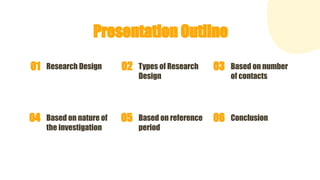
Presentation Outline
Research Design
01 Types of Research
Design
02 Based on number
of contacts
03
Based on nature of
the investigation
04 Based on reference
period
05 Conclusion
06
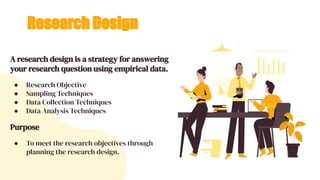
Research Design
A research design is a strategy for answering
your research question using empirical data.
● Research Objective
● Sampling Techniques
● Data Collection Techniques
● Data Analysis Techniques
Purpose
● To meet the research objectives through
planning the research design.
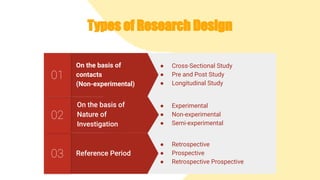
Types of Research Design
Reference Period
03
● Retrospective
● Prospective
● Retrospective Prospective
On the basis of
Nature of
Investigation
02
● Experimental
● Non-experimental
● Semi-experimental
On the basis of
contacts
(Non-experimental)
01
● Cross-Sectional Study
● Pre and Post Study
● Longitudinal Study
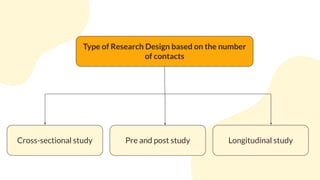
Type of Research Design based on the number
of contacts
Cross-sectional study Pre and post study Longitudinal study
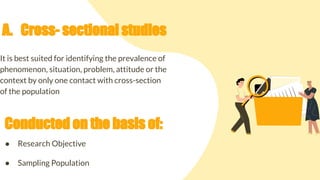
A. Cross- sectional studies
It is best suited for identifying the prevalence of
phenomenon, situation, problem, attitude or the
context by only one contact with cross-section
of the population
Conducted on the basis of:
● Research Objective
● Sampling Population
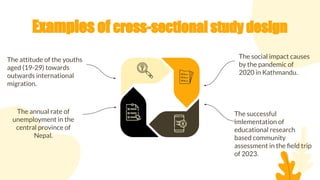
Examples of cross-sectional study design
The social impact causes
by the pandemic of
2020 in Kathmandu.
The attitude of the youths
aged (19-29) towards
outwards international
migration.
The successful
imlementation of
educational research
based community
assessment in the field trip
of 2023.
The annual rate of
unemployment in the
central province of
Nepal.
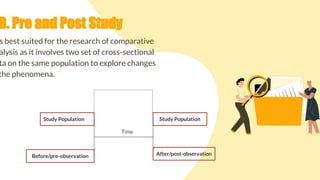
B. Pre and Post Study
s best suited for the research of comparative
alysis as it involves two set of cross-sectional
ta on the same population to explore changes
the phenomena.
Study Population Study Population
After/post-observation
Before/pre-observation
Time
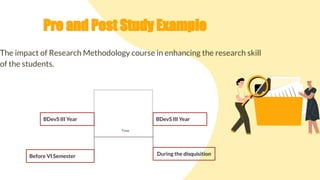
Pre and Post Study Example
The impact of Research Methodology course in enhancing the research skill
of the students.
BDevS III Year BDevS III Year
During the disquisition
Before VI Semester
Time
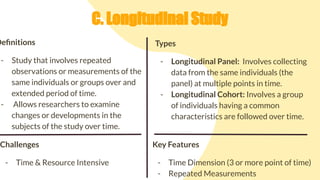
C. Longitudinal Study
Definitions
- Study that involves repeated
observations or measurements of the
same individuals or groups over and
extended period of time.
- Allows researchers to examine
changes or developments in the
subjects of the study over time.
Challenges
- Time & Resource Intensive
Types
- Longitudinal Panel: Involves collecting
data from the same individuals (the
panel) at multiple points in time.
- Longitudinal Cohort: Involves a group
of individuals having a common
characteristics are followed over time.
Key Features
- Time Dimension (3 or more point of time)
- Repeated Measurements
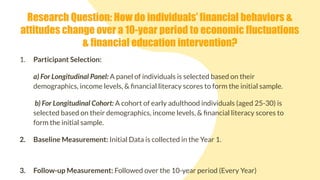
1. Participant Selection:
a) For Longitudinal Panel: A panel of individuals is selected based on their
demographics, income levels, & financial literacy scores to form the initial sample.
b) For Longitudinal Cohort: A cohort of early adulthood individuals (aged 25-30) is
selected based on their demographics, income levels, & financial literacy scores to
form the initial sample.
2. Baseline Measurement: Initial Data is collected in the Year 1.
3. Follow-up Measurement: Followed over the 10-year period (Every Year)
Research Question: How do individuals’ financial behaviors &
attitudes change over a 10-year period to economic fluctuations
& financial education intervention?
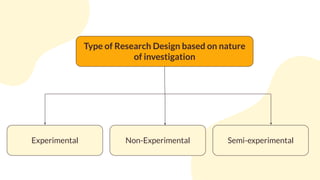
Type of Research Design based on nature
of investigation
Experimental Non-Experimental Semi-experimental
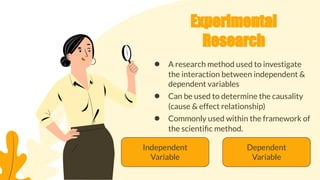
● A research method used to investigate
the interaction between independent &
dependent variables
● Can be used to determine the causality
(cause & effect relationship)
● Commonly used within the framework of
the scientific method.
Experimental
Research
Independent
Variable
Dependent
Variable
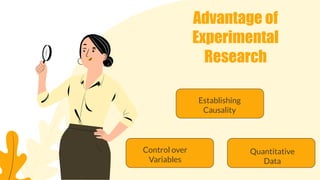
Advantage of
Experimental
Research
Control over
Variables
Quantitative
Data
Establishing
Causality
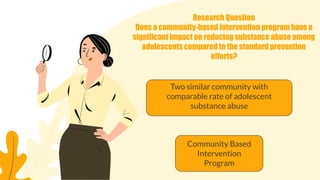
Research Question
Does a community-based intervention program have a
significant impact on reducing substance abuse among
adolescents compared to the standard prevention
efforts?
Community Based
Intervention
Program
Two similar community with
comparable rate of adolescent
substance abuse
● Independent variable is not manipulated,
simply measure variable as they
naturally occur
● Hard to establish actual cause and effect
relationship
● Usually undertaken in social settings
Non-Experimental
Cross-sectional Pre and Post Longitudinal
Why choose non-experimental
research design ?
● Usually when research question(s) are directed towards
studying characteristics, prevalence rates, trends, and
correlational connections.
● When the research question focuses on a singular variable.
● When the research question involves a non-causal statistical
relationship between variables.
● When the research question explores a causal relationship, but
the independent variable cannot be manipulated, or participants
cannot be randomly assigned to conditions or orders of
conditions due to practical or ethical constraints.
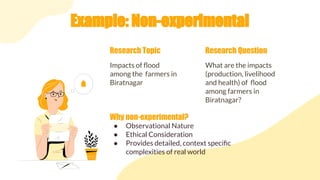
Example: Non-experimental
Impacts of flood
among the farmers in
Biratnagar
Research Topic
What are the impacts
(production, livelihood
and health) of flood
among farmers in
Biratnagar?
Research Question
● Observational Nature
● Ethical Consideration
● Provides detailed, context specific
complexities of real world
Why non-experimental?
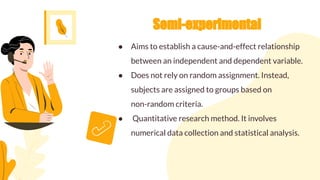
Semi-experimental
● Aims to establish a cause-and-effect relationship
between an independent and dependent variable.
● Does not rely on random assignment. Instead,
subjects are assigned to groups based on
non-random criteria.
● Quantitative research method. It involves
numerical data collection and statistical analysis.
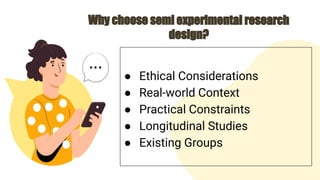
Why choose semi experimental research
design?
● Ethical Considerations
● Real-world Context
● Practical Constraints
● Longitudinal Studies
● Existing Groups
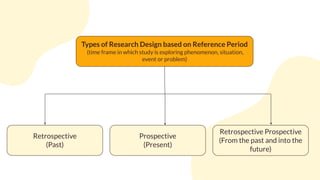
Types of Research Design based on Reference Period
(time frame in which study is exploring phenomenon, situation,
event or problem)
Retrospective
(Past)
Prospective
(Present)
Retrospective Prospective
(From the past and into the
future)
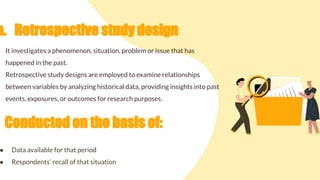
a. Retrospective study design
It investigates a phenomenon, situation, problem or issue that has
happened in the past.
Retrospective study designs are employed to examine relationships
between variables by analyzing historical data, providing insights into past
events, exposures, or outcomes for research purposes.
Conducted on the basis of:
● Data available for that period
● Respondents’ recall of that situation
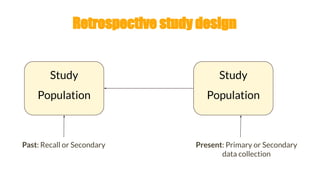
Retrospective study design
Study
Population
Study
Population
Past: Recall or Secondary Present: Primary or Secondary
data collection
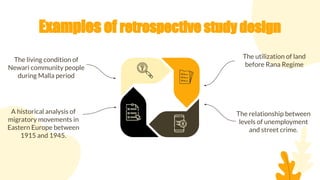
Examples of retrospective study design
The utilization of land
before Rana Regime
The living condition of
Newari community people
during Malla period
The relationship between
levels of unemployment
and street crime.
A historical analysis of
migratory movements in
Eastern Europe between
1915 and 1945.
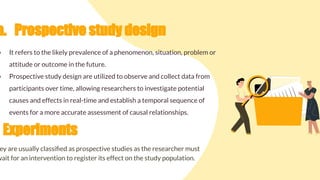
a. Prospective study design
● It refers to the likely prevalence of a phenomenon, situation, problem or
attitude or outcome in the future.
● Prospective study design are utilized to observe and collect data from
participants over time, allowing researchers to investigate potential
causes and effects in real-time and establish a temporal sequence of
events for a more accurate assessment of causal relationships.
Experiments
ey are usually classified as prospective studies as the researcher must
wait for an intervention to register its effect on the study population.
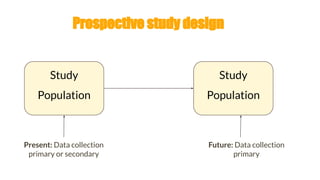
Prospective study design
Study
Population
Study
Population
Present: Data collection
primary or secondary
Future: Data collection
primary
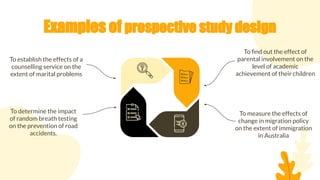
Examples of prospective study design
To find out the effect of
parental involvement on the
level of academic
achievement of their children
To establish the effects of a
counselling service on the
extent of marital problems
To measure the effects of
change in migration policy
on the extent of immigration
in Australia
To determine the impact
of random breath testing
on the prevention of road
accidents.
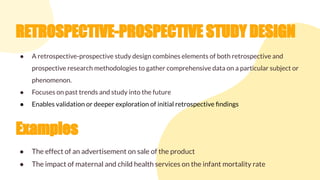
RETROSPECTIVE-PROSPECTIVE STUDY DESIGN
● A retrospective-prospective study design combines elements of both retrospective and
prospective research methodologies to gather comprehensive data on a particular subject or
phenomenon.
● Focuses on past trends and study into the future
● Enables validation or deeper exploration of initial retrospective findings
Examples
● The effect of an advertisement on sale of the product
● The impact of maternal and child health services on the infant mortality rate
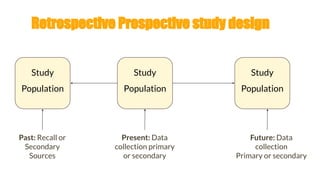
Retrospective Prospective study design
Study
Population
Study
Population
Present: Data
collection primary
or secondary
Future: Data
collection
Primary or secondary
Study
Population
Past: Recall or
Secondary
Sources
CONCLUSION
In summary, the fundamental aspect of any research design is significantly influenced
by the overall research question. The various kinds of research designs, each with
unique characteristics, provide a complex framework for study. It is crucial to carefully
choose an appropriate design because it has a significant impact on the study's
outcomes and the breadth of insights discovered. Comprehending these diverse
designs equips researchers to maneuver through the intricacies of investigation,
allowing them to customize approaches that best suit their research objectives.
THANK YOU

Research Design inciude types, examples, real

  • 1.
  • 2.
    Group Members Agraj Ranjitkar BituShah Dikshya Dangol Kriti Baral Palpasha Suwal Shreeti KC
  • 3.
    Presentation Outline Research Design 01Types of Research Design 02 Based on number of contacts 03 Based on nature of the investigation 04 Based on reference period 05 Conclusion 06
  • 4.
    Research Design A researchdesign is a strategy for answering your research question using empirical data. ● Research Objective ● Sampling Techniques ● Data Collection Techniques ● Data Analysis Techniques Purpose ● To meet the research objectives through planning the research design.
  • 5.
    Types of ResearchDesign Reference Period 03 ● Retrospective ● Prospective ● Retrospective Prospective On the basis of Nature of Investigation 02 ● Experimental ● Non-experimental ● Semi-experimental On the basis of contacts (Non-experimental) 01 ● Cross-Sectional Study ● Pre and Post Study ● Longitudinal Study
  • 6.
    Type of ResearchDesign based on the number of contacts Cross-sectional study Pre and post study Longitudinal study
  • 7.
    A. Cross- sectionalstudies It is best suited for identifying the prevalence of phenomenon, situation, problem, attitude or the context by only one contact with cross-section of the population Conducted on the basis of: ● Research Objective ● Sampling Population
  • 8.
    Examples of cross-sectionalstudy design The social impact causes by the pandemic of 2020 in Kathmandu. The attitude of the youths aged (19-29) towards outwards international migration. The successful imlementation of educational research based community assessment in the field trip of 2023. The annual rate of unemployment in the central province of Nepal.
  • 9.
    B. Pre andPost Study s best suited for the research of comparative alysis as it involves two set of cross-sectional ta on the same population to explore changes the phenomena. Study Population Study Population After/post-observation Before/pre-observation Time
  • 10.
    Pre and PostStudy Example The impact of Research Methodology course in enhancing the research skill of the students. BDevS III Year BDevS III Year During the disquisition Before VI Semester Time
  • 11.
    C. Longitudinal Study Definitions -Study that involves repeated observations or measurements of the same individuals or groups over and extended period of time. - Allows researchers to examine changes or developments in the subjects of the study over time. Challenges - Time & Resource Intensive Types - Longitudinal Panel: Involves collecting data from the same individuals (the panel) at multiple points in time. - Longitudinal Cohort: Involves a group of individuals having a common characteristics are followed over time. Key Features - Time Dimension (3 or more point of time) - Repeated Measurements
  • 12.
    1. Participant Selection: a)For Longitudinal Panel: A panel of individuals is selected based on their demographics, income levels, & financial literacy scores to form the initial sample. b) For Longitudinal Cohort: A cohort of early adulthood individuals (aged 25-30) is selected based on their demographics, income levels, & financial literacy scores to form the initial sample. 2. Baseline Measurement: Initial Data is collected in the Year 1. 3. Follow-up Measurement: Followed over the 10-year period (Every Year) Research Question: How do individuals’ financial behaviors & attitudes change over a 10-year period to economic fluctuations & financial education intervention?
  • 13.
    Type of ResearchDesign based on nature of investigation Experimental Non-Experimental Semi-experimental
  • 14.
    ● A researchmethod used to investigate the interaction between independent & dependent variables ● Can be used to determine the causality (cause & effect relationship) ● Commonly used within the framework of the scientific method. Experimental Research Independent Variable Dependent Variable
  • 15.
  • 16.
    Research Question Does acommunity-based intervention program have a significant impact on reducing substance abuse among adolescents compared to the standard prevention efforts? Community Based Intervention Program Two similar community with comparable rate of adolescent substance abuse
  • 17.
    ● Independent variableis not manipulated, simply measure variable as they naturally occur ● Hard to establish actual cause and effect relationship ● Usually undertaken in social settings Non-Experimental Cross-sectional Pre and Post Longitudinal
  • 18.
    Why choose non-experimental researchdesign ? ● Usually when research question(s) are directed towards studying characteristics, prevalence rates, trends, and correlational connections. ● When the research question focuses on a singular variable. ● When the research question involves a non-causal statistical relationship between variables. ● When the research question explores a causal relationship, but the independent variable cannot be manipulated, or participants cannot be randomly assigned to conditions or orders of conditions due to practical or ethical constraints.
  • 19.
    Example: Non-experimental Impacts offlood among the farmers in Biratnagar Research Topic What are the impacts (production, livelihood and health) of flood among farmers in Biratnagar? Research Question ● Observational Nature ● Ethical Consideration ● Provides detailed, context specific complexities of real world Why non-experimental?
  • 20.
    Semi-experimental ● Aims toestablish a cause-and-effect relationship between an independent and dependent variable. ● Does not rely on random assignment. Instead, subjects are assigned to groups based on non-random criteria. ● Quantitative research method. It involves numerical data collection and statistical analysis.
  • 21.
    Why choose semiexperimental research design? ● Ethical Considerations ● Real-world Context ● Practical Constraints ● Longitudinal Studies ● Existing Groups
  • 22.
    Types of ResearchDesign based on Reference Period (time frame in which study is exploring phenomenon, situation, event or problem) Retrospective (Past) Prospective (Present) Retrospective Prospective (From the past and into the future)
  • 23.
    a. Retrospective studydesign It investigates a phenomenon, situation, problem or issue that has happened in the past. Retrospective study designs are employed to examine relationships between variables by analyzing historical data, providing insights into past events, exposures, or outcomes for research purposes. Conducted on the basis of: ● Data available for that period ● Respondents’ recall of that situation
  • 24.
    Retrospective study design Study Population Study Population Past:Recall or Secondary Present: Primary or Secondary data collection
  • 25.
    Examples of retrospectivestudy design The utilization of land before Rana Regime The living condition of Newari community people during Malla period The relationship between levels of unemployment and street crime. A historical analysis of migratory movements in Eastern Europe between 1915 and 1945.
  • 26.
    a. Prospective studydesign ● It refers to the likely prevalence of a phenomenon, situation, problem or attitude or outcome in the future. ● Prospective study design are utilized to observe and collect data from participants over time, allowing researchers to investigate potential causes and effects in real-time and establish a temporal sequence of events for a more accurate assessment of causal relationships. Experiments ey are usually classified as prospective studies as the researcher must wait for an intervention to register its effect on the study population.
  • 27.
    Prospective study design Study Population Study Population Present:Data collection primary or secondary Future: Data collection primary
  • 28.
    Examples of prospectivestudy design To find out the effect of parental involvement on the level of academic achievement of their children To establish the effects of a counselling service on the extent of marital problems To measure the effects of change in migration policy on the extent of immigration in Australia To determine the impact of random breath testing on the prevention of road accidents.
  • 29.
    RETROSPECTIVE-PROSPECTIVE STUDY DESIGN ●A retrospective-prospective study design combines elements of both retrospective and prospective research methodologies to gather comprehensive data on a particular subject or phenomenon. ● Focuses on past trends and study into the future ● Enables validation or deeper exploration of initial retrospective findings Examples ● The effect of an advertisement on sale of the product ● The impact of maternal and child health services on the infant mortality rate
  • 30.
    Retrospective Prospective studydesign Study Population Study Population Present: Data collection primary or secondary Future: Data collection Primary or secondary Study Population Past: Recall or Secondary Sources
  • 31.
    CONCLUSION In summary, thefundamental aspect of any research design is significantly influenced by the overall research question. The various kinds of research designs, each with unique characteristics, provide a complex framework for study. It is crucial to carefully choose an appropriate design because it has a significant impact on the study's outcomes and the breadth of insights discovered. Comprehending these diverse designs equips researchers to maneuver through the intricacies of investigation, allowing them to customize approaches that best suit their research objectives.
  • 32.