Page 0Classification: Restricted
Business Analysis
Training
Requirement Management
Page 1Classification: Restricted
Agenda
•Requirements Management
• Requirement Prioritization
• MoSCoW Analysis
• Time Boxing
• Voting Technique
• Verifying and Validating Requirements
• Verifying Requirements
• Validate Requirements
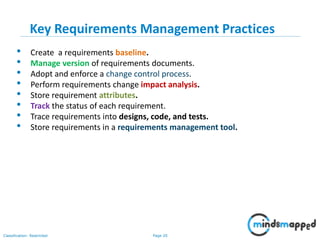
• Key Requirements Management Practices
• The Requirements Baseline
• Requirements Version Management
• Requirements Change Control
• Impact Analysis of Requirements
• Requirements Attributes
• Requirements status tracking
• Requirements Traceability
• Requirements Traceability Matrix
Page 2Classification: Restricted
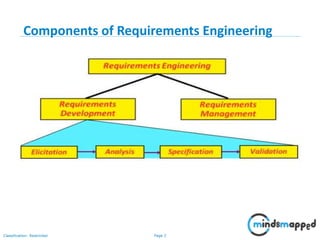
Components of Requirements Engineering
Page 3Classification: Restricted
Requirement Prioritization
• Prioritization plays a key role in our daily lives since we have a number
of tasks to be performed in the various roles we play. Likewise as a
business analyst we should be able to prioritize the requirements we
gather from the client. There are various techniques to do so such as
MoSCoW Analysis, Timeboxing or Budgeting, Voting, Decision Analysis
and Risk Analysis.
Page 4Classification: Restricted
MoSCoW Analysis
The requirements can be categorized into the following:
• Must: These are the most crucial requirements Without these the final
solution will be incomplete.
• Should: These are also crucial requirements but there could be
workarounds to satisfy these.
• Could: These are desirable or "nice to have" requirements. If time
permits these will be included in the final solution.
• Would/Won't: These will be included in the next release or will be
omitted completely.
Page 5Classification: Restricted
Time Boxing
Time boxing which is also known as budgeting. There are three approaches
in this.
All in: The group assigns a duration of time or cost to implement each
requirement. We start with all requirements in the box and remove one-by-
one based on the deadlines and budget.
Page 6Classification: Restricted
• All out: The group assigns the duration of time or cost to implement
each requirement. All requirements are out of the box and we add
these one-by-one until the cost/time limit is reached.
• Selective: This is a balanced approach. Here we identify the high priority
requirements and then add/remove those one-by-one to meet the
scheduled time/budget limits.
Page 7Classification: Restricted
Voting Technique
• A set requirements are distributed to a group of stakeholders and each
of them gives a vote to prioritize the distributed requirements.
• We can conclude by stating that one of the key skills a good business
analyst should have is prioritization of tasks as it would help in
minimizing overheads and maximizing the resource utilization.
Page 8Classification: Restricted
Verifying and Validating Requirements
Page 9Classification: Restricted
Verifying Requirements
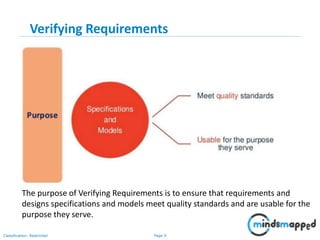
The purpose of Verifying Requirements is to ensure that requirements and
designs specifications and models meet quality standards and are usable for the
purpose they serve.
Page 10Classification: Restricted
Page 11Classification: Restricted
Page 12Classification: Restricted
Page 13Classification: Restricted
Page 14Classification: Restricted
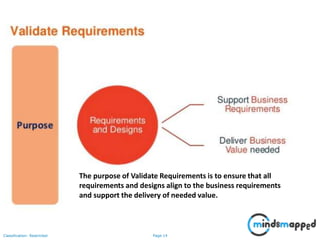
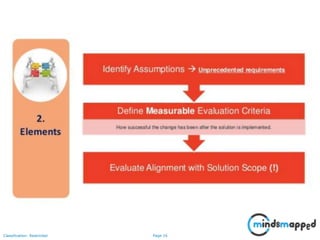
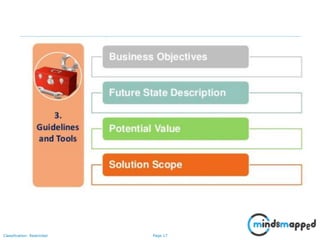
The purpose of Validate Requirements is to ensure that all
requirements and designs align to the business requirements
and support the delivery of needed value.
Page 15Classification: Restricted
Page 16Classification: Restricted
Page 17Classification: Restricted
Page 18Classification: Restricted
Page 19Classification: Restricted
Page 20Classification: Restricted
Key Requirements Management Practices
• Create a requirements baseline.
• Manage version of requirements documents.
• Adopt and enforce a change control process.
• Perform requirements change impact analysis.
• Store requirement attributes.
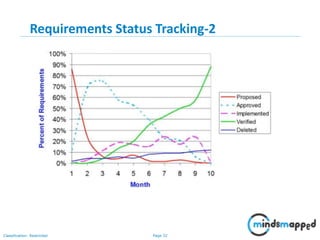
• Track the status of each requirement.
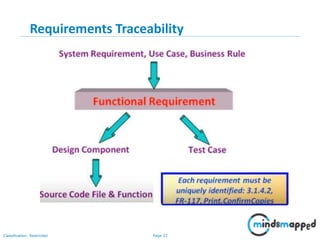
• Trace requirements into designs, code, and tests.
• Store requirements in a requirements management tool.
Page 21Classification: Restricted
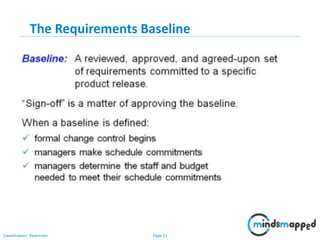
The Requirements Baseline
Page 22Classification: Restricted
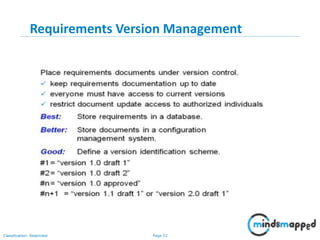
Requirements Version Management
Page 23Classification: Restricted
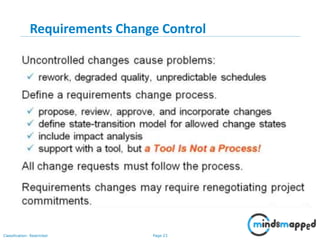
Requirements Change Control
Page 24Classification: Restricted
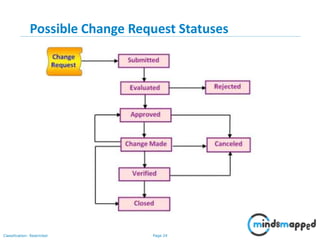
Possible Change Request Statuses
Page 25Classification: Restricted
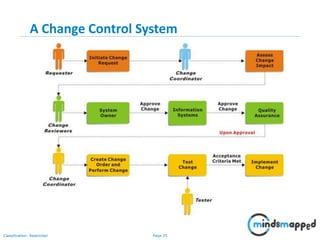
A Change Control System
Page 26Classification: Restricted
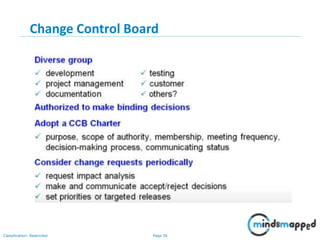
Change Control Board
Page 27Classification: Restricted
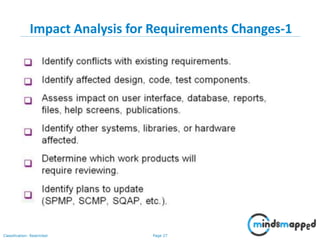
Impact Analysis for Requirements Changes-1
Page 28Classification: Restricted
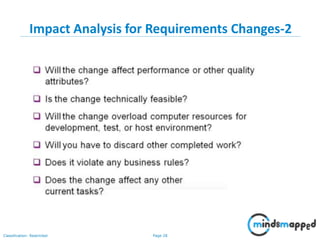
Impact Analysis for Requirements Changes-2
Page 29Classification: Restricted
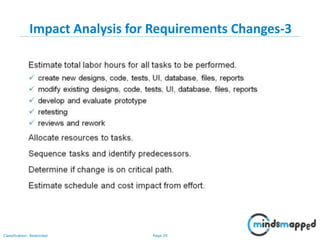
Impact Analysis for Requirements Changes-3
Page 30Classification: Restricted
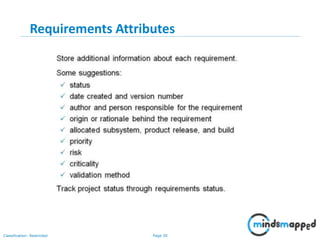
Requirements Attributes
Page 31Classification: Restricted
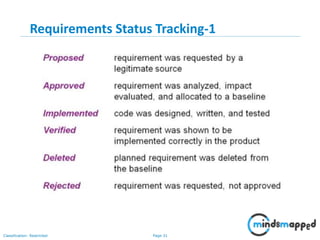
Requirements Status Tracking-1
Page 32Classification: Restricted
Requirements Status Tracking-2
Page 33Classification: Restricted
Requirements Traceability
Page 34Classification: Restricted
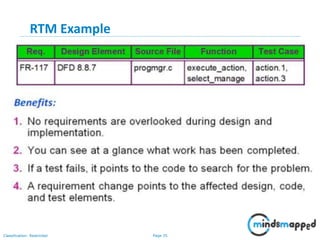
• The purpose of the Requirements Traceability Matrix is to ensure that all
requirements defined for a system are tested.
• The requirements traceability matrix is usually developed in
concurrence with the initial list of requirements (functional
requirements documents)
Requirement Traceability matrix
Page 35Classification: Restricted
RTM Example
Page 36Classification: Restricted
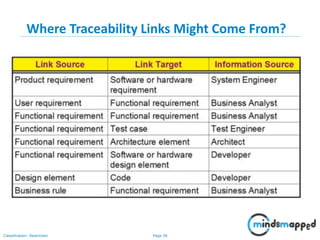
Where Traceability Links Might Come From?
Page 37Classification: Restricted
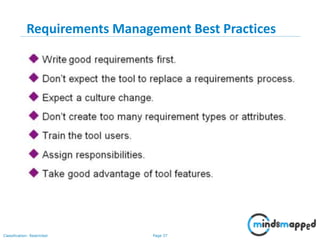
Requirements Management Best Practices
Page 38Classification: Restricted
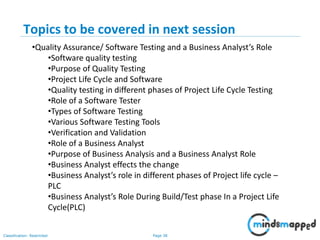
Topics to be covered in next session
•Quality Assurance/ Software Testing and a Business Analyst’s Role
•Software quality testing
•Purpose of Quality Testing
•Project Life Cycle and Software
•Quality testing in different phases of Project Life Cycle Testing
•Role of a Software Tester
•Types of Software Testing
•Various Software Testing Tools
•Verification and Validation
•Role of a Business Analyst
•Purpose of Business Analysis and a Business Analyst Role
•Business Analyst effects the change
•Business Analyst’s role in different phases of Project life cycle –
PLC
•Business Analyst’s Role During Build/Test phase In a Project Life
Cycle(PLC)
Page 39Classification: Restricted
Thank you

Requirements Management