Business Analysis
Training
Business Functional Requirements
Page 2Classification: Restricted
Agenda
• RACI Matrix
• Business Requirements Vs Functional Requirements
• Requirement Traceability Matrix
• Object Oriented Analysis
• Error Messages
• Data Dictionary
• Mock-up screens
• Decision Tree
Page 3Classification: Restricted
RACI Matrix
• The RACI matrix is a powerful tool useful to illustrate usual responsibilities
of the roles involved in planning and managing requirements. Note that
the chart below has been completed only for Requirements Planning and
Management, but the RACI approach is also very useful for documenting
roles and responsibilities in any project activity area.
• The table illustrated below may be broken down into further levels of task
detail by the Business Analyst to provide further assistance in identifying
roles and responsibilities during requirements planning and management.
[R]esponsible does the work,
[A]ccountable is the decision maker (only one)
[C]onsulted must be consulted prior to the work and gives input
[I]nformed is on a need to know basis after the work is done
Page 4Classification: Restricted
Stakeholder Analysis - RACI Matrix
Page 5Classification: Restricted
RACI Matrix: Example
Page 6Classification: Restricted
Business Requirements Vs Functional
Requirements
Typically requirement specifications are defined at two different levels from a
business point of view:
• Business requirements (high-level)
• Functional requirements, non-functional requirements and use cases
(detailed)
Page 7Classification: Restricted
Business Requirements Vs Functional
Requirements
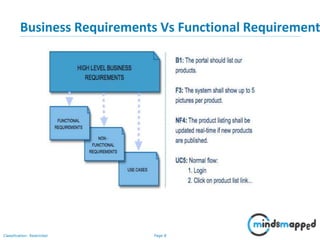
Business requirements are high level requirements that management and a
board of directors would typically understand, as follows:
• Business Requirement 1:
"We need to establish an online customer portal."
• Business Requirement 2:
"The portal should list our products."
Functional requirements on the other hand are very detailed and outline
exactly what needs to be delivered and would typically be read by business
analysts, developers, project manager and testers:
• Functional Requirement 3:
"The system shall be able to register a product using the following fields:
Name (20 characters long), Details (2000 characters long), Price (currency),
Category (pick list)."
• Functional Requirement 4:
"The system shall support that up to 5 pictures can be listed per product."
Page 8Classification: Restricted
Business Requirements Vs Functional Requirement
Page 9Classification: Restricted
Documenting Requirements
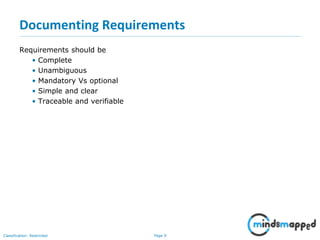
Requirements should be
• Complete
• Unambiguous
• Mandatory Vs optional
• Simple and clear
• Traceable and verifiable
Page 10Classification: Restricted
Requirement Traceability Matrix
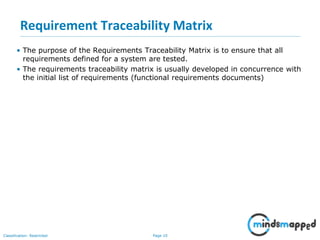
• The purpose of the Requirements Traceability Matrix is to ensure that all
requirements defined for a system are tested.
• The requirements traceability matrix is usually developed in concurrence with
the initial list of requirements (functional requirements documents)
Page 11Classification: Restricted
RTM : Example
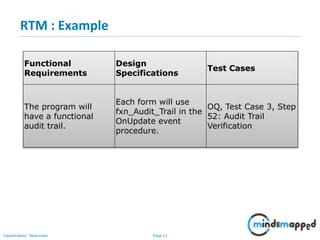
Functional
Requirements
Design
Specifications
Test Cases
The program will
have a functional
audit trail.
Each form will use
fxn_Audit_Trail in the
OnUpdate event
procedure.
OQ, Test Case 3, Step
52: Audit Trail
Verification
Page 12Classification: Restricted
Object Oriented Analysis
• Object is any ‘thing’ of interest in real world which is being modeled
• For lecture process, some objects could be
• Physical objects: desks&chairs, notebooks, computer
• Human objects: Faculty , student
• Conceptual objects: lecture, course, subject
• Documents/txn related object: invoice, receipt
Page 13Classification: Restricted
Association between Objects
faculty
Teaches
Guides
Mentors
student
Association between 2 objects is cardinality
Page 14Classification: Restricted
Cardinality
Cardinality can be
• 1:1( one mentor to one student)
• 1: M (one faculty can do mentoring of upto m students)one to many
• M: 1 (group of faculty can mentor upto M students)
• M:M
Page 15Classification: Restricted
Data Dictionary
Page 16Classification: Restricted
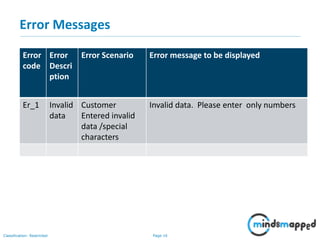
Error Messages
Error
code
Error
Descri
ption
Error Scenario Error message to be displayed
Er_1 Invalid
data
Customer
Entered invalid
data /special
characters
Invalid data. Please enter only numbers
Page 17Classification: Restricted
Mock-up screens
Page 18Classification: Restricted
Mock-up screens
Page 19Classification: Restricted
Mock-up screens
Page 20Classification: Restricted
Mock-up screens
• Create Mock-up screens for a retail online shopping portal :
• New user sign up (name, address, email, contact)
• Existing user login
• Select product
• Add product to wish list
• Buy the product
• Make payment
• Successful payment/failure payment
Page 21Classification: Restricted
Decision Tree
Page 22Classification: Restricted
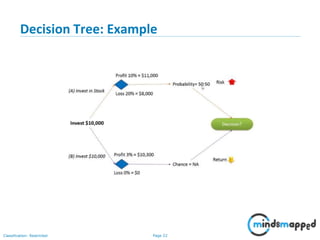
Decision Tree: Example
Page 23Classification: Restricted
Thank you

Business Functional Requirements

  • 1.
  • 2.
    Page 2Classification: Restricted Agenda •RACI Matrix • Business Requirements Vs Functional Requirements • Requirement Traceability Matrix • Object Oriented Analysis • Error Messages • Data Dictionary • Mock-up screens • Decision Tree
  • 3.
    Page 3Classification: Restricted RACIMatrix • The RACI matrix is a powerful tool useful to illustrate usual responsibilities of the roles involved in planning and managing requirements. Note that the chart below has been completed only for Requirements Planning and Management, but the RACI approach is also very useful for documenting roles and responsibilities in any project activity area. • The table illustrated below may be broken down into further levels of task detail by the Business Analyst to provide further assistance in identifying roles and responsibilities during requirements planning and management. [R]esponsible does the work, [A]ccountable is the decision maker (only one) [C]onsulted must be consulted prior to the work and gives input [I]nformed is on a need to know basis after the work is done
  • 4.
  • 5.
  • 6.
    Page 6Classification: Restricted BusinessRequirements Vs Functional Requirements Typically requirement specifications are defined at two different levels from a business point of view: • Business requirements (high-level) • Functional requirements, non-functional requirements and use cases (detailed)
  • 7.
    Page 7Classification: Restricted BusinessRequirements Vs Functional Requirements Business requirements are high level requirements that management and a board of directors would typically understand, as follows: • Business Requirement 1: "We need to establish an online customer portal." • Business Requirement 2: "The portal should list our products." Functional requirements on the other hand are very detailed and outline exactly what needs to be delivered and would typically be read by business analysts, developers, project manager and testers: • Functional Requirement 3: "The system shall be able to register a product using the following fields: Name (20 characters long), Details (2000 characters long), Price (currency), Category (pick list)." • Functional Requirement 4: "The system shall support that up to 5 pictures can be listed per product."
  • 8.
    Page 8Classification: Restricted BusinessRequirements Vs Functional Requirement
  • 9.
    Page 9Classification: Restricted DocumentingRequirements Requirements should be • Complete • Unambiguous • Mandatory Vs optional • Simple and clear • Traceable and verifiable
  • 10.
    Page 10Classification: Restricted RequirementTraceability Matrix • The purpose of the Requirements Traceability Matrix is to ensure that all requirements defined for a system are tested. • The requirements traceability matrix is usually developed in concurrence with the initial list of requirements (functional requirements documents)
  • 11.
    Page 11Classification: Restricted RTM: Example Functional Requirements Design Specifications Test Cases The program will have a functional audit trail. Each form will use fxn_Audit_Trail in the OnUpdate event procedure. OQ, Test Case 3, Step 52: Audit Trail Verification
  • 12.
    Page 12Classification: Restricted ObjectOriented Analysis • Object is any ‘thing’ of interest in real world which is being modeled • For lecture process, some objects could be • Physical objects: desks&chairs, notebooks, computer • Human objects: Faculty , student • Conceptual objects: lecture, course, subject • Documents/txn related object: invoice, receipt
  • 13.
    Page 13Classification: Restricted Associationbetween Objects faculty Teaches Guides Mentors student Association between 2 objects is cardinality
  • 14.
    Page 14Classification: Restricted Cardinality Cardinalitycan be • 1:1( one mentor to one student) • 1: M (one faculty can do mentoring of upto m students)one to many • M: 1 (group of faculty can mentor upto M students) • M:M
  • 15.
  • 16.
    Page 16Classification: Restricted ErrorMessages Error code Error Descri ption Error Scenario Error message to be displayed Er_1 Invalid data Customer Entered invalid data /special characters Invalid data. Please enter only numbers
  • 17.
  • 18.
  • 19.
  • 20.
    Page 20Classification: Restricted Mock-upscreens • Create Mock-up screens for a retail online shopping portal : • New user sign up (name, address, email, contact) • Existing user login • Select product • Add product to wish list • Buy the product • Make payment • Successful payment/failure payment
  • 21.
  • 22.
  • 23.