Film Studies – FM3 Small Scale Research 
Presentation Script 
How the Female Gender Challenges John Berger’s 
“men act, women appear” ideology in the Gangster Genre? 
Slide one – The Gangster Genre and the female Gender 
Presenter: Stereotypically, the female gender, willingly or unwillingly, are represented as an object of male desire 
(Male Gaze – Laura Mulvey). 
Their submissive and powerless state is ‘repeatedly’ (Steve Neale) presented in the genre to the extent where it has 
become accepted and a part of the norm. 
However, some texts have proven to “stretch the boundaries” (Steve Neale) on this representation, as the female 
gender are now challenging not only this stereotype but the dominant male character that are often ‘monstrous’ (Neale 
& Krutnik) towards them. 
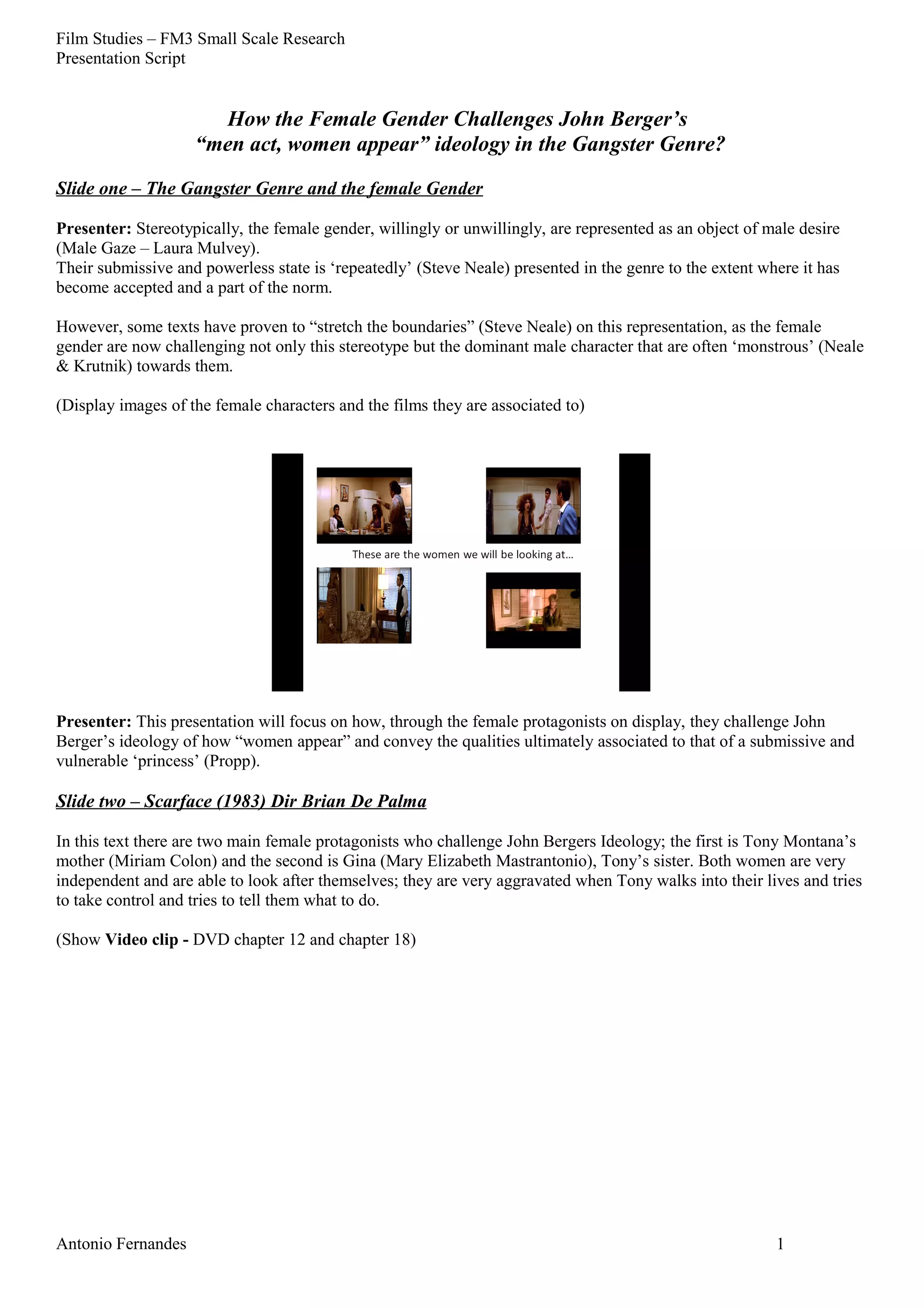
(Display images of the female characters and the films they are associated to) 
Presenter: This presentation will focus on how, through the female protagonists on display, they challenge John 
Berger’s ideology of how “women appear” and convey the qualities ultimately associated to that of a submissive and 
vulnerable ‘princess’ (Propp). 
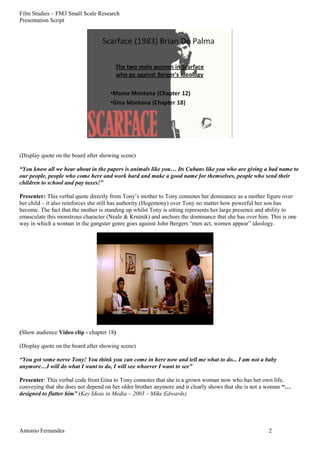
Slide two – Scarface (1983) Dir Brian De Palma 
In this text there are two main female protagonists who challenge John Bergers Ideology; the first is Tony Montana’s 
mother (Miriam Colon) and the second is Gina (Mary Elizabeth Mastrantonio), Tony’s sister. Both women are very 
independent and are able to look after themselves; they are very aggravated when Tony walks into their lives and tries 
to take control and tries to tell them what to do. 
(Show Video clip - DVD chapter 12 and chapter 18) 
Antonio Fernandes 1
Film Studies – FM3 Small Scale Research 
Presentation Script 
(Display quote on the board after showing scene) 
“You know all we hear about in the papers is animals like you… Its Cubans like you who are giving a bad name to 
our people, people who come here and work hard and make a good name for themselves, people who send their 
children to school and pay taxes!” 
Presenter: This verbal quote directly from Tony’s mother to Tony connotes her dominance as a mother figure over 
her child – it also reinforces she still has authority (Hegemony) over Tony no matter how powerful her son has 
become. The fact that the mother is standing up whilst Tony is sitting represents her large presence and ability to 
emasculate this monstrous character (Neale & Krutnik) and anchors the dominance that she has over him. This is one 
way in which a woman in the gangster genre goes against John Bergers “men act, women appear” ideology. 
(Show audience Video clip - chapter 18) 
(Display quote on the board after showing scene) 
“You got some nerve Tony! You think you can come in here now and tell me what to do... I am not a baby 
anymore…I will do what I want to do, I will see whoever I want to see” 
Presenter: This verbal code from Gina to Tony connotes that she is a grown woman now who has her own life, 
conveying that she does not depend on her older brother anymore and it clearly shows that she is not a woman “… 
designed to flatter him” (Key Ideas in Media – 2003 – Mike Edwards) 
Antonio Fernandes 2
Film Studies – FM3 Small Scale Research 
Presentation Script 
Therefore Gina is clearly presented as a female going against Bergers ideology and she “acts” emotionally and 
strongly towards her ‘villainous’ (Propp) brother; the spectators eyes are all on Gina whilst the men surrounding her 
merely just “appear”. 
Presenter: In dramatic irony to this dominance, Gina’s downfall is as a result of this defiance backfiring towards her 
controlling brother as he kills the man who falls in love with her (also his accomplice). 
Nelson Thomas focuses on the idea that in the Gangster genre women are “depicted in a different way to men – 
because the’ ideal’ spectator is always assumed to be male”. This verbal code connotes how the female gender, 
especially in the gangster genre where the males are ‘monstrously’ (Neale & Krutnik) controlling and at times brutal, 
are merely seen as objects of the male spectators desire (Male Gaze – Laura Mulvey) again – At this point though I’m 
interested to here what you think? 
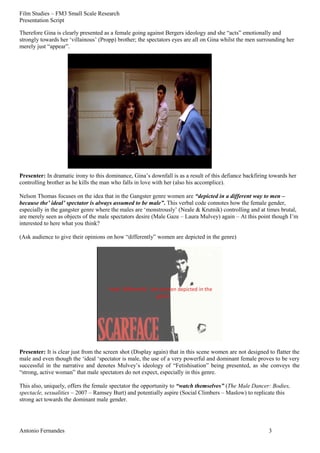
(Ask audience to give their opinions on how “differently” women are depicted in the genre) 
Presenter: It is clear just from the screen shot (Display again) that in this scene women are not designed to flatter the 
male and even though the ‘ideal ‘spectator is male, the use of a very powerful and dominant female proves to be very 
successful in the narrative and denotes Mulvey’s ideology of “Fetishisation” being presented, as she conveys the 
“strong, active woman” that male spectators do not expect, especially in this genre. 
This also, uniquely, offers the female spectator the opportunity to “watch themselves” (The Male Dancer: Bodies, 
spectacle, sexualities – 2007 – Ramsey Burt) and potentially aspire (Social Climbers – Maslow) to replicate this 
strong act towards the dominant male gender. 
Antonio Fernandes 3
Film Studies – FM3 Small Scale Research 
Presentation Script 
Slide 3 – Scarface vs. The Godfather Part II (1974) Dir Francis Ford Coppola 
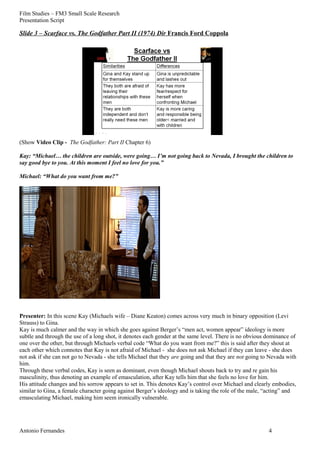
(Show Video Clip - The Godfather: Part II Chapter 6) 
Kay: “Michael… the children are outside, were going… I’m not going back to Nevada, I brought the children to 
say good bye to you. At this moment I feel no love for you.” 
Michael: “What do you want from me?” 
Presenter: In this scene Kay (Michaels wife – Diane Keaton) comes across very much in binary opposition (Levi 
Strauss) to Gina. 
Kay is much calmer and the way in which she goes against Berger’s “men act, women appear” ideology is more 
subtle and through the use of a long shot, it denotes each gender at the same level. There is no obvious dominance of 
one over the other, but through Michaels verbal code “What do you want from me?” this is said after they shout at 
each other which connotes that Kay is not afraid of Michael - she does not ask Michael if they can leave - she does 
not ask if she can not go to Nevada - she tells Michael that they are going and that they are not going to Nevada with 
him. 
Through these verbal codes, Kay is seen as dominant, even though Michael shouts back to try and re gain his 
masculinity, thus denoting an example of emasculation, after Kay tells him that she feels no love for him. 
His attitude changes and his sorrow appears to set in. This denotes Kay’s control over Michael and clearly embodies, 
similar to Gina, a female character going against Berger’s ideology and is taking the role of the male, “acting” and 
emasculating Michael, making him seem ironically vulnerable. 
Antonio Fernandes 4
Film Studies – FM3 Small Scale Research 
Presentation Script 
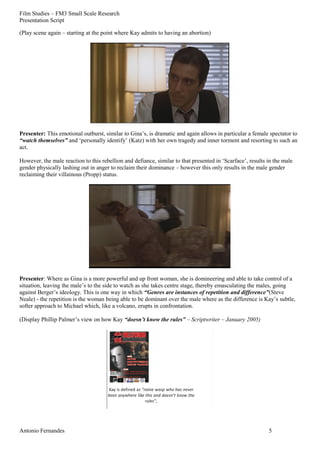
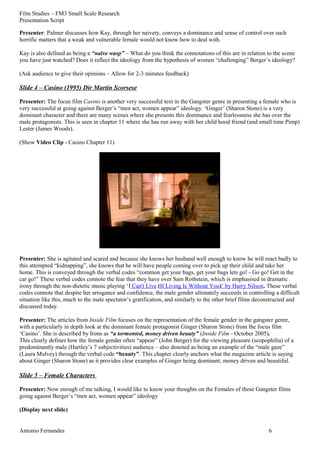
(Play scene again – starting at the point where Kay admits to having an abortion) 
Presenter: This emotional outburst, similar to Gina’s, is dramatic and again allows in particular a female spectator to 
“watch themselves” and ‘personally identify’ (Katz) with her own tragedy and inner torment and resorting to such an 
act. 
However, the male reaction to this rebellion and defiance, similar to that presented in ‘Scarface’, results in the male 
gender physically lashing out in anger to reclaim their dominance – however this only results in the male gender 
reclaiming their villainous (Propp) status. 
Presenter: Where as Gina is a more powerful and up front woman, she is domineering and able to take control of a 
situation, leaving the male’s to the side to watch as she takes centre stage, thereby emasculating the males, going 
against Berger’s ideology. This is one way in which “Genres are instances of repetition and difference”(Steve 
Neale) - the repetition is the woman being able to be dominant over the male where as the difference is Kay’s subtle, 
softer approach to Michael which, like a volcano, erupts in confrontation. 
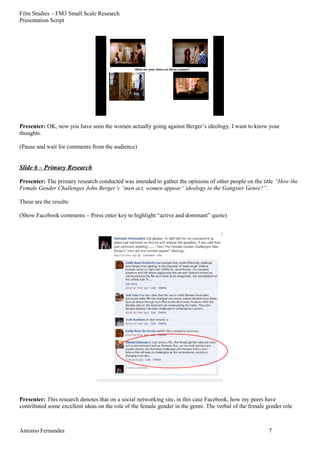
(Display Phillip Palmer’s view on how Kay “doesn’t know the rules” – Scriptwriter – January 2005) 
Antonio Fernandes 5
Film Studies – FM3 Small Scale Research 
Presentation Script 
Presenter: Palmer discusses how Kay, through her naivety, conveys a dominance and sense of control over such 
horrific matters that a weak and vulnerable female would not know how to deal with. 
Kay is also defined as being a “naïve wasp” – What do you think the connotations of this are in relation to the scene 
you have just watched? Does it reflect the ideology from the hypothesis of women “challenging” Berger’s ideology? 
(Ask audience to give their opinions – Allow for 2-3 minutes feedback) 
Slide 4 – Casino (1995) Dir Martin Scorsese 
Presenter: The focus film Casino is another very successful text in the Gangster genre in presenting a female who is 
very successful at going against Berger’s “men act, women appear” ideology. ‘Ginger’ (Sharon Stone) is a very 
dominant character and there are many scenes where she presents this dominance and fearlessness she has over the 
male protagonists. This is seen in chapter 11 where she has run away with her child hood friend (and small time Pimp) 
Lester (James Woods). 
(Show Video Clip - Casino Chapter 11) 
Presenter: She is agitated and scared and because she knows her husband well enough to know he will react badly to 
this attempted “kidnapping”, she knows that he will have people coming over to pick up their child and take her 
home. This is conveyed through the verbal codes “common get your bags, get your bags lets go! - Go go! Get in the 
car go!” These verbal codes connote the fear that they have over Sam Rothstein, which is emphasised in dramatic 
irony through the non-dietetic music playing ‘I Can't Live (If Living Is Without You)’ by Harry Nilson. These verbal 
codes connote that despite her arrogance and confidence, the male gender ultimately succeeds in controlling a difficult 
situation like this, much to the male spectator’s gratification, and similarly to the other brief films deconstructed and 
discussed today. 
Presenter: The articles from Inside Film focuses on the representation of the female gender in the gangster genre, 
with a particularly in depth look at the dominant female protagonist Ginger (Sharon Stone) from the focus film 
‘Casino’. She is described by Irons as “a tormented, money driven beauty” (Inside Film - October 2005). 
This clearly defines how the female gender often “appear” (John Berger) for the viewing pleasure (scopophilia) of a 
predominantly male (Hartley’s 7 subjectivities) audience – also denoted as being an example of the “male gaze” 
(Laura Mulvey) through the verbal code “beauty”. This chapter clearly anchors what the magazine article is saying 
about Ginger (Sharon Stone) as it provides clear examples of Ginger being dominant, money driven and beautiful. 
Slide 5 – Female Characters 
Presenter: Now enough of me talking, I would like to know your thoughts on the Females of these Gangster films 
going against Berger’s “men act, women appear” ideology 
(Display next slide) 
Antonio Fernandes 6
Film Studies – FM3 Small Scale Research 
Presentation Script 
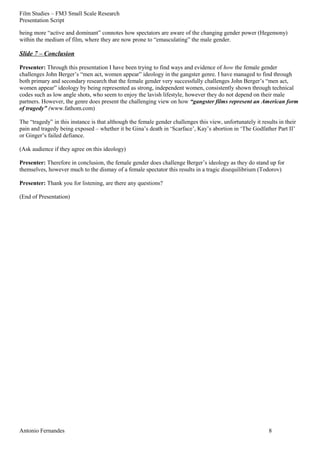
Presenter: OK, now you have seen the women actually going against Berger’s ideology, I want to know your 
thoughts. 
(Pause and wait for comments from the audience) 
Slide 6 – Primary Research 
Presenter: The primary research conducted was intended to gather the opinions of other people on the title “How the 
Female Gender Challenges John Berger’s “men act, women appear” ideology in the Gangster Genre?”. 
These are the results: 
(Show Facebook comments – Press enter key to highlight “active and dominant” quote) 
Presenter: This research denotes that on a social networking site, in this case Facebook, how my peers have 
contributed some excellent ideas on the role of the female gender in the genre. The verbal of the female gender role 
Antonio Fernandes 7
Film Studies – FM3 Small Scale Research 
Presentation Script 
being more “active and dominant” connotes how spectators are aware of the changing gender power (Hegemony) 
within the medium of film, where they are now prone to “emasculating” the male gender. 
Slide 7 – Conclusion 
Presenter: Through this presentation I have been trying to find ways and evidence of how the female gender 
challenges John Berger’s “men act, women appear” ideology in the gangster genre. I have managed to find through 
both primary and secondary research that the female gender very successfully challenges John Berger’s “men act, 
women appear” ideology by being represented as strong, independent women, consistently shown through technical 
codes such as low angle shots, who seem to enjoy the lavish lifestyle, however they do not depend on their male 
partners. However, the genre does present the challenging view on how “gangster films represent an American form 
of tragedy” (www.fathom.com) 
The “tragedy” in this instance is that although the female gender challenges this view, unfortunately it results in their 
pain and tragedy being exposed – whether it be Gina’s death in ‘Scarface’, Kay’s abortion in ‘The Godfather Part II’ 
or Ginger’s failed defiance. 
(Ask audience if they agree on this ideology) 
Presenter: Therefore in conclusion, the female gender does challenge Berger’s ideology as they do stand up for 
themselves, however much to the dismay of a female spectator this results in a tragic disequilibrium (Todorov) 
Presenter: Thank you for listening, are there any questions? 
(End of Presentation) 
Antonio Fernandes 8

Representation 24:25

  • 1.
    Film Studies –FM3 Small Scale Research Presentation Script How the Female Gender Challenges John Berger’s “men act, women appear” ideology in the Gangster Genre? Slide one – The Gangster Genre and the female Gender Presenter: Stereotypically, the female gender, willingly or unwillingly, are represented as an object of male desire (Male Gaze – Laura Mulvey). Their submissive and powerless state is ‘repeatedly’ (Steve Neale) presented in the genre to the extent where it has become accepted and a part of the norm. However, some texts have proven to “stretch the boundaries” (Steve Neale) on this representation, as the female gender are now challenging not only this stereotype but the dominant male character that are often ‘monstrous’ (Neale & Krutnik) towards them. (Display images of the female characters and the films they are associated to) Presenter: This presentation will focus on how, through the female protagonists on display, they challenge John Berger’s ideology of how “women appear” and convey the qualities ultimately associated to that of a submissive and vulnerable ‘princess’ (Propp). Slide two – Scarface (1983) Dir Brian De Palma In this text there are two main female protagonists who challenge John Bergers Ideology; the first is Tony Montana’s mother (Miriam Colon) and the second is Gina (Mary Elizabeth Mastrantonio), Tony’s sister. Both women are very independent and are able to look after themselves; they are very aggravated when Tony walks into their lives and tries to take control and tries to tell them what to do. (Show Video clip - DVD chapter 12 and chapter 18) Antonio Fernandes 1
  • 2.
    Film Studies –FM3 Small Scale Research Presentation Script (Display quote on the board after showing scene) “You know all we hear about in the papers is animals like you… Its Cubans like you who are giving a bad name to our people, people who come here and work hard and make a good name for themselves, people who send their children to school and pay taxes!” Presenter: This verbal quote directly from Tony’s mother to Tony connotes her dominance as a mother figure over her child – it also reinforces she still has authority (Hegemony) over Tony no matter how powerful her son has become. The fact that the mother is standing up whilst Tony is sitting represents her large presence and ability to emasculate this monstrous character (Neale & Krutnik) and anchors the dominance that she has over him. This is one way in which a woman in the gangster genre goes against John Bergers “men act, women appear” ideology. (Show audience Video clip - chapter 18) (Display quote on the board after showing scene) “You got some nerve Tony! You think you can come in here now and tell me what to do... I am not a baby anymore…I will do what I want to do, I will see whoever I want to see” Presenter: This verbal code from Gina to Tony connotes that she is a grown woman now who has her own life, conveying that she does not depend on her older brother anymore and it clearly shows that she is not a woman “… designed to flatter him” (Key Ideas in Media – 2003 – Mike Edwards) Antonio Fernandes 2
  • 3.
    Film Studies –FM3 Small Scale Research Presentation Script Therefore Gina is clearly presented as a female going against Bergers ideology and she “acts” emotionally and strongly towards her ‘villainous’ (Propp) brother; the spectators eyes are all on Gina whilst the men surrounding her merely just “appear”. Presenter: In dramatic irony to this dominance, Gina’s downfall is as a result of this defiance backfiring towards her controlling brother as he kills the man who falls in love with her (also his accomplice). Nelson Thomas focuses on the idea that in the Gangster genre women are “depicted in a different way to men – because the’ ideal’ spectator is always assumed to be male”. This verbal code connotes how the female gender, especially in the gangster genre where the males are ‘monstrously’ (Neale & Krutnik) controlling and at times brutal, are merely seen as objects of the male spectators desire (Male Gaze – Laura Mulvey) again – At this point though I’m interested to here what you think? (Ask audience to give their opinions on how “differently” women are depicted in the genre) Presenter: It is clear just from the screen shot (Display again) that in this scene women are not designed to flatter the male and even though the ‘ideal ‘spectator is male, the use of a very powerful and dominant female proves to be very successful in the narrative and denotes Mulvey’s ideology of “Fetishisation” being presented, as she conveys the “strong, active woman” that male spectators do not expect, especially in this genre. This also, uniquely, offers the female spectator the opportunity to “watch themselves” (The Male Dancer: Bodies, spectacle, sexualities – 2007 – Ramsey Burt) and potentially aspire (Social Climbers – Maslow) to replicate this strong act towards the dominant male gender. Antonio Fernandes 3
  • 4.
    Film Studies –FM3 Small Scale Research Presentation Script Slide 3 – Scarface vs. The Godfather Part II (1974) Dir Francis Ford Coppola (Show Video Clip - The Godfather: Part II Chapter 6) Kay: “Michael… the children are outside, were going… I’m not going back to Nevada, I brought the children to say good bye to you. At this moment I feel no love for you.” Michael: “What do you want from me?” Presenter: In this scene Kay (Michaels wife – Diane Keaton) comes across very much in binary opposition (Levi Strauss) to Gina. Kay is much calmer and the way in which she goes against Berger’s “men act, women appear” ideology is more subtle and through the use of a long shot, it denotes each gender at the same level. There is no obvious dominance of one over the other, but through Michaels verbal code “What do you want from me?” this is said after they shout at each other which connotes that Kay is not afraid of Michael - she does not ask Michael if they can leave - she does not ask if she can not go to Nevada - she tells Michael that they are going and that they are not going to Nevada with him. Through these verbal codes, Kay is seen as dominant, even though Michael shouts back to try and re gain his masculinity, thus denoting an example of emasculation, after Kay tells him that she feels no love for him. His attitude changes and his sorrow appears to set in. This denotes Kay’s control over Michael and clearly embodies, similar to Gina, a female character going against Berger’s ideology and is taking the role of the male, “acting” and emasculating Michael, making him seem ironically vulnerable. Antonio Fernandes 4
  • 5.
    Film Studies –FM3 Small Scale Research Presentation Script (Play scene again – starting at the point where Kay admits to having an abortion) Presenter: This emotional outburst, similar to Gina’s, is dramatic and again allows in particular a female spectator to “watch themselves” and ‘personally identify’ (Katz) with her own tragedy and inner torment and resorting to such an act. However, the male reaction to this rebellion and defiance, similar to that presented in ‘Scarface’, results in the male gender physically lashing out in anger to reclaim their dominance – however this only results in the male gender reclaiming their villainous (Propp) status. Presenter: Where as Gina is a more powerful and up front woman, she is domineering and able to take control of a situation, leaving the male’s to the side to watch as she takes centre stage, thereby emasculating the males, going against Berger’s ideology. This is one way in which “Genres are instances of repetition and difference”(Steve Neale) - the repetition is the woman being able to be dominant over the male where as the difference is Kay’s subtle, softer approach to Michael which, like a volcano, erupts in confrontation. (Display Phillip Palmer’s view on how Kay “doesn’t know the rules” – Scriptwriter – January 2005) Antonio Fernandes 5
  • 6.
    Film Studies –FM3 Small Scale Research Presentation Script Presenter: Palmer discusses how Kay, through her naivety, conveys a dominance and sense of control over such horrific matters that a weak and vulnerable female would not know how to deal with. Kay is also defined as being a “naïve wasp” – What do you think the connotations of this are in relation to the scene you have just watched? Does it reflect the ideology from the hypothesis of women “challenging” Berger’s ideology? (Ask audience to give their opinions – Allow for 2-3 minutes feedback) Slide 4 – Casino (1995) Dir Martin Scorsese Presenter: The focus film Casino is another very successful text in the Gangster genre in presenting a female who is very successful at going against Berger’s “men act, women appear” ideology. ‘Ginger’ (Sharon Stone) is a very dominant character and there are many scenes where she presents this dominance and fearlessness she has over the male protagonists. This is seen in chapter 11 where she has run away with her child hood friend (and small time Pimp) Lester (James Woods). (Show Video Clip - Casino Chapter 11) Presenter: She is agitated and scared and because she knows her husband well enough to know he will react badly to this attempted “kidnapping”, she knows that he will have people coming over to pick up their child and take her home. This is conveyed through the verbal codes “common get your bags, get your bags lets go! - Go go! Get in the car go!” These verbal codes connote the fear that they have over Sam Rothstein, which is emphasised in dramatic irony through the non-dietetic music playing ‘I Can't Live (If Living Is Without You)’ by Harry Nilson. These verbal codes connote that despite her arrogance and confidence, the male gender ultimately succeeds in controlling a difficult situation like this, much to the male spectator’s gratification, and similarly to the other brief films deconstructed and discussed today. Presenter: The articles from Inside Film focuses on the representation of the female gender in the gangster genre, with a particularly in depth look at the dominant female protagonist Ginger (Sharon Stone) from the focus film ‘Casino’. She is described by Irons as “a tormented, money driven beauty” (Inside Film - October 2005). This clearly defines how the female gender often “appear” (John Berger) for the viewing pleasure (scopophilia) of a predominantly male (Hartley’s 7 subjectivities) audience – also denoted as being an example of the “male gaze” (Laura Mulvey) through the verbal code “beauty”. This chapter clearly anchors what the magazine article is saying about Ginger (Sharon Stone) as it provides clear examples of Ginger being dominant, money driven and beautiful. Slide 5 – Female Characters Presenter: Now enough of me talking, I would like to know your thoughts on the Females of these Gangster films going against Berger’s “men act, women appear” ideology (Display next slide) Antonio Fernandes 6
  • 7.
    Film Studies –FM3 Small Scale Research Presentation Script Presenter: OK, now you have seen the women actually going against Berger’s ideology, I want to know your thoughts. (Pause and wait for comments from the audience) Slide 6 – Primary Research Presenter: The primary research conducted was intended to gather the opinions of other people on the title “How the Female Gender Challenges John Berger’s “men act, women appear” ideology in the Gangster Genre?”. These are the results: (Show Facebook comments – Press enter key to highlight “active and dominant” quote) Presenter: This research denotes that on a social networking site, in this case Facebook, how my peers have contributed some excellent ideas on the role of the female gender in the genre. The verbal of the female gender role Antonio Fernandes 7
  • 8.
    Film Studies –FM3 Small Scale Research Presentation Script being more “active and dominant” connotes how spectators are aware of the changing gender power (Hegemony) within the medium of film, where they are now prone to “emasculating” the male gender. Slide 7 – Conclusion Presenter: Through this presentation I have been trying to find ways and evidence of how the female gender challenges John Berger’s “men act, women appear” ideology in the gangster genre. I have managed to find through both primary and secondary research that the female gender very successfully challenges John Berger’s “men act, women appear” ideology by being represented as strong, independent women, consistently shown through technical codes such as low angle shots, who seem to enjoy the lavish lifestyle, however they do not depend on their male partners. However, the genre does present the challenging view on how “gangster films represent an American form of tragedy” (www.fathom.com) The “tragedy” in this instance is that although the female gender challenges this view, unfortunately it results in their pain and tragedy being exposed – whether it be Gina’s death in ‘Scarface’, Kay’s abortion in ‘The Godfather Part II’ or Ginger’s failed defiance. (Ask audience if they agree on this ideology) Presenter: Therefore in conclusion, the female gender does challenge Berger’s ideology as they do stand up for themselves, however much to the dismay of a female spectator this results in a tragic disequilibrium (Todorov) Presenter: Thank you for listening, are there any questions? (End of Presentation) Antonio Fernandes 8