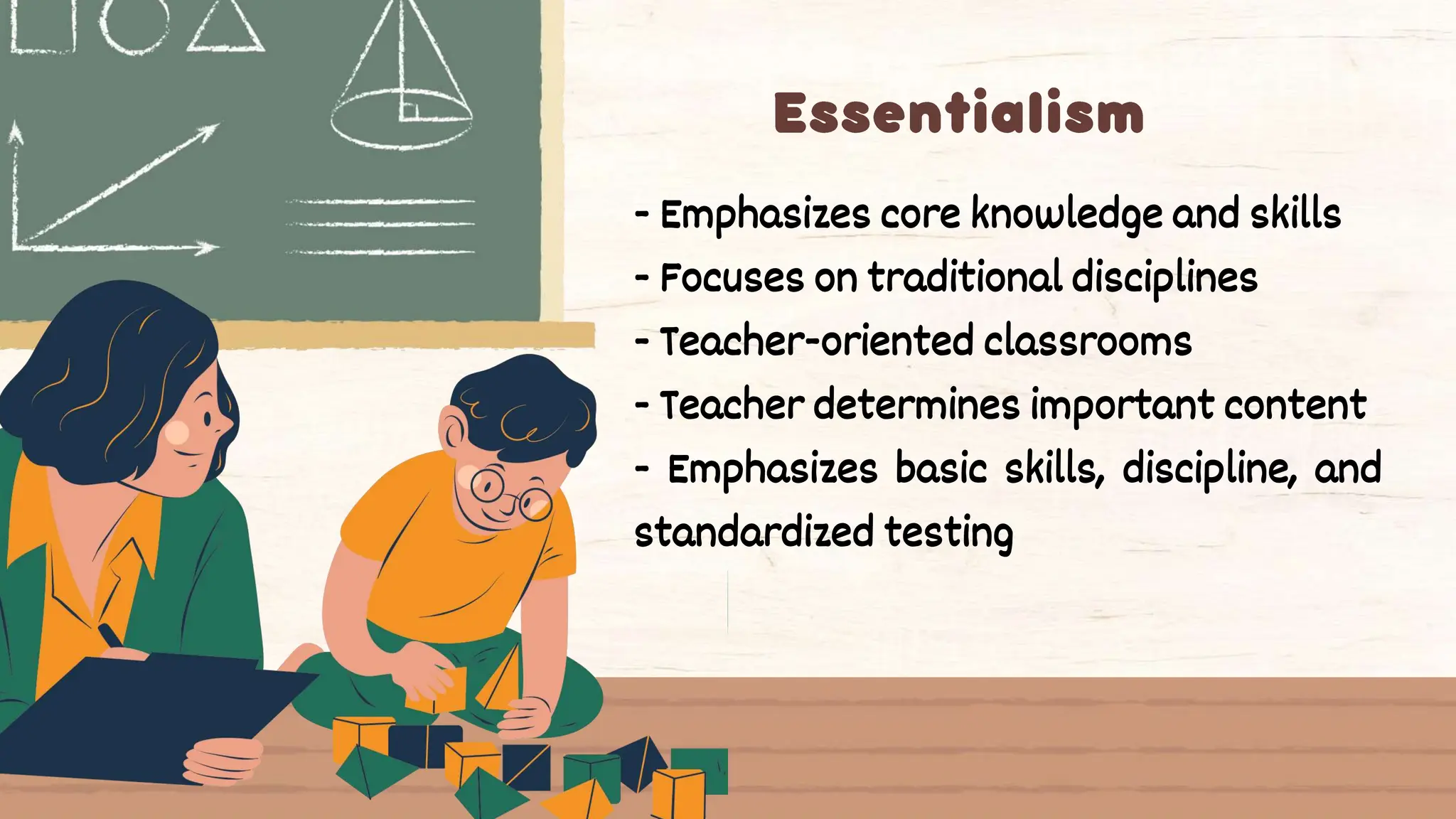
- Emphasizes core knowledge and skills
- Focuses on traditional disciplines
- Teacher-oriented classrooms
- Teacher determines important content
- Emphasizes basic skills, discipline, and
standardized testing
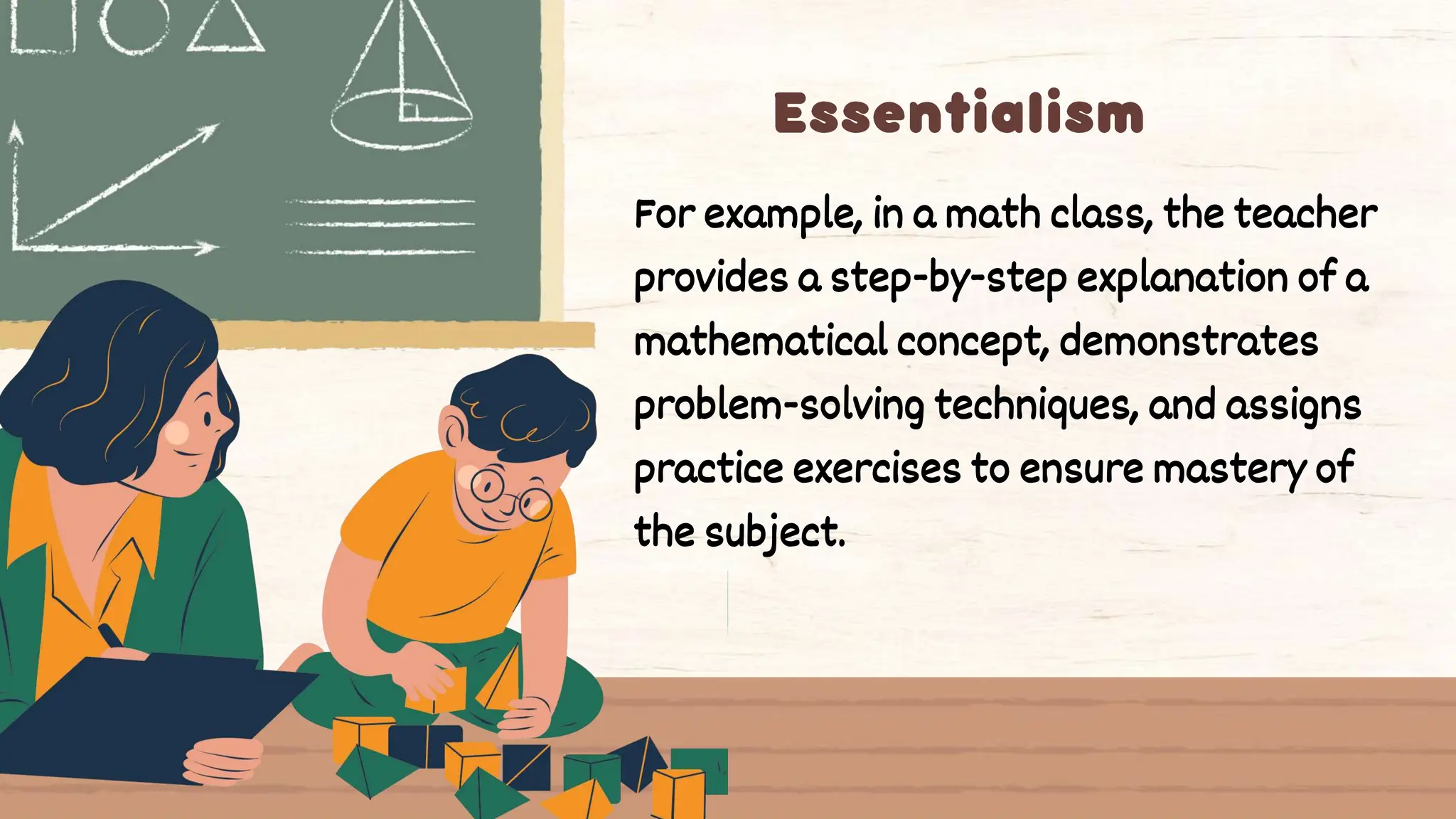
For example, in a math class, the teacher
provides a step-by-step explanation of a
mathematical concept, demonstrates
problem-solving techniques, and assigns
practice exercises to ensure mastery of
the subject.
- Perennialism is a teacher-centered philosophy.
- It emphasizes the importance of universal truths
and values.
- Perennialists believe that ideas from great
authors, thinkers, and artists are timeless and
should be included in the curriculum.
- The focus is on enduring knowledge and concepts
that have stood the test of time.
For example, in an English literature class, the
teacher may assign classic novels like “Pride and
Prejudice” by Jane Austen and facilitate
discussions on themes such as love, social class,
and morality.
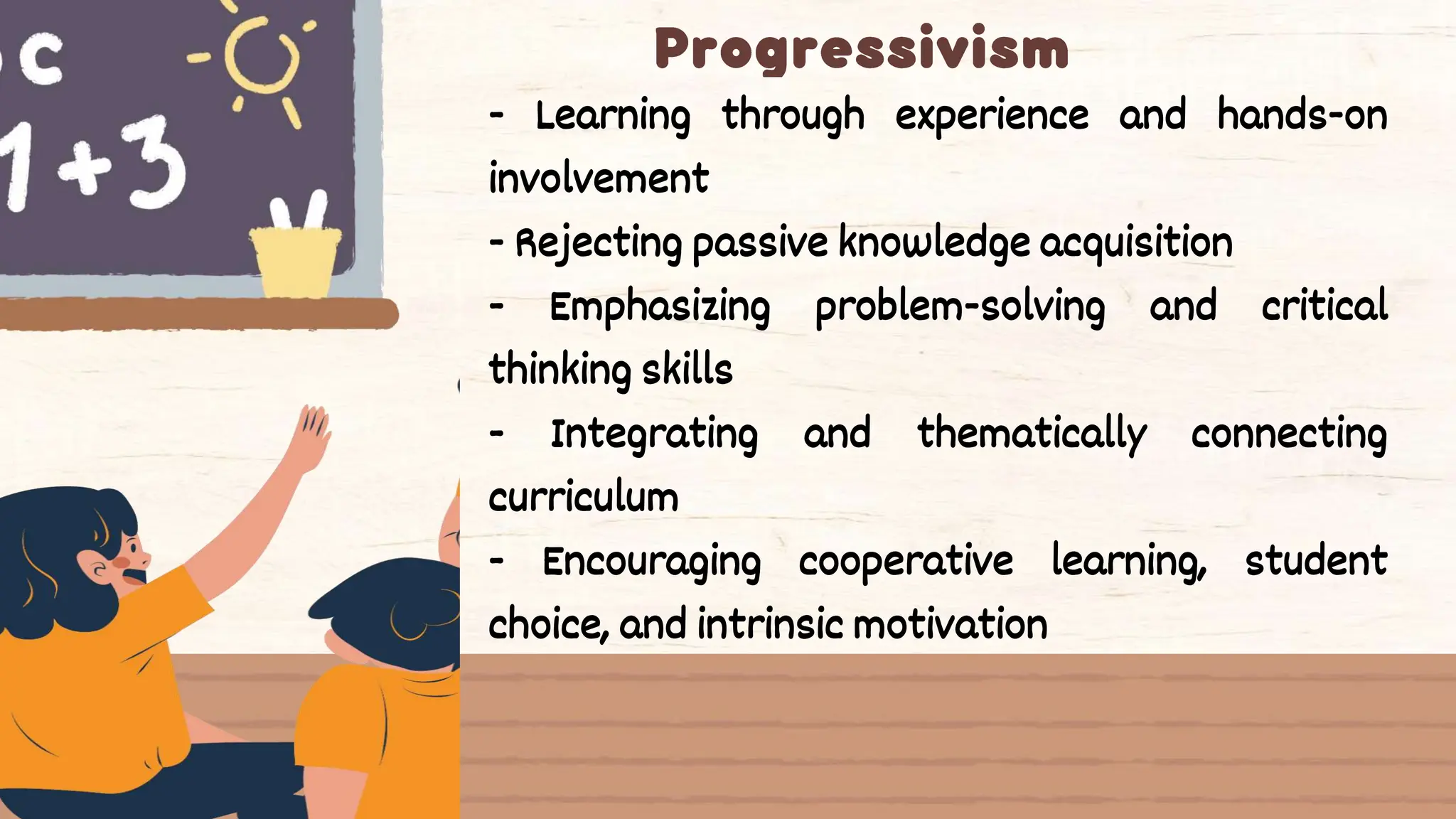
- Learning through experience and hands-on
involvement
- Rejecting passive knowledge acquisition
- Emphasizing problem-solving and critical
thinking skills
- Integrating and thematically connecting
curriculum
- Encouraging cooperative learning, student
choice, and intrinsic motivation
For example, in a science class, the teacher may
organize a field trip to a local nature reserve
where students can observe and study
ecosystems, collect samples, and conduct
experiments to deepen their understanding of
ecological concepts.
- Individuals construct their own understanding and
knowledge.
- Learning occurs through active engagement and
reflection.
- Knowledge is constructed, not passively received.
- Teachers facilitate the learning process rather
than providing direct knowledge.
- Students assess how activities contribute to their
understanding.
For example, in an art class, the teacher
encourages students to explore their
creativity, experiment with different art
forms, and express their emotions
through their artwork.
- Belief in the potential of every person for good
- Emphasis on the development of the whole person
and individual potential
- Focus on personal growth, self-fulfillment, and
self-actualization
- Learning seen as a personal act for fulfilling one’s
potential, not just for school or career success
For example, in a history class, the
teacher may assign a project where
students have to research and analyze
primary sources to develop their own
understanding of a historical event or
period.
Hattie, J. (2009). Visible Learning: A Synthesis of
Over 800 Meta-Analyses Relating to Achievement.
This influential book provides a comprehensive
analysis of various teaching strategies and their
impact on student achievement. It includes
research evidence supporting the effectiveness of
teacher-centered approaches such as direct
instruction.
Vygotsky, L. S. (1978). Mind in Society: The
Development of Higher Psychological Processes.
Vygotsky’s work on sociocultural theory
emphasizes the importance of learner-centered
approaches, focusing on the role of social
interaction and scaffolding in promoting cognitive
development and learning.
Resistance to Change: Managing the Shift:
Shifting from a teacher-centered to a learner-centered
approach may face resistance. Here are some strategies for
managing the resistance:
• Professional Development
• Collaboration
• Communication
• Gradual Implementation
• Assessment and Evaluation
- Professional Development: Provide comprehensive
training and support for teachers to understand and
implement learner-centered strategies effectively.
- Collaboration: Foster collaboration among teachers
to share experiences, resources, and best practices in
learner-centered teaching.
- Communication: Clearly communicate the rationale and
benefits of learner-centered approaches to all stakeholders,
including teachers, parents, and administrators.
- Gradual Implementation: Introduce learner-centered
practices gradually to allow for adjustment and build
confidence among teachers.
- Assessment and Evaluation: Develop appropriate
assessment methods that align with learner-centered
approaches and provide evidence of student growth and
achievement.
Reporting for the FLCT.pptx hahajajskksjs

Reporting for the FLCT.pptx hahajajskksjs

  • 4.
    - Emphasizes coreknowledge and skills - Focuses on traditional disciplines - Teacher-oriented classrooms - Teacher determines important content - Emphasizes basic skills, discipline, and standardized testing
  • 5.
    For example, ina math class, the teacher provides a step-by-step explanation of a mathematical concept, demonstrates problem-solving techniques, and assigns practice exercises to ensure mastery of the subject.
  • 6.
    - Perennialism isa teacher-centered philosophy. - It emphasizes the importance of universal truths and values. - Perennialists believe that ideas from great authors, thinkers, and artists are timeless and should be included in the curriculum. - The focus is on enduring knowledge and concepts that have stood the test of time.
  • 7.
    For example, inan English literature class, the teacher may assign classic novels like “Pride and Prejudice” by Jane Austen and facilitate discussions on themes such as love, social class, and morality.
  • 9.
    - Learning throughexperience and hands-on involvement - Rejecting passive knowledge acquisition - Emphasizing problem-solving and critical thinking skills - Integrating and thematically connecting curriculum - Encouraging cooperative learning, student choice, and intrinsic motivation
  • 10.
    For example, ina science class, the teacher may organize a field trip to a local nature reserve where students can observe and study ecosystems, collect samples, and conduct experiments to deepen their understanding of ecological concepts.
  • 11.
    - Individuals constructtheir own understanding and knowledge. - Learning occurs through active engagement and reflection. - Knowledge is constructed, not passively received. - Teachers facilitate the learning process rather than providing direct knowledge. - Students assess how activities contribute to their understanding.
  • 12.
    For example, inan art class, the teacher encourages students to explore their creativity, experiment with different art forms, and express their emotions through their artwork.
  • 13.
    - Belief inthe potential of every person for good - Emphasis on the development of the whole person and individual potential - Focus on personal growth, self-fulfillment, and self-actualization - Learning seen as a personal act for fulfilling one’s potential, not just for school or career success
  • 14.
    For example, ina history class, the teacher may assign a project where students have to research and analyze primary sources to develop their own understanding of a historical event or period.
  • 15.
    Hattie, J. (2009).Visible Learning: A Synthesis of Over 800 Meta-Analyses Relating to Achievement. This influential book provides a comprehensive analysis of various teaching strategies and their impact on student achievement. It includes research evidence supporting the effectiveness of teacher-centered approaches such as direct instruction.

  • 16.
    Vygotsky, L. S.(1978). Mind in Society: The Development of Higher Psychological Processes. Vygotsky’s work on sociocultural theory emphasizes the importance of learner-centered approaches, focusing on the role of social interaction and scaffolding in promoting cognitive development and learning.
  • 17.
    Resistance to Change:Managing the Shift: Shifting from a teacher-centered to a learner-centered approach may face resistance. Here are some strategies for managing the resistance: • Professional Development • Collaboration • Communication • Gradual Implementation • Assessment and Evaluation
  • 18.
    - Professional Development:Provide comprehensive training and support for teachers to understand and implement learner-centered strategies effectively. - Collaboration: Foster collaboration among teachers to share experiences, resources, and best practices in learner-centered teaching.
  • 19.
    - Communication: Clearlycommunicate the rationale and benefits of learner-centered approaches to all stakeholders, including teachers, parents, and administrators. - Gradual Implementation: Introduce learner-centered practices gradually to allow for adjustment and build confidence among teachers. - Assessment and Evaluation: Develop appropriate assessment methods that align with learner-centered approaches and provide evidence of student growth and achievement.

Editor's Notes

  • #5 Essentialism is a teaching philosophy that believes in a core set of knowledge and skills that an educated person must have. The focus is on traditional disciplines like math, natural science, history, foreign language, and literature. Essentialists argue that classrooms should be teacher-oriented. The teacher decides what is important for students to learn to prepare them for the future, emphasizing basic skills, discipline, and standardized testing. - Essentialism is a teaching philosophy that emphasizes a core set of knowledge and skills. - It focuses on traditional disciplines such as math, natural science, history, foreign language, and literature. - Essentialists believe that classrooms should be teacher-oriented, with the teacher determining what is important for students to learn. - The goal is to prepare students for the future by emphasizing basic skills, discipline, and standardized testing.
  • #6 Essentialism is a teaching philosophy that believes in a core set of knowledge and skills that an educated person must have. The focus is on traditional disciplines like math, natural science, history, foreign language, and literature. Essentialists argue that classrooms should be teacher-oriented. The teacher decides what is important for students to learn to prepare them for the future, emphasizing basic skills, discipline, and standardized testing. - Essentialism is a teaching philosophy that emphasizes a core set of knowledge and skills. - It focuses on traditional disciplines such as math, natural science, history, foreign language, and literature. - Essentialists believe that classrooms should be teacher-oriented, with the teacher determining what is important for students to learn. - The goal is to prepare students for the future by emphasizing basic skills, discipline, and standardized testing.
  • #7 Perennialism is a teacher-centered philosophy that emphasizes the importance of universal truths and values that have withstood the test of time. They believe the ideas of certain great authors, thinkers, and artists are as relevant today as when they were created, hence should be part of the curriculum.
  • #8 Perennialism is a teacher-centered philosophy that emphasizes the importance of universal truths and values that have withstood the test of time. They believe the ideas of certain great authors, thinkers, and artists are as relevant today as when they were created, hence should be part of the curriculum.
  • #12 Constructivism is a learning theory that holds the idea that individuals construct their own understanding and knowledge of the world through experiencing things and reflecting on those experiences. In other words, students learn by actively constructing their own knowledge, not by passively receiving information. Constructivist teachers encourage students to constantly assess how the activity is helping them gain understanding and facilitate the learning process rather than providing knowledge directly to students.
  • #13 Constructivism is a learning theory that holds the idea that individuals construct their own understanding and knowledge of the world through experiencing things and reflecting on those experiences. In other words, students learn by actively constructing their own knowledge, not by passively receiving information. Constructivist teachers encourage students to constantly assess how the activity is helping them gain understanding and facilitate the learning process rather than providing knowledge directly to students.
  • #14 Humanism is a pedagogical philosophy that believes in the potential of every person for good. It emphasizes the development of the whole person and the realization of each individual’s potential. The focus is on personal growth, self-fulfillment, and self-actualization. Humanistic educators believe that learning is a personal act to fulfill one’s potential rather than a step toward school or career success.
  • #15 Humanism is a pedagogical philosophy that believes in the potential of every person for good. It emphasizes the development of the whole person and the realization of each individual’s potential. The focus is on personal growth, self-fulfillment, and self-actualization. Humanistic educators believe that learning is a personal act to fulfill one’s potential rather than a step toward school or career success.