REPORTED SPEECH I:StatementsBy Antonio Romero
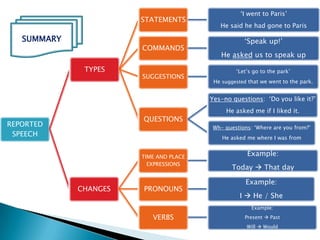
SUMMARY
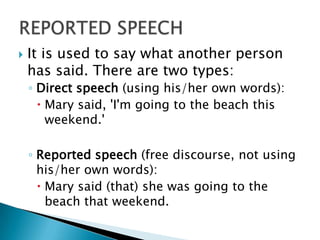
It is used to say what another person has said. There are two types: Direct speech (using his/her own words): Mary said, 'I'm going to the beach this weekend.' Reported speech (free discourse, not using his/her own words): Mary said (that) she was going to the beach that weekend. REPORTED SPEECH
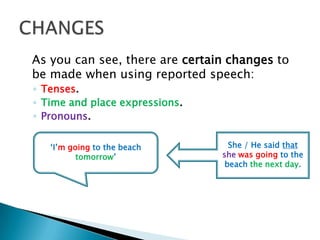
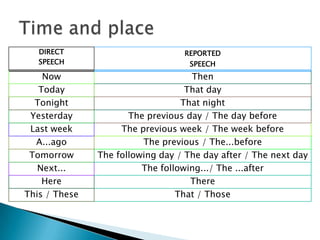
	As you can see, there are certain changes to be made when using reported speech: Tenses.Time and place expressions.Pronouns.CHANGES‘I’mgoingtothebeachtomorrow’She / He saidthatshewasgoingtothebeachthenextday.
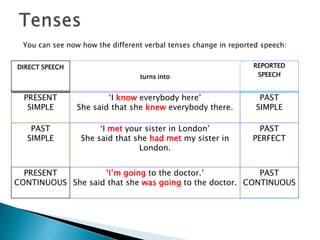
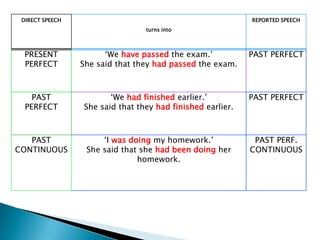
TensesYou can see now how the different verbal tenses change in reported speech:
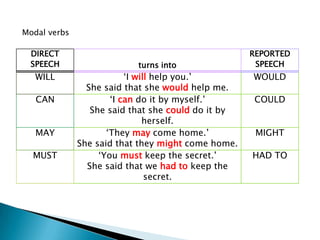
Modal verbs
Time and place
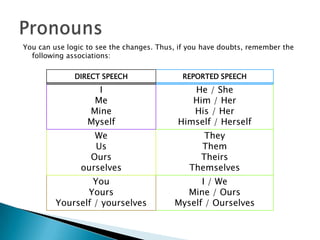
You can use logic to see the changes. Thus, if you have doubts, remember the following associations: Pronouns
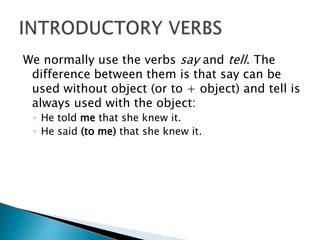
We normally use the verbs say and tell. The difference between them is that say can be used without object (or to + object) and tell is always used with the object: He told me that she knew it. He said (to me) that she knew it. INTRODUCTORY VERBS
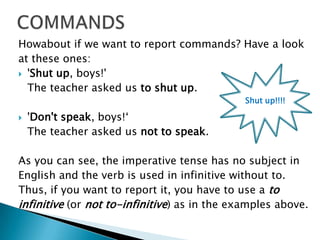
COMMANDSHowabout if we want to report commands? Have a lookat these ones: 'Shut up, boys!' The teacher asked us to shut up. 'Don't speak, boys!‘The teacher asked us not to speak. As you can see, the imperative tense has no subject inEnglish and the verb is used in infinitive without to.Thus, if you want to report it, you have to use a toinfinitive(or not to-infinitive) as in the examples above. Shut up!!!!
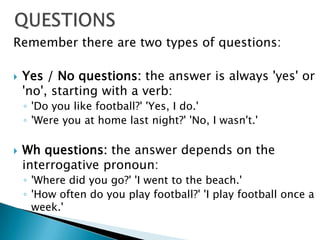
QUESTIONSRemember there are two types of questions: Yes / No questions: the answer is always 'yes' or 'no', starting with a verb: 'Do you like football?' 'Yes, I do.' 'Were you at home last night?' 'No, I wasn't.' Whquestions: the answer depends on the interrogative pronoun: 'Where did you go?' 'I went to the beach.' 'How often do you play football?' 'I play football once a week.'
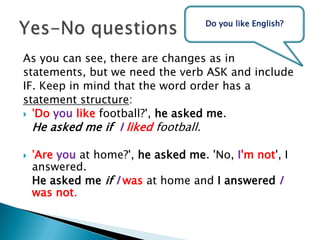
As you can see, there are changes as instatements, but we need the verb ASK and includeIF. Keep in mind that the word order has astatement structure: 'Doyoulikefootball?', he asked me. 	He asked meifIlikedfootball.'Areyou at home?', he asked me. 'No, I'm not', I answered. 	He asked meifIwas at home and I answered I was not. Yes-No questionsDo youlikeEnglish?
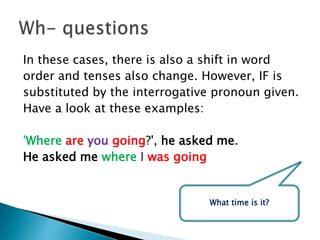
In these cases, there is also a shift in wordorder and tenses also change. However, IF issubstituted by the interrogative pronoun given.Have a look at these examples:   'Whereare you going?', he asked me.He asked mewhereIwas goingWh- questionsWhat time isit?
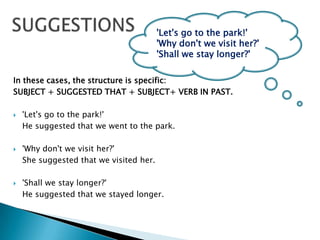
SUGGESTIONS'Let's go to the park!' 'Why don't we visit her?' 'Shall we stay longer?' In these cases, the structure is specific: SUBJECT + SUGGESTED THAT + SUBJECT+ VERB IN PAST.   'Let's go to the park!' He suggested that we went to the park. 'Why don't we visit her?' She suggested that we visited her. 'Shall we stay longer?' He suggested that we stayed longer.

Reported Speech

  • 1.
  • 2.
  • 3.
    It is usedto say what another person has said. There are two types: Direct speech (using his/her own words): Mary said, 'I'm going to the beach this weekend.' Reported speech (free discourse, not using his/her own words): Mary said (that) she was going to the beach that weekend. REPORTED SPEECH
  • 4.
    As you cansee, there are certain changes to be made when using reported speech: Tenses.Time and place expressions.Pronouns.CHANGES‘I’mgoingtothebeachtomorrow’She / He saidthatshewasgoingtothebeachthenextday.
  • 5.
    TensesYou can seenow how the different verbal tenses change in reported speech:
  • 7.
  • 8.
  • 9.
    You can uselogic to see the changes. Thus, if you have doubts, remember the following associations: Pronouns
  • 10.
    We normally usethe verbs say and tell. The difference between them is that say can be used without object (or to + object) and tell is always used with the object: He told me that she knew it. He said (to me) that she knew it. INTRODUCTORY VERBS
  • 11.
    COMMANDSHowabout if wewant to report commands? Have a lookat these ones: 'Shut up, boys!' The teacher asked us to shut up. 'Don't speak, boys!‘The teacher asked us not to speak. As you can see, the imperative tense has no subject inEnglish and the verb is used in infinitive without to.Thus, if you want to report it, you have to use a toinfinitive(or not to-infinitive) as in the examples above. Shut up!!!!
  • 12.
    QUESTIONSRemember there aretwo types of questions: Yes / No questions: the answer is always 'yes' or 'no', starting with a verb: 'Do you like football?' 'Yes, I do.' 'Were you at home last night?' 'No, I wasn't.' Whquestions: the answer depends on the interrogative pronoun: 'Where did you go?' 'I went to the beach.' 'How often do you play football?' 'I play football once a week.'
  • 13.
    As you cansee, there are changes as instatements, but we need the verb ASK and includeIF. Keep in mind that the word order has astatement structure: 'Doyoulikefootball?', he asked me. He asked meifIlikedfootball.'Areyou at home?', he asked me. 'No, I'm not', I answered. He asked meifIwas at home and I answered I was not. Yes-No questionsDo youlikeEnglish?
  • 14.
    In these cases,there is also a shift in wordorder and tenses also change. However, IF issubstituted by the interrogative pronoun given.Have a look at these examples:   'Whereare you going?', he asked me.He asked mewhereIwas goingWh- questionsWhat time isit?
  • 15.
    SUGGESTIONS'Let's go tothe park!' 'Why don't we visit her?' 'Shall we stay longer?' In these cases, the structure is specific: SUBJECT + SUGGESTED THAT + SUBJECT+ VERB IN PAST.   'Let's go to the park!' He suggested that we went to the park. 'Why don't we visit her?' She suggested that we visited her. 'Shall we stay longer?' He suggested that we stayed longer.