REPORTED SPEECH “EL ESTILO INDIRECTO” IES MURGI
1. REPORTING STATEMENTS – LAS ORACIONES ENUNCIATIVAS A) Podemos contar lo que alguien dijo de dos maneras:  1.  Repitiendo la idea, pero no las palabras exactas, es decir, empleando el estilo directo. “ I have to go now,” she said. “ We lived in Paris for three years,” Peter said. 2.  Contando la idea, pero no las palabras exactas, que es el “estilo indirecto”. She said (that) she had to go then. Peter told us (that) they had lived in Paris for three years.
1. REPORTING STATEMENTS – LAS ORACIONES ENUNCIATIVAS En el estilo directo se utilizan comillas y mayúsculas al empezar la cita, pero en el estilo indirecto: 1.  No hay comillas. 2.  La frase se suele introducir con los verbos   say   y   tell , o con   accept ,   advise ,   agree ,   announce ,   apologise ,   ask ,   beg ,   claim ,   complain ,   declare ,   explain ,   insist ,  invite ,   offer ,   point out ,   protest ,  remind ,   remark ,   state ,   think ,   etc. que llamamos   reporting verbs .
1. REPORTING STATEMENTS – LAS ORACIONES ENUNCIATIVAS Nota : Después de los verbos   say ,   suggest ,   tell   y   think   podemos omitir   that , pero nunca se puede omitir con verbos como   explain ,   complain ,   point out , etc. 3.  El tiempo de la narración da una especie de “salto atrás” si el verbo que lo introduce va en pasado. 4.  Las palabras que indican lugar o tiempo, los pronombres personales y posesivos, los demostrativos, etc., cambian lógicamente. 5.  Las preguntas dejan de serlo.
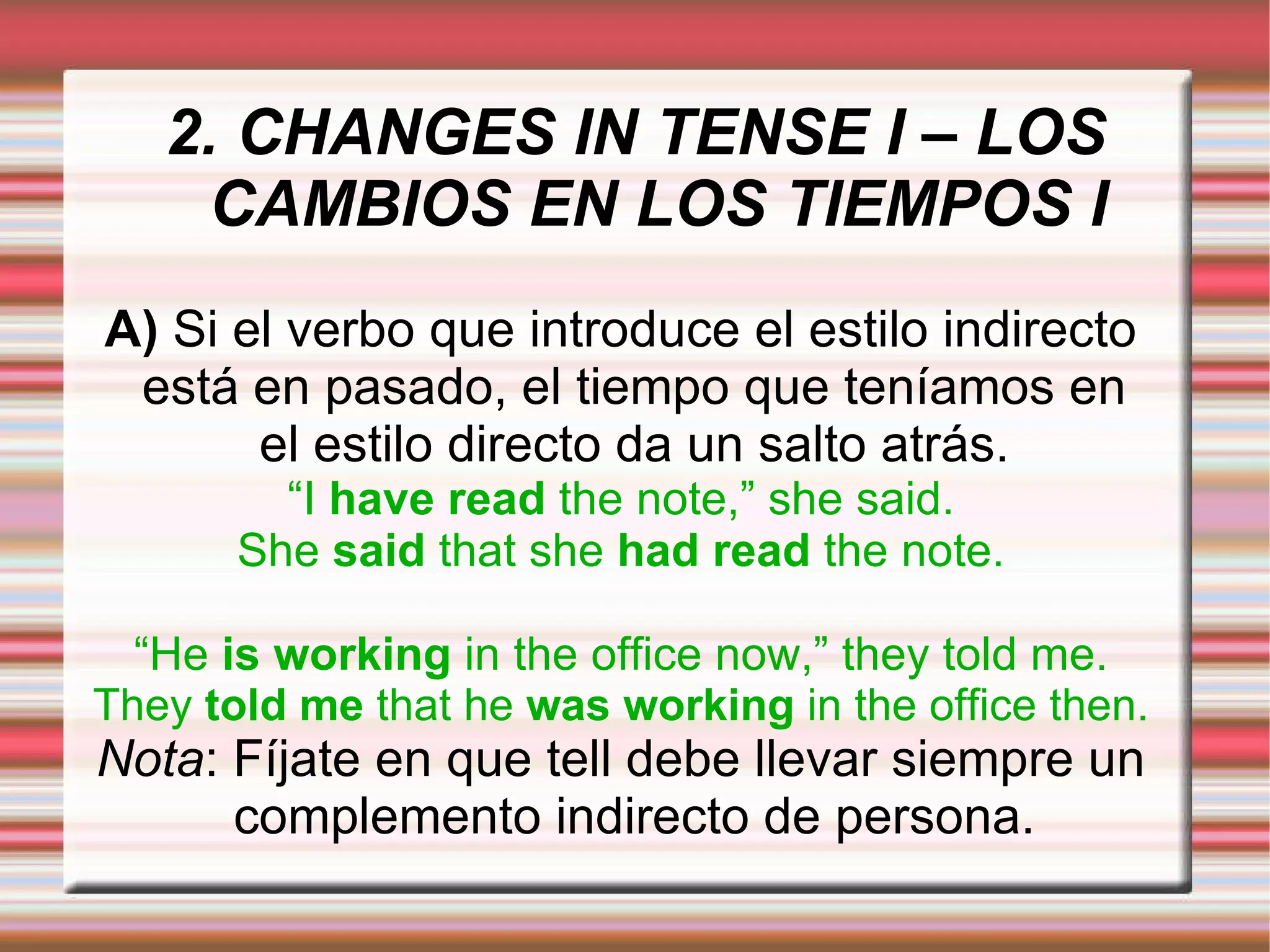
2. CHANGES IN TENSE I – LOS CAMBIOS EN LOS TIEMPOS I A)  Si el verbo que introduce el estilo indirecto está en pasado, el tiempo que teníamos en el estilo directo da un salto atrás. “ I  have read  the note,” she said. She  said  that she  had read  the note. “ He  is working  in the office now,” they told me. They  told me  that he  was working  in the office then. Nota : Fíjate en que tell debe llevar siempre un complemento indirecto de persona.
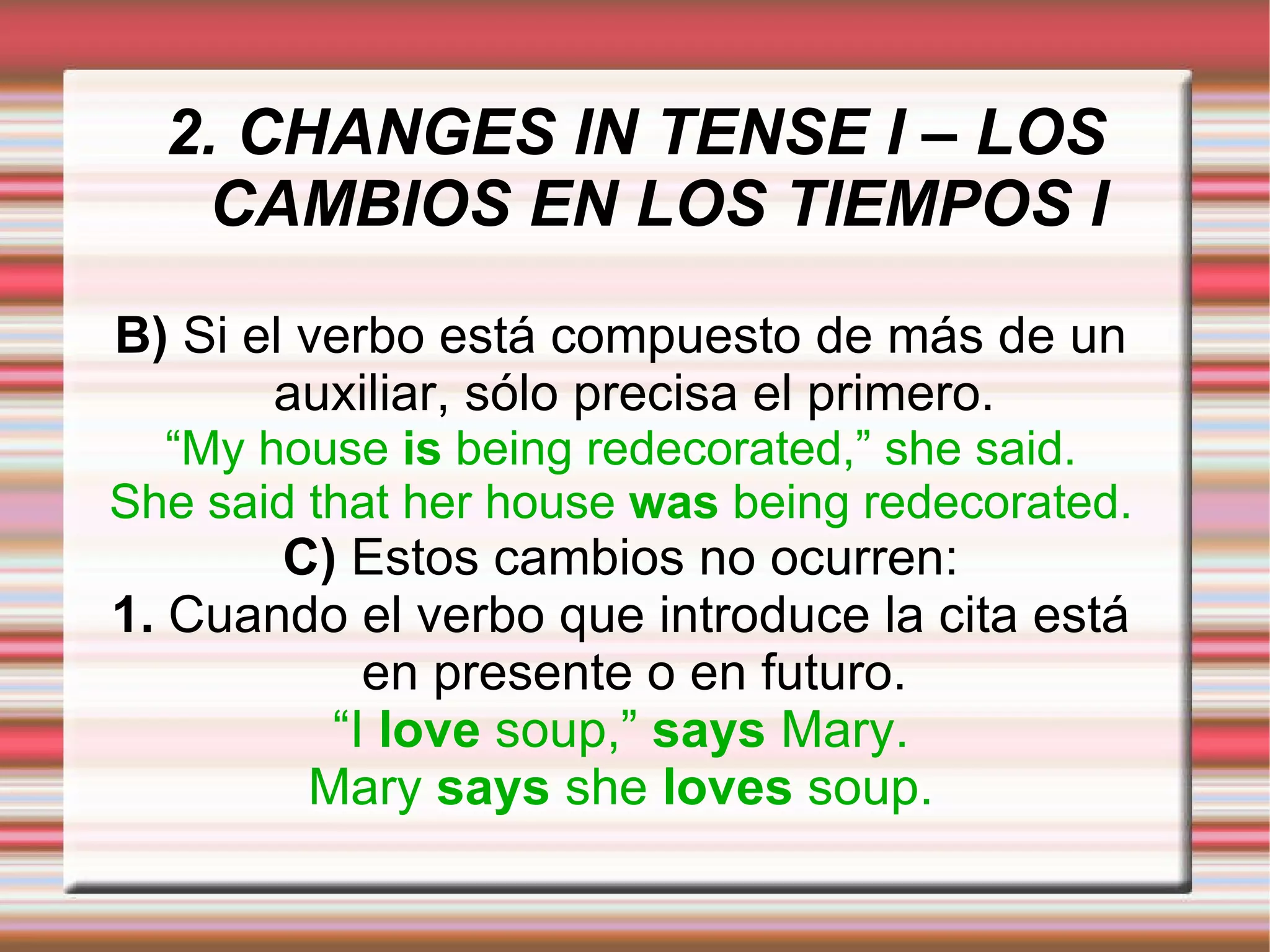
2. CHANGES IN TENSE I – LOS CAMBIOS EN LOS TIEMPOS I B)  Si el verbo está compuesto de más de un auxiliar, sólo precisa el primero. “ My house  is  being redecorated,” she said. She said that her house  was  being redecorated. C)  Estos cambios no ocurren: 1.  Cuando el verbo que introduce la cita está en presente o en futuro. “ I  love  soup,”  says  Mary. Mary  says  she  loves  soup.
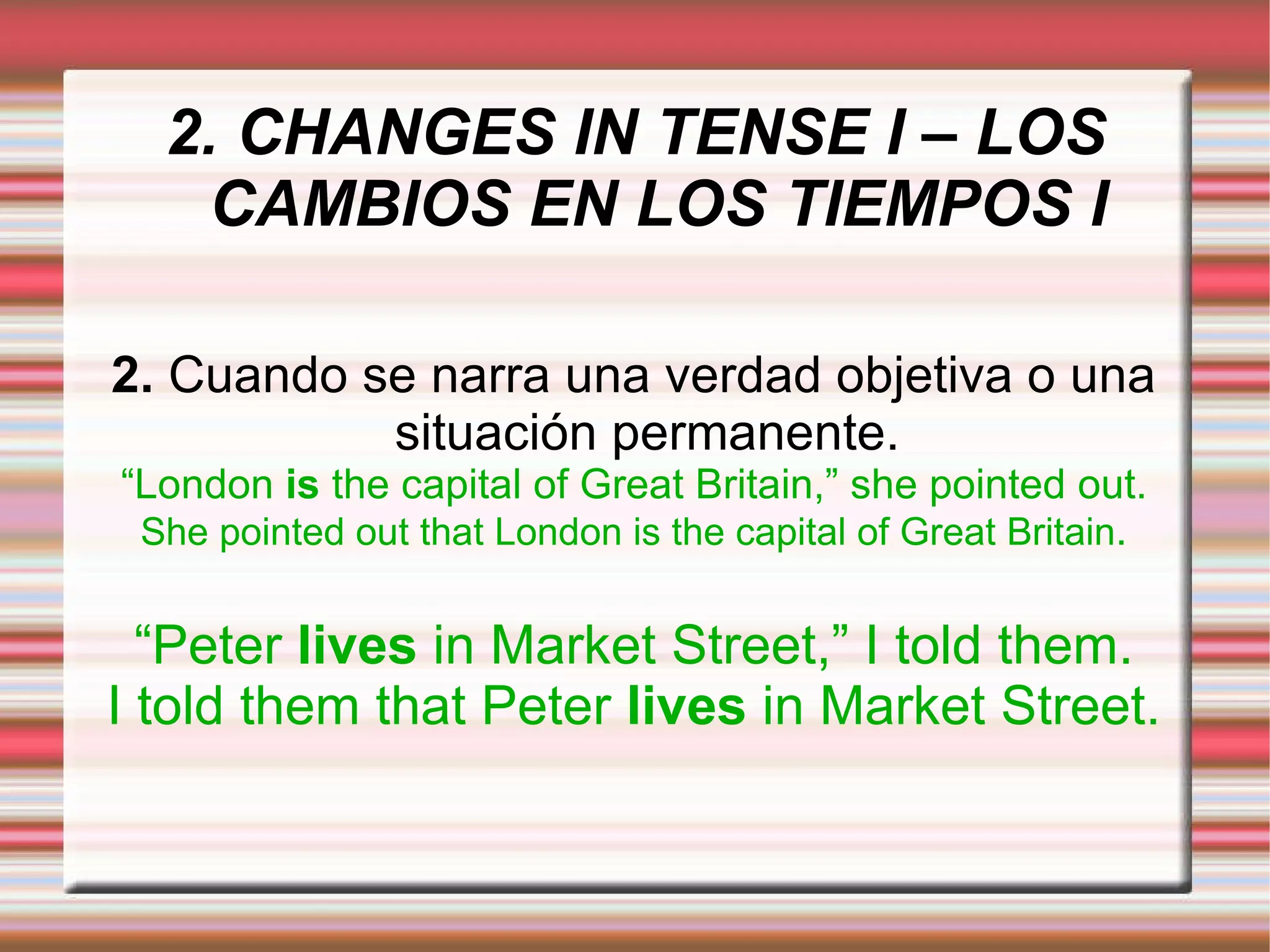
2. CHANGES IN TENSE I – LOS CAMBIOS EN LOS TIEMPOS I 2.  Cuando se narra una verdad objetiva o una situación permanente. “ London  is  the capital of Great Britain,” she pointed out. She pointed out that London is the capital of Great Britain . “ Peter  lives  in Market Street,” I told them. I told them that Peter  lives  in Market Street.
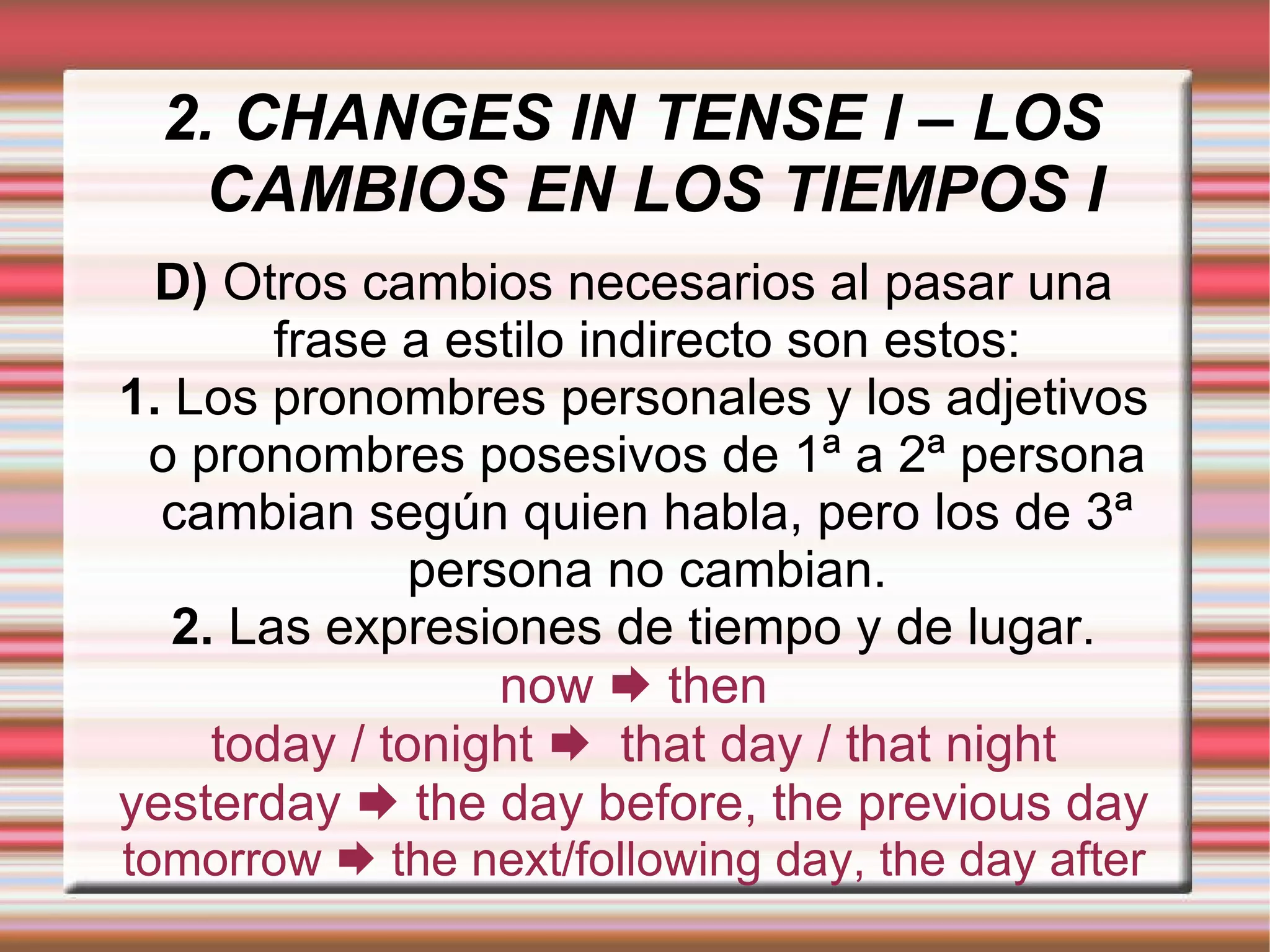
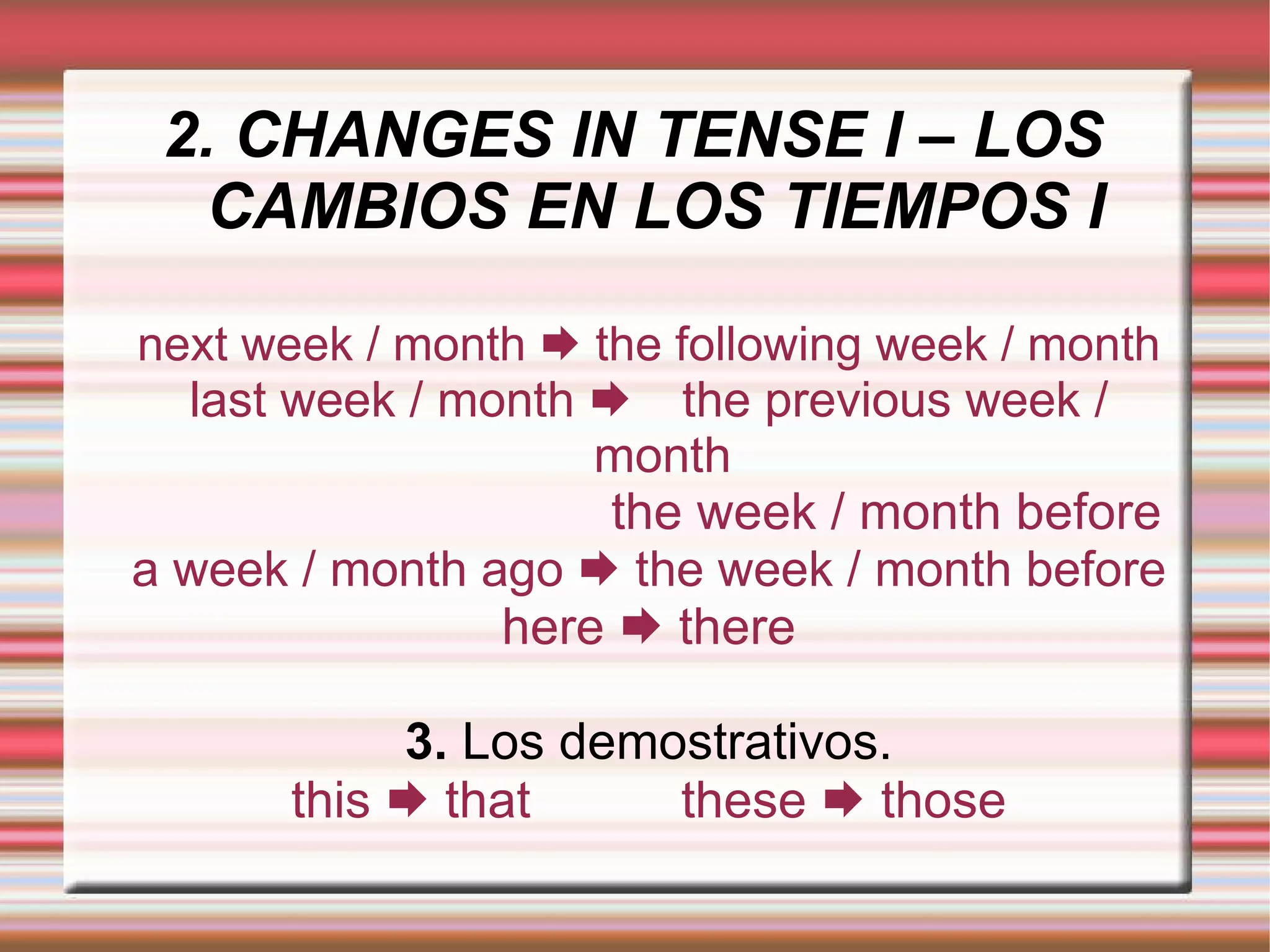
2. CHANGES IN TENSE I – LOS CAMBIOS EN LOS TIEMPOS I D)  Otros cambios necesarios al pasar una frase a estilo indirecto son estos: 1.  Los pronombres personales y los adjetivos o pronombres posesivos de 1ª a 2ª persona cambian según quien habla, pero los de 3ª persona no cambian. 2.  Las expresiones de tiempo y de lugar. now    then today / tonight     that day / that night yesterday    the day before, the previous day tomorrow    the next/following day, the day after
2. CHANGES IN TENSE I – LOS CAMBIOS EN LOS TIEMPOS I next week / month    the following week / month last week / month    the previous week / month   the week / month before a week / month ago    the week / month before here    there 3.  Los demostrativos. this    that these    those
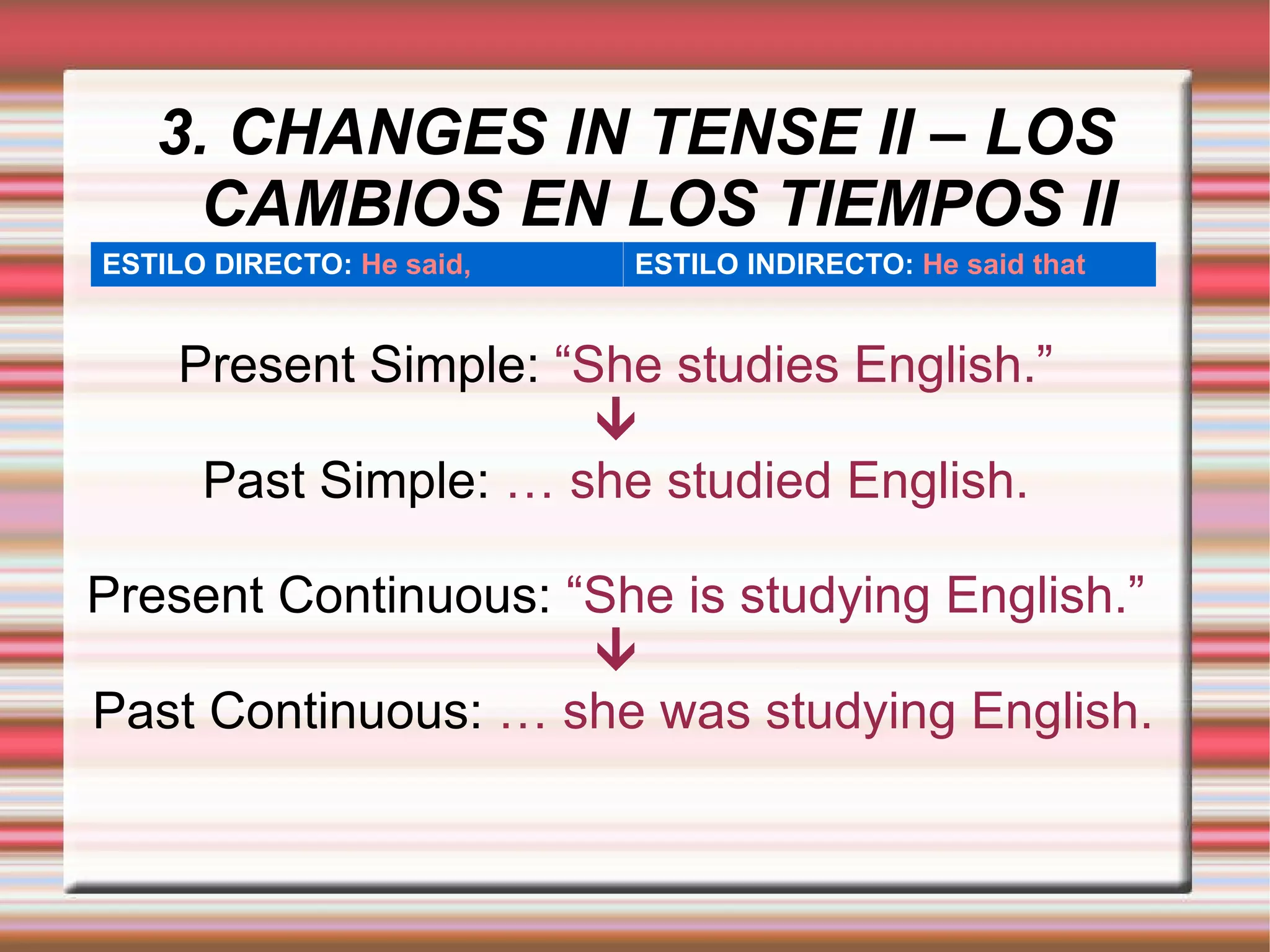
3. CHANGES IN TENSE II – LOS CAMBIOS EN LOS TIEMPOS II Present Simple:  “She studies English.”  Past Simple:  … she studied English. Present Continuous:  “She is studying English.”  Past Continuous:  … she was studying English. ESTILO DIRECTO:   He said, ESTILO INDIRECTO:   He said that
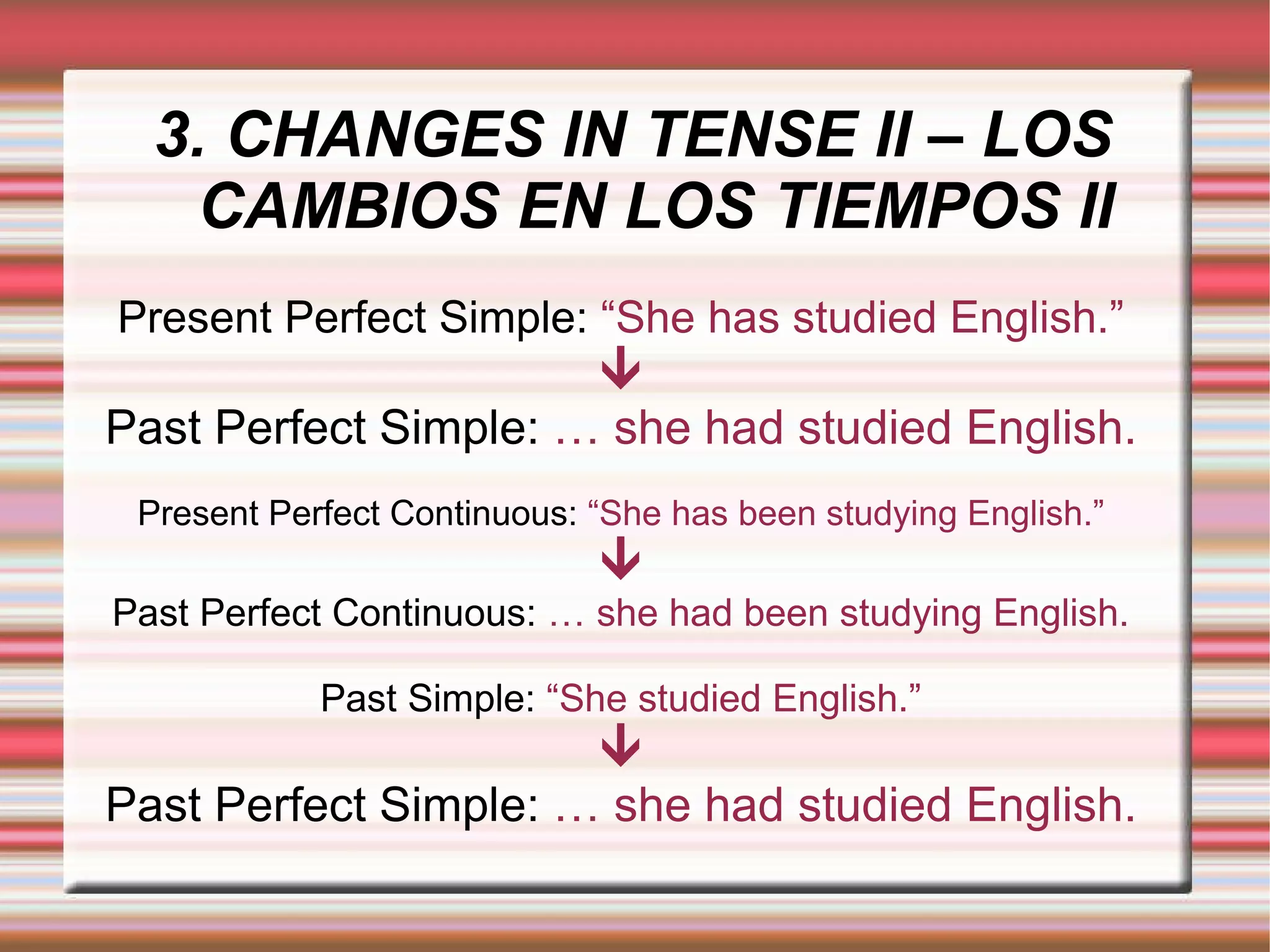
3. CHANGES IN TENSE II – LOS CAMBIOS EN LOS TIEMPOS II Present Perfect Simple:  “She has studied English.”  Past Perfect Simple:  … she had studied English. Present Perfect Continuous:  “She has been studying English.”  Past Perfect Continuous:  … she had been studying English. Past Simple:  “She studied English.”  Past Perfect Simple:  … she had studied English.
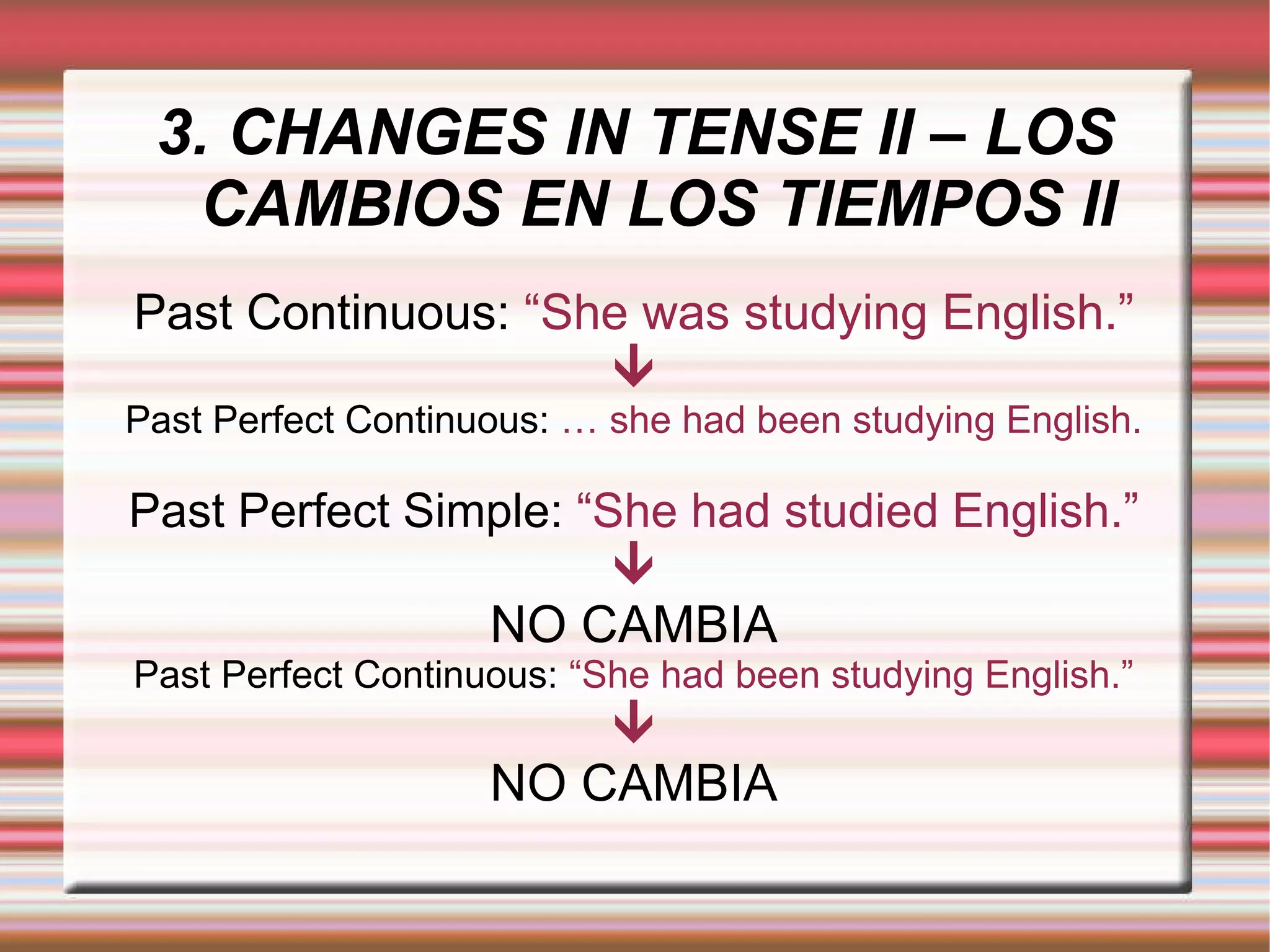
3. CHANGES IN TENSE II – LOS CAMBIOS EN LOS TIEMPOS II Past Continuous:  “She was studying English.”  Past Perfect Continuous:  … she had been studying English. Past Perfect Simple:  “She had studied English.”  NO CAMBIA Past Perfect Continuous:  “She had been studying English.”  NO CAMBIA
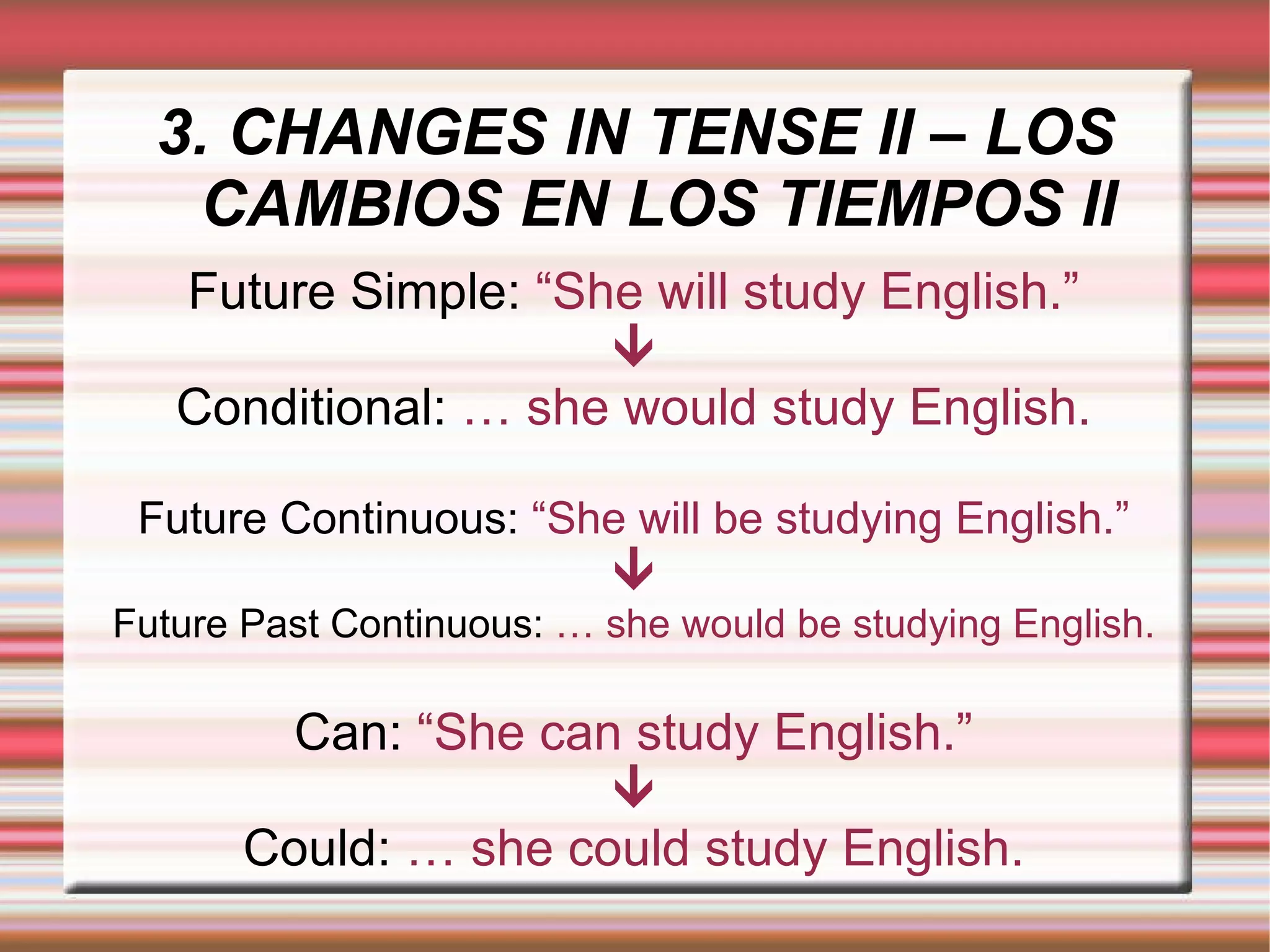
3. CHANGES IN TENSE II – LOS CAMBIOS EN LOS TIEMPOS II Future Simple:  “She will study English.”  Conditional:  … she would study English. Future Continuous:  “She will be studying English.”  Future Past Continuous:  … she would be studying English. Can:  “She can study English.”  Could:  … she could study English.
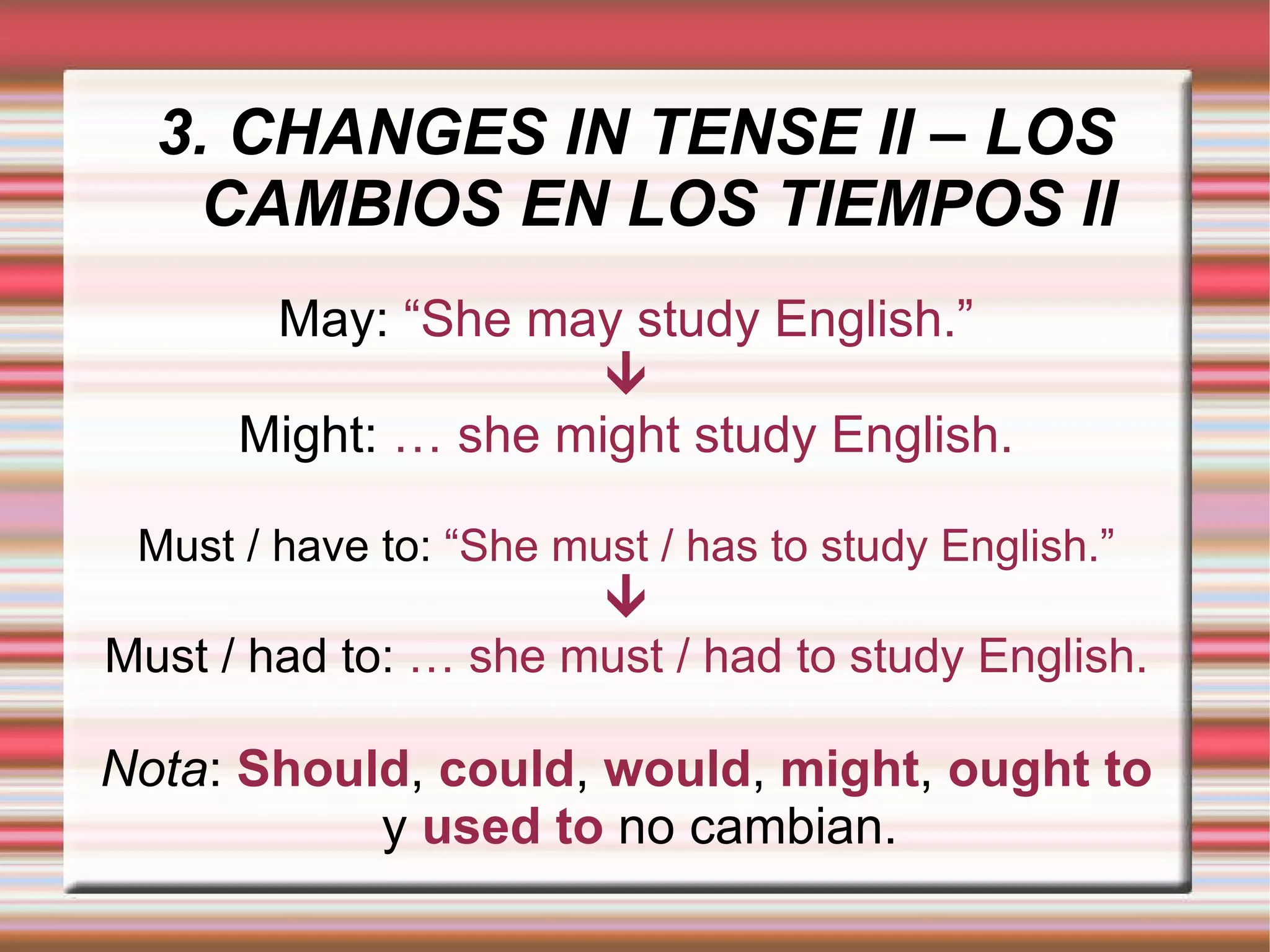
3. CHANGES IN TENSE II – LOS CAMBIOS EN LOS TIEMPOS II May:  “She may study English.”  Might:  … she might study English. Must / have to:  “She must / has to study English.”  Must / had to:  … she must / had to study English. Nota :   Should ,   could ,   would ,   might ,   ought to   y   used to   no cambian.
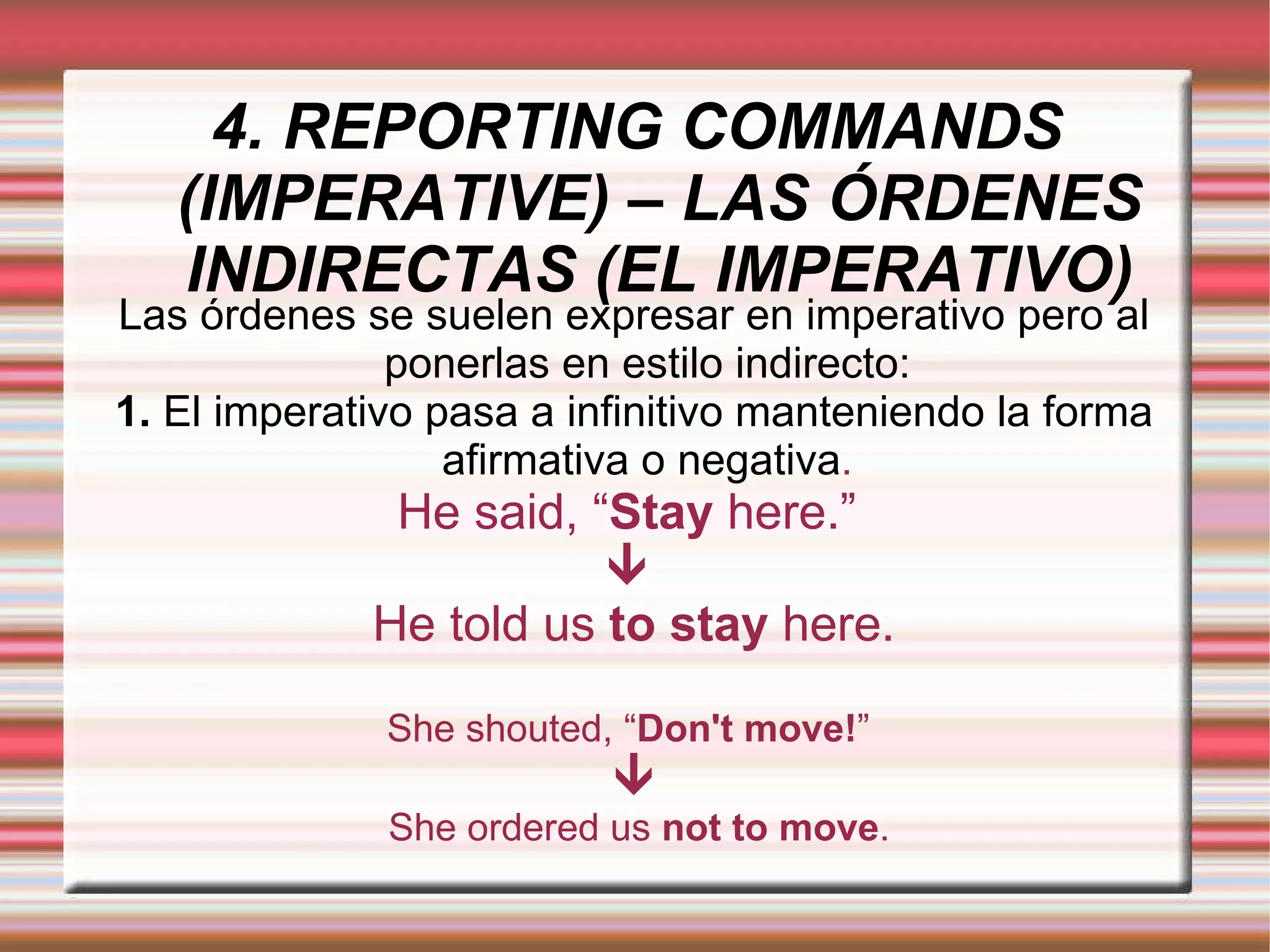
4. REPORTING COMMANDS (IMPERATIVE) – LAS ÓRDENES INDIRECTAS (EL IMPERATIVO) Las órdenes se suelen expresar en imperativo pero al ponerlas en estilo indirecto: 1.  El imperativo pasa a infinitivo manteniendo la forma afirmativa o negativa . He said, “ Stay  here.”     He told us  to stay  here. She shouted, “ Don't move! ”   She ordered us  not to move .
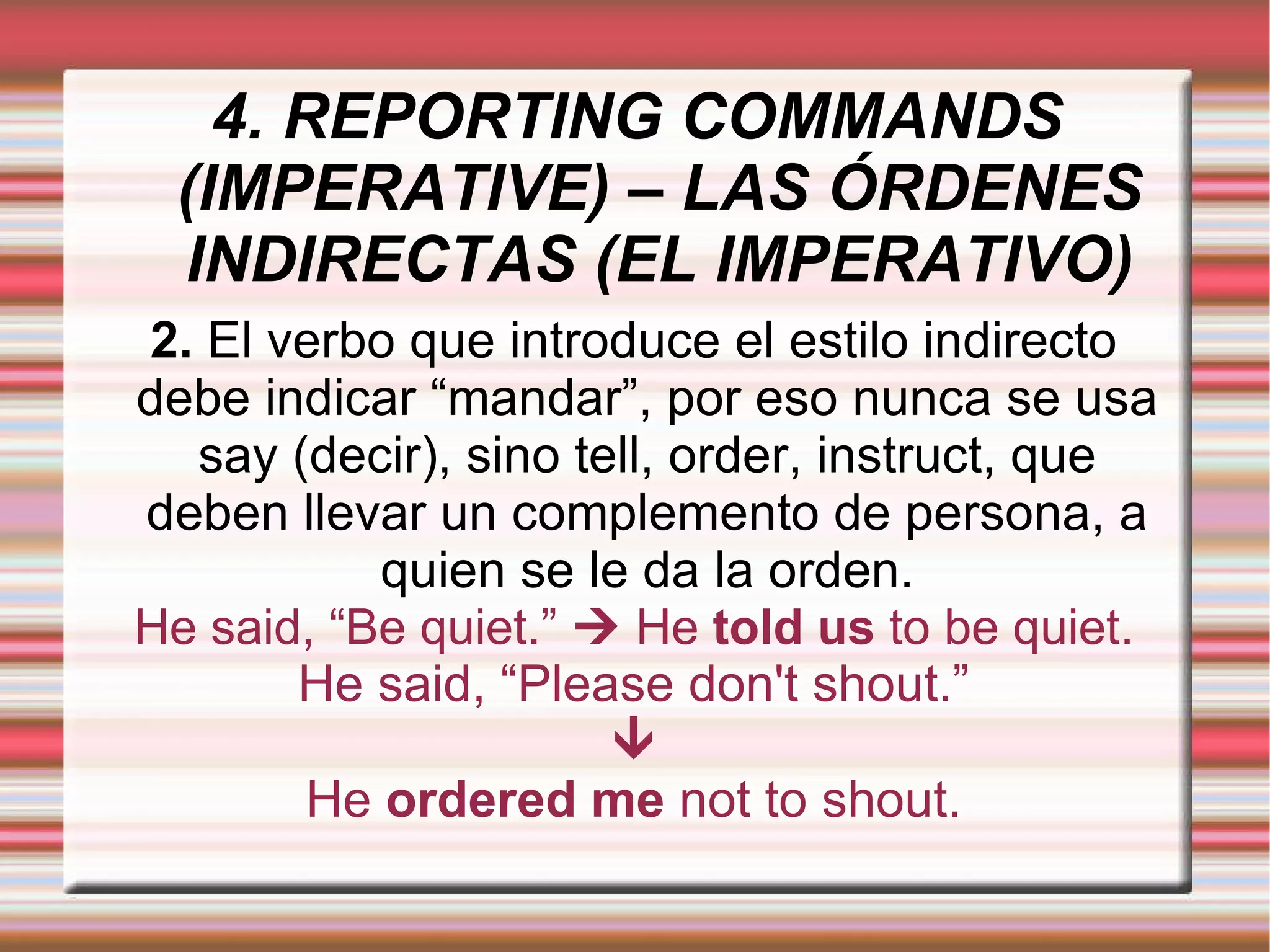
4. REPORTING COMMANDS (IMPERATIVE) – LAS ÓRDENES INDIRECTAS (EL IMPERATIVO) 2.  El verbo que introduce el estilo indirecto debe indicar “mandar”, por eso nunca se usa say (decir), sino tell, order, instruct, que deben llevar un complemento de persona, a quien se le da la orden. He said, “Be quiet.”    He  told us  to be quiet.
He said, “Please don't shout.”

Reported Speech

  • 1.
    REPORTED SPEECH “ELESTILO INDIRECTO” IES MURGI
  • 2.
    1. REPORTING STATEMENTS– LAS ORACIONES ENUNCIATIVAS A) Podemos contar lo que alguien dijo de dos maneras: 1. Repitiendo la idea, pero no las palabras exactas, es decir, empleando el estilo directo. “ I have to go now,” she said. “ We lived in Paris for three years,” Peter said. 2. Contando la idea, pero no las palabras exactas, que es el “estilo indirecto”. She said (that) she had to go then. Peter told us (that) they had lived in Paris for three years.
  • 3.
    1. REPORTING STATEMENTS– LAS ORACIONES ENUNCIATIVAS En el estilo directo se utilizan comillas y mayúsculas al empezar la cita, pero en el estilo indirecto: 1. No hay comillas. 2. La frase se suele introducir con los verbos say y tell , o con accept , advise , agree , announce , apologise , ask , beg , claim , complain , declare , explain , insist , invite , offer , point out , protest , remind , remark , state , think , etc. que llamamos reporting verbs .
  • 4.
    1. REPORTING STATEMENTS– LAS ORACIONES ENUNCIATIVAS Nota : Después de los verbos say , suggest , tell y think podemos omitir that , pero nunca se puede omitir con verbos como explain , complain , point out , etc. 3. El tiempo de la narración da una especie de “salto atrás” si el verbo que lo introduce va en pasado. 4. Las palabras que indican lugar o tiempo, los pronombres personales y posesivos, los demostrativos, etc., cambian lógicamente. 5. Las preguntas dejan de serlo.
  • 5.
    2. CHANGES INTENSE I – LOS CAMBIOS EN LOS TIEMPOS I A) Si el verbo que introduce el estilo indirecto está en pasado, el tiempo que teníamos en el estilo directo da un salto atrás. “ I have read the note,” she said. She said that she had read the note. “ He is working in the office now,” they told me. They told me that he was working in the office then. Nota : Fíjate en que tell debe llevar siempre un complemento indirecto de persona.
  • 6.
    2. CHANGES INTENSE I – LOS CAMBIOS EN LOS TIEMPOS I B) Si el verbo está compuesto de más de un auxiliar, sólo precisa el primero. “ My house is being redecorated,” she said. She said that her house was being redecorated. C) Estos cambios no ocurren: 1. Cuando el verbo que introduce la cita está en presente o en futuro. “ I love soup,” says Mary. Mary says she loves soup.
  • 7.
    2. CHANGES INTENSE I – LOS CAMBIOS EN LOS TIEMPOS I 2. Cuando se narra una verdad objetiva o una situación permanente. “ London is the capital of Great Britain,” she pointed out. She pointed out that London is the capital of Great Britain . “ Peter lives in Market Street,” I told them. I told them that Peter lives in Market Street.
  • 8.
    2. CHANGES INTENSE I – LOS CAMBIOS EN LOS TIEMPOS I D) Otros cambios necesarios al pasar una frase a estilo indirecto son estos: 1. Los pronombres personales y los adjetivos o pronombres posesivos de 1ª a 2ª persona cambian según quien habla, pero los de 3ª persona no cambian. 2. Las expresiones de tiempo y de lugar. now  then today / tonight  that day / that night yesterday  the day before, the previous day tomorrow  the next/following day, the day after
  • 9.
    2. CHANGES INTENSE I – LOS CAMBIOS EN LOS TIEMPOS I next week / month  the following week / month last week / month  the previous week / month the week / month before a week / month ago  the week / month before here  there 3. Los demostrativos. this  that these  those
  • 10.
    3. CHANGES INTENSE II – LOS CAMBIOS EN LOS TIEMPOS II Present Simple: “She studies English.”  Past Simple: … she studied English. Present Continuous: “She is studying English.”  Past Continuous: … she was studying English. ESTILO DIRECTO: He said, ESTILO INDIRECTO: He said that
  • 11.
    3. CHANGES INTENSE II – LOS CAMBIOS EN LOS TIEMPOS II Present Perfect Simple: “She has studied English.”  Past Perfect Simple: … she had studied English. Present Perfect Continuous: “She has been studying English.”  Past Perfect Continuous: … she had been studying English. Past Simple: “She studied English.”  Past Perfect Simple: … she had studied English.
  • 12.
    3. CHANGES INTENSE II – LOS CAMBIOS EN LOS TIEMPOS II Past Continuous: “She was studying English.”  Past Perfect Continuous: … she had been studying English. Past Perfect Simple: “She had studied English.”  NO CAMBIA Past Perfect Continuous: “She had been studying English.”  NO CAMBIA
  • 13.
    3. CHANGES INTENSE II – LOS CAMBIOS EN LOS TIEMPOS II Future Simple: “She will study English.”  Conditional: … she would study English. Future Continuous: “She will be studying English.”  Future Past Continuous: … she would be studying English. Can: “She can study English.”  Could: … she could study English.
  • 14.
    3. CHANGES INTENSE II – LOS CAMBIOS EN LOS TIEMPOS II May: “She may study English.”  Might: … she might study English. Must / have to: “She must / has to study English.”  Must / had to: … she must / had to study English. Nota : Should , could , would , might , ought to y used to no cambian.
  • 15.
    4. REPORTING COMMANDS(IMPERATIVE) – LAS ÓRDENES INDIRECTAS (EL IMPERATIVO) Las órdenes se suelen expresar en imperativo pero al ponerlas en estilo indirecto: 1. El imperativo pasa a infinitivo manteniendo la forma afirmativa o negativa . He said, “ Stay here.”  He told us to stay here. She shouted, “ Don't move! ”  She ordered us not to move .
  • 16.
    4. REPORTING COMMANDS(IMPERATIVE) – LAS ÓRDENES INDIRECTAS (EL IMPERATIVO) 2. El verbo que introduce el estilo indirecto debe indicar “mandar”, por eso nunca se usa say (decir), sino tell, order, instruct, que deben llevar un complemento de persona, a quien se le da la orden. He said, “Be quiet.”  He told us to be quiet.
  • 17.
    He said, “Pleasedon't shout.”
  • 18.
  • 19.
    He orderedme not to shout.
  • 20.
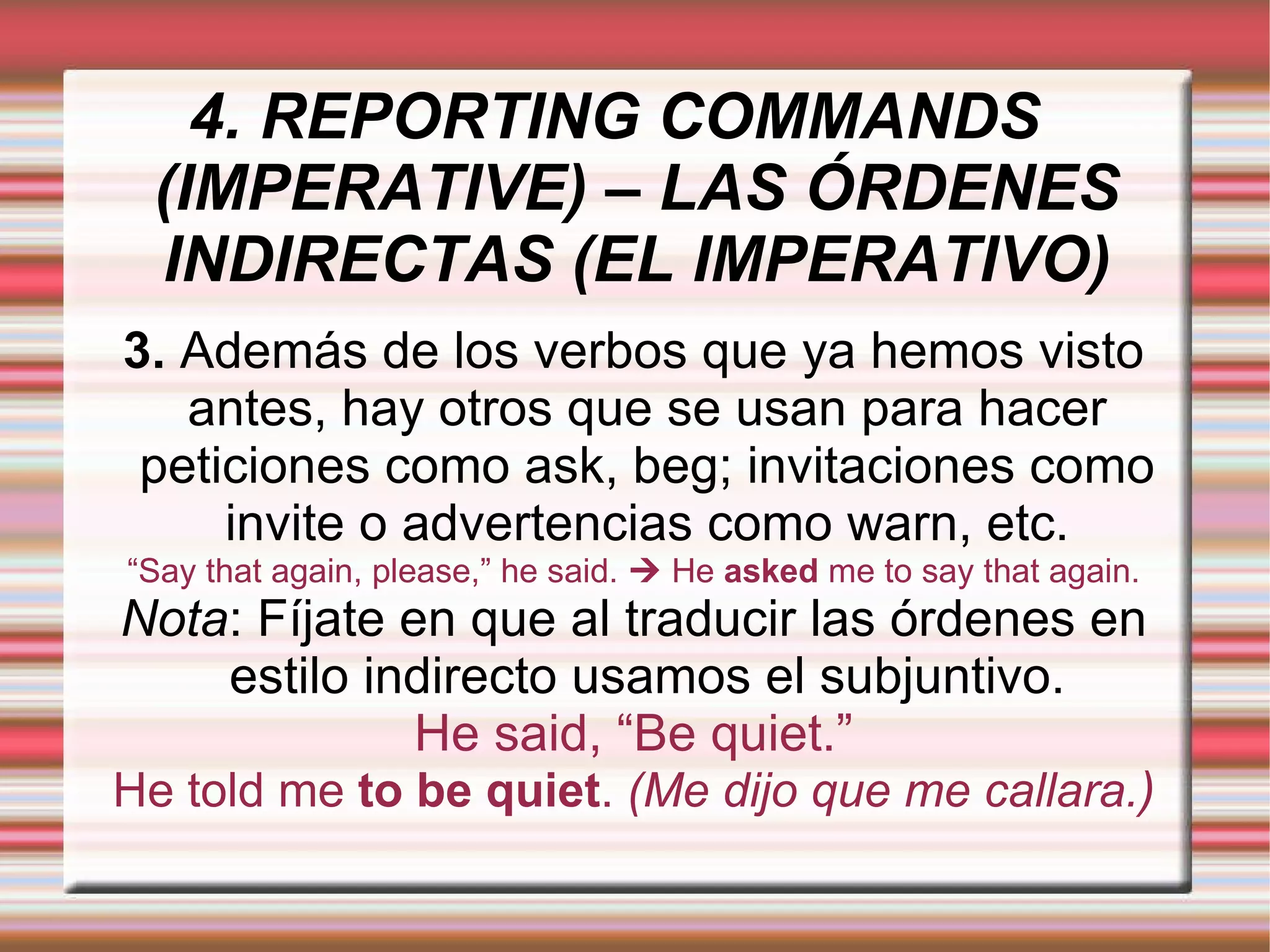
    4. REPORTING COMMANDS(IMPERATIVE) – LAS ÓRDENES INDIRECTAS (EL IMPERATIVO) 3. Además de los verbos que ya hemos visto antes, hay otros que se usan para hacer peticiones como ask, beg; invitaciones como invite o advertencias como warn, etc. “ Say that again, please,” he said.  He asked me to say that again. Nota : Fíjate en que al traducir las órdenes en estilo indirecto usamos el subjuntivo. He said, “Be quiet.” He told me to be quiet . (Me dijo que me callara. )