
REPORT ON OPTIONS FOR DIVISION WEBINARS 
Divisions Council - Education Committee (Summer 2011)
Introduction 
This report provides a description of existing services, both external and in-house, available 
to APA divisions for hosting and broadcasting webcasts to their members and other 
interested professionals, and specifically looks at the external Planning Webcast series. In 
addition, it includes an analysis of options for expanding these services. The report was 
produced in response to a request from the APA Divisions Council (DC), as follows: 
Mission Statement * 
To develop DC’s recommendations for educational programs, professional development 
and mentoring to be provided by divisions. 
1. To seek opportunities for complementary efforts among divisions, and with APA's 
component groups, including the Chapter Presidents Council (CPC), Student 
Representative Council (SRC), and American Institute of Certified Planners (AICP). 
2. The committee will also consider collaboration opportunities with external 
organizations where it serves APA's interests and furthers the adopted Development 
Plan. 
“In addition to its standing mission, the DC Education Committee (EC) shall develop one 
or more models through which Divisions may both deliver Certification Maintenance (CM) 
content and also generate additional sources of revenue for Divisions. The Committee shall 
consider current APA policies regarding access to Webinar software and the pricing of such 
access. Also, in building a revenue or business model, consider the pricing of other CM 
offerings, especially Webinars.” 
Towards these objectives, key team members were recruited at the National Conference in 
Boston. Refer to Appendix 2 for committee composition. 
* http://www.planning.org/leadership/committees/dc/education.htm 
Background 
The external Planning Webcasts series is run as a co-op and enjoys broad support within 
APA, being co-sponsored by six divisions and twenty- four chapters. Note that only 
divisions and chapters can be part of this co-op, not individual APA members. This number 
of co-sponsors varies only slightly on a monthly basis. To schedule a webcast, the instructor 
simply emails the title, description and biography, to the series coordinator 
(planningwebcast@yahoo.com) while the co-sponsors do the rest, including training new 
participants, registering participants, scheduling and advertising webcasts, trouble-shooting, 
collecting ratings, submitting credits etc. 
The service is streamed via Citrix's GoToMeeting, a remote meeting and desktop sharing 
software, and its website is administered by APA-UT (http://www.utah-apa.org/webcasts). 
Prakash, Harsh et al. Divisions Council, Education Committee. Summer 2011 Page 1 of 17
Some co-sponsors also link to their webcasts from their home pages on 
http://www.planning.org/. The external webcast series carries a fee for its co-sponsors, but 
not for the users. This no-cost and ease-of use for the users, its biggest selling points, are 
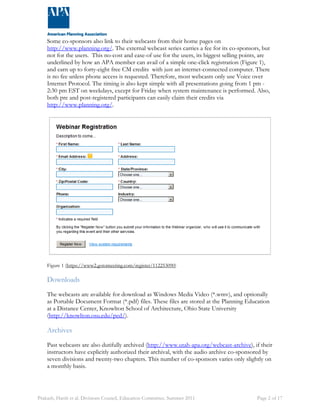
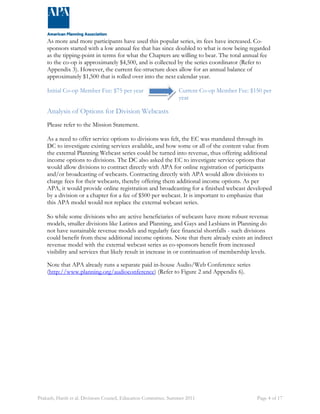
underlined by how an APA member can avail of a simple one-click registration (Figure 1), 
and earn up to forty-eight free CM credits with just an internet-connected computer. There 
is no fee unless phone access is requested. Therefore, most webcasts only use Voice over 
Internet Protocol. The timing is also kept simple with all presentations going from 1 pm - 
2:30 pm EST on weekdays, except for Friday when system maintenance is performed. Also, 
both pre and post-registered participants can easily claim their credits via 
http://www.planning.org/. 
Figure 1 (https://www2.gotomeeting.com/register/112253090) 
Downloads 
The webcasts are available for download as Windows Media Video (*.wmv), and optionally 
as Portable Document Format (*.pdf) files. These files are stored at the Planning Education 
at a Distance Center, Knowlton School of Architecture, Ohio State University 
(http://knowlton.osu.edu/ped/). 
Archives 
Past webcasts are also dutifully archived (http://www.utah-apa.org/webcast-archive), if their 
instructors have explicitly authorized their archival, with the audio archive co-sponsored by 
seven divisions and twenty-two chapters. This number of co-sponsors varies only slightly on 
a monthly basis. 
Prakash, Harsh et al. Divisions Council, Education Committee. Summer 2011 Page 2 of 17
Participants 
* Minimum 98 - Maximum 1,055 participants per webcast. 
* Average 400 - 500 participants per webcast. 
* Approximately 90% of participants are AICP. 
Topics 
Popular topics include Law and Ethics, Real Estate Finance, and Regional Issues. They 
topics are broken down into Introductory (appropriate for planners who are not working 
directly in this content area), Advanced (appropriate for planners who are working directly in 
this content area and planners in a management role supervising planners who are working 
in this content area), and Allied (appropriate for all planners and will cover topics in allied 
fields related to planning). 
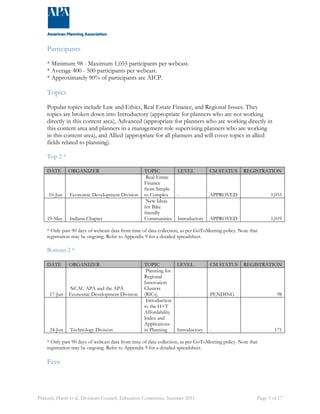
Top 2 * 
DATE ORGANIZER TOPIC LEVEL CM STATUS REGISTRATION 
10-Jun Economic Development Division 
Real Estate 
Finance 
from Simple 
to Complex - APPROVED 1,055 
19-May Indiana Chapter 
New Ideas 
for Bike 
friendly 
Communities Introductory APPROVED 1,019 
* Only past 90 days of webcast data from time of data collection, as per GoToMeeting policy. Note that 
registration may be ongoing. Refer to Appendix 9 for a detailed spreadsheet. 
Bottom 2 * 
DATE ORGANIZER TOPIC LEVEL CM STATUS REGISTRATION 
17-Jun 
NCAC APA and the APA 
Economic Development Division 
Planning for 
Regional 
Innovation 
Clusters 
(RICs) - PENDING 98 
24-Jun Technology Division 
Introduction 
to the H+T 
Affordability 
Index and 
Applications 
in Planning Introductory - 171 
* Only past 90 days of webcast data from time of data collection, as per GoToMeeting policy. Note that 
registration may be ongoing. Refer to Appendix 9 for a detailed spreadsheet. 
Fees 
Prakash, Harsh et al. Divisions Council, Education Committee. Summer 2011 Page 3 of 17
As more and more participants have used this popular series, its fees have increased. Co-sponsors 
started with a low annual fee that has since doubled to what is now being regarded 
as the tipping-point in terms for what the Chapters are willing to bear. The total annual fee 
to the co-op is approximately $4,500, and is collected by the series coordinator (Refer to 
Appendix 3). However, the current fee-structure does allow for an annual balance of 
approximately $1,500 that is rolled over into the next calendar year. 
Initial Co-op Member Fee: $75 per year Current Co-op Member Fee: $150 per 
year 
Analysis of Options for Division Webcasts 
Please refer to the Mission Statement. 
As a need to offer service options to divisions was felt, the EC was mandated through its 
DC to investigate existing services available, and how some or all of the content value from 
the external Planning Webcast series could be turned into revenue, thus offering additional 
income options to divisions. The DC also asked the EC to investigate service options that 
would allow divisions to contract directly with APA for online registration of participants 
and/or broadcasting of webcasts. Contracting directly with APA would allow divisions to 
charge fees for their webcasts, thereby offering them additional income options. As per 
APA, it would provide online registration and broadcasting for a finished webcast developed 
by a division or a chapter for a fee of $500 per webcast. It is important to emphasize that 
this APA model would not replace the external webcast series. 
So while some divisions who are active beneficiaries of webcasts have more robust revenue 
models, smaller divisions like Latinos and Planning, and Gays and Lesbians in Planning do 
not have sustainable revenue models and regularly face financial shortfalls - such divisions 
could benefit from these additional income options. Note that there already exists an indirect 
revenue model with the external webcast series as co-sponsors benefit from increased 
visibility and services that likely result in increase in or continuation of membership levels. 
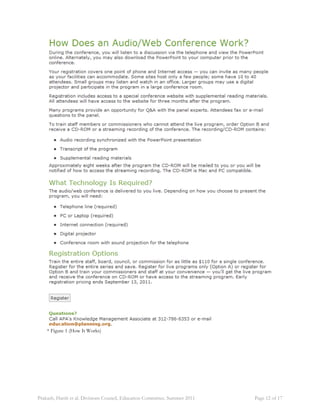
Note that APA already runs a separate paid in-house Audio/Web Conference series 
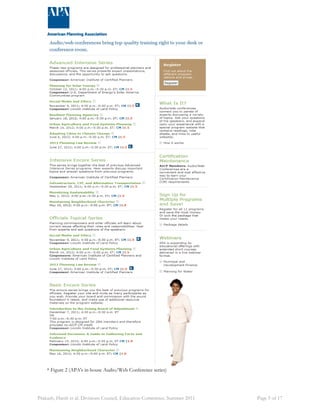
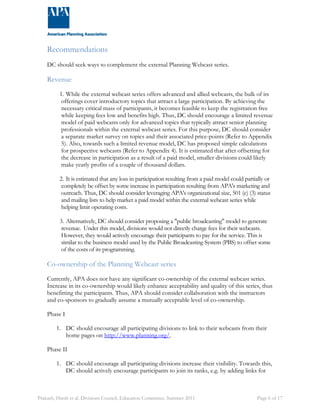
(http://www.planning.org/audioconference) (Refer to Figure 2 and Appendix 6). 
Prakash, Harsh et al. Divisions Council, Education Committee. Summer 2011 Page 4 of 17
* Figure 2 (APA's in-house Audio/Web Conference series) 
Prakash, Harsh et al. Divisions Council, Education Committee. Summer 2011 Page 5 of 17
Recommendations 
DC should seek ways to complement the external Planning Webcast series. 
Revenue 
1. While the external webcast series offers advanced and allied webcasts, the bulk of its 
offerings cover introductory topics that attract a large participation. By achieving the 
necessary critical mass of participants, it becomes feasible to keep the registration free 
while keeping fees low and benefits high. Thus, DC should encourage a limited revenue 
model of paid webcasts only for advanced topics that typically attract senior planning 
professionals within the external webcast series. For this purpose, DC should consider 
a separate market survey on topics and their associated price-points (Refer to Appendix 
5). Also, towards such a limited revenue model, DC has proposed simple calculations 
for prospective webcasts (Refer to Appendix 4). It is estimated that after offsetting for 
the decrease in participation as a result of a paid model, smaller divisions could likely 
make yearly profits of a couple of thousand dollars. 
2. It is estimated that any loss in participation resulting from a paid model could partially or 
completely be offset by some increase in participation resulting from APA's marketing and 
outreach. Thus, DC should consider leveraging APA's organizational size, 501 (c) (3) status 
and mailing lists to help market a paid model within the external webcast series while 
helping limit operating costs. 
3. Alternatively, DC should consider proposing a "public broadcasting" model to generate 
revenue. Under this model, divisions would not directly charge fees for their webcasts. 
However, they would actively encourage their participants to pay for the service. This is 
similar to the business model used by the Public Broadcasting System (PBS) to offset some 
of the costs of its programming. 
Co-ownership of the Planning Webcast series 
Currently, APA does not have any significant co-ownership of the external webcast series. 
Increase in its co-ownership would likely enhance acceptability and quality of this series, thus 
benefitting the participants. Thus, APA should consider collaboration with the instructors 
and co-sponsors to gradually assume a mutually acceptable level of co-ownership. 
Phase I 
1. DC should encourage all participating divisions to link to their webcasts from their 
home pages on http://www.planning.org/. 
Phase II 
1. DC should encourage all participating divisions increase their visibility. Towards this, 
DC should actively encourage participants to join its ranks, e.g. by adding links for 
Prakash, Harsh et al. Divisions Council, Education Committee. Summer 2011 Page 6 of 17
joining divisions to registration emails sent to the participants of the external 
Planning Webcast series. 
Phase III 
1. It is the committee’s understanding that APA attempted adding logos to the landing 
page (http://www.utah-apa.org/webcasts). APA should reconsider this identity 
branding via targeted banner advertisements with more flexible logo requirements. 
Additionally, APA should consider promoting the webcasts on 
http://www.planning.org/webcasts via mirroring etc. Note that this would require 
APA to be prompt in updating its website with regards to webcast schedules. 
2. Since it is currently not feasible to have APA run the registration (Refer to Appendix 
7) instead of GoToMeeting's integrated system without introducing unpredictability 
and high fees, APA should consider copying the registration data for marketing 
purposes- including ratings, topics, speakers and traffic, to 
http://www.planning.org/. 
Please also refer to Appendix 1. 
Prakash, Harsh et al. Divisions Council, Education Committee. Summer 2011 Page 7 of 17
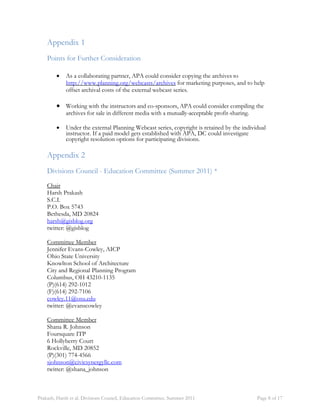
Appendix 1 
Points for Further Consideration 
 As a collaborating partner, APA could consider copying the archives to 
http://www.planning.org/webcasts/archives for marketing purposes, and to help 
offset archival costs of the external webcast series. 
 Working with the instructors and co-sponsors, APA could consider compiling the 
archives for sale in different media with a mutually-acceptable profit-sharing. 
 Under the external Planning Webcast series, copyright is retained by the individual 
instructor. If a paid model gets established with APA, DC could investigate 
copyright resolution options for participating divisions. 
Appendix 2 
Divisions Council - Education Committee (Summer 2011) * 
Chair 
Harsh Prakash 
S.C.I. 
P.O. Box 5743 
Bethesda, MD 20824 
harsh@gisblog.org 
twitter: @gisblog 
Committee Member 
Jennifer Evans-Cowley, AICP 
Ohio State University 
Knowlton School of Architecture 
City and Regional Planning Program 
Columbus, OH 43210-1135 
(P)(614) 292-1012 
(F)(614) 292-7106 
cowley.11@osu.edu 
twitter: @evanscowley 
Committee Member 
Shana R. Johnson 
Foursquare ITP 
6 Hollyberry Court 
Rockville, MD 20852 
(P)(301) 774-4566 
sjohnson@civicsynergyllc.com 
twitter: @shana_johnson 
Prakash, Harsh et al. Divisions Council, Education Committee. Summer 2011 Page 8 of 17
Committee Member 
Vicki Taylor Lee, AICP 
Cherokee County Georgia 
1130 Bluffs Parkway 
Canton, GA 30114-2703 
(P)(678) 493-6105 
(F)(678) 493-6111 
vtaylor@cherokeega.com 
Committee Member 
Robert A. Leiter, FAICP 
San Diego Association of Governments 
401 B St Ste 800 
San Diego, CA 92101-4231 
(P)(619) 699-6980 
ble@sandag.org 
Committee Member 
Juli Beth Hinds, AICP 
Tetra Tech 
9444 Balboa Ave #215 
San Diego, CA 92123 
(P)(858) 268-5746 
julibeth.hinds@tetratech.com 
Committee Member 
Daniel A. Friedlander 
Jackson, Demarcom, Tidus and Peckenpaugh 
2815 Townsgate Road, Suite 200 
Westlake Village, CA 91361 
(P)(805) 418-1909 
(F)(805) 230-0087 
dfriedlander@jdtplaw.com 
Staff Resource 
Ann Simms 
American Planning Association 
205 N Michigan Ave., Ste 1200 
Chicago, IL 60601 
(P)(312) 431-9100 
(F)(312) 431-9985 
asimms@planning.org 
* http://www.planning.org/leadership/committees/dc/education.htm 
Appendix 3 
Prakash, Harsh et al. Divisions Council, Education Committee. Summer 2011 Page 9 of 17
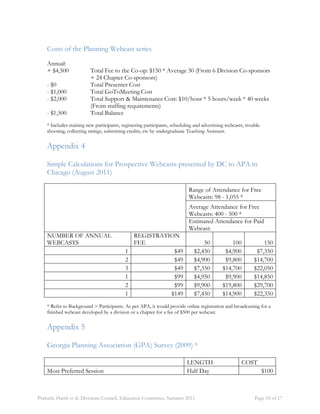
Costs of the Planning Webcast series 
Annual: 
+ $4,500 Total Fee to the Co-op: $150 * Average 30 (From 6 Division Co-sponsors 
+ 24 Chapter Co-sponsors) 
- $0 Total Presenter Cost 
- $1,000 Total GoToMeeting Cost 
- $2,000 Total Support & Maintenance Cost: $10/hour * 5 hours/week * 40 weeks 
(From staffing requirements) 
- $1,500 Total Balance 
* Includes training new participants, registering participants, scheduling and advertising webcasts, trouble-shooting, 
collecting ratings, submitting credits, etc by undergraduate Teaching Assistant. 
Appendix 4 
Simple Calculations for Prospective Webcasts presented by DC to APA in 
Chicago (August 2011) 
Range of Attendance for Free 
Webcasts: 98 - 1,055 * 
Average Attendance for Free 
Webcasts: 400 - 500 * 
Estimated Attendance for Paid 
Webcast: 
NUMBER OF ANNUAL 
WEBCASTS 
REGISTRATION 
FEE 50 100 150 
1 $49 $2,450 $4,900 $7,350 
2 $49 $4,900 $9,800 $14,700 
3 $49 $7,350 $14,700 $22,050 
1 $99 $4,950 $9,900 $14,850 
2 $99 $9,900 $19,800 $29,700 
1 $149 $7,450 $14,900 $22,350 
* Refer to Background > Participants. As per APA, it would provide online registration and broadcasting for a 
finished webcast developed by a division or a chapter for a fee of $500 per webcast. 
Appendix 5 
Georgia Planning Association (GPA) Survey (2009) * 
LENGTH COST 
Most Preferred Session Half Day $100 
Prakash, Harsh et al. Divisions Council, Education Committee. Summer 2011 Page 10 of 17
Second Most Preferred Session Full Day $200 
* http://georgiaplanning.org/ 
Appendix 6 
APA’s in-house Audio/Web Conference series * 
Prakash, Harsh et al. Divisions Council, Education Committee. Summer 2011 Page 11 of 17
* Figure 1 (How It Works) 
Prakash, Harsh et al. Divisions Council, Education Committee. Summer 2011 Page 12 of 17
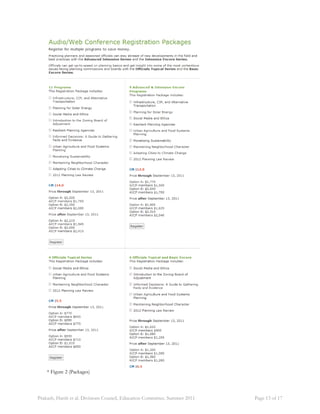
* Figure 2 (Packages) 
Prakash, Harsh et al. Divisions Council, Education Committee. Summer 2011 Page 13 of 17
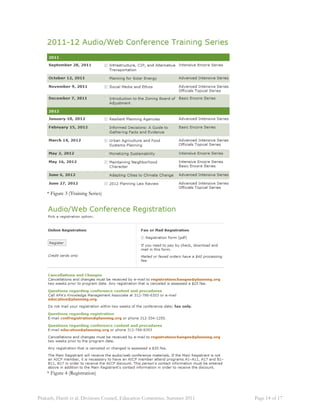
* Figure 3 (Training Series) 
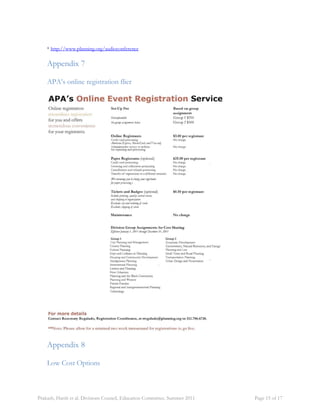
* Figure 4 (Registration) 
Prakash, Harsh et al. Divisions Council, Education Committee. Summer 2011 Page 14 of 17
* http://www.planning.org/audioconference 
Appendix 7 
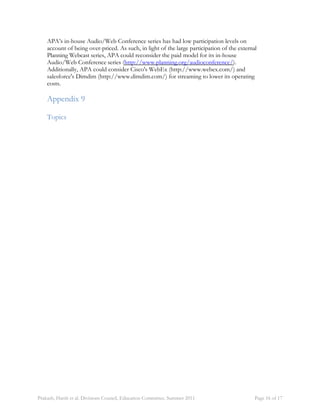
APA’s online registration flier 
Appendix 8 
Low Cost Options 
Prakash, Harsh et al. Divisions Council, Education Committee. Summer 2011 Page 15 of 17
APA’s in-house Audio/Web Conference series has had low participation levels on 
account of being over-priced. As such, in light of the large participation of the external 
Planning Webcast series, APA could reconsider the paid model for its in-house 
Audio/Web Conference series (http://www.planning.org/audioconference/). 
Additionally, APA could consider Cisco's WebEx (http://www.webex.com/) and 
salesforce's Dimdim (http://www.dimdim.com/) for streaming to lower its operating 
costs. 
Appendix 9 
Topics 
Prakash, Harsh et al. Divisions Council, Education Committee. Summer 2011 Page 16 of 17
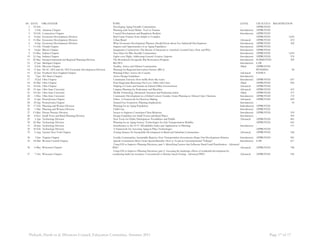
SN DATE ORGANIZER TOPIC LEVEL CM STATUS REGISTRATION 
1 23-Feb - Developing Aging Friendly Communities - APPROVED 
2 1-Feb Arkansas Chapter Planning with Social Media: Tool or Trauma Introductory APPROVED 
3 18-Feb Connecticut Chapter Coastal Development and Regulatory Realities Introductory APPROVED 
4 10-Jun Economic Development Division Real Estate Finance from Simple to Complex - APPROVED 1,055 
5 11-Mar Economic Development Division Urban Retail Advanced APPROVED 472 
6 8-Sep Economic Development Division What Economic Development Planners Should Know about Eco Industrial Development Introductory APPROVED 322 
7 11-Feb Florida Chapter Impacts and Opportunities of an Aging Population Introductory APPROVED 
8 14-Jan Illinois Chapter Imaginative Connectivity: The Return of Streetcars to America's Central Cities, How and Why Introductory APPROVED 
9 19-May Indiana Chapter New Ideas for Bike friendly Communities Introductory APPROVED 1,019 
10 12-Aug Indiana Chapter Fights over Flight: Addressing General Aviation Airports Introductory APPROVED 374 
11 25-May Intergovernmental and Regional Planning Division The Revitalized Chesapeake Bay Restoration Program Introductory SUBMITTED 383 
12 27-Jan Michigan Chapter RLUIPA Introductory LAW 
13 4-Feb Missouri Chapter Healthy, Active and Vibrant Communities Allied APPROVED 
14 17-Jun NCAC APA and the APA Economic Development Division Planning for Regional Innovation Clusters (RICs) - PENDING 98 
15 21-Jan Northern New England Chapter Planning Ethics Across the Country Advanced ETHICS 
16 7-Jan NY Metro Chapter Active Design Guidelines Introductory - 
17 15-Jul Ohio Chapter Community Erosion: How traffic flows like water Introductory APPROVED 657 
18 10-Mar Ohio Chapter Peter Kageyama Renewing Our Love Affair with Cities Allied APPROVED 656 
19 10-Feb Ohio Chapter Helping to Create and Sustain an Ethical Office Environment Advanced APPROVED 
20 15-Apr Ohio State University Campus Planning for Pedestrians and Bicyclists Advanced APPROVED 633 
21 14-Oct Ohio State University Mobile Technology, Distracted Attention and Pedestrian Safety Allied APPROVED 371 
22 1-Dec Ohio State University Community Development in a Global Context: Gender Aware Planning in African Cities Charisma Introductory APPROVED 172 
23 8-Apr Pennsylvania Chapter Ethics: A Framework for Decision Making Advanced APPROVED 852 
24 23-Sep Pennsylvania Chapter Natural Gas Extraction: Planning Implications Introductory - 18 
25 17-Feb Planning and Women Division Planning for an Aging Population Indroductory APPROVED 
26 1-Mar Planning and Women Division Child Care Introductory APPROVED 
27 13-May Private Practice Division Secrets to Improce Consultant Client Relations Introductory APPROVED 539 
28 4-Nov Small Town and Rural Planning Division Design Guidelines for Small Towns and Rural Places Introductory - 393 
29 1-Apr Technology Division New Tools for Public Participation: Possibilities and Pitfalls Advanced APPROVED 861 
30 25-Mar Technology Division Planning for an Aging Society: Technologies for Safe Transportation Mobility - APPROVED 641 
31 24-Jun Technology Division Introduction to the H+T Affordability Index and Applications in Planning Introductory - 171 
32 25-Feb Technology Division A Framework for Assessing Aging in Place Technologies - APPROVED 
33 5-Aug Upstate New York Chapter Zoning Statutes for Sustainable Development in Rural and Suburban Communities Advanced APPROVED 354 
34 3-Jun Virginia Chapter Livable Communities, Sustainable Regions: How Transportation Investments Shape Our Development Patterns Introductory APPROVED 581 
35 18-Mar Western Central Chapter Special Assessments Must Create Special Benefits: How to Avoid an Unconstitutional "Takings" Introductory LAW 617 
36 6-May Wisconsin Chapter 
Using GIS to Improve Planning Decisions, part 1: Identifying Factors that Influence Rural Land Parcelization - Advanced 
PDO Advanced APPROVED 708 
37 7-Oct Wisconsin Chapter 
Using GIS to Improve Planning Decisions, part 2: Assessing the landscape effects of residential development by 
conducting build out scenarios: Conventional vs Density based Zoning - Advanced PDO Advanced APPROVED 536 
Prakash, Harsh et al. Divisions Council, Education Committee. Summer 2011 Page 17 of 17

Report on Options for Division Webinars - Final (Version 7) - APA - DC - EC (11)

  • 1.
    REPORT ON OPTIONSFOR DIVISION WEBINARS Divisions Council - Education Committee (Summer 2011)
  • 2.
    Introduction This reportprovides a description of existing services, both external and in-house, available to APA divisions for hosting and broadcasting webcasts to their members and other interested professionals, and specifically looks at the external Planning Webcast series. In addition, it includes an analysis of options for expanding these services. The report was produced in response to a request from the APA Divisions Council (DC), as follows: Mission Statement * To develop DC’s recommendations for educational programs, professional development and mentoring to be provided by divisions. 1. To seek opportunities for complementary efforts among divisions, and with APA's component groups, including the Chapter Presidents Council (CPC), Student Representative Council (SRC), and American Institute of Certified Planners (AICP). 2. The committee will also consider collaboration opportunities with external organizations where it serves APA's interests and furthers the adopted Development Plan. “In addition to its standing mission, the DC Education Committee (EC) shall develop one or more models through which Divisions may both deliver Certification Maintenance (CM) content and also generate additional sources of revenue for Divisions. The Committee shall consider current APA policies regarding access to Webinar software and the pricing of such access. Also, in building a revenue or business model, consider the pricing of other CM offerings, especially Webinars.” Towards these objectives, key team members were recruited at the National Conference in Boston. Refer to Appendix 2 for committee composition. * http://www.planning.org/leadership/committees/dc/education.htm Background The external Planning Webcasts series is run as a co-op and enjoys broad support within APA, being co-sponsored by six divisions and twenty- four chapters. Note that only divisions and chapters can be part of this co-op, not individual APA members. This number of co-sponsors varies only slightly on a monthly basis. To schedule a webcast, the instructor simply emails the title, description and biography, to the series coordinator (planningwebcast@yahoo.com) while the co-sponsors do the rest, including training new participants, registering participants, scheduling and advertising webcasts, trouble-shooting, collecting ratings, submitting credits etc. The service is streamed via Citrix's GoToMeeting, a remote meeting and desktop sharing software, and its website is administered by APA-UT (http://www.utah-apa.org/webcasts). Prakash, Harsh et al. Divisions Council, Education Committee. Summer 2011 Page 1 of 17
  • 3.
    Some co-sponsors alsolink to their webcasts from their home pages on http://www.planning.org/. The external webcast series carries a fee for its co-sponsors, but not for the users. This no-cost and ease-of use for the users, its biggest selling points, are underlined by how an APA member can avail of a simple one-click registration (Figure 1), and earn up to forty-eight free CM credits with just an internet-connected computer. There is no fee unless phone access is requested. Therefore, most webcasts only use Voice over Internet Protocol. The timing is also kept simple with all presentations going from 1 pm - 2:30 pm EST on weekdays, except for Friday when system maintenance is performed. Also, both pre and post-registered participants can easily claim their credits via http://www.planning.org/. Figure 1 (https://www2.gotomeeting.com/register/112253090) Downloads The webcasts are available for download as Windows Media Video (*.wmv), and optionally as Portable Document Format (*.pdf) files. These files are stored at the Planning Education at a Distance Center, Knowlton School of Architecture, Ohio State University (http://knowlton.osu.edu/ped/). Archives Past webcasts are also dutifully archived (http://www.utah-apa.org/webcast-archive), if their instructors have explicitly authorized their archival, with the audio archive co-sponsored by seven divisions and twenty-two chapters. This number of co-sponsors varies only slightly on a monthly basis. Prakash, Harsh et al. Divisions Council, Education Committee. Summer 2011 Page 2 of 17
  • 4.
    Participants * Minimum98 - Maximum 1,055 participants per webcast. * Average 400 - 500 participants per webcast. * Approximately 90% of participants are AICP. Topics Popular topics include Law and Ethics, Real Estate Finance, and Regional Issues. They topics are broken down into Introductory (appropriate for planners who are not working directly in this content area), Advanced (appropriate for planners who are working directly in this content area and planners in a management role supervising planners who are working in this content area), and Allied (appropriate for all planners and will cover topics in allied fields related to planning). Top 2 * DATE ORGANIZER TOPIC LEVEL CM STATUS REGISTRATION 10-Jun Economic Development Division Real Estate Finance from Simple to Complex - APPROVED 1,055 19-May Indiana Chapter New Ideas for Bike friendly Communities Introductory APPROVED 1,019 * Only past 90 days of webcast data from time of data collection, as per GoToMeeting policy. Note that registration may be ongoing. Refer to Appendix 9 for a detailed spreadsheet. Bottom 2 * DATE ORGANIZER TOPIC LEVEL CM STATUS REGISTRATION 17-Jun NCAC APA and the APA Economic Development Division Planning for Regional Innovation Clusters (RICs) - PENDING 98 24-Jun Technology Division Introduction to the H+T Affordability Index and Applications in Planning Introductory - 171 * Only past 90 days of webcast data from time of data collection, as per GoToMeeting policy. Note that registration may be ongoing. Refer to Appendix 9 for a detailed spreadsheet. Fees Prakash, Harsh et al. Divisions Council, Education Committee. Summer 2011 Page 3 of 17
  • 5.
    As more andmore participants have used this popular series, its fees have increased. Co-sponsors started with a low annual fee that has since doubled to what is now being regarded as the tipping-point in terms for what the Chapters are willing to bear. The total annual fee to the co-op is approximately $4,500, and is collected by the series coordinator (Refer to Appendix 3). However, the current fee-structure does allow for an annual balance of approximately $1,500 that is rolled over into the next calendar year. Initial Co-op Member Fee: $75 per year Current Co-op Member Fee: $150 per year Analysis of Options for Division Webcasts Please refer to the Mission Statement. As a need to offer service options to divisions was felt, the EC was mandated through its DC to investigate existing services available, and how some or all of the content value from the external Planning Webcast series could be turned into revenue, thus offering additional income options to divisions. The DC also asked the EC to investigate service options that would allow divisions to contract directly with APA for online registration of participants and/or broadcasting of webcasts. Contracting directly with APA would allow divisions to charge fees for their webcasts, thereby offering them additional income options. As per APA, it would provide online registration and broadcasting for a finished webcast developed by a division or a chapter for a fee of $500 per webcast. It is important to emphasize that this APA model would not replace the external webcast series. So while some divisions who are active beneficiaries of webcasts have more robust revenue models, smaller divisions like Latinos and Planning, and Gays and Lesbians in Planning do not have sustainable revenue models and regularly face financial shortfalls - such divisions could benefit from these additional income options. Note that there already exists an indirect revenue model with the external webcast series as co-sponsors benefit from increased visibility and services that likely result in increase in or continuation of membership levels. Note that APA already runs a separate paid in-house Audio/Web Conference series (http://www.planning.org/audioconference) (Refer to Figure 2 and Appendix 6). Prakash, Harsh et al. Divisions Council, Education Committee. Summer 2011 Page 4 of 17
  • 6.
    * Figure 2(APA's in-house Audio/Web Conference series) Prakash, Harsh et al. Divisions Council, Education Committee. Summer 2011 Page 5 of 17
  • 7.
    Recommendations DC shouldseek ways to complement the external Planning Webcast series. Revenue 1. While the external webcast series offers advanced and allied webcasts, the bulk of its offerings cover introductory topics that attract a large participation. By achieving the necessary critical mass of participants, it becomes feasible to keep the registration free while keeping fees low and benefits high. Thus, DC should encourage a limited revenue model of paid webcasts only for advanced topics that typically attract senior planning professionals within the external webcast series. For this purpose, DC should consider a separate market survey on topics and their associated price-points (Refer to Appendix 5). Also, towards such a limited revenue model, DC has proposed simple calculations for prospective webcasts (Refer to Appendix 4). It is estimated that after offsetting for the decrease in participation as a result of a paid model, smaller divisions could likely make yearly profits of a couple of thousand dollars. 2. It is estimated that any loss in participation resulting from a paid model could partially or completely be offset by some increase in participation resulting from APA's marketing and outreach. Thus, DC should consider leveraging APA's organizational size, 501 (c) (3) status and mailing lists to help market a paid model within the external webcast series while helping limit operating costs. 3. Alternatively, DC should consider proposing a "public broadcasting" model to generate revenue. Under this model, divisions would not directly charge fees for their webcasts. However, they would actively encourage their participants to pay for the service. This is similar to the business model used by the Public Broadcasting System (PBS) to offset some of the costs of its programming. Co-ownership of the Planning Webcast series Currently, APA does not have any significant co-ownership of the external webcast series. Increase in its co-ownership would likely enhance acceptability and quality of this series, thus benefitting the participants. Thus, APA should consider collaboration with the instructors and co-sponsors to gradually assume a mutually acceptable level of co-ownership. Phase I 1. DC should encourage all participating divisions to link to their webcasts from their home pages on http://www.planning.org/. Phase II 1. DC should encourage all participating divisions increase their visibility. Towards this, DC should actively encourage participants to join its ranks, e.g. by adding links for Prakash, Harsh et al. Divisions Council, Education Committee. Summer 2011 Page 6 of 17
  • 8.
    joining divisions toregistration emails sent to the participants of the external Planning Webcast series. Phase III 1. It is the committee’s understanding that APA attempted adding logos to the landing page (http://www.utah-apa.org/webcasts). APA should reconsider this identity branding via targeted banner advertisements with more flexible logo requirements. Additionally, APA should consider promoting the webcasts on http://www.planning.org/webcasts via mirroring etc. Note that this would require APA to be prompt in updating its website with regards to webcast schedules. 2. Since it is currently not feasible to have APA run the registration (Refer to Appendix 7) instead of GoToMeeting's integrated system without introducing unpredictability and high fees, APA should consider copying the registration data for marketing purposes- including ratings, topics, speakers and traffic, to http://www.planning.org/. Please also refer to Appendix 1. Prakash, Harsh et al. Divisions Council, Education Committee. Summer 2011 Page 7 of 17
  • 9.
    Appendix 1 Pointsfor Further Consideration  As a collaborating partner, APA could consider copying the archives to http://www.planning.org/webcasts/archives for marketing purposes, and to help offset archival costs of the external webcast series.  Working with the instructors and co-sponsors, APA could consider compiling the archives for sale in different media with a mutually-acceptable profit-sharing.  Under the external Planning Webcast series, copyright is retained by the individual instructor. If a paid model gets established with APA, DC could investigate copyright resolution options for participating divisions. Appendix 2 Divisions Council - Education Committee (Summer 2011) * Chair Harsh Prakash S.C.I. P.O. Box 5743 Bethesda, MD 20824 harsh@gisblog.org twitter: @gisblog Committee Member Jennifer Evans-Cowley, AICP Ohio State University Knowlton School of Architecture City and Regional Planning Program Columbus, OH 43210-1135 (P)(614) 292-1012 (F)(614) 292-7106 cowley.11@osu.edu twitter: @evanscowley Committee Member Shana R. Johnson Foursquare ITP 6 Hollyberry Court Rockville, MD 20852 (P)(301) 774-4566 sjohnson@civicsynergyllc.com twitter: @shana_johnson Prakash, Harsh et al. Divisions Council, Education Committee. Summer 2011 Page 8 of 17
  • 10.
    Committee Member VickiTaylor Lee, AICP Cherokee County Georgia 1130 Bluffs Parkway Canton, GA 30114-2703 (P)(678) 493-6105 (F)(678) 493-6111 vtaylor@cherokeega.com Committee Member Robert A. Leiter, FAICP San Diego Association of Governments 401 B St Ste 800 San Diego, CA 92101-4231 (P)(619) 699-6980 ble@sandag.org Committee Member Juli Beth Hinds, AICP Tetra Tech 9444 Balboa Ave #215 San Diego, CA 92123 (P)(858) 268-5746 julibeth.hinds@tetratech.com Committee Member Daniel A. Friedlander Jackson, Demarcom, Tidus and Peckenpaugh 2815 Townsgate Road, Suite 200 Westlake Village, CA 91361 (P)(805) 418-1909 (F)(805) 230-0087 dfriedlander@jdtplaw.com Staff Resource Ann Simms American Planning Association 205 N Michigan Ave., Ste 1200 Chicago, IL 60601 (P)(312) 431-9100 (F)(312) 431-9985 asimms@planning.org * http://www.planning.org/leadership/committees/dc/education.htm Appendix 3 Prakash, Harsh et al. Divisions Council, Education Committee. Summer 2011 Page 9 of 17
  • 11.
    Costs of thePlanning Webcast series Annual: + $4,500 Total Fee to the Co-op: $150 * Average 30 (From 6 Division Co-sponsors + 24 Chapter Co-sponsors) - $0 Total Presenter Cost - $1,000 Total GoToMeeting Cost - $2,000 Total Support & Maintenance Cost: $10/hour * 5 hours/week * 40 weeks (From staffing requirements) - $1,500 Total Balance * Includes training new participants, registering participants, scheduling and advertising webcasts, trouble-shooting, collecting ratings, submitting credits, etc by undergraduate Teaching Assistant. Appendix 4 Simple Calculations for Prospective Webcasts presented by DC to APA in Chicago (August 2011) Range of Attendance for Free Webcasts: 98 - 1,055 * Average Attendance for Free Webcasts: 400 - 500 * Estimated Attendance for Paid Webcast: NUMBER OF ANNUAL WEBCASTS REGISTRATION FEE 50 100 150 1 $49 $2,450 $4,900 $7,350 2 $49 $4,900 $9,800 $14,700 3 $49 $7,350 $14,700 $22,050 1 $99 $4,950 $9,900 $14,850 2 $99 $9,900 $19,800 $29,700 1 $149 $7,450 $14,900 $22,350 * Refer to Background > Participants. As per APA, it would provide online registration and broadcasting for a finished webcast developed by a division or a chapter for a fee of $500 per webcast. Appendix 5 Georgia Planning Association (GPA) Survey (2009) * LENGTH COST Most Preferred Session Half Day $100 Prakash, Harsh et al. Divisions Council, Education Committee. Summer 2011 Page 10 of 17
  • 12.
    Second Most PreferredSession Full Day $200 * http://georgiaplanning.org/ Appendix 6 APA’s in-house Audio/Web Conference series * Prakash, Harsh et al. Divisions Council, Education Committee. Summer 2011 Page 11 of 17
  • 13.
    * Figure 1(How It Works) Prakash, Harsh et al. Divisions Council, Education Committee. Summer 2011 Page 12 of 17
  • 14.
    * Figure 2(Packages) Prakash, Harsh et al. Divisions Council, Education Committee. Summer 2011 Page 13 of 17
  • 15.
    * Figure 3(Training Series) * Figure 4 (Registration) Prakash, Harsh et al. Divisions Council, Education Committee. Summer 2011 Page 14 of 17
  • 16.
    * http://www.planning.org/audioconference Appendix7 APA’s online registration flier Appendix 8 Low Cost Options Prakash, Harsh et al. Divisions Council, Education Committee. Summer 2011 Page 15 of 17
  • 17.
    APA’s in-house Audio/WebConference series has had low participation levels on account of being over-priced. As such, in light of the large participation of the external Planning Webcast series, APA could reconsider the paid model for its in-house Audio/Web Conference series (http://www.planning.org/audioconference/). Additionally, APA could consider Cisco's WebEx (http://www.webex.com/) and salesforce's Dimdim (http://www.dimdim.com/) for streaming to lower its operating costs. Appendix 9 Topics Prakash, Harsh et al. Divisions Council, Education Committee. Summer 2011 Page 16 of 17
  • 18.
    SN DATE ORGANIZERTOPIC LEVEL CM STATUS REGISTRATION 1 23-Feb - Developing Aging Friendly Communities - APPROVED 2 1-Feb Arkansas Chapter Planning with Social Media: Tool or Trauma Introductory APPROVED 3 18-Feb Connecticut Chapter Coastal Development and Regulatory Realities Introductory APPROVED 4 10-Jun Economic Development Division Real Estate Finance from Simple to Complex - APPROVED 1,055 5 11-Mar Economic Development Division Urban Retail Advanced APPROVED 472 6 8-Sep Economic Development Division What Economic Development Planners Should Know about Eco Industrial Development Introductory APPROVED 322 7 11-Feb Florida Chapter Impacts and Opportunities of an Aging Population Introductory APPROVED 8 14-Jan Illinois Chapter Imaginative Connectivity: The Return of Streetcars to America's Central Cities, How and Why Introductory APPROVED 9 19-May Indiana Chapter New Ideas for Bike friendly Communities Introductory APPROVED 1,019 10 12-Aug Indiana Chapter Fights over Flight: Addressing General Aviation Airports Introductory APPROVED 374 11 25-May Intergovernmental and Regional Planning Division The Revitalized Chesapeake Bay Restoration Program Introductory SUBMITTED 383 12 27-Jan Michigan Chapter RLUIPA Introductory LAW 13 4-Feb Missouri Chapter Healthy, Active and Vibrant Communities Allied APPROVED 14 17-Jun NCAC APA and the APA Economic Development Division Planning for Regional Innovation Clusters (RICs) - PENDING 98 15 21-Jan Northern New England Chapter Planning Ethics Across the Country Advanced ETHICS 16 7-Jan NY Metro Chapter Active Design Guidelines Introductory - 17 15-Jul Ohio Chapter Community Erosion: How traffic flows like water Introductory APPROVED 657 18 10-Mar Ohio Chapter Peter Kageyama Renewing Our Love Affair with Cities Allied APPROVED 656 19 10-Feb Ohio Chapter Helping to Create and Sustain an Ethical Office Environment Advanced APPROVED 20 15-Apr Ohio State University Campus Planning for Pedestrians and Bicyclists Advanced APPROVED 633 21 14-Oct Ohio State University Mobile Technology, Distracted Attention and Pedestrian Safety Allied APPROVED 371 22 1-Dec Ohio State University Community Development in a Global Context: Gender Aware Planning in African Cities Charisma Introductory APPROVED 172 23 8-Apr Pennsylvania Chapter Ethics: A Framework for Decision Making Advanced APPROVED 852 24 23-Sep Pennsylvania Chapter Natural Gas Extraction: Planning Implications Introductory - 18 25 17-Feb Planning and Women Division Planning for an Aging Population Indroductory APPROVED 26 1-Mar Planning and Women Division Child Care Introductory APPROVED 27 13-May Private Practice Division Secrets to Improce Consultant Client Relations Introductory APPROVED 539 28 4-Nov Small Town and Rural Planning Division Design Guidelines for Small Towns and Rural Places Introductory - 393 29 1-Apr Technology Division New Tools for Public Participation: Possibilities and Pitfalls Advanced APPROVED 861 30 25-Mar Technology Division Planning for an Aging Society: Technologies for Safe Transportation Mobility - APPROVED 641 31 24-Jun Technology Division Introduction to the H+T Affordability Index and Applications in Planning Introductory - 171 32 25-Feb Technology Division A Framework for Assessing Aging in Place Technologies - APPROVED 33 5-Aug Upstate New York Chapter Zoning Statutes for Sustainable Development in Rural and Suburban Communities Advanced APPROVED 354 34 3-Jun Virginia Chapter Livable Communities, Sustainable Regions: How Transportation Investments Shape Our Development Patterns Introductory APPROVED 581 35 18-Mar Western Central Chapter Special Assessments Must Create Special Benefits: How to Avoid an Unconstitutional "Takings" Introductory LAW 617 36 6-May Wisconsin Chapter Using GIS to Improve Planning Decisions, part 1: Identifying Factors that Influence Rural Land Parcelization - Advanced PDO Advanced APPROVED 708 37 7-Oct Wisconsin Chapter Using GIS to Improve Planning Decisions, part 2: Assessing the landscape effects of residential development by conducting build out scenarios: Conventional vs Density based Zoning - Advanced PDO Advanced APPROVED 536 Prakash, Harsh et al. Divisions Council, Education Committee. Summer 2011 Page 17 of 17