HUMAN RESOURCE STRATEGIES
OF
RASTRIYA BANIJYA BANK
AN INTERNSHIP REPORT
Submitted To:
Office of Dean
Faculty of Business and Accounting
Lincoln University College, Malaysia
Submitted By:
Lekha Koirala
LUC Registration No.: LC0003000131
Phoenix College of Management (PCM)
in the partial fulfillment of the requirement for the degree of
Master of Business Administration (MBA)
Kathmandu, Nepal
November 2016
Koirala, ii
Approval Letter
Koirala, iii
Certificate from Industry
Koirala, iv
ACKNOWLEDGEMENT
This dissertation would not have been possible without the guidance and the help of
several individuals who in one way or another contributed and extended their valuable
assistance in the preparation and completion of this study. I would like to express my
gratitude to Phoenix College of Management and Lincoln University College for
including internship program as a Eight credit course which has provided an
opportunity to gain practical working experience in the organization.
My sincere gratitude to Mr. Madan Kumar Siwakoti, Human Resource Manager for
giving me a chance to do my internship in the HR Department of the organization. I
am thankful to Sony Shrestha – The branch manager, Krishna Prasad Koirala– the
assistant manager, for helping me from their busy schedule and explaining how work
is being done in HRD and assigning me with various tasks during these 8 weeks of
internship period.
I would also like to extend special thanks to the entire staff for their full co-operation,
guidance and support during my internship.
Lastly, I would like to thank Sr. Ass. Prof. Sanjeev Pradhan the supervisor of the
project, Mr. Amrish Kumar Das , Coordinator of Phoenix College of Management for
their valuable Instructions and Guidance during the Internship program.
Sincerely,
……………………………………….
Lekha Koirala
Koirala, v
LIST OF ACRONYM
RBB Rastriya Banijya Bank
MBA Master in Business Administration
LUC Lincoln University College
HR Human Resources
HRM Human Resources Management
ABBS Anywhere Banking Branch Service
NRB Nepal Rastra Bank
C.A Chatered Accountant
PAF Poverty Allievation Fund
NRS Nepal Rupees
TABLE OF CONTENTS
Title Page No.
Tittle Page i
Approval Letter ii
Certificate from Industry iii
Acknowledgements iv
List of Acronyms v
Table of Contents vi
List of Table ix
List of Figure x
Executive Summary xi
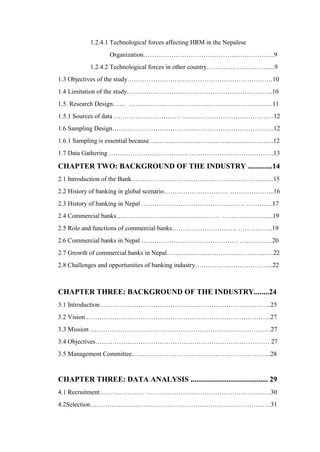
CHAPTER I: INTRODUCTION..........................................................1
1.1 Background……………………………………………………………………....2
1.2 Current Situation……………………………………………………………….. .3
1.2.1 Political environment affecting HR of the Organization……………….4
1.2.1.1 Political factor in Nepalese organization……………………...4
1.2.1.2 Political factor in other country……………………………….5
1.2.2 Economic factor that affect HR of the Organization …………..………5
1.2.2.1 Economic factor that affecting HRM in Nepalese Organization.5
1.2.2.2 Economic factor in other country……………………………..6
1.2.3 Social forces affecting HR of the Organization………….……………..7
1.2.3.1 Social forces affecting HRM in Nepalese Organization……....7
1.2.3.2 Social forces in other country…………………………………8
1.2.4 Technological forces affecting HRM of the organization……….…......8
1.2.4.1 Technological forces affecting HRM in the Nepalese
Organization…………………………………………………….9
1.2.4.2 Technological forces in other country………….. ………….......9
1.3 Objectives of the study…………………….…………………………………….10
1.4 Limitation of the study…………… …………………………………………….10
1.5. Research Design…… ………………………………………………………….11
1.5.1 Sources of data …………………………. …………………………………….12
1.6 Sampling Design………………………………...……………………………….12
1.6.1 Sampling is essential because………………………………...………………..12
1.7 Data Gathering ………………………………. …………………………………13
CHAPTER TWO: BACKGROUND OF THE INDUSTRY .............14
2.1 Introduction of the Bank……………………….………………………………...15
2.2 History of banking in global scenario………………………… ………………...16
2.3 History of banking in Nepal ………………………………………… …………17
2.4 Commercial banks………………………………………… …………………...19
2.5 Role and functions of commercial banks………………………… …………….19
2.6 Commercial banks in Nepal ……………………………………… ……………20
2.7 Growth of commercial banks in Nepal……………………………… …….……22
2.8 Challenges and opportunities of banking industry…………….………………...22
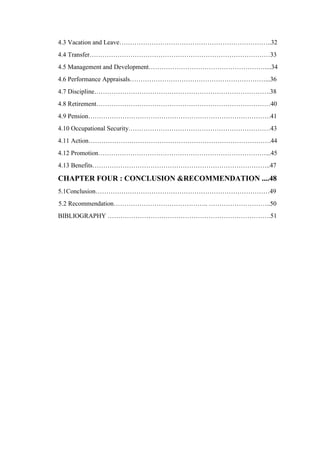
CHAPTER THREE: BACKGROUND OF THE INDUSTRY........24
3.1 Introduction……………………………………………………………………..25
3.2 Vision …………………………………………………………………………..27
3.3 Mission …………………………………………………………………………27
3.4 Objectives……………………………………………………………………… 27
3.5 Management Committee………………………………………………………..28
CHAPTER THREE: DATA ANALYSIS ......................................... 29
4.1 Recruitment………………… ……………………………………………….…30
4.2Selection…………………………………………………………………………31
4.3 Vacation and Leave……………………………………………………………..32
4.4 Transfer…………………………………………………………………………33
4.5 Management and Development………………………………………………....34
4.6 Performance Appraisals………………………………………………………...36
4.7 Discipline……………………………………………………………………….38
4.8 Retirement………………………………………………………………………40
4.9 Pension………………………………………………………………………….41
4.10 Occupational Security…………………………………………………………43
4.11 Action………………………………………………………………………….44
4.12 Promotion……………………………………………………………………...45
4.13 Benefits………………………………………………………………………..47
CHAPTER FOUR : CONCLUSION &RECOMMENDATION ....48
5.1Conclusion………………………………………………………………………49
5.2 Recommendation…………………………………….. ………………………..50
BIBLIOGRAPHY ………………………………………………………………….51
Koirala, ix
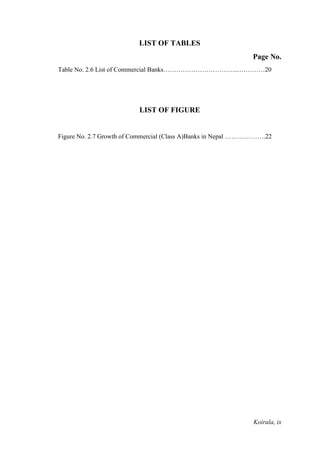
LIST OF TABLES
Page No.
Table No. 2.6 List of Commercial Banks……………………………...…………20
LIST OF FIGURE
Figure No. 2.7 Growth of Commercial (Class A)Banks in Nepal ……………….22
Koirala, x
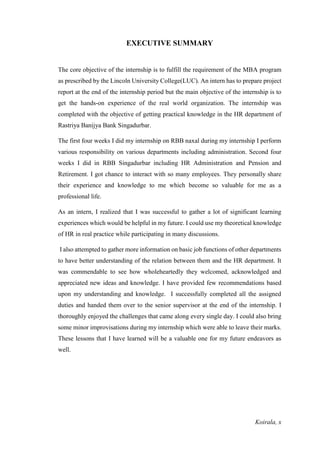
EXECUTIVE SUMMARY
The core objective of the internship is to fulfill the requirement of the MBA program
as prescribed by the Lincoln University College(LUC). An intern has to prepare project
report at the end of the internship period but the main objective of the internship is to
get the hands-on experience of the real world organization. The internship was
completed with the objective of getting practical knowledge in the HR department of
Rastriya Banijya Bank Singadurbar.
The first four weeks I did my internship on RBB naxal during my internship I perform
various responsibility on various departments including administration. Second four
weeks I did in RBB Singadurbar including HR Administration and Pension and
Retirement. I got chance to interact with so many employees. They personally share
their experience and knowledge to me which become so valuable for me as a
professional life.
As an intern, I realized that I was successful to gather a lot of significant learning
experiences which would be helpful in my future. I could use my theoretical knowledge
of HR in real practice while participating in many discussions.
I also attempted to gather more information on basic job functions of other departments
to have better understanding of the relation between them and the HR department. It
was commendable to see how wholeheartedly they welcomed, acknowledged and
appreciated new ideas and knowledge. I have provided few recommendations based
upon my understanding and knowledge. I successfully completed all the assigned
duties and handed them over to the senior supervisor at the end of the internship. I
thoroughly enjoyed the challenges that came along every single day. I could also bring
some minor improvisations during my internship which were able to leave their marks.
These lessons that I have learned will be a valuable one for my future endeavors as
well.
CHAPTER ONE
INTRODUCTION OF THE STUDY
Koirala, 2
1.1 Background of the study:
This report is made for the purpose of accomplishing internship course in order to
fulfillment of the degree of Master of Business Administration. As student we
necessarily have to go to internship program during the fourth semester. My
internship program period is for 8 weeks however it was divided into two parts I did
first 4 weeks at Rastriya Banijya Bank, Tangal, Naxal. And I also did second 4 weeks
in Rastriya Banijya Bank head office singhadurbar. However my overall focuses
during my internship program was on HR activities followed by bank.
Internship courses is blended with practical and theoretical knowledge. It provides us
opportunities to gain practical knowledge of what we theoretical learned during the
classroom period. It provides us opportunities to know what is really outside than the
letter inside the books. It gives us knowledge about what is really the external
working environment and how we can apply theoretical knowledge to the working
place. Internship program enables us to know the various structure and various
department of organization. It inserts the knowledge of how to handle the employees
and how to manage all the works inside the organization. Internship courses helps us
to become familiar with all the problems, situations, and activities inside the
organization and that can be useful for us in our future too.
This report is made on the basis of work experience of eight weeks dated 10th
july –
2nd
September 2016 at the Rastriya Banijya Bank. This report is made on the basis of
work experience and on the basis of my study as an internee in HR department.
During the internship program I am able to learn different culture, working
environment, different activities to be held as an individual, different types of
responsibility that we should perform as an internee. The report was made on the
basis of work experience on different section such as pension and retirement and HR
administration and also in internal administration of branch office.
All the staff was friendly and cooperative and they provide me proper guidance and
they provide me proper suggestion. They provide me a very useful information while
working in the bank as an internee. I interacts to collect useful information with Sony
Shrestha the branch manager of naxal branch and I also interacts with Krishna Prasad
Koirala, 3
Koirala the assistant manager of Naxal. I also interacts to collect useful information
with Madan Kumar Siwakoti the HR manager of Rastriya Banijya Bank, Singadurbar.
1.2 Current Situation: HR environment in Nepalese organization and
other countries:
People are the focus of human resource management. Organization need people and
people need organizations. Human resource management is concerned with managing
people in organizations. It is essential function of management. It is every manager’s
job.
Human resources are vital for achieving organizational objectives. Better people
achieve better results. Organizational effectiveness depends on the performance of
people working in organizations.
Human resources management is about managing people. It is concerned with the
management of human energy and competencies. It aims at achieving organizational
objectives through productive contribution of people. It creates harmony between the
objectives of organization and the objectives of the individual.
According to the Gary Desseler:
Human resource management refers to the policies and practices involved in carrying
out the people or human resources aspects of a management positions, including
recruiting, screening, training, rewarding and appraising.
According to the Decenzo and Robbins:
Human resource management is comprised of the acquisition, development,
motivation and maintenance functions.
In order to do this, HR managers must be aware of what going on within the
company, the industry and the wider market in relations to the factors that influence
change.
Koirala, 4
1.2.1 Political factor that affect HRM in Organization:
From a shift in local public opinion to a change in government or even a new
industrial world superpower entering the market, politics influence how much funding
is available how much tax must be paid, minimum wages rates, how markets are
controlled and the quality and quantity of staff available for hire. When planning
ahead you need to consider likely changes to markets, budgets and availability of
suitable applicants as a results of recent or anticipated political influences. For
example if a change of a government is possible in the coming year, understand the
new administration priorities in relation to markets industries and business.
1.2.1.1 Political factor in Nepalese Organization
Nepalese HRM operates in a rapidly changing environment. Environmental forces
influences HRM’s ability to achieve goals. HRM environment consists of forces that
have a bearing on the performances and outcomes of HRM. HRM should continually
monitor the changing forces in the external environment. It should adapt to the
environmental changes. External environment consists of conditions and forces
external to HRM. It influences the performances and outcomes of HRM by providing
oppurtunities and threats. Human resources management practices applied in nepalese
organization are greatly influenced by political system institutional and philosophy.
The government formulated various policy regarding HRM. The government made
different policy regarding HRM. The government made different policy which has
directly and indirectly affected HR strategy in nepalese organization. The policy such
as the policies regarding equal employment oppurtunities quotas in employment for
women, disadvantaged and indigenous people affect acquisition of HRM. And also
government agencies act as regulatory agencies they fix minimum wages of workers.
Local government institutions also affect HRM practices in their areas of jurisdiction
business.
1.2.1.2 Political factors in other country:
Political factors have also affected HR practices. It has stated that government
policies in any country also pose some threats and hurdles for the HR professionals.
For example: In Thailand the minimum wages level is very high set by government
and it has posed a threat to HR managers to cope with this issue because this matter
Koirala, 5
has increased the labor cost for companies. Labor cost is the major proportion of cost
structure in most of the Thailand manufacturing organization. Political factors are one
of the major forces which are responsive for a company mission and strategy it has
found that political and legal factors are one of these factors which affect HR
practices.
With the introduction of new workplace compliance standards your human resources
departments is constantly under pressure to stay with the law. These types of
regulations influences every process of the HR department including hiring, training,
compensation, termination, and much more without adhering to such regulations a
company can be fined extensively which if it was had enough could came the
company to shut down.
1.2.2 Economic forces that affect HRM in organization
How much money is available for salaries, training and equipment is the most
immediate concern in human resources planning. However external economics plays
an equally critical role. For example: people don’t have as much money to spend in an
economic downturn and tend to be much more selective in what they buy or services
they use. This means some industries, such as those producing luxury items or
nonessential services, sell less and may even you will need and have to lay off some
staff. This in turn makes the local economy even more difficult. Building economic
factors into the human resources plan helps to predict how many employees you will
need you can pay.
1.2.2.1 Economic factors affecting HRM in Nepalese organization:
In Nepalese HRM environment affected by economic forces. The economic forces
such as globalization. The globalization affected the HRM environment. It refers to
boarderless trade through extensions of operation in several countries. The human
resources in global organization have also assumed global dimensions. HRM policies
and practices need to be adapted to varying socio-cultural forces. HRM needs to think
globally but act locally.
Demographics also affect HR environment. It is concerned with human population
and its distribution. The forces consists of population size, growth, age mix,
urbanization and migration.
Koirala, 6
Demographic trends affect the size, composition and location of work force which
affects HRM.
Economic factors is one of the biggest factors which have altered the HRM practices
directly or indirectly country in economic conditions are directly related with labor
which market and labour supply which subsequently affect the recruitment and
selection patterns of the organizations.
Moreever in labour market the decrease in supply of particular skilled labour shapes
the training and development strategies of organizations. Per capita income and DGP
decides the minimum distribution wage rate which is the part of compensation and
benefits.
Economic Health: The health of the economy affects HRM. The level of income, the
stage of business cycle, inflationary pressures and fiscal policies of the government
affect the compensation of employees. Economic grouping, such as European Union
and SAARC facilitate cross border mobility of human resources.
Labour Market Forces:
A labour market is a geographical area within which people looking for work interact
with employers looking for people.
Work force diversity is increasing. The composition of people looking for work in the
labour market is getting diverse in terms of national origins, cultures, educations,
skills, sex and ages. Women and aged people are increasing in the labor market.
Labour market characteristics greatly affect HRM’s recruitment and compensation
policies.
1.2.2.2 Economic factor in other country:
Economic factor is one of the biggest factors which have altered the HRM practices
directly and indirectly. For example: 2010 study conducted a study on the relationship
between economic instability of Estonia and HRM practices and found that economic
instability has influenced the HRM practices.
Koirala, 7
1.2.3 Social Forces that affect HRM in organization:
Several social factors may influence your HR planning but you need to take into
account equalities and diversity in particular where there is a clear discrepancy of one
social group, it’s good idea to build in ways of opening up new oppurtunities. For
example if there are few Hispanic people in your company compared to numbers in
the wider community, determine why this is the case and what can be done to redress
the balance. Try holding a recruitment event in the area or conducting a survey of
locals, asking if they would consider a job at your company and if not why not. As an
older generation retires and a new generation enters the workforce the human
resources department must look for ways to attract this new set of candidates. They
must hire in a different way and offer different types of compensation packages that
work for this younger generation.
1.2.3.1 Social- Cultural Forces that affect HRM in Nepalese
organization:
They refer to all socio-cultural surroundings that affect HRM. Social and cultural
forces that affect HRM are:
Social Norms: They affect attitudes and expectations toward organization and the
work itself. Changing social values have significant implications for HRM. Social
institutions such as family, references groups and pressure group also affect HRM.
Life style: It is a person’s pattern of living reflected in his activities, interests and
opinions. HRM policies and practices should change to suit changes in life styles.
Changes in life styles have resulted in shorter work weeks, flexible working hours and
work at home patters of work.
Cultural forces: Culture is the complex whole of knowledge, customs, traditions,
values, religions, language and works of art and architecture. It is created by a society
and is handed down from generation to generation. It affects HRM by:
Creating the work force suitable to organizational settings.
Creating attitude towards work, leisure and business; influence values and beliefs of
employees.
Providing time orientation to work force.
Koirala, 8
Promoting work ethics reflected in hard work and organizational commitment.
Nepal has its national culture. Culture changes and cross cultural influences affect
HRM.
1.2.3.2 Social Factors in other country:
Demographic factors also affects the HRM of organization. Demographic factors are
the characteristics of workforce such as gender, educational level, race and cultural
background. Ratio of men and women in workforce and the cultural diversity has its
impact on organizational performance. On the other side demographic factors have an
impact on HRM practices within the organization. Organization now have to keep
balance in gender, racial and ethnic diversity. Morever, companies now have to
design jobs by keeping the work-life balance in consideration. Thus, demographic
factors have its impact on HRM practices.
Demographic or social forces affcect the HRM of organization in other countries for
example: Hotels in FIJI they explained the employee turnover ratio in different
departments and according to them the ratio is compared high in cleaning and Food
and Beverages departments ,when compared with front office. So the companies are
practicing different employee motivation and retention strategies for both types of
employees.
1.2.4 Technological Factors that affect HRM in organization:
This is considered an external influence because when new technologies are
introduces the HR department can start looking at how to downsize and look for ways
to save money. A job that used to take 2-4 people could be cut to one done by a single
person. Technology is revolutionizing the way we do business and not just from a
consumer standpoint, but from an internal-cost savings way. New technology brings
new skills requirements, so companies always need to be aware of proficiencies and
training needs when planning human resources. New products and services also may
require recruiting highly skilled employees or training existing employees to meet the
need. Make sure HR managers are aware of new equipment or knowledge be needed.
So they can build the required skills and most likely salary enhancements into the
plan.
Koirala, 9
1.2.4.1 Technology forces that affect HRM in Nepalese organization:
Technology makes work more efficient. It consists of skills, methods, systems and
equipment. It affects HRM by bringing about changes in jobs, skills, methods and
processes. Automation, computerization, digitalization, robotics, informatics, and
artificial intelligence have all affected the field of HRM. Technological Forces
relevant to HRM are:
Level of technology : It can be labour based or capital based and appropriate or
sophisticated. The level of technology affects acquisition and development activities
of HRM. Technological advances also affect HRM.
Technological Change: The speed of technological change dislocates employees by
eliminating old jobs, creating new jobs and increasing professionalization of jobs.
HRM in Nepalese organization must equip human resources with new competencies
and properly pay them to keep up with the technological advances.
HRM environment of future will be technologically advanced. Information
technology will lessen the need for middle managers and low-skilled employees.
More work will be performed by work teams. Virtual offices will emerge where
people will work from home through internet.
1.2.4.2 Technological factor in other country:
Technology advancement are affecting all the fields of life. Impact of technological
advancement can be observed in every field of life. Business have been transformed
from industrial state into
A study in 2007 investigated the impact of technology has played an effective role in
reshaping the HR practices in business environment. IT has affected the efficiently of
hiring process. With the help of technological advancements we now see online
recruitment process.
Koirala, 10
1.3 Objectives of the study:
The core objectives of the internship is to fulfill the requirement of the MBA program
prescribed by Lincoln University (LUC). Besides that the internship project was
completed with the objective of getting practical knowledge in the RBB bank.
Besides that the objectives of internship program are:
 To gain practical knowledge of what we have studied.
 To know the HR strategies of bank.
 To be familiar with the banking policies rules and regulations.
 To gain idea from the experienced people working in the bank.
 To find out the recruitment and selection process of bank.
 To find out the vacation and leave policy of bank.
 To find out transfer process of the bank.
 To find out the Management Development of the bank.
 To find out the Performance appraisals of the bank.
 To find out the discipline policy of the bank.
 To find out Retirement process of the bank.
 To find out pension process of the bank.
 To find out Occupational security facilities of the bank.
 To find out Action policy of the bank.
 To find out promotion facilities of the bank.
 To find out Benefits facilities of the bank.
 To develops managerial skills within ourselves.
 To know the strength and weakness of the bank.
 To develop personal standard and professional behavior.
 To be personally experience an knowledgeble in the various activities of the
bank.
1.4 Limitation:
The major limitation of the project can be discussed below:
 The report mostly based on data provided by RBB i.e secondary data.
Koirala, 11
 The study only focuses on HR strategies.
 References and resources is limited to the book, magazines websites.
 The study is done for the partial fulfillment of MBA degree.
 The study may not applicable for other organization of similar nature.
 The bank’s policy on keeping some matters confidential prevented from
analyzing differential activities.
 This study takes into consideration only about general activities and does not
include the minor details about each and every activity performed in the bank
due to the time constraints.
1.5 Research Design:
A research design is the detailed blueprint used to guide a research study towards its
objectives. The research design is the process of arriving to the solution of the
problem through planned and systematic dealing with the collection analysis and
interpretation of facts and figures.
This study of HR strategies of RBB bank has adopted the Secondary data analysis and
expert survey method.
1.5.1 Sources of data
As the report is based on the secondary data negligible amount of primary data has
been used. Direct interview, Reports and magazine are used as sources of data. Two
types of data are:
Primary data:
Primary data are mainly collected by a researcher to address the research problem. In
other words these are not readily available from various sources, rather the researcher
has to systematically collect the data relevant to a pre specified research problem. The
importance of primary data is unquestionable.
As the primary sources I myself worked as an internee in RBB bank for 8 weeks and
collected some crucial information. I interviewed many staff members, personnel
Koirala, 12
including managers, assistant managers, and subordinate staffs. I also observed the
operational activities of various departments during my 8 weeks period of internship.
Secondary Data:
Secondary data are the data that have already been collected by someone else before
the current needs of a researcher. The present researcher only uses these data with
related references and never collects it from the field. When compared with the
primary data, secondary data can be collected easily with time and cost efficiency.
Secondary data are readily available and provide a base to tackle the research
problem.
For a secondary data, I have collected books, periodicals, and other published
material, booklets, magazine, brochure and visited websites.
1.6 Sampling Design:
Population is any complete group and sample is a subset of larger population.
Sampling is the most widely used tool for gathering important and useful information
from the population. A researcher generally takes a small portion of the population for
study, which is referred to as sample. The process of selecting a sample from the
population is called sampling.
Population refers to the total of items about which information is desired. Sample is a
sub group that is chosen which is believed to be representative of population and the
method of choosing this sub group is done by sampling.
1.6.1 Sampling is essential because:
 Sampling saves time.
 Sampling saves money.
 Sampling boardens the scope of the study in light of scarcity of resources.
 Sampling minimizes the destruction.
 Sampling provides the more accurate results.
For the project I used simple random sampling.
Koirala, 13
Simple Random Sampling:
Simple random sampling is based on the process of selecting a sample randomly. This
does not mean the randomness allows haphazard selection of sample. It means that the
process of selecting a sample should be free from human judgement.
I used Simple random sampling to choose RBB bank.
1.7 Data Gathering:
The purpose of the various data collection techniques is to produce truth worthy
evidence that is reverent to the research question being asked. The various steps of
methods followed in order to get the most factual and dependable information about
the sources of data in order to get the most factual and dependable information about
the sources of data used in the area based on secondary data.
The data is gathered by secondary data sources such as published material, booklets,
magazine, brochure and visited websites.
CHAPTER TWO
BACKGROUND OF THE INDUSTRY
Koirala, 15
2.1 Introduction of Bank
After commerce and the arts had revived in Italy, the business of banking was
resumed. The word "bank" is commonly regarded as derived from the Italian word
'Banco', a bench - the Jews in Lombardy having benches in the market-place for
the exchange of money and bills. And people around the world start to use different
words for their convenient like in French 'Banque', Latin 'Bancus', and German 'Bank'.
At ancient times, bank means moneylenders who sat in the bench for keeping, lending
and exchanging of money in the market place.
A bank is an institution which deals in money receiving as deposits from customers,
honoring customers drawing against such deposits on demand, collecting cheques for
customers and lending or investing surplus deposits until they are requires for
repayment. It allows interest on the deposits made and charges interest on the loans
granted and further it creates credit and supports for the formation of capital and
hence it is regarded as manufacturer of money.
In simple, bank is an institution which deals with money and credit. A bank is
a financial institution that serves as a financial intermediary, who bridges gap between
the savers of the fund and users of the funds. Nowadays, a bank has broadened its
scope by providing financial as well as non-financial services to its customers. To
give specific meaning of bank is very difficult task however following are the few
definitions given by different
authors.
"Banking means the accepting for the purpose of lending or investment of deposits of
money from the public, repayable on demand or otherwise and withdrawal by cheque
draft order or otherwise." --Indian Banking Company Act 1949
"Bank is an organization established for the purpose of exchange money deposit
lending money and participation in transactions." --Commercial Bank Act of
2031
"Bank is a financial institution, which provides financial services that may be in the
form of accepting deposits, advancing loan, providing necessary technical advices,
Koirala, 16
dealing overt foreign currencies, remitting funds, etc." –Nepal Rastra Bank Act
2002
From the above definitions, we draw the conclusion that a bank is a financial
intermediary that accepts deposits and channels those deposits into lending activities,
either directly or through capital markets. It is the most important financial institution
dealing with money, receiving it as deposits from customers, honoring customers
drawing against such deposits on demand, collecting cheques for customers and
lending or investing surplus deposits until they are required for repayment.
Thus, bank receives demand deposits and time deposits, honors instruments drawn on
them, and pays interest on them, makes loans, and invests in securities, collects
cheques, drafts and certifies depositor's cheques and issues drafts and cashier's
cheques. The difference in interest rate on lending and deposit, interest rate spread, is
the major source of income for the bank. Interest on lending is higher than the
deposits.
2.2 History of Banking in Global Scenario
The history of banking is nearly as old as civilization. In the Babylon, at the time of
Hammurabi, in the 18th century BC, there are records of loans made by the priests of
the temple. The concept of banking has arrived. When the word bank is used it is
meant for commercial bank. Before 1960 there was no such word as “banking’.
However, in the temple Babylon the practices of safeguarding and saving flourished
as early as 2000 B.C. Chanakya in his Arthashastra written in about 300 B.C.
mentioning about the existence of powerful guilds of merchant’s bankers received
deposits, advance loans and hundies. Merchants and goldsmith were ancestors of
bank.
The 'Bank of Venice', established in1157 A.D. is supposed to be the ancient bank.
Originally, it was not a bank in real sense being simply on office for the transfer of the
public debt. Venice, after being possibly the first city to found a bank for the keeping
of money on safe deposit and the clearing of cheques, is also a pioneer in the
involvement of a bank with state financiers. In 1617 the BancoGiro is established to
Koirala, 17
solve problems encountered by the earlier, which has got into trouble through the
making of unsecured loans. Subsequently, 'Bank of Barcelona' (1401) and 'Bank of
Geneva' (1407) were established.
During the 18th century the Bank of England gradually undertakes many of the tasks
now associated with a central bank, The 'Bank of England', first English Bank, was
established in1964 A.D. It organizes the sale of government bonds when funds need
to be raised. It acts as a clearing bank for government departments, facilitating and
processing their daily transactions.
History apart, it was the “Merchant bank” that first evolved the system by trading in
commodities than money. They used to do their trading activities by remitting the
money from one place to another. The next stage in the growth of banking was
goldsmith. An honest goldsmith was also trusted with billions money and ornaments
by merchants in neighborhoods. He started charging for acting as custodians of these
valuables. As an evidence for receiving valuables he issued a receipt, which in turn
became like cheques as a mode of exchange. He started advancing the coins on loan
by charging interest. He started to keep some reserve as a safeguard. In this way the
goldsmith money lender became a banker who started performing the two functions of
modern banking that of accepting deposits and advancing loans.
2.3 History of Banking in Nepal
Banking service is the oldest service industry in Nepal. It has gone through various
stages of evolution and development since the Vedic times (2000 to 1400 B.C.). In the
Nepalese chronicles, it was recorded that the new era known as Nepal Sambat was
introduced by Shankhadhar, a Sudra merchant of Kantipur in 880 A.D.
The banking in the form of money leading can be traced back in the reign of Gun
Kam Dev towards the end of 8th century. According to the historical evidence in 723
Gun Kam Dev, the king of Kathmandu had borrowed money to rebuild and to rule
Kathmandu.
Koirala, 18
In the 11th century, during Malla regime, there was an evidence of professional
money-lenders and bankers. It is further believed that money-lending business,
particularly for financing the foreign trade with Tibet, became quite popular.
Another historical example as to the pre-modern banking system is found when Rana
Prime minister Randip Singh was administering Nepal in 1880 A.D. During his
regime one financial institution name by "TejarathAdda" was establish to give loan
facilities to the governmental staff and to afford loan facilities to the public in general
in the term of 5% interest. The credit facilities of "TejarathAdda" were also extended
outside the valley during the Prime Minister ship of Chandra Shumsher Rana.
Although this institution did not accept any deposits, it had played an important role
in the development process of banking system in Nepal. Modern banking business
started in the country just before the Second World War. In 1938 state financial
institute which supply credit or loan against security.
His Majesty King Tribhuvan inaugurated first commercial bank i.e. Nepal Bank
Limited on Kartik 30, 1994 B.S. In the year 1994 B.S. as a semi government
organization with an authorized capital RS.10 million of which 51% share are owned
by government, this marked the beginning of an era of formal banking in Nepal. Until
then all monetary tractions were carried out by private dealers and trading center.
The need to regulate financial and monetary system increased enormously resulting in
the establishment of Nepal Rastra Bank in 2013 B.S. In order to cater the demand of
banking system, Rastriya Banijya Bank was established in 2022 B.S with 100%
government ownership.
Later some development banks and financial institutions were established to provide
medium and long-term credit facilities to the industry and agriculture. In this contest,
Nepal Industrial Development Corporation was established in 2016 B.S. to provide
the financial and managerial assistance in the field of industry and to help private
sector in the field of industry. In order to provide service to the agriculture sector,
Agriculture Development Bank Ltd. was established in 2024 B.S.
The government of Nepal adopted liberal economic policy to accelerate country's
growth and development. Foreign investment and participation of private sector were
Koirala, 19
encouraged. The government then enacted "Joint Venture Banking" policy.
Commercial Banks should operate under the Commercial Bank Act 2031, Nepal
Rastra Bank Act 2058 and Contract Act 2056. Nepal Arab Bank Ltd. (currently
known as NABIL) is the first bank established in joint investment in Nepal in 2041
B.S. With the passage of time several other joint venture and private bank has been
established such as Indosuez bank Limited (Nepal investment bank) in 2042 B.S.,
Nepal Grindlays Bank (Standard Chartered bank) 2043 B.S., Himalayan Bank
Limited in 2049 B.S. and so on.
2.4 Commercial Banks
Commercial bank is the term used for a normal bank to distinguish it from an
investment bank. This is what people normally call a “Bank”. The term “commercial”
was used to distinguish it from an investment bank. The commercial bank refers to
bank which focus mainly on companies.
The commercial banks are those banks that pool together the saving of community
and arrange for their productive use. They activate the idle money to the different
productive areas. They supply the financial needs of the modern business by various
means. Most of the banks in the world are found established with a view to finance
and help in developing trade, industry and commerce. In fact, commercial banks can
be defined according to the function they perform. Commercial banks accept the
deposit and also provide loan functions they perform. Commercial banks can accept
deposit and also provide loan primarily to business firms, thereby facilitating the
transfer of funds in the economy.
2.5 Role and Functions of Commercial Bank
Commercial Banks are engaged in the following activities:
 Processing of payments by way of telegraphic transfer, EFTPOS, internet
banking or other means.
 Issuing bank drafts and bank cheques.
 Accepting money on term deposit & lending money by way of overdraft,
installment loan or otherwise.
Koirala, 20
 Providing documentary and standby letter of credit, guarantees, performance
bonds, securities underwritings commitments and other forms of off balance
sheet exposures.
 Safekeeping of documents and other item in safe deposit boxes.
 Currency exchange.
 Sale, distribution or brokerage, with or without advice, of insurance, unit trusts
and similar financial products as a “financial supermarket”.
 Economic liberalization.
 Capital formation by mobilizing small savings.
2.6 Commercial Bank in Nepal
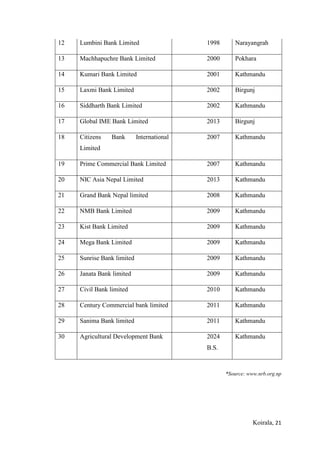
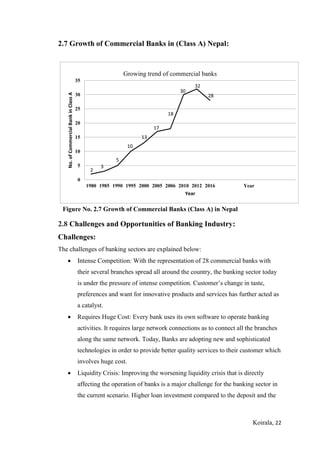
Table No. 2.6 List of Commercial Banks
S.N. Name of Commercial Bank Year Head office
1 Nepal Bank Limited 1957 Kathmandu
2 Rastriya Banijya Bank Limited 1966 Kathmandu
3 Nabil Bank Limited 1984 Kathmandu
4 Nepal Investment Bank Limited 1986 Kathmandu
5 Standard Chartered Bank Limited 1987 Kathmandu
6 Himalayan Bank Limited 1993 Kathmandu
7 Nepal SBI Bank Limited 1993 Kathmandu
8 Nepal Bangladesh Bank Limited 1993 Kathmandu
9 Everest Bank Limited 1994 Kathmandu
10 Bank of Kathmandu Limited 1995 Kathmandu
11 Nepal Credit and Commerce
Bank Limited
1996 Bhairawa
Koirala, 21
*Source: www.nrb.org.np
12 Lumbini Bank Limited 1998 Narayangrah
13 Machhapuchre Bank Limited 2000 Pokhara
14 Kumari Bank Limited 2001 Kathmandu
15 Laxmi Bank Limited 2002 Birgunj
16 Siddharth Bank Limited 2002 Kathmandu
17 Global IME Bank Limited 2013 Birgunj
18 Citizens Bank International
Limited
2007 Kathmandu
19 Prime Commercial Bank Limited 2007 Kathmandu
20 NIC Asia Nepal Limited 2013 Kathmandu
21 Grand Bank Nepal limited 2008 Kathmandu
22 NMB Bank Limited 2009 Kathmandu
23 Kist Bank Limited 2009 Kathmandu
24 Mega Bank Limited 2009 Kathmandu
25 Sunrise Bank limited 2009 Kathmandu
26 Janata Bank limited 2009 Kathmandu
27 Civil Bank limited 2010 Kathmandu
28 Century Commercial bank limited 2011 Kathmandu
29 Sanima Bank limited 2011 Kathmandu
30 Agricultural Development Bank 2024
B.S.
Kathmandu
Koirala, 22
2
3
5
10
13
17
18
30
32
28
0
5
10
15
20
25
30
35
1980 1985 1990 1995 2000 2005 2006 2010 2012 2016 Year
No.ofCommercialBankinClassA
Year
Growing trend of commercial banks
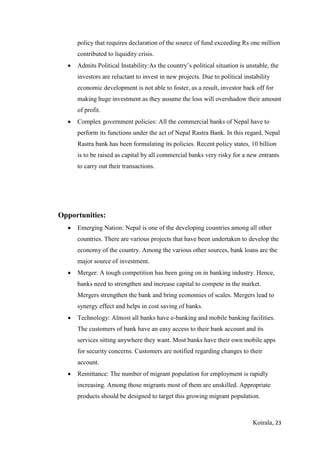
2.7 Growth of Commercial Banks in (Class A) Nepal:
2.8 Challenges and Opportunities of Banking Industry:
Challenges:
The challenges of banking sectors are explained below:
 Intense Competition: With the representation of 28 commercial banks with
their several branches spread all around the country, the banking sector today
is under the pressure of intense competition. Customer’s change in taste,
preferences and want for innovative products and services has further acted as
a catalyst.
 Requires Huge Cost: Every bank uses its own software to operate banking
activities. It requires large network connections as to connect all the branches
along the same network. Today, Banks are adopting new and sophisticated
technologies in order to provide better quality services to their customer which
involves huge cost.
 Liquidity Crisis: Improving the worsening liquidity crisis that is directly
affecting the operation of banks is a major challenge for the banking sector in
the current scenario. Higher loan investment compared to the deposit and the
Figure No. 2.7 Growth of Commercial Banks (Class A) in Nepal
Koirala, 23
policy that requires declaration of the source of fund exceeding Rs one million
contributed to liquidity crisis.
 Admits Political Instability:As the country’s political situation is unstable, the
investors are reluctant to invest in new projects. Due to political instability
economic development is not able to foster, as a result, investor back off for
making huge investment as they assume the loss will overshadow their amount
of profit.
 Complex government policies: All the commercial banks of Nepal have to
perform its functions under the act of Nepal Rastra Bank. In this regard, Nepal
Rastra bank has been formulating its policies. Recent policy states, 10 billion
is to be raised as capital by all commercial banks very risky for a new entrants
to carry out their transactions.
Opportunities:
 Emerging Nation: Nepal is one of the developing countries among all other
countries. There are various projects that have been undertaken to develop the
economy of the country. Among the various other sources, bank loans are the
major source of investment.
 Merger: A tough competition has been going on in banking industry. Hence,
banks need to strengthen and increase capital to compete in the market.
Mergers strengthen the bank and bring economies of scales. Mergers lead to
synergy effect and helps in cost saving of banks.
 Technology: Almost all banks have e-banking and mobile banking facilities.
The customers of bank have an easy access to their bank account and its
services sitting anywhere they want. Most banks have their own mobile apps
for security concerns. Customers are notified regarding changes to their
account.
 Remittance: The number of migrant population for employment is rapidly
increasing. Among those migrants most of them are unskilled. Appropriate
products should be designed to target this growing migrant population.
CHAPTER THREE
INTRODUCTION OF THE ORGANIZATION
Koirala, 25
3.1 Introduction
Rastriya Banijya Bank is fully government owned, and the largest commercial bank
in Nepal. RBB was established on January 23, 1966 (2022 Magh 10 BS) under the
RBB Act. RBB provides various banking services to a wide range of customers
including banks, insurance companies, industrial trading houses, airlines, hotels, and
many other sectors. RBB has Nepal's most extensive banking network with 161
branches.
RBB Ltd. - established on January 23, 1966 ( 2022 Magh 10 ) - a synonymous of
stable and people's bank in Nepal - is one of the pioneer Bank in the country with the
history of nearly a half century. Earlier constituted under RBB act 2021 with the full
ownership of the government of Nepal, the Bank has been running under Bank and
Financial Institute Act ( BAFIA ) and Company Act (CA) 2063 at present. The Bank
licensed by NRB as a 'A' class commercial Bank of the country, has grown up as an
indispensable component of the Nepalese economy. The bank is the highest profit
earning bank for the FY 2014/15. The bank has second highest paid up capital till the
end of FY 2015/16 after agriculture development bank. In terms of deposit, the bank
has collected Rs more than Rs 130 Billion (F/Y 2015/16) which is the highest deposit
of any commercial bank in Nepal.
Rastriya Banijya Bank is one of the pioneering bank in Nepalese market that has
carried out Note Kosh Fund, Bharu Kosh Fund, NRB's Draft transaction, Government
Transaction, Pension Fund of Nepal Government. Besides more than 2 dozens of
bank's branches are running in Losses, they provides continue services to the general
public because it is the government bank. Profit is not only the solo motive of the
bank. RBB provides services in remote and undeveloped areas of Nepal.
RBBL – which has made glorious history of contributing for the monetization of the
economy, eliminating dual currency in the market, initiating preliminary financial
literacy, help flourish industrial, commercial and financial sector of the country has
now emerged as a modern and strong financial institute of the country. The Bank with
2600 hands has expanded its wings in the most part of the country through multiple
distribution outlets of 161 branches, 17 counters, 28 branch less banking (BLB) and
72 ATMs. The Bank with the highest public confidence- reflected in the highest
deposit base and growing demand for branch establishment in the various parts -has
Koirala, 26
stood as a pyramid in the financial arena of the country. The Bank with as many as
1.7 millions satisfied /direct customers ranging from poor to elite ones and millions of
indirect ones, has drawn important imprint in the picture of country's economy
through its significant involvement in the best use of its resources to enhance the
production, income and employment opportunities. The Bank is fully committed to
contribute its best for the socio economic development of the country and people in
the days to come.
RBB provides various banking services to a wide range of customers they include
elite to poor individuals, institutional customers, and the customers from industry /
business communities.
RBB is a commercial bank which is service oriented and of philanthropic nature. At
beginning it started its operation with 30 employees at Kathmandu. Currently it is
employing 5627 employees and 128 branches in different part of the country. It has
been running in profit from the very first of its operation but recently it is going on
loss. Currently the bank has authorized capital of 1 billion, 17 million and 32 lakhs.
This bank has authority of holding cash up to Nrs.1,80,00,000 and good also work
that amount.
RBB has Nepal's most extensive banking network with over 128 branches (101 ABBS
Branches). Through its widest branch and ABBS network RBB has been catering
modern Banking services to millions of customers. The Bank was transformed in
company in 2063-1-6 B.S.
Following this historical transformation the bank has successfully completed its first
ever general assembly on 2067-05-31 BS. According to recent information it has also
authorized of 38 crores, total amount to 3000 crores. It is also authorized to act as the
agency or representative bank of NRB ltd.
The bank is also in the frontline towards fulfilling corporate social responsibility.
The bank has been working as a development partner by acting as a fund
administrator of Poverty Alleviation Fund (PAF). Similarly, the bank has been
working as a chief administrator in the Educational Assistance Project (run with the
assistance of World Bank) aimed at assisting poor and diligent students learning at
higher secondary and bachelor level.
Koirala, 27
3.2 Vision of the organization:
To provide innovative banking services to everyone every time everywhere for the
economic development of the nation.
3.3 Mission of the organization:
To provide easy and innovative banking products and services for our customers by
implementing one stop service concept from our wide network using our modern
technology qualified human resources in competitive environment. We always look
for the benefit of the local communities supporting entrepreneurship, social
responsibility and economic prosperity of the nation.
3.4 Objectives of the organization:
 Focus on providing innovative financial services.
 Increase in capital base of the Bank by meeting the minimum capital
requirement.
 Business growth and increase in market share.
 Enhance operational efficiency.
 Sustainable increase in profits.
 Focus on empowerment of deprived class
Koirala, 28
3.5 Management Committee:
Chief Executive officer Kiran kumar Shrestha Coordinator
Acting Deputy Chief Executive
Officer
Bishnu Prasad Baidya Member
Acting Deputy Chief Executive
Officer
Bhupendra Pandey Member
Deputy General Manager Sushil Shrestha Member
Deputy General Manager Kaviraj Adhikari Member
Acting Deputy General Manager Keshav Prasad Lamsal Member
Acting Deputy General Manager Tek Raj Joshi Member
Dept. Chief Naresh Raj Aryal Member
Dept. Chief Uddhav Prasad Khanal
Member
Secretary
Chapter Four
Data Analysis
Koirala, 30
Data analysis is a core part of the study. In this section the data which are received are
analyzed according to the requirement. In this section the human resources strategies
of RBB bank are analyzed. Bank follow many HR strategies and it has very unique
culture that bound the employees in the organization. The major HR strategies of
RBB bank can be discussed below:
4.1 Recruitment
Recruitment is an important function in all organizations. It brings together employer
and employee. It aims to attract a high performing workforce in the organization.
Recruitment is part of the acquisition component of human resource management. It
is the process of finding right people for right positions at the right time. It is
concerned with identifying and attracting a pool of qualified candidates to fulfill
human resources needs of an organization. The quality of human resources depends
on the quality of recruits.
According to Edwin B. Flipp
Recruitment is a process of searching for prospective employees and stimulating them
to apply for jobs.
According to DeCenzo and Robbins:
Recruiting is the process of discovering potential job candidates.
According to Gary Dessler:
Recruiting is to build up a pool of qualified applicants.
Recruitment process in the RBB:
In RBB there is one most common method used for recruitment process is advertising.
Advertising: This is the most common method for external recruiting. It reaches a
much wider audience through various media. The media selection and the design of
the advertisement should be given careful thought. It should encourages qualified
candidates.
In RBB bank the advertising is done by publishing vacancy on any national level
newspaper daily. Such as: Gorkhapatra and Kantipur. Notices on the public places for
the places where newspapers are not reached are also one way of advertising. The
Koirala, 31
candidates are allowed to apply through firm till 30 days. Recruitment team are
responsible for vacancy format.
4.2 The Selection Process:
No organization can function effectively without the right quality of people. Selection
is the process of choosing the most suitable candidate for a particular position from
among the prospective applicants. The goal is to select the right person for the right
job. Selection follows recruitment. It is concerned with hiring as well as rejecting the
applicants.
According to Wendell French:
Selection is the process of choosing among people who apply for work with an
organization.
According to Werther and Davis:
The selection process is a series of steps used to decide which recruits should be
hired.
According to Decenzo and Robbins:
Selection activities predict which job applicant will be successful if hired.
The selection process consists of a series of steps through which applicants pass. Each
step serves as a hurdle which the steps successful candidates must cross. However the
steps differ from organization to organization.
In RBB bank the selection process consists of the following steps:
 Application Form
 Written Test
 Oral Test
 Practical Test
 Interview
 Application form: The recruitment process generates sufficiently large
number of filled. In application forms from prospective candidates. Such
forms consists information about.
Koirala, 32
Personal background information: Name, Sex, Age, Martial Status, Nationality,
Address etc.
Qualification: Educational, professional and other qualification specialized skills and
training.
Work experience: Experience in previous jobs and the name of organization served
including duties, responsibilities etc.
Salary: Salary drawn in present employment and expected salary.
References: Names and address of persons who can be contacted as references.
 Written Test: Standardized written test are administered to the candidates.
They assess the suitability of candidates for the job. They provide objectives
information about the candidates.
 Oral Test: The candidates who have been selected from written test have to
crossed oral test. Oral test include presentation and group discussion.
 Practical Test: Practical test are for employees such as: Driver, Typist,
Computer operator, mechanics etc.
 Interview: The candidates who are selected from written test and the oral test
has to crossed the interview section within 35 days.
4.3 Vacation and Leave:
Vacation and leave is also called supplementary pay benefits is the most costly benefit
because of the large amount of time off that most employees receive. Common time-
off with-pay periods include holidays, vacations, jury duty, funeral leave, personal
days, sick leave, sabbatical leave, maternity leave etc.
In RBB bank there are nine types of leave that each employee will
benefitted:
 Casual leave : Casual leave are for nine days in a year. Employee are paid
who are at casual leave.
 Festival leave: Festival leave are for 3 days. Employees are paid who are at
festival leave.
Koirala, 33
 Home Leave: Home leave are for 30 days. Employees are paid who are at
home leave.
 Sick Leave: Sick leave provides pay to employees when they are out of work
due to illness. Sick leave are for 15 days. Employees are paid who are at sick
leave.
 Study leave: Study leave provides to employees when they are out of work
to study. Employees above 45 years are not allowed to have study leave.
Employees are paid for their study leave.
 Special Leave: Special leave are for one months. Employees are paid half of
their salary who are on special leave. Employees have served enough for three
years to have special leave.
 Unusual leave: employees are not paid for their unusual leave.Employees
who work more than 5 years can only benefitted by unusual leave.
 Material leave: Material leave is provided to the women who get pregnant
during their work life. Married women employees are benefitted by material
leave. Women are paid for their material leave.
 Funeral Leave: Funeral leave are provided to employees when they are out
of work because of death of their closet person or relatives. Funeral leave are
for 15 days. Employees are paid for their funeral leave.
4.4 Tansfer:
A transfer is a move from one job to another usually with no change in salary or
grade. Employers may transfer a worker to vacate a position where he or she is no
longer needed, to fill one where he or she is needed, or more generally, to find a better
fit for the employees the firm. Many firm today boost productivity by consolidating
positions. Transfers are a way to give displaced employees a chance for another
assignment or perhaps some personal growth. Employees seek transfers for many
reasons, including personal enrichment more interesting jobs, greater convienience
better hours location of work and so on or to job offering greater advancement
possibilities.
Koirala, 34
Many firms have had policies of routinely transferring employees from locale to
locale, either to expose them to a wider range of jobs or to fill open positions with the
trained employees. Such easy transfer policies have fallen into some disfavor.
Transfer in RBB
Employees only who work more than one years are allowed to transfer.
Employees who are married and they are working together in bank are allowed to
transfer in another branch of bank for their purposes.
Cashier are also allowed to transfer for their purposes.
Guards and security guards are also allowed to transfer for their purposes after
completing all the procedures.
Procedures of Transfer
 Collect transfer letter from reigning office.
 Submit transfer letter to the new office.
 Employees in a new office to be understand all the new rules.
 Attendance is necessary in time in new office.
4.5 Management development:
Management development is a systematic process of improving managerial
performance. It prepare manager or other employees to handle present and future
responsibilities. It develops managerial potential.
Management development is given to managerial employees supervise the activities
of others. It develops managerial potential by increasing conceptual interpersonal and
decision making skills. Above all it develops managerial capability to manage
effectively. It is also known as executive development.
According to Gary Desseler:
Management development is any attempt to improve current or future management
performance by importing knowledge, changing attitudes or increasing skills.
Koirala, 35
Management development is future oriented training focusing as personal growth of
the employees.
According to DenCenzo and Robbins:
Management development increases the knowledge of employees. It is useful for
following purposes:
 It focuses on future responsibilities.
 It is a long term on going educational process.
 Its target are managerial employees.
 It develops potential through conceptual, interpersonal, technical, and decision
making skills.
 It is proactive to future needs.
 It is employee initiated and management facilitated.
Management development in RBB:
Management development are particularly for managers but we see in many
organization and in bank also it is provided to many others employees also.
Management development in RBB is provided to employees who work more than 3
years.
Management development in RBB is provided to employees who have not cross 40
years.
 Study development: Employees encouraged and developed to gain more
knowledge on related field. Employees are encouraged to gain degree on C.A,
M.B.A, Finance specialist by the bank.
 Training development: Training are conducted by representative institution
to the employees of bank.
 Seminar : Seminar are also conducted and provided to the employees of bank.
Seminar are known as oral communication of information by instructors to
managers. It is based on talking and showing. Participants get opportunity to
acquire knowledge and develop their skills.
Koirala, 36
4.6 Performance appraisals:
Performance refers to accomplishment of assigned tasks by an employee. It is the
results of abilities plus motivation. It is productivity measured in terms of
effectiveness and efficiency. It also implies minimum degree of employees created
disruptions interms of turnover, accidents and absences.
Performing employees are productive employees. They accomplish tasks. All
organizations evaluate the performance of their employees. It is essential for
productivity improvement.
Performance appraisal provides feedback to employees. It helps them to know where
they stand, where they ought to be going, and how they are going to get there. It
assess the relative worth of each employees to the organization. It is the basis for
allocating rewards. It helps to plan employee development.
Employees should perceive the performance appraisal system as fair equitable and
transparent.
Performance evaluation is a review of the job relevant strength and weaknesses of an
individual or a team in an organization.
Performance refers to accomplishment of assigned tasks by an employee. It is the
result of abilities plus motivation. It is productivity measured in terms of effectiveness
and efficiency. It also implies minimum degree of employee created disruptions in
terms of turnover, accidents and absences.
Performance appraisals is review of an employee actual performance on the job and
his potential for assuming future responsibilities. It reviews job relevant strength and
weaknesses of an employee. It is result based.
According to Wayne F Cascio:
Performance evaluation is a review of the job relevant strength and weaknesses of an
individual or a team in an organization.
According to the Dale s. Beach:
Performance evaluation is the systematic evaluation of individuals with respect to
their performance on the job and their potential for development:
Koirala, 37
Who should do the appraising in RBB:
 The Supervisor: In RBB the supervisor do the performance appraisal.
Supervisor rating are the heart of the most appraisals. This makes sense. The
supervisor usually is in the best positions to evaluate the subordinates
performance and is responsible for that person’s performance.
 Rating Committees: In RBB many employers use rating committee. These
committees usually contain the employee’s immediate supervisors and two or
three other, supervisors.
In RBB performance appraisals process includes following steps:
 Preparation is essential: Beforehand review the persons job description,
compare performance to the standard and review the previous appraisals.
Give the employees at least a week’s notice to review his or her work.
 Set a mutually agreeable time for the interview and allow enough time:
Interviews with lower level personal like clerical workers should take no
more than an hour. Interviews with management employees often take 2 or 3
hours. Conduct the interview in a private place with no interruptions.
Talk in terms of objective work data: Use examples such as absences, tardiness,
quality records, orders processed, productivity records, order processing time,
accidents reports and so on.
Don’t get personel: Try to compare the person’s performance to a standard. (These
reports should normally be done within 10 days.) Similarly don’t compare the
person’s performance to that of other people. (He’s quicker than you are.)
 Encourage the person to talk: Stop and listen to what the person is saying:
ask open ended questions such as. “what do you think we can do to improve
this situation?” Use a command such as “Go on”. Restate the person’s last
point as a question such as “you don’t think you can get the job done.
 Get agreement: Make sure the person leaves knowing specially what he or
she is doing right and doing wrong and with agreement on how things will be
improved, and by when. Write up an action plan with target and dates.
Koirala, 38
4.7 Discipline
Employees discipline is needed for effective human resources management. No
organization can be effective without discipline at all levels of employees. Discipline
regulates the behavior of employees. It is a necessary condition of orderly behavior.
Discipline implies orderliness. It means adherence to rules, regulations, procedures
and standards of acceptable behavior in the organization. Employee discipline is the
result of employee behavior.
According to DeCenzo and Robbins:
Discipline is a condition in the organization when employees conduct themselves in
accordance with the organization’s rules and standards of accepatable behavior.
According to Gary Dessler:
Discipline is a procedure that corrects or punishes a subordinates because a rule or
procedure has been violated.
When employees willingly follow rules and standard of acceptable behavior,
discipline is said to be good. It is said to be bad when employees follow rules and
standard of acceptable behavior unwillingly or disobey them.
Discipline in RBB
Attendance: Attendance is compulsory, expect in holidays.
Employees should arrive at time for work.
No unexcused absences.
Employees are not allow to leave work without permission.
1 hour break for lunch.
Dress code: Employees should follow the proper dress code.
Bribery: Employees should reject any kind of bribe and corruption.
Gift and entertainment: Employees are not allowed to accept any kind of gift and
benefits.
Koirala, 39
Besides that there are others rules that each employees should follow:
 Obey safety rules.
 Obey orders.
 Employees should respect all their upper level employees.
 Employees should be polite to all their lower level employees.
 Employees should protect or keep safe all their documents.
 Employees should perform and accomplished all their work at time.
 Employees should inform the head if they get any information that is against
bank.
 Employees are not allowed to work in other competing firm without the
permission of head.
 Employees are not allowed to criticize the bank in any press media, radio
and television.
 Employees are allowed to write in favor of bank in any press media, radio
and television.
 Employees are not allowed to steal organization property.
 Employees are not allowed to falsify information.
 Employees are not allowed to go strike illegally.
 Employees are not allowed to leak confidential information to competitors.
 Employees are not allowed to smuggling and murder.
 Employees are not allowed to make embarrassing speeches to the
organization.
 Wages garnishment is prohibited.
 Employees are not allowed to do terrorism and arson by employees.
 Employees are not allowed to give threat to management.
 Employees are not allowed to use of drugs on the jobs.
 Employees are not allowed to carry unauthorized weapons on the job.
 Employees are not allowed to destruct organizational property.
 Employees are not allowed to gambling on the job.
 Employees are not allowed to do childmarriage, multimarriage.
 Employees are not allowed to involve in any other banking business.
 Employees are not allowed to play on any departments.
Koirala, 40
 Employees are not allowed to interrupt other employees and customer in
bank.
 Employees are not allowed to enter in no entry zone.
 Employees are not allowed to stop the facilities like drinking water,
electricity, telephone.
4.8 Retirement:
For many employees years of appraisals and career planning end with retirement.
Retirement is the point where a person stops employment completely. A person may
also semi-retire by reducing work hours.
An increasing number of individuals are choosing to put off this point of total
retirement, by selecting to exist in the emerging state of Pre-tirement.
Many people choose to retire when they are eligible for private or
public pension benefits, although some are forced to retire when physical conditions
no longer allow the person to work any longer (by illness or accident) or as a result of
legislation concerning their position. In most countries, the idea of retirement is of
recent origin, being introduced during the late 19th and early 20th centuries.
Previously, low life expectancy and the absence of pension arrangements meant that
most workers continued to work until death. Germany was the first country to
introduce retirement, in 1889.
Nowadays, most developed countries have systems to provide pensions on retirement
in old age, which may be sponsored by employers and/or the state. In many poorer
countries, support for the old is still mainly provided through the family. Today,
retirement with a pension is considered a right of the worker in many societies, and
hard ideological, social, cultural and political battles have been fought over whether
this is a right. In many western countries this right is mentioned in
national constitutions.
Koirala, 41
Retirement in RBB:
 Compulsory retirement:
Employees who are older than 58 years should retire from the job.
 Personal retirement:
Employees who work more than 20 years are allowed to have retirement from the job.
 Unusual retirement:
Employees who become mentally and physically unable to work they also have to
retired.
Employees who are not benefitted from retirement benefit:
 Employees involved in department cases.
 Employees involved in investigation.
 Employees involved in other cases.
Regination:
 Employees who want to regine from their work should inform their head one
month early.
 If employees have to regine early than time then they should pay to the bank.
4.9 Pension:
A pension is a fund into which a sum of money is added during an employee's
employment years, and from which payments are drawn to support the
person's retirement from work in the form of periodic payments. A pension may be a
"defined benefit plan" where a fixed sum is paid regularly to a person, or a "defined
contribution plan" under which a fixed sum is invested and then becomes available at
retirement age. Pensions should not be confused with severance pay; the former is
usually paid in regular installments for life after retirement, while the latter is
Koirala, 42
typically paid as a fixed amount after involuntary termination of employment prior to
retirement.
The terms "retirement plan" and "superannuation" tend to refer to a pension granted
upon retirement of the individual. Retirement plans may be set up by employers,
insurance companies, the government or other institutions such as employer
associations or trade unions..
A pension created by an employer for the benefit of an employee is commonly
referred to as an occupational or employer pension. Labor unions, the government, or
other organizations may also fund pensions. Occupational pensions are a form
of deferred compensation, usually advantageous to employee and employer
for tax reasons. Many pensions also contain an additional insurance aspect, since they
often will pay benefits to survivors or disabled beneficiaries. Other vehicles
(certain lottery payouts, for example, or an annuity) may provide a similar stream of
payments.
The common use of the term pension is to describe the payments a person receives
upon retirement, usually under pre-determined legal or contractual terms. A recipient
of a retirement pension is known as a pensioner or retiree.
Pension in RBB:
 Employees who work 5-10years in bank get pension after their retirement.
Pension will be half of their salary.
 Employees who work 10-15 years get the pension after their retirement.
Pension will be equal to their salary.
 Employees who work 15-20 years will get the pension after their retirement.
Pension will be equal to their one and half month salary.
 Employees who work more than 20 years will get pension after their
retirement. Pension will be equal to their two month salary.
Beneficial Person:
 If any employees get death then the beneficial person, wife, son, daughter,
whoever they have explained will get pension.
 But the beneficial person get half of their pension.
Koirala, 43
4.10 Occupational Security:
Job security is the probability that an individual will keep his or her job; a job with a
high level of job security is such that a person with the job would have a small chance
of becoming unemployed.
Basic economic theory holds that during periods of economic expansion businesses
experience increased demand, which in turn necessitates investment in more capital or
labor. When businesses are experiencing growth, job confidence and security
typically increase. The opposite often holds true during a recession businesses
experience reduced demand and look to downsize their workforces in the short term.
Governments and individuals are both motivated to achieve higher levels of job
security. Governments attempt to do this by passing laws (such as the U.S. Civil
Rights Act of 1964) which make it illegal to fire employees for certain reasons.
Individuals can influence their degree of job security by increasing their skills through
education and experience, or by moving to a more favorable location. The official
unemployment rate and employee confidence indexes are good indicators of job
security in particular fields. These statistics are closely watched
by economists, government officials, and banks.
Unions also strongly influence job security. Jobs that traditionally have a strong union
presence such as many government jobs and jobs in education, healthcare and law
enforcement are considered very secure while many non-unionized private sector jobs
are generally believed to offer lower job security, although this varies by industry and
country.
Job security in RBB:
In RBB employee’s job is secured:
 Employees are not allowed to terminate unless they are consider by court.
 Employees job are not allowed to terminate unless they are not out of contract.
 Employees are not allowed to terminate unless they are on any positions.
 Employees are encouraged to do or plan to do better work for bank and for
themselves.
Koirala, 44
4.11 Action:
Punishment is the authoritative imposition of an undesirable or unpleasant outcome
upon a group or individual, in response to a particular action or behavior that is
deemed unacceptable or threatening to some norm.
The unpleasant imposition may include a fine, penalty, or confinement, or be the
removal or denial of something pleasant or desirable. The individual may be a person,
or even an animal. The authority may be either a group or a single person, and
punishment may be carried out formally under a system of law or informally in other
kinds of social settings such as within a family. Negative consequences that are not
authorized or that are administered without a breach of rules are not considered to be
punishment as defined here. The study and practice of the punishment of crimes,
particularly as it applies to imprisonment, is called penology, or, often in modern
texts, corrections; in this context, the punishment process is euphemistically called
"correctional process". Research into punishment often includes similar research into
prevention.
Justifications for punishment include retribution, deterrence, rehabilitation,
and incapacitation. The last could include such measures as isolation, in order to
prevent the wrongdoer's having contact with potential victims, or the removal of a
hand in order to make theft more difficult. Of the four justifications, only retribution
is part of the definition of punishment and none of the other justifications is a
guaranteed outcome, aside from obvious exceptions such as an executed man being
incapacitated with regard to further crimes.
The punishment department take action if:
If employees do not fulfill their responsibilities and their work.
 When they do not obey discipline.
 When the secret of bank disclosed.
 When employees involved in politics.
 When the property of bank and any other secret try to be sold.
 When they try to mismatch the money or cash.
 When they try to take bribery, they are dismissed, punished or disqualified.
Koirala, 45
 When they blame by court.
 When they go for strike, illegally then they will be warn by management.
 But there is a chance for employees to fight against them.
 They get chance for their clarification.
Action for punishment will be:
 Grading should be stopped for 2 years.
 Salary incremental should be stopped for 2 years.
 Promotion should be stopped for 2 years.
 Demotion to one step lower.
4.12 Promotion
A promotion is the advancement of an employee's rank or position in an
organizational hierarchy system. Promotion may be an employee's reward for good
performance, i.e., positive appraisal. Before a company promotes an employee to a
particular position it ensures that the person is able to handle the added
responsibilities by screening the employee with interviews and tests and giving them
training or on-the-job experience. A promotion can involve advancement in terms of
designation, salary and benefits, and in some organizations the type of job activities
may change a great deal. The opposite of a promotion is a demotion.
A promotion can involve advancement in terms of designation, salary and benefits,
and in some organizations the type of job activities may change a great deal. In many
companies and public service organizations, more senior positions have a different
title: an analyst who is promoted becomes a "principal analyst"; an economist
becomes a "senior economist"; or an associate professor becomes a "full professor".
The amount of salary increase associated with a promotion varies a great deal
between industries and sectors, and depending on what parts of the hierarchical ladder
an employee is moving between. In some industries or sectors, there may be only a
modest increase in salary for a promotions; in other fields, a promotion may
substantially increase an employee's salary.
Koirala, 46
The same is true with benefits and other privileges; in some industries, the promotion
only changes the title and salary, and there are no additional benefits or privileges
(beyond the psycho-social benefits that may accrue to the individual). In some not-
for-profit organizations, the values of the organization or the tightness of funding may
result in there being only modest salary increases associated with a promotion. In
other industries, especially in private sector companies, a promotion to senior
management may carry a number of benefits, such as stock options, a reserved
parking space, a corner office with a secretary, and bonus pay for good performance.
The degree to which job activities change varies between industries and sectors. In
some fields, even after an employee is promoted, they continue to do similar work.
For example, a policy analyst in the federal government who is promoted to the post
of senior policy analyst will continue to do similar tasks such as writing briefing notes
and carrying out policy research. The differences may be in the complexity of the files
that the individual is assigned to or in the sensitivity of the issues that they are asked
to deal with. In other fields, when an employee is promoted, their work changes
substantially.
Promotion in RBB:
 If employees work for 3 years in level 5 then he/she will be promoted in level
6.
 If employees work for 2years 6month in level 6 then he/she will be promoted
in level 7.
 If employees work for 2 years 6 month in level 7 then he/she will be promoted
in level 8.
 If employees work for 2 years 6month in level 8 then he/she will be promoted
in level 9.
 If employees work for 2 years 6 month in level 9 then he/she will be promoted
in level 10.
 If employees work for 3years in level 10 then he/she will be promoted in level
11.
Koirala, 47
4.13 Benefits:
Employee benefits and (especially in British English) benefits in kind (also called fringe
benefits, perquisites, or perks) include various types of non-wage compensation
provided to employees in addition to their normal wages or salaries. In instances
where an employee exchanges (cash) wages for some other form of benefit is
generally referred to as a 'salary packaging' or 'salary exchange' arrangement. In most
countries, most kinds of employee benefits are taxable to at least some degree.
Examples of these benefits include: housing (employer-provided or employer-paid),
group insurance (health, dental, life etc.), disability income protection, retirement
benefits, daycare, tuition reimbursement, sick leave, vacation (paid and non-
paid), social security, profit sharing, employer student loan contributions, and other
specialized benefits.
The purpose of employee benefits is to increase the economic security of staff
members, and in doing so, improve worker retention across the organization. As such,
it is one component of reward management.
The term perks is often used colloquially to refer to those benefits of a more
discretionary nature. Often, perks are given to employees who are doing notably well
and/or have seniority. Common perks are take-home vehicles, hotel stays, free
refreshments, leisure activities on work time (golf, etc.), stationery, allowances
for lunch, and—when multiple choices exist—first choice of such things as job
assignments and vacation scheduling. They may also be given first chance at job
promotions when vacancies exist.
Benefits in RBB:
 Insurance: Each employees get insurance.
 Funeral expenses: employees are paid 10000 for funeral expenses.
 Home loan: Home loan provided to all employees.
 Dashain bonus: Dashain bonus are paid to employees for the month of aswin.
The amount will be equal to monthly salary.
 Telephone facilities: Telephone facilities are paid to all employees.
 Home repair loan: Employees who work more than 5 years in bank are paid
for their home loan.
CHAPTER FIVE
CONCLUSIONS AND RECOMMENDATION
Koirala, 49
5.1 CONCLUSION
Conclusion is very important part of the report writing. It is necessary to find out the
conclusions because it helps to know in which area the organization is not performing
well so the major steps could be taken to overcome those problems.
 Recruitment is an important aspects of human resources management in RBB.
But we found that Bank is following only one method of recruitment process
i.e Advertising. There are so many other process such as Job Posting,
Employee Referral, Human resource Inventory search, Educational Institution
Placement, Internet search contact which is completely missing.
 Selection process involves a series of step to choose the right candidates. But
we found that in bank some step is still incomplete. It lacks preliminary
interview, references checks, physical examination etc.
 Employees paid for their leave is one of the attractive facilities provided by
bank.
 Employees seeks transfer for better location, hour and work. But when
employees are transfer other part of country they may not found all the
facilities they need.
 Bank don’t give adequate attention to developing their managers to assume
greater responsibilities in the future. It has only limited number of programs.
The popular management development methods such as Job Rotation,
Behavior Modeling, Sensitivity Training, Transactional Analysis is completely
missing.
 Performance Appraisals hasn’t received adequate priority in RBB. It lacks
feedback to employees.
 Although discipline is major part of bank but it has been seen that employees
are becoming careless. They postponed their work for tomorrow which never
seems to come. It also seen that go slow to work and sometimes unnecessary
strike.
Koirala, 50
 The people who are unable to work should be retired. This types of benefits
encourage new employee to join the firm and old employees to leave the firm
without hesitation.
 Pension plan is one of the attractive policy of the bank. It has been heard that
the pension facilities from the bank is reducing permanently after 2/3 years.
But we should understand the importance of pension how it help the old age
employees to live and relax in their retirement life.
 Occupational security is also one of the attractive facilities in the bank.
 Action should be taken it also should be flexible and give sufficient chances to
the employees for clarification.
 Promotion facilities is also one of the attractive facilities provided by the bank.
 Benefits facilities is also one of the attractive facilities provided by the bank.
5.2 RECOMMENDATION:
 RBB should follow and implement different recruitment process. Such as: Job
Posting, Employee referral, Human Resources inventory search, Educational
Institutional Placement, Internet search.
 RBB should add some steps in selection process. Such as: Preliminary
interview, reference checks, physical examination.
 Transferred employees should provided every possible facilities.
 RBB should not only limited on understudy for their management
development program they should provide every facilities.
 RBB should adopted some modern performance appraisals technique such as:
graphical rating scale, Behavioral anchored rating scale.
 Discipline policies should not only noticed but should also implemented.
 Retirement policy should be more flexible.
 Pension policy should be extended.
 Employees should get chances for clarification.
 Besides these RBB lack employee motivation, employee Communication
management and labor relations management in the bank.
Koirala, 51
BIBLIOGRAPHY
Employee service rule of RBB 2062.
Employee service rule of RBB 2053.
Desseler Gary, Human Resources Management, Pearson.
Agrawal Govinda Ram, Human Resources Management in Nepal, M.K Publishers
and Distributors Bhotahiti, Kathmandu, Nepal.
Agrawal Govinda Ram, Dynamics of Human Resources Management in Nepal, M.K
Publishers and Distributors Bhotahiti, Kathmandu, Nepal.
Zikmund William, Business Research Methods, Cenage Learning.
Bajpai Naval, Business Research Methods, Pearson.
Official Websites of Nepal Rastra Bank www.nrb.com.np
Official Websites of Rastriya Banijya Bank www.rbb.com.np.
Others Magazine and Newspapers.

Report on hr

  • 1.
    HUMAN RESOURCE STRATEGIES OF RASTRIYABANIJYA BANK AN INTERNSHIP REPORT Submitted To: Office of Dean Faculty of Business and Accounting Lincoln University College, Malaysia Submitted By: Lekha Koirala LUC Registration No.: LC0003000131 Phoenix College of Management (PCM) in the partial fulfillment of the requirement for the degree of Master of Business Administration (MBA) Kathmandu, Nepal November 2016
  • 2.
  • 3.
  • 4.
    Koirala, iv ACKNOWLEDGEMENT This dissertationwould not have been possible without the guidance and the help of several individuals who in one way or another contributed and extended their valuable assistance in the preparation and completion of this study. I would like to express my gratitude to Phoenix College of Management and Lincoln University College for including internship program as a Eight credit course which has provided an opportunity to gain practical working experience in the organization. My sincere gratitude to Mr. Madan Kumar Siwakoti, Human Resource Manager for giving me a chance to do my internship in the HR Department of the organization. I am thankful to Sony Shrestha – The branch manager, Krishna Prasad Koirala– the assistant manager, for helping me from their busy schedule and explaining how work is being done in HRD and assigning me with various tasks during these 8 weeks of internship period. I would also like to extend special thanks to the entire staff for their full co-operation, guidance and support during my internship. Lastly, I would like to thank Sr. Ass. Prof. Sanjeev Pradhan the supervisor of the project, Mr. Amrish Kumar Das , Coordinator of Phoenix College of Management for their valuable Instructions and Guidance during the Internship program. Sincerely, ………………………………………. Lekha Koirala
  • 5.
    Koirala, v LIST OFACRONYM RBB Rastriya Banijya Bank MBA Master in Business Administration LUC Lincoln University College HR Human Resources HRM Human Resources Management ABBS Anywhere Banking Branch Service NRB Nepal Rastra Bank C.A Chatered Accountant PAF Poverty Allievation Fund NRS Nepal Rupees
  • 6.
    TABLE OF CONTENTS TitlePage No. Tittle Page i Approval Letter ii Certificate from Industry iii Acknowledgements iv List of Acronyms v Table of Contents vi List of Table ix List of Figure x Executive Summary xi CHAPTER I: INTRODUCTION..........................................................1 1.1 Background……………………………………………………………………....2 1.2 Current Situation……………………………………………………………….. .3 1.2.1 Political environment affecting HR of the Organization……………….4 1.2.1.1 Political factor in Nepalese organization……………………...4 1.2.1.2 Political factor in other country……………………………….5 1.2.2 Economic factor that affect HR of the Organization …………..………5 1.2.2.1 Economic factor that affecting HRM in Nepalese Organization.5 1.2.2.2 Economic factor in other country……………………………..6 1.2.3 Social forces affecting HR of the Organization………….……………..7 1.2.3.1 Social forces affecting HRM in Nepalese Organization……....7 1.2.3.2 Social forces in other country…………………………………8 1.2.4 Technological forces affecting HRM of the organization……….…......8
  • 7.
    1.2.4.1 Technological forcesaffecting HRM in the Nepalese Organization…………………………………………………….9 1.2.4.2 Technological forces in other country………….. ………….......9 1.3 Objectives of the study…………………….…………………………………….10 1.4 Limitation of the study…………… …………………………………………….10 1.5. Research Design…… ………………………………………………………….11 1.5.1 Sources of data …………………………. …………………………………….12 1.6 Sampling Design………………………………...……………………………….12 1.6.1 Sampling is essential because………………………………...………………..12 1.7 Data Gathering ………………………………. …………………………………13 CHAPTER TWO: BACKGROUND OF THE INDUSTRY .............14 2.1 Introduction of the Bank……………………….………………………………...15 2.2 History of banking in global scenario………………………… ………………...16 2.3 History of banking in Nepal ………………………………………… …………17 2.4 Commercial banks………………………………………… …………………...19 2.5 Role and functions of commercial banks………………………… …………….19 2.6 Commercial banks in Nepal ……………………………………… ……………20 2.7 Growth of commercial banks in Nepal……………………………… …….……22 2.8 Challenges and opportunities of banking industry…………….………………...22 CHAPTER THREE: BACKGROUND OF THE INDUSTRY........24 3.1 Introduction……………………………………………………………………..25 3.2 Vision …………………………………………………………………………..27 3.3 Mission …………………………………………………………………………27 3.4 Objectives……………………………………………………………………… 27 3.5 Management Committee………………………………………………………..28 CHAPTER THREE: DATA ANALYSIS ......................................... 29 4.1 Recruitment………………… ……………………………………………….…30 4.2Selection…………………………………………………………………………31
  • 8.
    4.3 Vacation andLeave……………………………………………………………..32 4.4 Transfer…………………………………………………………………………33 4.5 Management and Development………………………………………………....34 4.6 Performance Appraisals………………………………………………………...36 4.7 Discipline……………………………………………………………………….38 4.8 Retirement………………………………………………………………………40 4.9 Pension………………………………………………………………………….41 4.10 Occupational Security…………………………………………………………43 4.11 Action………………………………………………………………………….44 4.12 Promotion……………………………………………………………………...45 4.13 Benefits………………………………………………………………………..47 CHAPTER FOUR : CONCLUSION &RECOMMENDATION ....48 5.1Conclusion………………………………………………………………………49 5.2 Recommendation…………………………………….. ………………………..50 BIBLIOGRAPHY ………………………………………………………………….51
  • 9.
    Koirala, ix LIST OFTABLES Page No. Table No. 2.6 List of Commercial Banks……………………………...…………20 LIST OF FIGURE Figure No. 2.7 Growth of Commercial (Class A)Banks in Nepal ……………….22
  • 10.
    Koirala, x EXECUTIVE SUMMARY Thecore objective of the internship is to fulfill the requirement of the MBA program as prescribed by the Lincoln University College(LUC). An intern has to prepare project report at the end of the internship period but the main objective of the internship is to get the hands-on experience of the real world organization. The internship was completed with the objective of getting practical knowledge in the HR department of Rastriya Banijya Bank Singadurbar. The first four weeks I did my internship on RBB naxal during my internship I perform various responsibility on various departments including administration. Second four weeks I did in RBB Singadurbar including HR Administration and Pension and Retirement. I got chance to interact with so many employees. They personally share their experience and knowledge to me which become so valuable for me as a professional life. As an intern, I realized that I was successful to gather a lot of significant learning experiences which would be helpful in my future. I could use my theoretical knowledge of HR in real practice while participating in many discussions. I also attempted to gather more information on basic job functions of other departments to have better understanding of the relation between them and the HR department. It was commendable to see how wholeheartedly they welcomed, acknowledged and appreciated new ideas and knowledge. I have provided few recommendations based upon my understanding and knowledge. I successfully completed all the assigned duties and handed them over to the senior supervisor at the end of the internship. I thoroughly enjoyed the challenges that came along every single day. I could also bring some minor improvisations during my internship which were able to leave their marks. These lessons that I have learned will be a valuable one for my future endeavors as well.
  • 11.
  • 12.
    Koirala, 2 1.1 Backgroundof the study: This report is made for the purpose of accomplishing internship course in order to fulfillment of the degree of Master of Business Administration. As student we necessarily have to go to internship program during the fourth semester. My internship program period is for 8 weeks however it was divided into two parts I did first 4 weeks at Rastriya Banijya Bank, Tangal, Naxal. And I also did second 4 weeks in Rastriya Banijya Bank head office singhadurbar. However my overall focuses during my internship program was on HR activities followed by bank. Internship courses is blended with practical and theoretical knowledge. It provides us opportunities to gain practical knowledge of what we theoretical learned during the classroom period. It provides us opportunities to know what is really outside than the letter inside the books. It gives us knowledge about what is really the external working environment and how we can apply theoretical knowledge to the working place. Internship program enables us to know the various structure and various department of organization. It inserts the knowledge of how to handle the employees and how to manage all the works inside the organization. Internship courses helps us to become familiar with all the problems, situations, and activities inside the organization and that can be useful for us in our future too. This report is made on the basis of work experience of eight weeks dated 10th july – 2nd September 2016 at the Rastriya Banijya Bank. This report is made on the basis of work experience and on the basis of my study as an internee in HR department. During the internship program I am able to learn different culture, working environment, different activities to be held as an individual, different types of responsibility that we should perform as an internee. The report was made on the basis of work experience on different section such as pension and retirement and HR administration and also in internal administration of branch office. All the staff was friendly and cooperative and they provide me proper guidance and they provide me proper suggestion. They provide me a very useful information while working in the bank as an internee. I interacts to collect useful information with Sony Shrestha the branch manager of naxal branch and I also interacts with Krishna Prasad
  • 13.
    Koirala, 3 Koirala theassistant manager of Naxal. I also interacts to collect useful information with Madan Kumar Siwakoti the HR manager of Rastriya Banijya Bank, Singadurbar. 1.2 Current Situation: HR environment in Nepalese organization and other countries: People are the focus of human resource management. Organization need people and people need organizations. Human resource management is concerned with managing people in organizations. It is essential function of management. It is every manager’s job. Human resources are vital for achieving organizational objectives. Better people achieve better results. Organizational effectiveness depends on the performance of people working in organizations. Human resources management is about managing people. It is concerned with the management of human energy and competencies. It aims at achieving organizational objectives through productive contribution of people. It creates harmony between the objectives of organization and the objectives of the individual. According to the Gary Desseler: Human resource management refers to the policies and practices involved in carrying out the people or human resources aspects of a management positions, including recruiting, screening, training, rewarding and appraising. According to the Decenzo and Robbins: Human resource management is comprised of the acquisition, development, motivation and maintenance functions. In order to do this, HR managers must be aware of what going on within the company, the industry and the wider market in relations to the factors that influence change.
  • 14.
    Koirala, 4 1.2.1 Politicalfactor that affect HRM in Organization: From a shift in local public opinion to a change in government or even a new industrial world superpower entering the market, politics influence how much funding is available how much tax must be paid, minimum wages rates, how markets are controlled and the quality and quantity of staff available for hire. When planning ahead you need to consider likely changes to markets, budgets and availability of suitable applicants as a results of recent or anticipated political influences. For example if a change of a government is possible in the coming year, understand the new administration priorities in relation to markets industries and business. 1.2.1.1 Political factor in Nepalese Organization Nepalese HRM operates in a rapidly changing environment. Environmental forces influences HRM’s ability to achieve goals. HRM environment consists of forces that have a bearing on the performances and outcomes of HRM. HRM should continually monitor the changing forces in the external environment. It should adapt to the environmental changes. External environment consists of conditions and forces external to HRM. It influences the performances and outcomes of HRM by providing oppurtunities and threats. Human resources management practices applied in nepalese organization are greatly influenced by political system institutional and philosophy. The government formulated various policy regarding HRM. The government made different policy regarding HRM. The government made different policy which has directly and indirectly affected HR strategy in nepalese organization. The policy such as the policies regarding equal employment oppurtunities quotas in employment for women, disadvantaged and indigenous people affect acquisition of HRM. And also government agencies act as regulatory agencies they fix minimum wages of workers. Local government institutions also affect HRM practices in their areas of jurisdiction business. 1.2.1.2 Political factors in other country: Political factors have also affected HR practices. It has stated that government policies in any country also pose some threats and hurdles for the HR professionals. For example: In Thailand the minimum wages level is very high set by government and it has posed a threat to HR managers to cope with this issue because this matter
  • 15.
    Koirala, 5 has increasedthe labor cost for companies. Labor cost is the major proportion of cost structure in most of the Thailand manufacturing organization. Political factors are one of the major forces which are responsive for a company mission and strategy it has found that political and legal factors are one of these factors which affect HR practices. With the introduction of new workplace compliance standards your human resources departments is constantly under pressure to stay with the law. These types of regulations influences every process of the HR department including hiring, training, compensation, termination, and much more without adhering to such regulations a company can be fined extensively which if it was had enough could came the company to shut down. 1.2.2 Economic forces that affect HRM in organization How much money is available for salaries, training and equipment is the most immediate concern in human resources planning. However external economics plays an equally critical role. For example: people don’t have as much money to spend in an economic downturn and tend to be much more selective in what they buy or services they use. This means some industries, such as those producing luxury items or nonessential services, sell less and may even you will need and have to lay off some staff. This in turn makes the local economy even more difficult. Building economic factors into the human resources plan helps to predict how many employees you will need you can pay. 1.2.2.1 Economic factors affecting HRM in Nepalese organization: In Nepalese HRM environment affected by economic forces. The economic forces such as globalization. The globalization affected the HRM environment. It refers to boarderless trade through extensions of operation in several countries. The human resources in global organization have also assumed global dimensions. HRM policies and practices need to be adapted to varying socio-cultural forces. HRM needs to think globally but act locally. Demographics also affect HR environment. It is concerned with human population and its distribution. The forces consists of population size, growth, age mix, urbanization and migration.
  • 16.
    Koirala, 6 Demographic trendsaffect the size, composition and location of work force which affects HRM. Economic factors is one of the biggest factors which have altered the HRM practices directly or indirectly country in economic conditions are directly related with labor which market and labour supply which subsequently affect the recruitment and selection patterns of the organizations. Moreever in labour market the decrease in supply of particular skilled labour shapes the training and development strategies of organizations. Per capita income and DGP decides the minimum distribution wage rate which is the part of compensation and benefits. Economic Health: The health of the economy affects HRM. The level of income, the stage of business cycle, inflationary pressures and fiscal policies of the government affect the compensation of employees. Economic grouping, such as European Union and SAARC facilitate cross border mobility of human resources. Labour Market Forces: A labour market is a geographical area within which people looking for work interact with employers looking for people. Work force diversity is increasing. The composition of people looking for work in the labour market is getting diverse in terms of national origins, cultures, educations, skills, sex and ages. Women and aged people are increasing in the labor market. Labour market characteristics greatly affect HRM’s recruitment and compensation policies. 1.2.2.2 Economic factor in other country: Economic factor is one of the biggest factors which have altered the HRM practices directly and indirectly. For example: 2010 study conducted a study on the relationship between economic instability of Estonia and HRM practices and found that economic instability has influenced the HRM practices.

  • 17.
    Koirala, 7 1.2.3 SocialForces that affect HRM in organization: Several social factors may influence your HR planning but you need to take into account equalities and diversity in particular where there is a clear discrepancy of one social group, it’s good idea to build in ways of opening up new oppurtunities. For example if there are few Hispanic people in your company compared to numbers in the wider community, determine why this is the case and what can be done to redress the balance. Try holding a recruitment event in the area or conducting a survey of locals, asking if they would consider a job at your company and if not why not. As an older generation retires and a new generation enters the workforce the human resources department must look for ways to attract this new set of candidates. They must hire in a different way and offer different types of compensation packages that work for this younger generation. 1.2.3.1 Social- Cultural Forces that affect HRM in Nepalese organization: They refer to all socio-cultural surroundings that affect HRM. Social and cultural forces that affect HRM are: Social Norms: They affect attitudes and expectations toward organization and the work itself. Changing social values have significant implications for HRM. Social institutions such as family, references groups and pressure group also affect HRM. Life style: It is a person’s pattern of living reflected in his activities, interests and opinions. HRM policies and practices should change to suit changes in life styles. Changes in life styles have resulted in shorter work weeks, flexible working hours and work at home patters of work. Cultural forces: Culture is the complex whole of knowledge, customs, traditions, values, religions, language and works of art and architecture. It is created by a society and is handed down from generation to generation. It affects HRM by: Creating the work force suitable to organizational settings. Creating attitude towards work, leisure and business; influence values and beliefs of employees. Providing time orientation to work force.
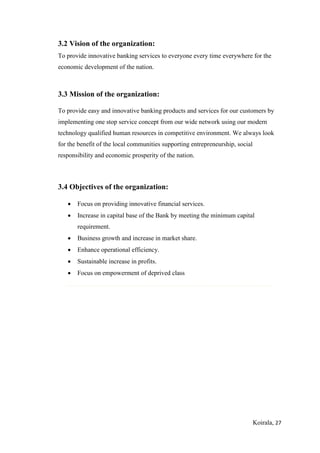
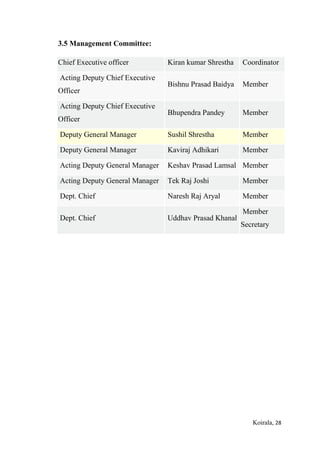
  • 18.
    Koirala, 8 Promoting workethics reflected in hard work and organizational commitment. Nepal has its national culture. Culture changes and cross cultural influences affect HRM. 1.2.3.2 Social Factors in other country: Demographic factors also affects the HRM of organization. Demographic factors are the characteristics of workforce such as gender, educational level, race and cultural background. Ratio of men and women in workforce and the cultural diversity has its impact on organizational performance. On the other side demographic factors have an impact on HRM practices within the organization. Organization now have to keep balance in gender, racial and ethnic diversity. Morever, companies now have to design jobs by keeping the work-life balance in consideration. Thus, demographic factors have its impact on HRM practices. Demographic or social forces affcect the HRM of organization in other countries for example: Hotels in FIJI they explained the employee turnover ratio in different departments and according to them the ratio is compared high in cleaning and Food and Beverages departments ,when compared with front office. So the companies are practicing different employee motivation and retention strategies for both types of employees. 1.2.4 Technological Factors that affect HRM in organization: This is considered an external influence because when new technologies are introduces the HR department can start looking at how to downsize and look for ways to save money. A job that used to take 2-4 people could be cut to one done by a single person. Technology is revolutionizing the way we do business and not just from a consumer standpoint, but from an internal-cost savings way. New technology brings new skills requirements, so companies always need to be aware of proficiencies and training needs when planning human resources. New products and services also may require recruiting highly skilled employees or training existing employees to meet the need. Make sure HR managers are aware of new equipment or knowledge be needed. So they can build the required skills and most likely salary enhancements into the plan.
  • 19.
    Koirala, 9 1.2.4.1 Technologyforces that affect HRM in Nepalese organization: Technology makes work more efficient. It consists of skills, methods, systems and equipment. It affects HRM by bringing about changes in jobs, skills, methods and processes. Automation, computerization, digitalization, robotics, informatics, and artificial intelligence have all affected the field of HRM. Technological Forces relevant to HRM are: Level of technology : It can be labour based or capital based and appropriate or sophisticated. The level of technology affects acquisition and development activities of HRM. Technological advances also affect HRM. Technological Change: The speed of technological change dislocates employees by eliminating old jobs, creating new jobs and increasing professionalization of jobs. HRM in Nepalese organization must equip human resources with new competencies and properly pay them to keep up with the technological advances. HRM environment of future will be technologically advanced. Information technology will lessen the need for middle managers and low-skilled employees. More work will be performed by work teams. Virtual offices will emerge where people will work from home through internet. 1.2.4.2 Technological factor in other country: Technology advancement are affecting all the fields of life. Impact of technological advancement can be observed in every field of life. Business have been transformed from industrial state into A study in 2007 investigated the impact of technology has played an effective role in reshaping the HR practices in business environment. IT has affected the efficiently of hiring process. With the help of technological advancements we now see online recruitment process.
  • 20.
    Koirala, 10 1.3 Objectivesof the study: The core objectives of the internship is to fulfill the requirement of the MBA program prescribed by Lincoln University (LUC). Besides that the internship project was completed with the objective of getting practical knowledge in the RBB bank. Besides that the objectives of internship program are:  To gain practical knowledge of what we have studied.  To know the HR strategies of bank.  To be familiar with the banking policies rules and regulations.  To gain idea from the experienced people working in the bank.  To find out the recruitment and selection process of bank.  To find out the vacation and leave policy of bank.  To find out transfer process of the bank.  To find out the Management Development of the bank.  To find out the Performance appraisals of the bank.  To find out the discipline policy of the bank.  To find out Retirement process of the bank.  To find out pension process of the bank.  To find out Occupational security facilities of the bank.  To find out Action policy of the bank.  To find out promotion facilities of the bank.  To find out Benefits facilities of the bank.  To develops managerial skills within ourselves.  To know the strength and weakness of the bank.  To develop personal standard and professional behavior.  To be personally experience an knowledgeble in the various activities of the bank. 1.4 Limitation: The major limitation of the project can be discussed below:  The report mostly based on data provided by RBB i.e secondary data.
  • 21.
    Koirala, 11  Thestudy only focuses on HR strategies.  References and resources is limited to the book, magazines websites.  The study is done for the partial fulfillment of MBA degree.  The study may not applicable for other organization of similar nature.  The bank’s policy on keeping some matters confidential prevented from analyzing differential activities.  This study takes into consideration only about general activities and does not include the minor details about each and every activity performed in the bank due to the time constraints. 1.5 Research Design: A research design is the detailed blueprint used to guide a research study towards its objectives. The research design is the process of arriving to the solution of the problem through planned and systematic dealing with the collection analysis and interpretation of facts and figures. This study of HR strategies of RBB bank has adopted the Secondary data analysis and expert survey method. 1.5.1 Sources of data As the report is based on the secondary data negligible amount of primary data has been used. Direct interview, Reports and magazine are used as sources of data. Two types of data are: Primary data: Primary data are mainly collected by a researcher to address the research problem. In other words these are not readily available from various sources, rather the researcher has to systematically collect the data relevant to a pre specified research problem. The importance of primary data is unquestionable. As the primary sources I myself worked as an internee in RBB bank for 8 weeks and collected some crucial information. I interviewed many staff members, personnel
  • 22.
    Koirala, 12 including managers,assistant managers, and subordinate staffs. I also observed the operational activities of various departments during my 8 weeks period of internship. Secondary Data: Secondary data are the data that have already been collected by someone else before the current needs of a researcher. The present researcher only uses these data with related references and never collects it from the field. When compared with the primary data, secondary data can be collected easily with time and cost efficiency. Secondary data are readily available and provide a base to tackle the research problem. For a secondary data, I have collected books, periodicals, and other published material, booklets, magazine, brochure and visited websites. 1.6 Sampling Design: Population is any complete group and sample is a subset of larger population. Sampling is the most widely used tool for gathering important and useful information from the population. A researcher generally takes a small portion of the population for study, which is referred to as sample. The process of selecting a sample from the population is called sampling. Population refers to the total of items about which information is desired. Sample is a sub group that is chosen which is believed to be representative of population and the method of choosing this sub group is done by sampling. 1.6.1 Sampling is essential because:  Sampling saves time.  Sampling saves money.  Sampling boardens the scope of the study in light of scarcity of resources.  Sampling minimizes the destruction.  Sampling provides the more accurate results. For the project I used simple random sampling.
  • 23.
    Koirala, 13 Simple RandomSampling: Simple random sampling is based on the process of selecting a sample randomly. This does not mean the randomness allows haphazard selection of sample. It means that the process of selecting a sample should be free from human judgement. I used Simple random sampling to choose RBB bank. 1.7 Data Gathering: The purpose of the various data collection techniques is to produce truth worthy evidence that is reverent to the research question being asked. The various steps of methods followed in order to get the most factual and dependable information about the sources of data in order to get the most factual and dependable information about the sources of data in order to get the most factual and dependable information about the sources of data used in the area based on secondary data. The data is gathered by secondary data sources such as published material, booklets, magazine, brochure and visited websites.
  • 24.
  • 25.
    Koirala, 15 2.1 Introductionof Bank After commerce and the arts had revived in Italy, the business of banking was resumed. The word "bank" is commonly regarded as derived from the Italian word 'Banco', a bench - the Jews in Lombardy having benches in the market-place for the exchange of money and bills. And people around the world start to use different words for their convenient like in French 'Banque', Latin 'Bancus', and German 'Bank'. At ancient times, bank means moneylenders who sat in the bench for keeping, lending and exchanging of money in the market place. A bank is an institution which deals in money receiving as deposits from customers, honoring customers drawing against such deposits on demand, collecting cheques for customers and lending or investing surplus deposits until they are requires for repayment. It allows interest on the deposits made and charges interest on the loans granted and further it creates credit and supports for the formation of capital and hence it is regarded as manufacturer of money. In simple, bank is an institution which deals with money and credit. A bank is a financial institution that serves as a financial intermediary, who bridges gap between the savers of the fund and users of the funds. Nowadays, a bank has broadened its scope by providing financial as well as non-financial services to its customers. To give specific meaning of bank is very difficult task however following are the few definitions given by different authors. "Banking means the accepting for the purpose of lending or investment of deposits of money from the public, repayable on demand or otherwise and withdrawal by cheque draft order or otherwise." --Indian Banking Company Act 1949 "Bank is an organization established for the purpose of exchange money deposit lending money and participation in transactions." --Commercial Bank Act of 2031 "Bank is a financial institution, which provides financial services that may be in the form of accepting deposits, advancing loan, providing necessary technical advices,
  • 26.
    Koirala, 16 dealing overtforeign currencies, remitting funds, etc." –Nepal Rastra Bank Act 2002 From the above definitions, we draw the conclusion that a bank is a financial intermediary that accepts deposits and channels those deposits into lending activities, either directly or through capital markets. It is the most important financial institution dealing with money, receiving it as deposits from customers, honoring customers drawing against such deposits on demand, collecting cheques for customers and lending or investing surplus deposits until they are required for repayment. Thus, bank receives demand deposits and time deposits, honors instruments drawn on them, and pays interest on them, makes loans, and invests in securities, collects cheques, drafts and certifies depositor's cheques and issues drafts and cashier's cheques. The difference in interest rate on lending and deposit, interest rate spread, is the major source of income for the bank. Interest on lending is higher than the deposits. 2.2 History of Banking in Global Scenario The history of banking is nearly as old as civilization. In the Babylon, at the time of Hammurabi, in the 18th century BC, there are records of loans made by the priests of the temple. The concept of banking has arrived. When the word bank is used it is meant for commercial bank. Before 1960 there was no such word as “banking’. However, in the temple Babylon the practices of safeguarding and saving flourished as early as 2000 B.C. Chanakya in his Arthashastra written in about 300 B.C. mentioning about the existence of powerful guilds of merchant’s bankers received deposits, advance loans and hundies. Merchants and goldsmith were ancestors of bank. The 'Bank of Venice', established in1157 A.D. is supposed to be the ancient bank. Originally, it was not a bank in real sense being simply on office for the transfer of the public debt. Venice, after being possibly the first city to found a bank for the keeping of money on safe deposit and the clearing of cheques, is also a pioneer in the involvement of a bank with state financiers. In 1617 the BancoGiro is established to
  • 27.
    Koirala, 17 solve problemsencountered by the earlier, which has got into trouble through the making of unsecured loans. Subsequently, 'Bank of Barcelona' (1401) and 'Bank of Geneva' (1407) were established. During the 18th century the Bank of England gradually undertakes many of the tasks now associated with a central bank, The 'Bank of England', first English Bank, was established in1964 A.D. It organizes the sale of government bonds when funds need to be raised. It acts as a clearing bank for government departments, facilitating and processing their daily transactions. History apart, it was the “Merchant bank” that first evolved the system by trading in commodities than money. They used to do their trading activities by remitting the money from one place to another. The next stage in the growth of banking was goldsmith. An honest goldsmith was also trusted with billions money and ornaments by merchants in neighborhoods. He started charging for acting as custodians of these valuables. As an evidence for receiving valuables he issued a receipt, which in turn became like cheques as a mode of exchange. He started advancing the coins on loan by charging interest. He started to keep some reserve as a safeguard. In this way the goldsmith money lender became a banker who started performing the two functions of modern banking that of accepting deposits and advancing loans. 2.3 History of Banking in Nepal Banking service is the oldest service industry in Nepal. It has gone through various stages of evolution and development since the Vedic times (2000 to 1400 B.C.). In the Nepalese chronicles, it was recorded that the new era known as Nepal Sambat was introduced by Shankhadhar, a Sudra merchant of Kantipur in 880 A.D. The banking in the form of money leading can be traced back in the reign of Gun Kam Dev towards the end of 8th century. According to the historical evidence in 723 Gun Kam Dev, the king of Kathmandu had borrowed money to rebuild and to rule Kathmandu.
  • 28.
    Koirala, 18 In the11th century, during Malla regime, there was an evidence of professional money-lenders and bankers. It is further believed that money-lending business, particularly for financing the foreign trade with Tibet, became quite popular. Another historical example as to the pre-modern banking system is found when Rana Prime minister Randip Singh was administering Nepal in 1880 A.D. During his regime one financial institution name by "TejarathAdda" was establish to give loan facilities to the governmental staff and to afford loan facilities to the public in general in the term of 5% interest. The credit facilities of "TejarathAdda" were also extended outside the valley during the Prime Minister ship of Chandra Shumsher Rana. Although this institution did not accept any deposits, it had played an important role in the development process of banking system in Nepal. Modern banking business started in the country just before the Second World War. In 1938 state financial institute which supply credit or loan against security. His Majesty King Tribhuvan inaugurated first commercial bank i.e. Nepal Bank Limited on Kartik 30, 1994 B.S. In the year 1994 B.S. as a semi government organization with an authorized capital RS.10 million of which 51% share are owned by government, this marked the beginning of an era of formal banking in Nepal. Until then all monetary tractions were carried out by private dealers and trading center. The need to regulate financial and monetary system increased enormously resulting in the establishment of Nepal Rastra Bank in 2013 B.S. In order to cater the demand of banking system, Rastriya Banijya Bank was established in 2022 B.S with 100% government ownership. Later some development banks and financial institutions were established to provide medium and long-term credit facilities to the industry and agriculture. In this contest, Nepal Industrial Development Corporation was established in 2016 B.S. to provide the financial and managerial assistance in the field of industry and to help private sector in the field of industry. In order to provide service to the agriculture sector, Agriculture Development Bank Ltd. was established in 2024 B.S. The government of Nepal adopted liberal economic policy to accelerate country's growth and development. Foreign investment and participation of private sector were
  • 29.
    Koirala, 19 encouraged. Thegovernment then enacted "Joint Venture Banking" policy. Commercial Banks should operate under the Commercial Bank Act 2031, Nepal Rastra Bank Act 2058 and Contract Act 2056. Nepal Arab Bank Ltd. (currently known as NABIL) is the first bank established in joint investment in Nepal in 2041 B.S. With the passage of time several other joint venture and private bank has been established such as Indosuez bank Limited (Nepal investment bank) in 2042 B.S., Nepal Grindlays Bank (Standard Chartered bank) 2043 B.S., Himalayan Bank Limited in 2049 B.S. and so on. 2.4 Commercial Banks Commercial bank is the term used for a normal bank to distinguish it from an investment bank. This is what people normally call a “Bank”. The term “commercial” was used to distinguish it from an investment bank. The commercial bank refers to bank which focus mainly on companies. The commercial banks are those banks that pool together the saving of community and arrange for their productive use. They activate the idle money to the different productive areas. They supply the financial needs of the modern business by various means. Most of the banks in the world are found established with a view to finance and help in developing trade, industry and commerce. In fact, commercial banks can be defined according to the function they perform. Commercial banks accept the deposit and also provide loan functions they perform. Commercial banks can accept deposit and also provide loan primarily to business firms, thereby facilitating the transfer of funds in the economy. 2.5 Role and Functions of Commercial Bank Commercial Banks are engaged in the following activities:  Processing of payments by way of telegraphic transfer, EFTPOS, internet banking or other means.  Issuing bank drafts and bank cheques.  Accepting money on term deposit & lending money by way of overdraft, installment loan or otherwise.
  • 30.
    Koirala, 20  Providingdocumentary and standby letter of credit, guarantees, performance bonds, securities underwritings commitments and other forms of off balance sheet exposures.  Safekeeping of documents and other item in safe deposit boxes.  Currency exchange.  Sale, distribution or brokerage, with or without advice, of insurance, unit trusts and similar financial products as a “financial supermarket”.  Economic liberalization.  Capital formation by mobilizing small savings. 2.6 Commercial Bank in Nepal Table No. 2.6 List of Commercial Banks S.N. Name of Commercial Bank Year Head office 1 Nepal Bank Limited 1957 Kathmandu 2 Rastriya Banijya Bank Limited 1966 Kathmandu 3 Nabil Bank Limited 1984 Kathmandu 4 Nepal Investment Bank Limited 1986 Kathmandu 5 Standard Chartered Bank Limited 1987 Kathmandu 6 Himalayan Bank Limited 1993 Kathmandu 7 Nepal SBI Bank Limited 1993 Kathmandu 8 Nepal Bangladesh Bank Limited 1993 Kathmandu 9 Everest Bank Limited 1994 Kathmandu 10 Bank of Kathmandu Limited 1995 Kathmandu 11 Nepal Credit and Commerce Bank Limited 1996 Bhairawa
  • 31.
    Koirala, 21 *Source: www.nrb.org.np 12Lumbini Bank Limited 1998 Narayangrah 13 Machhapuchre Bank Limited 2000 Pokhara 14 Kumari Bank Limited 2001 Kathmandu 15 Laxmi Bank Limited 2002 Birgunj 16 Siddharth Bank Limited 2002 Kathmandu 17 Global IME Bank Limited 2013 Birgunj 18 Citizens Bank International Limited 2007 Kathmandu 19 Prime Commercial Bank Limited 2007 Kathmandu 20 NIC Asia Nepal Limited 2013 Kathmandu 21 Grand Bank Nepal limited 2008 Kathmandu 22 NMB Bank Limited 2009 Kathmandu 23 Kist Bank Limited 2009 Kathmandu 24 Mega Bank Limited 2009 Kathmandu 25 Sunrise Bank limited 2009 Kathmandu 26 Janata Bank limited 2009 Kathmandu 27 Civil Bank limited 2010 Kathmandu 28 Century Commercial bank limited 2011 Kathmandu 29 Sanima Bank limited 2011 Kathmandu 30 Agricultural Development Bank 2024 B.S. Kathmandu
  • 32.
    Koirala, 22 2 3 5 10 13 17 18 30 32 28 0 5 10 15 20 25 30 35 1980 19851990 1995 2000 2005 2006 2010 2012 2016 Year No.ofCommercialBankinClassA Year Growing trend of commercial banks 2.7 Growth of Commercial Banks in (Class A) Nepal: 2.8 Challenges and Opportunities of Banking Industry: Challenges: The challenges of banking sectors are explained below:  Intense Competition: With the representation of 28 commercial banks with their several branches spread all around the country, the banking sector today is under the pressure of intense competition. Customer’s change in taste, preferences and want for innovative products and services has further acted as a catalyst.  Requires Huge Cost: Every bank uses its own software to operate banking activities. It requires large network connections as to connect all the branches along the same network. Today, Banks are adopting new and sophisticated technologies in order to provide better quality services to their customer which involves huge cost.  Liquidity Crisis: Improving the worsening liquidity crisis that is directly affecting the operation of banks is a major challenge for the banking sector in the current scenario. Higher loan investment compared to the deposit and the Figure No. 2.7 Growth of Commercial Banks (Class A) in Nepal
  • 33.
    Koirala, 23 policy thatrequires declaration of the source of fund exceeding Rs one million contributed to liquidity crisis.  Admits Political Instability:As the country’s political situation is unstable, the investors are reluctant to invest in new projects. Due to political instability economic development is not able to foster, as a result, investor back off for making huge investment as they assume the loss will overshadow their amount of profit.  Complex government policies: All the commercial banks of Nepal have to perform its functions under the act of Nepal Rastra Bank. In this regard, Nepal Rastra bank has been formulating its policies. Recent policy states, 10 billion is to be raised as capital by all commercial banks very risky for a new entrants to carry out their transactions. Opportunities:  Emerging Nation: Nepal is one of the developing countries among all other countries. There are various projects that have been undertaken to develop the economy of the country. Among the various other sources, bank loans are the major source of investment.  Merger: A tough competition has been going on in banking industry. Hence, banks need to strengthen and increase capital to compete in the market. Mergers strengthen the bank and bring economies of scales. Mergers lead to synergy effect and helps in cost saving of banks.  Technology: Almost all banks have e-banking and mobile banking facilities. The customers of bank have an easy access to their bank account and its services sitting anywhere they want. Most banks have their own mobile apps for security concerns. Customers are notified regarding changes to their account.  Remittance: The number of migrant population for employment is rapidly increasing. Among those migrants most of them are unskilled. Appropriate products should be designed to target this growing migrant population.
  • 34.
  • 35.
    Koirala, 25 3.1 Introduction RastriyaBanijya Bank is fully government owned, and the largest commercial bank in Nepal. RBB was established on January 23, 1966 (2022 Magh 10 BS) under the RBB Act. RBB provides various banking services to a wide range of customers including banks, insurance companies, industrial trading houses, airlines, hotels, and many other sectors. RBB has Nepal's most extensive banking network with 161 branches. RBB Ltd. - established on January 23, 1966 ( 2022 Magh 10 ) - a synonymous of stable and people's bank in Nepal - is one of the pioneer Bank in the country with the history of nearly a half century. Earlier constituted under RBB act 2021 with the full ownership of the government of Nepal, the Bank has been running under Bank and Financial Institute Act ( BAFIA ) and Company Act (CA) 2063 at present. The Bank licensed by NRB as a 'A' class commercial Bank of the country, has grown up as an indispensable component of the Nepalese economy. The bank is the highest profit earning bank for the FY 2014/15. The bank has second highest paid up capital till the end of FY 2015/16 after agriculture development bank. In terms of deposit, the bank has collected Rs more than Rs 130 Billion (F/Y 2015/16) which is the highest deposit of any commercial bank in Nepal. Rastriya Banijya Bank is one of the pioneering bank in Nepalese market that has carried out Note Kosh Fund, Bharu Kosh Fund, NRB's Draft transaction, Government Transaction, Pension Fund of Nepal Government. Besides more than 2 dozens of bank's branches are running in Losses, they provides continue services to the general public because it is the government bank. Profit is not only the solo motive of the bank. RBB provides services in remote and undeveloped areas of Nepal. RBBL – which has made glorious history of contributing for the monetization of the economy, eliminating dual currency in the market, initiating preliminary financial literacy, help flourish industrial, commercial and financial sector of the country has now emerged as a modern and strong financial institute of the country. The Bank with 2600 hands has expanded its wings in the most part of the country through multiple distribution outlets of 161 branches, 17 counters, 28 branch less banking (BLB) and 72 ATMs. The Bank with the highest public confidence- reflected in the highest deposit base and growing demand for branch establishment in the various parts -has
  • 36.
    Koirala, 26 stood asa pyramid in the financial arena of the country. The Bank with as many as 1.7 millions satisfied /direct customers ranging from poor to elite ones and millions of indirect ones, has drawn important imprint in the picture of country's economy through its significant involvement in the best use of its resources to enhance the production, income and employment opportunities. The Bank is fully committed to contribute its best for the socio economic development of the country and people in the days to come. RBB provides various banking services to a wide range of customers they include elite to poor individuals, institutional customers, and the customers from industry / business communities. RBB is a commercial bank which is service oriented and of philanthropic nature. At beginning it started its operation with 30 employees at Kathmandu. Currently it is employing 5627 employees and 128 branches in different part of the country. It has been running in profit from the very first of its operation but recently it is going on loss. Currently the bank has authorized capital of 1 billion, 17 million and 32 lakhs. This bank has authority of holding cash up to Nrs.1,80,00,000 and good also work that amount. RBB has Nepal's most extensive banking network with over 128 branches (101 ABBS Branches). Through its widest branch and ABBS network RBB has been catering modern Banking services to millions of customers. The Bank was transformed in company in 2063-1-6 B.S. Following this historical transformation the bank has successfully completed its first ever general assembly on 2067-05-31 BS. According to recent information it has also authorized of 38 crores, total amount to 3000 crores. It is also authorized to act as the agency or representative bank of NRB ltd. The bank is also in the frontline towards fulfilling corporate social responsibility. The bank has been working as a development partner by acting as a fund administrator of Poverty Alleviation Fund (PAF). Similarly, the bank has been working as a chief administrator in the Educational Assistance Project (run with the assistance of World Bank) aimed at assisting poor and diligent students learning at higher secondary and bachelor level.
  • 37.
    Koirala, 27 3.2 Visionof the organization: To provide innovative banking services to everyone every time everywhere for the economic development of the nation. 3.3 Mission of the organization: To provide easy and innovative banking products and services for our customers by implementing one stop service concept from our wide network using our modern technology qualified human resources in competitive environment. We always look for the benefit of the local communities supporting entrepreneurship, social responsibility and economic prosperity of the nation. 3.4 Objectives of the organization:  Focus on providing innovative financial services.  Increase in capital base of the Bank by meeting the minimum capital requirement.  Business growth and increase in market share.  Enhance operational efficiency.  Sustainable increase in profits.  Focus on empowerment of deprived class
  • 38.
    Koirala, 28 3.5 ManagementCommittee: Chief Executive officer Kiran kumar Shrestha Coordinator Acting Deputy Chief Executive Officer Bishnu Prasad Baidya Member Acting Deputy Chief Executive Officer Bhupendra Pandey Member Deputy General Manager Sushil Shrestha Member Deputy General Manager Kaviraj Adhikari Member Acting Deputy General Manager Keshav Prasad Lamsal Member Acting Deputy General Manager Tek Raj Joshi Member Dept. Chief Naresh Raj Aryal Member Dept. Chief Uddhav Prasad Khanal Member Secretary
  • 39.
  • 40.
    Koirala, 30 Data analysisis a core part of the study. In this section the data which are received are analyzed according to the requirement. In this section the human resources strategies of RBB bank are analyzed. Bank follow many HR strategies and it has very unique culture that bound the employees in the organization. The major HR strategies of RBB bank can be discussed below: 4.1 Recruitment Recruitment is an important function in all organizations. It brings together employer and employee. It aims to attract a high performing workforce in the organization. Recruitment is part of the acquisition component of human resource management. It is the process of finding right people for right positions at the right time. It is concerned with identifying and attracting a pool of qualified candidates to fulfill human resources needs of an organization. The quality of human resources depends on the quality of recruits. According to Edwin B. Flipp Recruitment is a process of searching for prospective employees and stimulating them to apply for jobs. According to DeCenzo and Robbins: Recruiting is the process of discovering potential job candidates. According to Gary Dessler: Recruiting is to build up a pool of qualified applicants. Recruitment process in the RBB: In RBB there is one most common method used for recruitment process is advertising. Advertising: This is the most common method for external recruiting. It reaches a much wider audience through various media. The media selection and the design of the advertisement should be given careful thought. It should encourages qualified candidates. In RBB bank the advertising is done by publishing vacancy on any national level newspaper daily. Such as: Gorkhapatra and Kantipur. Notices on the public places for the places where newspapers are not reached are also one way of advertising. The
  • 41.
    Koirala, 31 candidates areallowed to apply through firm till 30 days. Recruitment team are responsible for vacancy format. 4.2 The Selection Process: No organization can function effectively without the right quality of people. Selection is the process of choosing the most suitable candidate for a particular position from among the prospective applicants. The goal is to select the right person for the right job. Selection follows recruitment. It is concerned with hiring as well as rejecting the applicants. According to Wendell French: Selection is the process of choosing among people who apply for work with an organization. According to Werther and Davis: The selection process is a series of steps used to decide which recruits should be hired. According to Decenzo and Robbins: Selection activities predict which job applicant will be successful if hired. The selection process consists of a series of steps through which applicants pass. Each step serves as a hurdle which the steps successful candidates must cross. However the steps differ from organization to organization. In RBB bank the selection process consists of the following steps:  Application Form  Written Test  Oral Test  Practical Test  Interview  Application form: The recruitment process generates sufficiently large number of filled. In application forms from prospective candidates. Such forms consists information about.
  • 42.
    Koirala, 32 Personal backgroundinformation: Name, Sex, Age, Martial Status, Nationality, Address etc. Qualification: Educational, professional and other qualification specialized skills and training. Work experience: Experience in previous jobs and the name of organization served including duties, responsibilities etc. Salary: Salary drawn in present employment and expected salary. References: Names and address of persons who can be contacted as references.  Written Test: Standardized written test are administered to the candidates. They assess the suitability of candidates for the job. They provide objectives information about the candidates.  Oral Test: The candidates who have been selected from written test have to crossed oral test. Oral test include presentation and group discussion.  Practical Test: Practical test are for employees such as: Driver, Typist, Computer operator, mechanics etc.  Interview: The candidates who are selected from written test and the oral test has to crossed the interview section within 35 days. 4.3 Vacation and Leave: Vacation and leave is also called supplementary pay benefits is the most costly benefit because of the large amount of time off that most employees receive. Common time- off with-pay periods include holidays, vacations, jury duty, funeral leave, personal days, sick leave, sabbatical leave, maternity leave etc. In RBB bank there are nine types of leave that each employee will benefitted:  Casual leave : Casual leave are for nine days in a year. Employee are paid who are at casual leave.  Festival leave: Festival leave are for 3 days. Employees are paid who are at festival leave.
  • 43.
    Koirala, 33  HomeLeave: Home leave are for 30 days. Employees are paid who are at home leave.  Sick Leave: Sick leave provides pay to employees when they are out of work due to illness. Sick leave are for 15 days. Employees are paid who are at sick leave.  Study leave: Study leave provides to employees when they are out of work to study. Employees above 45 years are not allowed to have study leave. Employees are paid for their study leave.  Special Leave: Special leave are for one months. Employees are paid half of their salary who are on special leave. Employees have served enough for three years to have special leave.  Unusual leave: employees are not paid for their unusual leave.Employees who work more than 5 years can only benefitted by unusual leave.  Material leave: Material leave is provided to the women who get pregnant during their work life. Married women employees are benefitted by material leave. Women are paid for their material leave.  Funeral Leave: Funeral leave are provided to employees when they are out of work because of death of their closet person or relatives. Funeral leave are for 15 days. Employees are paid for their funeral leave. 4.4 Tansfer: A transfer is a move from one job to another usually with no change in salary or grade. Employers may transfer a worker to vacate a position where he or she is no longer needed, to fill one where he or she is needed, or more generally, to find a better fit for the employees the firm. Many firm today boost productivity by consolidating positions. Transfers are a way to give displaced employees a chance for another assignment or perhaps some personal growth. Employees seek transfers for many reasons, including personal enrichment more interesting jobs, greater convienience better hours location of work and so on or to job offering greater advancement possibilities.
  • 44.
    Koirala, 34 Many firmshave had policies of routinely transferring employees from locale to locale, either to expose them to a wider range of jobs or to fill open positions with the trained employees. Such easy transfer policies have fallen into some disfavor. Transfer in RBB Employees only who work more than one years are allowed to transfer. Employees who are married and they are working together in bank are allowed to transfer in another branch of bank for their purposes. Cashier are also allowed to transfer for their purposes. Guards and security guards are also allowed to transfer for their purposes after completing all the procedures. Procedures of Transfer  Collect transfer letter from reigning office.  Submit transfer letter to the new office.  Employees in a new office to be understand all the new rules.  Attendance is necessary in time in new office. 4.5 Management development: Management development is a systematic process of improving managerial performance. It prepare manager or other employees to handle present and future responsibilities. It develops managerial potential. Management development is given to managerial employees supervise the activities of others. It develops managerial potential by increasing conceptual interpersonal and decision making skills. Above all it develops managerial capability to manage effectively. It is also known as executive development. According to Gary Desseler: Management development is any attempt to improve current or future management performance by importing knowledge, changing attitudes or increasing skills.
  • 45.
    Koirala, 35 Management developmentis future oriented training focusing as personal growth of the employees. According to DenCenzo and Robbins: Management development increases the knowledge of employees. It is useful for following purposes:  It focuses on future responsibilities.  It is a long term on going educational process.  Its target are managerial employees.  It develops potential through conceptual, interpersonal, technical, and decision making skills.  It is proactive to future needs.  It is employee initiated and management facilitated. Management development in RBB: Management development are particularly for managers but we see in many organization and in bank also it is provided to many others employees also. Management development in RBB is provided to employees who work more than 3 years. Management development in RBB is provided to employees who have not cross 40 years.  Study development: Employees encouraged and developed to gain more knowledge on related field. Employees are encouraged to gain degree on C.A, M.B.A, Finance specialist by the bank.  Training development: Training are conducted by representative institution to the employees of bank.  Seminar : Seminar are also conducted and provided to the employees of bank. Seminar are known as oral communication of information by instructors to managers. It is based on talking and showing. Participants get opportunity to acquire knowledge and develop their skills.
  • 46.
    Koirala, 36 4.6 Performanceappraisals: Performance refers to accomplishment of assigned tasks by an employee. It is the results of abilities plus motivation. It is productivity measured in terms of effectiveness and efficiency. It also implies minimum degree of employees created disruptions interms of turnover, accidents and absences. Performing employees are productive employees. They accomplish tasks. All organizations evaluate the performance of their employees. It is essential for productivity improvement. Performance appraisal provides feedback to employees. It helps them to know where they stand, where they ought to be going, and how they are going to get there. It assess the relative worth of each employees to the organization. It is the basis for allocating rewards. It helps to plan employee development. Employees should perceive the performance appraisal system as fair equitable and transparent. Performance evaluation is a review of the job relevant strength and weaknesses of an individual or a team in an organization. Performance refers to accomplishment of assigned tasks by an employee. It is the result of abilities plus motivation. It is productivity measured in terms of effectiveness and efficiency. It also implies minimum degree of employee created disruptions in terms of turnover, accidents and absences. Performance appraisals is review of an employee actual performance on the job and his potential for assuming future responsibilities. It reviews job relevant strength and weaknesses of an employee. It is result based. According to Wayne F Cascio: Performance evaluation is a review of the job relevant strength and weaknesses of an individual or a team in an organization. According to the Dale s. Beach: Performance evaluation is the systematic evaluation of individuals with respect to their performance on the job and their potential for development:
  • 47.
    Koirala, 37 Who shoulddo the appraising in RBB:  The Supervisor: In RBB the supervisor do the performance appraisal. Supervisor rating are the heart of the most appraisals. This makes sense. The supervisor usually is in the best positions to evaluate the subordinates performance and is responsible for that person’s performance.  Rating Committees: In RBB many employers use rating committee. These committees usually contain the employee’s immediate supervisors and two or three other, supervisors. In RBB performance appraisals process includes following steps:  Preparation is essential: Beforehand review the persons job description, compare performance to the standard and review the previous appraisals. Give the employees at least a week’s notice to review his or her work.  Set a mutually agreeable time for the interview and allow enough time: Interviews with lower level personal like clerical workers should take no more than an hour. Interviews with management employees often take 2 or 3 hours. Conduct the interview in a private place with no interruptions. Talk in terms of objective work data: Use examples such as absences, tardiness, quality records, orders processed, productivity records, order processing time, accidents reports and so on. Don’t get personel: Try to compare the person’s performance to a standard. (These reports should normally be done within 10 days.) Similarly don’t compare the person’s performance to that of other people. (He’s quicker than you are.)  Encourage the person to talk: Stop and listen to what the person is saying: ask open ended questions such as. “what do you think we can do to improve this situation?” Use a command such as “Go on”. Restate the person’s last point as a question such as “you don’t think you can get the job done.  Get agreement: Make sure the person leaves knowing specially what he or she is doing right and doing wrong and with agreement on how things will be improved, and by when. Write up an action plan with target and dates.
  • 48.
    Koirala, 38 4.7 Discipline Employeesdiscipline is needed for effective human resources management. No organization can be effective without discipline at all levels of employees. Discipline regulates the behavior of employees. It is a necessary condition of orderly behavior. Discipline implies orderliness. It means adherence to rules, regulations, procedures and standards of acceptable behavior in the organization. Employee discipline is the result of employee behavior. According to DeCenzo and Robbins: Discipline is a condition in the organization when employees conduct themselves in accordance with the organization’s rules and standards of accepatable behavior. According to Gary Dessler: Discipline is a procedure that corrects or punishes a subordinates because a rule or procedure has been violated. When employees willingly follow rules and standard of acceptable behavior, discipline is said to be good. It is said to be bad when employees follow rules and standard of acceptable behavior unwillingly or disobey them. Discipline in RBB Attendance: Attendance is compulsory, expect in holidays. Employees should arrive at time for work. No unexcused absences. Employees are not allow to leave work without permission. 1 hour break for lunch. Dress code: Employees should follow the proper dress code. Bribery: Employees should reject any kind of bribe and corruption. Gift and entertainment: Employees are not allowed to accept any kind of gift and benefits.
  • 49.
    Koirala, 39 Besides thatthere are others rules that each employees should follow:  Obey safety rules.  Obey orders.  Employees should respect all their upper level employees.  Employees should be polite to all their lower level employees.  Employees should protect or keep safe all their documents.  Employees should perform and accomplished all their work at time.  Employees should inform the head if they get any information that is against bank.  Employees are not allowed to work in other competing firm without the permission of head.  Employees are not allowed to criticize the bank in any press media, radio and television.  Employees are allowed to write in favor of bank in any press media, radio and television.  Employees are not allowed to steal organization property.  Employees are not allowed to falsify information.  Employees are not allowed to go strike illegally.  Employees are not allowed to leak confidential information to competitors.  Employees are not allowed to smuggling and murder.  Employees are not allowed to make embarrassing speeches to the organization.  Wages garnishment is prohibited.  Employees are not allowed to do terrorism and arson by employees.  Employees are not allowed to give threat to management.  Employees are not allowed to use of drugs on the jobs.  Employees are not allowed to carry unauthorized weapons on the job.  Employees are not allowed to destruct organizational property.  Employees are not allowed to gambling on the job.  Employees are not allowed to do childmarriage, multimarriage.  Employees are not allowed to involve in any other banking business.  Employees are not allowed to play on any departments.
  • 50.
    Koirala, 40  Employeesare not allowed to interrupt other employees and customer in bank.  Employees are not allowed to enter in no entry zone.  Employees are not allowed to stop the facilities like drinking water, electricity, telephone. 4.8 Retirement: For many employees years of appraisals and career planning end with retirement. Retirement is the point where a person stops employment completely. A person may also semi-retire by reducing work hours. An increasing number of individuals are choosing to put off this point of total retirement, by selecting to exist in the emerging state of Pre-tirement. Many people choose to retire when they are eligible for private or public pension benefits, although some are forced to retire when physical conditions no longer allow the person to work any longer (by illness or accident) or as a result of legislation concerning their position. In most countries, the idea of retirement is of recent origin, being introduced during the late 19th and early 20th centuries. Previously, low life expectancy and the absence of pension arrangements meant that most workers continued to work until death. Germany was the first country to introduce retirement, in 1889. Nowadays, most developed countries have systems to provide pensions on retirement in old age, which may be sponsored by employers and/or the state. In many poorer countries, support for the old is still mainly provided through the family. Today, retirement with a pension is considered a right of the worker in many societies, and hard ideological, social, cultural and political battles have been fought over whether this is a right. In many western countries this right is mentioned in national constitutions.
  • 51.
    Koirala, 41 Retirement inRBB:  Compulsory retirement: Employees who are older than 58 years should retire from the job.  Personal retirement: Employees who work more than 20 years are allowed to have retirement from the job.  Unusual retirement: Employees who become mentally and physically unable to work they also have to retired. Employees who are not benefitted from retirement benefit:  Employees involved in department cases.  Employees involved in investigation.  Employees involved in other cases. Regination:  Employees who want to regine from their work should inform their head one month early.  If employees have to regine early than time then they should pay to the bank. 4.9 Pension: A pension is a fund into which a sum of money is added during an employee's employment years, and from which payments are drawn to support the person's retirement from work in the form of periodic payments. A pension may be a "defined benefit plan" where a fixed sum is paid regularly to a person, or a "defined contribution plan" under which a fixed sum is invested and then becomes available at retirement age. Pensions should not be confused with severance pay; the former is usually paid in regular installments for life after retirement, while the latter is
  • 52.
    Koirala, 42 typically paidas a fixed amount after involuntary termination of employment prior to retirement. The terms "retirement plan" and "superannuation" tend to refer to a pension granted upon retirement of the individual. Retirement plans may be set up by employers, insurance companies, the government or other institutions such as employer associations or trade unions.. A pension created by an employer for the benefit of an employee is commonly referred to as an occupational or employer pension. Labor unions, the government, or other organizations may also fund pensions. Occupational pensions are a form of deferred compensation, usually advantageous to employee and employer for tax reasons. Many pensions also contain an additional insurance aspect, since they often will pay benefits to survivors or disabled beneficiaries. Other vehicles (certain lottery payouts, for example, or an annuity) may provide a similar stream of payments. The common use of the term pension is to describe the payments a person receives upon retirement, usually under pre-determined legal or contractual terms. A recipient of a retirement pension is known as a pensioner or retiree. Pension in RBB:  Employees who work 5-10years in bank get pension after their retirement. Pension will be half of their salary.  Employees who work 10-15 years get the pension after their retirement. Pension will be equal to their salary.  Employees who work 15-20 years will get the pension after their retirement. Pension will be equal to their one and half month salary.  Employees who work more than 20 years will get pension after their retirement. Pension will be equal to their two month salary. Beneficial Person:  If any employees get death then the beneficial person, wife, son, daughter, whoever they have explained will get pension.  But the beneficial person get half of their pension.
  • 53.
    Koirala, 43 4.10 OccupationalSecurity: Job security is the probability that an individual will keep his or her job; a job with a high level of job security is such that a person with the job would have a small chance of becoming unemployed. Basic economic theory holds that during periods of economic expansion businesses experience increased demand, which in turn necessitates investment in more capital or labor. When businesses are experiencing growth, job confidence and security typically increase. The opposite often holds true during a recession businesses experience reduced demand and look to downsize their workforces in the short term. Governments and individuals are both motivated to achieve higher levels of job security. Governments attempt to do this by passing laws (such as the U.S. Civil Rights Act of 1964) which make it illegal to fire employees for certain reasons. Individuals can influence their degree of job security by increasing their skills through education and experience, or by moving to a more favorable location. The official unemployment rate and employee confidence indexes are good indicators of job security in particular fields. These statistics are closely watched by economists, government officials, and banks. Unions also strongly influence job security. Jobs that traditionally have a strong union presence such as many government jobs and jobs in education, healthcare and law enforcement are considered very secure while many non-unionized private sector jobs are generally believed to offer lower job security, although this varies by industry and country. Job security in RBB: In RBB employee’s job is secured:  Employees are not allowed to terminate unless they are consider by court.  Employees job are not allowed to terminate unless they are not out of contract.  Employees are not allowed to terminate unless they are on any positions.  Employees are encouraged to do or plan to do better work for bank and for themselves.
  • 54.
    Koirala, 44 4.11 Action: Punishmentis the authoritative imposition of an undesirable or unpleasant outcome upon a group or individual, in response to a particular action or behavior that is deemed unacceptable or threatening to some norm. The unpleasant imposition may include a fine, penalty, or confinement, or be the removal or denial of something pleasant or desirable. The individual may be a person, or even an animal. The authority may be either a group or a single person, and punishment may be carried out formally under a system of law or informally in other kinds of social settings such as within a family. Negative consequences that are not authorized or that are administered without a breach of rules are not considered to be punishment as defined here. The study and practice of the punishment of crimes, particularly as it applies to imprisonment, is called penology, or, often in modern texts, corrections; in this context, the punishment process is euphemistically called "correctional process". Research into punishment often includes similar research into prevention. Justifications for punishment include retribution, deterrence, rehabilitation, and incapacitation. The last could include such measures as isolation, in order to prevent the wrongdoer's having contact with potential victims, or the removal of a hand in order to make theft more difficult. Of the four justifications, only retribution is part of the definition of punishment and none of the other justifications is a guaranteed outcome, aside from obvious exceptions such as an executed man being incapacitated with regard to further crimes. The punishment department take action if: If employees do not fulfill their responsibilities and their work.  When they do not obey discipline.  When the secret of bank disclosed.  When employees involved in politics.  When the property of bank and any other secret try to be sold.  When they try to mismatch the money or cash.  When they try to take bribery, they are dismissed, punished or disqualified.
  • 55.
    Koirala, 45  Whenthey blame by court.  When they go for strike, illegally then they will be warn by management.  But there is a chance for employees to fight against them.  They get chance for their clarification. Action for punishment will be:  Grading should be stopped for 2 years.  Salary incremental should be stopped for 2 years.  Promotion should be stopped for 2 years.  Demotion to one step lower. 4.12 Promotion A promotion is the advancement of an employee's rank or position in an organizational hierarchy system. Promotion may be an employee's reward for good performance, i.e., positive appraisal. Before a company promotes an employee to a particular position it ensures that the person is able to handle the added responsibilities by screening the employee with interviews and tests and giving them training or on-the-job experience. A promotion can involve advancement in terms of designation, salary and benefits, and in some organizations the type of job activities may change a great deal. The opposite of a promotion is a demotion. A promotion can involve advancement in terms of designation, salary and benefits, and in some organizations the type of job activities may change a great deal. In many companies and public service organizations, more senior positions have a different title: an analyst who is promoted becomes a "principal analyst"; an economist becomes a "senior economist"; or an associate professor becomes a "full professor". The amount of salary increase associated with a promotion varies a great deal between industries and sectors, and depending on what parts of the hierarchical ladder an employee is moving between. In some industries or sectors, there may be only a modest increase in salary for a promotions; in other fields, a promotion may substantially increase an employee's salary.
  • 56.
    Koirala, 46 The sameis true with benefits and other privileges; in some industries, the promotion only changes the title and salary, and there are no additional benefits or privileges (beyond the psycho-social benefits that may accrue to the individual). In some not- for-profit organizations, the values of the organization or the tightness of funding may result in there being only modest salary increases associated with a promotion. In other industries, especially in private sector companies, a promotion to senior management may carry a number of benefits, such as stock options, a reserved parking space, a corner office with a secretary, and bonus pay for good performance. The degree to which job activities change varies between industries and sectors. In some fields, even after an employee is promoted, they continue to do similar work. For example, a policy analyst in the federal government who is promoted to the post of senior policy analyst will continue to do similar tasks such as writing briefing notes and carrying out policy research. The differences may be in the complexity of the files that the individual is assigned to or in the sensitivity of the issues that they are asked to deal with. In other fields, when an employee is promoted, their work changes substantially. Promotion in RBB:  If employees work for 3 years in level 5 then he/she will be promoted in level 6.  If employees work for 2years 6month in level 6 then he/she will be promoted in level 7.  If employees work for 2 years 6 month in level 7 then he/she will be promoted in level 8.  If employees work for 2 years 6month in level 8 then he/she will be promoted in level 9.  If employees work for 2 years 6 month in level 9 then he/she will be promoted in level 10.  If employees work for 3years in level 10 then he/she will be promoted in level 11.
  • 57.
    Koirala, 47 4.13 Benefits: Employeebenefits and (especially in British English) benefits in kind (also called fringe benefits, perquisites, or perks) include various types of non-wage compensation provided to employees in addition to their normal wages or salaries. In instances where an employee exchanges (cash) wages for some other form of benefit is generally referred to as a 'salary packaging' or 'salary exchange' arrangement. In most countries, most kinds of employee benefits are taxable to at least some degree. Examples of these benefits include: housing (employer-provided or employer-paid), group insurance (health, dental, life etc.), disability income protection, retirement benefits, daycare, tuition reimbursement, sick leave, vacation (paid and non- paid), social security, profit sharing, employer student loan contributions, and other specialized benefits. The purpose of employee benefits is to increase the economic security of staff members, and in doing so, improve worker retention across the organization. As such, it is one component of reward management. The term perks is often used colloquially to refer to those benefits of a more discretionary nature. Often, perks are given to employees who are doing notably well and/or have seniority. Common perks are take-home vehicles, hotel stays, free refreshments, leisure activities on work time (golf, etc.), stationery, allowances for lunch, and—when multiple choices exist—first choice of such things as job assignments and vacation scheduling. They may also be given first chance at job promotions when vacancies exist. Benefits in RBB:  Insurance: Each employees get insurance.  Funeral expenses: employees are paid 10000 for funeral expenses.  Home loan: Home loan provided to all employees.  Dashain bonus: Dashain bonus are paid to employees for the month of aswin. The amount will be equal to monthly salary.  Telephone facilities: Telephone facilities are paid to all employees.  Home repair loan: Employees who work more than 5 years in bank are paid for their home loan.
  • 58.
  • 59.
    Koirala, 49 5.1 CONCLUSION Conclusionis very important part of the report writing. It is necessary to find out the conclusions because it helps to know in which area the organization is not performing well so the major steps could be taken to overcome those problems.  Recruitment is an important aspects of human resources management in RBB. But we found that Bank is following only one method of recruitment process i.e Advertising. There are so many other process such as Job Posting, Employee Referral, Human resource Inventory search, Educational Institution Placement, Internet search contact which is completely missing.  Selection process involves a series of step to choose the right candidates. But we found that in bank some step is still incomplete. It lacks preliminary interview, references checks, physical examination etc.  Employees paid for their leave is one of the attractive facilities provided by bank.  Employees seeks transfer for better location, hour and work. But when employees are transfer other part of country they may not found all the facilities they need.  Bank don’t give adequate attention to developing their managers to assume greater responsibilities in the future. It has only limited number of programs. The popular management development methods such as Job Rotation, Behavior Modeling, Sensitivity Training, Transactional Analysis is completely missing.  Performance Appraisals hasn’t received adequate priority in RBB. It lacks feedback to employees.  Although discipline is major part of bank but it has been seen that employees are becoming careless. They postponed their work for tomorrow which never seems to come. It also seen that go slow to work and sometimes unnecessary strike.
  • 60.
    Koirala, 50  Thepeople who are unable to work should be retired. This types of benefits encourage new employee to join the firm and old employees to leave the firm without hesitation.  Pension plan is one of the attractive policy of the bank. It has been heard that the pension facilities from the bank is reducing permanently after 2/3 years. But we should understand the importance of pension how it help the old age employees to live and relax in their retirement life.  Occupational security is also one of the attractive facilities in the bank.  Action should be taken it also should be flexible and give sufficient chances to the employees for clarification.  Promotion facilities is also one of the attractive facilities provided by the bank.  Benefits facilities is also one of the attractive facilities provided by the bank. 5.2 RECOMMENDATION:  RBB should follow and implement different recruitment process. Such as: Job Posting, Employee referral, Human Resources inventory search, Educational Institutional Placement, Internet search.  RBB should add some steps in selection process. Such as: Preliminary interview, reference checks, physical examination.  Transferred employees should provided every possible facilities.  RBB should not only limited on understudy for their management development program they should provide every facilities.  RBB should adopted some modern performance appraisals technique such as: graphical rating scale, Behavioral anchored rating scale.  Discipline policies should not only noticed but should also implemented.  Retirement policy should be more flexible.  Pension policy should be extended.  Employees should get chances for clarification.  Besides these RBB lack employee motivation, employee Communication management and labor relations management in the bank.
  • 61.
    Koirala, 51 BIBLIOGRAPHY Employee servicerule of RBB 2062. Employee service rule of RBB 2053. Desseler Gary, Human Resources Management, Pearson. Agrawal Govinda Ram, Human Resources Management in Nepal, M.K Publishers and Distributors Bhotahiti, Kathmandu, Nepal. Agrawal Govinda Ram, Dynamics of Human Resources Management in Nepal, M.K Publishers and Distributors Bhotahiti, Kathmandu, Nepal. Zikmund William, Business Research Methods, Cenage Learning. Bajpai Naval, Business Research Methods, Pearson. Official Websites of Nepal Rastra Bank www.nrb.com.np Official Websites of Rastriya Banijya Bank www.rbb.com.np. Others Magazine and Newspapers.