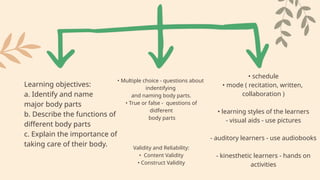
Learning objectives:
a. Identifyand name
major body parts
b. Describe the functions of
different body parts
c. Explain the importance of
taking care of their body.
• Multiple choice - questions about
indentifying
and naming body parts.
• True or false - questions of
didferent
body parts
Validity and Reliability:
• Content Validity
• Construct Validity
• schedule
• mode ( recitation, written,
collaboration )
• learning styles of the learners
- visual aids - use pictures
- auditory learners - use audiobooks
- kinesthetic learners - hands on
activities
4.
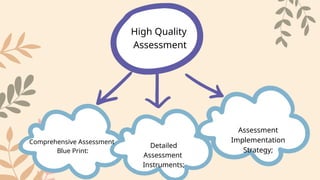
Comprehensive Assessment
Blue print
Learningobjectives:
a. Identify and name
major body parts
b. Describe the functions of
different body parts
c. Explain the importance of
taking care of their body.
5.
Detailed assessment Instruments
MultipleChoice
Multiple choice question
can be used as a quick
review of previously
learned information,
helping students solidify
their knowledge of body
parts name .
True or False
True or False questions are
quick and easy to administer,
making them ideal for quick
checks of understanding or for
reviewing a large amount of
information
6.
Validity and reliability
ConstructValidity: Refers to how well a test or
assessment measures the underlying construct or
theoretical concept related to those body parts.
Content Validity:
Refres to how well a test or assessment
accurately measures the specific knowledge and
skills related to those body parts.
7.
Assessment implementation strategy
SCHEDULE
Week1: Discovering My Body
- Day 1: "My Amazing Body!" (Students explore their own bodies through movement and self-discovery.
Introduce the concept of "body parts" and encourage them to identify parts they know.)
- Day 2: "Head to Toe" (Introduce major body parts through songs, rhymes, and picture books. Focus on
head, torso, arms, legs, hands, feet. Use visuals and simple labeling activities.)
- Day 3: "Body Part Bingo" (Play a game where students identify and name body parts on a bingo card.
This reinforces vocabulary and encourages active participation.)
- Day 4: "Body Part Scavenger Hunt" (Students search for objects in the classroom that resemble body
parts. This reinforces vocabulary and encourages observation skills.)
- Day 5: "My Body Drawing" (Students draw themselves and label major body parts. This allows for
individual expression and reinforces learning.)
8.
Week 2: WhatDo My Body Parts Do?
- Day 1: "Seeing and Hearing" (Focus on eyes and ears. Conduct simple experiments with light
and sound to demonstrate their functions. Introduce vocabulary like "see," "hear," "look,"
"listen.")
- Day 2: "Tasting and Smelling" (Explore tongue and nose. Conduct taste tests and smell
identification games. Introduce vocabulary like "taste," "smell," "sweet," "sour," "salty.")
- Day 3: "Moving and Holding" (Focus on hands and feet. Engage in simple motor skills
activities, drawing, and labeling. Introduce vocabulary like "grab," "hold," "walk," "run.")
- Day 4: "Keeping Me Safe" (Introduce skin and bones. Explain their functions in protecting the
body. Use simple models or drawings to illustrate the skeleton.)
- Day 5: "My Body's Helpers" (Introduce internal organs - heart, lungs, stomach. Use simple
models and explanations. Emphasize their importance in keeping the body healthy.)
9.
Week 3: TakingCare of My Amazing Body
- Day 1: "Healthy Eating" (Discuss food groups and their importance for a
healthy body. Use visuals and simple activities like sorting food pictures.)
- Day 2: "Staying Clean" (Hygiene - washing hands, brushing teeth, bathing.
Emphasize the importance of cleanliness for health.)
- Day 3: "Staying Safe" (Safety rules - crossing the street, playing safely.
Discuss how to keep our bodies safe from harm.)
- Day 4: "Getting Rest" (Importance of sleep. Discuss how sleep helps our
bodies recover and grow.)
- Day 5: "My Body is Special" (Celebrate individuality and diversity. Emphasize
that everyone's body is unique and special.)
10.
ASSESSMENT MODE
Written Assessment:
-"My Body Parts Book": Students
create a simple book with pictures
and descriptions of different body
parts and their functions. They can
draw, trace, or use cut-out pictures.
Collaborative Assessment:
- "Body Part Scavenger Hunt": Divide
students into small groups. Each group
receives a list of body parts. They search
the classroom for objects that represent
those body parts (e.g., a round ball for a
head, a long stick for an arm, a shoe for a
foot). They then present their findings to
the class.
Recitation Assessment:
- "Body Part Bingo": Create a bingo card with
pictures of different body parts. Call out the
names of body parts, and students mark them
off on their cards. The first student to get five in
a row (or a full card) wins!


![[DSC Europe 25] Tali Fulman - Guild Meetings, Then What? Building Data Commun...](https://cdn.slidesharecdn.com/ss_thumbnails/fgohhi33rwmhqdowdj5k-tali-fulman-guild-meetings-then-what-building-data-communities-that-actually-ch-260120105855-528492c3-thumbnail.jpg?width=640&height=640&fit=bounds)

![[DSC Europe 25] Jovan Sumarac - Real-World Applications of Computer Vision in...](https://cdn.slidesharecdn.com/ss_thumbnails/fiksms22smcpopvvld03-jovan-sumarac-real-life-applications-of-computer-vision-in-automotive-systems-260120105855-de622abb-thumbnail.jpg?width=640&height=640&fit=bounds)


![[DSC Europe 25] Harshvardhan Jain - From Pre-Trained to Purpose-Built: Fine-T...](https://cdn.slidesharecdn.com/ss_thumbnails/zru4zmiseku5tgvu2dgw-harshvardhan-jain-from-pre-trained-to-purpose-built-fine-tuning-llms-for-high-i-260119101520-8335585f-thumbnail.jpg?width=640&height=640&fit=bounds)
![[DSC Europe 25] Marcos Heidemann - Beyond the Hype: Making AI Coding Assistan...](https://cdn.slidesharecdn.com/ss_thumbnails/eexkhvldrjsopspdjbur-marcos-heidemann-beyond-the-hype-getting-real-value-out-of-ai-assisted-coding-260121115910-7e9d41ec-thumbnail.jpg?width=640&height=640&fit=bounds)


![[DSC Europe 25] Milovan Jovicic - Beyond AI's Reach: The Enduring Value of Ev...](https://cdn.slidesharecdn.com/ss_thumbnails/pyeij0hurgwq5jugmtnv-2-milovan-jovicic-beyond-ais-reach-the-enduring-value-of-evergreen-design-v2-260120105856-d6ee57e5-thumbnail.jpg?width=640&height=640&fit=bounds)


![[DSC Europe 25] Paula Garcia Esteban -Building the Future: The Role of Data S...](https://cdn.slidesharecdn.com/ss_thumbnails/9ld1r1bsqpwve8qfvphy-paula-garcia-esteban-building-the-future-260122103838-4171f5cb-thumbnail.jpg?width=640&height=640&fit=bounds)


![[DSC Europe 25] Tamas Srancsik - How To Teach Your AI Football? An Argument f...](https://cdn.slidesharecdn.com/ss_thumbnails/bcjh1m9xtbosv20ucftb-tamas-srancsik-how-to-teach-your-ai-football-260121115910-08b53e9e-thumbnail.jpg?width=640&height=640&fit=bounds)

