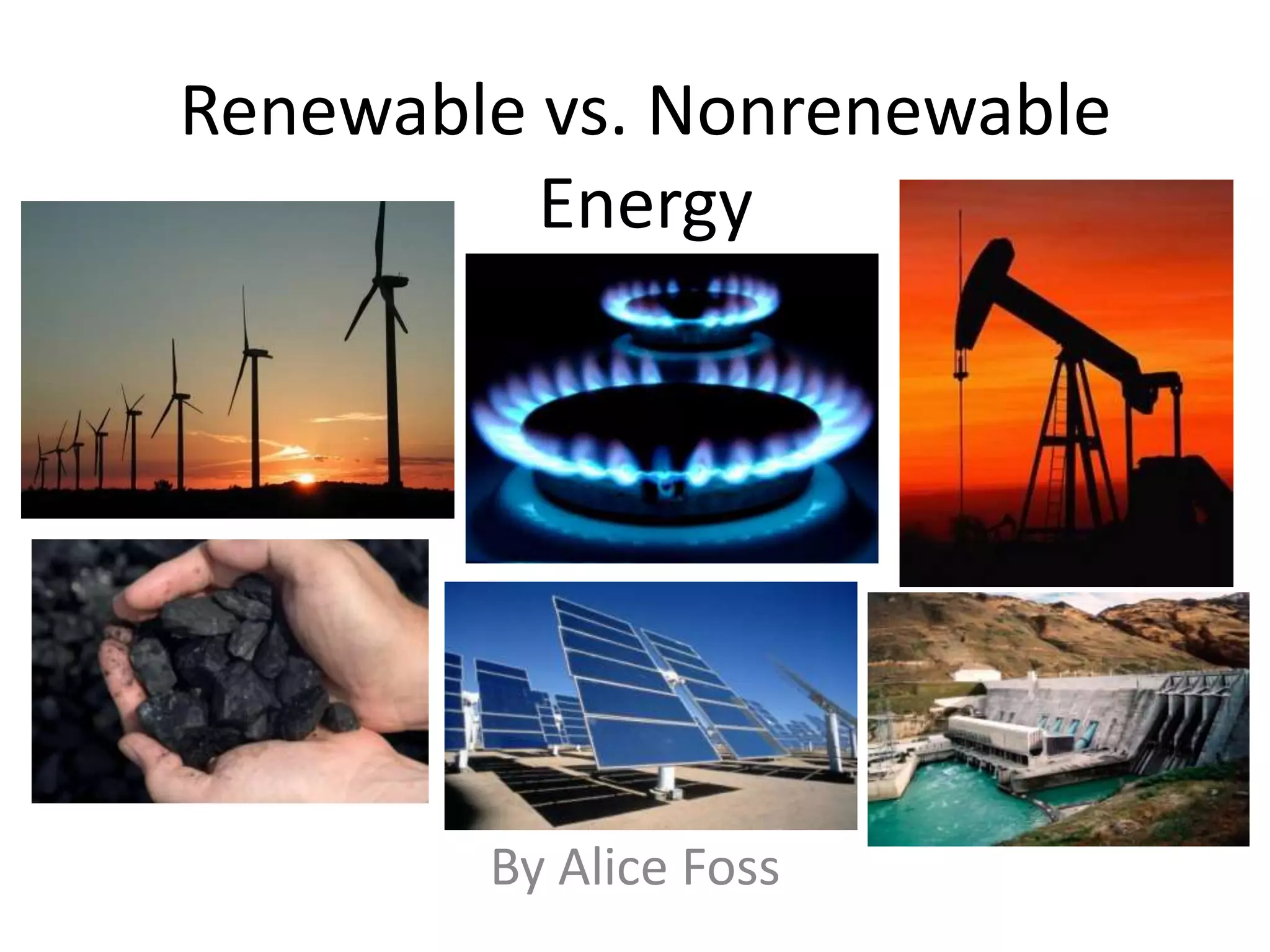
Renewable vs. Nonrenewable
          Energy


        By Alice Foss
Renewable Resources
• Definition: Any natural occurring, theoretically
  inexhaustible source of energy, as
  biomass, solar, wind, tidal, wave and
  hydroelectric power, that is not derived from
  fossil or nuclear fuel.
• Examples I am using today to compare
    *Wind Energy
    *Solar Energy
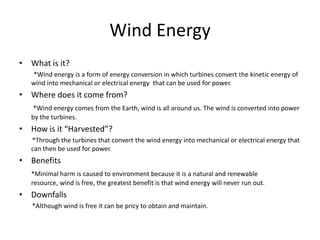
Wind Energy
• What is it?
   *Wind energy is a form of energy conversion in which turbines convert the kinetic energy of
   wind into mechanical or electrical energy that can be used for power.
• Where does it come from?
    *Wind energy comes from the Earth, wind is all around us. The wind is converted into power
   by the turbines.
• How is it “Harvested”?
   *Through the turbines that convert the wind energy into mechanical or electrical energy that
   can then be used for power.
• Benefits
   *Minimal harm is caused to environment because it is a natural and renewable
   resource, wind is free, the greatest benefit is that wind energy will never run out.
• Downfalls
   *Although wind is free it can be pricy to obtain and maintain.
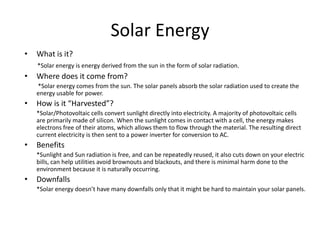
Solar Energy
•   What is it?
    *Solar energy is energy derived from the sun in the form of solar radiation.
•   Where does it come from?
    *Solar energy comes from the sun. The solar panels absorb the solar radiation used to create the
    energy usable for power.
•   How is it “Harvested”?
    *Solar/Photovoltaic cells convert sunlight directly into electricity. A majority of photovoltaic cells
    are primarily made of silicon. When the sunlight comes in contact with a cell, the energy makes
    electrons free of their atoms, which allows them to flow through the material. The resulting direct
    current electricity is then sent to a power inverter for conversion to AC.
•   Benefits
    *Sunlight and Sun radiation is free, and can be repeatedly reused, it also cuts down on your electric
    bills, can help utilities avoid brownouts and blackouts, and there is minimal harm done to the
    environment because it is naturally occurring.
•   Downfalls
    *Solar energy doesn’t have many downfalls only that it might be hard to maintain your solar panels.
Nonrenewable Resources
• Definition: Any natural resource from the
  earth that exists in limited supply and cannot
  be replaced if it is used up; also, any natural
  resource that cannot be replenished by
  natural means at the same rates that it is
  consumed.
• Example I am using today to compare
  *Natural Gas
Natural Gas

Renewable vs nonrenewable2

  • 1.
    Renewable vs. Nonrenewable Energy By Alice Foss
  • 2.
    Renewable Resources • Definition:Any natural occurring, theoretically inexhaustible source of energy, as biomass, solar, wind, tidal, wave and hydroelectric power, that is not derived from fossil or nuclear fuel. • Examples I am using today to compare *Wind Energy *Solar Energy
  • 3.
    Wind Energy • Whatis it? *Wind energy is a form of energy conversion in which turbines convert the kinetic energy of wind into mechanical or electrical energy that can be used for power. • Where does it come from? *Wind energy comes from the Earth, wind is all around us. The wind is converted into power by the turbines. • How is it “Harvested”? *Through the turbines that convert the wind energy into mechanical or electrical energy that can then be used for power. • Benefits *Minimal harm is caused to environment because it is a natural and renewable resource, wind is free, the greatest benefit is that wind energy will never run out. • Downfalls *Although wind is free it can be pricy to obtain and maintain.
  • 4.
    Solar Energy • What is it? *Solar energy is energy derived from the sun in the form of solar radiation. • Where does it come from? *Solar energy comes from the sun. The solar panels absorb the solar radiation used to create the energy usable for power. • How is it “Harvested”? *Solar/Photovoltaic cells convert sunlight directly into electricity. A majority of photovoltaic cells are primarily made of silicon. When the sunlight comes in contact with a cell, the energy makes electrons free of their atoms, which allows them to flow through the material. The resulting direct current electricity is then sent to a power inverter for conversion to AC. • Benefits *Sunlight and Sun radiation is free, and can be repeatedly reused, it also cuts down on your electric bills, can help utilities avoid brownouts and blackouts, and there is minimal harm done to the environment because it is naturally occurring. • Downfalls *Solar energy doesn’t have many downfalls only that it might be hard to maintain your solar panels.
  • 5.
    Nonrenewable Resources • Definition:Any natural resource from the earth that exists in limited supply and cannot be replaced if it is used up; also, any natural resource that cannot be replenished by natural means at the same rates that it is consumed. • Example I am using today to compare *Natural Gas
  • 6.