RENAL FAILURE
PRESENTER: KEAGAN KIRUGO; UROLOGY PGY 1, 2019
FACILITATOR: DR. E.S OTIENO, DEPARTMENT OF PHYSIOLOGY, UNIVERSITY OF NAIROBI.
OBJECTIVES
 Classification of renal failure
 Definition
 Aetiology
 Pathophysiology
 Treatment
CLASSIFICATION
 Renal failure is classified into Acute and
Chronic.
ACUTE RENAL
FAILURE
DEFINITION
 It refers to the abrupt decrease in kidney
function resulting in the retention of urea and
other nitrogenous waste and in the
dysregulation of extracellular volume and
electrolytes.
 The term Acute Renal Failure (ARF) is largely
being replaced by the term Acute Kidney
Injury (AKI) highlighting that injury to the
kidney does not lead to failure.
AETIOLOGY
 Prerenal
 Intrarenal
 Postrenal
PRERENAL
Causes
Volume depletion states: Haemorrhage,
Gastrointestinal tract loss, Excessive loss of fluid
due to burns, Diuretics
Decreased vascular filling: Anaphylactic shock,
septic shock.
Hypoperfusion: Heart failure, Cardiogenic shock,
Non steroidal anti-inflammatory drugs
PRERENAL
Pathophysiology
The kidneys receive 20-25 % of the cardiac
output. The large supply is required for the
kidney to carry out its functions; removal of
metabolic wastes and regulation of body fluids
and electrolytes. Fortunately, the normal kidneys
can tolerate relatively large reductions in blood
flow before renal damage occurs.
PRERENAL
 Pathophysiology
As renal blood flow is reduced, the glomerular
filtration rate (GFR) decreases. This results to a
corresponding decrease of urine output and an
elevated blood urea nitrogen (BUN). Ischemic
changes will occur. The tubular epithelial cells which
have a high metabolic rate are the most vulnerable
to injury. Tubular necrosis results as a result of
improper treatment of prerenal acute kidney injury.
INTRARENAL
Causes
Infections: glomerulonephritis
Pharmacologic agents: aminoglycosides,
platinum analogues, radiocontrast agents
INTRARENAL
 Pathophysiology
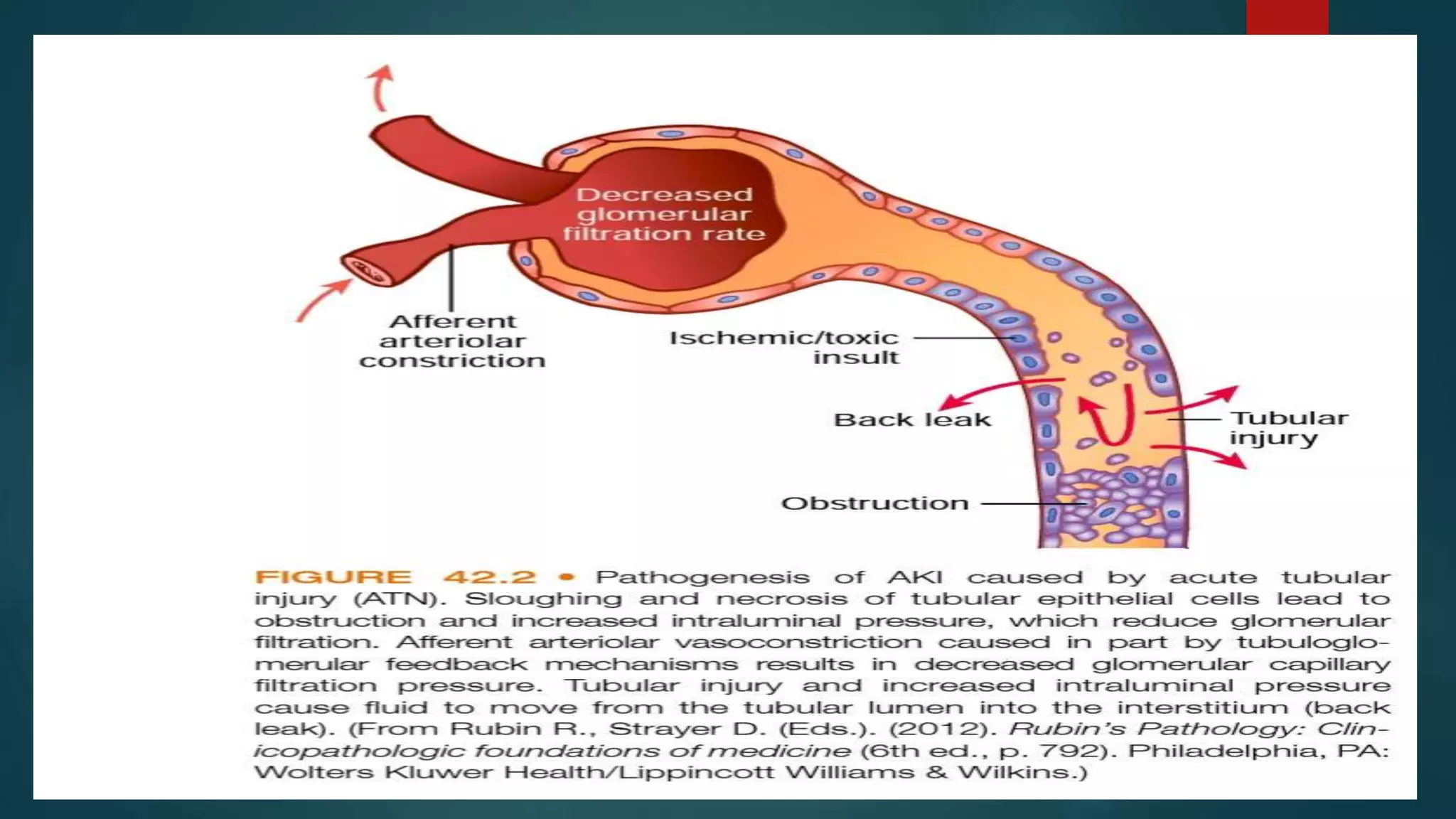
Entails damage to the parenchyma in the
glomeruli, vessels ,tubules or interstitium.
The kidney is vulnerable to nephrotoxic injury
because of its rich blood supply and ability to
concentrate toxins to high levels in its medullary
portion.
ACUTE TUBULAR NECROSIS
 It results from prerenal etiology or Intrarenal
where there is direct injury to the tubules.
Ischemic vs. nephrotoxic ATN.
 In contrast to prerenal failure, the GFR does
not improve with restoration of blood flow.
POSTRENAL
 Causes
Obstruction in the urinary tract at the level of;
Ureter: calculi, strictures
Bladder: tumours, neurogenic bladder
(functional)
Urethra: prostatic hyperplasia
POSTRENAL
 Pathophysiology
Obstruction can be structural or mechanical (neurogenic bladder).
The functional unit, the nephron, being intact continues performing its
filtration function. Increased urine is not able to be excreted further due to
the obstruction. This leads to retrograde pressure and flow which ultimately
damages the nephron.
DIAGNOSIS OF AKI
 Clinical evaluation: history and physical exam-dehydration,
urine output
 Laboratory evaluation:
Urine tests: proteinuria, haemoglobinuria, casts, crystals, urine
osmolality, urinary sodium concentration and fractional
excretion of sodium which differentiates prerenal azotemia, in
which the reabsorptive capacity of the tubular cells is
maintained, from tubular necrosis in which these functions are
lost. One of the earliest manifestations of tubular damage is
the inability to concentrate urine.
DIAGNOSIS OF AKI
 Laboratory evaluation:
Blood tests: BUN, creatinine.
New biomarkers: Interleukin 18 (IL-18) produced
in the proximal tubule after AKI, Neutrophil
gelatinin-associated lipocalin (NGAL), Kidney
injury molecule-1.
TREATMENT PRINCIPLES OF AKI
 1. Fluid administration so as to maintain
normovolemia and normal electrolyte balance
 2. Discontinuing the nephrotoxic agent
 3. Hemodialysis/ Continuous renal replacement
therapy (CRRT) when nitrogenous wastes and the
water and electrolyte balance cannot be kept
control by other means.
CHRONIC RENAL
FAILURE
DEFINITION
 Used interchangeably with the term Chronic
Kidney Disease (CKD).
 CKD is defined as presence of kidney damage
(usually detected as urinary albumin excretion
of 30mg/day or more) or decreased kidney
function (defined as an estimated GFR
<60ml/min/1.73m^2) for three or more
months irrespective of the cause.
CAUSES
 Hypertension
 Diabetes
The aforementioned are the most common
causes
Persistence of prerenal, Intrarenal and postrenal
causes
CLINICAL MANIFESTATION
PATHOPHYSIOLOGY
 1. Accumulation of nitrogenous waste
It is an early sign of kidney failure. Urea is one of
the first nitrogenous wastes to accumulate in
blood and the BUN becomes increasingly
elevated as CKD progresses.
Progressive azotemia leads to uremia.
PATHOPHYSIOLOGY
 Uremia affects various organs:
CNS-uremic encephalopathy, peripheral neuropathy
Skin-pruritus
GIT-ulcers, emesis
CVS-pericarditis
Reproductive-reduced libido due to disturbance in
hypothalamo-pituitary-gonadal function
Constitutional-weakness, fatigue
PATHOPHYSIOLOGY
 Creatinine, a byproduct of muscle metabolism,
is freely filtered in the glomerulus and is not
reabsorbed. Used as an indirect measure of
degree of failure.
PATHOPHYSIOLOGY
 2. Fluid, Electrolyte and Acid-Base
Disturbance
The function of extracellular fluid regulation by
either conserving sodium and water is impaired.
Moreover, the concentration of urine is impaired
leading to polyuria which is an early sign of CKD.
The urine at this point is almost isotonic to
plasma.
PATHOPHYSIOLOGY
 Salt wasting presents in advanced renal failure
due to impaired tubular reabsorption of
sodium.
 Approximately 90% of K+ excretion is renal.
Hyperkalemia usually does not develop until
GFR is below 5-10 ml/min/1.73m2. This is due
to renal adaptation to excrete K+ with
diminished GFR and GIT K+ loss increase.
PATHOPHYSIOLOGY
 PH regulation is by H+ elimination and HCO3-
regeneration. This is achieved by H+ secretion,
Na+ and HCO3- reabsorption and ammonia
production which acts as an acid buffer.
 With decline in renal function, the
aforementioned mechanisms become
impaired.
PATHOPHYSIOLOGY
Metabolic acidosis results if the patient is
challenged with excessive acid load or loss of
alkali as seen in diarrhea.
PATHOPHYSIOLOGY
 3. Disorders of Calcium and Phosphorus
metabolism
 Regulation of Phosphate requires daily urinary
excretion almost equal to the amount
ingested. With progressive renal failure, its
excretion is impaired leading to rise in plasma
phosphate levels.
PATHOPHYSIOLOGY
 Serum calcium levels, which are inversely
proportional to phosphate levels decrease.
This stimulates parathyroid hormone release
resulting in increased calcium resorption from
bone. Maintenance of calcium levels comes at
an expense of the skeletal system.
 Vitamin D synthesis is impaired in CKD. The
kidneys regulate vitamin D activity by
converting the inactive form-25(OH)to
calcitriol (1,25(OH)vitamin D3). Calcitriol has a
direct suppressive effect on PTH. In addition,
reduced calcitriol levels leads to impaired GIT
calcium absorption. Vitamin D also regulates
osteoblast differentiation, thereby affecting
bone replacement.
TREATMENT
 Measures to slow progression
Blood pressure control
Glycemic control
Calcium replacement
Avoiding nephrotoxic agents
Prompt treatment of infections
Optimizing the haemoglobin
Protein restriction
TREATMENT
 Definitive
Dialysis (haemodialysis or peritoneal dialysis) and renal transplant when there
is advanced uraemia or electrolyte abnormalities intractable to
pharmacological measures.
REFERENCES
 Grossman S, Porth C.M; Porth’s Pathophysiology, 9e, Lipincott.
 Https://www.uptodate.com. Last updated June 29 2018
 Monyihan R, Glassock R; Chronic kidney disease controversy: BMJ
2013;347. 30 July 2013

RENAL FAILURE

  • 1.
    RENAL FAILURE PRESENTER: KEAGANKIRUGO; UROLOGY PGY 1, 2019 FACILITATOR: DR. E.S OTIENO, DEPARTMENT OF PHYSIOLOGY, UNIVERSITY OF NAIROBI.
  • 2.
    OBJECTIVES  Classification ofrenal failure  Definition  Aetiology  Pathophysiology  Treatment
  • 3.
    CLASSIFICATION  Renal failureis classified into Acute and Chronic.
  • 4.
  • 5.
    DEFINITION  It refersto the abrupt decrease in kidney function resulting in the retention of urea and other nitrogenous waste and in the dysregulation of extracellular volume and electrolytes.  The term Acute Renal Failure (ARF) is largely being replaced by the term Acute Kidney Injury (AKI) highlighting that injury to the kidney does not lead to failure.
  • 6.
  • 8.
    PRERENAL Causes Volume depletion states:Haemorrhage, Gastrointestinal tract loss, Excessive loss of fluid due to burns, Diuretics Decreased vascular filling: Anaphylactic shock, septic shock. Hypoperfusion: Heart failure, Cardiogenic shock, Non steroidal anti-inflammatory drugs
  • 9.
    PRERENAL Pathophysiology The kidneys receive20-25 % of the cardiac output. The large supply is required for the kidney to carry out its functions; removal of metabolic wastes and regulation of body fluids and electrolytes. Fortunately, the normal kidneys can tolerate relatively large reductions in blood flow before renal damage occurs.
  • 10.
    PRERENAL  Pathophysiology As renalblood flow is reduced, the glomerular filtration rate (GFR) decreases. This results to a corresponding decrease of urine output and an elevated blood urea nitrogen (BUN). Ischemic changes will occur. The tubular epithelial cells which have a high metabolic rate are the most vulnerable to injury. Tubular necrosis results as a result of improper treatment of prerenal acute kidney injury.
  • 11.
    INTRARENAL Causes Infections: glomerulonephritis Pharmacologic agents:aminoglycosides, platinum analogues, radiocontrast agents
  • 12.
    INTRARENAL  Pathophysiology Entails damageto the parenchyma in the glomeruli, vessels ,tubules or interstitium. The kidney is vulnerable to nephrotoxic injury because of its rich blood supply and ability to concentrate toxins to high levels in its medullary portion.
  • 13.
    ACUTE TUBULAR NECROSIS It results from prerenal etiology or Intrarenal where there is direct injury to the tubules. Ischemic vs. nephrotoxic ATN.  In contrast to prerenal failure, the GFR does not improve with restoration of blood flow.
  • 15.
    POSTRENAL  Causes Obstruction inthe urinary tract at the level of; Ureter: calculi, strictures Bladder: tumours, neurogenic bladder (functional) Urethra: prostatic hyperplasia
  • 16.
    POSTRENAL  Pathophysiology Obstruction canbe structural or mechanical (neurogenic bladder). The functional unit, the nephron, being intact continues performing its filtration function. Increased urine is not able to be excreted further due to the obstruction. This leads to retrograde pressure and flow which ultimately damages the nephron.
  • 17.
    DIAGNOSIS OF AKI Clinical evaluation: history and physical exam-dehydration, urine output  Laboratory evaluation: Urine tests: proteinuria, haemoglobinuria, casts, crystals, urine osmolality, urinary sodium concentration and fractional excretion of sodium which differentiates prerenal azotemia, in which the reabsorptive capacity of the tubular cells is maintained, from tubular necrosis in which these functions are lost. One of the earliest manifestations of tubular damage is the inability to concentrate urine.
  • 18.
    DIAGNOSIS OF AKI Laboratory evaluation: Blood tests: BUN, creatinine. New biomarkers: Interleukin 18 (IL-18) produced in the proximal tubule after AKI, Neutrophil gelatinin-associated lipocalin (NGAL), Kidney injury molecule-1.
  • 19.
    TREATMENT PRINCIPLES OFAKI  1. Fluid administration so as to maintain normovolemia and normal electrolyte balance  2. Discontinuing the nephrotoxic agent  3. Hemodialysis/ Continuous renal replacement therapy (CRRT) when nitrogenous wastes and the water and electrolyte balance cannot be kept control by other means.
  • 20.
  • 21.
    DEFINITION  Used interchangeablywith the term Chronic Kidney Disease (CKD).  CKD is defined as presence of kidney damage (usually detected as urinary albumin excretion of 30mg/day or more) or decreased kidney function (defined as an estimated GFR <60ml/min/1.73m^2) for three or more months irrespective of the cause.
  • 23.
    CAUSES  Hypertension  Diabetes Theaforementioned are the most common causes Persistence of prerenal, Intrarenal and postrenal causes
  • 24.
  • 25.
    PATHOPHYSIOLOGY  1. Accumulationof nitrogenous waste It is an early sign of kidney failure. Urea is one of the first nitrogenous wastes to accumulate in blood and the BUN becomes increasingly elevated as CKD progresses. Progressive azotemia leads to uremia.
  • 26.
    PATHOPHYSIOLOGY  Uremia affectsvarious organs: CNS-uremic encephalopathy, peripheral neuropathy Skin-pruritus GIT-ulcers, emesis CVS-pericarditis Reproductive-reduced libido due to disturbance in hypothalamo-pituitary-gonadal function Constitutional-weakness, fatigue
  • 27.
    PATHOPHYSIOLOGY  Creatinine, abyproduct of muscle metabolism, is freely filtered in the glomerulus and is not reabsorbed. Used as an indirect measure of degree of failure.
  • 28.
    PATHOPHYSIOLOGY  2. Fluid,Electrolyte and Acid-Base Disturbance The function of extracellular fluid regulation by either conserving sodium and water is impaired. Moreover, the concentration of urine is impaired leading to polyuria which is an early sign of CKD. The urine at this point is almost isotonic to plasma.
  • 29.
    PATHOPHYSIOLOGY  Salt wastingpresents in advanced renal failure due to impaired tubular reabsorption of sodium.  Approximately 90% of K+ excretion is renal. Hyperkalemia usually does not develop until GFR is below 5-10 ml/min/1.73m2. This is due to renal adaptation to excrete K+ with diminished GFR and GIT K+ loss increase.
  • 30.
    PATHOPHYSIOLOGY  PH regulationis by H+ elimination and HCO3- regeneration. This is achieved by H+ secretion, Na+ and HCO3- reabsorption and ammonia production which acts as an acid buffer.  With decline in renal function, the aforementioned mechanisms become impaired.
  • 31.
    PATHOPHYSIOLOGY Metabolic acidosis resultsif the patient is challenged with excessive acid load or loss of alkali as seen in diarrhea.
  • 32.
    PATHOPHYSIOLOGY  3. Disordersof Calcium and Phosphorus metabolism  Regulation of Phosphate requires daily urinary excretion almost equal to the amount ingested. With progressive renal failure, its excretion is impaired leading to rise in plasma phosphate levels.
  • 33.
    PATHOPHYSIOLOGY  Serum calciumlevels, which are inversely proportional to phosphate levels decrease. This stimulates parathyroid hormone release resulting in increased calcium resorption from bone. Maintenance of calcium levels comes at an expense of the skeletal system.
  • 34.
     Vitamin Dsynthesis is impaired in CKD. The kidneys regulate vitamin D activity by converting the inactive form-25(OH)to calcitriol (1,25(OH)vitamin D3). Calcitriol has a direct suppressive effect on PTH. In addition, reduced calcitriol levels leads to impaired GIT calcium absorption. Vitamin D also regulates osteoblast differentiation, thereby affecting bone replacement.
  • 35.
    TREATMENT  Measures toslow progression Blood pressure control Glycemic control Calcium replacement Avoiding nephrotoxic agents Prompt treatment of infections Optimizing the haemoglobin Protein restriction
  • 36.
    TREATMENT  Definitive Dialysis (haemodialysisor peritoneal dialysis) and renal transplant when there is advanced uraemia or electrolyte abnormalities intractable to pharmacological measures.
  • 37.
    REFERENCES  Grossman S,Porth C.M; Porth’s Pathophysiology, 9e, Lipincott.  Https://www.uptodate.com. Last updated June 29 2018  Monyihan R, Glassock R; Chronic kidney disease controversy: BMJ 2013;347. 30 July 2013

Editor's Notes

  • #6 AKI is usually reversible. Azotemia is accumulation of nitrogenous waste (urea, uric acid and creatinine)
  • #9 Most common Aetiology of AKI
  • #10 The renal functions are mainly excretory or regulatory.
  • #11 Kidney Disease: Improving Global Outcomes (KDIGO) uses creatinine (>0.3 mg/dl or >26.5 micromole/L) and urine output (<0.5 ml/kg/hr in 6 hours) in the diagnostic criteria of AKI. The former is used in staging. KDIGO is a global non profit organization developing and implementing evidence-based clinical practice guidelines.
  • #22 It’s a gradua loss of renal function.
  • #23 Cockroft-Gault formula-Adults and Schwartz-Children
  • #29 1.008 to 1.012-SG of plasma 1.002 to 1.030-SG of urine
  • #30 Supplemental sodium intake in persons with renal failure often improves GFR but caution ought to be taken in hypertensive patients. It is not necessary to conduct potassium excretion initially in renal failure. Care must be observed in acidosis due to extracellular K+ shift.