Michelangelo's Philosophy & His 2 Famous Art Works
Michelangelo Buonarroti (1475-1564) was a famous artist in a time called the Renaissance, known for
making beautiful and meaningful art. His way of thinking about art was all about showing how amazing
the human body is and expressing important ideas about God and life.
High Renaissance: The Creation of Adam
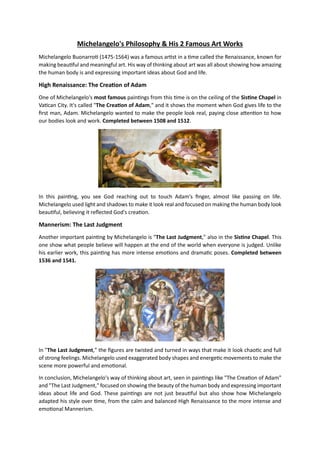
One of Michelangelo's most famous paintings from this time is on the ceiling of the Sistine Chapel in
Vatican City. It's called "The Creation of Adam," and it shows the moment when God gives life to the
first man, Adam. Michelangelo wanted to make the people look real, paying close attention to how
our bodies look and work. Completed between 1508 and 1512.
In this painting, you see God reaching out to touch Adam's finger, almost like passing on life.
Michelangelo used light and shadows to make it look real and focused on making the human body look
beautiful, believing it reflected God's creation.
Mannerism: The Last Judgment
Another important painting by Michelangelo is "The Last Judgment," also in the Sistine Chapel. This
one show what people believe will happen at the end of the world when everyone is judged. Unlike
his earlier work, this painting has more intense emotions and dramatic poses. Completed between
1536 and 1541.
In "The Last Judgment," the figures are twisted and turned in ways that make it look chaotic and full
of strong feelings. Michelangelo used exaggerated body shapes and energetic movements to make the
scene more powerful and emotional.
In conclusion, Michelangelo's way of thinking about art, seen in paintings like "The Creation of Adam"
and "The Last Judgment," focused on showing the beauty of the human body and expressing important
ideas about life and God. These paintings are not just beautiful but also show how Michelangelo
adapted his style over time, from the calm and balanced High Renaissance to the more intense and
emotional Mannerism.
Raphael’s Philosophy & His 2 Famous Art Works
Raphael was a famous artist during a time called the Renaissance. He believed in making art that
looked balanced and beautiful, using classical ideas and creating scenes that were pleasant to look at.
High Renaissance: The School of Athens
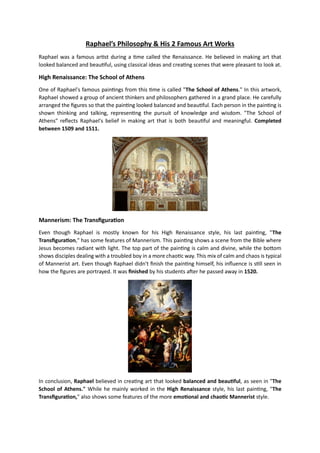
One of Raphael's famous paintings from this time is called "The School of Athens." In this artwork,
Raphael showed a group of ancient thinkers and philosophers gathered in a grand place. He carefully
arranged the figures so that the painting looked balanced and beautiful. Each person in the painting is
shown thinking and talking, representing the pursuit of knowledge and wisdom. "The School of
Athens" reflects Raphael's belief in making art that is both beautiful and meaningful. Completed
between 1509 and 1511.
Mannerism: The Transfiguration
Even though Raphael is mostly known for his High Renaissance style, his last painting, "The
Transfiguration," has some features of Mannerism. This painting shows a scene from the Bible where
Jesus becomes radiant with light. The top part of the painting is calm and divine, while the bottom
shows disciples dealing with a troubled boy in a more chaotic way. This mix of calm and chaos is typical
of Mannerist art. Even though Raphael didn't finish the painting himself, his influence is still seen in
how the figures are portrayed. It was finished by his students after he passed away in 1520.
In conclusion, Raphael believed in creating art that looked balanced and beautiful, as seen in "The
School of Athens." While he mainly worked in the High Renaissance style, his last painting, "The
Transfiguration," also shows some features of the more emotional and chaotic Mannerist style.
COLOSSEUM
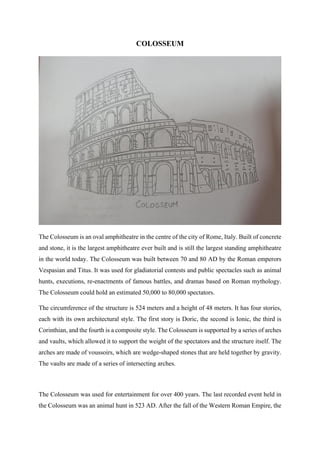
The Colosseum is an oval amphitheatre in the centre of the city of Rome, Italy. Built of concrete
and stone, it is the largest amphitheatre ever built and is still the largest standing amphitheatre
in the world today. The Colosseum was built between 70 and 80 AD by the Roman emperors
Vespasian and Titus. It was used for gladiatorial contests and public spectacles such as animal
hunts, executions, re-enactments of famous battles, and dramas based on Roman mythology.
The Colosseum could hold an estimated 50,000 to 80,000 spectators.
The circumference of the structure is 524 meters and a height of 48 meters. It has four stories,
each with its own architectural style. The first story is Doric, the second is Ionic, the third is
Corinthian, and the fourth is a composite style. The Colosseum is supported by a series of arches
and vaults, which allowed it to support the weight of the spectators and the structure itself. The
arches are made of voussoirs, which are wedge-shaped stones that are held together by gravity.
The vaults are made of a series of intersecting arches.
The Colosseum was used for entertainment for over 400 years. The last recorded event held in
the Colosseum was an animal hunt in 523 AD. After the fall of the Western Roman Empire, the
Colosseum was abandoned and fell into disrepair. In the Middle Ages, it was used as a quarry
for building materials, and it was also used as a fortress and a bullring.
In the 18th century, the Colosseum began to be restored. Today, it is one of the most popular
tourist destinations in Rome. It is a UNESCO World Heritage Site and is considered to be one
of the greatest architectural achievements of the Roman Empire.
The Colosseum is made of travertine limestone, tuff, and brick-faced concrete. The travertine
limestone was quarried from Tivoli, which is about 20 miles east of Rome. The tuff was quarried
from the Alban Hills, which are about 10 miles south of Rome. The brick-faced concrete was
made from a mixture of lime, sand, and pozzolana, which is a volcanic ash found near Rome.
The Colosseum is an example of Roman architecture at its finest. It is a massive and impressive
structure that has stood for over 2,000 years. The Colosseum is a reminder of the power and
ingenuity of the Roman Empire.
Baroque Architecture
Baroque architecture is a highly ornate and extravagant style that emerged in the late 16th
century and flourished in the 17th and 18th centuries in Europe. It is known for its drama"c
and theatrical quali"es, characterized by grandeur, opulence, and a sense of movement.
Baroque architecture is part of the broader Baroque art movement that also includes pain"ng,
sculpture, and music.
Characteris cs of Baroque Architecture
• Dynamic Forms: Curves, counter-curves, and oval shapes create a sense of movement
and energy.
• Grandeur and Ornamenta on: Elaborate ornamenta"on with detailed sculptures,
scrolls, and cherubs.
• Light and Shadow Play: Skilled use of light and shadow for a drama"c effect, o*en
through strategic window and dome placement.
• Large and Imposing Structures: Associated with grand palaces, churches, and public
buildings, designed to impress and convey power.
• Domes and Central Plans: Prominent domes and centralized floor plans draw a-en"on
upward, emphasizing a focal point.
• Contrast and Exuberance: Use of contras"ng colors, textures, and materials for a
visually striking effect.
• Emo onal Theatricality: Aims to evoke emo"ons and engage viewers through
drama"c spa"al arrangements, theatrical ligh"ng, and expressive sculptures.
Church of San Carlo Alle Qua(ro Fontane by Francesco Borromini Rome, Italy
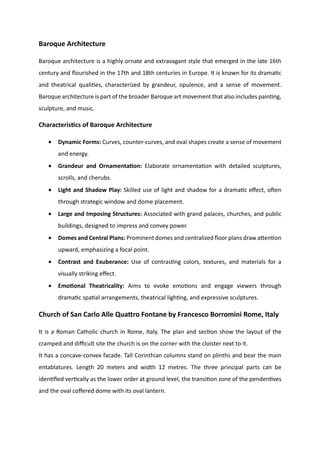
It is a Roman Catholic church in Rome, Italy. The plan and sec"on show the layout of the
cramped and difficult site the church is on the corner with the cloister next to it.
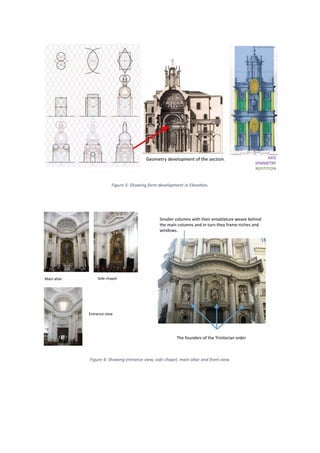
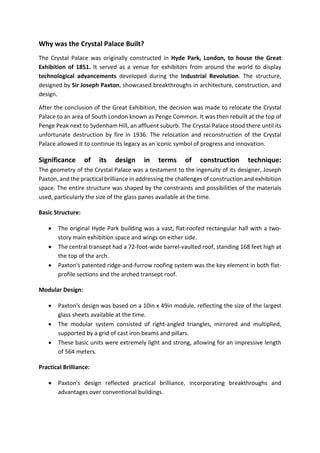
It has a concave-convex facade. Tall Corinthian columns stand on plinths and bear the main
entablatures. Length 20 meters and width 12 metres. The three principal parts can be
iden"fied ver"cally as the lower order at ground level, the transi"on zone of the penden"ves
and the oval coffered dome with its oval lantern.
Figure 1: Showing the plan of Church of San Carlo Alle Qua ro Fontane by Francesco Borromini Rome, Italy.
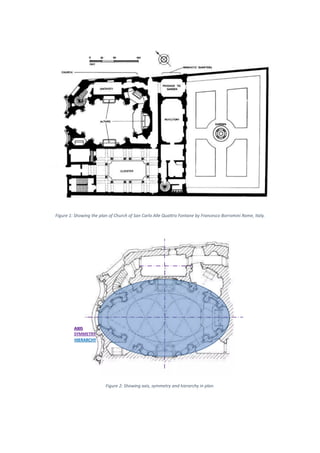
Figure 2: Showing axis, symmetry and hierarchy in plan.
Figure 3: Showing form development in Eleva(on.
Figure 4: Showing entrance view, side chapel, main altar and front view.
Why Eiffle Tower Is Important?
The Eiffel Tower was designed by Gustave Eiffel, a French engineer, and designer. It was
built as the centrepiece of the 1889 World's Fair, which was held in Paris to celebrate the
100th anniversary of the French Revolution. The tower was originally intended to be a
temporary structure, but it quickly became a permanent structure in the city.
The construction of the Eiffel Tower took just over two years, with work beginning in 1887
and finishing in 1889. It was a monumental feat of engineering at the time, with the tower
standing at 324 meters tall and weighing over 10,000 tons.
Significance of the Eiffel Tower
The Eiffel Tower has become a symbol of France and is recognized all over the world. It has
come to represent not only the city of Paris but also the country as a whole. The tower is a
testament to France's engineering and artistic prowess, and it has become an important part
of the country's identity.
The tower has also played an important role in French history. During World War I, the Eiffel
Tower was used as a radio transmission station, helping the French military to communicate
with their allies. And during World War II, the tower was used by the Germans as a radio
jamming station.
Figure 1: Sketch of Eiffel Tower
Why was the Crystal Palace Built?
The Crystal Palace was originally constructed in Hyde Park, London, to house the Great
Exhibition of 1851. It served as a venue for exhibitors from around the world to display
technological advancements developed during the Industrial Revolution. The structure,
designed by Sir Joseph Paxton, showcased breakthroughs in architecture, construction, and
design.
After the conclusion of the Great Exhibition, the decision was made to relocate the Crystal
Palace to an area of South London known as Penge Common. It was then rebuilt at the top of
Penge Peak next to Sydenham Hill, an affluent suburb. The Crystal Palace stood there until its
unfortunate destruction by fire in 1936. The relocation and reconstruction of the Crystal
Palace allowed it to continue its legacy as an iconic symbol of progress and innovation.
Significance of its design in terms of construction technique:
The geometry of the Crystal Palace was a testament to the ingenuity of its designer, Joseph
Paxton, and the practical brilliance in addressing the challenges of construction and exhibition
space. The entire structure was shaped by the constraints and possibilities of the materials
used, particularly the size of the glass panes available at the time.
Basic Structure:
• The original Hyde Park building was a vast, flat-roofed rectangular hall with a two-
story main exhibition space and wings on either side.
• The central transept had a 72-foot-wide barrel-vaulted roof, standing 168 feet high at
the top of the arch.
• Paxton's patented ridge-and-furrow roofing system was the key element in both flat-
profile sections and the arched transept roof.
Modular Design:
• Paxton's design was based on a 10in x 49in module, reflecting the size of the largest
glass sheets available at the time.
• The modular system consisted of right-angled triangles, mirrored and multiplied,
supported by a grid of cast iron beams and pillars.
• These basic units were extremely light and strong, allowing for an impressive length
of 564 meters.
Practical Brilliance:
• Paxton's design reflected practical brilliance, incorporating breakthroughs and
advantages over conventional buildings.
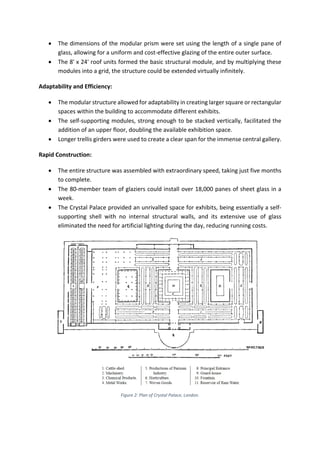
• The dimensions of the modular prism were set using the length of a single pane of
glass, allowing for a uniform and cost-effective glazing of the entire outer surface.
• The 8' x 24' roof units formed the basic structural module, and by multiplying these
modules into a grid, the structure could be extended virtually infinitely.
Adaptability and Efficiency:
• The modular structure allowed for adaptability in creating larger square or rectangular
spaces within the building to accommodate different exhibits.
• The self-supporting modules, strong enough to be stacked vertically, facilitated the
addition of an upper floor, doubling the available exhibition space.
• Longer trellis girders were used to create a clear span for the immense central gallery.
Rapid Construction:
• The entire structure was assembled with extraordinary speed, taking just five months
to complete.
• The 80-member team of glaziers could install over 18,000 panes of sheet glass in a
week.
• The Crystal Palace provided an unrivalled space for exhibits, being essentially a self-
supporting shell with no internal structural walls, and its extensive use of glass
eliminated the need for artificial lighting during the day, reducing running costs.
Figure 2: Plan of Crystal Palace, London.
Renaissance Architecture
The 15th and 16th centuries in Europe witnessed the rise of Renaissance architecture,
characterized by a renewed fascination with classical art and culture. This architectural
movement represented a departure from the preceding Gothic style, as it embraced design
elements inspired by the classical architecture of ancient Greece and Rome.
Early Renaissance Architecture
Example of early renaissance architecture:
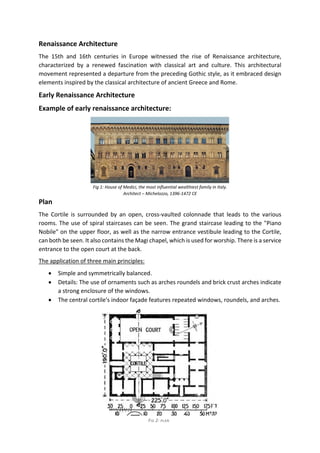
Fig 1: House of Medici, the most influential wealthiest family in Italy.
Architect – Michelozzo, 1396-1472 CE
Plan
The Cortile is surrounded by an open, cross-vaulted colonnade that leads to the various
rooms. The use of spiral staircases can be seen. The grand staircase leading to the "Piano
Nobile" on the upper floor, as well as the narrow entrance vestibule leading to the Cortile,
can both be seen. It also contains the Magi chapel, which is used for worship. There is a service
entrance to the open court at the back.
The application of three main principles:
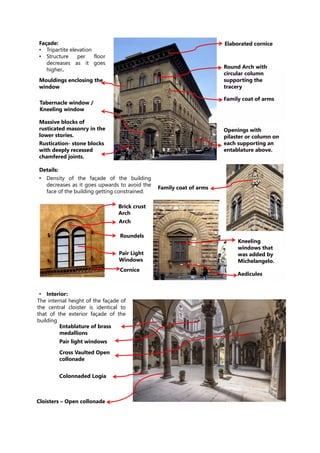
• Simple and symmetrically balanced.
• Details: The use of ornaments such as arches roundels and brick crust arches indicate
a strong enclosure of the windows.
• The central cortile's indoor façade features repeated windows, roundels, and arches.
FIG 2: PLAN
F 2:
FIG 2: PLAN
Renaissance to Industrial Evolution history notes

Renaissance to Industrial Evolution history notes

  • 1.
    Michelangelo's Philosophy &His 2 Famous Art Works Michelangelo Buonarroti (1475-1564) was a famous artist in a time called the Renaissance, known for making beautiful and meaningful art. His way of thinking about art was all about showing how amazing the human body is and expressing important ideas about God and life. High Renaissance: The Creation of Adam One of Michelangelo's most famous paintings from this time is on the ceiling of the Sistine Chapel in Vatican City. It's called "The Creation of Adam," and it shows the moment when God gives life to the first man, Adam. Michelangelo wanted to make the people look real, paying close attention to how our bodies look and work. Completed between 1508 and 1512. In this painting, you see God reaching out to touch Adam's finger, almost like passing on life. Michelangelo used light and shadows to make it look real and focused on making the human body look beautiful, believing it reflected God's creation. Mannerism: The Last Judgment Another important painting by Michelangelo is "The Last Judgment," also in the Sistine Chapel. This one show what people believe will happen at the end of the world when everyone is judged. Unlike his earlier work, this painting has more intense emotions and dramatic poses. Completed between 1536 and 1541. In "The Last Judgment," the figures are twisted and turned in ways that make it look chaotic and full of strong feelings. Michelangelo used exaggerated body shapes and energetic movements to make the scene more powerful and emotional. In conclusion, Michelangelo's way of thinking about art, seen in paintings like "The Creation of Adam" and "The Last Judgment," focused on showing the beauty of the human body and expressing important ideas about life and God. These paintings are not just beautiful but also show how Michelangelo adapted his style over time, from the calm and balanced High Renaissance to the more intense and emotional Mannerism.
  • 2.
    Raphael’s Philosophy &His 2 Famous Art Works Raphael was a famous artist during a time called the Renaissance. He believed in making art that looked balanced and beautiful, using classical ideas and creating scenes that were pleasant to look at. High Renaissance: The School of Athens One of Raphael's famous paintings from this time is called "The School of Athens." In this artwork, Raphael showed a group of ancient thinkers and philosophers gathered in a grand place. He carefully arranged the figures so that the painting looked balanced and beautiful. Each person in the painting is shown thinking and talking, representing the pursuit of knowledge and wisdom. "The School of Athens" reflects Raphael's belief in making art that is both beautiful and meaningful. Completed between 1509 and 1511. Mannerism: The Transfiguration Even though Raphael is mostly known for his High Renaissance style, his last painting, "The Transfiguration," has some features of Mannerism. This painting shows a scene from the Bible where Jesus becomes radiant with light. The top part of the painting is calm and divine, while the bottom shows disciples dealing with a troubled boy in a more chaotic way. This mix of calm and chaos is typical of Mannerist art. Even though Raphael didn't finish the painting himself, his influence is still seen in how the figures are portrayed. It was finished by his students after he passed away in 1520. In conclusion, Raphael believed in creating art that looked balanced and beautiful, as seen in "The School of Athens." While he mainly worked in the High Renaissance style, his last painting, "The Transfiguration," also shows some features of the more emotional and chaotic Mannerist style.
  • 3.
    COLOSSEUM The Colosseum isan oval amphitheatre in the centre of the city of Rome, Italy. Built of concrete and stone, it is the largest amphitheatre ever built and is still the largest standing amphitheatre in the world today. The Colosseum was built between 70 and 80 AD by the Roman emperors Vespasian and Titus. It was used for gladiatorial contests and public spectacles such as animal hunts, executions, re-enactments of famous battles, and dramas based on Roman mythology. The Colosseum could hold an estimated 50,000 to 80,000 spectators. The circumference of the structure is 524 meters and a height of 48 meters. It has four stories, each with its own architectural style. The first story is Doric, the second is Ionic, the third is Corinthian, and the fourth is a composite style. The Colosseum is supported by a series of arches and vaults, which allowed it to support the weight of the spectators and the structure itself. The arches are made of voussoirs, which are wedge-shaped stones that are held together by gravity. The vaults are made of a series of intersecting arches. The Colosseum was used for entertainment for over 400 years. The last recorded event held in the Colosseum was an animal hunt in 523 AD. After the fall of the Western Roman Empire, the
  • 4.
    Colosseum was abandonedand fell into disrepair. In the Middle Ages, it was used as a quarry for building materials, and it was also used as a fortress and a bullring. In the 18th century, the Colosseum began to be restored. Today, it is one of the most popular tourist destinations in Rome. It is a UNESCO World Heritage Site and is considered to be one of the greatest architectural achievements of the Roman Empire. The Colosseum is made of travertine limestone, tuff, and brick-faced concrete. The travertine limestone was quarried from Tivoli, which is about 20 miles east of Rome. The tuff was quarried from the Alban Hills, which are about 10 miles south of Rome. The brick-faced concrete was made from a mixture of lime, sand, and pozzolana, which is a volcanic ash found near Rome. The Colosseum is an example of Roman architecture at its finest. It is a massive and impressive structure that has stood for over 2,000 years. The Colosseum is a reminder of the power and ingenuity of the Roman Empire.
  • 5.
    Baroque Architecture Baroque architectureis a highly ornate and extravagant style that emerged in the late 16th century and flourished in the 17th and 18th centuries in Europe. It is known for its drama"c and theatrical quali"es, characterized by grandeur, opulence, and a sense of movement. Baroque architecture is part of the broader Baroque art movement that also includes pain"ng, sculpture, and music. Characteris cs of Baroque Architecture • Dynamic Forms: Curves, counter-curves, and oval shapes create a sense of movement and energy. • Grandeur and Ornamenta on: Elaborate ornamenta"on with detailed sculptures, scrolls, and cherubs. • Light and Shadow Play: Skilled use of light and shadow for a drama"c effect, o*en through strategic window and dome placement. • Large and Imposing Structures: Associated with grand palaces, churches, and public buildings, designed to impress and convey power. • Domes and Central Plans: Prominent domes and centralized floor plans draw a-en"on upward, emphasizing a focal point. • Contrast and Exuberance: Use of contras"ng colors, textures, and materials for a visually striking effect. • Emo onal Theatricality: Aims to evoke emo"ons and engage viewers through drama"c spa"al arrangements, theatrical ligh"ng, and expressive sculptures. Church of San Carlo Alle Qua(ro Fontane by Francesco Borromini Rome, Italy It is a Roman Catholic church in Rome, Italy. The plan and sec"on show the layout of the cramped and difficult site the church is on the corner with the cloister next to it. It has a concave-convex facade. Tall Corinthian columns stand on plinths and bear the main entablatures. Length 20 meters and width 12 metres. The three principal parts can be iden"fied ver"cally as the lower order at ground level, the transi"on zone of the penden"ves and the oval coffered dome with its oval lantern.
  • 6.
    Figure 1: Showingthe plan of Church of San Carlo Alle Qua ro Fontane by Francesco Borromini Rome, Italy. Figure 2: Showing axis, symmetry and hierarchy in plan.
  • 7.
    Figure 3: Showingform development in Eleva(on. Figure 4: Showing entrance view, side chapel, main altar and front view.
  • 8.
    Why Eiffle TowerIs Important? The Eiffel Tower was designed by Gustave Eiffel, a French engineer, and designer. It was built as the centrepiece of the 1889 World's Fair, which was held in Paris to celebrate the 100th anniversary of the French Revolution. The tower was originally intended to be a temporary structure, but it quickly became a permanent structure in the city. The construction of the Eiffel Tower took just over two years, with work beginning in 1887 and finishing in 1889. It was a monumental feat of engineering at the time, with the tower standing at 324 meters tall and weighing over 10,000 tons. Significance of the Eiffel Tower The Eiffel Tower has become a symbol of France and is recognized all over the world. It has come to represent not only the city of Paris but also the country as a whole. The tower is a testament to France's engineering and artistic prowess, and it has become an important part of the country's identity. The tower has also played an important role in French history. During World War I, the Eiffel Tower was used as a radio transmission station, helping the French military to communicate with their allies. And during World War II, the tower was used by the Germans as a radio jamming station. Figure 1: Sketch of Eiffel Tower
  • 9.
    Why was theCrystal Palace Built? The Crystal Palace was originally constructed in Hyde Park, London, to house the Great Exhibition of 1851. It served as a venue for exhibitors from around the world to display technological advancements developed during the Industrial Revolution. The structure, designed by Sir Joseph Paxton, showcased breakthroughs in architecture, construction, and design. After the conclusion of the Great Exhibition, the decision was made to relocate the Crystal Palace to an area of South London known as Penge Common. It was then rebuilt at the top of Penge Peak next to Sydenham Hill, an affluent suburb. The Crystal Palace stood there until its unfortunate destruction by fire in 1936. The relocation and reconstruction of the Crystal Palace allowed it to continue its legacy as an iconic symbol of progress and innovation. Significance of its design in terms of construction technique: The geometry of the Crystal Palace was a testament to the ingenuity of its designer, Joseph Paxton, and the practical brilliance in addressing the challenges of construction and exhibition space. The entire structure was shaped by the constraints and possibilities of the materials used, particularly the size of the glass panes available at the time. Basic Structure: • The original Hyde Park building was a vast, flat-roofed rectangular hall with a two- story main exhibition space and wings on either side. • The central transept had a 72-foot-wide barrel-vaulted roof, standing 168 feet high at the top of the arch. • Paxton's patented ridge-and-furrow roofing system was the key element in both flat- profile sections and the arched transept roof. Modular Design: • Paxton's design was based on a 10in x 49in module, reflecting the size of the largest glass sheets available at the time. • The modular system consisted of right-angled triangles, mirrored and multiplied, supported by a grid of cast iron beams and pillars. • These basic units were extremely light and strong, allowing for an impressive length of 564 meters. Practical Brilliance: • Paxton's design reflected practical brilliance, incorporating breakthroughs and advantages over conventional buildings.
  • 10.
    • The dimensionsof the modular prism were set using the length of a single pane of glass, allowing for a uniform and cost-effective glazing of the entire outer surface. • The 8' x 24' roof units formed the basic structural module, and by multiplying these modules into a grid, the structure could be extended virtually infinitely. Adaptability and Efficiency: • The modular structure allowed for adaptability in creating larger square or rectangular spaces within the building to accommodate different exhibits. • The self-supporting modules, strong enough to be stacked vertically, facilitated the addition of an upper floor, doubling the available exhibition space. • Longer trellis girders were used to create a clear span for the immense central gallery. Rapid Construction: • The entire structure was assembled with extraordinary speed, taking just five months to complete. • The 80-member team of glaziers could install over 18,000 panes of sheet glass in a week. • The Crystal Palace provided an unrivalled space for exhibits, being essentially a self- supporting shell with no internal structural walls, and its extensive use of glass eliminated the need for artificial lighting during the day, reducing running costs. Figure 2: Plan of Crystal Palace, London.
  • 11.
    Renaissance Architecture The 15thand 16th centuries in Europe witnessed the rise of Renaissance architecture, characterized by a renewed fascination with classical art and culture. This architectural movement represented a departure from the preceding Gothic style, as it embraced design elements inspired by the classical architecture of ancient Greece and Rome. Early Renaissance Architecture Example of early renaissance architecture: Fig 1: House of Medici, the most influential wealthiest family in Italy. Architect – Michelozzo, 1396-1472 CE Plan The Cortile is surrounded by an open, cross-vaulted colonnade that leads to the various rooms. The use of spiral staircases can be seen. The grand staircase leading to the "Piano Nobile" on the upper floor, as well as the narrow entrance vestibule leading to the Cortile, can both be seen. It also contains the Magi chapel, which is used for worship. There is a service entrance to the open court at the back. The application of three main principles: • Simple and symmetrically balanced. • Details: The use of ornaments such as arches roundels and brick crust arches indicate a strong enclosure of the windows. • The central cortile's indoor façade features repeated windows, roundels, and arches. FIG 2: PLAN F 2: FIG 2: PLAN