

1485-1660
The Rebirth of
Classical Knowledge
UTFPR
The Renaissance Period
 Human beings and nature as the results of natural law
rather than occult powers
 Focus on afterlife switches to focus on the Here and
Now.
– Discovery of New World and International Travel
– Invention of the printing press
– Rise of Democracy and Nationalism
– Revitalized interest in education and the founding of
Universities
– Patronage of the arts
Life is GOOD!
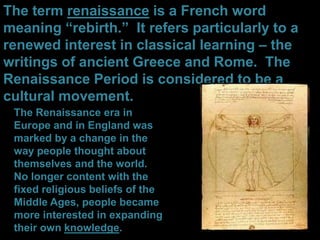
The term renaissance is a French word
meaning “rebirth.” It refers particularly to a
renewed interest in classical learning – the
writings of ancient Greece and Rome. The
Renaissance Period is considered to be a
cultural movement.
The Renaissance era in
Europe and in England was
marked by a change in the
way people thought about
themselves and the world.
No longer content with the
fixed religious beliefs of the
Middle Ages, people became
more interested in expanding
their own knowledge.
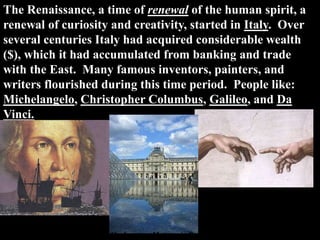
The Renaissance, a time of renewal of the human spirit, a
renewal of curiosity and creativity, started in Italy. Over
several centuries Italy had acquired considerable wealth
($), which it had accumulated from banking and trade
with the East. Many famous inventors, painters, and
writers flourished during this time period. People like:
Michelangelo, Christopher Columbus, Galileo, and Da
Vinci.
The Louvre – Museum in Paris
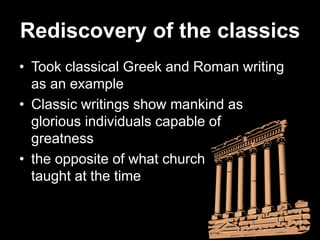
Rediscovery of the classics
• Took classical Greek and Roman writing
as an example
• Classic writings show mankind as
glorious individuals capable of
greatness
• the opposite of what church
taught at the time
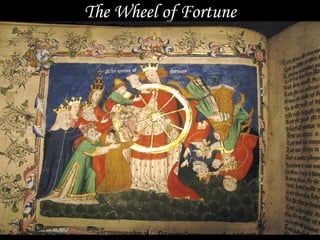
The Wheel of Fortune
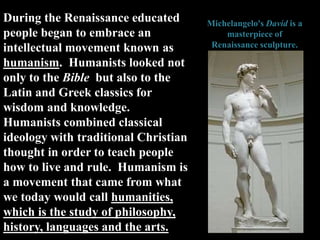
During the Renaissance educated
people began to embrace an
intellectual movement known as
humanism. Humanists looked not
only to the Bible but also to the
Latin and Greek classics for
wisdom and knowledge.
Humanists combined classical
ideology with traditional Christian
thought in order to teach people
how to live and rule. Humanism is
a movement that came from what
we today would call humanities,
which is the study of philosophy,
history, languages and the arts.
Michelangelo's David is a
masterpiece of
Renaissance sculpture.
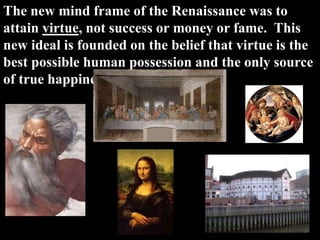
The new mind frame of the Renaissance was to
attain virtue, not success or money or fame. This
new ideal is founded on the belief that virtue is the
best possible human possession and the only source
of true happiness.
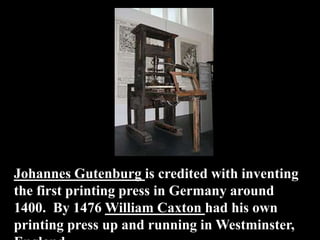
Johannes Gutenburg is credited with inventing
the first printing press in Germany around
1400. By 1476 William Caxton had his own
printing press up and running in Westminster,
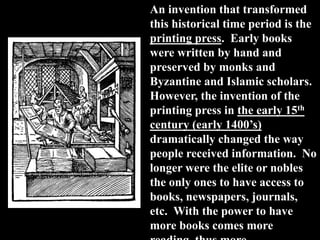
An invention that transformed
this historical time period is the
printing press. Early books
were written by hand and
preserved by monks and
Byzantine and Islamic scholars.
However, the invention of the
printing press in the early 15th
century (early 1400’s)
dramatically changed the way
people received information. No
longer were the elite or nobles
the only ones to have access to
books, newspapers, journals,
etc. With the power to have
more books comes more
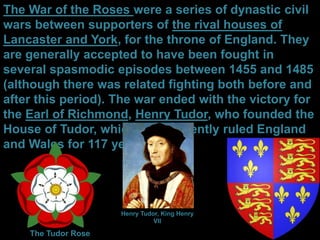
The War of the Roses were a series of dynastic civil
wars between supporters of the rival houses of
Lancaster and York, for the throne of England. They
are generally accepted to have been fought in
several spasmodic episodes between 1455 and 1485
(although there was related fighting both before and
after this period). The war ended with the victory for
the Earl of Richmond, Henry Tudor, who founded the
House of Tudor, which subsequently ruled England
and Wales for 117 years.
The Tudor Rose
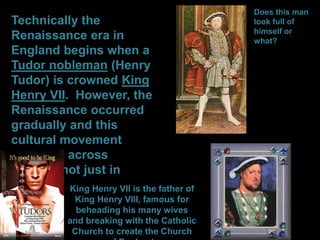
Henry Tudor, King Henry
VII
Technically the
Renaissance era in
England begins when a
Tudor nobleman (Henry
Tudor) is crowned King
Henry VII. However, the
Renaissance occurred
gradually and this
cultural movement
occurred across
Europe, not just in
England. King Henry VII is the father of
King Henry VIII, famous for
beheading his many wives
and breaking with the Catholic
Church to create the Church
Does this man
look full of
himself or
what?
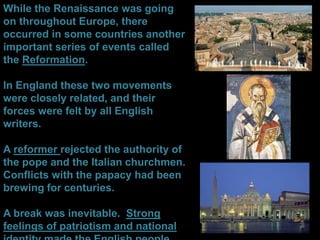
While the Renaissance was going
on throughout Europe, there
occurred in some countries another
important series of events called
the Reformation.
In England these two movements
were closely related, and their
forces were felt by all English
writers.
A reformer rejected the authority of
the pope and the Italian churchmen.
Conflicts with the papacy had been
brewing for centuries.
A break was inevitable. Strong
feelings of patriotism and national
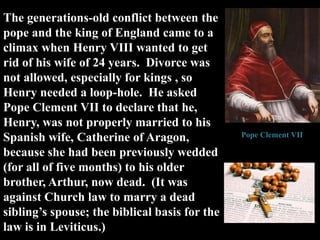
The generations-old conflict between the
pope and the king of England came to a
climax when Henry VIII wanted to get
rid of his wife of 24 years. Divorce was
not allowed, especially for kings , so
Henry needed a loop-hole. He asked
Pope Clement VII to declare that he,
Henry, was not properly married to his
Spanish wife, Catherine of Aragon,
because she had been previously wedded
(for all of five months) to his older
brother, Arthur, now dead. (It was
against Church law to marry a dead
sibling’s spouse; the biblical basis for the
law is in Leviticus.)
Pope Clement VII
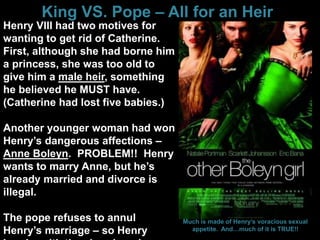
King VS. Pope – All for an Heir
Henry VIII had two motives for
wanting to get rid of Catherine.
First, although she had borne him
a princess, she was too old to
give him a male heir, something
he believed he MUST have.
(Catherine had lost five babies.)
Another younger woman had won
Henry’s dangerous affections –
Anne Boleyn. PROBLEM!! Henry
wants to marry Anne, but he’s
already married and divorce is
illegal.
The pope refuses to annul
Henry’s marriage – so Henry
Much is made of Henry’s voracious sexual
appetite. And…much of it is TRUE!!
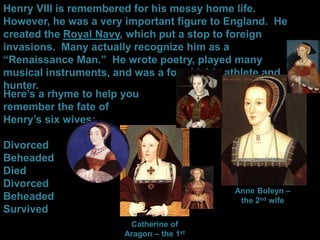
Henry VIII is remembered for his messy home life.
However, he was a very important figure to England. He
created the Royal Navy, which put a stop to foreign
invasions. Many actually recognize him as a
“Renaissance Man.” He wrote poetry, played many
musical instruments, and was a formidable athlete and
hunter.
Here’s a rhyme to help you
remember the fate of
Henry’s six wives:
Divorced
Beheaded
Died
Divorced
Beheaded
Survived
Catherine of
Aragon – the 1st
Anne Boleyn –
the 2nd wife
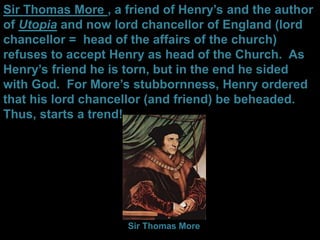
Sir Thomas More , a friend of Henry’s and the author
of Utopia and now lord chancellor of England (lord
chancellor = head of the affairs of the church)
refuses to accept Henry as head of the Church. As
Henry’s friend he is torn, but in the end he sided
with God. For More’s stubbornness, Henry ordered
that his lord chancellor (and friend) be beheaded.
Thus, starts a trend!
Sir Thomas More
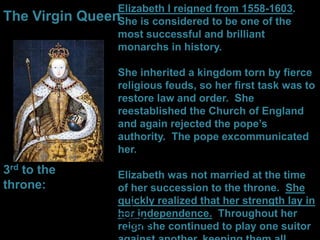
Elizabeth I reigned from 1558-1603.
She is considered to be one of the
most successful and brilliant
monarchs in history.
She inherited a kingdom torn by fierce
religious feuds, so her first task was to
restore law and order. She
reestablished the Church of England
and again rejected the pope’s
authority. The pope excommunicated
her.
Elizabeth was not married at the time
of her succession to the throne. She
quickly realized that her strength lay in
her independence. Throughout her
reign she continued to play one suitor
The Virgin Queen
3rd to the
throne:
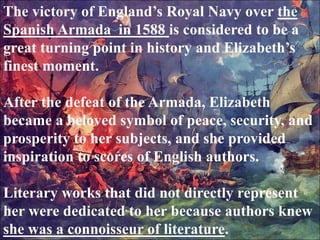
The victory of England’s Royal Navy over the
Spanish Armada in 1588 is considered to be a
great turning point in history and Elizabeth’s
finest moment.
After the defeat of the Armada, Elizabeth
became a beloved symbol of peace, security, and
prosperity to her subjects, and she provided
inspiration to scores of English authors.
Literary works that did not directly represent
her were dedicated to her because authors knew
she was a connoisseur of literature.
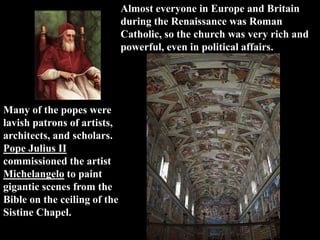
Almost everyone in Europe and Britain
during the Renaissance was Roman
Catholic, so the church was very rich and
powerful, even in political affairs.
Many of the popes were
lavish patrons of artists,
architects, and scholars.
Pope Julius II
commissioned the artist
Michelangelo to paint
gigantic scenes from the
Bible on the ceiling of the
Sistine Chapel.
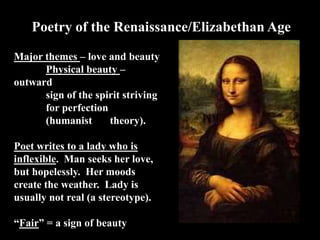
Poetry of the Renaissance/Elizabethan Age
Major themes – love and beauty
Physical beauty –
outward
sign of the spirit striving
for perfection
(humanist theory).
Poet writes to a lady who is
inflexible. Man seeks her love,
but hopelessly. Her moods
create the weather. Lady is
usually not real (a stereotype).
“Fair” = a sign of beauty
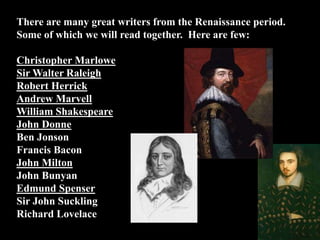
There are many great writers from the Renaissance period.
Some of which we will read together. Here are few:
Christopher Marlowe
Sir Walter Raleigh
Robert Herrick
Andrew Marvell
William Shakespeare
John Donne
Ben Jonson
Francis Bacon
John Milton
John Bunyan
Edmund Spenser
Sir John Suckling
Richard Lovelace
lassicism
nthropology
ationality
ndividualism
aturalism
edonism
ptimism
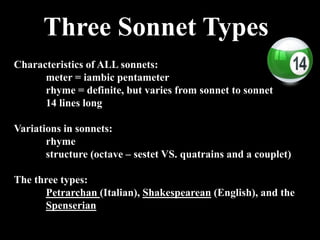
Three Sonnet Types
Characteristics of ALL sonnets:
meter = iambic pentameter
rhyme = definite, but varies from sonnet to sonnet
14 lines long
Variations in sonnets:
rhyme
structure (octave – sestet VS. quatrains and a couplet)
The three types:
Petrarchan (Italian), Shakespearean (English), and the
Spenserian
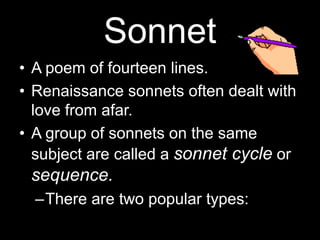
Sonnet
• A poem of fourteen lines.
• Renaissance sonnets often dealt with
love from afar.
• A group of sonnets on the same
subject are called a sonnet cycle or
sequence.
–There are two popular types:
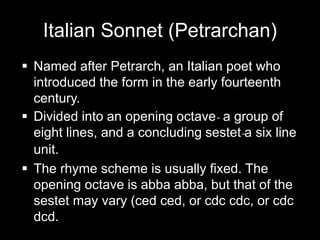
Italian Sonnet (Petrarchan)
 Named after Petrarch, an Italian poet who
introduced the form in the early fourteenth
century.
 Divided into an opening octave- a group of
eight lines, and a concluding sestet-a six line
unit.
 The rhyme scheme is usually fixed. The
opening octave is abba abba, but that of the
sestet may vary (ced ced, or cdc cdc, or cdc
dcd.
Hamilton, Sharon. Essential Literary Terms With Exercises. New York: W.W. Norton & Company, 2007. Print.
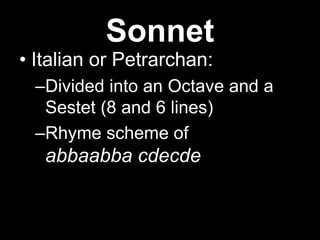
Sonnet
• Italian or Petrarchan:
–Divided into an Octave and a
Sestet (8 and 6 lines)
–Rhyme scheme of
abbaabba cdecde
Sonnet
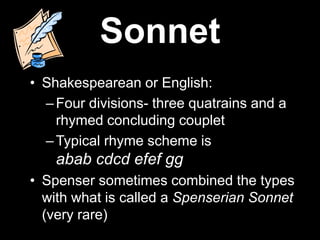
• Shakespearean or English:
–Four divisions- three quatrains and a
rhymed concluding couplet
–Typical rhyme scheme is
abab cdcd efef gg
• Spenser sometimes combined the types
with what is called a Spenserian Sonnet
(very rare)
Lots to read.
Lots to do.
Let’s get started!
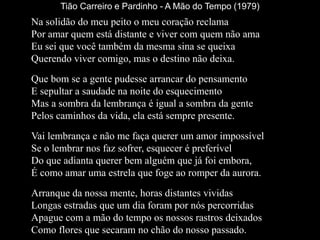
Tião Carreiro e Pardinho - A Mão do Tempo (1979)
Na solidão do meu peito o meu coração reclama
Por amar quem está distante e viver com quem não ama
Eu sei que você também da mesma sina se queixa
Querendo viver comigo, mas o destino não deixa.
Que bom se a gente pudesse arrancar do pensamento
E sepultar a saudade na noite do esquecimento
Mas a sombra da lembrança é igual a sombra da gente
Pelos caminhos da vida, ela está sempre presente.
Vai lembrança e não me faça querer um amor impossível
Se o lembrar nos faz sofrer, esquecer é preferível
Do que adianta querer bem alguém que já foi embora,
É como amar uma estrela que foge ao romper da aurora.
Arranque da nossa mente, horas distantes vividas
Longas estradas que um dia foram por nós percorridas
Apague com a mão do tempo os nossos rastros deixados
Como flores que secaram no chão do nosso passado.
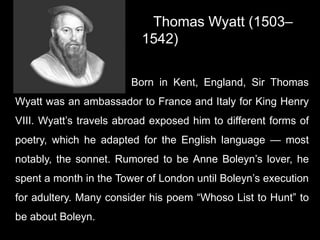
Thomas Wyatt (1503–
1542)
Born in Kent, England, Sir Thomas
Wyatt was an ambassador to France and Italy for King Henry
VIII. Wyatt’s travels abroad exposed him to different forms of
poetry, which he adapted for the English language — most
notably, the sonnet. Rumored to be Anne Boleyn’s lover, he
spent a month in the Tower of London until Boleyn’s execution
for adultery. Many consider his poem “Whoso List to Hunt” to
be about Boleyn.
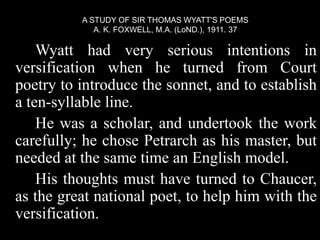
Wyatt had very serious intentions in
versification when he turned from Court
poetry to introduce the sonnet, and to establish
a ten-syllable line.
He was a scholar, and undertook the work
carefully; he chose Petrarch as his master, but
needed at the same time an English model.
His thoughts must have turned to Chaucer,
as the great national poet, to help him with the
versification.
A STUDY OF SIR THOMAS WYATT'S POEMS
A. K. FOXWELL, M.A. (LoND.), 1911. 37
“Whoso List to Hunt, I Know where is an Hind” (Sir Thomas Wyatt)
Whoso list to hunt, I know where is an hind, A
But as for me, alas, I may no more. B
The vain travail hath wearied me so sore, B
I am of them that farthest cometh behind. A
Yet may I by no means my wearied mind A
Draw from the deer, but as she fleeth afore B
Fainting I follow. I leave off therefore, B
Since in a net I seek to hold the wind. A
Who list her hunt, I put him out of doubt, C
As well as I may spend his time in vain. D
And graven with diamonds in letters plain D
There is written, her fair neck round about: C
Noli me tangere, for Caesar's I am, E
And wild for to hold, though I seem tame. E
Francesco Petrarca (1304-1374)
Rime sparse 190
Una candida cerva sopra l’erba
verde m’apparve con duo corna d’oro,
fra due riviere all’ombra d’un alloro,
levando ’l sole a la stagione acerba.
Era sua vista si dolce superba
ch’ i’ lasciai per seguirla ogni lavoro,
come l’avaro che ’n cercar tesoro
con diletto l’affanno disacerba.
“Nessun mi tocchi,” al bel collo d’intorno
scritto avea di diamanti et di topazi.
“Libera farmi al mio Cesare parve.”
Et era ’l sol già vòlto al mezzo giorno,
Gli occhi miei stanchi di mirar, non sazi,
Quand‘ io caddi ne l’acqua et ella sparve.
They flee from me that sometime did me seek
With naked foot, stalking in my chamber.
I have seen them gentle, tame, and meek,
That now are wild and do not remember
That sometime they put themselves in danger
To take bread at my hand; and now they range,
Busily seeking with a continual change.
Thanked be fortune it hath been otherwise
Twenty times better; but once in special,
In thin array after a pleasant guise,
When her loose gown from her shoulders did fall,
And she me caught in her arms long and small;
Therewithall sweetly did me kiss
And softly said, “Dear heart, how like you this?”
“They Flee From Me” -SIR THOMAS WYATT
It was no dream: I lay broad waking.
But all is turned thorough my gentleness
Into a strange fashion of forsaking;
And I have leave to go of her goodness,
And she also, to use new fangleness.
But since that I so kindly am served
I would fain know what she hath deserved?

Renaissance - Thomas Wyatt - The Sonnet

  • 1.
    1485-1660 The Rebirth of ClassicalKnowledge UTFPR The Renaissance Period
  • 4.
     Human beingsand nature as the results of natural law rather than occult powers  Focus on afterlife switches to focus on the Here and Now. – Discovery of New World and International Travel – Invention of the printing press – Rise of Democracy and Nationalism – Revitalized interest in education and the founding of Universities – Patronage of the arts Life is GOOD!
  • 5.
    The term renaissanceis a French word meaning “rebirth.” It refers particularly to a renewed interest in classical learning – the writings of ancient Greece and Rome. The Renaissance Period is considered to be a cultural movement. The Renaissance era in Europe and in England was marked by a change in the way people thought about themselves and the world. No longer content with the fixed religious beliefs of the Middle Ages, people became more interested in expanding their own knowledge.
  • 6.
    The Renaissance, atime of renewal of the human spirit, a renewal of curiosity and creativity, started in Italy. Over several centuries Italy had acquired considerable wealth ($), which it had accumulated from banking and trade with the East. Many famous inventors, painters, and writers flourished during this time period. People like: Michelangelo, Christopher Columbus, Galileo, and Da Vinci. The Louvre – Museum in Paris
  • 7.
    Rediscovery of theclassics • Took classical Greek and Roman writing as an example • Classic writings show mankind as glorious individuals capable of greatness • the opposite of what church taught at the time
  • 8.
    The Wheel ofFortune
  • 10.
    During the Renaissanceeducated people began to embrace an intellectual movement known as humanism. Humanists looked not only to the Bible but also to the Latin and Greek classics for wisdom and knowledge. Humanists combined classical ideology with traditional Christian thought in order to teach people how to live and rule. Humanism is a movement that came from what we today would call humanities, which is the study of philosophy, history, languages and the arts. Michelangelo's David is a masterpiece of Renaissance sculpture.
  • 12.
    The new mindframe of the Renaissance was to attain virtue, not success or money or fame. This new ideal is founded on the belief that virtue is the best possible human possession and the only source of true happiness.
  • 13.
    Johannes Gutenburg iscredited with inventing the first printing press in Germany around 1400. By 1476 William Caxton had his own printing press up and running in Westminster,
  • 14.
    An invention thattransformed this historical time period is the printing press. Early books were written by hand and preserved by monks and Byzantine and Islamic scholars. However, the invention of the printing press in the early 15th century (early 1400’s) dramatically changed the way people received information. No longer were the elite or nobles the only ones to have access to books, newspapers, journals, etc. With the power to have more books comes more
  • 15.
    The War ofthe Roses were a series of dynastic civil wars between supporters of the rival houses of Lancaster and York, for the throne of England. They are generally accepted to have been fought in several spasmodic episodes between 1455 and 1485 (although there was related fighting both before and after this period). The war ended with the victory for the Earl of Richmond, Henry Tudor, who founded the House of Tudor, which subsequently ruled England and Wales for 117 years. The Tudor Rose Henry Tudor, King Henry VII
  • 17.
    Technically the Renaissance erain England begins when a Tudor nobleman (Henry Tudor) is crowned King Henry VII. However, the Renaissance occurred gradually and this cultural movement occurred across Europe, not just in England. King Henry VII is the father of King Henry VIII, famous for beheading his many wives and breaking with the Catholic Church to create the Church Does this man look full of himself or what?
  • 18.
    While the Renaissancewas going on throughout Europe, there occurred in some countries another important series of events called the Reformation. In England these two movements were closely related, and their forces were felt by all English writers. A reformer rejected the authority of the pope and the Italian churchmen. Conflicts with the papacy had been brewing for centuries. A break was inevitable. Strong feelings of patriotism and national
  • 19.
    The generations-old conflictbetween the pope and the king of England came to a climax when Henry VIII wanted to get rid of his wife of 24 years. Divorce was not allowed, especially for kings , so Henry needed a loop-hole. He asked Pope Clement VII to declare that he, Henry, was not properly married to his Spanish wife, Catherine of Aragon, because she had been previously wedded (for all of five months) to his older brother, Arthur, now dead. (It was against Church law to marry a dead sibling’s spouse; the biblical basis for the law is in Leviticus.) Pope Clement VII
  • 20.
    King VS. Pope– All for an Heir Henry VIII had two motives for wanting to get rid of Catherine. First, although she had borne him a princess, she was too old to give him a male heir, something he believed he MUST have. (Catherine had lost five babies.) Another younger woman had won Henry’s dangerous affections – Anne Boleyn. PROBLEM!! Henry wants to marry Anne, but he’s already married and divorce is illegal. The pope refuses to annul Henry’s marriage – so Henry Much is made of Henry’s voracious sexual appetite. And…much of it is TRUE!!
  • 21.
    Henry VIII isremembered for his messy home life. However, he was a very important figure to England. He created the Royal Navy, which put a stop to foreign invasions. Many actually recognize him as a “Renaissance Man.” He wrote poetry, played many musical instruments, and was a formidable athlete and hunter. Here’s a rhyme to help you remember the fate of Henry’s six wives: Divorced Beheaded Died Divorced Beheaded Survived Catherine of Aragon – the 1st Anne Boleyn – the 2nd wife
  • 22.
    Sir Thomas More, a friend of Henry’s and the author of Utopia and now lord chancellor of England (lord chancellor = head of the affairs of the church) refuses to accept Henry as head of the Church. As Henry’s friend he is torn, but in the end he sided with God. For More’s stubbornness, Henry ordered that his lord chancellor (and friend) be beheaded. Thus, starts a trend! Sir Thomas More
  • 23.
    Elizabeth I reignedfrom 1558-1603. She is considered to be one of the most successful and brilliant monarchs in history. She inherited a kingdom torn by fierce religious feuds, so her first task was to restore law and order. She reestablished the Church of England and again rejected the pope’s authority. The pope excommunicated her. Elizabeth was not married at the time of her succession to the throne. She quickly realized that her strength lay in her independence. Throughout her reign she continued to play one suitor The Virgin Queen 3rd to the throne:
  • 25.
    The victory ofEngland’s Royal Navy over the Spanish Armada in 1588 is considered to be a great turning point in history and Elizabeth’s finest moment. After the defeat of the Armada, Elizabeth became a beloved symbol of peace, security, and prosperity to her subjects, and she provided inspiration to scores of English authors. Literary works that did not directly represent her were dedicated to her because authors knew she was a connoisseur of literature.
  • 26.
    Almost everyone inEurope and Britain during the Renaissance was Roman Catholic, so the church was very rich and powerful, even in political affairs. Many of the popes were lavish patrons of artists, architects, and scholars. Pope Julius II commissioned the artist Michelangelo to paint gigantic scenes from the Bible on the ceiling of the Sistine Chapel.
  • 29.
    Poetry of theRenaissance/Elizabethan Age Major themes – love and beauty Physical beauty – outward sign of the spirit striving for perfection (humanist theory). Poet writes to a lady who is inflexible. Man seeks her love, but hopelessly. Her moods create the weather. Lady is usually not real (a stereotype). “Fair” = a sign of beauty
  • 30.
    There are manygreat writers from the Renaissance period. Some of which we will read together. Here are few: Christopher Marlowe Sir Walter Raleigh Robert Herrick Andrew Marvell William Shakespeare John Donne Ben Jonson Francis Bacon John Milton John Bunyan Edmund Spenser Sir John Suckling Richard Lovelace
  • 31.
  • 33.
    Three Sonnet Types Characteristicsof ALL sonnets: meter = iambic pentameter rhyme = definite, but varies from sonnet to sonnet 14 lines long Variations in sonnets: rhyme structure (octave – sestet VS. quatrains and a couplet) The three types: Petrarchan (Italian), Shakespearean (English), and the Spenserian
  • 34.
    Sonnet • A poemof fourteen lines. • Renaissance sonnets often dealt with love from afar. • A group of sonnets on the same subject are called a sonnet cycle or sequence. –There are two popular types:
  • 35.
    Italian Sonnet (Petrarchan) Named after Petrarch, an Italian poet who introduced the form in the early fourteenth century.  Divided into an opening octave- a group of eight lines, and a concluding sestet-a six line unit.  The rhyme scheme is usually fixed. The opening octave is abba abba, but that of the sestet may vary (ced ced, or cdc cdc, or cdc dcd. Hamilton, Sharon. Essential Literary Terms With Exercises. New York: W.W. Norton & Company, 2007. Print.
  • 36.
    Sonnet • Italian orPetrarchan: –Divided into an Octave and a Sestet (8 and 6 lines) –Rhyme scheme of abbaabba cdecde
  • 37.
    Sonnet • Shakespearean orEnglish: –Four divisions- three quatrains and a rhymed concluding couplet –Typical rhyme scheme is abab cdcd efef gg • Spenser sometimes combined the types with what is called a Spenserian Sonnet (very rare)
  • 38.
    Lots to read. Lotsto do. Let’s get started!
  • 39.
    Tião Carreiro ePardinho - A Mão do Tempo (1979) Na solidão do meu peito o meu coração reclama Por amar quem está distante e viver com quem não ama Eu sei que você também da mesma sina se queixa Querendo viver comigo, mas o destino não deixa. Que bom se a gente pudesse arrancar do pensamento E sepultar a saudade na noite do esquecimento Mas a sombra da lembrança é igual a sombra da gente Pelos caminhos da vida, ela está sempre presente. Vai lembrança e não me faça querer um amor impossível Se o lembrar nos faz sofrer, esquecer é preferível Do que adianta querer bem alguém que já foi embora, É como amar uma estrela que foge ao romper da aurora. Arranque da nossa mente, horas distantes vividas Longas estradas que um dia foram por nós percorridas Apague com a mão do tempo os nossos rastros deixados Como flores que secaram no chão do nosso passado.
  • 40.
    Thomas Wyatt (1503– 1542) Bornin Kent, England, Sir Thomas Wyatt was an ambassador to France and Italy for King Henry VIII. Wyatt’s travels abroad exposed him to different forms of poetry, which he adapted for the English language — most notably, the sonnet. Rumored to be Anne Boleyn’s lover, he spent a month in the Tower of London until Boleyn’s execution for adultery. Many consider his poem “Whoso List to Hunt” to be about Boleyn.
  • 41.
    Wyatt had veryserious intentions in versification when he turned from Court poetry to introduce the sonnet, and to establish a ten-syllable line. He was a scholar, and undertook the work carefully; he chose Petrarch as his master, but needed at the same time an English model. His thoughts must have turned to Chaucer, as the great national poet, to help him with the versification. A STUDY OF SIR THOMAS WYATT'S POEMS A. K. FOXWELL, M.A. (LoND.), 1911. 37
  • 42.
    “Whoso List toHunt, I Know where is an Hind” (Sir Thomas Wyatt) Whoso list to hunt, I know where is an hind, A But as for me, alas, I may no more. B The vain travail hath wearied me so sore, B I am of them that farthest cometh behind. A Yet may I by no means my wearied mind A Draw from the deer, but as she fleeth afore B Fainting I follow. I leave off therefore, B Since in a net I seek to hold the wind. A Who list her hunt, I put him out of doubt, C As well as I may spend his time in vain. D And graven with diamonds in letters plain D There is written, her fair neck round about: C Noli me tangere, for Caesar's I am, E And wild for to hold, though I seem tame. E
  • 43.
    Francesco Petrarca (1304-1374) Rimesparse 190 Una candida cerva sopra l’erba verde m’apparve con duo corna d’oro, fra due riviere all’ombra d’un alloro, levando ’l sole a la stagione acerba. Era sua vista si dolce superba ch’ i’ lasciai per seguirla ogni lavoro, come l’avaro che ’n cercar tesoro con diletto l’affanno disacerba. “Nessun mi tocchi,” al bel collo d’intorno scritto avea di diamanti et di topazi. “Libera farmi al mio Cesare parve.” Et era ’l sol già vòlto al mezzo giorno, Gli occhi miei stanchi di mirar, non sazi, Quand‘ io caddi ne l’acqua et ella sparve.
  • 44.
    They flee fromme that sometime did me seek With naked foot, stalking in my chamber. I have seen them gentle, tame, and meek, That now are wild and do not remember That sometime they put themselves in danger To take bread at my hand; and now they range, Busily seeking with a continual change. Thanked be fortune it hath been otherwise Twenty times better; but once in special, In thin array after a pleasant guise, When her loose gown from her shoulders did fall, And she me caught in her arms long and small; Therewithall sweetly did me kiss And softly said, “Dear heart, how like you this?” “They Flee From Me” -SIR THOMAS WYATT It was no dream: I lay broad waking. But all is turned thorough my gentleness Into a strange fashion of forsaking; And I have leave to go of her goodness, And she also, to use new fangleness. But since that I so kindly am served I would fain know what she hath deserved?