Topsoil
Padding pipeline &
cable excavation
Composting
Industrial
Applications
Recycling
Screening Peat
Mine Clearance
Stabilization
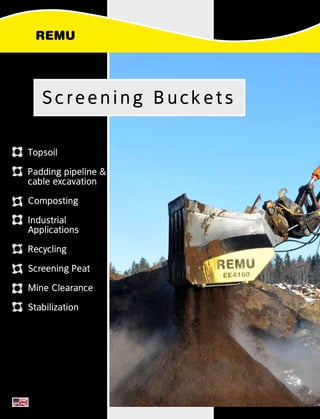
Screening Buckets
Topsoil
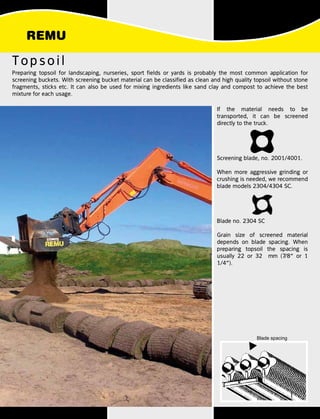
Preparing topsoil for landscaping, nurseries, sport fields or yards is probably the most common application for
screening buckets. With screening bucket material can be classified as clean and high quality topsoil without stone
fragments, sticks etc. It can also be used for mixing ingredients like sand clay and compost to achieve the best
mixture for each usage.
If the material needs to be
transported, it can be screened
directly to the truck.
Screening blade, no. 2001/4001.
When more aggressive grinding or
crushing is needed, we recommend
blade models 2304/4304 SC.
Blade no. 2304 SC
Grain size of screened material
depends on blade spacing. When
preparing topsoil the spacing is
usually 22 or 32 mm (7/8” or 1
1/4”).
q
Blade spacing
Normally required particle size for
padding is 0-16 mm (-5/16”). With
REMU screening bucket even the
0-8 mm (-3/8”) grain size can be
produced.
Widely used blade model for
padding is no. 4001. This blade
doesn’t crush stones etc. and the
final product is homogenous.
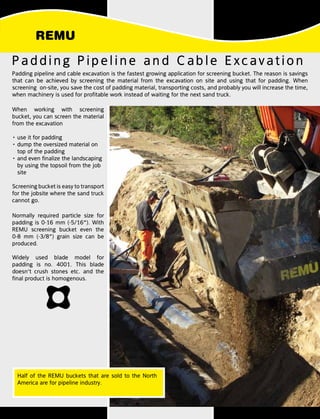
When working with screening
bucket, you can screen the material
from the excavation
• use it for padding
• dump the oversized material on 	
top of the padding
• and even finalize the landscaping 	
by using the topsoil from the job 	
site
Screening bucket is easy to transport
for the jobsite where the sand truck
cannot go.
Padding Pipeline and Cable Excavation
Padding pipeline and cable excavation is the fastest growing application for screening bucket. The reason is savings
that can be achieved by screening the material from the excavation on site and using that for padding. When
screening on-site, you save the cost of padding material, transporting costs, and probably you will increase the time,
when machinery is used for profitable work instead of waiting for the next sand truck.
Half of the REMU buckets that are sold to the North
America are for pipeline industry.
Composting
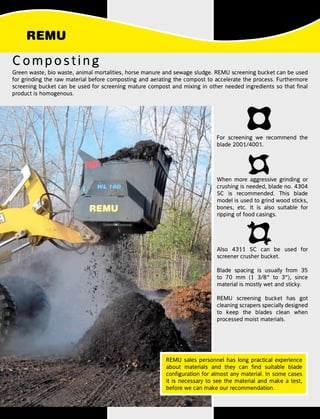
Green waste, bio waste, animal mortalities, horse manure and sewage sludge. REMU screening bucket can be used
for grinding the raw material before composting and aerating the compost to accelerate the process. Furthermore
screening bucket can be used for screening mature compost and mixing in other needed ingredients so that final
product is homogenous.
For screening we recommend the
blade 2001/4001.
When more aggressive grinding or
crushing is needed, blade no. 4304
SC is recommended. This blade
model is used to grind wood sticks,
bones, etc. It is also suitable for
ripping of food casings.
Also 4311 SC can be used for
screener crusher bucket.
Blade spacing is usually from 35
to 70 mm (1 3/8” to 3”), since
material is mostly wet and sticky.
REMU screening bucket has got
cleaning scrapers specially designed
to keep the blades clean when
processed moist materials.
REMU sales personnel has long practical experience
about materials and they can find suitable blade
configuration for almost any material. In some cases
it is necessary to see the material and make a test,
before we can make our recommendation.
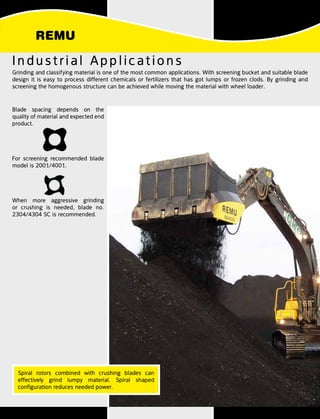
Industrial Applications
Blade spacing depends on the
quality of material and expected end
product.
For screening recommended blade
model is 2001/4001.
When more aggressive grinding
or crushing is needed, blade no.
2304/4304 SC is recommended.
Grinding and classifying material is one of the most common applications. With screening bucket and suitable blade
design it is easy to process different chemicals or fertilizers that has got lumps or frozen clods. By grinding and
screening the homogenous structure can be achieved while moving the material with wheel loader.
Spiral rotors combined with crushing blades can
effectively grind lumpy material. Spiral shaped
configuration reduces needed power.
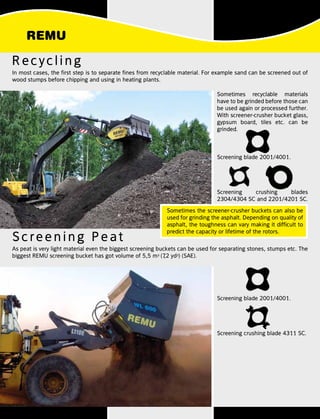
Screening Peat
Recycling
In most cases, the first step is to separate fines from recyclable material. For example sand can be screened out of
wood stumps before chipping and using in heating plants.
Sometimes recyclable materials
have to be grinded before those can
be used again or processed further.
With screener-crusher bucket glass,
gypsum board, tiles etc. can be
grinded.
Screening blade 2001/4001.
Screening crushing blades
2304/4304 SC and 2201/4201 SC.
As peat is very light material even the biggest screening buckets can be used for separating stones, stumps etc. The
biggest REMU screening bucket has got volume of 5,5 m³ (7,2 yd³) (SAE).
Screening blade 2001/4001.
Screening crushing blade 4311 SC.
Sometimes the screener-crusher buckets can also be
used for grinding the asphalt. Depending on quality of
asphalt, the toughness can vary making it difficult to
predict the capacity or lifetime of the rotors.
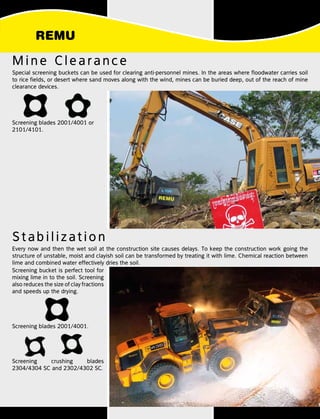
Every now and then the wet soil at the construction site causes delays. To keep the construction work going the
structure of unstable, moist and clayish soil can be transformed by treating it with lime. Chemical reaction between
lime and combined water effectively dries the soil.
Screening blades 2001/4001 or
2101/4101.
Mine Clearance
Special screening buckets can be used for clearing anti-personnel mines. In the areas where floodwater carries soil
to rice fields, or desert where sand moves along with the wind, mines can be buried deep, out of the reach of mine
clearance devices.
Stabilization
Screening bucket is perfect tool for
mixing lime in to the soil. Screening
also reduces the size of clay fractions
and speeds up the drying.
Screening blades 2001/4001.
Screening crushing blades
2304/4304 SC and 2302/4302 SC.
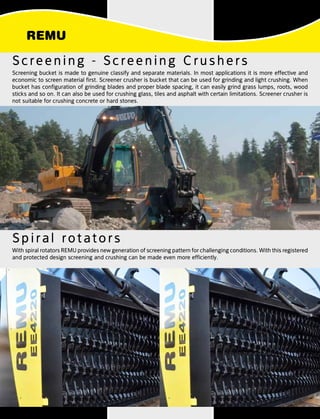
Spiral rotators
Screening - Screening Crushers
Screening bucket is made to genuine classify and separate materials. In most applications it is more effective and
economic to screen material first. Screener crusher is bucket that can be used for grinding and light crushing. When
bucket has configuration of grinding blades and proper blade spacing, it can easily grind grass lumps, roots, wood
sticks and so on. It can also be used for crushing glass, tiles and asphalt with certain limitations. Screener crusher is
not suitable for crushing concrete or hard stones.
With spiral rotators REMU provides new generation of screening pattern for challenging conditions. With this registered
and protected design screening and crushing can be made even more efficiently.
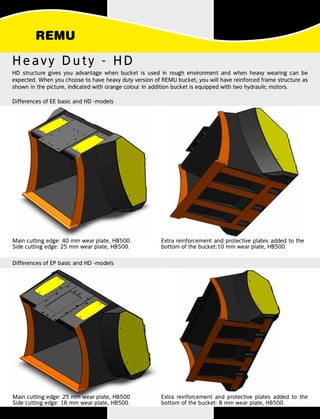
Heavy Duty - HD
HD structure gives you advantage when bucket is used in rough environment and when heavy wearing can be
expected. When you choose to have heavy duty version of REMU bucket, you will have reinforced frame structure as
shown in the picture, indicated with orange colour. In addition bucket is equipped with two hydraulic motors.
Main cutting edge: 40 mm wear plate, HB500.
Side cutting edge: 25 mm wear plate, HB500.
Extra reinforcement and protective plates added to the
bottom of the bucket:10 mm wear plate, HB500.
Differences of EE basic and HD -models
Main cutting edge: 25 mm wear plate, HB500
Side cutting edge: 16 mm wear plate, HB500.
Differences of EP basic and HD -models
Extra reinforcement and protective plates added to the
bottom of the bucket: 8 mm wear plate, HB500.
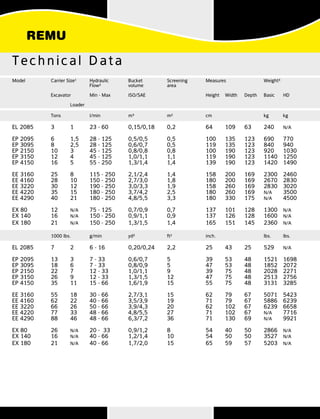
Technical Data
Model		Carrier Size¹	Hydraulic		Bucket 		Screening	Measures		Weight³	
				Flow²		volume		area
			
		Excavator	Min - Max	ISO/SAE				Height	Width	Depth	Basic	HD		
			
			Loader									
		Tons		l/min		m³		m²		cm			kg	kg
EL 2085	 3	 1	 23 - 60		 0,15/0,18	 0,2		 64	 109	 63	 240	 N/A
														
EP 2095	 6	 1,5	 28 - 125	 0,5/0,5	 0,5		 100	135	123	690	770
EP 3095	 8	 2,5	 28 - 125	 0,6/0,7	 0,5		 119	135	123	840	940
EP 2150	 10	 3	 45 - 125	 0,8/0,8	 0,8		 100	190	123	920	1030
EP 3150	 12	 4	 45 - 125	 1,0/1,1	 1,1		 119	 190	 123	 1140	 1250
EP 4150	 16	 5	 55 - 250	 1,3/1,4	 1,4		 139	 190	 123	 1420	 1490
															
EE 3160	 25	 8	 115 - 250	 2,1/2,4	 1,4		 158	 200	 169	 2300	 2460
EE 4160	 28	 10	 150 - 250	 2,7/3,0	 1,8		 180	 200	 169	 2670	 2830
EE 3220	 30	 12	 190 - 250	 3,0/3,3	 1,9		 158	 260	 169	 2830	 3020
EE 4220	 35	 15	 180 - 250	 3,7/4,2	 2,5		 180	 260	 169	 N/A	3500
EE 4290	 40	 21	 180 - 250	 4,8/5,5	 3,3		 180	 330	 175	 N/A	4500
															
EX 80		 12	 N/A	 75 - 125	 0,7/0,9	 0,7		 137	101	128	1300	N/A
EX 140		 16	 N/A	 150 - 250	 0,9/1,1	 0,9		 137	126	128	1600	N/A
EX 180		 21	 N/A	 150 - 250	 1,3/1,5	 1,4		 165	151	145	2360	N/A
															
		1000 lbs.	g/min		yd³		ft²		inch.			lbs.	lbs.
EL 2085	 7	 2	 6 - 16		 0,20/0,24	 2,2		 25	 43	 25	 529	 N/A
															
EP 2095	 13	3	 7 - 33		 0,6/0,7	 5		 39	53	48	1521	1698
EP 3095	 18	6	 7 - 33		 0,8/0,9	 5		 47	53	48	1852	2072
EP 2150	 22	7	 12 - 33		 1,0/1,1	 9		 39	75	48	2028	2271
EP 3150	 26	9	 12 - 33		 1,3/1,5	 12		 47	75	48	2513	2756
EP 4150	 35	11	15 - 66		 1,6/1,9	 15		 55	75	48	3131	3285
															
EE 3160	 55	18	30 - 66		 2,7/3,1	 15		 62	79	67	5071	5423
EE 4160	 62	22	40 - 66		 3,5/3,9	 19		 71	79	67	5886	6239
EE 3220	 66	26	50 - 66		 3,9/4,3	 20		 62	102	67	6239	6658
EE 4220	 77	33	48 - 66		 4,8/5,5	 27		 71	102	67	N/A	7716
EE 4290	 88	46	48 - 66		 6,3/7,2	 36		 71	130	69	N/A	9921
															
EX 80		 26	 N/A	 20 - 33	 0,9/1,2	 8		 54	 40	 50	 2866	 N/A
EX 140		 16	 N/A	40 - 66		 1,2/1,4	 10		 54	50	50	3527	N/A
EX 180		 21	 N/A	40 - 66		 1,7/2,0	 15		 65	59	57	5203	N/A
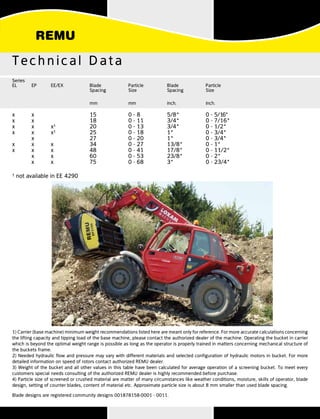
Technical Data
		
Series
EL	EP	EE/EX		Blade		Particle		Blade		Particle
				Spacing		Size		Spacing		Size
				mm		mm		inch.		inch.		
x	x			15		0 - 8		5/8"		0 - 5/16"
x	x			18		0 - 11		3/4"		0 - 7/16"
x	 x	 x¹		 20		 0 - 13		 3/4"		 0 - 1/2"
x	 x	 x¹		 25		 0 - 18		 1"		 0 - 3/4"
	x			27		0 - 20		1"		0 - 3/4"
x	 x	 x		 34		 0 - 27		 13/8"		 0 - 1"
x	 x	 x		 48		 0 - 41		 17/8"		 0 - 11/2"
	x	x		60		0 - 53		23/8"		0 - 2"
	x	x		75		0 - 68		3"		0 - 23/4"
									
¹ not available in EE 4290		
1) Carrier (base machine) minimum weight recommendations listed here are meant only for reference. For more accurate calculations concerning
the lifting capacity and tipping load of the base machine, please contact the authorized dealer of the machine. Operating the bucket in carrier
which is beyond the optimal weight range is possible as long as the operator is properly trained in matters concerning mechanical structure of
the buckets frame.
2) Needed hydraulic flow and pressure may vary with different materials and selected configuration of hydraulic motors in bucket. For more
detailed information on speed of rotors contact authorized REMU dealer.
3) Weight of the bucket and all other values in this table have been calculated for average operation of a screening bucket. To meet every
customers special needs consulting of the authorized REMU dealer is highly recommended before purchase.
4) Particle size of screened or crushed material are matter of many circumstances like weather conditions, moisture, skills of operator, blade
design, setting of counter blades, content of material etc. Approximate particle size is about 8 mm smaller than used blade spacing.
Blade designs are registered community designs 001878158-0001 - 0011.
Your dealer
REMU Oy
Headquarters
	 +358 (0)20 743 1160
	info@remu.fi
REMU Norge AS
	 94 13 13 80, Norge
	 +358 20 743 1164
	norge@remu.fi
REMU Deutschland GmbH
	 +49 171 418 0862
	deutschland@remu.fi
REMU USA Inc.
North/South American operations
	 +1 888 600 0018
	usa@remu.fi
Remu has a policy of continuing improvement, and reserves the right to change specifications
without prior notice.
Printed in Finland 03/2012.

Remu Screening Bucket Brochure

  • 1.
    Topsoil Padding pipeline & cableexcavation Composting Industrial Applications Recycling Screening Peat Mine Clearance Stabilization Screening Buckets
  • 2.
    Topsoil Preparing topsoil forlandscaping, nurseries, sport fields or yards is probably the most common application for screening buckets. With screening bucket material can be classified as clean and high quality topsoil without stone fragments, sticks etc. It can also be used for mixing ingredients like sand clay and compost to achieve the best mixture for each usage. If the material needs to be transported, it can be screened directly to the truck. Screening blade, no. 2001/4001. When more aggressive grinding or crushing is needed, we recommend blade models 2304/4304 SC. Blade no. 2304 SC Grain size of screened material depends on blade spacing. When preparing topsoil the spacing is usually 22 or 32 mm (7/8” or 1 1/4”). q Blade spacing
  • 3.
    Normally required particlesize for padding is 0-16 mm (-5/16”). With REMU screening bucket even the 0-8 mm (-3/8”) grain size can be produced. Widely used blade model for padding is no. 4001. This blade doesn’t crush stones etc. and the final product is homogenous. When working with screening bucket, you can screen the material from the excavation • use it for padding • dump the oversized material on top of the padding • and even finalize the landscaping by using the topsoil from the job site Screening bucket is easy to transport for the jobsite where the sand truck cannot go. Padding Pipeline and Cable Excavation Padding pipeline and cable excavation is the fastest growing application for screening bucket. The reason is savings that can be achieved by screening the material from the excavation on site and using that for padding. When screening on-site, you save the cost of padding material, transporting costs, and probably you will increase the time, when machinery is used for profitable work instead of waiting for the next sand truck. Half of the REMU buckets that are sold to the North America are for pipeline industry.
  • 4.
    Composting Green waste, biowaste, animal mortalities, horse manure and sewage sludge. REMU screening bucket can be used for grinding the raw material before composting and aerating the compost to accelerate the process. Furthermore screening bucket can be used for screening mature compost and mixing in other needed ingredients so that final product is homogenous. For screening we recommend the blade 2001/4001. When more aggressive grinding or crushing is needed, blade no. 4304 SC is recommended. This blade model is used to grind wood sticks, bones, etc. It is also suitable for ripping of food casings. Also 4311 SC can be used for screener crusher bucket. Blade spacing is usually from 35 to 70 mm (1 3/8” to 3”), since material is mostly wet and sticky. REMU screening bucket has got cleaning scrapers specially designed to keep the blades clean when processed moist materials. REMU sales personnel has long practical experience about materials and they can find suitable blade configuration for almost any material. In some cases it is necessary to see the material and make a test, before we can make our recommendation.
  • 5.
    Industrial Applications Blade spacingdepends on the quality of material and expected end product. For screening recommended blade model is 2001/4001. When more aggressive grinding or crushing is needed, blade no. 2304/4304 SC is recommended. Grinding and classifying material is one of the most common applications. With screening bucket and suitable blade design it is easy to process different chemicals or fertilizers that has got lumps or frozen clods. By grinding and screening the homogenous structure can be achieved while moving the material with wheel loader. Spiral rotors combined with crushing blades can effectively grind lumpy material. Spiral shaped configuration reduces needed power.
  • 6.
    Screening Peat Recycling In mostcases, the first step is to separate fines from recyclable material. For example sand can be screened out of wood stumps before chipping and using in heating plants. Sometimes recyclable materials have to be grinded before those can be used again or processed further. With screener-crusher bucket glass, gypsum board, tiles etc. can be grinded. Screening blade 2001/4001. Screening crushing blades 2304/4304 SC and 2201/4201 SC. As peat is very light material even the biggest screening buckets can be used for separating stones, stumps etc. The biggest REMU screening bucket has got volume of 5,5 m³ (7,2 yd³) (SAE). Screening blade 2001/4001. Screening crushing blade 4311 SC. Sometimes the screener-crusher buckets can also be used for grinding the asphalt. Depending on quality of asphalt, the toughness can vary making it difficult to predict the capacity or lifetime of the rotors.
  • 7.
    Every now andthen the wet soil at the construction site causes delays. To keep the construction work going the structure of unstable, moist and clayish soil can be transformed by treating it with lime. Chemical reaction between lime and combined water effectively dries the soil. Screening blades 2001/4001 or 2101/4101. Mine Clearance Special screening buckets can be used for clearing anti-personnel mines. In the areas where floodwater carries soil to rice fields, or desert where sand moves along with the wind, mines can be buried deep, out of the reach of mine clearance devices. Stabilization Screening bucket is perfect tool for mixing lime in to the soil. Screening also reduces the size of clay fractions and speeds up the drying. Screening blades 2001/4001. Screening crushing blades 2304/4304 SC and 2302/4302 SC.
  • 8.
    Spiral rotators Screening -Screening Crushers Screening bucket is made to genuine classify and separate materials. In most applications it is more effective and economic to screen material first. Screener crusher is bucket that can be used for grinding and light crushing. When bucket has configuration of grinding blades and proper blade spacing, it can easily grind grass lumps, roots, wood sticks and so on. It can also be used for crushing glass, tiles and asphalt with certain limitations. Screener crusher is not suitable for crushing concrete or hard stones. With spiral rotators REMU provides new generation of screening pattern for challenging conditions. With this registered and protected design screening and crushing can be made even more efficiently.
  • 9.
    Heavy Duty -HD HD structure gives you advantage when bucket is used in rough environment and when heavy wearing can be expected. When you choose to have heavy duty version of REMU bucket, you will have reinforced frame structure as shown in the picture, indicated with orange colour. In addition bucket is equipped with two hydraulic motors. Main cutting edge: 40 mm wear plate, HB500. Side cutting edge: 25 mm wear plate, HB500. Extra reinforcement and protective plates added to the bottom of the bucket:10 mm wear plate, HB500. Differences of EE basic and HD -models Main cutting edge: 25 mm wear plate, HB500 Side cutting edge: 16 mm wear plate, HB500. Differences of EP basic and HD -models Extra reinforcement and protective plates added to the bottom of the bucket: 8 mm wear plate, HB500.
  • 10.
    Technical Data Model Carrier Size¹ Hydraulic Bucket Screening Measures Weight³ Flow² volume area Excavator Min - Max ISO/SAE Height Width Depth Basic HD Loader Tons l/min m³ m² cm kg kg EL 2085 3 1 23 - 60 0,15/0,18 0,2 64 109 63 240 N/A EP 2095 6 1,5 28 - 125 0,5/0,5 0,5 100 135 123 690 770 EP 3095 8 2,5 28 - 125 0,6/0,7 0,5 119 135 123 840 940 EP 2150 10 3 45 - 125 0,8/0,8 0,8 100 190 123 920 1030 EP 3150 12 4 45 - 125 1,0/1,1 1,1 119 190 123 1140 1250 EP 4150 16 5 55 - 250 1,3/1,4 1,4 139 190 123 1420 1490 EE 3160 25 8 115 - 250 2,1/2,4 1,4 158 200 169 2300 2460 EE 4160 28 10 150 - 250 2,7/3,0 1,8 180 200 169 2670 2830 EE 3220 30 12 190 - 250 3,0/3,3 1,9 158 260 169 2830 3020 EE 4220 35 15 180 - 250 3,7/4,2 2,5 180 260 169 N/A 3500 EE 4290 40 21 180 - 250 4,8/5,5 3,3 180 330 175 N/A 4500 EX 80 12 N/A 75 - 125 0,7/0,9 0,7 137 101 128 1300 N/A EX 140 16 N/A 150 - 250 0,9/1,1 0,9 137 126 128 1600 N/A EX 180 21 N/A 150 - 250 1,3/1,5 1,4 165 151 145 2360 N/A 1000 lbs. g/min yd³ ft² inch. lbs. lbs. EL 2085 7 2 6 - 16 0,20/0,24 2,2 25 43 25 529 N/A EP 2095 13 3 7 - 33 0,6/0,7 5 39 53 48 1521 1698 EP 3095 18 6 7 - 33 0,8/0,9 5 47 53 48 1852 2072 EP 2150 22 7 12 - 33 1,0/1,1 9 39 75 48 2028 2271 EP 3150 26 9 12 - 33 1,3/1,5 12 47 75 48 2513 2756 EP 4150 35 11 15 - 66 1,6/1,9 15 55 75 48 3131 3285 EE 3160 55 18 30 - 66 2,7/3,1 15 62 79 67 5071 5423 EE 4160 62 22 40 - 66 3,5/3,9 19 71 79 67 5886 6239 EE 3220 66 26 50 - 66 3,9/4,3 20 62 102 67 6239 6658 EE 4220 77 33 48 - 66 4,8/5,5 27 71 102 67 N/A 7716 EE 4290 88 46 48 - 66 6,3/7,2 36 71 130 69 N/A 9921 EX 80 26 N/A 20 - 33 0,9/1,2 8 54 40 50 2866 N/A EX 140 16 N/A 40 - 66 1,2/1,4 10 54 50 50 3527 N/A EX 180 21 N/A 40 - 66 1,7/2,0 15 65 59 57 5203 N/A
  • 11.
    Technical Data Series EL EP EE/EX Blade Particle Blade Particle Spacing Size Spacing Size mm mm inch. inch. x x 15 0 -8 5/8" 0 - 5/16" x x 18 0 - 11 3/4" 0 - 7/16" x x x¹ 20 0 - 13 3/4" 0 - 1/2" x x x¹ 25 0 - 18 1" 0 - 3/4" x 27 0 - 20 1" 0 - 3/4" x x x 34 0 - 27 13/8" 0 - 1" x x x 48 0 - 41 17/8" 0 - 11/2" x x 60 0 - 53 23/8" 0 - 2" x x 75 0 - 68 3" 0 - 23/4" ¹ not available in EE 4290 1) Carrier (base machine) minimum weight recommendations listed here are meant only for reference. For more accurate calculations concerning the lifting capacity and tipping load of the base machine, please contact the authorized dealer of the machine. Operating the bucket in carrier which is beyond the optimal weight range is possible as long as the operator is properly trained in matters concerning mechanical structure of the buckets frame. 2) Needed hydraulic flow and pressure may vary with different materials and selected configuration of hydraulic motors in bucket. For more detailed information on speed of rotors contact authorized REMU dealer. 3) Weight of the bucket and all other values in this table have been calculated for average operation of a screening bucket. To meet every customers special needs consulting of the authorized REMU dealer is highly recommended before purchase. 4) Particle size of screened or crushed material are matter of many circumstances like weather conditions, moisture, skills of operator, blade design, setting of counter blades, content of material etc. Approximate particle size is about 8 mm smaller than used blade spacing. Blade designs are registered community designs 001878158-0001 - 0011.
  • 12.
    Your dealer REMU Oy Headquarters +358 (0)20 743 1160 info@remu.fi REMU Norge AS 94 13 13 80, Norge +358 20 743 1164 norge@remu.fi REMU Deutschland GmbH +49 171 418 0862 deutschland@remu.fi REMU USA Inc. North/South American operations +1 888 600 0018 usa@remu.fi Remu has a policy of continuing improvement, and reserves the right to change specifications without prior notice. Printed in Finland 03/2012.