W I N T E R 2 0 1 7 9
A S L I C E O F C A M P U S L I F E
C O M M O N S R O O M
Mindful Path
B Y L I B E R T Y F E R D A
Aclassroom has been
transformed into a
sanctuary of sorts.
Gone are the desks
and chairs. The tiled floor is
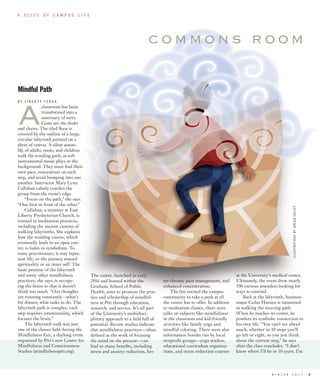
covered by the outline of a large,
circular labyrinth painted on a
sheet of canvas. A silent assem-
bly of adults, teens, and children
walk the winding path, as soft
instrumental music plays in the
background. They must find their
own pace, concentrate on each
step, and avoid bumping into one
another. Instructor Mary Lynn
Callahan calmly coaches the
group from the room’s edge.
“Focus on the path,” she says.
“One foot in front of the other.”
Callahan, a minister at East
Liberty Presbyterian Church, is
trained in meditation practices,
including the ancient custom of
walking labyrinths. She explains
how the winding course, which
eventually leads to an open cen-
ter, is laden in symbolism. To
some practitioners, it may repre-
sent life, or the journey toward
spirituality or an inner self. The
basic premise of the labyrinth
and many other mindfulness
practices, she says, is occupy-
ing the brain so that it doesn’t
think too much. “Our thoughts
are running constantly—what’s
for dinner, what tasks to do. The
labyrinth path is complex; each
step requires intentionality, which
focuses the brain.”
The labyrinth walk was just
one of the classes held during the
Mindfulness Fair, a daylong event
organized by Pitt’s new Center for
Mindfulness and Consciousness
Studies (mindfulnesspitt.org).
The center, launched in early
2016 and housed within the
Graduate School of Public
Health, aims to promote the prac-
tice and scholarship of mindful-
ness at Pitt through education,
research, and service. It’s all part
of the University’s multidisci-
plinary approach to a field full of
potential. Recent studies indicate
that mindfulness practices—often
defined as the work of focusing
the mind on the present—can
lead to many benefits, including
stress and anxiety reduction, bet-
ter chronic pain management, and
enhanced concentration.
The fair invited the campus
community to take a peek at all
the center has to offer. In addition
to meditation classes, there were
talks on subjects like mindfulness
in the classroom and kid-friendly
activities like family yoga and
mindful coloring. There were also
information booths run by local
nonprofit groups—yoga studios,
educational curriculum organiza-
tions, and stress reduction courses
at the University’s medical center.
Ultimately, the event drew nearly
500 curious attendees looking for
ways to unwind.
Back at the labyrinth, business
major Cedar Hansen is immersed
in walking the weaving path.
When he reaches its center, he
ponders its symbolic connection to
his own life. “You can’t see ahead
much, whether in 10 steps you’ll
go left or right, so you just think
about the current step,” he says
after the class concludes. “I don’t
know where I’ll be in 10 years. I’m
ILLUSTRATIONSBYGREGGVALLEY
P I T T M A G A Z I N E10
C O M M O N S R O O M
Welcome, Neighbors
B Y K A Y L E N S A N D E R S
Large cardboard boxes
fill the room—perched
on tables, propped on
chairs, and clutter-
ing the floor of the William Pitt
Union assembly room. In one
box, a ceramic pitcher peeks out
from behind a kettle and a set of
silverware. In another, shampoo
bottles are stacked beside soaps
and lotions. Busy Pitt students
flit among the cardboard contain-
ers, carrying items ranging from
teddy bears to toasters.
Undergrad Harpreet Bassi
pauses for a moment to survey the
scene. She is the public relations
chair for Pitt’s Genocide Relief
and Awareness Club (GRAC).
Her Facebook updates and rounds
of emails requesting volunteers
paid off. The room is bustling
with more than 100 students and
community members, all part of
the Pitt Good Neighbor Project,
an effort to gather and distribute
household goods—and good-
will—to 17 Syrian-refugee fami-
lies arriving or already settled in
Pittsburgh.
Bassi and fellow GRAC mem-
bers began planning this project
weeks ago, but it didn’t feel real
until the donation drive, which
produced an estimated $30,000
student-run political action club,
hoped to show that, regardless of
what may divide us, people want
to help each other.
As the welcome packages
were assembled, that sentiment
was reflected over and over in
the dozens of colorful welcome
notes strung together as a banner
stretching across the assembly
room. Participants in the dona-
tion drive had been invited to
write cards, to be tucked into the
boxes for refugee families.
Meanwhile, sophomore Liam
McLane shuttled children’s
books back and forth, cradling
stacks in his arms before placing
them neatly in cardboard
crates. Dedicating time to the
community is one of his passions.
“I’ve started trying to plan
my own project like this,” says
McLane, who studies political
science and economics. “This is
giving me an idea of what it could
look like.”
The packaging of welcome
kits continued into the evening.
Eventually, GRAC members
pulled out thick rolls of cheerfully
colored wrapping paper. They
wrapped the kits like presents—
gifts of support from the Pitt
community to Pittsburgh’s newest
arrivals. ■
A Ball for All
B Y K A Y L E N S A N D E R S
Throngs of young peo-
ple decked out in suits,
gowns, and glitzy
cocktail dresses gather
in a sunny room of the O’Hara
Student Center. The crowd min-
gles over finger sandwiches.
At a nearby table, Pitt junior
Sydney Vickers chats with her
friend, Joyce Braun, who wears a
long, blue dress and has a shim-
mery tiara perched on her head.
The attire is inspired by the
Disney movie, Cinderella, which
Braun and Vickers watched
together several years ago. Since
then, Braun enjoys making a regal
appearance at big events—like
today’s occasion, the Best Buddies
Friendship Ball.
The ball is the annual culmi-
nation of the nonprofit’s efforts
to break down barriers and cre-
ate opportunities for people with
intellectual and developmental
disabilities. In particular, the
event fosters friendships between
people with disabilities—
“buddies”—and others, their
“peer buddies.”
This year, the University
of Pittsburgh’s chapter of Best
Buddies Pennsylvania hosted the
regional soiree. Months of plan-
ning resulted in the gathering of
more than 300 buddies and peer
buddies from colleges and high
schools all over Pittsburgh.
“My favorite thing about the
ball is that it’s like a prom. You
get to dress up and really enjoy
it,” says Braun. “All of the schools
come together to have fun.” Her
peer buddy, Vickers, is an eco-
working toward graduation and a
career, and meditation helps me
not get overwhelmed by the des-
tination and stay focused on what
I’m doing now.”
Hansen’s personal meditation
practice—focusing on his breath
and clearing out thoughts for
exactly 21 minutes each day—
began a year ago, and he enjoys
the sense of calm and centeredness
it brings. With the Center for
Mindfulness and Consciousness
Studies now on campus, keeping
up with his restorative routine
and gaining new resources will be
easier than ever. ■
worth of items from Pittsburghers
and an additional $680 in fund-
ing contributions. Today’s goal:
assemble the “welcome kits,”
which consist of the things each
family needs to rebuild their lives,
including kitchenware, linens,
diapers, groceries, and school sup-
plies. The extraordinary turnout
of both donors and volunteers
uplifted club members.
“When a community comes
together and says ‘you’re welcome
here, you’re accepted, we don’t
discriminate against you, and we
don’t hate you,’ it’s a very power-
ful message,” says Sam Mostofa, a
neuroscience major and founding
president of GRAC.
The project began with a $250
grant awarded by Pitt’s Student
Organization Resource Center
through PittServes, an initiative
that engages students in com-
munity service on the local and
national scale. In a complex politi-
cal climate, members of GRAC, a

PITT_Winter2017_MindfulPath

  • 1.
    W I NT E R 2 0 1 7 9 A S L I C E O F C A M P U S L I F E C O M M O N S R O O M Mindful Path B Y L I B E R T Y F E R D A Aclassroom has been transformed into a sanctuary of sorts. Gone are the desks and chairs. The tiled floor is covered by the outline of a large, circular labyrinth painted on a sheet of canvas. A silent assem- bly of adults, teens, and children walk the winding path, as soft instrumental music plays in the background. They must find their own pace, concentrate on each step, and avoid bumping into one another. Instructor Mary Lynn Callahan calmly coaches the group from the room’s edge. “Focus on the path,” she says. “One foot in front of the other.” Callahan, a minister at East Liberty Presbyterian Church, is trained in meditation practices, including the ancient custom of walking labyrinths. She explains how the winding course, which eventually leads to an open cen- ter, is laden in symbolism. To some practitioners, it may repre- sent life, or the journey toward spirituality or an inner self. The basic premise of the labyrinth and many other mindfulness practices, she says, is occupy- ing the brain so that it doesn’t think too much. “Our thoughts are running constantly—what’s for dinner, what tasks to do. The labyrinth path is complex; each step requires intentionality, which focuses the brain.” The labyrinth walk was just one of the classes held during the Mindfulness Fair, a daylong event organized by Pitt’s new Center for Mindfulness and Consciousness Studies (mindfulnesspitt.org). The center, launched in early 2016 and housed within the Graduate School of Public Health, aims to promote the prac- tice and scholarship of mindful- ness at Pitt through education, research, and service. It’s all part of the University’s multidisci- plinary approach to a field full of potential. Recent studies indicate that mindfulness practices—often defined as the work of focusing the mind on the present—can lead to many benefits, including stress and anxiety reduction, bet- ter chronic pain management, and enhanced concentration. The fair invited the campus community to take a peek at all the center has to offer. In addition to meditation classes, there were talks on subjects like mindfulness in the classroom and kid-friendly activities like family yoga and mindful coloring. There were also information booths run by local nonprofit groups—yoga studios, educational curriculum organiza- tions, and stress reduction courses at the University’s medical center. Ultimately, the event drew nearly 500 curious attendees looking for ways to unwind. Back at the labyrinth, business major Cedar Hansen is immersed in walking the weaving path. When he reaches its center, he ponders its symbolic connection to his own life. “You can’t see ahead much, whether in 10 steps you’ll go left or right, so you just think about the current step,” he says after the class concludes. “I don’t know where I’ll be in 10 years. I’m ILLUSTRATIONSBYGREGGVALLEY
  • 2.
    P I TT M A G A Z I N E10 C O M M O N S R O O M Welcome, Neighbors B Y K A Y L E N S A N D E R S Large cardboard boxes fill the room—perched on tables, propped on chairs, and clutter- ing the floor of the William Pitt Union assembly room. In one box, a ceramic pitcher peeks out from behind a kettle and a set of silverware. In another, shampoo bottles are stacked beside soaps and lotions. Busy Pitt students flit among the cardboard contain- ers, carrying items ranging from teddy bears to toasters. Undergrad Harpreet Bassi pauses for a moment to survey the scene. She is the public relations chair for Pitt’s Genocide Relief and Awareness Club (GRAC). Her Facebook updates and rounds of emails requesting volunteers paid off. The room is bustling with more than 100 students and community members, all part of the Pitt Good Neighbor Project, an effort to gather and distribute household goods—and good- will—to 17 Syrian-refugee fami- lies arriving or already settled in Pittsburgh. Bassi and fellow GRAC mem- bers began planning this project weeks ago, but it didn’t feel real until the donation drive, which produced an estimated $30,000 student-run political action club, hoped to show that, regardless of what may divide us, people want to help each other. As the welcome packages were assembled, that sentiment was reflected over and over in the dozens of colorful welcome notes strung together as a banner stretching across the assembly room. Participants in the dona- tion drive had been invited to write cards, to be tucked into the boxes for refugee families. Meanwhile, sophomore Liam McLane shuttled children’s books back and forth, cradling stacks in his arms before placing them neatly in cardboard crates. Dedicating time to the community is one of his passions. “I’ve started trying to plan my own project like this,” says McLane, who studies political science and economics. “This is giving me an idea of what it could look like.” The packaging of welcome kits continued into the evening. Eventually, GRAC members pulled out thick rolls of cheerfully colored wrapping paper. They wrapped the kits like presents— gifts of support from the Pitt community to Pittsburgh’s newest arrivals. ■ A Ball for All B Y K A Y L E N S A N D E R S Throngs of young peo- ple decked out in suits, gowns, and glitzy cocktail dresses gather in a sunny room of the O’Hara Student Center. The crowd min- gles over finger sandwiches. At a nearby table, Pitt junior Sydney Vickers chats with her friend, Joyce Braun, who wears a long, blue dress and has a shim- mery tiara perched on her head. The attire is inspired by the Disney movie, Cinderella, which Braun and Vickers watched together several years ago. Since then, Braun enjoys making a regal appearance at big events—like today’s occasion, the Best Buddies Friendship Ball. The ball is the annual culmi- nation of the nonprofit’s efforts to break down barriers and cre- ate opportunities for people with intellectual and developmental disabilities. In particular, the event fosters friendships between people with disabilities— “buddies”—and others, their “peer buddies.” This year, the University of Pittsburgh’s chapter of Best Buddies Pennsylvania hosted the regional soiree. Months of plan- ning resulted in the gathering of more than 300 buddies and peer buddies from colleges and high schools all over Pittsburgh. “My favorite thing about the ball is that it’s like a prom. You get to dress up and really enjoy it,” says Braun. “All of the schools come together to have fun.” Her peer buddy, Vickers, is an eco- working toward graduation and a career, and meditation helps me not get overwhelmed by the des- tination and stay focused on what I’m doing now.” Hansen’s personal meditation practice—focusing on his breath and clearing out thoughts for exactly 21 minutes each day— began a year ago, and he enjoys the sense of calm and centeredness it brings. With the Center for Mindfulness and Consciousness Studies now on campus, keeping up with his restorative routine and gaining new resources will be easier than ever. ■ worth of items from Pittsburghers and an additional $680 in fund- ing contributions. Today’s goal: assemble the “welcome kits,” which consist of the things each family needs to rebuild their lives, including kitchenware, linens, diapers, groceries, and school sup- plies. The extraordinary turnout of both donors and volunteers uplifted club members. “When a community comes together and says ‘you’re welcome here, you’re accepted, we don’t discriminate against you, and we don’t hate you,’ it’s a very power- ful message,” says Sam Mostofa, a neuroscience major and founding president of GRAC. The project began with a $250 grant awarded by Pitt’s Student Organization Resource Center through PittServes, an initiative that engages students in com- munity service on the local and national scale. In a complex politi- cal climate, members of GRAC, a