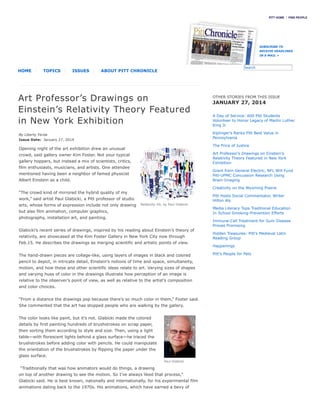
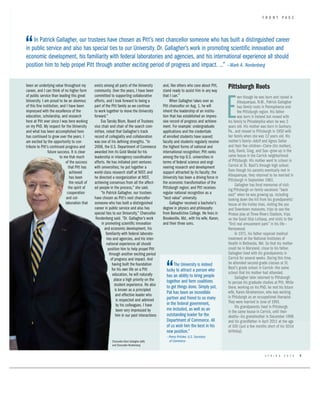
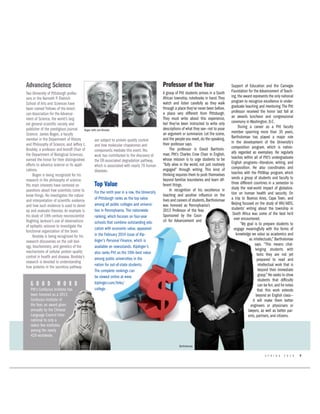
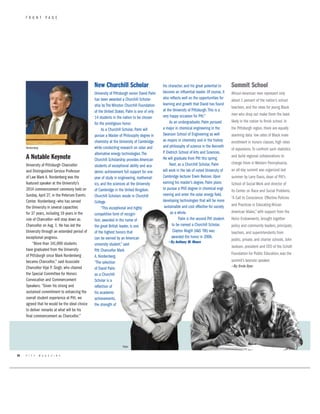
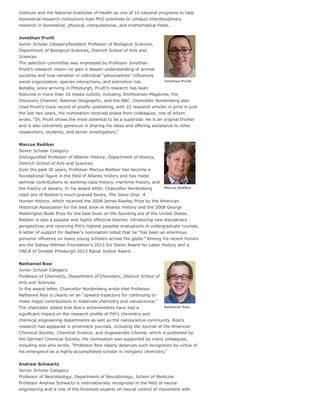
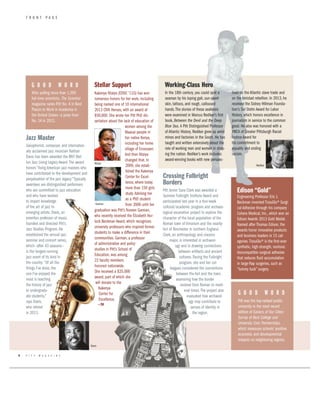
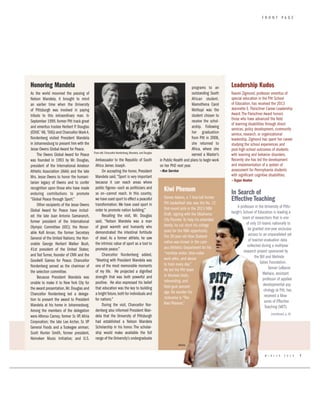
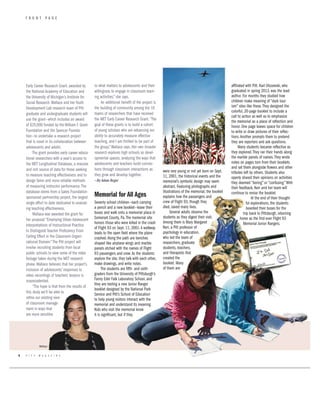
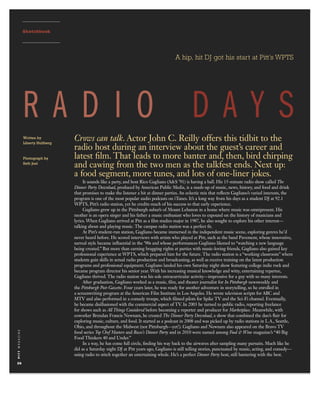
Relativity #6, by Paul Glabicki
Paul Glabicki
Art Professor’s Drawings on
Einstein’s Relativity Theory Featured
in New York Exhibition
By Liberty Ferda
Issue Date: January 27, 2014
Opening night of the art exhibition drew an unusual
crowd, said gallery owner Kim Foster. Not your typical
gallery hoppers, but instead a mix of scientists, critics,
film enthusiasts, musicians, and artists. One attendee
mentioned having been a neighbor of famed physicist
Albert Einstein as a child.
“The crowd kind of mirrored the hybrid quality of my
work,” said artist Paul Glabicki, a Pitt professor of studio
arts, whose forms of expression include not only drawing
but also film animation, computer graphics,
photography, installation art, and painting.
Glabicki’s recent series of drawings, inspired by his reading about Einstein’s theory of
relativity, are showcased at the Kim Foster Gallery in New York City now through
Feb.15. He describes the drawings as merging scientific and artistic points of view.
The hand-drawn pieces are collage-like, using layers of images in black and colored
pencil to depict, in intricate detail, Einstein’s notions of time and space, simultaneity,
motion, and how these and other scientific ideas relate to art. Varying sizes of shapes
and varying hues of color in the drawings illustrate how perception of an image is
relative to the observer’s point of view, as well as relative to the artist’s composition
and color choices.
“From a distance the drawings pop because there’s so much color in them,” Foster said.
She commented that the art has stopped people who are walking by the gallery.
The color looks like paint, but it’s not. Glabicki made the colored
details by first painting hundreds of brushstrokes on scrap paper,
then sorting them according to style and size. Then, using a light
table—with florescent lights behind a glass surface—he traced the
brushstrokes before adding color with pencils. He could manipulate
the orientation of the brushstrokes by flipping the paper under the
glass surface.
“Traditionally that was how animators would do things, a drawing
on top of another drawing to see the motion. So I’ve always liked that process,”
Glabicki said. He is best known, nationally and internationally, for his experimental film
animations dating back to the 1970s. His animations, which have earned a bevy of
PITT HOME FIND PEOPLE
HOME TOPICS ISSUES ABOUT PITT CHRONICLE
OTHER STORIES FROM THIS ISSUE
JANUARY 27, 2014
A Day of Service: 600 Pitt Students
Volunteer to Honor Legacy of Martin Luther
King Jr.
Kiplinger’s Ranks Pitt Best Value in
Pennsylvania
The Price of Justice
Art Professor’s Drawings on Einstein’s
Relativity Theory Featured in New York
Exhibition
Grant from General Electric, NFL Will Fund
Pitt-UPMC Concussion Research Using
Brain-Imaging
Creativity on the Wyoming Prairie
Pitt Hosts Social Commentator, Writer
Hilton Als
Media Literacy Tops Traditional Education
In School Smoking-Prevention Efforts
Immune-Cell Treatment for Gum Disease
Proves Promising
Hidden Treasures: Pitt’s Medieval Latin
Reading Group
Happenings
Pitt’s People for Pets
SUBSCRIBE TO
RECEIVE HEADLINES
IN E-MAIL »
SearchSearch
awards and appearances at screenings such as the Cannes Film Festival, were crafted
by means of thousands of hand-drawn images on paper—each drawing representing a
frame of film. His 1989 film “Under the Sea” contains 10,000 exquisitely handcrafted
images.
After preparing the “brushstrokes” for the Relativity pieces, Glabicki copiously drew
images that illustrated Einstein’s theories, such as detailed math formulations, circular
wavelengths representing the Doppler Effect, and 3-D shapes and planes
demonstrating space-time. He then progressively added layers, changing one element
in an image relationship at a time. For example, he paired a left-facing “brushstroke”
image with a right-facing one, a dark color with a lighter color, or added another
version of the same data set. Some calligraphic images were painted with an extra-fine
brush, which appear as drawing marks to the naked eye.
“It’s deceptive in that way, and many people at first mistake the drawings as computer
generated,” he said.
There are no computer graphics in the drawings, though Glabicki does have
considerable experience with computer art. He was one of the first artists at Pitt to
make art with computer pixels, gaining access to emerging computer graphics
technology at Pitt’s Old Engineering Hall in the late 1980s. There, he experimented
with creating still images and with advanced graphics software as it developed. During
the 1990s, Glabicki focused entirely on digital media.
“People who know my work can see aspects of the Relativity drawings that relate to
the films I did in the 70s and 80s. Some who recall the computer imaging I was doing
in the 90s can see the influence of my work with computers,” he said. “That’s what I
like most about the Relativity series, besides playing with scientists’ and artists’
perspectives—how bringing experience from all these different worlds happened
organically.”
Glabicki’s interdisciplinary background and various interests inform his teaching, too.
At Pitt, where he has been a professor of studio arts since 1976, he teaches classes in
design, drawing, and color theory. A mix of students take the Foundation Design course
as a general education elective, which allows him to cite examples that students who
study a broad range of subjects can relate to. He might, for example, draw from
science, architecture, film, dance, or music to discuss balance and color relationships in
a painting or computer image.
The Relativity exhibition, Glabicki’s third solo show at the gallery since 2009, has
received a great response since opening night on Jan. 9, said Foster. The notable art
magazine Blouin Artinfo’s Gallery Guide featured Glabicki’s exhibition as the cover story
in its January issue. Located in New York’s Chelsea arts district, The Kim Foster Gallery
features artists who “deviate from traditional mediums and instead have developed
entirely new methods and sophisticated techniques that often require massive hand
labor.” Foster said she appreciates the “nearly obsessive” nature of hand-drawn detail
in Glabicki’s work.
Glabicki noted that although the Relativity drawings are very complex and dense with
visual information, they are not meant to be scientific—they are playful. Perhaps this,
too, reflects Einstein’s sensibilities. After all, the late physicist is famously credited with
saying, “Creativity is intelligence having fun.”
Pitt Chronicle
University News Services
200 South Craig Street
Pittsburgh, PA 15260
chron@pitt.edu
412-624-1033
PITT CHRONICLE
RSS Feed
How to subscribe
Sayre N.
Greenfield
Chancellor’s Teaching, Research,
and Service Awards Announced
By Liberty Ferda
Issue Date: February 24, 2014
University of Pittsburgh Chancellor Mark A. Nordenberg has announced the winners of
the 2014 Chancellor’s Distinguished Teaching, Research, and Public Service Awards.
Each awardee will receive a $2,000 cash prize and a $3,000 grant for support of their
teaching, research or service activities—and will be recognized during the University of
Pittsburgh’s 38th annual Honors Convocation, to be held at 3 p.m. this Friday, Feb. 28,
in Carnegie Music Hall, 4400 Forbes Ave., Oakland. The event is free and open to the
public.
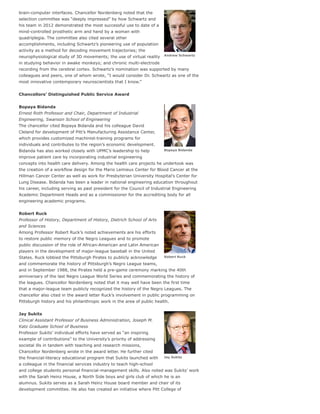
The following four Pitt faculty members will receive the 2014 Chancellor’s Distinguished
Teaching Award: Sayre N. Greenfield, Cynthia Lance-Jones, Steven Levitan, and
Samuel Poloyac.
The following five Pitt faculty members will receive the 2014 Chancellor’s Distinguished
Research Award: Ivet Bahar, Jonathan Pruitt, Marcus Rediker, Nathaniel Rosi,
and Andrew B. Schwartz.
The three winners of the 2014 Chancellor’s Distinguished Public Service Awards are:
Bopaya Bidanda, Robert Ruck, and Jay Sukits.
Chancellor’s Distinguished Teaching Award
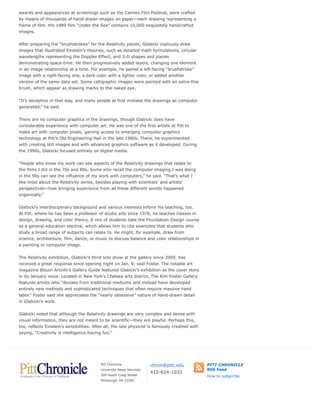
Sayre N. Greenfield
Professor of English, Department of English, University of Pittsburgh at Greensburg
Professor Sayre Greenfield excels in his use of technology in the classroom and his
engagement of students in digital humanities and research at the
University of Pittsburgh-Greensburg. In the award letter, Chancellor
Nordenberg cited Greenfield’s “innovative use of electronic database
search technology” in assignments for his History of English
Language course, as well as his role in initiating the Digital
Humanities course. In addition, Greenfield has devised ways for
students to gain practical experience in working with digital
methods for generating, archiving, and researching cultural
resources in the humanities. His prior teaching awards include the
1998 UPG Distinguished Teaching Award and the 2012 Primary
Source Award for Teaching from the Center for Research Libraries. The chancellor also
noted that as the first instructor on the Greensburg campus to request and receive a
Green Scholar undergraduate research assistant, Greenfield has shown commitment to
engaging students in collaborative research and providing them with “real world”
experience.
PITT HOME FIND PEOPLE
HOME TOPICS ISSUES ABOUT PITT CHRONICLE
OTHER STORIES FROM THIS ISSUE
FEBRUARY 24, 2014
Alumni Association Names Distinguished
Alumni Fellows
Chancellor’s Teaching, Research, and
Service Awards Announced
Nordenberg Honors Staff for Service to the
University and Community
“Experience the World Showcase” To
Support PittAdvantage Grants
Geri Allen: Finding Creative Simpatico
The Cascading Thoughts of Terrance Hayes
Hidden Treasures: Cathedral-A-Day
Pitt Press, Hebrew Union College Press
Launch Collaboration in Jewish Studies
Newsmakers: A Celebration of Teaching
Newsmakers: A Conversation With Sonia
Sotomayor
Scene: Galileo
Happenings
SUBSCRIBE TO
RECEIVE HEADLINES
IN E-MAIL »
SearchSearch
Cynthia Lance-
Jones
Steven Levitan
Samuel Poloyac
Ivet Bahar
Cynthia Lance-Jones
Professor of Neurobiology, Department of Neurobiology, and
Assistant Dean for Medical Student Research, School of Medicine
As coordinator for the first-year basic science block in the School of
Medicine and as assistant dean for medical student research,
Professor Cynthia Lance-Jones positively influences the development
of medical students and helps prepare them to be outstanding
clinicians. Chancellor Nordenberg noted that, in addition to
frequently earning top-notch teaching evaluations from students,
Lance-Jones is one of only three faculty members who has received repeated requests
to provide review sessions for U.S. Medical Licensing Exam Step 1 exams. She has
earned numerous educator awards, including the 2013 Excellence in Education Award
as Small Group Facilitator and the 2013 Alpha Omega Alpha Robert J. Glaser
Distinguished Teacher Award from the Association of American Medical Colleges.
Steven Levitan
John A. Jurenko Professor of Computer Engineering, Department of
Electrical and Computer Engineering, Swanson School of
Engineering
Professor Steven Levitan is recognized for his use of innovative
teaching initiatives to help students become critical thinkers. Levitan
employs a “flipped classroom” structure, a form of blended learning
where what used to be homework is done interactively in class, and
new content is learned in various ways, including by watching video
lectures at home. Levitan has also developed new courses, such as Very Large Scale
Integration Design, Computer Modeling, and the Digital Design Laboratory. In the
award letter, Chancellor Nordenberg wrote that those models “have set the standard”
for how the department teaches laboratory courses. Previous recognition of Levitan’s
excellence in teaching include his receipt of the 2010 Provost’s Academic Council on
Instructional Excellence Award and the Swanson School’s 2013 Outstanding Educator
Award.
Samuel Poloyac
Professor of Pharmaceutical Sciences, Department of
Pharmaceutical Sciences, School of Pharmacy
As a professor in the School of Pharmacy and chair of Pitt’s Clinical
and Translational Science Institute’s core curriculum committee,
Samuel Poloyac has demonstrated excellence in teaching and
curriculum development. He received the student-selected Faculty
Member of the Year Award in 2003 and the Phi Delta Chi
Outstanding Chapter Advisor Award in 2008. Poloyac also developed
the interdisciplinary course Translational Research in the Health Sciences, which has
made major contributions to the University’s curriculum. In the award letter, Chancellor
Nordenberg described the course as “instrumental in introducing students to the
objectives, concepts, models, and processes of clinical and translational science.”
Chancellor’s Distinguished Research Awards
Ivet Bahar
Senior Scholar Category
Distinguished Professor and John K. Vries Chair, Department of
Computational and Systems Biology, School of Medicine
Professor Ivet Bahar is known worldwide for her work in the fields of
computational biology and biophysics. Bahar’s research
accomplishments have been described as “important, innovative,
and fundamental to the development of the extensive and
expanding field of computational biology.” Upon joining Pitt in 2001,
Bahar founded the Center for Computational Biology and Bioinformatics in the School
of Medicine, which became the Department of Computational and Systems Biology in
2004. Additionally, she cofounded the first such degree-granting program between
Carnegie Mellon University and Pitt, which was selected by the Howard Hughes Medical
Jonathan Pruitt
Marcus Rediker
Nathaniel Rosi
Institute and the National Institutes of Health as one of 10 national programs to help
biomedical research institutions train PhD scientists to conduct interdisciplinary
research in biomedical, physical, computational, and mathematical fields.
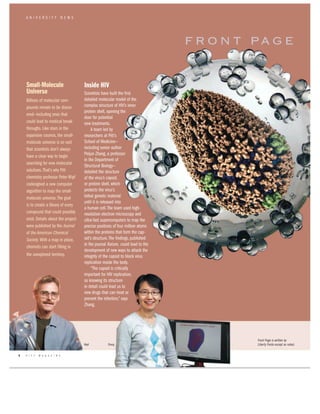
Jonathan Pruitt
Junior Scholar CategoryAssistant Professor of Biological Sciences,
Department of Biological Sciences, Dietrich School of Arts and
Sciences
The selection committee was impressed by Professor Jonathan
Pruitt’s research vision—to gain a deeper understanding of animal
societies and how variation in individual “personalities” influences
social organization, species interactions, and extinction risk.
Notably, since arriving in Pittsburgh, Pruitt’s research has been
featured in more than 16 media outlets, including Smithsonian Magazine, the
Discovery Channel, National Geographic, and the BBC. Chancellor Nordenberg also
cited Pruitt’s track record of prolific publishing, with 22 research articles in print in just
the last two years. His nomination received praise from colleagues, one of whom
wrote, “Dr. Pruitt shows the most potential to be a superstar. He is an original thinker
and is also extremely generous in sharing his ideas and offering assistance to other
researchers, students, and senior investigators.”
Marcus Rediker
Senior Scholar Category
Distinguished Professor of Atlantic History, Department of History,
Dietrich School of Arts and Sciences
Over the past 30 years, Professor Marcus Rediker has become a
foundational figure in the field of Atlantic history and has made
seminal contributions to working-class history, maritime history, and
the history of slavery. In his award letter, Chancellor Nordenberg
cited one of Rediker’s much-praised books, The Slave Ship: A
Human History, which received the 2008 James Rawley Prize by the American
Historical Association for the best book in Atlantic History and the 2008 George
Washington Book Prize for the best book on the founding era of the United States.
Rediker is also a popular and highly effective teacher, introducing new disciplinary
perspectives and receiving Pitt’s highest possible evaluations in undergraduate courses.
A letter of support for Rediker’s nomination noted that he “has been an enormous
personal influence on many young scholars across the globe.” Among his recent honors
are the Sidney Hillman Foundation’s 2013 Sol Stetin Award for Labor History and a
YWCA of Greater Pittsburgh 2013 Racial Justice Award.
Nathaniel Rosi
Junior Scholar Category
Professor of Chemistry, Department of Chemistry, Dietrich School of
Arts and Sciences
In the award letter, Chancellor Nordenberg wrote that Professor
Nathaniel Rosi is clearly on an “upward trajectory for continuing to
make major contributions in materials chemistry and nanoscience.”
The chancellor added that Rosi’s achievements have had a
significant impact on the research profile of Pitt’s chemistry and
chemical engineering departments as well as the nanoscience community. Rosi’s
research has appeared in prominent journals, including the Journal of the American
Chemical Society, Chemical Science, and Angewandte Chemie, which is published by
the German Chemical Society. His nomination was supported by many colleagues,
including one who wrote, “Professor Rosi clearly deserves such recognition by virtue of
his emergence as a highly accomplished scholar in inorganic chemistry.”
Andrew Schwartz
Senior Scholar Category
Professor of Neurobiology, Department of Neurobiology, School of Medicine
Professor Andrew Schwartz is internationally recognized in the field of neural
engineering and is one of the foremost experts on neural control of movement with
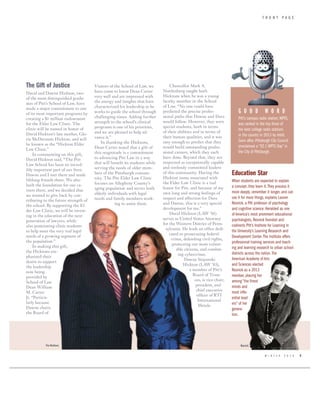
Andrew Schwartz
Bopaya Bidanda
Robert Ruck
Jay Sukits
brain-computer interfaces. Chancellor Nordenberg noted that the
selection committee was “deeply impressed” by how Schwartz and
his team in 2012 demonstrated the most successful use to date of a
mind-controlled prosthetic arm and hand by a woman with
quadriplegia. The committee also cited several other
accomplishments, including Schwartz’s pioneering use of population
activity as a method for decoding movement trajectories; the
neurophysiological study of 3D movements; the use of virtual reality
in studying behavior in awake monkeys; and chronic multi-electrode
recording from the cerebral cortex. Schwartz’s nomination was supported by many
colleagues and peers, one of whom wrote, “I would consider Dr. Schwartz as one of the
most innovative contemporary neuroscientists that I know.”
Chancellors’ Distinguished Public Service Award
Bopaya Bidanda
Ernest Roth Professor and Chair, Department of Industrial
Engineering, Swanson School of Engineering
The chancellor cited Bopaya Bidanda and his colleague David
Cleland for development of Pitt’s Manufacturing Assistance Center,
which provides customized machinist-training programs for
individuals and contributes to the region’s economic development.
Bidanda has also worked closely with UPMC’s leadership to help
improve patient care by incorporating industrial engineering
concepts into health care delivery. Among the health care projects he undertook was
the creation of a workflow design for the Mario Lemieux Center for Blood Cancer at the
Hillman Cancer Center as well as work for Presbyterian University Hospital’s Center for
Lung Disease. Bidanda has been a leader in national engineering education throughout
his career, including serving as past president for the Council of Industrial Engineering
Academic Department Heads and as a commissioner for the accrediting body for all
engineering academic programs.
Robert Ruck
Professor of History, Department of History, Dietrich School of Arts
and Sciences
Among Professor Robert Ruck’s noted achievements are his efforts
to restore public memory of the Negro Leagues and to promote
public discussion of the role of African-American and Latin American
players in the development of major-league baseball in the United
States. Ruck lobbied the Pittsburgh Pirates to publicly acknowledge
and commemorate the history of Pittsburgh’s Negro League teams,
and in September 1988, the Pirates held a pre-game ceremony marking the 40th
anniversary of the last Negro League World Series and commemorating the history of
the leagues. Chancellor Nordenberg noted that it may well have been the first time
that a major-league team publicly recognized the history of the Negro Leagues. The
chancellor also cited in the award letter Ruck’s involvement in public programming on
Pittsburgh history and his philanthropic work in the area of public health.
Jay Sukits
Clinical Assistant Professor of Business Administration, Joseph M.
Katz Graduate School of Business
Professor Sukits’ individual efforts have served as “an inspiring
example of contributions” to the University’s priority of addressing
societal ills in tandem with teaching and research missions,
Chancellor Nordenberg wrote in the award letter. He further cited
the financial-literacy educational program that Sukits launched with
a colleague in the financial services industry to teach high-school
and college students personal financial-management skills. Also noted was Sukits’ work
with the Sarah Heinz House, a North Side boys and girls club of which he is an
alumnus. Sukits serves as a Sarah Heinz House board member and chair of its
development committee. He also has created an initiative where Pitt College of
Business Administration students are drafting a marketing plan for the organization. In
addition, Sukits founded Pitt’s Student Veterans Association, which connects veterans
with organizations interested in recruiting those who served in the military as
employees.
Pitt Chronicle
University News Services
200 South Craig Street
Pittsburgh, PA 15260
chron@pitt.edu
412-624-1033
PITT CHRONICLE
RSS Feed
How to subscribe
,i i':i{t-
: i*.1 l.-;.1
" .ll.,,-1,.-,
"_ --j!-. 'ii :
',1
i Lr"l; fTjii{f
:,-'i i-l .",
-, : !") i-;'l .'-,.a i-,
Ii..l .i-r..,.{..1.l-11 r-: ''.i
',*, i ''-.,
r-i.]
!..,,r i i:: i...;.
l.
1- :l ii;.::, :-': -.
i ....,-
1- l. !...:
li l-l'., : I .:.:.:-: :r
tially be modi-
,o, like air-
lse con-
Reichle
rging
brain
rrc eyes
Llpport
tiftrtcs
:ing
anglia, a
ought to
lforccment
t eye move-
language
ding.
rf methods
re brain is
is read-
h reverse
; from
rts back-
,,e func-
-Reichle
he com-
uorkinEfs
d
o
N
o
;
33
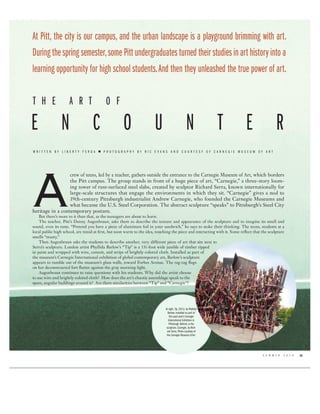
A Slice of Campus Life
Hula Happy
he clay always comes like a sur-
prise in late March: Suddenly it's
70 degrees outside, the sky is that
piercing blue you had forgotten about,
the grass a bed of green sparkling in the
sun. Pitt's campus is alive with move-
ment and activiry-students wearing
shorts for the first time in months chat
with friends, bicyclists ztp by, a group of
€iuys tosses a football back and forth. It
has been a long Pittsburgh winter, and
spring is here at last.
This season, on a small clearing of
the Cathedral lawn, there was a different
kind of movement going on. A group
of four young women swayed their hips
while big rings circled their waists. They
stood barefoot on blankets. It looked
like they were dancing, but there was
no music. They were hula-hooping, and
they were not beginners. One of them
stretched out her leg and deftly spun
a hoop on her ankle. Another guided a
hoop up from her waist to her arm until
it looped evenly around her wrist: She
rotated the ring around and around as
if waving to passersby on Fifth Avenue,
while her yellow dress fluttered gently
in the breeze.
The women talked and laughed as
their bodies gyrated in s1mc, as if these
impressive balancing acts were simply
afterthoughts. When a curious student
approached and asked what they were
doing, one of the hoopers-Kasey
Augustine-smiled modestly. When she
arrived on campus as a freshman last
fail, she made the hoops, using simple
but sturdy PVC piping and colored
electrical tape.
While expertly spinning a hoop
around her waist, Augustine, a French
and business major, explained that she
and her sister once took a class in the
art ofhula-hooping and how to craft
the hoops. She wanted to keep it up
rvhen she came to college, so she gave
her hornemade hoops to her new friends
and asked them to join her. At first some
l'ere reluctant, she said, chuckiing as
she glanced at her friends, whose hoops
'ere still orbiting steadily, but soon they
caught on. The group honed its skills
indoors during the cold, dark davs of
sinter, chatting about bor,.friends and
college life while they learned hooping
techniques. There, on the first and third
floors of Posvar Hall, they cultivated
new friendships as well as new skills.
Thelr, finally, the snow melted as
the seasons changed. Amid the bustle
of people that sunny day, a certain
movement buoyed the joyful rnood.
It was young women dancing together
inside circles, a perfect emblem of
spring's return.
-Liberty
Hultberg
Beyond Robots
A;fi:i#,r;H1fftr+"
ics student raises his hand. "I'd like to
:::*+.i:_1ry:r '11
start off with a question," he says cheer-
fully. "Is this play ultimately misogynistic
or does it put forth certain feminine
qualities as the ultimate human charac-
teristics? "
Undaunted by the question, several
students share their views about how
female characters were portrayed in the
plav thev read during the week. They riff
on each other's comments. Jivo begin to
speak at the same time, then stop, laugh-
inq and insisting that the other go first.
It looks and sounds .just like a
literature class. But these I I University
Honors Colleee students are here,
on the l-;th floor of the Cathedral of
Learning. on their own time. They're
participadne in a -oluntary reading
ffi*'ili,'
#.ii'
sr-i
iE:
,t
l:s1Tii131|1itr:qgr€.%
ic
:-
c
:q
z
=
=
' '+ii;/h
''4'
.
".::i",,. .1**,-:
r!'. =i .,
,:-:rr';-.';
ar
:;: l, .!t .t.;i${i--:
Ir..=al, .
o
d
o
9

Pitt Mag & Chronicle writing clips

  • 10.
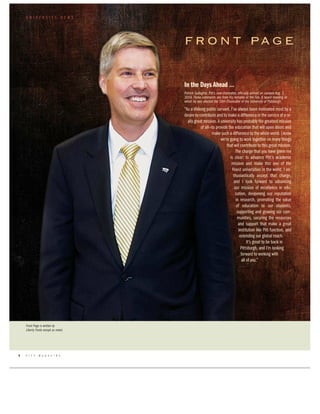
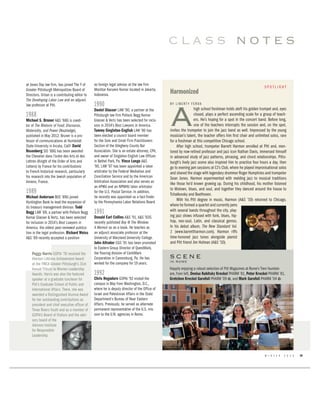
    Relativity #6, byPaul Glabicki Paul Glabicki Art Professor’s Drawings on Einstein’s Relativity Theory Featured in New York Exhibition By Liberty Ferda Issue Date: January 27, 2014 Opening night of the art exhibition drew an unusual crowd, said gallery owner Kim Foster. Not your typical gallery hoppers, but instead a mix of scientists, critics, film enthusiasts, musicians, and artists. One attendee mentioned having been a neighbor of famed physicist Albert Einstein as a child. “The crowd kind of mirrored the hybrid quality of my work,” said artist Paul Glabicki, a Pitt professor of studio arts, whose forms of expression include not only drawing but also film animation, computer graphics, photography, installation art, and painting. Glabicki’s recent series of drawings, inspired by his reading about Einstein’s theory of relativity, are showcased at the Kim Foster Gallery in New York City now through Feb.15. He describes the drawings as merging scientific and artistic points of view. The hand-drawn pieces are collage-like, using layers of images in black and colored pencil to depict, in intricate detail, Einstein’s notions of time and space, simultaneity, motion, and how these and other scientific ideas relate to art. Varying sizes of shapes and varying hues of color in the drawings illustrate how perception of an image is relative to the observer’s point of view, as well as relative to the artist’s composition and color choices. “From a distance the drawings pop because there’s so much color in them,” Foster said. She commented that the art has stopped people who are walking by the gallery. The color looks like paint, but it’s not. Glabicki made the colored details by first painting hundreds of brushstrokes on scrap paper, then sorting them according to style and size. Then, using a light table—with florescent lights behind a glass surface—he traced the brushstrokes before adding color with pencils. He could manipulate the orientation of the brushstrokes by flipping the paper under the glass surface. “Traditionally that was how animators would do things, a drawing on top of another drawing to see the motion. So I’ve always liked that process,” Glabicki said. He is best known, nationally and internationally, for his experimental film animations dating back to the 1970s. His animations, which have earned a bevy of PITT HOME FIND PEOPLE HOME TOPICS ISSUES ABOUT PITT CHRONICLE OTHER STORIES FROM THIS ISSUE JANUARY 27, 2014 A Day of Service: 600 Pitt Students Volunteer to Honor Legacy of Martin Luther King Jr. Kiplinger’s Ranks Pitt Best Value in Pennsylvania The Price of Justice Art Professor’s Drawings on Einstein’s Relativity Theory Featured in New York Exhibition Grant from General Electric, NFL Will Fund Pitt-UPMC Concussion Research Using Brain-Imaging Creativity on the Wyoming Prairie Pitt Hosts Social Commentator, Writer Hilton Als Media Literacy Tops Traditional Education In School Smoking-Prevention Efforts Immune-Cell Treatment for Gum Disease Proves Promising Hidden Treasures: Pitt’s Medieval Latin Reading Group Happenings Pitt’s People for Pets SUBSCRIBE TO RECEIVE HEADLINES IN E-MAIL » SearchSearch
  • 11.
    awards and appearancesat screenings such as the Cannes Film Festival, were crafted by means of thousands of hand-drawn images on paper—each drawing representing a frame of film. His 1989 film “Under the Sea” contains 10,000 exquisitely handcrafted images. After preparing the “brushstrokes” for the Relativity pieces, Glabicki copiously drew images that illustrated Einstein’s theories, such as detailed math formulations, circular wavelengths representing the Doppler Effect, and 3-D shapes and planes demonstrating space-time. He then progressively added layers, changing one element in an image relationship at a time. For example, he paired a left-facing “brushstroke” image with a right-facing one, a dark color with a lighter color, or added another version of the same data set. Some calligraphic images were painted with an extra-fine brush, which appear as drawing marks to the naked eye. “It’s deceptive in that way, and many people at first mistake the drawings as computer generated,” he said. There are no computer graphics in the drawings, though Glabicki does have considerable experience with computer art. He was one of the first artists at Pitt to make art with computer pixels, gaining access to emerging computer graphics technology at Pitt’s Old Engineering Hall in the late 1980s. There, he experimented with creating still images and with advanced graphics software as it developed. During the 1990s, Glabicki focused entirely on digital media. “People who know my work can see aspects of the Relativity drawings that relate to the films I did in the 70s and 80s. Some who recall the computer imaging I was doing in the 90s can see the influence of my work with computers,” he said. “That’s what I like most about the Relativity series, besides playing with scientists’ and artists’ perspectives—how bringing experience from all these different worlds happened organically.” Glabicki’s interdisciplinary background and various interests inform his teaching, too. At Pitt, where he has been a professor of studio arts since 1976, he teaches classes in design, drawing, and color theory. A mix of students take the Foundation Design course as a general education elective, which allows him to cite examples that students who study a broad range of subjects can relate to. He might, for example, draw from science, architecture, film, dance, or music to discuss balance and color relationships in a painting or computer image. The Relativity exhibition, Glabicki’s third solo show at the gallery since 2009, has received a great response since opening night on Jan. 9, said Foster. The notable art magazine Blouin Artinfo’s Gallery Guide featured Glabicki’s exhibition as the cover story in its January issue. Located in New York’s Chelsea arts district, The Kim Foster Gallery features artists who “deviate from traditional mediums and instead have developed entirely new methods and sophisticated techniques that often require massive hand labor.” Foster said she appreciates the “nearly obsessive” nature of hand-drawn detail in Glabicki’s work. Glabicki noted that although the Relativity drawings are very complex and dense with visual information, they are not meant to be scientific—they are playful. Perhaps this, too, reflects Einstein’s sensibilities. After all, the late physicist is famously credited with saying, “Creativity is intelligence having fun.” Pitt Chronicle University News Services 200 South Craig Street Pittsburgh, PA 15260 chron@pitt.edu 412-624-1033 PITT CHRONICLE RSS Feed How to subscribe
  • 19.
    Sayre N. Greenfield Chancellor’s Teaching,Research, and Service Awards Announced By Liberty Ferda Issue Date: February 24, 2014 University of Pittsburgh Chancellor Mark A. Nordenberg has announced the winners of the 2014 Chancellor’s Distinguished Teaching, Research, and Public Service Awards. Each awardee will receive a $2,000 cash prize and a $3,000 grant for support of their teaching, research or service activities—and will be recognized during the University of Pittsburgh’s 38th annual Honors Convocation, to be held at 3 p.m. this Friday, Feb. 28, in Carnegie Music Hall, 4400 Forbes Ave., Oakland. The event is free and open to the public. The following four Pitt faculty members will receive the 2014 Chancellor’s Distinguished Teaching Award: Sayre N. Greenfield, Cynthia Lance-Jones, Steven Levitan, and Samuel Poloyac. The following five Pitt faculty members will receive the 2014 Chancellor’s Distinguished Research Award: Ivet Bahar, Jonathan Pruitt, Marcus Rediker, Nathaniel Rosi, and Andrew B. Schwartz. The three winners of the 2014 Chancellor’s Distinguished Public Service Awards are: Bopaya Bidanda, Robert Ruck, and Jay Sukits. Chancellor’s Distinguished Teaching Award Sayre N. Greenfield Professor of English, Department of English, University of Pittsburgh at Greensburg Professor Sayre Greenfield excels in his use of technology in the classroom and his engagement of students in digital humanities and research at the University of Pittsburgh-Greensburg. In the award letter, Chancellor Nordenberg cited Greenfield’s “innovative use of electronic database search technology” in assignments for his History of English Language course, as well as his role in initiating the Digital Humanities course. In addition, Greenfield has devised ways for students to gain practical experience in working with digital methods for generating, archiving, and researching cultural resources in the humanities. His prior teaching awards include the 1998 UPG Distinguished Teaching Award and the 2012 Primary Source Award for Teaching from the Center for Research Libraries. The chancellor also noted that as the first instructor on the Greensburg campus to request and receive a Green Scholar undergraduate research assistant, Greenfield has shown commitment to engaging students in collaborative research and providing them with “real world” experience. PITT HOME FIND PEOPLE HOME TOPICS ISSUES ABOUT PITT CHRONICLE OTHER STORIES FROM THIS ISSUE FEBRUARY 24, 2014 Alumni Association Names Distinguished Alumni Fellows Chancellor’s Teaching, Research, and Service Awards Announced Nordenberg Honors Staff for Service to the University and Community “Experience the World Showcase” To Support PittAdvantage Grants Geri Allen: Finding Creative Simpatico The Cascading Thoughts of Terrance Hayes Hidden Treasures: Cathedral-A-Day Pitt Press, Hebrew Union College Press Launch Collaboration in Jewish Studies Newsmakers: A Celebration of Teaching Newsmakers: A Conversation With Sonia Sotomayor Scene: Galileo Happenings SUBSCRIBE TO RECEIVE HEADLINES IN E-MAIL » SearchSearch
  • 20.
    Cynthia Lance- Jones Steven Levitan SamuelPoloyac Ivet Bahar Cynthia Lance-Jones Professor of Neurobiology, Department of Neurobiology, and Assistant Dean for Medical Student Research, School of Medicine As coordinator for the first-year basic science block in the School of Medicine and as assistant dean for medical student research, Professor Cynthia Lance-Jones positively influences the development of medical students and helps prepare them to be outstanding clinicians. Chancellor Nordenberg noted that, in addition to frequently earning top-notch teaching evaluations from students, Lance-Jones is one of only three faculty members who has received repeated requests to provide review sessions for U.S. Medical Licensing Exam Step 1 exams. She has earned numerous educator awards, including the 2013 Excellence in Education Award as Small Group Facilitator and the 2013 Alpha Omega Alpha Robert J. Glaser Distinguished Teacher Award from the Association of American Medical Colleges. Steven Levitan John A. Jurenko Professor of Computer Engineering, Department of Electrical and Computer Engineering, Swanson School of Engineering Professor Steven Levitan is recognized for his use of innovative teaching initiatives to help students become critical thinkers. Levitan employs a “flipped classroom” structure, a form of blended learning where what used to be homework is done interactively in class, and new content is learned in various ways, including by watching video lectures at home. Levitan has also developed new courses, such as Very Large Scale Integration Design, Computer Modeling, and the Digital Design Laboratory. In the award letter, Chancellor Nordenberg wrote that those models “have set the standard” for how the department teaches laboratory courses. Previous recognition of Levitan’s excellence in teaching include his receipt of the 2010 Provost’s Academic Council on Instructional Excellence Award and the Swanson School’s 2013 Outstanding Educator Award. Samuel Poloyac Professor of Pharmaceutical Sciences, Department of Pharmaceutical Sciences, School of Pharmacy As a professor in the School of Pharmacy and chair of Pitt’s Clinical and Translational Science Institute’s core curriculum committee, Samuel Poloyac has demonstrated excellence in teaching and curriculum development. He received the student-selected Faculty Member of the Year Award in 2003 and the Phi Delta Chi Outstanding Chapter Advisor Award in 2008. Poloyac also developed the interdisciplinary course Translational Research in the Health Sciences, which has made major contributions to the University’s curriculum. In the award letter, Chancellor Nordenberg described the course as “instrumental in introducing students to the objectives, concepts, models, and processes of clinical and translational science.” Chancellor’s Distinguished Research Awards Ivet Bahar Senior Scholar Category Distinguished Professor and John K. Vries Chair, Department of Computational and Systems Biology, School of Medicine Professor Ivet Bahar is known worldwide for her work in the fields of computational biology and biophysics. Bahar’s research accomplishments have been described as “important, innovative, and fundamental to the development of the extensive and expanding field of computational biology.” Upon joining Pitt in 2001, Bahar founded the Center for Computational Biology and Bioinformatics in the School of Medicine, which became the Department of Computational and Systems Biology in 2004. Additionally, she cofounded the first such degree-granting program between Carnegie Mellon University and Pitt, which was selected by the Howard Hughes Medical
  • 21.
    Jonathan Pruitt Marcus Rediker NathanielRosi Institute and the National Institutes of Health as one of 10 national programs to help biomedical research institutions train PhD scientists to conduct interdisciplinary research in biomedical, physical, computational, and mathematical fields. Jonathan Pruitt Junior Scholar CategoryAssistant Professor of Biological Sciences, Department of Biological Sciences, Dietrich School of Arts and Sciences The selection committee was impressed by Professor Jonathan Pruitt’s research vision—to gain a deeper understanding of animal societies and how variation in individual “personalities” influences social organization, species interactions, and extinction risk. Notably, since arriving in Pittsburgh, Pruitt’s research has been featured in more than 16 media outlets, including Smithsonian Magazine, the Discovery Channel, National Geographic, and the BBC. Chancellor Nordenberg also cited Pruitt’s track record of prolific publishing, with 22 research articles in print in just the last two years. His nomination received praise from colleagues, one of whom wrote, “Dr. Pruitt shows the most potential to be a superstar. He is an original thinker and is also extremely generous in sharing his ideas and offering assistance to other researchers, students, and senior investigators.” Marcus Rediker Senior Scholar Category Distinguished Professor of Atlantic History, Department of History, Dietrich School of Arts and Sciences Over the past 30 years, Professor Marcus Rediker has become a foundational figure in the field of Atlantic history and has made seminal contributions to working-class history, maritime history, and the history of slavery. In his award letter, Chancellor Nordenberg cited one of Rediker’s much-praised books, The Slave Ship: A Human History, which received the 2008 James Rawley Prize by the American Historical Association for the best book in Atlantic History and the 2008 George Washington Book Prize for the best book on the founding era of the United States. Rediker is also a popular and highly effective teacher, introducing new disciplinary perspectives and receiving Pitt’s highest possible evaluations in undergraduate courses. A letter of support for Rediker’s nomination noted that he “has been an enormous personal influence on many young scholars across the globe.” Among his recent honors are the Sidney Hillman Foundation’s 2013 Sol Stetin Award for Labor History and a YWCA of Greater Pittsburgh 2013 Racial Justice Award. Nathaniel Rosi Junior Scholar Category Professor of Chemistry, Department of Chemistry, Dietrich School of Arts and Sciences In the award letter, Chancellor Nordenberg wrote that Professor Nathaniel Rosi is clearly on an “upward trajectory for continuing to make major contributions in materials chemistry and nanoscience.” The chancellor added that Rosi’s achievements have had a significant impact on the research profile of Pitt’s chemistry and chemical engineering departments as well as the nanoscience community. Rosi’s research has appeared in prominent journals, including the Journal of the American Chemical Society, Chemical Science, and Angewandte Chemie, which is published by the German Chemical Society. His nomination was supported by many colleagues, including one who wrote, “Professor Rosi clearly deserves such recognition by virtue of his emergence as a highly accomplished scholar in inorganic chemistry.” Andrew Schwartz Senior Scholar Category Professor of Neurobiology, Department of Neurobiology, School of Medicine Professor Andrew Schwartz is internationally recognized in the field of neural engineering and is one of the foremost experts on neural control of movement with
  • 22.
    Andrew Schwartz Bopaya Bidanda RobertRuck Jay Sukits brain-computer interfaces. Chancellor Nordenberg noted that the selection committee was “deeply impressed” by how Schwartz and his team in 2012 demonstrated the most successful use to date of a mind-controlled prosthetic arm and hand by a woman with quadriplegia. The committee also cited several other accomplishments, including Schwartz’s pioneering use of population activity as a method for decoding movement trajectories; the neurophysiological study of 3D movements; the use of virtual reality in studying behavior in awake monkeys; and chronic multi-electrode recording from the cerebral cortex. Schwartz’s nomination was supported by many colleagues and peers, one of whom wrote, “I would consider Dr. Schwartz as one of the most innovative contemporary neuroscientists that I know.” Chancellors’ Distinguished Public Service Award Bopaya Bidanda Ernest Roth Professor and Chair, Department of Industrial Engineering, Swanson School of Engineering The chancellor cited Bopaya Bidanda and his colleague David Cleland for development of Pitt’s Manufacturing Assistance Center, which provides customized machinist-training programs for individuals and contributes to the region’s economic development. Bidanda has also worked closely with UPMC’s leadership to help improve patient care by incorporating industrial engineering concepts into health care delivery. Among the health care projects he undertook was the creation of a workflow design for the Mario Lemieux Center for Blood Cancer at the Hillman Cancer Center as well as work for Presbyterian University Hospital’s Center for Lung Disease. Bidanda has been a leader in national engineering education throughout his career, including serving as past president for the Council of Industrial Engineering Academic Department Heads and as a commissioner for the accrediting body for all engineering academic programs. Robert Ruck Professor of History, Department of History, Dietrich School of Arts and Sciences Among Professor Robert Ruck’s noted achievements are his efforts to restore public memory of the Negro Leagues and to promote public discussion of the role of African-American and Latin American players in the development of major-league baseball in the United States. Ruck lobbied the Pittsburgh Pirates to publicly acknowledge and commemorate the history of Pittsburgh’s Negro League teams, and in September 1988, the Pirates held a pre-game ceremony marking the 40th anniversary of the last Negro League World Series and commemorating the history of the leagues. Chancellor Nordenberg noted that it may well have been the first time that a major-league team publicly recognized the history of the Negro Leagues. The chancellor also cited in the award letter Ruck’s involvement in public programming on Pittsburgh history and his philanthropic work in the area of public health. Jay Sukits Clinical Assistant Professor of Business Administration, Joseph M. Katz Graduate School of Business Professor Sukits’ individual efforts have served as “an inspiring example of contributions” to the University’s priority of addressing societal ills in tandem with teaching and research missions, Chancellor Nordenberg wrote in the award letter. He further cited the financial-literacy educational program that Sukits launched with a colleague in the financial services industry to teach high-school and college students personal financial-management skills. Also noted was Sukits’ work with the Sarah Heinz House, a North Side boys and girls club of which he is an alumnus. Sukits serves as a Sarah Heinz House board member and chair of its development committee. He also has created an initiative where Pitt College of
  • 23.
    Business Administration studentsare drafting a marketing plan for the organization. In addition, Sukits founded Pitt’s Student Veterans Association, which connects veterans with organizations interested in recruiting those who served in the military as employees. Pitt Chronicle University News Services 200 South Craig Street Pittsburgh, PA 15260 chron@pitt.edu 412-624-1033 PITT CHRONICLE RSS Feed How to subscribe
  • 29.
    ,i i':i{t- : i*.1l.-;.1 " .ll.,,-1,.-, "_ --j!-. 'ii : ',1 i Lr"l; fTjii{f :,-'i i-l .", -, : !") i-;'l .'-,.a i-, Ii..l .i-r..,.{..1.l-11 r-: ''.i ',*, i ''-., r-i.] !..,,r i i:: i...;. l. 1- :l ii;.::, :-': -. i ....,- 1- l. !...: li l-l'., : I .:.:.:-: :r tially be modi- ,o, like air- lse con- Reichle rging brain rrc eyes Llpport tiftrtcs :ing anglia, a ought to lforccment t eye move- language ding. rf methods re brain is is read- h reverse ; from rts back- ,,e func- -Reichle he com- uorkinEfs d o N o ; 33
  • 33.
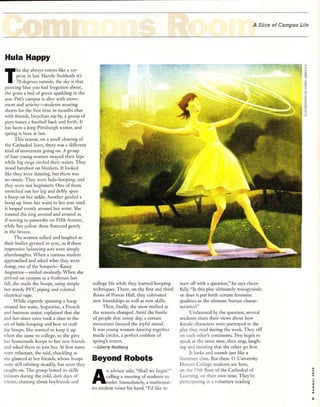
    A Slice ofCampus Life Hula Happy he clay always comes like a sur- prise in late March: Suddenly it's 70 degrees outside, the sky is that piercing blue you had forgotten about, the grass a bed of green sparkling in the sun. Pitt's campus is alive with move- ment and activiry-students wearing shorts for the first time in months chat with friends, bicyclists ztp by, a group of €iuys tosses a football back and forth. It has been a long Pittsburgh winter, and spring is here at last. This season, on a small clearing of the Cathedral lawn, there was a different kind of movement going on. A group of four young women swayed their hips while big rings circled their waists. They stood barefoot on blankets. It looked like they were dancing, but there was no music. They were hula-hooping, and they were not beginners. One of them stretched out her leg and deftly spun a hoop on her ankle. Another guided a hoop up from her waist to her arm until it looped evenly around her wrist: She rotated the ring around and around as if waving to passersby on Fifth Avenue, while her yellow dress fluttered gently in the breeze. The women talked and laughed as their bodies gyrated in s1mc, as if these impressive balancing acts were simply afterthoughts. When a curious student approached and asked what they were doing, one of the hoopers-Kasey Augustine-smiled modestly. When she arrived on campus as a freshman last fail, she made the hoops, using simple but sturdy PVC piping and colored electrical tape. While expertly spinning a hoop around her waist, Augustine, a French and business major, explained that she and her sister once took a class in the art ofhula-hooping and how to craft the hoops. She wanted to keep it up rvhen she came to college, so she gave her hornemade hoops to her new friends and asked them to join her. At first some l'ere reluctant, she said, chuckiing as she glanced at her friends, whose hoops 'ere still orbiting steadily, but soon they caught on. The group honed its skills indoors during the cold, dark davs of sinter, chatting about bor,.friends and college life while they learned hooping techniques. There, on the first and third floors of Posvar Hall, they cultivated new friendships as well as new skills. Thelr, finally, the snow melted as the seasons changed. Amid the bustle of people that sunny day, a certain movement buoyed the joyful rnood. It was young women dancing together inside circles, a perfect emblem of spring's return. -Liberty Hultberg Beyond Robots A;fi:i#,r;H1fftr+" ics student raises his hand. "I'd like to :::*+.i:_1ry:r '11 start off with a question," he says cheer- fully. "Is this play ultimately misogynistic or does it put forth certain feminine qualities as the ultimate human charac- teristics? " Undaunted by the question, several students share their views about how female characters were portrayed in the plav thev read during the week. They riff on each other's comments. Jivo begin to speak at the same time, then stop, laugh- inq and insisting that the other go first. It looks and sounds .just like a literature class. But these I I University Honors Colleee students are here, on the l-;th floor of the Cathedral of Learning. on their own time. They're participadne in a -oluntary reading ffi*'ili,' #.ii' sr-i iE: ,t l:s1Tii131|1itr:qgr€.% ic :- c :q z = = ' '+ii;/h ''4' . ".::i",,. .1**,-: r!'. =i ., ,:-:rr';-.'; ar :;: l, .!t .t.;i${i--: Ir..=al, . o d o 9