PowerPoint Presentation
www.LifelongFaith.com
“Presentation”
What the
Research Tells Us
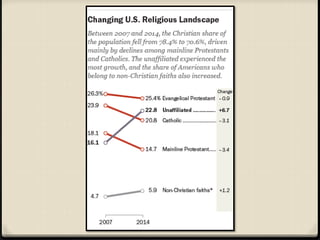
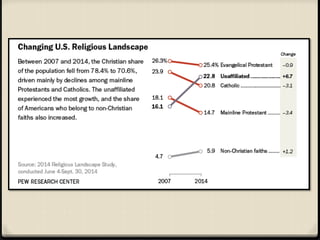
America’s Changing Religious Landscape
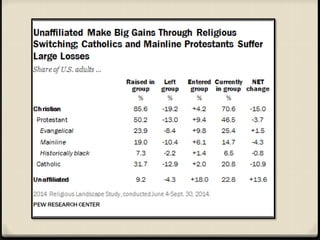
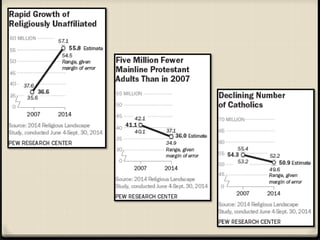
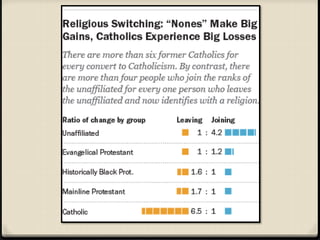
Christians Decline Sharply as Share of Population; Unaffiliated
and Other Faiths Continue to Grow
Pew Research Center, May 12, 2015
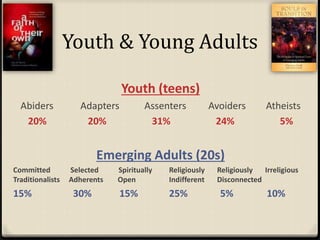
Youth & Young Adults
Youth (teens)
Abiders Adapters Assenters Avoiders Atheists
20% 20% 31% 24% 5%
Emerging Adults (20s)
Committed Selected Spiritually Religiously Religiously Irreligious
Traditionalists Adherents Open Indifferent Disconnected
15% 30% 15% 25% 5% 10%
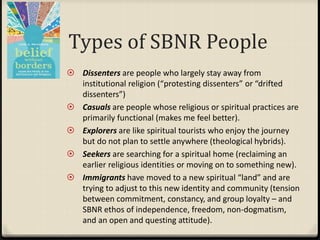
Types of SBNR People
 Dissenters are people who largely stay away from
institutional religion (“protesting dissenters” or “drifted
dissenters”)
 Casuals are people whose religious or spiritual practices are
primarily functional (makes me feel better).
 Explorers are like spiritual tourists who enjoy the journey
but do not plan to settle anywhere (theological hybrids).
 Seekers are searching for a spiritual home (reclaiming an
earlier religious identities or moving on to something new).
 Immigrants have moved to a new spiritual “land” and are
trying to adjust to this new identity and community (tension
between commitment, constancy, and group loyalty – and
SBNR ethos of independence, freedom, non-dogmatism,
and an open and questing attitude).
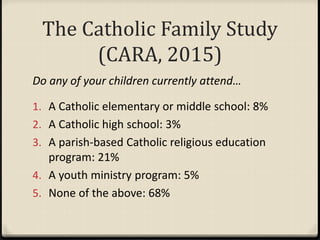
The Catholic Family Study
(CARA, 2015)
Do any of your children currently attend…
1. A Catholic elementary or middle school: 8%
2. A Catholic high school: 3%
3. A parish-based Catholic religious education
program: 21%
4. A youth ministry program: 5%
5. None of the above: 68%
Analysis
Analysis:
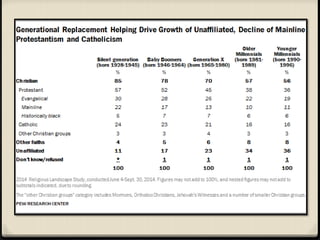
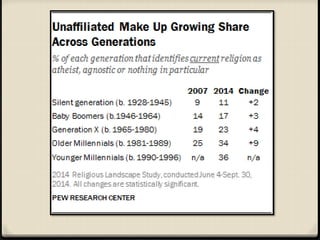
Generational Transition
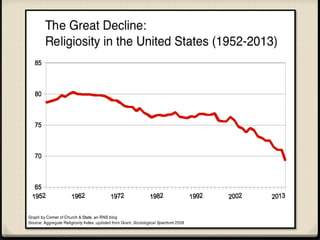
 Younger generations more unaffiliated
and less involved in faith communities
 Older generations more affiliated and
more involved and supportive
 Generational transition: as younger
generations replace the older
generations there will be fewer engaged
and more unaffiliated
Analysis:
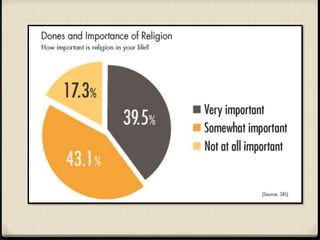
Importance of Religion
 40% of the “no religion in particular” say it is
“very” or “somewhat” important in their lives
 The overwhelming majority of religiously
unaffiliated believe in God
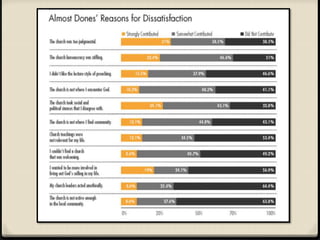
 Less about people “losing their religion” than
dissatisfaction with available institutional options
 Young generations seem allergic to large-scale
institutions that demand not only spiritual
allegiance but financial commitment. None of
these things are “religion” for these people.
Analysis:
Importance of Religion
 Corporate, mega-church dominated models of
religious & spiritual activity are starting to be replaced
by smaller, more locally oriented church communities,
and by larger churches that attract the masses for a
spiritual or musical performance, and a sense of
belonging to something much larger than themselves.
 Young people are looking for intimacy and personal
connections, deep spiritual experiences, service to
others, and the opportunity to create their own
community.
Analysis
Importance of Religion
Religion is not going away anytime soon,
regardless of how people may identify
themselves. But business as usual among
existing religious institutions will not stem
the losses we are seeing.
(Richard Flory, USC)
(http://religiondispatches.org/u-s-christianity-is-dead-
long-live-u-s-christianity)
Analysis
Religious Transmission
 Value & religious transmission is a family
affair (research by Bengston & Smith)
 Families can transmit a particular religious
faith tradition or not
 Declining levels of family religious
transmission and faith practice at home are
a result of non-affiliation
 1st generation & 2nd generation
 If the pattern continues, expect higher
levels of non-affiliation and lower levels of
church involvement in younger families
Suggested
Directions
Family: Starting Early
Missional Outreach
Missional Pathways
Design for Spiritual Diversity
Directions
Engaging Reality
Working what matters
In context… In language and actions… That give life.
 Identity: Who am I? What’s like to be me? How do I live well with
myself?
 Belonging: Who else works life with me? Where do I fit in? How do I be
with others who matter? Can I trust anyone?
 Meaning: What’s going on? What matters to me…to those I care
about…at all? Why am I here? Does life ever make sense?
 Brokenness: How do I live with life’s messiness? What works? How do I
endure pain? How do I focus in the confusion?
 Stress: Why am I so busy? What should I do? What shouldn’t I do? Will I
ever not be overwhelmed?
 Hope: Is there good future? Whose promises can I count on? Where
should I put my trust?
Directions
Christianity as Mission
Becoming a Faith Community in Mission:
Cultivating a community of faith where God is at the center
of conversation and action…and where God shapes the focus
and work of the people...whose concern focuses on the world
God loves.
By practicing….
Dwelling in the Word:
Immersing oneself in the Word so that it shapes imagination,
intentions and actions.
Dwelling in the World:
Becoming alert to, observant of and connected with the
people in the world where God send us.
Directions
Christianity as Mission
Hospitality:
Creating a welcoming and generative community within
God’s mission in the world.
Spiritual Formation and Discernment:
Following and facilitating the Holy Spirit’s work in the
formation of faith, community and mission.
Announcing the Reign of God:
Recognizing and bearing witness to God’s presence and work
in the world most especially in the life Jesus.
Focused Missional Action:
Discerning and focusing attention and action on that which is
central to mission in our time and context.
Directions
Family Faith Formation
Starting early to equipping families to become
centers of learning, faith growth, and faith practice.
. .
 Family Faith: nurturing family faith at home
through faith practices
 Parents: Developing parental faith, and skills for
effective parenting & nurturing faith growth
 Family Strengths: Building strong families by
developing family assets
nurturing relationships, establishing routines,
maintaining expectations, adapting to challenges,
and connecting to the community
Directions
Developmental Relationships
① Express Care: Show that you like me and want the
best for me.
② Challenge Growth: Insist that I tray to continuously
improve
③ Provide Support: Help me complete tasks and achieve
goals
④ Share Power: Hear my voice and let me share in
making decisions
⑤ Expand Possibilities: Expand my horizon and connect
me to opportunities
Directions
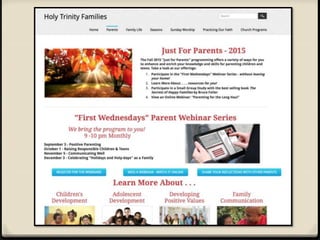
Missional Outreach
Missional faith formation expands and extends
the church’s presence through outreach,
connection, relationship building, and
engagement with people where they live—moving
faith formation out into the community.
 Moving worship and faith formation into the
community
 Opening programs to everyone – VBS
 Life skills: parenting, careers, training, mentoring
 Small group programs on a variety of topics
 Community-wide service
 Community events: arts, music, theater
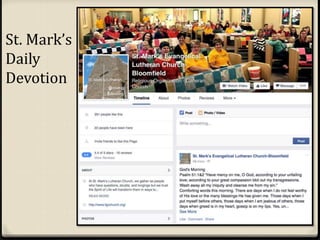
St. Mark’s
Daily
Devotion
Directions
Missional Outreach
Missional Outreach
Invitation & Mentoring
Step 1. Prepare church leaders
Step 2: 40-day preparation for
community members (study, prayer,
worship, small groups)
Step 3: Invitation to one person &
four-week small group experience
with “taste & see” church
experiences
Directions
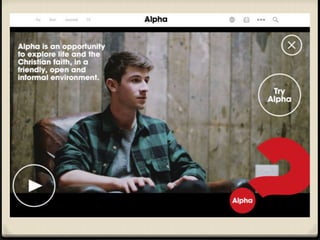
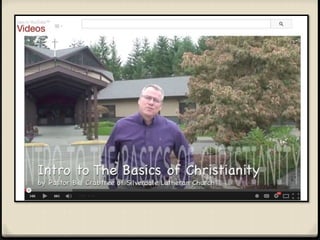
Missional Pathways
Missional faith formation provides
pathways for people to consider or
reconsider the Christian faith, to encounter
Jesus and the Good News, and to live as
disciples in a supportive faith community.
Directions
Design for Spiritual Diversity
 Rituals/Milestones Preparation
 Marriage
 Baptism
 First Communion
 Confirmation Funerals
 Educational Programming
 Vacation Bible School
 Worship Experiences

Below the Surface Event Presentation

  • 2.
  • 3.
  • 5.
    America’s Changing ReligiousLandscape Christians Decline Sharply as Share of Population; Unaffiliated and Other Faiths Continue to Grow Pew Research Center, May 12, 2015
  • 13.
    Youth & YoungAdults Youth (teens) Abiders Adapters Assenters Avoiders Atheists 20% 20% 31% 24% 5% Emerging Adults (20s) Committed Selected Spiritually Religiously Religiously Irreligious Traditionalists Adherents Open Indifferent Disconnected 15% 30% 15% 25% 5% 10%
  • 14.
    Types of SBNRPeople  Dissenters are people who largely stay away from institutional religion (“protesting dissenters” or “drifted dissenters”)  Casuals are people whose religious or spiritual practices are primarily functional (makes me feel better).  Explorers are like spiritual tourists who enjoy the journey but do not plan to settle anywhere (theological hybrids).  Seekers are searching for a spiritual home (reclaiming an earlier religious identities or moving on to something new).  Immigrants have moved to a new spiritual “land” and are trying to adjust to this new identity and community (tension between commitment, constancy, and group loyalty – and SBNR ethos of independence, freedom, non-dogmatism, and an open and questing attitude).
  • 15.
    The Catholic FamilyStudy (CARA, 2015) Do any of your children currently attend… 1. A Catholic elementary or middle school: 8% 2. A Catholic high school: 3% 3. A parish-based Catholic religious education program: 21% 4. A youth ministry program: 5% 5. None of the above: 68%
  • 26.
  • 27.
    Analysis: Generational Transition  Youngergenerations more unaffiliated and less involved in faith communities  Older generations more affiliated and more involved and supportive  Generational transition: as younger generations replace the older generations there will be fewer engaged and more unaffiliated
  • 28.
    Analysis: Importance of Religion 40% of the “no religion in particular” say it is “very” or “somewhat” important in their lives  The overwhelming majority of religiously unaffiliated believe in God  Less about people “losing their religion” than dissatisfaction with available institutional options  Young generations seem allergic to large-scale institutions that demand not only spiritual allegiance but financial commitment. None of these things are “religion” for these people.
  • 29.
    Analysis: Importance of Religion Corporate, mega-church dominated models of religious & spiritual activity are starting to be replaced by smaller, more locally oriented church communities, and by larger churches that attract the masses for a spiritual or musical performance, and a sense of belonging to something much larger than themselves.  Young people are looking for intimacy and personal connections, deep spiritual experiences, service to others, and the opportunity to create their own community.
  • 30.
    Analysis Importance of Religion Religionis not going away anytime soon, regardless of how people may identify themselves. But business as usual among existing religious institutions will not stem the losses we are seeing. (Richard Flory, USC) (http://religiondispatches.org/u-s-christianity-is-dead- long-live-u-s-christianity)
  • 31.
    Analysis Religious Transmission  Value& religious transmission is a family affair (research by Bengston & Smith)  Families can transmit a particular religious faith tradition or not  Declining levels of family religious transmission and faith practice at home are a result of non-affiliation  1st generation & 2nd generation  If the pattern continues, expect higher levels of non-affiliation and lower levels of church involvement in younger families
  • 32.
    Suggested Directions Family: Starting Early MissionalOutreach Missional Pathways Design for Spiritual Diversity
  • 33.
    Directions Engaging Reality Working whatmatters In context… In language and actions… That give life.  Identity: Who am I? What’s like to be me? How do I live well with myself?  Belonging: Who else works life with me? Where do I fit in? How do I be with others who matter? Can I trust anyone?  Meaning: What’s going on? What matters to me…to those I care about…at all? Why am I here? Does life ever make sense?  Brokenness: How do I live with life’s messiness? What works? How do I endure pain? How do I focus in the confusion?  Stress: Why am I so busy? What should I do? What shouldn’t I do? Will I ever not be overwhelmed?  Hope: Is there good future? Whose promises can I count on? Where should I put my trust?
  • 34.
    Directions Christianity as Mission Becominga Faith Community in Mission: Cultivating a community of faith where God is at the center of conversation and action…and where God shapes the focus and work of the people...whose concern focuses on the world God loves. By practicing…. Dwelling in the Word: Immersing oneself in the Word so that it shapes imagination, intentions and actions. Dwelling in the World: Becoming alert to, observant of and connected with the people in the world where God send us.
  • 35.
    Directions Christianity as Mission Hospitality: Creatinga welcoming and generative community within God’s mission in the world. Spiritual Formation and Discernment: Following and facilitating the Holy Spirit’s work in the formation of faith, community and mission. Announcing the Reign of God: Recognizing and bearing witness to God’s presence and work in the world most especially in the life Jesus. Focused Missional Action: Discerning and focusing attention and action on that which is central to mission in our time and context.
  • 36.
    Directions Family Faith Formation Startingearly to equipping families to become centers of learning, faith growth, and faith practice. . .  Family Faith: nurturing family faith at home through faith practices  Parents: Developing parental faith, and skills for effective parenting & nurturing faith growth  Family Strengths: Building strong families by developing family assets nurturing relationships, establishing routines, maintaining expectations, adapting to challenges, and connecting to the community
  • 37.
    Directions Developmental Relationships ① ExpressCare: Show that you like me and want the best for me. ② Challenge Growth: Insist that I tray to continuously improve ③ Provide Support: Help me complete tasks and achieve goals ④ Share Power: Hear my voice and let me share in making decisions ⑤ Expand Possibilities: Expand my horizon and connect me to opportunities
  • 38.
    Directions Missional Outreach Missional faithformation expands and extends the church’s presence through outreach, connection, relationship building, and engagement with people where they live—moving faith formation out into the community.  Moving worship and faith formation into the community  Opening programs to everyone – VBS  Life skills: parenting, careers, training, mentoring  Small group programs on a variety of topics  Community-wide service  Community events: arts, music, theater
  • 42.
  • 43.
  • 44.
    Missional Outreach Invitation &Mentoring Step 1. Prepare church leaders Step 2: 40-day preparation for community members (study, prayer, worship, small groups) Step 3: Invitation to one person & four-week small group experience with “taste & see” church experiences
  • 45.
    Directions Missional Pathways Missional faithformation provides pathways for people to consider or reconsider the Christian faith, to encounter Jesus and the Good News, and to live as disciples in a supportive faith community.
  • 48.
    Directions Design for SpiritualDiversity  Rituals/Milestones Preparation  Marriage  Baptism  First Communion  Confirmation Funerals  Educational Programming  Vacation Bible School  Worship Experiences