-SREELAYA R
21BCM550
The rapidly growing amount of data
in bioinformatics makes the use of a
database management system
(DBMS) indispensable. Additionally,
modern DBMS provide advantages
like concurrent multiuser access,
security features, and easy web
integration.
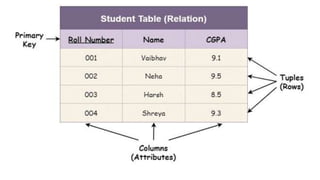
The relational data model is based on the
single concept of relations for data
representation. Relations are perceived by the
user as tables whose rows are called tuples
representing the objects. All entries in a
column of a table are atomic values from the
same domain, and a single column is called an
attribute.
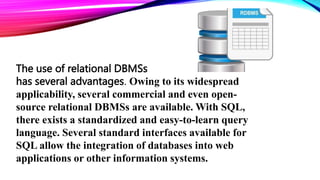
The use of relational DBMSs
has several advantages. Owing to its widespread
applicability, several commercial and even open-
source relational DBMSs are available. With SQL,
there exists a standardized and easy-to-learn query
language. Several standard interfaces available for
SQL allow the integration of databases into web
applications or other information systems.
ACID properties and RDBMS
Four crucial properties define relational database transactions:
atomicity, consistency, isolation, and durability—typically
referred to as ACID.
 Atomicity defines all the elements that make up a
complete database transaction.
 Consistency defines the rules for maintaining data
points in a correct state after a transaction.
Isolation keeps the effect of a transaction
invisible to others until it is committed, to
avoid confusion.
Durability ensures that data changes
become permanent once the transaction is
committed
THANK YOU

RELATIONAL DATABASE.pptx

  • 1.
  • 2.
    The rapidly growingamount of data in bioinformatics makes the use of a database management system (DBMS) indispensable. Additionally, modern DBMS provide advantages like concurrent multiuser access, security features, and easy web integration.
  • 3.
    The relational datamodel is based on the single concept of relations for data representation. Relations are perceived by the user as tables whose rows are called tuples representing the objects. All entries in a column of a table are atomic values from the same domain, and a single column is called an attribute.
  • 6.
    The use ofrelational DBMSs has several advantages. Owing to its widespread applicability, several commercial and even open- source relational DBMSs are available. With SQL, there exists a standardized and easy-to-learn query language. Several standard interfaces available for SQL allow the integration of databases into web applications or other information systems.
  • 7.
    ACID properties andRDBMS Four crucial properties define relational database transactions: atomicity, consistency, isolation, and durability—typically referred to as ACID.  Atomicity defines all the elements that make up a complete database transaction.  Consistency defines the rules for maintaining data points in a correct state after a transaction.
  • 8.
    Isolation keeps theeffect of a transaction invisible to others until it is committed, to avoid confusion. Durability ensures that data changes become permanent once the transaction is committed
  • 9.