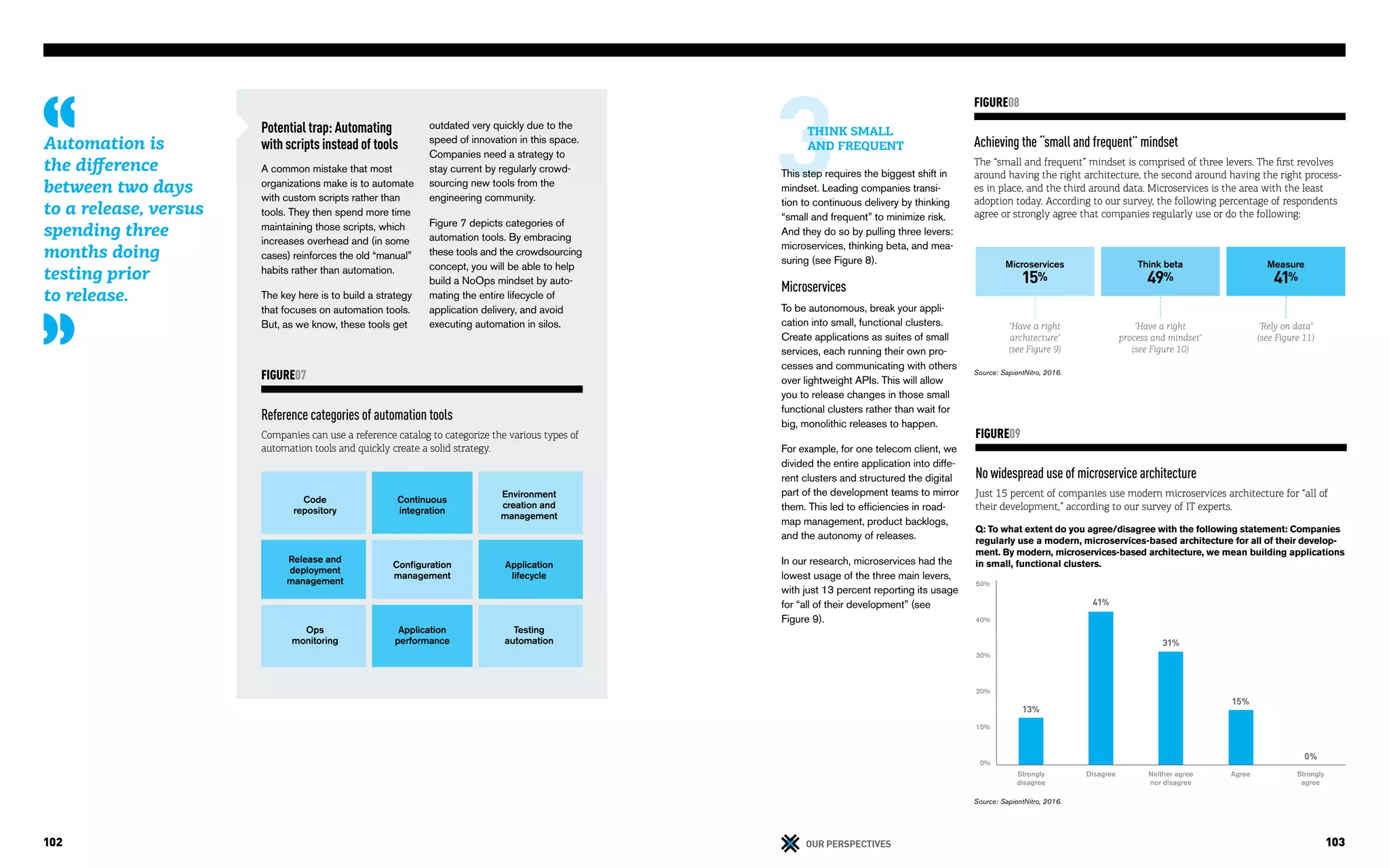
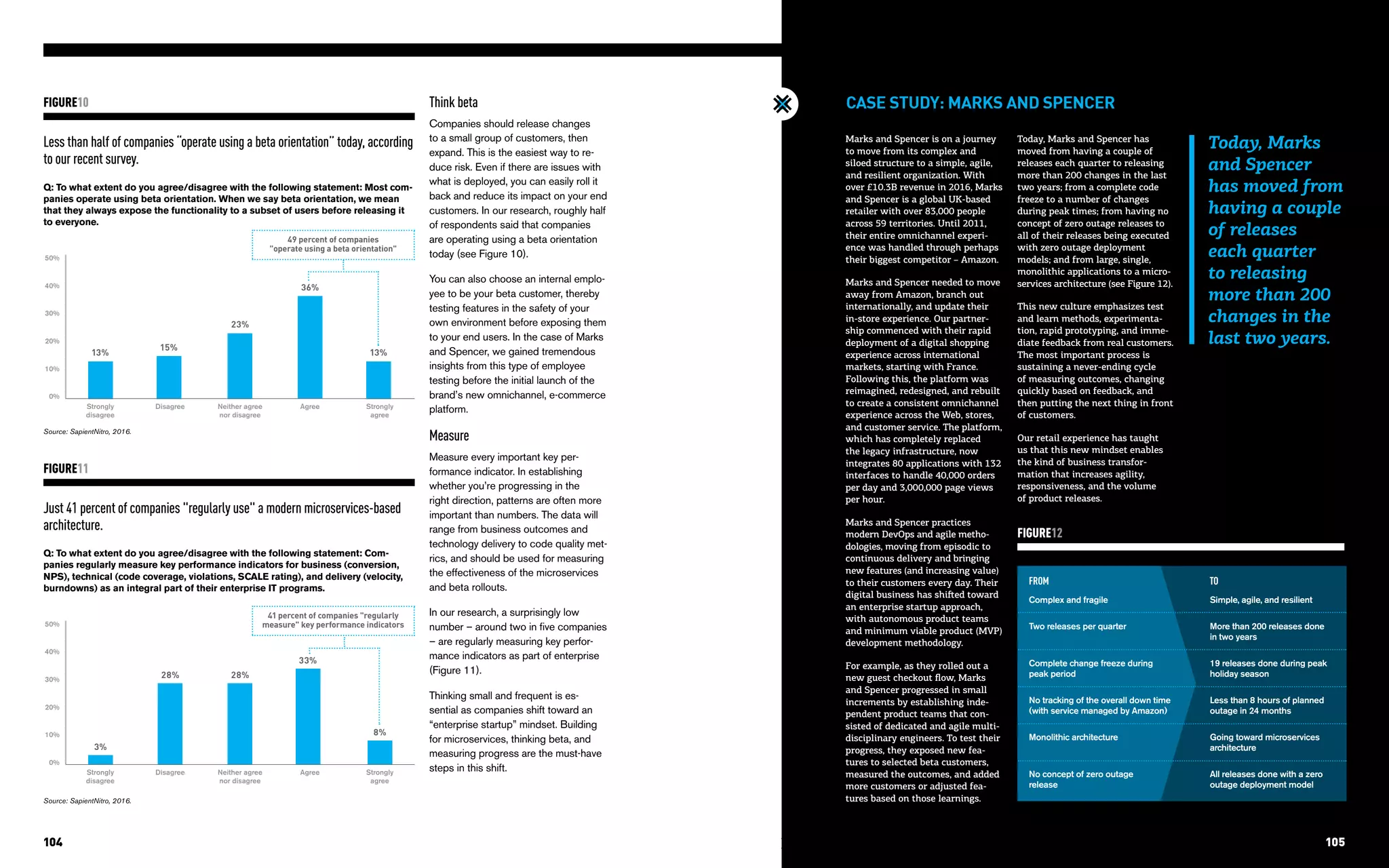
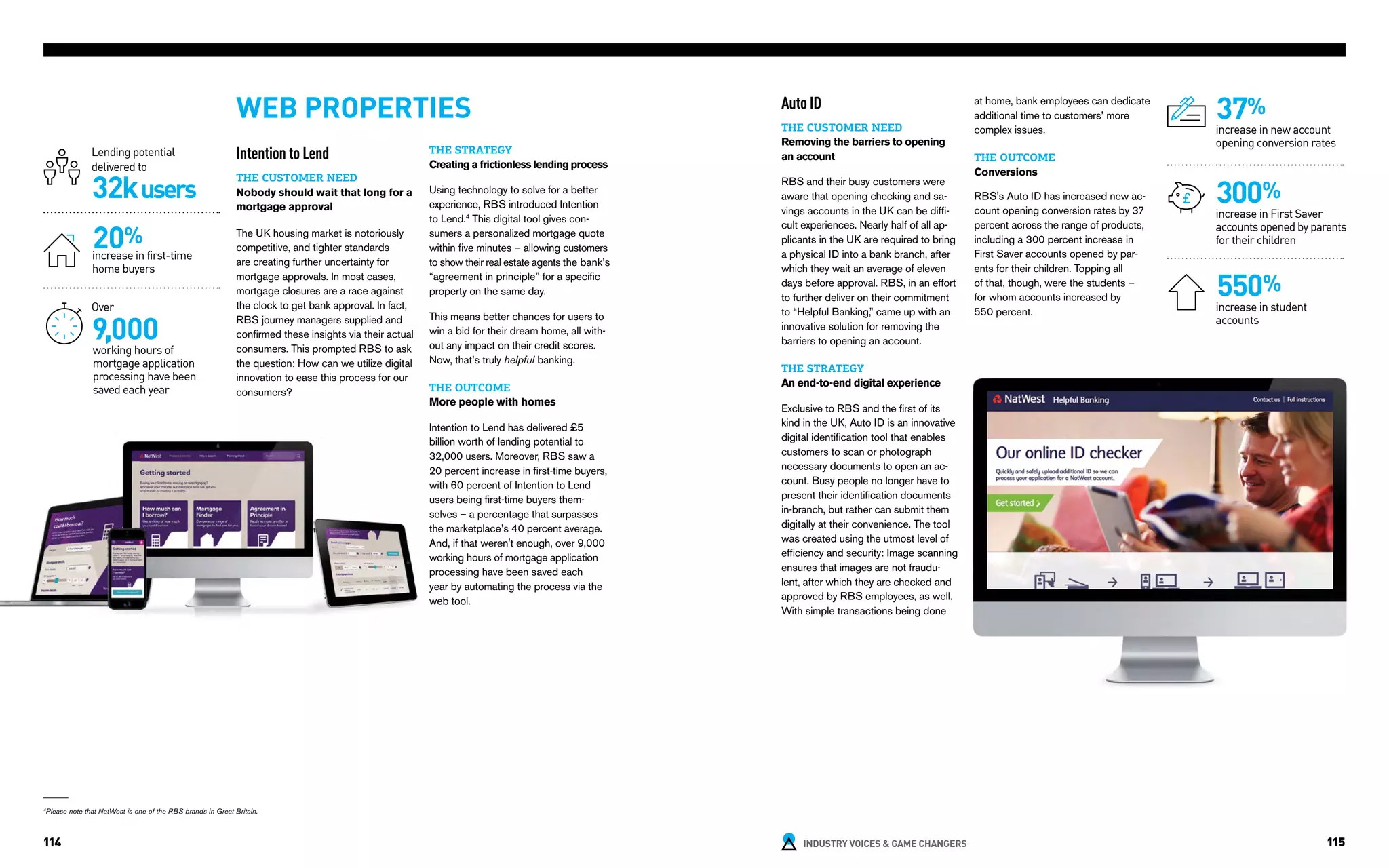
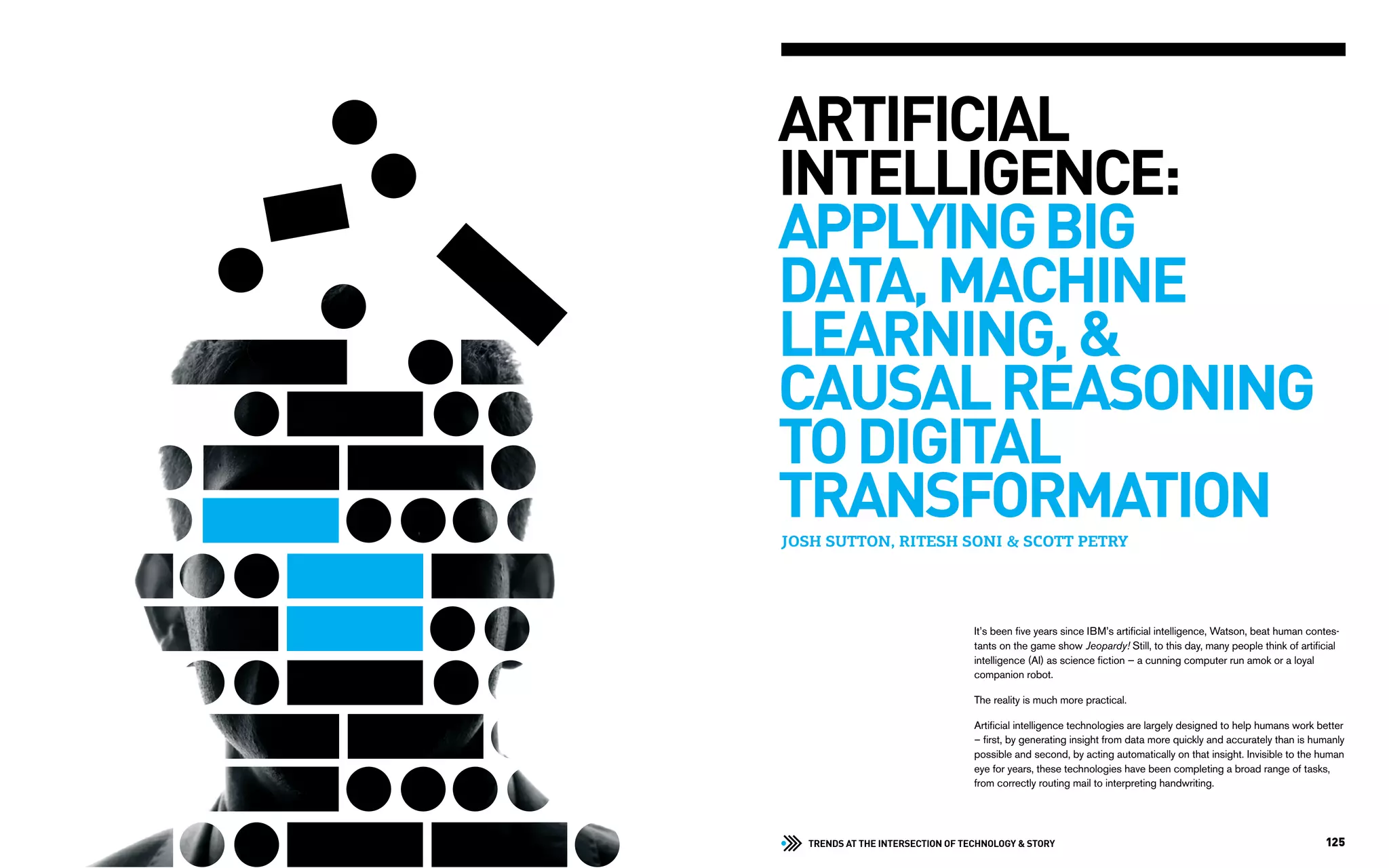
REIMAGINING BUSINESS IN THE AGE OF THE CUSTOMER
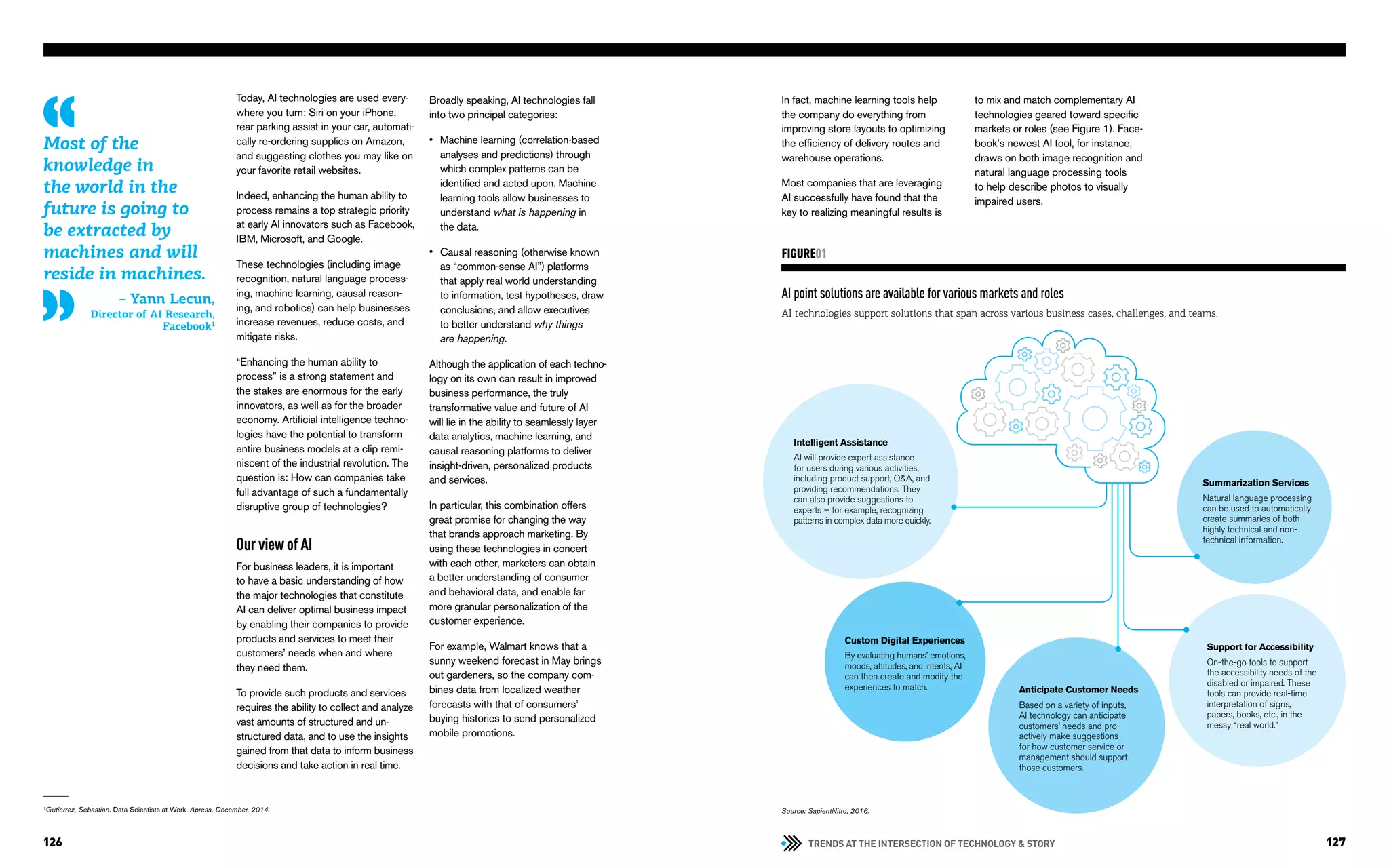
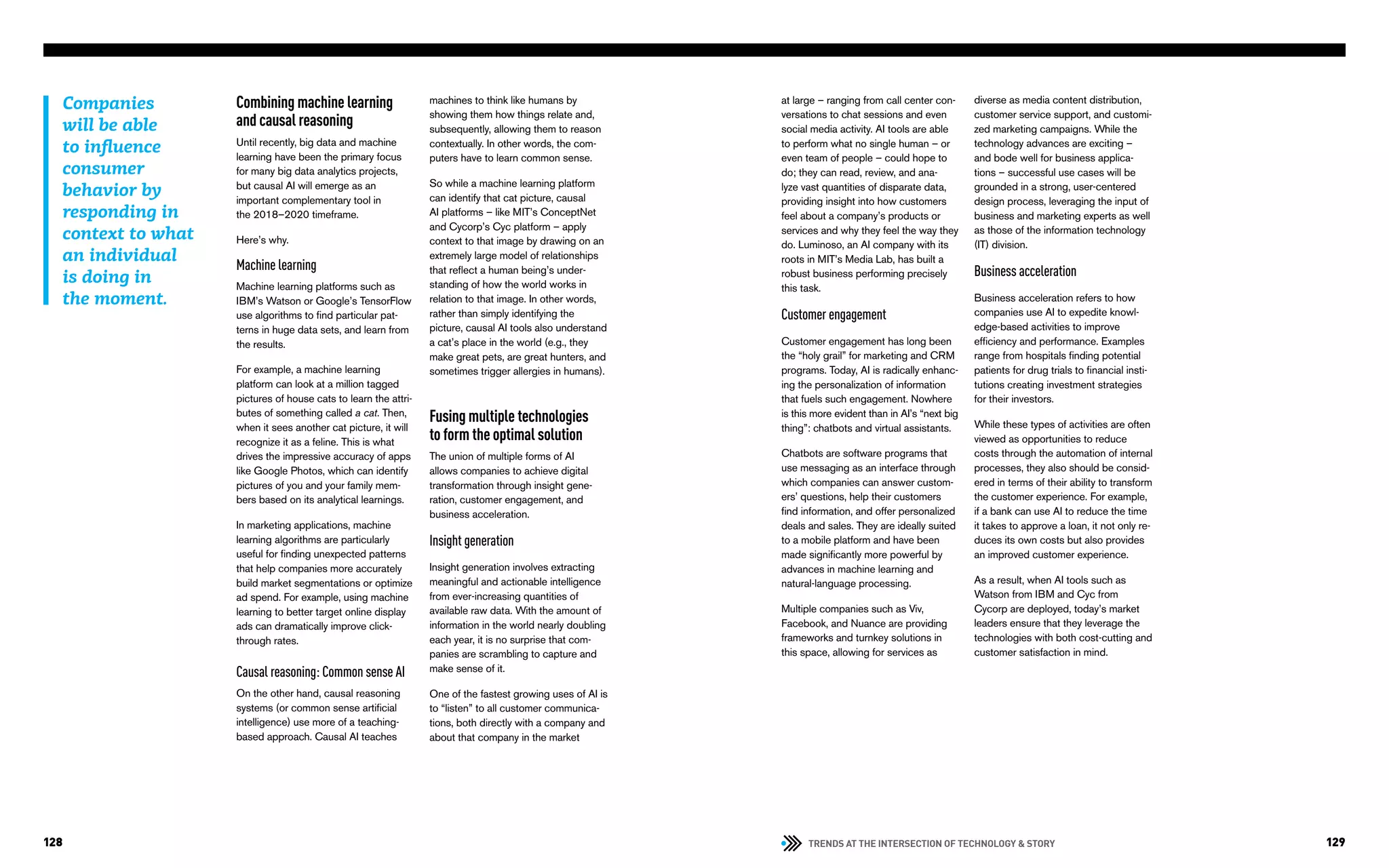
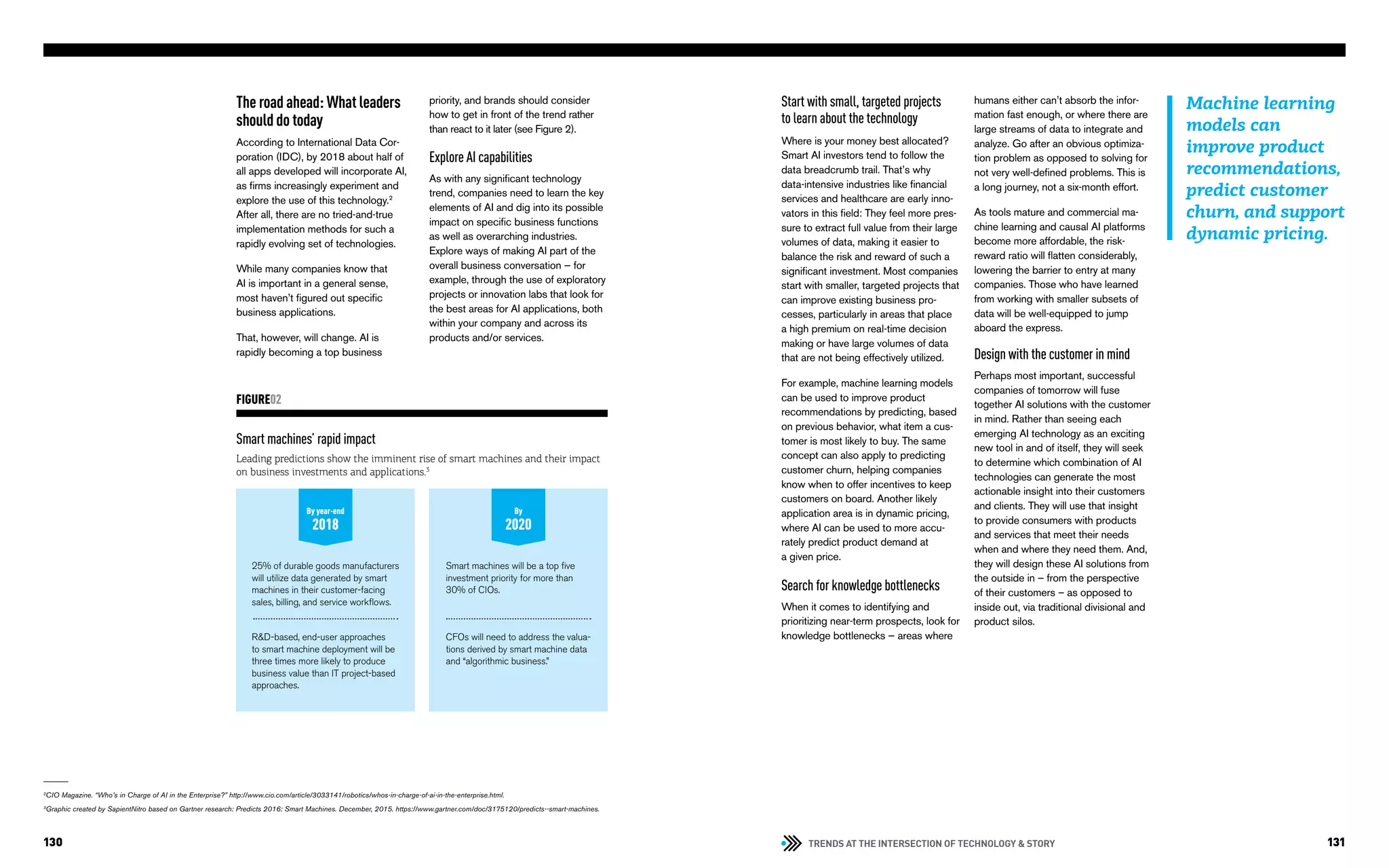
ISSUE 5
194
– Nigel Vaz,
Global Chief Strategy Officer & SVP,
Managing Director EMEA, SapientNitro London
Today's strategic imperative isn't
only to do things right, but also
to do the right things. Now is the
time for leaders to move beyond
incremental change, to reflect and
consider the fundamentals of
value creation in their business.
3
REIMAGINING BUSINESS
IN THE AGE OF THE CUSTOMER
As I meet with business leaders about the most pressing challenges and issues they’re facing, I notice a common angst that
spans all industries and geographies. They know that they need to evolve their businesses, but they don’t know precisely how or
where to turn for help. Technology innovation, shifting customer expectations and behaviors, and unforseen disruptors are
creating challenges to existing business models and threats to relevance. The pace of change required feels daunting.
Businesses are responding to the transformation challenge. The organization is changing. Roles that existed three
or four years ago are no longer relevant, and new roles are being created. Silos are breaking down, and how work
gets done is changing. Leading companies, and their partners, are creating transformative experiences and
business models.
It's a pivotal moment in business and, when we look at the ways we've historically prioritized experi-
ence to help our clients realize a better future for their customers and businesses, this feels like a
season purpose-built for our teams.
For example, our recently announced multiyear partnership with James Cameron’s Light-
storm Entertainment and 20th
Century Fox is designed to immerse current and future
fans in the world of Avatar, and ignite and sustain their passion for the franchise
through a next-generation digital experience. These are the types of partner-
ships that are truly reimagining business for the age of the customer.
Another groundbreaking example of reimagining business is our cus-
tomer journey transformation initiative for a leading financial services
client. We’ve been partnering with them to transform how customers engage
with the bank and establish a new operating model that can rapidly adapt and
respond to future customer needs.
To that end, in this edition of Insights we offer valuable research, provocations, and obser-
vations. These articles will, we hope, enlighten, guide, and inspire global leaders to reimagine
and rethink the fundamentals of their business. You'll find thinking and analysis on a wide
variety of topics like customer experience, enterprise information technology, artificial intelligence,
digital experience platforms, and more. Don't miss some new research on the retail industry on page
26, and learn from RBS’s eye-opening case study. We even explore business lessons that can be learned
from classical art.
I invite you to delve into these fascinating areas and I look forward to partnering with you to help lay the founda-
tion for what’s next. If you haven’t already, I encourage you to download our Insights app, which is available on iOS
and Android. Simply go to the relevant app store and search for “SapientNitro Insights.”
I hope you enjoy this book as much as we did putting it together.
Alan Wexler
SapientNitro CEO
4 5
INTRODUCTION
6 	 Contributors
10 	 Helping Clients Reimagine Business in the Age of the Customer
RESEARCH
26 	 Global Retailing in the Digital Age
48 	 Banks, Brands, and Consumers: A Vision for Mobile, Payment-Driven Change
OUR PERSPECTIVES
64 	 Dispelling 5 Myths About Experience Design
78 	 The Rise of Digital Experience Platforms
94 	 Enterprise Startup: Tactics for Thriving in Fast-Changing IT Environments
INDUSTRY VOICES & GAME CHANGERS
110 	 Case Study: Reimagining Banking at RBS
TRENDS AT THE INTERSECTION
OF TECHNOLOGY & STORY
124 	Artificial Intelligence: Applying Big Data, Machine Learning, & Causal
	 Reasoning to Digital Transformation
134 	Leveraging Emotion Insights to Drive Experiential Return
146 	Conversational UI: Talking Loud and Saying Plenty
158 	How Brands Are Changing the Context of Location Marketing
THE EYE-OPENER
170 	Picture This: How Art Can Help Digital Find Its Soul
TABLE
OF
ONT
ENT
C
7
CONTRI
BUTORS
Paul Eisen, PhD
Director, Experience Design,
SapientNitro Toronto
Paul helps businesses transform by
creating innovative and powerful ex-
periences. To help clients achieve their
goals, he defines experience strategies
and robust frameworks that enable
ongoing optimization of the value ex-
change between brands and customers.
Kieron Leppard
Creative Director, Experience Design,
SapientNitro London
At heart, Kieron is an experience de-
signer and a lover of all things digital.
Since joining SapientNitro in 2010, he
has worked for clients like Saks Fifth
Avenue, British Airways, and RBS – and
has picked up numerous awards along
the way.
Nathan Chmielewski 
Senior Associate, Research and Insights,
SapientNitro Chicago
Nate is a researcher focused on customers’
interactions with brands across all
touchpoints. He connects experience,
secondary research, and social insights
to understand consumer behavior and
brand positioning, and identify opportuni-
ties to improve the customer experience.
Andre Engberts
Technology Director,
SapientNitro Minneapolis
Andre has worked in digital technology
for over a decade helping transform
global clients such as Dell, Harley-
Davidson, Samsung and a large US-
based quick-service restaurant chain.
His technical experience spans web,
mobile, campaign, commerce, and
personalization technologies.
Daniel Harvey
Creative Director & Global Practice
Lead, Experience Design,
SapientNitro London
Daniel is Creative Director & Global
Practice Lead, Experience Design at
SapientNitro in London. Before that,
he was Executive Creative Director at
R/GA in New York. He’s led innovative
work for clients like HBO, NatWest,
and Verizon.
Matthew Maxwell
Associate Creative Director,
SapientNitro London
Matthew originally trained as an artist,
but found the Internet offered a broader
canvas. As a digital creative, his work
has helped sell everything from luxury
cars and sexual health to gaming
platforms, long distance flights, and
delivery pizza.
8 9
David Poole
Financial Services Center of Excellence,
SapientNitro Boston
David Poole leads SapientNitro’s Finan-
cial Services Center of Excellence which
supports a global network of banking,
insurance, and wealth management cli-
ents in thought leadership, innovation,
and customer insight. A change agent
with over twenty years of experience,
David shares his passion for making it
fun to be financially healthy.
Melissa Read, PhD
Global Emotion Insights Head,
SapientNitro Atlanta
Melissa’s practice uses cognitive and
neural science techniques to assess real
emotions in response to brand experi-
ences. Emotion insights help marketers
maximize brand engagement, minimize
pain points, drive creativity, and quan-
tify success.
Scott Petry
Vice President, Technology,
SapientNitro Atlanta
Scott drives effective technology solu-
tions as part of a cross-functional team
helping brands connect with their cus-
tomers through experience, media, and
technology. He works with great brands
like UPS, ADT, MD Anderson, AT&T,
Universal Orlando, and Carnival.
Nigel Vaz
Global Chief Strategy Officer & SVP,
Managing Director EMEA,
SapientNitro London
Nigel leads Razorfish and SapientNitro
for EMEA – working closely with the
agencies’ combined leadership team to
partner with clients to help them realize
a better future for their businesses and
improve their customers’ lives.
Josh Sutton
Global Head, Artificial
Intelligence Practice,
Publicis.Sapient
Josh is the Global Head of Publicis.
Sapient’s Data and Artificial Intelligence
Practice. In this role, he is responsible
for leveraging big data tools as well as
correlation-based and causal-based
AI platforms to help clients transform
their businesses.
Alan Wexler
SapientNitro CEO
Alan is responsible for overall leadership
of SapientNitro globally, Alan has held
a number of key management positions
since joining Sapient in 1998, including
leadership of the North America, Europe,
and Asia-Pacific regions. Alan has also
led several industry verticals including
media, entertainment, telecommuni-
cation, and healthcare, and launched
SapientNitro’s mobile practice in 2000.
Jemuel Ripley
Vice President, Global Retail Lead,
SapientNitro New York
Jem is responsible for driving key sector
initiatives that include retail innovation,
original research, talent development,
and strategies that guide retailers as
they navigate uncertainty, compete
globally, and connect always-on con-
sumers to their brands.
Zachary Jean Paradis
Vice President, Retail Strategy,
SapientNitro Chicago
Zachary is a strategist, professor, and
writer obsessed with transforming lives
through customer experience. He acts
as co-lead for the firm’s Experience
Strategy domain, supports the company’s
innovation efforts, and teaches at the
IIT Institute of Design.
Pawan Udernani
Director, Client Services,
SapientNitro London
Over the last 3 years, Pawan has been
leading SapientNitro and RBS’ experience-
led digital transformation journey.
This successful partnership has resul-
ted in multiple awards, along with
increases in RBS’ NPS, digital sales,
and employee engagement.
Ritesh Soni
Vice President, Data Science,
SapientNitro Washington, D.C.
Ritesh focuses on applying methods
in machine learning to opportunities
in retail, e-commerce, marketing, and
operational optimization. His Data
Sciences team combines the latest
methods to develop highly scalable
systems with machine learning at
their core.
Sheldon Monteiro
Global Chief Technology Officer,
SapientNitro Chicago
Sheldon leads global technology capa-
bilities, engineering, quality, methods,
DevOps, and tools. He sponsors and is a
senior faculty member at SapientNitro’s
CMTO University, an in-house executive
development program to grow Sapient-
Nitro’s marketing technologists.
Pinak Kiran Vedalankar
Director of Technology,
Digital Transformation
SapientNitro London
Pinak leads digital transformation
engagements from a technology and
engineering standpoint. His specific
focus is on scaling agile and engineer-
ing for enterprise, microservices, auto-
mation, DevOps, commerce, content,
social, mobile, and stores/branches.
11
In boardrooms around the world, senior executives are discussing a common
dilemma: how to create transformative experiences and business models that
improve their customers’ lives, drive growth, and boost profitability and efficiency.
Regardless of industry or location, businesses are facing a new world. By 2026,
the average Standard & Poor's 500 business will last just fourteen years.2
The
average business model is sustained for roughly half that: just six years.3
What
was once a landscape of five-year strategies, long-lived information technology (IT)
investments, and product line extensions is evolving into a rapid series of digital
business transformation initiatives, platform thinking, and customer experience.
The continued evolution of digital capabilities is pushing businesses to rethink their
fundamental views on customers, competitors, products, and partners.
For most companies, the strategic imperative should not just be doing things right,
more efficiently, or optimally. Leaders must also determine the right things to do.
Now is the time to reflect and consider the fundamentals of value creation in the
business – to go beyond the immediate, incremental change. How are you serving
your customers? Where do you want to fit into their lives? Are your traditional
ways of generating value sufficient?
HELPING CLIENTS
REIMAGINE
BUSINESS IN
THE AGE OF THE
CUSTOMERNIGEL VAZ
1
SapientNitro. Be the Gryphon. http://www.sapientnitro.com/en-us.html#perspective/insights/insights-articles/
be-the-gryphon-digital-business-transformation.
2
Innosight. Corporate Longevity: Turbulence Ahead for Large Organizations. http://www.innosight.com/innovation-
resources/strategy-innovation/upload/Corporate-Longevity-2016-Final.pdf.
3
The Boston Consulting Group. “Business Model Innovation.” https://www.bcg.com/expertise/capabilities/strategy/
business-model-innovation.aspx.
Successful digital
transformation
is not a one-off
activity, but
an ongoing
commitment to
adapt in line
with changing
customer needs
and expectations.1
12 13
3.1%
What are businesses’ ambitions for transforming?
Many large institutions, typically incumbents, start with a defense strategy. Yet
evidence shows that a more aggressive approach – one that embraces innovation
and digital business transformation – can be more effective.
FIGURE01
Digital business
transformation is
widespread and of
urgent importance
among executives.
Both studies reinforced the same point:
Digital business transformation is of
urgent importance among executives.
In fact, our 2016 CMTO study deter-
mined that, while nearly all organiza-
tions (96.9 percent) are addressing
digital in some way, just six out of ten
(56 percent) have made DBT a priority
(see Figure 2).
Comparing and contrasting the adoption and prioritization of transformation
This year’s CMTO study revealed the stark difference between the percentage of organizations that are addressing digital
and those that prioritize digital business transformation, specifically. It appears from this research that many firms recog-
nize the need to respond to digital, but are failing to make DBT a priority. In fact, nearly 2 of 10 businesses didn’t even know
whether DBT is a priority.
FIGURE02
New digital pure-plays – companies
designed expressly for the digital world
– have arrived. Faster, simpler, and
better optimized, these businesses are
in some ways stronger than the legacy
players. From a category disruptor like
Airbnb to a new entrant like Under
Armour, they are challenging the status
quo in long-established industries.
Today’s competitive marketplace
requires a deeper level of change
– a reimagining of every part of the
business. More specifically, businesses
must invest in product innovation, the
integration of technology and frame-
works, and open platforms.
In light of this new landscape, senior
leaders have a quandary (see Figure 1).
Do they defend, build upon, and lock in
their positions as incumbents? Or do
they take risks, disrupt, and potentially
expose themselves?
To understand companies’ ambitions
for transforming, SapientNitro conducted
two pieces of research on the nature of
digital business transformation (DBT)
over the past two years. In the first, Be
the Gryphon, SapientNitro partnered
with Ovum, a research and consulting
firm, to interview fifty global chief execu-
tive officers (CEOs) involved in DBT.
The second, Digital Business Trans-
formation and the CMTO: Leadership
in the Digital Age, explores the DBT
perspectives of 223 U.S. and Canadian
executives in charge of both marketing
and technology, a hybrid role called
the chief marketing technology officer
(CMTO).
Most businesses are responding to digital in some way
But less than 60% have made digital business transformation a top three priority
60%
50%
40%
30%
20%
10%
0%
Customer experience
holistically across all
channels
Operational
processes
Customer experience
with specific channels
IT capabilities to be more
agile/continuous
Business
models
56.5%
96.9% of organizations are transforming their businesses in some way
Differentiate
Defend
Disrupt
Digital redefines the
terms of competition
Business benefits
The company
replatforms
marketing,
sales & service
Delivering new value
and experience
organizations have
made digital business
transformation a priority
6outof 10
No significant initiatives
in digital
54.3%
49.8% 48.4%
39%
Q: Is digital business transformation a top 3 priority?
56%
Yes
17.1%
I don't know
26.9%
No
Source: SapientNitro, 2016.
14 15
The reimagining imperative
Forces from across technology, consumer behavior, and the marketplace are pushing organizations (and their leaders) to
recognize, adopt, and prioritize their need to evolve new ways of doing business.
FIGURE03
To respond, we’ve developed an ap-
proach called the reimagining impera-
tive (see Figure 3). We define this as
the compelling need for companies to
embrace change across all aspects of
their business, including personnel and
leadership, partners, and supply chain.
As executive leaders focus on two
priorities – the search for further reve-
nue growth and improving profitability
by driving down costs and boosting
efficiency – we believe a reimagining of
fundamental business characteristics
and relationships will be necessary.
The size of the gap between these
businesses' aspirations and their reali-
ties is reinforced in this research.
The sentiment is
that there's still a
lack of attention and
resources dedicated
to DBT.
– SapientNitro’s Digital
Business Transformation
and the CMTO: Leadership
in the Digital Age
Key DBT research findings
Effective digital business transformation strategies will become an underlying
survival and success factor in the age of Tesla, Uber, and Airbnb. Rather than
digitizing piecemeal, DBT calls upon business leaders to reimagine their entire
organizations for the digital world. Nothing short of wholesale transformation will
be sufficient to compete.
Yet our research shows that companies willing to make this leap are rare. We
identified four key research findings across these two studies.
1Leadingcompaniesareexploring
businesstransformation,butthe
shiftisnascent
Leading companies are exploring
business transformation, but the shift is
nascent – just 22 percent have a formal
business document, and 34 percent
remain in the “boardroom discussion”
phase (see Figure 4).4
Most executives
are still in their early stages of planning.
In reality, few are “advanced” and most
are assessing their strategies.
Our research revealed three main stages
in DBT concept development:
Creating “strategic intent”
Having a boardroom discussion
and strategy debate
Creating a tangible and formal
business document that articulates
the scope of the challenge, along
with the resources and timescale
required to execute
Our second study, completed in
the first half of 2016, found that a
majority of businesses (97 percent)
are “addressing digital,” but this broad
language leads us to conclude that it
is likely piecemeal innovation and not
wholesale transformation.
Most commonly, organizations are
focusing on transforming the customer
experiences holistically “across all
channels” or “within specific channels.”
Some are also transforming operational
processes. However, just 56 percent
believe that digital business transfor-
mation is a priority as of mid-2016,
much lower than those who are just
responding to digital (see Figures 2a
and 2b on the previous page). This re-
flects the gap between those creating
short-term, point solutions and those
embracing digital business transforma-
tion holistically.5
4
SapientNitro. Be the Gryphon. http://www.sapientnitro.com/en-us.html#perspective/insights/insights-articles/be-the-gryphon-digital-business-transformation.
5
SapientNitro. Digital Business Transformation and the CMTO: Leadership in the Digital Age. Research not yet released.
New types
of competitors
New, emerging
business models
New technologies
The Millennial
Generation
THE REIMAGINING IMPERATIVE
The fundamental need to evolve new ways of doing business
Marketplace
factors
Give
rise to
Forces
of change
SAAS
Mobile & cloud
Wearables
The Internet of Things
Virtual reality
Artificial intelligence
Any time, anywhere expectations
Content creators & curators
Massive data generators
Empowered consumers
Technology New consumer
What is your digital business
transformation agenda?
FIGURE04
22%
Formal
business
document
34%
Boardroom
discussion
44%
A strategic intent
Source: SapientNitro, 2016.
16 17
2Successful DBT must be led by
the C-suite – and with teams
(not just individuals)
Such is the importance of reimagining
business that among companies with
a DBT agenda, all fifty CEO-level res-
pondents considered themselves to be
the leaders of their companies’ DBT
agendas. And over two-thirds nomi-
nated a lieutenant to lead the digital
business transformation charge. In
nearly half (47 percent) of these nomi-
native instances, the chief information
officer (CIO) or chief technology officer
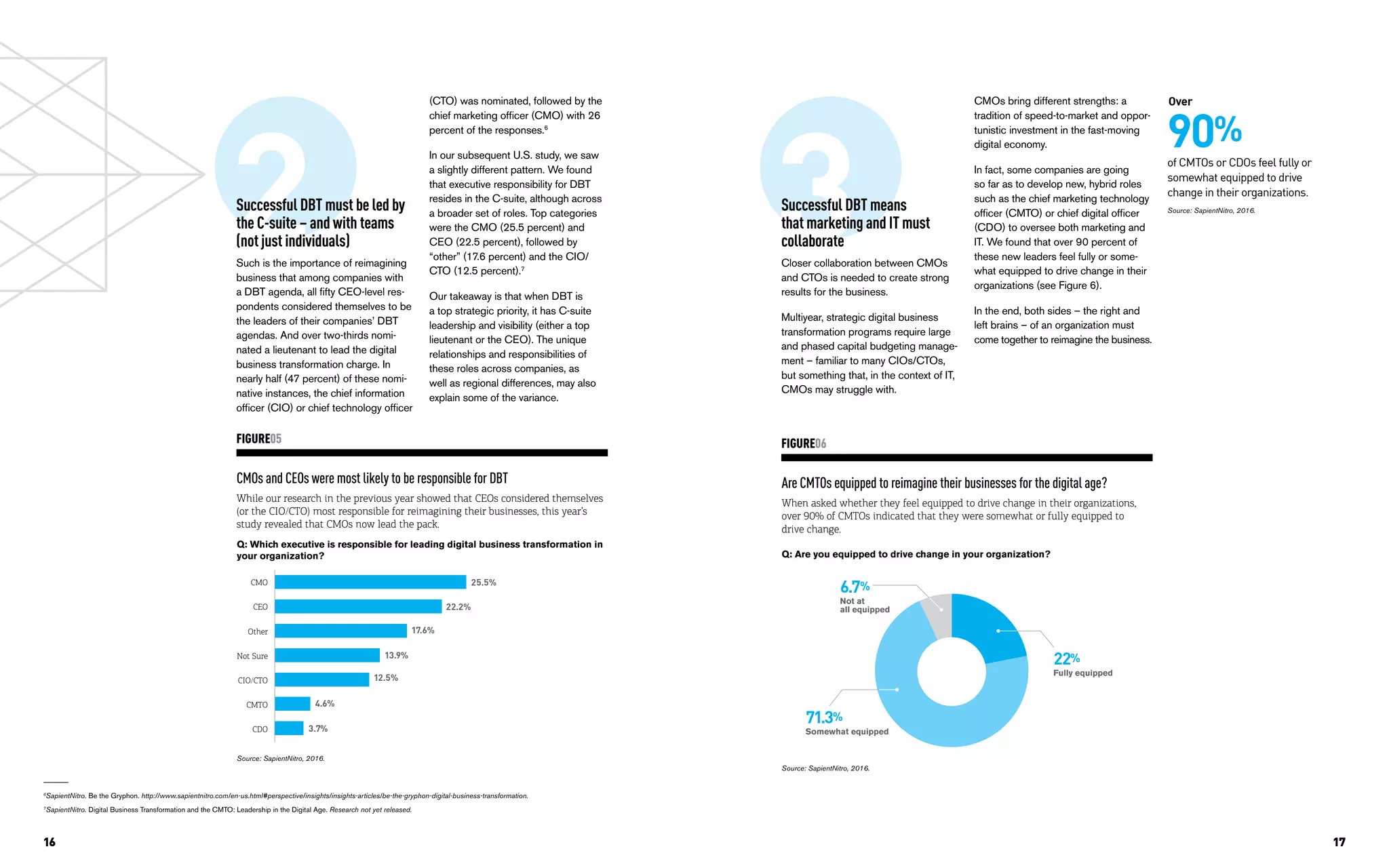
CMOs and CEOs were most likely to be responsible for DBT
While our research in the previous year showed that CEOs considered themselves
(or the CIO/CTO) most responsible for reimagining their businesses, this year’s
study revealed that CMOs now lead the pack.
FIGURE05
3Successful DBT means
that marketing and IT must
collaborate
Closer collaboration between CMOs
and CTOs is needed to create strong
results for the business.
Multiyear, strategic digital business
transformation programs require large
and phased capital budgeting manage-
ment – familiar to many CIOs/CTOs,
but something that, in the context of IT,
CMOs may struggle with.
6
SapientNitro. Be the Gryphon. http://www.sapientnitro.com/en-us.html#perspective/insights/insights-articles/be-the-gryphon-digital-business-transformation.
7
SapientNitro. Digital Business Transformation and the CMTO: Leadership in the Digital Age. Research not yet released.
(CTO) was nominated, followed by the
chief marketing officer (CMO) with 26
percent of the responses.6
In our subsequent U.S. study, we saw
a slightly different pattern. We found
that executive responsibility for DBT
resides in the C-suite, although across
a broader set of roles. Top categories
were the CMO (25.5 percent) and
CEO (22.5 percent), followed by
“other” (17.6 percent) and the CIO/
CTO (12.5 percent).7
Our takeaway is that when DBT is
a top strategic priority, it has C-suite
leadership and visibility (either a top
lieutenant or the CEO). The unique
relationships and responsibilities of
these roles across companies, as
well as regional differences, may also
explain some of the variance.
Are CMTOs equipped to reimagine their businesses for the digital age?
When asked whether they feel equipped to drive change in their organizations,
over 90% of CMTOs indicated that they were somewhat or fully equipped to
drive change.
FIGURE06
CMO
CEO
Other
Not Sure
CIO/CTO
CMTO
CDO
25.5%
22.2%
4.6%
3.7%
17.6%
13.9%
Q: Are you equipped to drive change in your organization?
22%
Fully equipped
6.7%
Not at
all equipped
71.3%
Somewhat equipped
CMOs bring different strengths: a
tradition of speed-to-market and oppor-
tunistic investment in the fast-moving
digital economy.
In fact, some companies are going
so far as to develop new, hybrid roles
such as the chief marketing technology
officer (CMTO) or chief digital officer
(CDO) to oversee both marketing and
IT. We found that over 90 percent of
these new leaders feel fully or some-
what equipped to drive change in their
organizations (see Figure 6).
In the end, both sides – the right and
left brains – of an organization must
come together to reimagine the business.
90%
of CMTOs or CDOs feel fully or
somewhat equipped to drive
change in their organizations.
Q: Which executive is responsible for leading digital business transformation in
your organization?
Over
Source: SapientNitro, 2016.
12.5%
18 19
4Conflicting priorities, along
with a lack of dedicated
resources and organizational
alignment, are some of the key
obstructions to successful DBT
Our research suggests that having con-
flicting priorities remains the top (39
WHAT IS A GRYPHON?
The Gryphon of legend was half
lion, half eagle – a dominant preda-
tor among all creatures. Similarly, a
business Gryphon is also equipped
with hybrid capabilities. It looks
and behaves differently from any-
thing seen before. It causes tradi-
tional predators to struggle to adapt
to the new rules of the ecosystem.
Gryphons are born every day.
They disrupt our understanding
of the world and instinctively break
previously-assumed boundaries to
combine the best technologies, ser-
vices, and experiences (see Figure 8).
Gryphon-like attributes can be seen
in the rapid advances of businesses
such as Uber in transportation,
Airbnb in property rentals, Spotify
in music (notably, streaming has
already disrupted the emergent
download market), and BuzzFeed
in media.
Being a Gryphon organization is not
about age or size, but rather about
state of mind. Apple is an example
of a large organization that conti-
nually reinvents itself by creating
product lines like the Apple Watch
and iPhone that supplant previously
successful lines such as the iPod –
itself a byproduct of Apple’s con-
quest of the music industry.
The characteristics of a Gryphon organization
A Gryphon organization is one that reimagines its business across the board – covering aspects such as
leadership, customer experience, digital integration, internal structure, agility, and talent.
FIGURE08
Obstacles in implementation
Conflicting priorities, along with a lack of dedicated resources and organizational
alignment, are the top obstacles to digital business transformation. One surprise?
Just 10% indicate a lack of clear business case as a key obstruction – in which
case, why aren’t businesses doing it more?
FIGURE07
Q: What are the major obstacles to the successful implementation of your orga-
nization's digital business transformation initiatives?
Conflicting priorities
Lack of dedicated resources
Lack of organizational alignment
Budget concerns/lack of investment
Lack of vision from leadership
Inadequate IT capabilities
Lack of skills
Lack of governance/coordination
Lack of plan
Lack of a clear business case
None
Lack of awareness of market forces
Regulatory/security concerns
Other
38.0%
35.2%
29.6%
26.4%
18.5%
17.1%
14.8%
13.9%
10.6%
10.6%
9.7%
3.7%
8.8%
0.9%
19
COLLABORATIVE STRUCTURE
Organizational culture and/or defined
processes by which key executive
stakeholders and functions unite be-
hind digital business transformation
DIGITAL CORE
Digital as a core competence
not a bolt-on
CUSTOMER-CENTRIC
Business is built around the
belief that consumers and rapid
uptake of technology are the
drivers of change
AGILITY AND SPEED
The ability to pivot and the
notion of speed itself being a
competitive advantage
HYBRID SKILLS
Marketing and technology skills
and roles are increasingly hybrid
VISIONARY LEADERSHIP
A CEO and leadership team that leads
digital business transformation within
the organization and drives ongoing
change and improvements
DISRUPTIVE CULTURE
A willingness to challenge norms
and disrupt itself in order to enter
new markets and categories
ALL-EMBRACING APPROACH
A holistic, company-wide
commitment to reshape and
retool for a digital future
ONGOING COMMITMENT
TO CHANGE
Recognize that change is
iterative and permanent
percent) obstruction to the successful
implementation of an organization’s
digital business transformation. This is
perhaps reflective of the 40 percent of
organizations that haven’t made DBT
a top three priority for their company.
Similarly, the next three obstacles –
a lack of dedicated resources (35
percent), organizational alignment
(30 percent), and investment (26
percent) – suggest a lack of vision
around the comprehensive organiza-
tional change required for successful
business transformation (see Figure 7).
Just10%
indicate a lack of clear business
case as a key obstruction to DBT –
in which case, why aren’t businesses
doing it more?
One surprise?
Source: SapientNitro, 2016.
20 21
Key steps to successful reimagining
LARGE ORGANIZATIONS
URGENTLY NEED TO BEGIN A
BOARD-LEVEL REIMAGINING
DISCUSSION
The data is stark: Just 22 percent of
companies have a formal plan for digital
business transformation. And just 56 per-
cent have made DBT a top three priority.
To create a digital business trans-
formation strategy and intent, large
incumbents (in most industries) need
to move faster to embrace digitally-led
transformation. Defend, differentiate,
or disrupt: Regardless of strategy,
the transformation priority affects
every aspect of businesses, including
business strategy, the business model,
data, internal processes, and culture.
All of these are materially influenced by
the digital priority.
Furthermore, for many companies,
quality board-level discussions around
reimagining the business may not
be possible without a new level of
executive digital savvy and awareness,
even as organizations cultivate these
skills throughout their ranks. People
and talent, as ever, are key pieces of
the puzzle.
RETHINK HOW THE BUSI-
NESS GENERATES VALUE
FOR ITS CUSTOMERS
For many organizations grappling
with its potential, digital business
transformation represents a once in
a decade opportunity to rethink the
core levers involved in generating value
for customers.
Contextualizing your business and its
value – not based on where it has been
in the past, but rather where it should
be in the future – is an urgent priority.
In our experience, a focus on the cus-
tomer journey – and your part in it – is
a good place to start.
Ultimately, though, DBT involves re-
thinking the entire value proposition of
the enterprise. To that end, successful
DBT initiatives should be focused on
the customer journey, should be owned
by the CEO, and must be supported
and implemented by an executive team
or task force. For most organizations,
this means close involvement and colla-
boration between the CTO and CMO.
ENABLE THE RIGHT CULTURE
AND INCENTIVES
To thrive in this fast-changing, technolo-
gy intensive environment, leaders need
to ensure that their organizations rein-
force values that will help them succeed.
To that end, organizations should
endeavor to build and maintain cultures
that prize innovation, constant change,
and evolution. Rather than being
process-oriented, organizations must
select and train for flexibility and agility.
Executives should ensure people’s
incentives and alignment, evaluate
systems and structures, and design a
culture consistent with these traits.
Culture too often is viewed as an out-
come of business transformation. On
the contrary, culture should be an input
in the transformation process – one as
important as organizational changes
or the value-generating aspects of the
business model.
EMBRACE INNOVATION
AND CONSTANT CHANGE
There is no steady state. Forward-
thinking leaders know that constant
reinvention is the key to medium- and
long-term success. There is no “one
and done” in business transformation
today. Consider Netflix’s continued evo-
lution from DVDs to streaming services,
and now content production. They have
used technology as an enabler with
every step.
For most companies, a strategic
reimagining is becoming ever more
urgent given the current pace of
disruption, new entrants, and changing
consumer behaviors.
TECHNOLOGY & MARKETING
ARE DIFFERENTIATORS, NOT
SUPPORT FUNCTIONS
In this new era, both technology and
marketing are playing new roles in
generating value. Technology is no
longer just supporting the business
or enabling operations. Rather, it is a
strategic weapon and differentiator.
Similarly, forward-looking companies
think of marketing not as a broadcast
center or passive lead generation ma-
chine, but rather as an area to generate
insights and define the proposition to
the customer.
1 2 3 4 5
22 23
Conclusion
The world has shifted from allowing
brands to simply state their missions,
visions, and promises, to requiring them
to demonstrate their intentions through
tangible and sustainable actions.
There are several organizations in
particular that have reimagined their
business to remain relevant in the
digital age. Lightstorm Entertainment
is in the process of transforming the
entire world of Avatar into a multiyear,
multichannel digital platform for fan
engagement – a platform that uses
advanced analytics to evolve with each
sequel release. And in financial ser-
vices, RBS embraced digital business
transformation to deliver on its promise
of “Helpful Banking.”10
Now, the need for leaders is to consider
how they go about transforming their
entire organization for a digital world.
By reimagining the business and embra-
cing technology, it’s possible for every
company to become a Gryphon.
Nigel Vaz
Global Chief Strategy Officer & SVP,
Managing Director EMEA,
SapientNitro London
nvaz@sapient.com
Now, the need
for leaders is to
consider how
they go about
transforming
their entire
organization for
a digital world.
By reimagining
the business and
embracing
technology, it’s
possible for every
company to
become a Gryphon.
WHAT S-CURVES TELL US ABOUT REIMAGINING
BUSINESS
Theories of disruptive innovation have
long been used in technology intensive
businesses to understand the dynamics
of competition. But as all businesses
become technology intensive, the
model’s applications and relevance
have broadened.8
In particular, we’ve found the s-curve
model of technology diffusion helpful
to both reinforce the need for constant
reinvention and to spot inbound disrup-
tions from other industries.
Several characteristics of the theory of
disruptive innovation, and its associated
s-curve model, are relevant to the boards
and executives that are reimagining
their businesses:
Success in a non-linear business environment means forcing your
business from the status quo onto new, fast-growing platforms
before they're mainstream.
FIGURE09
The nature of competition is that a
technology or company, not initially
seen as a direct threat, will evolve
over time and possibly outperform
an existing technology. There are
many examples in the history of
business, including the development
of mini-mills in the steel industry;
the growth of Amazon in the retail
industry; Airbnb’s innovation in
the hospitality industry; and the
software disruption brought on by
Apple’s iTunes Store.
With today’s competition being
based on platforms, technology, and
agility, it is evident that we live in
an increasingly non-linear world.
Non-linear functions reward early
adopters and fast-movers, while
punishing large, slow-paced orga-
nizations that can see the ground
beneath them shifting dramatically.
To ride these repeating waves of
innovation, companies must rein-
vent themselves continuously, often
through strategic partnerships or
acquisition strategies. A case-in-
point is Facebook’s aggressive acqui-
sition of WhatsApp and Oculus.
Studying the s-curves in other
industries – particularly ones with
a greater competitive intensity and
more technology – can provide the
opportunity to spot new disruptions
before they hit your market. For
example, the digital shift of both the
music and publishing industries pre-
saged that of telecoms and financial
services, as well as the automotive
industry’s leap toward autonomous
and electric vehicles.
By understanding s-curves and their
associated theories, business leaders can
mitigate some of the risk of operating in
a modern landscape – one where (as we
noted in the introduction) the average
lifespan of the S&P 500 is fourteen
years, and business models need to be
reinvented in half that time.9
8
Clayton M. Christensen. The Innovator’s Dilemma: The Revolutionary Book That Will Change the Way You Do Business. 2011.
9
Innosight. Creative Destruction Whips through Corporate America. http://www.innosight.com/innovation-resources/strategy-innovation/upload/creative-de-
struction-whips-through-corporate-america_final2015.pdf.
Performance
Prepare
Path of a Gryphon
organization
Switch
Harness
Transition
Time
10
See “Case Study: Reimagining Banking at RBS” on page 110.
RESEARCH
Global Retailing in the Digital Age
Jemuel Ripley, Zachary Paradis, Hilding Anderson
& Nathan Chmielewski 
Banks, Brands, and Consumers: A Vision for Mobile,
Payment-Driven Change
David Poole
26
48
RESEARCH 27
The third annual study of retailers’ use of mobile, e-commerce,
and in-store experiences
Current state
The retail industry remains poised on a knife’s edge. Dropping foot traffic, new
online-only competitors, and profound changes in customer preferences have
buffeted the industry for a decade or more.
Yet the same technology disrupting retail may also be its salvation. Click and
collect in-store. Mobile apps. E-commerce. Instagram. Beacons.
In this, our third annual retail study, we’ve tried to take a fairly comprehensive look
at how retailers are responding to this new environment. How effectively are retail-
ers weaving together mobile apps, e-commerce platforms, and in-store innova-
tions? What does the current state of retailing tell us about the future?
GLOBAL RETAILING
IN THE DIGITAL AGEJEMUEL RIPLEY, ZACHARY PARADIS, HILDING ANDERSON
& NATHAN CHMIELEWSKI 
RESEARCH28 29
Retail stores are seeing roughly half of the foot traffic they saw 6 years ago.1
2010
1
SapientNitro estimates based on data reported by the Wall Street Journal, RetailNext.net, and Shoppertrax.com.
2
Mintel. Online Shopping US 2015 Report. http://www.mintel.com/press-centre/nearly-70-of-americans-shop-online-regularly-with-close-to-50-taking-advantage-of-free-shipping.
34.3 billion
visits
Key findings3
Four leaders: This year, we selected
four retailers as our leaders, based on
the strength and quality of their cus-
tomer experience. Apple, Sephora,
Argos, and Home Depot earned
their spots by integrating digital and
rethinking their store environments
more significantly than any others in
our study.
Stores are increasingly focused
on the entire customer journey,
with new innovations in the pre-visit
and post-visit stages. Starbucks’
pre-purchase, Walmart’s Savings
Catcher, and John Lewis’ click and
collect were notable.
Mobile payments continued
to be a hot topic this year, with
widespread use in the UK and slower
adoption in the U.S.4
Just three
retailers in our study enabled sales
associates to check out customers
remotely, however.
Reimagining the store: We’re still
early in the reinvention of the store.
Argos, Sephora, and Apple were
among the notables that have truly
rethought the store.
Future opportunities
This crucible of consumer change and
technology transformation must be met
with a similar transformation amongst
retailers. For most retailers, the easy
steps of pilots, testing, and point
solutions are largely done. What is left
is more fundamental – retailers must
reimagine their business in the age of
the customer (see Figure 1).
These steps include rethinking the role
of the store, IT operations, merchandis-
ing, and even the supply chain. The
fundamentals of competition are changing.
For marketers and retailers, this is no
longer the challenge of digitalizing
retailing. It is the challenge of retailing
in a digital age.
As part of Publicis.Sapient, SapientNitro works with our partners Digitas,
Razorfish, Rosetta, and Sapient Consulting to drive digital-at-the-core thinking.
Together, the P.S platform offers a digital transformation platform purpose-built
for today's digital world, helping companies transform existing business
activities from digital as an extension to digital as the core of the enterprise.
FIGURE01
Experience
Customer-focused > Experience-led
Enterprise IT
Industrial > Multispeed
Products & services
Individual projects > Service ecosystems
Organization
Silos > Collaborative
Marketing
Mass > Precision
Commerce
Point solution > Omnichannel
Data
Backward-looking > Real-time impact
•
•
•
•
3
For full details, see “About our research” at the end of this article.
4
For more on mobile payments, see SapientNitro’s “Banks, Brands, and Consumers: A Vision for Mobile, Payment-Driven Change.” http://www.sapientnitro.com/en-us.html#perspec-
tive/insights/insights-articles/banks-brands-and-consumers-a-vision-for-mobile-payment-driven-change.
15.1 billion
visits
33%
shop online
every week
69%
shop online at
least monthly
Dropping foot traffic
MORE DIGITAL2
2011
24.6 billion
visits
2012
20.6 billion
visits
2013
17.6 billion
visits
2014
16.1 billion
visits
2015
2016
14.2 billion
visits
Source: Publicis.Sapient, 2016.
RESEARCH30 31
Introduction to the research
To assess retailing in the digital age,
we studied retailers with physical
stores to see how the use of mobile,
e-commerce, and in-store technology
has evolved (see Figure 2). Our hypo-
thesis was that retailers were already
adapting to this changing environment.
We wanted to understand how they
were adapting and explore how sub-
segments (luxury, apparel, mass mer-
chandisers, etc.) have developed and
were competing.
We covered four major global cities
during the research: New York, Chicago,
Toronto, and London (see “About the
research” for details).
In reviewing ninety-nine retailers, we,
of course, discovered major variances
in competitive intent, degree of vision,
and quality of execution. There is no
one-size-fits-all here, and not every
innovation is appropriate for every busi-
ness. Each marketer has to evaluate the
fit to their specific business — to learn
from the best and decide what makes
the most sense for their needs.
In fact, our big realization is that
retailing in the digital age doesn’t mean
introducing “digital” (e.g., kiosks or
tablets) to the physical space. Instead,
it means redefining your entire business
around operating in a digital world.
Brands must follow the customer’s
journey across touchpoints — only
some of which will include digital tools
at all. A touchpoint might be defined
by a smile or the feel of a linen shirt.
A mirror image of you dressed in the
new style of the iconic Burberry trench
coat. The smell of a store as you enter.
Operating in a digital world requires
integrating the physical and digital,
hand in hand.
Our big realization
is that retailing
in the digital age
doesn’t mean
introducing
“digital” to the
physical space.
Instead, it means
redefining your
entire business
around operating
in a digital world.OUR
RESEARCH
We evaluated three categories of retail experiences: mobile, e-commerce,
and in-store.
FIGURE02
25%
Mobile app
effectiveness
overall and
in-store
Visibility Content Functionality Brand
20%
E-commerce
effectivness
(BOPIS/ROPIS,
ratings & reviews,
store location
finder, etc.)
55%
Store experience
12.5% 15% 15% 12.5%
Source: SapientNitro, 2016.
RESEARCH32 33
Rules for creating retail experiences
How do you go about defining the best combination of physical and
digital for your brand? Our research uncovered five overarching rules
to keep in mind when designing the future of your retail experience.
1Retailers must become
more flexible, immersive,
and fit for purpose
Digital extensions — a great interactive
kiosk, mobile app, or sales associate
tool — are no longer enough. Retail
brands must reimagine their business
in the age of the customer.
Digital transformation is on the agenda
of retailers and their boardrooms.
According to a 2015 International
Data Corporation (IDC) study, nearly
two-thirds (64 percent) of Western
European retailers are currently under-
taking a formal digital transformation
5
IDC. “64% of Western European Retailers Currently Undergoing Formal Digital Transformation Effort, While Further 21% About to Start by End of the Year, Says IDC.”
https://www.idc.com/getdoc.jsp?containerId=prUK25829515.
program, while a further 21 percent
were expected to have started one by
the end of 2015. They note that a “race
to digitize [is] taking place among the
largest retailers in Europe.”5
Our research shows that more trans-
formation is sorely needed. If there is
one overarching finding from our study
it is this: The examples that we saw in
market do not go far enough toward
rethinking the retail business for the
digital age.
Based on our research, we see the top
reimagining priorities to be centered
around three main questions:
You’ve been matched:
the output of the ColorIQ process
Sephora’s ColorIQ measures skin color, sets up follow-up purchases of
various foundations, and also offers a hands-on experience in the store.
FIGURE03
1HOW CAN YOU IMPROVE
FLEXIBILITY?
Retailing in the digital age should be
more flexible than in the past. This
means omnichannel and visibility; click
and collect; mobile ordering; ship-to-
home; and all the permutations. Our
leaders — Apple, Argos, and Sephora
— have all made significant progress in
this area (see Figure 3). In the UK, spe-
cifically in the cities, click and collect/
reserve has been credited with stalling
the decline in footfall. In fact, at one
leading UK retailer, it accounts for the
majority of orders via online platforms.
2HOW CAN YOU MAKE
THE EXPERIENCE MORE
IMMERSIVE?
On the less frequent occasions that
customers do go to the store, they
need to be greeted by great experiences.
Museum quality if you’re selling tech
hardware. Dynamic changing rooms
and great customer service if you’re in
apparel. Smaller spaces. Better tools.
Faster service.
3HOW CAN YOU MAKE
YOUR RETAILING PROPER-
TIES FIT FOR PURPOSE?
Retailing properties (mobile, e-com-
merce, and physical) should be fit for
purpose. Retailers in the digital age
need inventory, but they don’t need as
much inventory. Endless aisle tools,
smartphones, visibility of inventory, and
sales associates (You do have visibility,
right?) all mean more flexibility. Reduce
square footage, invest in community
events, and make the store and brand
be more connected to humans. Look
to recent trends in bookstores and
banks — fewer, smaller, and more
beautiful examples with higher sales
per square foot.
RESEARCH34 35
2Thinkexperience-ledandmobile
first:Mobile as the gateway to
the brand
If experience is the combination of
interactions (the tools that you use)
and perceptions (how you feel about
the brand), then the leaders in our
study thought more deeply about both.
We observed multiple techniques to
enhance the experiences of guests,
as each retailer made choices for their
discrete target audience.
Mobile as the gateway to the brand
For most retailers, smartphones are
now the gateway to the brand. Mobile
is how they start and sustain customer
relationships.
Forty-four percent of smartphone-
owning U.S. online adults (ages 18+)
have used their phone to research
products online while shopping in a
physical store in the past three months.
The most common, reported activities
include comparing prices (48 percent),
looking up product information (41
percent), and searching for coupons
(37 percent).6
It is how people find their local store,
explore the inventory, reserve the pro-
duct that they want (30 percent of
Sams Club’s e-commerce sales in
2015 involved in-store pickup), and,
increasingly, pay for their products.7
Mobile is now a primary touchpoint
for retailers.
In our study, we commonly noted
barcode scanners (to pull up reviews/
ratings and place orders), store loca-
tors, the ability to shop (m-commerce),
and wish list/save-for-later features
(see Figure 4). Top-scoring retailers are
pushing the boundaries even further
with voice capabilities, image search,
live chat, and mobile in-store maps.
With a buy button on more digital platforms, m-commerce is more widespread
than ever.
FIGURE04
FIGURE05
Mobile is becoming an essential channel in the store, with image search, wayfin-
ding, mobile payments, and voice-based search being offered. As we'll see in later
sections, it is also a key channel pre- and post-visit.
Among grocers, Walmart packs an
industry-leading mobile app with
notable tools including the Savings
Catcher, items’ aisle locations, pharma-
cies, registries, wish lists, weekly ads
and rollbacks, m-commerce with click
and collect, and Apple Watch support
for grocery lists. Waitrose has taken a
contrasting approach to Walmart with
a single-task mobile app. The “Pick
Your Own Offers” mobile app puts
the customer in control of couponing:
Customers choose ten items to link to
their myWaitrose card and automatical-
ly save 20 percent every time they buy
them, both in-store and online.
In North America, features like Macy’s
image search, Home Depot’s voice-
based search, and Apple’s EasyPay
make the phone a more powerful
tool in the store, and reduce the
workload in-store (see Figure 5).
In the UK, we found fewer smartphone
innovations. Waitrose and John Lewis
impressed with their mobile payment
app and “price match claim request,”
respectively, discussed elsewhere.
Waitrose, Marks & Spencer, and Boots
all supported Apple Pay.
6
Forrester. Consumer Technographics North American Retail And Travel Online Benchmark Recontact Survey 1, Q3 2016 (US). https://www.forrester.com/go?objectid=SUS3275.
7
eMarketer. “In-Store Pickups Account for Significant Ecommerce Sales.” http://www.emarketer.com/Article/In-Store-Pickups-Account-Significant-Ecommerce-Sales/1013503.
For most retailers,
smartphones are
now gateways
to the brand.
Mobile is how
they start and
sustain customer
relationships.
Facebook Instagram Pinterest Twitter WeChat
Macy’s image
search
Home Depot’s
voice-based
search
Apple’s
EasyPay
Waitrose’s
mobile payment
app
Buy button
RESEARCH36 37
Mobile payments
Both retailers and mobile providers are
entering the mobile payment space.
We noted a few stores which offer their
own payment technologies — Neiman
Marcus, Apple, and Starbucks, for
example. In the UK, the touch-to-pay
function (NFC) for small purchases
under thirty pounds was nearly ubiqui-
tous in London.
And mobile payments are growing
more widespread. By 2018, IDC pre-
dicts that 60 percent of omnichannel
retailers will have launched customer
mobile payment initiatives.9
According to NFC World, over 10
percent of UK card payments are
contactless, up over 300 percent from
the previous year.10
Grocery in the UK
leads the way, with 30 percent of all
transactions paid through some form
of contactless payment.11
According to
research from Barclaycard, one in three
merchants in the UK accepts contact-
less payments.
Contactless payment options in the
U.S. are just being introduced by the
likes of Apple Pay and Samsung Pay,
but banks and retailers have yet to buy
in – only 23 percent of big box retailers
offer Apple Pay in-store.12
Argos – a UK variety store – replaced their traditional catalogs with tablets and
enabled mobile-based payments for click-and-collect.
FIGURE08
FIGURE06
Neiman Marcus offers a novel in-store
payment mechanism with QR codes
tied to cards on file and their loyalty
program. This allows an easy mobile
checkout process.
Walmart recently introduced “Walmart
Pay,” a new feature on their existing app
that lets shoppers pay in-store using
their smartphones — replacing a tradi-
tional credit card swipe or writing
a check.13
Joining Apple, Samsung,
PayPal, and Google, Walmart is posi-
tioning itself for a stake in the growing
U.S. mobile payment market, which,
according to Forrester Research, is
anticipated to handle $142 billion in
transactions by 2019.14
We also saw some new innovations in
payments. Neiman Marcus’s app offers
a QR code feature, linked to an existing
card or account, which allows you to
use your smartphone to check out (see
Figure 6). And effective use of mobile
payments by Apple and Sephora
helped bolster their scores.
Sales-associate-based mobile check-
out in the U.S. was also noted, but only
at Apple, Sephora, and Neiman Marcus
(see Figure 7).
In the UK, the story is more compelling.
Self-checkout is now common across
all supermarkets in the UK and also in
home improvement stores, large news
agents, and chemists/pharmacies.
Leaders in our study include Tesco,
Argos, John Lewis, and Waitrose (see
Figure 8).
Sephora offers a clienteling app, allowing
sales associates to check out customers
in the aisle.
FIGURE07
60%
By 2018
of omnichannel retailers
will have launched
customer mobile
payment initiatives8
8
IDC. IDC FutureScape: Worldwide Retail 2015 Predictions — It's All About Participation Now. http://www.idc.com/research/viewtoc.jsp?containerId=252327.
9
Ibid.
10
NFC World. “One in Ten UK Card Payments Now Contactless.” http://www.nfcworld.com/2016/01/04/340840/one-in-10-uk-card-payments-are-now-contactless/.
11
Barclays Bank. “Reluctance to Introduce Contactless Payments for Christmas Leaves Merchants Out in the Cold.” https://www.home.barclaycard/news/reluctance-to-introduce-con-
tactless-payments-for-christmas-leaves-merchants-out-in-the-cold.html.
12
NFC World. “One in 10 UK Card Payments Where Contactless in 2015.” http://www.nfcworld.com/2016/05/23/344954/one-10-uk-card-payments-contactless-2015/.
13
Fortune. “Walmart Launches its Own Mobile Payment System.” http://fortune.com/2015/12/10/walmart-mobile-payment/.
14
Forrester. Five Payment Trends North American eBusiness Professionals Should Watch: 2016 To 2018. April 2016. https://www.forrester.com/go?objectid=RES129571.
The Argos mobile app
allows you to pay now
or pay when you pick up
an item.
RESEARCH38 39
3Focusonthefullcustomer
journey
By broadening the aperture of expe-
rience beyond its traditional focus in
retail — the store — leading brands are
creating a new competitive battle-
ground and winning sales before some-
one even arrives at a physical property
(see Figure 11).
According to Forrester, 41 percent of
U.S. online adults (ages 18+) discove-
red a retail product that they recently
purchased through an online source.
And 68 percent of online adults who
did research prior to a recent purchase
used two or more sources of informa-
tion in the process.15
And these customers are more valuable.
According to a study by IDC, omni-
channel shoppers have a 30 percent
higher lifetime value than those who
shop using only one channel.16
The Samsung store had a dedicated
kids’ play area.
FIGURE09
15
Forrester. Consumer Technographics North American Retail And Travel Customer Life Cycle Survey, Q1 2016 (US). https://www.forrester.com/go?objectid=SUS3172.
16
IDC. IDC FutureScape: Worldwide Retail 2015 Predictions — It's All About Participation Now. http://www.idc.com/research/viewtoc.jsp?containerId=252327.
17
Mobile Commerce Daily. “Starbucks’ Mobile Ordering Program Drives 20 percent of Transactions During Peak Hours.” http://www.mobilecommercedaily.com/starbucks-earnings-
call-shows-significant-adoption-rates-for-mobile-order-and-pay.
18
GeekWire. “Starbucks Mobile Order-Ahead Usage Doubles from Last Year, Now Up to 8M Transactions per Month.” http://www.geekwire.com/2016/starbucks-mobile-order-ahead-
usage-doubles-last-year-now-8m-transactions-per-month/.
Experience-led, community-oriented,
and subtly enhanced by digital
In our study, it was clear that the store
has become, in turns, a distribution
hub, customer service zone, training
area, and community spot. Stores are
being reconceptualized. For example,
Waitrose is the click and collect leader
in the UK. Microsoft and Samsung
stores offer training areas and cus-
tomer service (as well as a bar, in
Samsung’s case). Under Armour has
a treadmill and jump zone to let you try
out their shoes and outfits on the move.
H&M even has a virtual runway that
lets you strut in front of cameras and a
green screen, and then lets you post
the finished product online. Increas-
ingly, new experience-led versions of
stores are being built within the context
of the digital age.
Community orientation was also
evident. Samsung, in its store in New
York’s Village, has a “kids section” with
a low table, comfortable seats, and
apps preloaded on their devices (see
Figure 9).
Digital should be a subtle experience
enhancer, rather than “in your face”
screens and kiosks. For example,
Sephora’s use of beacons — one of the
few in our study — is done well. Warby
Parker’s only digital solution — their
photobooth — provides entertainment,
drives mobile activity, and adds to the
try-on and store experience.
In the end, retailers are growing wiser
in their investments into the customer
experience. Gone are the “Me-Ality”
full-body scanners that occupied valu-
able floor space.
Retail should be the center of your cus-
tomers’ passion points (see Figure 10).
Provide the customers more reasons to
increase their dwell time.
Pre-visit
Starbucks was a highlight of capturing
pre-visit sales. Pre-orders (with their
“Mobile Order and Pay” app) account for
10 percent of all U.S. store transactions,
jumping to 20 percent of transactions
during peak hours.17
Twenty-four per-
cent of all transactions are paid using
Starbucks’ mobile app.18
This presents
multiple benefits: reduced wait time for
the customer, higher throughput, and
improved working capital for the store.
It also buttresses their loyalty program.
Starbucks is not alone in this, how-
ever. About one-third of U.S. retailers
covered in the study have click and
collect (BOPIS/ROPIS), while about
three-quarters of the UK retailers that
we reviewed had click and collect (see
Figure 12). Click and collect is prac-
tically ubiquitous in UK, with retailers
investing in operations for next-day
pickup (e.g., at TopShop, order in-store
by 5 PM and pick up from 12 PM the
next day; or at John Lewis, order by
8 PM and collect after 2 PM the
next day).
Waitrose offers self-checkout and click
and to collect in their London stores.
FIGURE12Samsung/Best Buy virtual reality promotion
For example, in our testing, Best Buy's Gear VR demo (left image) was unavailable
in our first three visits to stores. And, when we did ultimately sit down with the
headset, several elements were missing: no secondary screen (for friends to watch
the headset video), a non-swiveling chair, and a lack of separation from the noisy
environment. The Samsung store (right image) had all of these elements, which
resulted in a better experience.
FIGURE10
Foot Locker allows shoe fans to send
emoji versions of the latest sneaker
releases to their friends.
FIGURE11
RESEARCH40 41
As we noted earlier, click and collect
has been credited with forestalling a
decline in footfall in major UK cities.
Click and collect accounts for a majori-
ty of orders placed via online platforms
at one large retail store, as well as
helps drive revenue growth, according
to Matt Bradbeer, UK Retail Executive.
Over the past two years, there have
been signs of similar levels of invest-
ment by U.S. retailers. In 2015, Target
invested $1 billion in strengthening its
e-commerce offerings, which include
everything from grocery delivery, to
ship from store, and click and collect.20
Home Depot claims that over 40 per-
cent of online sales involves physical
stores.21
Walmart’s click and collect
was used the most during the holiday
period in the U.S., followed by Best
Buy, Target, Kmart, and Macy’s.22
Yet, by some measures, North Ameri-
can stores underperformed with their
pre-purchase experiences during the
latest holiday season (2015-2016).
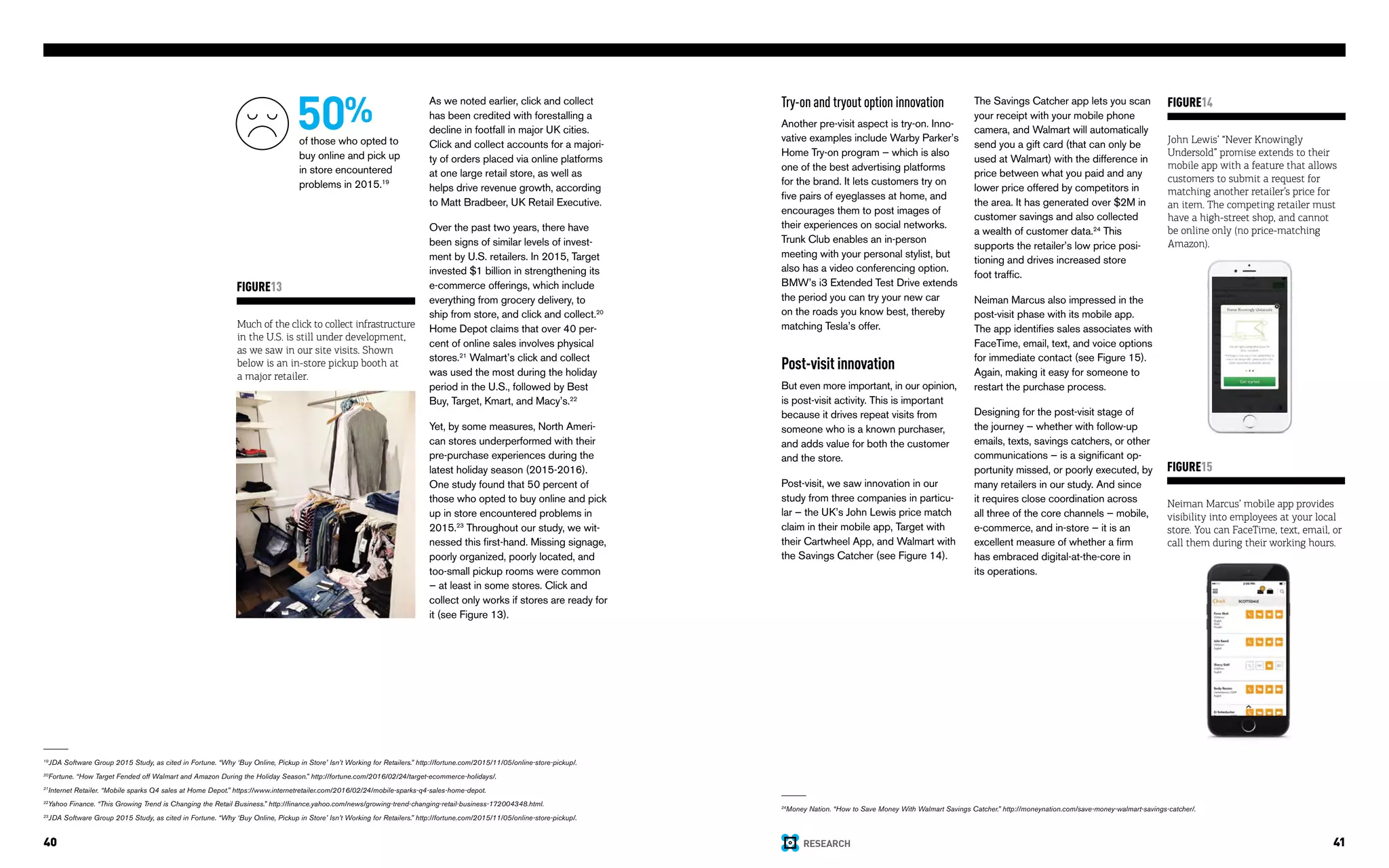
One study found that 50 percent of
those who opted to buy online and pick
up in store encountered problems in
2015.23
Throughout our study, we wit-
nessed this first-hand. Missing signage,
poorly organized, poorly located, and
too-small pickup rooms were common
— at least in some stores. Click and
collect only works if stores are ready for
it (see Figure 13).
Much of the click to collect infrastructure
in the U.S. is still under development,
as we saw in our site visits. Shown
below is an in-store pickup booth at
a major retailer.
FIGURE13
19
JDA Software Group 2015 Study, as cited in Fortune. “Why ‘Buy Online, Pickup in Store’ Isn’t Working for Retailers.” http://fortune.com/2015/11/05/online-store-pickup/.
20
Fortune. “How Target Fended off Walmart and Amazon During the Holiday Season.” http://fortune.com/2016/02/24/target-ecommerce-holidays/.
21
Internet Retailer. “Mobile sparks Q4 sales at Home Depot.” https://www.internetretailer.com/2016/02/24/mobile-sparks-q4-sales-home-depot.
22
Yahoo Finance. “This Growing Trend is Changing the Retail Business.” http://finance.yahoo.com/news/growing-trend-changing-retail-business-172004348.html.
23
JDA Software Group 2015 Study, as cited in Fortune. “Why ‘Buy Online, Pickup in Store’ Isn’t Working for Retailers.” http://fortune.com/2015/11/05/online-store-pickup/.
Try-on and tryout option innovation
Another pre-visit aspect is try-on. Inno-
vative examples include Warby Parker’s
Home Try-on program — which is also
one of the best advertising platforms
for the brand. It lets customers try on
five pairs of eyeglasses at home, and
encourages them to post images of
their experiences on social networks.
Trunk Club enables an in-person
meeting with your personal stylist, but
also has a video conferencing option.
BMW’s i3 Extended Test Drive extends
the period you can try your new car
on the roads you know best, thereby
matching Tesla’s offer.
Post-visit innovation
But even more important, in our opinion,
is post-visit activity. This is important
because it drives repeat visits from
someone who is a known purchaser,
and adds value for both the customer
and the store.
Post-visit, we saw innovation in our
study from three companies in particu-
lar — the UK’s John Lewis price match
claim in their mobile app, Target with
their Cartwheel App, and Walmart with
the Savings Catcher (see Figure 14).
John Lewis’ “Never Knowingly
Undersold” promise extends to their
mobile app with a feature that allows
customers to submit a request for
matching another retailer’s price for
an item. The competing retailer must
have a high-street shop, and cannot
be online only (no price-matching
Amazon).
FIGURE14
Neiman Marcus’ mobile app provides
visibility into employees at your local
store. You can FaceTime, text, email, or
call them during their working hours.
FIGURE15
50%
of those who opted to
buy online and pick up
in store encountered
problems in 2015.19
24
Money Nation. “How to Save Money With Walmart Savings Catcher.” http://moneynation.com/save-money-walmart-savings-catcher/.
The Savings Catcher app lets you scan
your receipt with your mobile phone
camera, and Walmart will automatically
send you a gift card (that can only be
used at Walmart) with the difference in
price between what you paid and any
lower price offered by competitors in
the area. It has generated over $2M in
customer savings and also collected
a wealth of customer data.24
This
supports the retailer’s low price posi-
tioning and drives increased store
foot traffic.
Neiman Marcus also impressed in the
post-visit phase with its mobile app.
The app identifies sales associates with
FaceTime, email, text, and voice options
for immediate contact (see Figure 15).
Again, making it easy for someone to
restart the purchase process.
Designing for the post-visit stage of
the journey — whether with follow-up
emails, texts, savings catchers, or other
communications — is a significant op-
portunity missed, or poorly executed, by
many retailers in our study. And since
it requires close coordination across
all three of the core channels — mobile,
e-commerce, and in-store — it is an
excellent measure of whether a firm
has embraced digital-at-the-core in
its operations.
RESEARCH42 43
4Movefromdataandreportsto
intelligenceaboutperformance
andyourcustomers
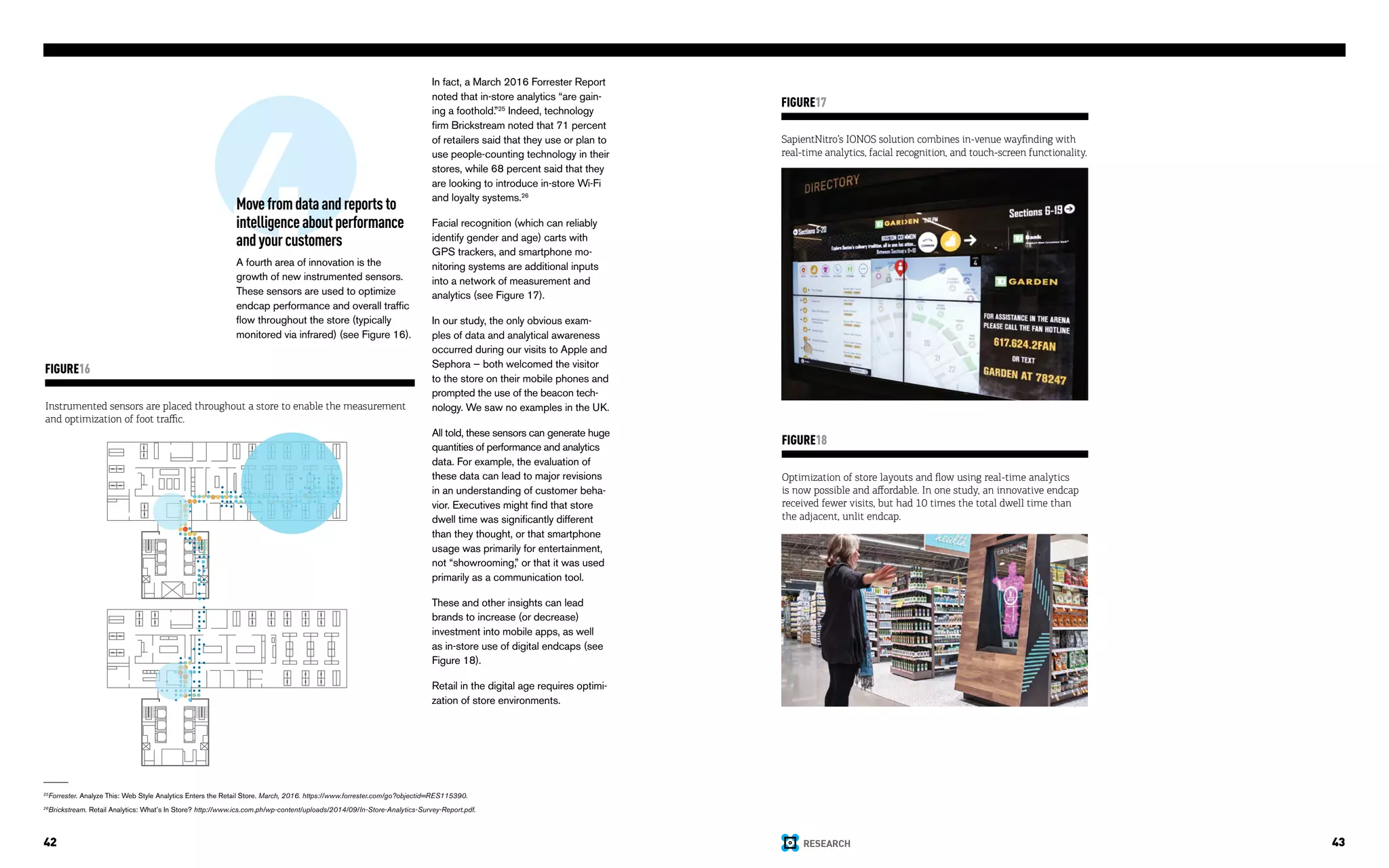
A fourth area of innovation is the
growth of new instrumented sensors.
These sensors are used to optimize
endcap performance and overall traffic
flow throughout the store (typically
monitored via infrared) (see Figure 16).
Instrumented sensors are placed throughout a store to enable the measurement
and optimization of foot traffic.
FIGURE16
In fact, a March 2016 Forrester Report
noted that in-store analytics “are gain-
ing a foothold.”25
Indeed, technology
firm Brickstream noted that 71 percent
of retailers said that they use or plan to
use people-counting technology in their
stores, while 68 percent said that they
are looking to introduce in-store Wi-Fi
and loyalty systems.26
Facial recognition (which can reliably
identify gender and age) carts with
GPS trackers, and smartphone mo-
nitoring systems are additional inputs
into a network of measurement and
analytics (see Figure 17).
In our study, the only obvious exam-
ples of data and analytical awareness
occurred during our visits to Apple and
Sephora — both welcomed the visitor
to the store on their mobile phones and
prompted the use of the beacon tech-
nology. We saw no examples in the UK.
All told, these sensors can generate huge
quantities of performance and analytics
data. For example, the evaluation of
these data can lead to major revisions
in an understanding of customer beha-
vior. Executives might find that store
dwell time was significantly different
than they thought, or that smartphone
usage was primarily for entertainment,
not “showrooming,” or that it was used
primarily as a communication tool.
These and other insights can lead
brands to increase (or decrease)
investment into mobile apps, as well
as in-store use of digital endcaps (see
Figure 18).
Retail in the digital age requires optimi-
zation of store environments.
SapientNitro’s IONOS solution combines in-venue wayfinding with
real-time analytics, facial recognition, and touch-screen functionality.
FIGURE17
Optimization of store layouts and flow using real-time analytics
is now possible and affordable. In one study, an innovative endcap
received fewer visits, but had 10 times the total dwell time than
the adjacent, unlit endcap.
FIGURE18
25
Forrester. Analyze This: Web Style Analytics Enters the Retail Store. March, 2016. https://www.forrester.com/go?objectid=RES115390.
26
Brickstream. Retail Analytics: What’s In Store? http://www.ics.com.ph/wp-content/uploads/2014/09/In-Store-Analytics-Survey-Report.pdf.
RESEARCH44 45
Lowe's experimental robot, shown here
in its test store in Palo Alto, California,
offers wayfinding, voice recognition,
and product information.
FIGURE21
5Keepinmindthatstoresarefar
fromirrelevant
Our study confirmed that the role of
the store is changing. And you can’t
contemplate the changing retail envi-
ronment without noting Amazon and its
recent opening of digitally-enhanced
bookstores.
Innovations in store format
One of the big surprises from brands
in our study was that online pure-play
leaders — Bonobos, Warby Parker, and
Trunk Club — didn’t weave together their
physical and digital experiences. For
example, none offer click and collect
functions or in-store inventory visibility.
In the UK, we saw in-store innovations
from mass merchandiser Argos, which
is in the process of revitalizing its 700+
stores with tablets replacing traditional
print catalogs, LED screens placed
on the walls for dynamic signage, and
dedicated counters for fast click and
collect service. Argos delivers larger
“hub” store stock to nearby smaller
stores, enabling customer access to
the full range of stock in a few hours
or overnight.
A second example in the UK was
Made.com, a small-footprint furniture
showroom, which includes Instagram-
ready markers on the floor, self-service
tablets with scanners for in-store
shopping, and the collection of emails
through the tablet tool (see Figure 19).
In addition, projectors are used for
in-store signage, the store has a startup
feel (with glass walls to peer behind the
scenes at Made.com employees), and
private consulting rooms are available.
The Samsung pop-up shop in the UK’s
Westfield Mall ably showcases future
technology with hands-on demonstra-
tions of mobile, virtual reality (VR),
and wearables. They offer Gear VR
roller coaster, ski jump, and surfing
sections. A premium experience with
white-gloved employees allows try-on
of wearables and experimentation with
mobile devices (see Figure 20).
Bonobos’ mobile experience, on the
other hand, is a responsive website,
not an app, preventing any in-store
functions. In addition, the Bonobos
store checkout was handled through
their consumer e-commerce site on
a standard Apple laptop placed on
a table.
Is this due to a belief that those experi-
ences aren’t relevant? Or reflective
of the difficulty in getting them right?
Or maybe they’re more in tune with
the needs of the Millennial shopper.
(If this is the case, it suggests a bleak
world indeed for stores with large
physical locations.)
On balance, we believe the cause to
be that retailers have only just started
to develop their in-store channels. The
value of the store experience — tactile
engagement, a full 360-degree expe-
rience, and of course a sales force —
makes it a difficult channel to replace
or shut off. In fact, retailers in our study
are seeing more uses in more ways
than ever before: human interaction,
tactile engagement, entertainment, and
fulfillment flexibility (see Figure 21).
Stores remain just a part of the total
retail experience. Great companies are
broadening the aperture of experience.
Made.com, a furniture showroom,
uses digital projectors and store tablets
to merchandise and sell products. In
Palo Alto, California, digital tools offer
wayfinding, voice recognition, and
product information.
FIGURE19
Samsung's pop-up experience at the
Westfield Mall includes multiple VR
demonstrations and a white-glove,
high-quality experience.
FIGURE20
46
Conclusion
Retailers are on the verge. Too few
retailers successfully blend the three
main channels — mobile, e-commerce,
and stores — together in a way that is
optimized for customer experience.
Instead, like many legacy organizations,
retailers have focused on point solutions
and worked within channel silos.
The time for this type of thinking has
passed. Retailers must now consider
a wholesale reimagining of their busi-
ness. To succeed over the next decade,
retailers must fundamentally transform
themselves, touching every area from
organizational structure to the products
and services that they offer.
Our research reveals five main points:
The need for a vision of a future retailer;
the importance of mobile; the opportu-
nities in the pre- and post-visit phases
of the purchase cycle; the importance
of analytics and optimization; and,
finally, the continued, central role of
the physical store.
Jemuel Ripley
Vice President, Global Retail Lead,
SapientNitro New York
jripley@sapient.com
Zachary Jean Paradis
Vice President, Retail Strategy,
SapientNitro Chicago
zparadis@sapient.com
Hilding Anderson
Director, Research & Insights,
SapientNitro Washington, D.C.
handerson@sapient.com
Nathan Chmielewski 
Senior Associate, Research and Insights,
SapientNitro Chicago
nchmielewski@sapient.com
The brands that succeed in this environ-
ment will be the ones that transition and
evolve quickly enough to get ahead of
the changes in their core business.
About the research
The intent of this survey was to evaluate the full retail experience created by
major U.S., Canadian, and UK retailers. To what extent were they offering an
effective and intertwined customer platform for business in the digital age?
To that end, we conducted unannounced visits to online, mobile, and in-store
properties of ninety-nine U.S., UK, and Canadian retailers. We audited English-
language mobile apps and websites, stores in at least one location, and primarily
flagship stores in London, New York City, Chicago, and Toronto. The research was
conducted over a full year, starting in the second half of 2015 and concluding in
the first half of 2016.
We evaluated three main areas: mobile app effectiveness overall and in-store
(25 percent of the weighting), the store experience (55 percent), and e-commerce
effectiveness (including click and collect, and ratings and reviews) (20 percent) to
determine our top performing brands overall.
We also compared our results to our previous evaluations conducted in 2012 and 2013.
RESEARCH 49
DAVID POOLE
With contributions from Greg Boullin
BANKS, BRANDS,
ANDCONSUMERS:
AVISIONFORMOBILE,
PAYMENT-DRIVEN
CHANGE
Retail banks, financial technology startups, and merchants have all been caught in
a whirlwind of new technology and shifting consumer preferences. Bitcoin. Alipay.
Apple Watch. NFC. Google Wallet. Payment options are changing. And the trends
driving the change in payments are powerful:
Substantial funding: $3 billion+ in venture capital (VC) funding drives a
massive proliferation of startups1
Shifting technologies and their applications: mobile, cloud, artificial
intelligence (AI), software as a service
Evolving consumer behavior: empowered, smartphone-equipped, with
anytime and anywhere expectations
For banking executives, these changes represent a profound transformation, and,
we believe, a profound opportunity.
•
•
•
1
$3.8B in 2015. CB Insights. “Financing to Payments Startups on Track for a Second-Straight Record Year.”
https://www.cbinsights.com/blog/payments-tech-funding-statistics-and-growth/.
RESEARCH50 51
The evolving consumer is perhaps the
biggest single driver for change. This
new, global consumer — connected,
smartwatch-wielding, and always on
— is having a profound impact on the
banking ecosystem. To better under-
stand this new behavior, we surveyed
approximately 500 U.S. smartphone-
using consumers to understand how
frequency, convenience, and security
are playing a role in reshaping the
mobile payment market.
Our research reveals extensive usage
of mobile payments. The survey found
that mobile payment usage continues
to grow year after year, with more than
half of respondents (56 percent) now
using mobile payments. More signifi-
cant, consumers are using mobile
payments more than ever before.
Eighty percent of mobile payment users
engage this technology in-store at least
a few times a month, up from just 36
percent a year earlier.3
This is a global phenomenon. Asia
Pacific is set to lead mobile payment
growth.4
For example, China’s mobile
payment users increased from 216
million to 276 million in the first half of
2015.5
This represents about half of
mobile Internet users in that country.
And according to China Central Bank,
the total value of mobile payments
stood at $4.2 trillion in the second
quarter of 2015 – up 445 percent
(2014 to 2015).6
Chinese mobile payment
users in 20182
of consumers use mobile
payments at least a few
times a month
36% 80%
2015 2016
704million
2
CNBC. “Tencent’s Charges for WeChat Pay Users Kick in Amid Fight for Mobile Payment Market Share.” http://www.cnbc.com/2016/03/01/tencents-charges-for-wechat-pay-users-
kick-in-amid-fight-for-mobile-payment-marketshare.html.
3
SapientNitro. Informing The Mobile Banking Experience with Behavioral Data. February, 2016. http://www.sapientnitro.com/en-us.html#perspective/insights/insights-articles/inform-
ing-the-mobile-banking-experience-with-behavioral-data.
4
yStats.com. “Mobile Payments Continue to Grow Worldwide.” https://www.ystats.com/mobile-payments-continue-to-grow-worldwide/.
5
yStats.com. “Security Remains the Main Concern of Global Mobile Payment Users.” https://www.ystats.com/ystats-com-security-remains-the-main-concern-of-global-mobile-payment-
users/.
6
China Internet Watch. “China Mobile Payment Reached $4.19 Trillion, up by 445% in Q2 2015.” http://www.chinainternetwatch.com/14808/mobile-payment-q2-2015/.
7
yStats.com. “Infographic: Global Mobile Payment Methods: First Half of 2015.” https://www.ystats.com/infographic-global-mobile-payment-methods-first-half-2015/.
In Europe, Italy (with 27 percent) leads
in mobile payment users, while Spain
and France are tied for second (with 17
percent). Germany and the UK stand in
third place at 15 percent.7
According to our research, banks
– with higher consumer trust (43
percent) than any other player in the
ecosystem – hold strong potential
for growth and leadership. Despite
the proliferation of payment startups,
most transactions still run through the
traditional bank networks of Automated
Clearing House, wire, and cards –
thereby directly compensating banks in
the process.
To avoid being sidestepped by novel
players (e.g., technology startups)
entering this lucrative space, banks will
need to take several steps. They must:
Partner more closely with retailers
and technology companies who offer
direct payments.
Develop unified payments, integrated
reward and loyalty programs, per-
sonalized offers, and even GPS and
in-venue navigation, all in a single
and compelling payment experience.
Place the customer in the center
when designing user experiences
and be more agile in order to
better engage new generations
of payment customers.
•
•
•
8
The study data was collected in February 2016 and February 2015. See “About the survey” on page 61.
9
Among respondents who say that they’ve used mobile payments. The survey had 498 respondents, of which 56% (276) reported using mobile payments. Only those who have
used mobile payments could answer the question around how often they used their smartphones for in-store payments. N = 276.
1
Section 1
Today’s consumers use mobile
payments more frequently
As was noted in the introduction,
mobile payment usage has increased
significantly. Among the 56 percent
who now use mobile payments, in-store
adoption jumped from 36 percent to
80 percent from 2015 to 2016 – a
growth that is most likely linked to
increasing feasibility, access, and
comfort (see Figure 1).
More important, the percentage of
people who rarely use mobile payments
in physical stores decreased drastically.
The figure, which stood at 49 percent
only a year before, dropped to just 6
percent in 2016.
RESEARCH FINDINGS:
HOW CONSUMERS ARE
USING MOBILE PAYMENTS
In early 2016, we surveyed nearly 500 smartphone users in the U.S. to under-
stand the evolving usage of mobile payments.8
We also looked at secondary
data from markets in Europe and Asia Pacific to see how similar findings
varied in other regions.
Among respondents who say that they’ve used mobile payments, we saw a large
increase in usage – from 36 percent to 80 percent (for those who use it “a few
times a month” or more). The percentage of respondents who “rarely” use mobile
payments, on the other hand, dropped to just 6 percent.
FIGURE01
Q: How often would you say that you currently use your mobile phone to pay for
things in physical stores?9
50%
45%
40%
35%
30%
25%
20%
15%
10%
5%
0%
Very
frequently
(daily)
Frequently
(2-3 times
a week)
Occasionally
(a few times
a month)
Seldom
(every few
months)
Rarely
(a few times
a year)
5%
27%
39%
14%
6%
2015
13% 12%
19%
15%
49%
2016
Source: SapientNitro, 2016.
RESEARCH52 53
10
The New York Times. “Why Apple Pay and Other Mobile Wallets Beat Chip Cards.” http://www.nytimes.com/2016/05/05/technology/personaltech/in-the-race-to-pay-mobile-wallets-
win.html.
11
ING International Survey. The Rise of Mobile Banking and the Changing Face of Payments in the Digital Age. April 2015. http://www.slideshare.net/ING/ing-mobile-banking-2015-
report.
12
Tencent Penguin Intelligence, as quoted in eMarketer. “Convenience, Promotions Drive Mobile Payments in China.” http://www.emarketer.com/Article/Convenience-Promotions-Drive-
Mobile-Payments-China/1013081.
2Convenience is the key usage driver
According to our survey, convenience
is the number one reason why respon-
dents use mobile payments (see Figure
2). As a new alternative, developers
and merchants must increase the
accessibility and acceptance of mobile
payments if they want to capture those
consumers looking to make the switch
from their traditional cash and credit
methods. This may be more evident in
Convenience was the number one reason to use mobile payments, garnering a
mention from 77% of respondents.
FIGURE02
Q: What motivates you to use mobile payments instead of other forms of pay-
ments, like cash or credit cards?
Convenience
Rewards, discounts,
or promotions
Security
Other (specify)
77%
31%
2%
3Security is the leading barrier
to adoption
While some of our survey respondents
understand that mobile payments have
arguably better security, other consumers
do not. Security is often cited as a
major barrier to mobile payment adop-
tion, and it was the most frequently
cited barrier in our study, followed by
acceptance/availability (see Figure 3).
Global preferences are generally
aligned to what we found in our study,
with Ipsos’ Chinese surveys finding that
more than two-thirds of smartphone us-
ers, including both those who were and
were not using mobile payments, had
security concerns.13
Similarly, TSYS’s
survey of Germany’s smartphone-owning
consumers indicated that security and
fraud protection would attract them to
using mobile payments.14
Mobile payment users prioritize security, with 53% of respondents citing the
importance of this factor.
FIGURE03
Q: Finish this sentence: I will use mobile payments more if...
It is secure
More retailers accept mobile payments
I receive exclusive offers and discounts
All of my payment cards, loyalty cards, and coupons are in one app
My purchase details are kept private
It is easy to use
None of these
It has social features, like being able to share my purchases
53%
43%
40%
36%
34%
31%
8%
3%
13
Ipsos. Ideas: Ipsos in China. Sep, 2014. http://www.ipsos.com.cn/sites/default/files/09.2014EN_1.pdf.
14
TSYS. 2015 German Consumer Mobile Payment Study. http://tsys.com/Assets/TSYS/downloads/rs_2015-german-consumer-mobile-payments(English).pdf.
the U.S. where the – albeit perceived –
slower transaction time of chip cards is
highlighting the convenience of mobile
payment alternatives.10
A secondary
motivation (after convenience) was
rewards, discounts, or promotions.
The U.S. findings are largely mirrored
globally. For example, in Europe, ING
International reported that 50 percent
of consumers use mobile payment
apps because “it’s quicker,” while 42
percent cite ease-of-use as another
driver.11
Similarly, in China, 54 percent
of users who tried mobile payments
did so because of convenience, while
49 percent also cited promotions as
another major reason for use.12
At MasterCard, we are looking at
innovative ways to balance security with
consumer engagement. Selfie Pay does just
that, allowing the consumer to securely
identify themselves for mobile payments.
– Karen Pascoe,
Group Head for Experience Design, Digital
Payments & Labs at MasterCard Worldwide
Source: SapientNitro, 2016.
45%
RESEARCH54 55
4Consumers trust banks more
than retailers
Our survey found trust to be the major
impediment to retailers and technology
companies becoming go-to sources
for mobile payments. Only 1 percent of
15
ING International Survey. The Rise of Mobile Banking and the Changing Face of Payments in the Digital Age. April, 2015. http://www.slideshare.net/ING/ing-mobile-banking-2015-
report.
For retailers and technology companies, trust has proven to be one of the leading barriers to consumers’ acceptance and
usage of their bespoke mobile payment options.
FIGURE04
Q: Who do you trust the most to provide mobile payment services?
43%
14%
11% 10%
6% 5% 4% 3%
2%
1% 1%
16
Vibes. 2016 Mobile Consumer Report. http://www.vibes.com/resources/2016-mobile-consumer-report/.
Section 2
A LOOK AT MOBILE PAYMENTS
IN THE RETAIL EXPERIENCE
Consumers are using mobile payments
more than ever before, but it is helpful
to explore a few examples from retailers
to understand the future (see Figure 5).
The typical retail payment app leaves
much room for improvement. However,
selected retailers have overcome trust
and complexity challenges to deliver
great payment experiences. These
retailers are increasingly offering
rewards integration, valuable in-store
tools (e.g., product reviews and auto-
matic payment method selection), and
post-visit features.
Rewards represent one of the top
drivers for using retail apps – and one
of the top motivators for using mobile
payments (consider revisiting Figure 2).
Therefore, the integration of rewards
programs and mobile payments is
critical. Wallets themselves represent
a powerful marketing platform, with the
“add to wallet” features of mobile ads
making it easy to store personalized
offers — a notion further supported by
the nine-in-ten mobile wallet users who
are likely to save them.16
Future retail payment experiences will
automatically recognize when consum-
ers enter the store, allowing them to
browse peer reviews, shop, wayfind,
connect socially, manage coupons and
rewards, and — of course — pay for
goods and services through bespoke
mobile apps. The device itself will de-
termine the right payment method and
currency, ensure the highest security,
Waitrose supports Apple Pay and also offers rewards/promotions on ten products
of your choosing as part of their “Waitrose: Pick Your Own Offers” app (pictured
on the left). The Starbucks app (pictured on the right) offers mobile ordering and
payments, integrated with rewards. In fact, it is the #1 retailer app for mobile
payments and accounts for 25% of the company’s transactions.
FIGURE05
and stay on top of what each consumer
can afford. Furthermore, consumers
will be rewarded in line with their
preferences and in real time every time
they engage in a transaction — not to
mention having automatically-organized
records of each payment.
Mobile apps play a strong role in the
post-visit consumer experience, as well.
For example, we’re seeing retailers
such as Walmart and Target sustain
significant digital engagement activity
with their Savings Catcher and Cart-
wheel apps, respectively.
respondents cited retailers as the most
trusted, while banks led the pack with
43 percent, followed by alternate pay-
ment service providers (such as PayPal
and Square) (see Figure 4).
This holds true in Europe also. Among
Europeans who have not used a mobile
payments app, 42 percent say the
reason is lack of trust. And banks are
trusted the most by Europeans to offer
mobile payment solutions. In fact, 84
percent of Europeans would trust their
banks the most to offer mobile payments.15
My bank or other
established financial
institutions
Alternate payment
service providers,
like PayPal, Square, etc.
Credit card
providers
It doesn’t matter
who provides the
service as long as I
get what I want
Amazon
No one
Google
Device manufacturers,
like Apple, Samsung,
or Motorola
A mobile phone carrier,
like Verizon, AT&T,
or Sprint
A retailer, like Walmart,
Target, or Starbucks
Other
Source: SapientNitro, 2016.
RESEARCH56 57
1
Section 3
FOUR WAYS THAT BRANDS
CAN PREPARE FOR THE
PAYMENT (R)EVOLUTION
No single brand has solved for every
aspect of the payment experience.
But, as technology and business model
innovation change, bank executives
must develop solutions that prioritize
more real-time, convenient, contextual,
and intelligent functionalities.
The following is a Fantasy Payment Team made up of the best-in-class payment solutions from each category.
FIGURE06
FANTASY PAYMENT TEAM
Social
Venmo
Point of Sale
Square
Wallet
Wallaby
Brand
PayPal
Open API
Visa
Developer
Bank
Danske Bank
Merchant
Starbucks
Empire
Alipay
Compatible
SamsungPay
Messaging
WeChat
E-commerce
Stripe
Inclusive
M-Pesa
Selfie Pay
MasterCard
Transparency
Bitcoin
Anticipate needs and provide
contextual experiences
YESTERDAY
Reactive and generic financial advice
was provided to customers based on
preconfigured spending thresholds
(e.g., a low balance alert).
TODAY
Personalized financial guidance and
product offerings focus on disinter-
mediating core financial activities by
being better, faster, and cheaper than
traditional banks (e.g., investments
focused on robo-advisors, tax and fee
harvesting, and peer-to-peer lending).
TOMORROW
Financial experiences will leverage
artificial intelligence to learn customer
needs, adapt over time, and provide
proactive personalized shortcuts
that help maximize customers’ lives
in real time.
Banks can learn from leaders in each
category, and integrate those features
that matter the most to their customers
in a way that’s true to their brands (see
Figure 6).
Here we highlight four key trends from
across the board.
In early 2014, Amazon patented “an-
ticipatory shipping” — shipping goods
to a warehouse before consumers buy
them.17
Google continues to invest in
its predictive “Now” technology. While
using data and algorithms to better
serve customers is nothing new, the
field of predictive analytics represents
a potential holy grail for the businesses
and brands that crack the code on pre-
dicting what customers actually want
before they know it themselves. Proac-
tively serving up payment experiences
that help steward customers to make
smarter decisions in real time would
represent a valuable concierge service.
Indeed, triggering contextual experi-
ences based on where and who people
are, and what and how they are doing,
will elevate the value that payment
solutions can provide. For example,
contextual mobile intelligence can be
leveraged to automatically send restau-
rant recommendations and promotional
offers to customers visiting new cities.
The largest opportunity is for brands to
target a behavior we call “down-timing,”
when customers transition between
experiences, whether “captive” on a
bus or simply unwinding at the airport.
This could involve serving up welcome
reminders to complete financial tasks
and make the most of “dead” travel time,
triggered as a location-based service.
17
Forbes. “Why Amazon’s Anticipatory Shipping is Pure Genius.” http://www.forbes.com/sites/onmarket-
ing/2014/01/28/why-amazons-anticipatory-shipping-is-pure-genius/#6d5bf9c42fac.
RESEARCH58 59
2 3Move faster and be nimbler
with payment investments
YESTERDAY
A multistep, payment process that was
hard to complete on mobile.
TODAY
A mobile-first, app-based approach that
is more social.
TOMORROW
An invisible user interface that will
be facilitated by voice payments or
seamless integration with third-party
apps or sites to enable contextual
payments (e.g., Pinterest's “buy now”
button or Facebook's “buy” feature on
the News Feed.)
22
Forbes. “Kik Battles Facebook with Bots in the New Messaging Wars.” http://www.forbes.com/sites/parmyolson/2016/02/10/kik-bots-messaging-facebook-
wechat/#52923d8c2571.
23
Andreessen Horowitz. “When One App Rules Them All: The Case of WeChat and Mobile in China.” http://a16z.com/2015/08/06/wechat-china-mobile-first/.
Join the conversation
YESTERDAY
Physical banking and trusting an
advisor (more than a secure AI bot)
to make payments on your behalf.
TODAY
The emergence of cashless payments,
with Apple and Android Pay identifying
the best card for each transaction
(like the Wallaby app does based on
rewards, fees, interest rates, and other
financial data), and integrating coupons
and loyalty programs into a unified
wallet (as Walmart has done).
TOMORROW
Messaging platforms (like Facebook
Messenger) delivered through voice
interfaces (like Amazon Alexa and Viv)
that consumers trust enough to make
payment transactions on their behalf.
Voice payments could combine two
steps, serving as both the interface and
the method of authentication with the
security of voice biometrics.
What if, instead of investing all that time
and energy in persuading customers
to download your app, you could have
an instantaneous, seamless, and per-
sonalized way to engage them in con-
versation? With over 2.1 billion active
users on messaging apps like Facebook
Messenger, Line, and WeChat, the
promise of a conversational user inter-
face is already here.22
Indeed, Facebook has just launched
“M” – its bold answer to Siri and
Cortana – that augments its AI algorithm
with actual people to provide your very
own conversational personal assistant.23
WeChat, on the other hand, is the
pioneer of messaging payments with at
least one-in-five active users already set
up for WeChat payments. In fact, it’s
growing so quickly that WeChat is now
experimenting with offline payments, bill
payments, the splitting of bills, shopping,
wealth management, and Bitcoin trans-
fers — all through the messaging app.
As messaging platforms threaten to
become the new “operating system”
— the one app to rule them all — other
payment providers need to quickly
decide how they will partner, compete,
or integrate these new (and inevitably
dominant) payment distribution channels.
THE HALO OF APPLE PAY
18
European Commission. “Payment Services Directive: Frequently Asked Questions.” http://europa.eu/rapid/press-release_MEMO-15-5793_en.htm?locale=en.
19
Over 1,100 banks have partnered with Apple Pay in the U.S. as of March 2016. Apple. “Apple Pay Participating Banks and Store Cards.” https://support.apple.com/en-us/
HT204916.
20
L2 INC. Retail Innovations: Mobile Payments. January, 2016. https://www.l2inc.com/research/retail-innovations-mobile-payments.
21
Apple. “Apple Pay.” https://developer.apple.com/apple-pay/.
Fueled by venture capital investment,
payment apps today are better, faster,
and cheaper than generic white label
payment solutions.
For example, banks must make
payments easier with fewer steps and
less attention required. Potential tactics
include biometric authentication (e.g.,
fingerprint, voice, or facial), conver-
sational interfaces like chat bots and
natural language recognition, and
predicting needs through machine
learning and saved preferences to
automate decisions and make
better recommendations.
Lastly, we expect more payments
innovation spurred by recent regulatory
changes in Europe like the Payments
Services Directive (PSD2) and the
global banking trend toward open
payment application programming
interfaces (APIs). Both make it easier
for banks to collaborate with nimble
fintechs and merchants.18
58
Banks in the U.S. jumped on board with
Apple Pay.19
User experiences on the
iPhone, the Apple Watch, and in-app are
elegant and easy. Banks partnering with
Apple benefited from the halo effect of
being associated with a beloved lifestyle
brand, and one that conveyed innovation.
The challenge with Apple’s closed sys-
tem, however, is the lack of merchant
acceptance, with just 23% of big box
merchants accepting payments as of
January, 2016.20
While the list of mer-
chants and apps is growing, consumers
cannot practically rely on the iPhone
for all payments. Banks in China may
see even more challenges with Apple
Pay, given how much further along their
market is in mobile payments.
With Apple Pay available in the Safari
browser across devices in September
2016, Apple will compete directly with
PayPal when the consumer checks
out online, with the added security of
authentication using the nearby iPhone
Touch ID. Apple’s closed system makes
it at best one more option, rather than
a PayPal replacement working across
browsers. In contrast, Apple’s effort
to open up Messages to external deve-
lopers like Square promises to make
payments within the Apple ecosystem
increasingly viable.21
The other leading consideration for
consumers is the store rewards card —
with Walgreens being the first to fully
integrate Apple Pay — so that when
they pay, consumers have the peace
of mind that they are rewarded.
RESEARCH60 61
About the survey
SapientNitro conducted the 2016 Mobile Payment Study to better understand the
mobile payment behaviors of U.S. smartphone users. We conducted a survey of
our U.S.-based panel on February 2016, and received 493 responses.
The panel consists of over 800 U.S.-based smartphone users, and is directionally
accurate for modeling the U.S.-based, smartphone-empowered population. It is a
non-random sample that skews slightly younger, higher-income, and more female
than the population as a whole. Full details of gender, ethnicity, education, age,
and income are available upon request.
The Wallaby app identifies the best card
for each transaction – for example, the
card that offers 2% back at restaurants.
FIGURE08
In its advertisements, PayPal uses
humor to highlight the flexibility of
its digital payment tools. Peer-to-peer
payments and easy bill-sharing are
emphasized.
FIGURE07
4 respondents want payments
integrated into their banking apps
2-in-5
Nearly
David Poole
Financial Services Center of Excellence,
SapientNitro Boston
dpoole@sapient.com
A special thanks to Greg Boullin for his
contribution to this article.
CLICK FOR MONEY YOU
CAN SHARE WITHOUT
DESTROYING IT
CLICK FOR MONEY YOU
CAN SHARE WITHOUT
DESTROYING IT
With such rising competition from inno-
vative startups, payment providers also
need to ask themselves how they can
provide value beyond the transaction
and in the context of the end-to-end
customer journey.
Peer-to-peer (P2P) payments are a
significant opportunity area. Banks can
help customers spend more time on
relationships, rather than transactions,
by offering the automated splitting of
bills in P2P payments (see Figure 7).
Another form of added value is that
delivered by Bank of America, which
recently announced the launch of
its cardless-enabled ATMs at 2,400
locations across the U.S. In coopera-
tion with partners such as Google,
these ATMs utilize near field commu-
nication (NFC) to streamline the cash
withdrawal process by allowing Android
Pay users (and other mobile wallet
customers) to access their accounts by
simply tapping their smartphones.25
Rewards are another opportunity area.
By aligning themselves with the likes of
Apple Pay, Android Pay, or Samsung
Pay (whose Gift Card program is now
supported by hundreds of merchants
and retailers), banks can integrate
themselves seamlessly into the vast
network of consumer gift cards, mem-
berships, and loyalty features.26
Banks can even use technology like
artificial intelligence. A simple example
is a digital wallet, like Wallaby, that
automatically selects which credit card
maximizes rewards at the point of sale,
avoiding the need to remember which
category accrues the most points (see
Figure 8).
More than money
YESTERDAY
A focus on commoditized payment
services, with loyalty partnerships in
select areas.
TODAY
Intelligence-driven recommendations
provided by third parties.
TOMORROW
Dynamic pricing functions and other
value-added services for the empow-
ered customer.
Have you ever browsed for a flight only
to later return and see that the price
has increased? Many retailers employ
dynamic pricing tactics to either charge
certain consumers more than others
or to respond to fluctuations in supply
and demand (i.e., returning to view the
same product/service a second time).
To fight back against this hidden price
discrimination, a new startup, Paribus,
has launched with the mission to get
consumers' money back when prices
drop post-purchase. The service con-
nects to the email address that you use
for shopping online and, as it scans
your receipts, it monitors prices. If the
price of your purchase drops, Paribus
negotiates for a refund, while keeping a
cut of about 25 percent.24
24
Paribus. “Frequently Asked Questions.” https://paribus.co/faq.
25
Bank of America. “Bank of America Cardless ATM Technology Featured at Google IO Conference.” http://newsroom.bankofamerica.com/press-releases/consumer-banking/
bank-america-cardless-atm-technology-featured-google-io-conference.
26
Samsung. “Samsung Pay Accelerates Growth with Three New Markets in Three Weeks.” https://www.samsungmobilepress.com/press/Samsung-Pay-Accelerates-Growth-with-
Three-New-Markets-in-Three-Weeks?2016-06-21.
Conclusion
To summarize, our research found that
the frequency of using mobile pay-
ments in-store has increased signifi-
cantly. Eighty percent of consumers
make mobile payments at least a few
times a month, compared to just 36
percent last year. Yet it is still an emerg-
ing behavior. U.S. mobile payments
remain a growing niche; even the pro-
jected $210 billion in mobile payments
by 2019 is only 1 percent of the $16
trillion total consumer spend.27
Globally,
the trends are similar.
Amid evolving consumer behavior, and
the shifting technology landscape,
banks have one unique advantage:
trust. In our study, U.S. consumers
voted for banks as the most trusted
providers of mobile payment solutions.
Nearly two-in-five respondents want
payments integrated into their banking
apps. And we see the same degree
of trust in Europe, with 84 percent of
Europeans saying that they would trust
their banks the most to offer mobile
payment solutions.28
The financial services industry is
impatient to proclaim the mainstream
adoption of mobile payments, yet let’s
remember that ATMs took a decade to
take off. Consumers have been paying
with cash and credit cards for several
decades. A full transition to mobile
payments is going to take a while,
especially since we are all creatures
of habit.
To be the primary way that we pay, mo-
bile payments need to become easier
and more top-of-mind than pulling out
cash or a card. Indeed, while com-
paring data from 2015 to 2016, we
discovered that convenience remains
the biggest motivator, with one of the
biggest deterrents being that few retail-
ers even accept mobile payments.
The vision of a unified, cashless, global
payment experience is a long way off,
but banks need to make progress
toward that goal if they wish to remain
relevant in the eyes of future, ever-
smarter shoppers.
27
eMarketer. “Mobile Payments Will Triple in the US in 2016.” http://www.emarketer.com/Article/Mobile-Payments-Will-Triple-US-2016/1013147.
28
ING International Survey. The Rise of Mobile Banking and the Changing Face of Payments in the Digital Age. April, 2015. http://www.slideshare.net/ING/ing-mobile-banking-
2015-report.
Source: SapientNitro, 2016.
OUR PERSPECTIVES
Dispelling 5 Myths About Experience Design
Paul Eisen, PhD
The Rise of Digital Experience Platforms
Andre Engberts
Enterprise Startup: Tactics for Thriving in
Fast-Changing IT Environments
Pinak Kiran Vedalankar
64
78
94
65OUR PERSPECTIVES
Customer experience (CX) has finally reached prime time. It is being recognized
broadly as a key differentiator of the products and services that businesses offer,
no matter what the industry. Business leaders get it: The environments they create
and interactions they foster for their customers define their brands. As such, they
need to pay closer attention to experience design and related disciplines [in-
cluding user experience (UX), customer experience (CX), and human computer
interactions (HCI)].
Along with the aforementioned C-level epiphany, experience designers and product
managers are being inundated with (often contradictory) advice from bloggers,
analysts, and self-proclaimed experts on how to achieve breakthrough experiences.
And, among this rabble, those same product managers have also formed their own
opinions about experience design – opinions which are often heavily influenced by
idiosyncratic brand loyalties.
In a world where digital interactions pervade almost every experience that custom-
ers have with a brand, business leaders can’t afford to get UX wrong. But how can
they get it right when design opinions are endless, design patterns are seemingly
infinite, and consumer interactions and expectations are ever-evolving?
We recommend starting by taking a step back, understanding the foundations of
experience design, and debunking some of the contemporary, mainstream myths.
DISPELLING
5 MYTHS ABOUT
EXPERIENCEDESIGN
PAUL EISEN, PhD
66 67OUR PERSPECTIVES
How did we get here?
Just as architecture emerged from
the convoluted designer-builder role
(known as the “master builder”) of
traditional craftsmen, user experience
was borne as a distinct software design
discipline in the 1980s.1
As personal
computers and digital technologies
were making their way into the hands of
consumers and employees, technology
developers were woefully negligent in
addressing the basic needs and capa-
How far we have come
FIGURE01
1
Davis, Howard. The Culture of Building. Oxford University Press. 2006. P 108.
2
Landauer, Thomas. The Trouble with Computers: Usefulness, Usability, and Productivity. MIT Press. 1995.
3
Norman, Don and Stephen Draper. User-Centered System Design: New Perspectives on Human-Computer Interaction. Laurence Erlbaum Assoc. 1986.
SapientNitro’s Return on Experience (RoX) DimensionsTM
These five dimensions define the key characteristics of user experience that brands must consider when shaping their stories.
FIGURE03
bilities of end users. This resulted
in some staggering inefficiencies that
often totally offset the processing
speed improvements brought by
automation.2
And users, who typically
took the blame for their lack of under-
standing, were forgiving – not charitably,
but out of ignorance.
Out of these dark days of inattention
to UX (cue the blinking “12:00” on the
home VCR), the field of user-centered
design (UCD) appeared (see Figure 1).3
4
Mok, Clement. Designing Business: Multiple Media, Multiple Disciplines. Adobe Press. 1996.
5
McColl, Darren “Daz.” “Our Storyscaping Approach.” http://www.sapientnitro.com/en-us.html#perspective/insights/insights-articles/our-storyscaping-approach.
UCD capitalized on psychology and
systems design to establish practical
methods for building usable products
(i.e., products that are useful, efficient,
and satisfying).
Furthermore, the overarching field of ex-
perience design – which encompasses
UX, HCI, and other related disciplines
– was developed and refined on a core
premise: Only by studying how real
people experience real products can
we create innovative product concepts
and services. This idea, to this day, still
serves as a challenge to the world of
focus groups, consumer surveys, and
test markets that have, historically, do-
minated much of the product innovation
and marketing landscape.
What is user experience?
User experience is the sum total of
all impressions formed by customers
when experiencing a brand, across all
touchpoints – a blend of perceptions
and interactions. How does this differ from
the brand itself? Well, frankly, it doesn’t.
The user experience is the brand.4
Historically, many brands got away
with shoddy experiences due to low
consumer expectations. Today, with
global access to creating memorable
and effective user experiences, this is
no longer the case.
Through our work, SapientNitro devel-
oped five dimensions that brands need
to focus on in order to create experi-
ences that customers will value (see
Figure 2). We use these five dimen-
sions of the user experience to quantify
relative areas of strength and weakness
for each brand. The five dimensions
are control, access, fit, sense, and
continuity (see Figure 3). To enable
effective user experiences, brands must
attend to each of these dimensions in
the stories that they shape.5
And, in achieving such effective UX, a
critical success factor is to avoid falling
prey to the following five myths regard-
ing user experience.
CONTROL
How well my com-
pany’s digital experi-
ences allow users to
accomplish what they
intend without being
restricted by policies,
procedures, or bureau-
cracy.
ACCESS
How well my com-
pany’s digital experi-
ences give users full,
unfettered access to all
of the information and
resources they need to
make decisions and get
things done.
FIT
How well my com-
pany’s digital expe-
riences fit into users’
lives, whenever users
need them, at any
time, on any device
which users wish to
use to access them.
SENSE
How pleasurable my
company’s digital expe-
riences feel; how much
users look forward to
using them.
CONTINUITY
How easily users can
stop what they’re
doing and then pick
up where they left
off later without any
difficulty when using
my company's digital
experiences.
A three-decade-long commitment to experience
SapientNitro has long focused on the importance of experience, dating back to our 1998 acquisition of the design firm Studio
Archetype, and the hiring of Clement Mok as Sapient’s first chief creative officer. Subsequent acquisitions of the consumer
intelligence firm eLab in 1999, and the purchase of IOTA in 2012, reinforce our commitment to design and the role of experi-
ence in our work.
FIGURE02
1995
First website
created
1996
1997
2007
2004
2001
2002 2003
2005
2008
2010
2015
2011
2013
1998
Acquisition of Studio
Archetype, an early
pioneer in experience
design
1999
Acquisition of design
experience leader
Adjacency
Acquisition of eLab,
a visionary consumer
intelligence firm
2000
Acquisition of
Human Code
2006
Acquisition of PGI (Plan-
ning Group
International), a digital
marketing agency
2012
Acquisition of IOTA, a leader in
using the Internet of Things to
sense people, places and things
Acquisition of Second Story, a
standout in blending physical
and digital experiences in spaces
Acquisition of mPhasize, a spe-
cialist in multichannel attribution
modeling
2014
Acquisition of Campfire,
an award-winning boutique
specializing in transmedia
storytelling
2009
Sapient becomes first major digitally-
led firm to acquire a traditional agency
(Nitro Group), improving the reach
of our experience-led thinking. One
year later, SapientNitro is born.
2016
2015
Sapient acquired by
Publicis Group for $3.7
billion, creating a digital
platform grounded in
experience thinking
2017
2011
Acquisition of agencies
Clanmo, a mobile
specialist, and D&D
Holdings, a physical
and digital direct expert
68 69OUR PERSPECTIVES
You can’t really measure
experience
A typical assumption that we run
across is that experience design is
about touchy-feely impressions and,
therefore, is hard to measure.
Busting the myth
There are many sound ways to
measure experience
The reality is that all it takes is a clear
understanding of solution goals, and
a selection of metrics and targets that
are good indicators of those goals. We
then measure experience design effec-
tiveness by examining the outcomes of
these goals. We refer to this business
return-on-investment (ROI) in user
A long-term digital experience measurement approach
Our digital brand approach takes various elements into consideration – elements including context, scale, measurement,
optimization, and long-term analysis.
FIGURE04
experience as the “return on expe-
rience,” or RoX.
In addition to business outcomes,
UX professionals employ a host of
direct metrics to better diagnose
experience design flaws and prioritize
areas to improve. These range from
behavioral metrics – quantifying con-
sumer activity through instrumentation
and observation – to subjective metrics
that quantify end-user reactions to
the experience.
These all come together in a long-term
measurement approach that connects
the RoX dimensions to various aspects
of the digital experience (such as con-
text) and allows for clearer evaluation
and optimization (see Figure 4).
For example, for one client we used
our proprietary RoX methodology from
Figure 3 to score experiences by quar-
ter (see Figure 5).
In fact, in 2015, SapientNitro worked
with a large U.S. bank to re-envision
the user experience for online account
opening (OAO) of retail banking
deposit products. We streamlined the
process; extended customer access
to mobile devices through responsive
design; and tuned the interactions, visual
design, and copy to remove barriers.
Our redesign resulted in an immediate
and sustained lift in conversion of over
300 percent. The product set didn’t
change, nor did the bank offer. Rather,
it was the new experience that led to
this outcome. Hence, the RoX was cal-
culated as the revenue lift divided by the
investment in this new OAO solution.
MYTH
UNDERSTAND
CONTEXT
MEASURE &
EVALUATE
CURRENT STATE
SITUATE & SCALE
EXPERIENCE
DIMENSIONS
RECOMMEND
EXPERIENCE
OPTIMIZATION
CAPTURE NEXT-GEN
EXPERIENCE
METRICS
Experience channels
Segments
Intent
Typical digital
journey (and other
applicable channels)
Core user experience
implications
Understand and
articulate the RoX
dimensions against
the needs of the end
user on a 1 to 5 scale
Understand perceived
performances of
your company vs.
the competition
Generate composite
scores
Size the revenue
opportunity in each
individual RoX
dimension movement
Prioritize digital
projects and invest-
ments that drive
positive impacts on
RoX dimensions
Forecast desired
performance metrics
based upon anticipated
returns
Allocate budgets
based on ability to
move RoX
Continuous Experience
Tracking Study (CETS)
Calculate trajectories
using predictive
modeling
Agile refinement of
go-to-market approach
Predictive model
equals (or exceeds)
traditional channel
models
Applying the Continuous Experience Tracking Study (CETS) for a client
As part of our CETS (see Figure 4 for details on the overall process), we
conducted quarterly assessments of each aspect of client engagement.
For example, we tracked how the on-boarding process changed with
the introduction of a new mobile app, additional training, and improved
in-store capabilities.
FIGURE05
Q1-Q2 Q3 Q4
CONTROL 3.2 4.3 4.4
ACCESS 3.3 4.3 4.3
FIT 3.6 4.4 4.4
SENSE 3.0 4.3 4.3
CONTINUITY 2.9 4.3 4.4
Scoring based on our RoX dimensions
16.0 21.6 21.8
Here are some common areas
where UX metrics can be defined.
They apply both to customer-facing
and employee-facing solutions.
OPERATIONAL METRICS
• Organizational learning costs
• Organizational efficiency
• Organizational effectiveness
• Support costs
• Sales volume and revenue
END-USER IMPACT METRICS
• Adoption
• Usage frequency and duration
• Wait time
• Satisfaction
• Loyalty (propensity to re-engage)
WAYS TO
MEASURE UX
Overall CETS score (out of 30)
69
70 71OUR PERSPECTIVES
Design standards yield success
We commonly refer to a product experi-
ence as “usable” when the process
to use it is intuitive.6
With this goal in
mind, brands standardize their design
patterns based on conventions and
user expectations, adhering to the core
UX principle of consistency. These
consistent patterns address the visual
appearance (the “look”) and interac-
tions (the “feel”). Many brands feel that
this will ensure a good user experience.
Busting the myth
Standards are necessary, but
not sufficient
There’s no question that sticking to a
set of well-crafted design standards is
an important part of usability. However,
what is unclear is that compliance with
a set of well-crafted design standards
is simply not sufficient. In fact, it’s not
even remotely sufficient.
We regularly review and analyze digital
solutions whose user interfaces comply
with well-regarded standards. Yet many
of these solutions offer extremely poor
user experiences. These solutions
might superficially look familiar, but
6
Usability maps roughly to the control and fit dimensions of SapientNitro’s model of user experience.
where the rubber meets the road –
with actual usage – they just don’t do
the job. Why is this? Imagine a hotel
bed with a cozy, attractive blanket,
but a worn, lumpy mattress. Your first
impression upon entering the hotel
room might be positive, but once
the lights are out, that soft, attractive
blanket will do little to offset the inade-
quate support.
In addition to consistency, effective
user experiences rely on a deep
understanding of the user model –
that is, how end users think about the
world, and their associated needs and
motivations. Smart brands acquire this
understanding through a combination
of direct research and know-how, and
then choose where to improve the
experience by building well-crafted
experience frameworks and content
taxonomies reflective of the user model.
These two activities – understanding
the user model and creating an
appropriate framework and taxonomy
– form the mandatory underpinnings of
effective user experiences like a strong,
supportive mattress. Alone, design
standards (like cozy blankets) are
not enough.
Analyticsalonerevealuserneeds
As analytics specialists become de
rigueur in most large organizations to-
day, brands might assume that forming
insights about user needs and motiva-
tions follows naturally from activity
and site-log analysis (by monitoring
click-paths, for example). In our own
experience, we’ve had many conversa-
tions with brand managers who show
little interest in delving into qualitative
ethnographic research, feeling that all
they need is the quantitative tracking of
customer behavior.7
Busting the myth
Analytics need to be supplemented
with qualitative research
Activity and site logs illustrate what
end users are doing, but not why.
User behavior is a response to what
users encounter in the current solution
ecosystem. For example, if users are
following ineffective or misleading
content and navigational cues, or
neglecting to follow potentially valuable
but visually obscure links, then the site
logs could be merely reflecting these
poor design choices. Or, if users tend
to use a mobile phone inside a store to
learn about a specific product on the
shelf, then it may be due to the lack of
effective in-venue digital support, rather
than an explicit desire to do product
research on a mobile device.
Domino’s Pizza has an elaborate
program in analytics, and has published
several case studies about how the
vast data they capture informs their
business strategy. Still, with the host
of metrics tracked across customer
touchpoints, it took a qualitative,
observational study of usage to
uncover multiple and fundamental
shortcomings (related to tasks as basic
as applying a coupon or scheduling
a delivery) in their mobile app and
website experiences.8
To gather valid insights about user
needs and motivations, analytics need
to be supplemented with consumer
research and insights methods, such as
contextual inquiry, digital ethnography,
and participatory design. These methods
are structured to elicit design-relevant
input from end users that, in combi-
nation with quantitative analytics, can
lead to deep insights that will improve
the overall experience as well as specific,
tactical UX elements.
An organization should gather insights
because it wants to improve the overall
experience, not just users’ interactions
with a touchpoint.
7
Slobin, Adrian and Todd Cherkasky. Ethnography in the Age of Analytics. EPIC 2010 Proceedings. American Anthropological Association (2010).
8
UserTesting Blog. “Hangry UserTesting: Domino’s Pizza Mobile Site and App.” https://www.usertesting.com/blog/2015/06/02/hangry-usertesting-dominos/.
MYTH MYTH
Compliance with a set of well-crafted
design standards is simply not sufficient.
In fact, it’s not even remotely sufficient.
72 73OUR PERSPECTIVES
In the spirit of consistency – and under
the assumption that this approach will
lead to good UX – brands often use
responsive design to provide the same
design across devices, adjusting only
layout and images, and abbreviating
copy for smaller screens.
Busting the myth
“Consistent” does not mean
“the same”
Propagating look and feel, as well as
tone and voice, across devices makes
sense.9
But a consistent experience
across devices also entails explicitly
tuning the interactions to the device,
and further varying the experience to
address the changing context of usage.
Many brands (even high-traffic brands
like Netflix) inappropriately apply same-
ness to various design elements on
their websites, one being the browsing
function. The “hamburger” menu icon
(referring to the three horizontal lines
iconography) is arguably an effective
design element for access to a main
menu on a narrow screen, but propa-
gating that design choice to a wide
screen unnecessarily buries useful
navigational cues (see Figure 6).
Responsive design can be more effec-
tively applied by tuning these important
design elements to each layout.
9
Nielsen-Norman Group. “Consistency in the Cross-Channel Experience.” https://www.nngroup.com/articles/cross-channel-consistency/.
An example of “sameness”
The hamburger menu (top left showing it closed and top right showing it opened)
is often considered to be an effective design option on a narrow screen, but repli-
cating that browsing menu experience onto a wider screen (bottom) may not be
the best design choice.
FIGURE06
MYTH
Hamburger menu
Home
GENRES
TV Shows
Action & Adventure
Anime
Children & Family Movies
Comedies
Home
My List
New Arrivals
Ways to Watch
TV Shows
Action
Anime
Children
Classics
Comedies
Documentaries
Drama
Faith
Horror
Consistency = the same
With the explosion of consumer
device types and sizes – ranging
from traditional desktop monitors to
watches, and extending to a growing
list of unconventional products within
the Internet of Things – brands are
challenged by content presentation.
SapientNitro designed Lufthansa's
mobile cross-device experience by not
only tuning the presentation to the
device, but also by emphasizing access
to features based on the context of usage
and optimization of the interactions for
touch input. This approach optimizes the
experience across the customer journey,
avoiding the trap of “sameness” (see Fi-
gure 7). The continuous optimization and
personalization of the Lufthansa mobile
experience led to a constant 4+ star
rating in the iOS app store, and contributed
significantly to an increase in the volume
of bookings made with smartphones and
a considerable decrease in drop-offs.
CASE STUDY: LUFTHANSA
73
Design across Lufthansa’s connected devices
SapientNitro designed this cross-platform experience to be tailored to each channel, while still
achieving the desired level of consistency.
FIGURE07
Lufthansa's
approach
optimizes the
experience across
the customer
journey, avoiding
the trap of
“sameness.”
74 75OUR PERSPECTIVES
effectiveness, ease, and emotion
across all touchpoints and including
traditional customer-service channels
(see Figure 8). Still, with the tremendous
emphasis on digital and cross-channel
experiences, one would expect that provi-
ding great digital user experiences would
be a prerequisite for a high CX ranking,
especially among technology companies.
In our own work, we’ve evaluated
numerous brands on their level of CX,
as well. Two that we have identified as
U.S. leaders, in particular, are Apple
and National Car Rental (a large, U.S.-
based car rental chain). Since UX is
a key part of CX, these brands must
provide great UX, right? And these
rankings are consistent with public
sentiment. Since UX is a key part of
CX, these brands must provide great
UX, right?
Busting the myth
UX is still wanting in CX leaders
Well, not necessarily. Leading in user
experience demands a focus on learn-
ability, ease of use, and productivity.
The key principles of interaction design
also include ensuring that users are
aware of what actions are possible and
how to select those actions. Yet the
leaders aren’t always delivering against
these best practices.
Let’s start with a sample UX from
Apple, the widely proclaimed master of
consumer product design. Apple leads
the way in balancing form and function
to appeal to both the core needs and
emotional drivers of its customers. This
is obvious in the relatively high prices
that Apple products command com-
pared to their competitors.
The distribution of industry scores in Forrester’s CX index11
FIGURE08
10
Forrester. Customer Experience Drives Revenue Growth, 2016. June, 2016. https://www.forrester.com/report/Does+Customer+Experience+Really+Drive+Business+Success/
-/E-RES125102.
11
Forrester. The US Customer Experience Index, 2016. July, 2016. https://www.forrester.com/go?objectid=RES131003.
Unfortunately, in the past several years,
Apple, according to several leaders in
the UX field, has sacrificed the user
experience in favor of design simplicity
and visual elegance – attributes that
influence purchase decisions while
negatively impacting learnability, ease
of use, and productivity.
The founding fathers of Apple’s human
interface design guidelines recently
published a critical review of how
Apple has abandoned user-centered
design principles in favor of aesthetics
like flat design and over-simplification
(such as not providing a universal back
button).12
Where Apple products once
embodied key principles of interaction
design, they now seem to be heading
in a different direction (see Figure 9).
Many websites still lack UX basics.
For example, one car rental website
didn't allow authenticated customers
the ability to see their list of upcoming
reservations. This treats customers as
anonymous, requiring them to enter a
reservation number to view or modify
an existing reservation.
In another example, National Rental
Car's iPhone app, while functionally
very effective, includes a common
design flaw that can hamper the
experience. On login, the visual style
chosen for the “Keep me signed in”
switch is ambiguous, due to the dark
background of the off state.
Apple continues to move away from
user-centered design principles12
The “New Event” screen on Apple’s
iOS 9 uses flat design, obscuring the
separation of fields.13
FIGURE09
12
Norman, Don and Bruce Tognazzini. “How Apple is Giving Design a Bad Name.” http://www.fastcodesign.com/3053406/how-apple-is-giving-design-a-bad-name.
13
Wikipedia. “Flat Design.” https://en.wikipedia.org/wiki/Flat_design.
National Car Rental's iPhone app
login screen
National Car Rental iPhone screen
includes an ambiguous “Keep me
signed in” switch, and also fails to pull
in existing reservations even in the
logged-in state.
FIGURE10
CX leaders create great
user experiences
In their customer experience index,
Forrester Research found strong
positive correlations between CX and
revenue growth.10
This Forrester CX
Index addresses customer experiences
that extend beyond UX, considering
MYTH To some, this is just a momentary con-
fusion; however, to security-minded
customers, this may prove to be a deal
breaker for usage. The bottom line:
Even leaders in CX scores still have
many opportunities to improve their
digital user experiences.
Base: 122,500 US online adult customers (ages 18+) of at least one industry who interacted with that industry
within the past 12 months (bases vary by industry)
Very poor Poor OK Good Excellent
Traditional retail banks
Digital-only retailers
Auto and home insurance providers
Direct banks
Wireless service providers
Full-service investment firms
Credit card providers
Auto manufacturers
Direct or discount brokerages
OTT service providers
Traditional retailers (stores and digital)
Hotels
Mobile device manufacturers
PC manufacturers
Parcel shipping/delivery providers
Rental car providers
Health insurance providers
Airlines
TV service providers
Internet service providers
US federal government agencies
Industry average Individual company score
76 77OUR PERSPECTIVES
14
Pagination was also used to reduce the time required to load content onto the page.
15
CXPartners. “The Myth of the Page Fold: Evidence from User Testing.” https://www.cxpartners.co.uk/our-thinking/the_myth_of_the_page_fold_evidence_from_
user_testing/.
16
McColl, Darren “Daz.” “Our Storyscaping Approach.” http://www.sapientnitro.com/en-us.html#perspective/insights/insights-articles/our-storyscaping-approach.
The way forward
Achieving breakthrough experience
design relies on a strong, flexible,
user-centered research and strategy
process, and the right mix of talent.
Avoid falling prey to the above myths
by embracing the following three
key ingredients:
Identify metrics of success that
tie directly to business goals
Brands should consider creating
specific experience metrics that
align directly to established goals
for the solution. Next, brands should
set targets against these metrics
and track progress toward these
targets during development and
after deployment.
Extend well beyond design
standards and analytics,
ensuring early and continual
involvement of target users
through objective research
and insights practices
Brands should select and shape
cost-effective research activities to
gather customer needs and experi-
ence opportunities, and to validate
solution approaches. Brands
should also consider identifying
and recruiting customers from their
target audiences to participate in
this research.
Apply ruthless attention to
detail to ensure that all material
design flaws are addressed
Even minor, seemingly trivial experi-
ence issues and missed opportuni-
ties can easily undermine a brand’s
image. While avoiding chasing
perfection, experience designers
should focus on tuning each design
element and their collective interac-
tions to achieve breakthrough
user experiences.
The long-overdue, broad desire of
brands to deliver great experiences is
very heartening. There is still, unfortu-
nately, a general lack of understanding
of how great experiences are achieved.
With users continuing to be forgiving
of a lack of user-centricity, the field of
experience design still has a long way
before full maturity. Avoiding the pitfalls
of the aforementioned myths is a very
positive step forward.
Paul Eisen, PhD
Director, Experience Design,
SapientNitro Toronto
peisen@sapient.com
Place important content
above the fold
“The fold” is a term adopted from news-
print media, referring to the physical
crease of a folded newspaper. In its
face-up position, only the content above
the fold is visible and can initially catch
the attention of the viewer. This term
and design philosophy was adopted
by digital media in the 1990’s for the
default view of a webpage, without
scrolling. And rightfully so, as initially
there were only a few standard monitor
resolutions, and few people would nat-
urally scroll. As a result, content below
the fold was less likely to be seen. For
long lists, techniques like pagination
have been employed to keep content
above the fold.14
Busting the myth
The fold is nonexistent or irrelevant
In our studies over the years, we’ve
noticed a dramatic behavioral shift
from clicking to scrolling. The inflection
point was roughly 2006. At that point,
consumers electing to view lists of con-
tent (such as e-commerce search results)
in a single page outnumbered those
preferring pagination.
In addition to consumers’ growing
familiarity with scrolling, input devices
with scrolling buttons became wide-
ly available. These days, we observe
scrolling as a reflexive action on page
load. As a result, the imperative to place
important content above the fold no
longer holds true – a new reality
supported by research.15
Long scrolling home pages
are effective
So, if people are now scrolling reflex-
ively, then surely the recent trend of
long scrolling home pages makes sense,
right? Many brands are jumping at the
idea of presenting all of their primary
content on a single, long home page.
In this design approach, the user scrolls
down the page to encounter the main
content, rather than clicking on links
to various pages. In its extreme, all of
the website content (other than privacy
notices and the like) is housed on this
one long page.
Busting the myth
Long scrolling pages tell a
linear story
Long scrolling pages control the sequence
of the messages to be communicated to
the user. For linear storytelling, this is
warranted. However, as we’ve described
with our Storyscaping approach®, linear
storytelling is rarely effective in the
creation of web experiences.16
To support
people’s need to be a part of – and in
control of – the story, sites should be
structured to allow users to decide
how and when they encounter content.
Usually, the classic web hierarchy
enables this control.
In an attempt to address this need for
control, some long scrolling home pages
provide section headings that link to
content lower on the page. However,
these section headings usually introduce
disorientation and inefficiency in navi-
gation. The bottom line: The traditional
web structure generally should be used
for access to online content.
MYTH MYTH
79OUR PERSPECTIVES
ANDRE ENGBERTS
THE RISE
OF DIGITAL
EXPERIENCE
PLATFORMS
Digital marketing planning has permanently changed. What was once a focus on
banner ads, microsites, and website optimization is now a platform approach that
emphasizes the multichannel experience.
And in a digital marketing world replete with new data sources – mobile phones,
connected cars, and in-store beacons, to name a few – managing the customer
experience is more challenging than ever.
To respond, leading companies are now realizing that they need to integrate their
marketing systems and create a new marketing “operating system,” if you will, that
bridges and enables customer outreach at scale.
80 81OUR PERSPECTIVES
2
Forrester. The State Of Consumers And Technology: Benchmark 2016, US. August, 2016. https://www.forrester.com/report/The+State+Of+Consumers+And+Technology+Bench-
mark+2016+US/-/E-RES136088.
These new platforms, called Digital
Experience Platforms (DEPs) by many
industry players (see the “What’s in a
name?” sidebar), can be deeply inte-
grated into any customer touchpoint,
including the Internet of Things (IoT),
and are even getting into the world of
transactions. They create, optimize,
and orchestrate the multiple elements
of modern marketing (like digital ads,
mobile tools, e-commerce pricing, in-
store signage). And with improvements
in workflow, project management, and
business processes, DEPs are helping
marketers streamline operations, as well
as manage and optimize creative assets.
These systems have evolved from be-
ing focused on basic efficiency and re-
use, to becoming integral parts of their
companies’ enterprise architectures.
For example, at one global consumer
Factors driving the evolution
of the DEP
Theincreasingcomplexityofmarketing
The latest wave of consumer tech-
nologies – including conversational
user interfaces, chatbots, virtual reality,
and beacons – is forcing Chief Mar-
keting Officers (CMOs) to update their
tools. One study found that the average
U.S. online adult uses more than four
connected devices, and 75 percent
use a smartphone.2
The result is that the DEPs are evolving
from a hub-and-spoke architecture –
supporting a few channels and using
single sources of data collection – to
a network of touchpoints that support
more complex user scenarios (see
Figure 1). Part of the evolution is that
these have moved from “nice to have”
initiatives, which were primarily done
for technology rationalization, to now
being enterprise-critical systems (along
the lines of ERP) in many organizations.
The winners in this space will be the
ones who can shift their thinking to
making these initiatives mission-critical.
A changing technology strategy
Digital marketing planning has now per-
manently shifted from focusing on initial
user experiences on the web – update
the website, enable analytics and SEO,
and then measure the results – to a
platform approach that defines a data
plan and comprehensive, multichannel
experience around the customer (see
Figure 2).
What is changing with the platform?
DEPs in the last few years have evolved from centralized, command and control
systems to more distributed, networked systems that support more data sources
and flexibility.
FIGURE01
FROM
Hub-and-spoke platform
TO
A network of digital touchpoints
Few channels – web and mobile –
with slow life-cycles
Interconnecting mainstream media: web/mobile,
TV, and print
Few peripheral systems connected to the hub as
single sources of data collection: web analytics
extended to mobile + SEO
New data sources and easier integration with
online and offline channels
Channel explosion: iBeacon, Wi-Fi, wearables,
RFID, and in-venue interactive kiosks that can
push content and collect data
A Digital Experience Platform (DEP)
is the technology that links multi-
ple marketing technologies into one
marketing platform. Forrester defines
this technology as “software to manage,
deliver, and optimize digital experiences
consistently across every phase of the
customer life cycle.”1
Different organizations have applied
different names to this concept and
approach. SapientNitro uses DEP, as does
Forrester, but others include:
WHAT'S IN A NAME?
packaged goods (CPG) firm, DEPs
are used to streamline the process of
creating and approving website, social,
mobile, and in-store content, and
then tracking its relative performance
globally (see “How to do it: a CPG
case study” on page 91). Assets are
centrally stored to maximize reuse, and
clear handoffs improve efficiency.
The successful use of DEPs depends
on recognizing their new – surprisingly
strategic – role. How do you coordinate
your marketing in a very complex digital
world? How do you plan and measure
experiences?
In this article, we propose a new
approach to the challenge of planning,
defining, and building digital experience
platforms, built on our hard-won experi-
ence implementing these platforms.
Digital Experience Platform
(SapientNitro and Forrester)
User Experience Platform (Gartner)
Marketing Cloud (Adobe, Oracle,
Salesforce, etc.)
Marketing Operating System
(Razorfish and now Forrester)
Marketing Technology Platform
(Forrester, as a subset of the Market-
ing Operating System)
80
A Digital Experience
Platform is the
technology that
links multiple
marketing techno-
logies into one
marketing platform.
What is changing with the strategy?
A strategy of combining marketing channels has driven the development of this
new breed of digital marketing platforms.
FIGURE02
FROM
A company asks, “Can you build the web-
site, analytics, and SEO?”
TO
A company asks, “What do we do once we
have the platform? What’s the vision? How
do we get to the marketing work as soon as
possible? And what does our digital world
look like?”
Focus on an initial user experience on
the web and mobile sites
Paint a concrete vision, rooted in industry domain
expertise and fresh ideas from the consumer
world, of the digital roadmap for the client. Begin
the implementation with table stakes experiences:
web + mobile.
Focus on showing how you can deliver the project
with quality platform implementation
Quickly set up the platform and define a compre-
hensive, multichannel experience and data plan
around the consumer•
•
•
•
•
1
Forrester. Vendor Landscape: Digital Experience Platforms, 2016. May, 2016. https://www.forrester.com/report/Vendor+Landscape+Digital+Experience+Platforms/
-/E-RES104302.
82 83OUR PERSPECTIVES
Marketing and business strategies,
accordingly, are changing. CMOs
now work with their technologists
to articulate a vision first, and then
create a corresponding business
roadmap and technology architecture
blueprint for deploying available solu-
tions productively.
The new leadership expectations
of the CMO
The third area driving the evolution of
the DEP is the new role of the CMO.
The marketing department, which used
to be a cost center, is taking more
responsibility for revenue generation,
with marketers’ priorities now including
3
Forrester. The Evolved CMO in 2016: CMOs Broaden Their Influence and Leadership. July, 2016. https://www.forrester.com/report/The+Evolved+CMO+In+2016/-/E-RES119909.
achieving positive business outcomes,
like qualified leads, closed deals, and
accurate measurements (see Figure 3).
How to plan, define, and build
a top-performing DEP solution
Today, implementing a DEP solution is
more about optimizing, rebuilding, and
reconnecting than it is about deploying
large, new chunks of software. Most
organizations already have the individual
pieces of technology, but are missing
the connections and hand-offs between
them. And knitting together software
must also be combined with steps to
align the organization’s processes
and technology roadmaps. To help
close these gaps, we start with the
following steps:
Identifying immediate opportunity
areas to improve and create a
business case
Defining customer journeys and
associated experiences
Planning for supporting experiences
with data
Defining an architecture blueprint
Developing a prioritization matrix
and roadmap
82%
41%
37%
27%
CMOs manage a portfolio of objectives3
CMOs focus on a balanced scorecard.
CX increases in importance
FIGURE03
Q: To which business drivers are your goals or objectives most directly aligned?
Percent reporting customer experience to be higher priority than it was two years ago.
Revenue targets
Profit targets
Brand health
Customer satisfaction
B2C
B2B
72%
63%
Step 1: Identify immediate opportunity
areas to improve and create a
business case
It is usually unnecessary for a brand
to need to start from scratch to build
a DEP, though most organizations
are usually aware of their most severe
gaps. Addressing some of these gaps
early with a couple of small to medium
efforts can create momentum.
For many clients, enabling mobile us-
age in multiple locations is an obvious
first step. By defining a simple multi-
channel user experience, collecting
channel performance data, and then
rolling out an update (for example, one
Typical channels for a Digital Experience Platform
We identified a set of seven common areas to optimize and coordinate as we build DEPs.
FIGURE04
that stores and tracks in-store market-
ing messages sent via iBeacon), we
are often able to deliver an immediate
success for the program (see Figure 4).
With this, the development of a
comprehensive customer journey and
experience optimization strategy can
become a natural “What’s next?” story
to be sold by the CMO.
Then, in order to identify success metrics
and value – and ultimately prioritize the
roadmap – a business case for the plat-
form investment should be developed
in parallel with the quick-win activities.
CHANNEL IMPLEMENTATION MARKETING IMPACT
Web Cloud, on-premise, or managed hosting, Content
Delivery Network
Web is the architecture backbone for all other
channels
Mobile Hybrid: native (iOS + Android) + PhoneGap for
content management integration
The most effective channel to connect with
shoppers in the store
Integration
layer
• Hosted service layer for server-side integration
with internal and external services
• SSO
The way to extend DEP capabilities with external
service providers
Email and
SMS
Cloud service for email campaign configuration,
delivery, and data collection
Message that a new feature has been launched.
Retail or event marketing. Measure interest in
campaign topics.
Wi-Fi Third-party service provider for access to Wi-Fi
router landing page
Entice shoppers to use the app in the store and
receive messages in context
iBeacon Third-party service provider to push messages to
mobile users in proximity of iBeacon
Push promotional content, messaging, and
iBeacon device configuration in very local
context. Track who is going where and when.
Social Media • Media-specific APIs and framework for content
publishing
• Third-party service provider for social sentiment
extraction across multiple social platforms
Understand sentiment about the brand and
broaden outreach
Base: 219 senior most marketing leaders
84 85OUR PERSPECTIVES
Step 2: Defining customer journeys
and associated experiences
Brands should frame opportunities
along the dimensions (acquire, engage,
etc.) of the customer journey (see
Figure 5). Scenarios, use cases, sto-
ries, and epics are practical notations
for documenting and understanding
consumer behavior, and the specific
opportunities surrounding each. For ex-
ample, at a large automotive client, we
developed a set of journeys including
upgrading an existing vehicle, maintain-
ing a vehicle, buying a vehicle for the
first time, and buying a vehicle again.
For each journey, something digital
is happening that must be planned,
measured, and optimized. It might be a
touchpoint at the dealership or on the
car club's website, or a live demo, TV
ad, or mobile app download.
Prioritizing these journeys is the first
step in the optimization of a DEP
investment. Content for each of these
touchpoints must be developed and
then managed over generations of
marketing campaigns.
As content proliferates across cha-
nnels, DEPs have focused more on
rationalizing and optimizing content
assets. Part of the value of DEPs is
that channel experiences can (and
should) be designed to transition from
one stage to the next in the customer
journey. For instance, product explora-
tion should carry its context to the store
or dealership visit.
The “buy for the first time” customer journey
One client managed all of their digital touchpoints across generations of cam-
paigns through their DEP. Different brands have their own stories, but in general,
we see that mobile is moving past desktop web as the leading digital influence.
FIGURE05
Corp sites
Ads
Paid media
In-store
digital
Mobile web
+ app
Games
Campaign
Offers
Commerce
BUILDING
AWARENESS ENGAGEACQUIRE TRANSACT RETAINOPTIMIZE
RELATIONSHIP
Low Medium High
Step 3: Planning for supporting
experiences with data
Experiences defined along the customer
journey are then paired with a measure-
ment plan and approach, which can
evolve into an optimization strategy.
What is the impact of DEP-managed
user experiences? And how do we
make these experiences achieve
better results?
Using the latest DEP technology
to deliver a continuously-updated cus-
tomer profile is key, as it informs which
content types are delivered through the
data-driven personalization mechanism
(see Figure 6). All sources of data,
whether online, offline, generated
in-house, or acquired by a third party
should be leveraged to build a rich
customer profile that can be segmented
for targeting.
Personalization requires experimenta-
tion and ongoing testing. Even simple
forms should be tried early to build
an understanding of influence on the
customer, and A/B testing should be
included in the roadmap to test person-
alization scenarios.
The personalization and experimental dimension
Data-driven personalization is a key aspect of the latest DEP technology.
Enriching a customer profile over time helps drive key business outcomes.
FIGURE06
A/B and
multivariate testing
Product
recommendation
Content and asset
optimization
Offer and promotion
targeting
Data
Content and experience optimization
2nd
and 3rd
party
Event/survey
participation
Transactional
Social trends
Location
history
Experience
analytics Demographic
Customer
profile
Used for
86 87OUR PERSPECTIVES
Exemplary building blocks of architecture patterns
This simplified logical diagram is used to drive discussions around the “what” and “how” of the marketing strategy
implementation. These architecture patterns should be created independently of product packages. Package selection
is best done later in the process, once requirements and budgets are better defined.
FIGURE07Step 4: Defining an architecture
blueprint
Today’s vendor platforms come with
powerful building blocks, but you also
need to understand how these blocks
interact with each other. At SapientNitro,
we define and communicate those inter-
actions through architecture patterns.
Architecture patterns are simplified
logical representations of a system that
are used to drive discussions around
the “what” and “how” of marketing
strategy implementation. For instance,
we use architecture patterns to describe
how to implement multichannel
user experiences for international
markets, in-store digital experiences,
or content management.
When building architecture patterns,
we usually start with a list of building
blocks – a collection of technology
capabilities that are integrated with
either existing or future systems. For
illustrative purposes, Figure 7 shows
a list of building blocks used to create
architecture patterns. These building
blocks have been organized into several
enablement categories: data, business
logic, experiences, and measurement.
Source: Razorfish Cosmos Reference Model.
88 89OUR PERSPECTIVES
After identifying the major technology
systems, we then connect these build-
ing blocks with data flows and user or
system interactions to create patterns
that fulfill one or more business use
cases (see Figure 8).
An example of an offer management architecture pattern
This is an example of a pattern with data flows between system capability blocks to represent the implementation of an offer
management service on the DEP. This pattern is specific to a particular business context.
FIGURE08
A collection of architecture patterns
that cover the execution of all business
use cases creates an architecture blue-
print for the marketing platform.
Offer Creation
Campaign Engine for Push Channels
“Push” User Experience “Pull” User Experience
Transaction System
Data
(Data Transfers Through Middleware)
R/T Targeting Rules Engine
for Pull Channels
To Analytics
Export Offer
Specification
Export Offer Specification
(Creative, Content, Targeting,..)
Export Offer
Campaign
Statistics
Offer
Redemption
Notification
Get Available
Offers
Generate 2D
Barcode
Export
Segment Data
Import Offer
Campaign Statistics
Export
Registration
Profile
Export
Registration
Profile
Login and
Registration
Scan Offer Code
on Mobile Device
Message Delivery
Scan Offer Code
on Paper
Data From
Transitional
Systems
Export
Customer Data
Data Transfer MiddlewareService Layer
Service Layer
Data
Business Logic
Experiences
Analytics
Store Point of Sales
+ Scanner
Commerce App
Product
Selection
Creative
+
Content
Discount
+
Pricing
Campaign
Term
Specification
Target
Specification
Campaign
Parameter
Setup
Data: Audience + Offer Description + Contextual Info
API Layer
Message to
Audience
Mapping
Message
Delivery
Delivery
Tracking
Rule Definition Rules Engine
Data: Audience + Offer Description + Contextual Info
API Layer
SSO
and
Registration
Email Message
in Email Client
(e.g., Outlook)
Web – Responsive
or Adaptive
SMS
Message on
Mobile Phone
Mobile App
Push Notification
on Mobile Phone
Kiosk
Step 5: Developing a prioritization
matrix and roadmap
The final step in developing and
implementing a strategic DEP is to
prioritize these new areas of scope –
now informed by the customer journey
and architectural documents – and lay
them out on a long-term roadmap to
maximize business value.
We typically prioritize business sce-
narios and corresponding technology
solutions as functions of strategic value,
complexity, dependencies, and align-
ment with a company’s business objec-
tives. The set of customer journeys and
FIRST ACTIVATION SECOND ACTIVATION
Refinement of first one + mobile
MAJOR LAUNCH
Followed by iterative launch and learn
A roadmap across multiple use cases
From first activation all the way to launch, this DEP roadmap pairs business objectives with capabilities in order to
prioritize efforts and track progress.
FIGURE09
Consolidate all sites to a single CMS platform with a unified design, branding,
template, and component system
Global multichannel user experience
evolution under data-driven governance
Enable CMS-driven email campaign
experiences
Build campaign
microsites
Build campaign microsites
Build a mobile app for interaction between brand, customer,
and environment
Build in-venue user
experiences
Analytics setup on current-state UX Measure customer
interest. Get insights.
Capture mobile analytics Iterative reporting and planning next
moves based on analytics insights.
Enable mutual feeds between analytics
and CRM.
Campaign enablement on
current-state UX
Run campaign on broad
user segments
Run campaign on refined
user segments
Extend campaigns to different channels
and modes: web, mobile push, in-venue,
product offers + 3rd
party offers,
loyalty program
Get 2nd
& 3rd
party data Merge with CRM data Merge with CRM data Iterative customer data augmentation,
refinement, and segmentation
Develop targeting strategy Analyze campaign Plan personalization Iterative plan + activate + analyze
and learn
Technology
Foundational technology enablement – close the gap on strategic capabilities:
• Data – CRM and analysis
• Content and assets management + site search
• Infrastructure
• Campaign
• Service layer for back-end integration
Adding new capabilities over time:
• E-commerce integration
• 3rd
party solutions
• Loyalty program
• Extended in-venue infrastructure for
contextualized experiences
MarketingUserExperience
an architecture blueprint (defined as
a collection of patterns) are the two
key inputs.
Using these assets, one can now
assess both value and complexity.
In addition, the fact that simple
patterns can be assembled to form
more complex systems allows brands
to better prioritize the work.
For illustration, the roadmap in Figure
9 proposes simple use cases that
result in the early activation of a
marketing platform. From there, we
plan for additional capability launches
at regular intervals.
3rd
Party Consumer Data
Segmentation Database
Data Warehouse
Customer Profile Data
90 91OUR PERSPECTIVES
Keys to success
Once you pass the planning stage,
the implementation of a few notable
best practices will ensure early and
continuous delivery of value.
How to do it: A CPG case study
We worked with a large CPG company
that was looking to consolidate its tech-
nologies, processes, and teams in an
effort to manage the digital experiences
of its many brands. This consolidation
would result in cost savings that would
then be redirected toward innovating
around consumers’ engagement with
the brands.
Initial approach
For the rapid activation of a digital
landscape, our approach was to
quickly build out multiple channels and
corresponding customer touchpoints
to achieve both internal and external
benefits. Internally, this would activate
the necessary digital organization
within the company. Externally, this
would test the impact of different types
of experiences.
After an initial experiment and seeding
stage, an architecture rationalization
and blueprinting exercise was conducted
to build a set of enterprise-wide, scala-
ble, and extensible system capabilities.
Infrastructure, hosting, and platforms
were consolidated for the immediate
reduction of costs, while digital expe-
riences that proved an instant return
on customer interactions were left with
more freedom of action.
Moving along a progressive roadmap
of investments
The platform was following an evolu-
tionary path where new capabilities
would be delivered on an as-needed
basis, sometimes pioneered by the
brand and shared with others.
The platform components with high-
priority investments included core
content management, social and
community marketing management,
analytics, digital asset management,
and consumer data management.
A common platform fostered cross-
brand reuse, allowing marketers to
do more, both faster and more eco-
nomically. In turn, a strong focus on
analytics and data-enabled measure-
ments upfront brought spending in
line with effectiveness.
Business results
The results? Our approach achieved
major digital transformations for the
brand across the board:
Over 100 websites migrated to the
shared marketing platform, including
brand relaunches, with ongoing work
in 16 countries.
The reuse of marketing assets and
platform capabilities increased
efficiency.
Time-to-market for new digital cam-
paigns became shorter and brand
consistency improved.
The greater coverage and consis-
tency of data improved customer
insights.
Website performance and security
improved significantly.
With technology requiring less
attention, more time was freed up
for innovation.
Buy vs. build: Reflect before building your own
Most industries have a growing number of niche vendors
who have created integrated, proven solutions for new,
digital business models.
In the real estate industry, you will find vendors enabling
indoor building maps and wayfinding tools. In the fast
food industry, there are out-of-the-box solutions for con-
tent distribution on digital panels at the store level. These
solutions are usually thought through from a capability
and usability standpoint, and often come in a software
as a service (SaaS) or cloud configuration (for faster
deployment and lower maintenance costs).
These solutions are powerful from a customer experience
standpoint, but they are also complex to deploy in physi-
cal locations at a large scale. Third-party vendors have
resolved these challenges. In fact, they enable high-value
interactions between the brand, customers, and envi-
ronment (e.g., in stores, in buildings, or with objects).
Replicating these interactions as added-on, custom
implementations tends to be slower, cost
more, or pose a higher risk.
Start Fast: Delivering measurable
value early
Most organizations have websites, mobile
apps, and some form of outbound marketing
in place. As such, it is unlikely that everything
needs to be built from scratch. Your existing
systems can be used to improve on the cur-
rent situation and deliver measurable value
early by integrating them with the DEP.
•
•
•
•
•
•
Invest in key infrastructure components
In addition to the content management
platform, additional infrastructure elements
need to be considered upfront in the solu-
tion. To shorten infrastructure setup timelines
and increase flexibility, consider using SaaS
solutions or cloud deployment. Another best
practice involves investing in a service layer to
ease integration. Finally, be sure to set up data
and analytics tools upfront. These should be
used early for data collection, optimization, and
analytics reports in order to generate insights
and, eventually, personalization.
92 93OUR PERSPECTIVES
Conclusion
The continuous and rapid adoption
of new technologies by consumers has
transformed the CMO’s approach to
digital marketing.
To make matters more complicated,
expectations regarding return on
investment from marketing strategy
have increased drastically. And the
tolerance for that first return to be
delayed by complex implementations
has gone down rapidly.
Each brand has its own story, imple-
menting various business models in
different industries. Even though
individual brands will require their
own strategies, we can see a set
of common principles emerging on
how to approach the problem and
define, plan, and implement digital
marketing solutions.
The overall approach is a balancing act
between breadth and depth of solution,
progress over perfection, and data-
driven experiments on a growing set
of multichannel user experiences. The
key to success comes with building
a map of business opportunities and
a blueprint of the technology solution
architecture. Together, these two views
realize the successful planning and
rationalization of your investment.
The key to
success comes
with building
a map of business
opportunities
and a blueprint
of the technology
solution
architecture.
Andre Engberts
Technology Director,
SapientNitro Minneapolis
aengberts@sapient.com
95OUR PERSPECTIVES
PINAK KIRAN VEDALANKAR
With contributions from Andy Halliwell and Shivdas Nair
ENTERPRISE
STARTUP:TACTICS
FORTHRIVINGIN
FAST-CHANGINGIT
ENVIRONMENTS
Driven by outside pressure, digital transformation is now on the agenda of many
boardrooms. Alibaba, the most valuable retailer, has no inventory. Airbnb, the
world’s largest accommodation provider, owns no real estate. Uber, the world’s
largest taxi company, owns no vehicles. Facebook, the world’s most popular
media owner, creates no content.1
Disruption is everywhere across every
category. Established businesses have to transform or face the consequences.
For enterprise information technology (IT) professionals, and increasingly the board
of directors, delivering software in an iterative and continuous manner is no longer
optional. In fact, continuous delivery, powered by development and operations
(DevOps) and other methodologies, has been shown to enable business transfor-
mation and improve business results by delivering software products to market
faster, reducing downtime costs, reducing risk, and other benefits.2,3
Yet in our recently conducted survey of IT experts, just 23 percent of companies
support an “experimentation culture” – one characterized by “test and learn”
and “small and frequent” methods. Most large companies are not embracing
modern development best practices.
1
Adapted from comments by Tom Goodwin.
2
DevOps. “The ROI of Enterprise DevOps.” http://devops.com/2015/03/09/the-roi-of-enterprise-devops/.
3
For the average Fortune 1000 company, the average total cost of unplanned application downtime is $1.25 billion to
$2.5 billion annually. DEVOPS Digest. “IDC Survey: Downtime Costs Large Companies Billions.” http://www.devops-
digest.com/idc-survey-appdynamics-devops-application-performance.
96 97OUR PERSPECTIVES
In a separate question, the culture
and mindset change was the biggest
challenge. One expert noted, “[the
biggest challenge] is the people and
not the technology. Changing people’s
mindset, be it for agile, microservices or
experimentation-orientation, would take
considerable effort.”
In today’s always-on age, customers
are less patient and expect to interact
almost instantly. This requires software
delivery to be transformed into an
outside-in function that plans, builds,
and runs technology according to how
customers move within market spaces.
In this article, we explain how we’ve
helped clients embrace continuous
delivery, and respond to the challenge
of the always-on age. We’ll also share
our latest research into enterprise
IT practices and the current state of
enterprise IT.
A culture of experimentation
The single, greatest key to embracing
continuous delivery is culture, and
systematically building a culture of
rapid change. Both Amazon and
Google emphasize their “fail fast”
culture, with Jeff Bezos, for example,
noting that “[Amazon is] the best place
in the world to fail.” To put it simply,
these firms build and pilot hundreds of
ideas to find the successful ones.5
For
example, Google's 25,000 engineers
reportedly modify 15 million lines of
code across 250,000 files each week.6
The only constant is change.
This experimentation culture is particu-
larly important in retail (or any customer-
facing channel) where it is key to
truly realizing returns from the major
e-commerce, content, or digital market-
ing platform implementation projects
that are now largely complete.
Yet our research shows that just 23
percent of companies support an
experimentation culture (see Figure 1).
Companies which adopt a culture of
experimentation emphasize test and
learn methods, rapid prototyping, and
immediate feedback from real cus-
tomers. The most important process
is sustaining a never-ending cycle of
measuring outcomes, changing quickly
based on feedback, and then putting
the next thing in front of your customers.
Just 23% of companies support an experimentation culture.
FIGURE01
Q: To what extent do you agree/disagree with the following statement: Most com-
panies support an “experimentation culture,” that is, one characterized by “test
and learn” and “small and frequent” methods.
Introducing a shift in mindset
Our approach to continuous delivery
is a bit like a long car trip. In the past,
we have always focused on reaching
the destination, on how to “go live” on
a specific date. It was not about how
the car was working, how bumpy the
ride was, or how we lost our direction
hundreds of times along the way; rather,
it was all about “have we reached
the destination?”
Our new mindset focuses on both the
car and the journey. By focusing on
the car, new traits become important:
the flexibility to adapt to changing
road conditions, the speed to quickly
achieve your goals, and the endurance
to reach the end destination.
Having a solid engineering methodo-
logy is like having a good car which
is maintained well with excellent road
conditions. It doesn’t guarantee that
you'll make it to your destination safely
and comfortably, but it makes the pros-
pect a lot more likely.
Autonomous product teams
To help large corporations embrace
an experimentation culture, we’ve
developed and refined an “Enterprise
Startup” approach. We start with an
autonomous product team that runs its
own profit and loss (P&L) and reports
to internal investors, even as it also
makes decisions on a daily basis.
The team tests and fails fast by deploy-
ing minimum viable products (MVPs)
and then iterating.
Organize around customer journeys
We organize product teams around
customer journeys, not around traditional
functional areas. For example, rather
than having a team focused on product
development, we focus it around the
customer need. Instead of mortgage
origination, we organize the team on
the “buying a home” customer journey.
Use best-in-class agile methods
We also use best-in-class agile me-
thods. This means shifting the IT
culture from long product development
cycles and extended quality assurance
(QA) periods to daily releases and
continuous QA.
For example, Marks and Spencer, like
most retailers, had traditionally done a
code freeze for several months during
the holidays. This year that changed:
They conducted nineteen code releases
during the peak holiday season. The
result was an improved product and
millions of new data points on customer
behaviors in the new experience.
40%
30%
20%
10%
0%
Strongly
disagree
Disagree Neither agree
nor disagree
Agree Strongly
agree
38%
33%
5%
23 percent of
companies support
experimentation
culture
13%
10%
90%
IDC prediction
of IT projects will be
rooted in the principles
of experimentation,
speed, and quality by
the end of 2018.4
23%
Just
of companies support an
“experimentation culture.”
Source: SapientNitro, 2016.
4
IDC. IDC FutureScape CIO Agenda Predication 5: Driving Experimentation, Speed, and Quality. http://www.idc.com/getdoc.jsp?containerId=US40548115.
5
Forbes. “Jeff Bezos Calls Amazon ‘Best Place in the World to Fail’ in Shareholder Letter.” http://www.forbes.com/sites/ryanmac/2016/04/05/jeff-bezos-calls-amazon-best-place-in-
the-world-to-fail-in-shareholder-letter/.
6
Wired. “Google is 2 Billion Lines of Code – And It’s All in One Place.” http://www.wired.com/2015/09/google-2-billion-lines-codeand-one-place/.
7
For more information, see “About the research” on page 106.
Source: SapientNitro, 2016.7
98 99OUR PERSPECTIVES
1BUILD CLEAN, HIGH-
QUALITY CODE
Building clean, high-quality code
involves two steps. The first is making
sure the code is of production quality
from the start (see Figure 2). The second
step is to build and use a DevOps tool-
chain – and ensure that it is adopted by
enterprise IT teams.
Each developer must build production-ready code. Developers should try to perfect the quality as part of their development
process, rather than as part of a dedicated testing process.
FIGURE02
These are only sample products which
we have put in the pipeline and most of
the tools will have alternatives based on
client-specific requirements (see
Figure 4).
The purpose of the pipeline is to
enable developers to get rapid feed-
back (in minutes) and optimize their
code throughout the development pro-
cess. By using this method, developers
and test engineers perfect quality as
part of the development process rather
than waiting until a future, separate
testing phase.
Just 13 percent of companies “routinely build clean, high-quality code.”
Q: To what extent do you agree/disagree with the following statement: Most
companies routinely build clean, high-quality code at every stage of the cycle. By
high-quality code, we mean more than 90 percent unit testing and more than 90
percent code coverage for front- and back-end code.
FIGURE03
DevOps toolchain for continuous delivery
This is an example of a continuous delivery DevOps tool pipeline, which enables developers to get rapid feedback (in minu-
tes) and improve quality during the development process. The pipeline should use open source tools where possible.
FIGURE04
The three pillars of an enterprise startup
To create an enterprise startup, we believe there are three things which we need
to do differently from the traditional approach: build clean, high-quality code;
automate with a no operations (NoOps) mindset; and think small and frequent.
In our recent research, we found that
just 13 percent of companies routinely
build clean, high-quality code at every
stage in the lifecycle (see Figure 3).
To help companies overcome this gap,
we have designed and built our own
continuous delivery DevOps toolchain
which builds in high levels of quality
using mostly open source tools.
DEVELOPERS OWN THE QUALITY AND BUILD
PRODUCTION-READY CODE
The key objective is to make sure that all developers own their code:
They perfect the quality as part of the development process rather
than having a dedicated testing phase.
The foundation for enterprise startup driven methodologies is
Unit Testing. And, increasingly, automation is used for Unit
Testing, Service & Integration, and the End-to-End phases
of QA.
However, Exploratory, the final phase, requires the human
touch. In this phase, an inquisitive product owner, deve-
loper, or tester goes through the application to find
issues which no robot (i.e., automated testing) can
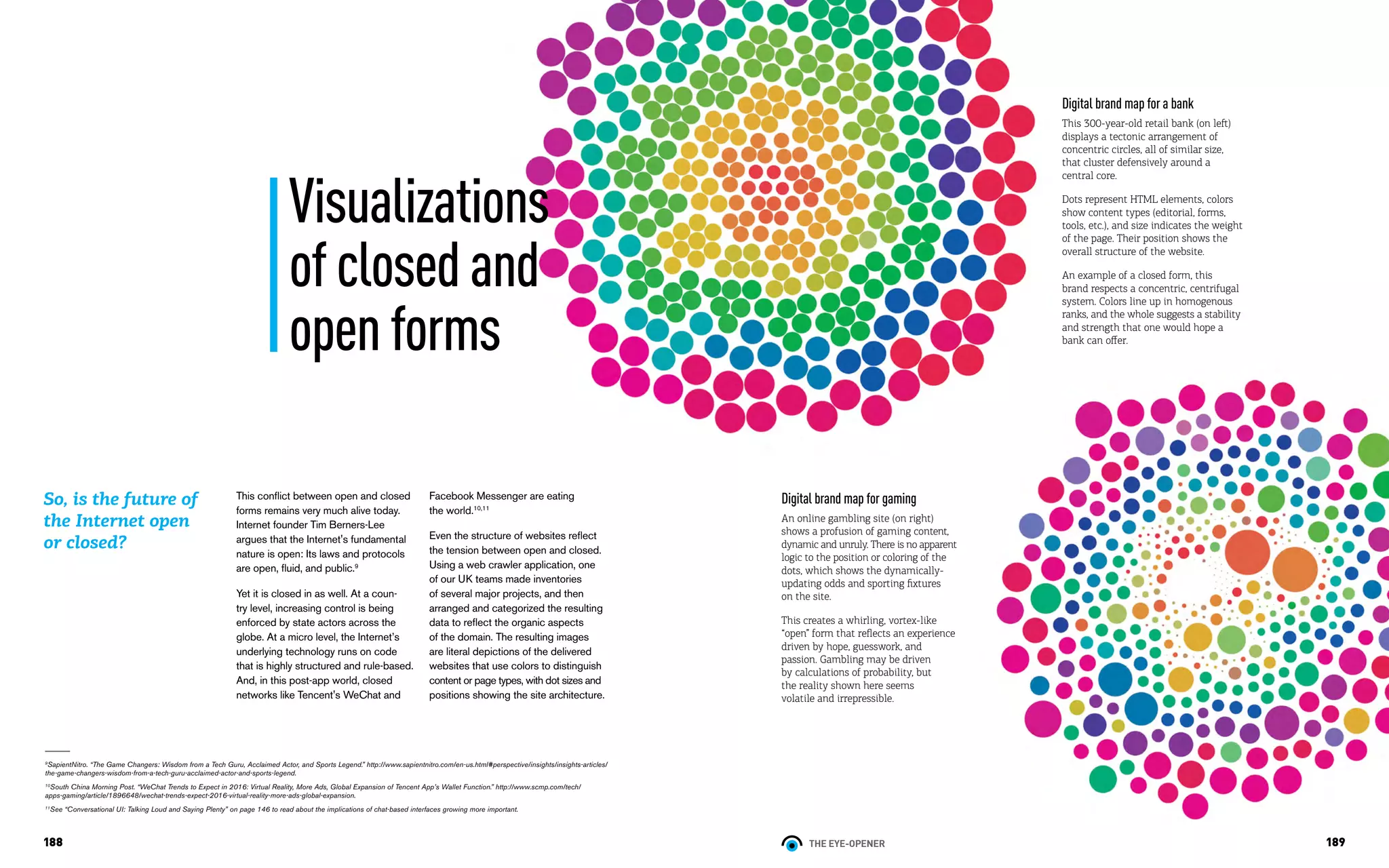
find. As the software being built is for humans, it
makes sense for humans to test (a very small per-
centage) directly to determine usability issues.
•
•
Exploratory
End-to-End
Service & Integration
Unit Testing
60%
50%
40%
30%
20%
10%
0%
Strongly
disagree
Disagree Neither agree
nor disagree
Agree Strongly
agree
13%
51%
23%
13 percent of companies
"routinely build clean,
high-quality code"
8%
5%
Rapid feedback
collected from
appropriate roles:
Business Owner,
Service Developer,
Service Operations,
Service Tester
Builds
e.g., Gradle,
Nexus, Jenkins,
Bower, NPM
Code Compliance
e.g., Sonar
Deployment on CI Environment
e.g., Computer Associates, Lisa,
Jenkins, Ansible
JUnit & Code Coverage
e.g., JUnit, Jasmine, Jest,
Cobertura, Karma
Functional Automation Test
e.g., Cucumber, SE, Pally,
SauceLabs
Security Scan
e.g., Veracode,
Fortify
Performance
Automation Test
e.g., BlazeMeter, Sitespeed.io
Publish Reports/Update Dashboard/
Pass/Fail Status
e.g., Jira, Cucumber, Confluence, Sonar
Automated Deployment/
Environment On Demand
e.g., Urban (code), Docker,
Ansible, Lisa, Splunk
Code Review
e.g., Gerrit
Development
e.g., Confluence,
Jira, Git
Developer
IDE
Development
Unit test
Code compliance
Test
Commit
•
Source: SapientNitro, 2016.
100 101OUR PERSPECTIVES
13 percent of companies
"regularly use a NoOps
mindset"
2AUTOMATE WITH A
NOOPS MINDSET
In our study, 92 percent of digital
leaders agree or strongly agree that cli-
ents want to “automate all enterprise IT
processes,” but just 16 percent agree
or strongly agree that clients have
been “very successful” in doing so
across their organizations. Companies
recognize the value of automation, but
are struggling to make it widespread
(see Figure 5).
This begs the question: If something is
so important, then why is it failing?
We encourage organizations to look
at automation with a NoOps mindset.
The NoOps mindset will force you to
think differently and force the paradigm
shift needed. Namely, that no opera-
tions team will be needed to manage
and maintain the product (i.e., there
will be no operations team for testing,
deployment, environment creation, or
application support).
Few companies – be they startups or
large enterprises – meet this standard
today. Just 13 percent of our IT experts
agree or strongly agree that companies
“regularly” use a NoOps mindset (see
Figure 6).
In our experience, the inability of IT
teams to setup and maintain test
environments which are needed to run
different experiments is a key chal-
lenge. There are occasions in which
environment creation is so manual and
error-prone that it takes weeks and
months to create test environments.
A good example of NoOps in this case
8
In parallel, all other testing is triggered so that over the next 10-20 minutes or so, the developer will get a complete view of security, front-end performance, and functional testing
across all priority browsers. This number varies based on the amount of unit tests and the functionalities which exist in the microservices.
2m48sfor developers to get initial feedback
on their code, passing both a violations
check and unit test coverage.8
Just 13 percent of companies “regularly” use a NoOps mindset.
Q: To what extent do you agree/disagree with the following statement: Compa-
nies regularly use a NoOps mindset (meaning that the company assumed that
there will be no operations team to manage and maintain the product).
FIGURE06
50%
40%
30%
20%
10%
0%
Strongly
disagree
Disagree Neither agree
nor disagree
Agree Strongly
agree
15%
44%
28%
0%
13%
The automation gap
92 percent of digital leaders agreed that clients want to automate all enterprise IT
processes, but just 16 percent of clients were considered to be “very successful” in
doing so.
FIGURE05
16%
of clients were considered
to be "very successful" in
automating all enterprise
IT processes
92%
agreed that
clients want to
automate all
enterprise IT
processes
is using a container-based approach
and tools like Docker. This will make
the entire process of creating and
maintaining an environment completely
automated and repeatable with no
manual steps.
Potential trap: Limited or fitful
adoption of processes
It is not enough to simply create
this toolchain. You must then
make sure that it is adopted by
the product teams – adopted
such that engineers are not
only using this toolchain and its
processes, but also using them
effectively without slowing down
the entire development process.
For example, we used a combi-
nation of steps to drive adoption
for one of the United Kingdom’s
leading banks:
Create champions
We trained six developers
as “advocates” in these new
tools and technologies. They
then encouraged adoption
amongst their peers.
Use metrics very early
Use a consolidated code-
quality dashboard to house
all relevant metrics in one
place. This can act as an
information radiator and help
drive adoption by making the
metrics visible to everyone in
the team.
Create competition or
gamification
One successful method is
creating competition and
involvement by comparing
teams’ key metrics and
recognizing those which
are most successful.
Ensure that product
owners understand the
value of quality
It is essential to educate
product owners – and the
entire ecosystem – on the
importance of quality. Other-
wise, conflicts of interest and
priority (prioritizing the release
of new features above quality)
can arise and impact adoption.
Source: SapientNitro, 2016.
102 103OUR PERSPECTIVES
Automation is
the difference
between two days
to a release, versus
spending three
months doing
testing prior
to release.
Achieving the “small and frequent” mindset
The “small and frequent” mindset is comprised of three levers. The first revolves
around having the right architecture, the second around having the right process-
es in place, and the third around data. Microservices is the area with the least
adoption today. According to our survey, the following percentage of respondents
agree or strongly agree that companies regularly use or do the following:
FIGURE08
No widespread use of microservice architecture
Just 15 percent of companies use modern microservices architecture for “all of
their development,” according to our survey of IT experts.
Q: To what extent do you agree/disagree with the following statement: Companies
regularly use a modern, microservices-based architecture for all of their develop-
ment. By modern, microservices-based architecture, we mean building applications
in small, functional clusters.
FIGURE09
Reference categories of automation tools
Companies can use a reference catalog to categorize the various types of
automation tools and quickly create a solid strategy.
FIGURE07
Code
repository
Continuous
integration
Environment
creation and
management
Release and
deployment
management
Configuration
management
Application
lifecycle
Ops
monitoring
Application
performance
Testing
automation
3THINK SMALL
AND FREQUENT
This step requires the biggest shift in
mindset. Leading companies transi-
tion to continuous delivery by thinking
“small and frequent” to minimize risk.
And they do so by pulling three levers:
microservices, thinking beta, and mea-
suring (see Figure 8).
Microservices
To be autonomous, break your appli-
cation into small, functional clusters.
Create applications as suites of small
services, each running their own pro-
cesses and communicating with others
over lightweight APIs. This will allow
you to release changes in those small
functional clusters rather than wait for
big, monolithic releases to happen.
For example, for one telecom client, we
divided the entire application into diffe-
rent clusters and structured the digital
part of the development teams to mirror
them. This led to efficiencies in road-
map management, product backlogs,
and the autonomy of releases.
In our research, microservices had the
lowest usage of the three main levers,
with just 13 percent reporting its usage
for “all of their development” (see
Figure 9).
"Have a right
architecture"
(see Figure 9)
Microservices
15%
"Have a right
process and mindset"
(see Figure 10)
"Rely on data"
(see Figure 11)
50%
40%
30%
20%
10%
0%
Strongly
disagree
Disagree Neither agree
nor disagree
Agree Strongly
agree
31%
41%
13%
0%
15%
Potential trap: Automating
with scripts instead of tools
A common mistake that most
organizations make is to automate
with custom scripts rather than
tools. They then spend more time
maintaining those scripts, which
increases overhead and (in some
cases) reinforces the old “manual”
habits rather than automation.
The key here is to build a strategy
that focuses on automation tools.
But, as we know, these tools get
outdated very quickly due to the
speed of innovation in this space.
Companies need a strategy to
stay current by regularly crowd-
sourcing new tools from the
engineering community.
Figure 7 depicts categories of
automation tools. By embracing
these tools and the crowdsourcing
concept, you will be able to help
build a NoOps mindset by auto-
mating the entire lifecycle of
application delivery, and avoid
executing automation in silos.
Source: SapientNitro, 2016.
Measure
41%
Think beta
49%
104 105OUR PERSPECTIVES
Less than half of companies “operate using a beta orientation” today, according
to our recent survey.
Q: To what extent do you agree/disagree with the following statement: Most com-
panies operate using beta orientation. When we say beta orientation, we mean
that they always expose the functionality to a subset of users before releasing it
to everyone.
FIGURE10
Just 41 percent of companies "regularly use" a modern microservices-based
architecture.
Q: To what extent do you agree/disagree with the following statement: Com-
panies regularly measure key performance indicators for business (conversion,
NPS), technical (code coverage, violations, SCALE rating), and delivery (velocity,
burndowns) as an integral part of their enterprise IT programs.
FIGURE11
Think beta
Companies should release changes
to a small group of customers, then
expand. This is the easiest way to re-
duce risk. Even if there are issues with
what is deployed, you can easily roll it
back and reduce its impact on your end
customers. In our research, roughly half
of respondents said that companies
are operating using a beta orientation
today (see Figure 10).
You can also choose an internal emplo-
yee to be your beta customer, thereby
testing features in the safety of your
own environment before exposing them
to your end users. In the case of Marks
and Spencer, we gained tremendous
insights from this type of employee
testing before the initial launch of the
brand’s new omnichannel, e-commerce
platform.
Measure
Measure every important key per-
formance indicator. In establishing
whether you’re progressing in the
right direction, patterns are often more
important than numbers. The data will
range from business outcomes and
technology delivery to code quality met-
rics, and should be used for measuring
the effectiveness of the microservices
and beta rollouts.
In our research, a surprisingly low
number – around two in five companies
– are regularly measuring key perfor-
mance indicators as part of enterprise
(Figure 11).
Thinking small and frequent is es-
sential as companies shift toward an
“enterprise startup” mindset. Building
for microservices, thinking beta, and
measuring progress are the must-have
steps in this shift.
50%
40%
30%
20%
10%
0%
Strongly
disagree
Disagree Neither agree
nor disagree
Agree Strongly
agree
23%
15%
13%
49 percent of companies
"operate using a beta orientation"
13%
36%
50%
40%
30%
20%
10%
0%
Strongly
disagree
Disagree Neither agree
nor disagree
Agree Strongly
agree
28%28%
3%
41 percent of companies "regularly
measure" key performance indicators
8%
33%
Marks and Spencer is on a journey
to move from its complex and
siloed structure to a simple, agile,
and resilient organization. With
over £10.3B revenue in 2016, Marks
and Spencer is a global UK-based
retailer with over 83,000 people
across 59 territories. Until 2011,
their entire omnichannel experi-
ence was handled through perhaps
their biggest competitor – Amazon.
Marks and Spencer needed to move
away from Amazon, branch out
internationally, and update their
in-store experience. Our partner-
ship commenced with their rapid
deployment of a digital shopping
experience across international
markets, starting with France.
Following this, the platform was
reimagined, redesigned, and rebuilt
to create a consistent omnichannel
experience across the Web, stores,
and customer service. The platform,
which has completely replaced
the legacy infrastructure, now
integrates 80 applications with 132
interfaces to handle 40,000 orders
per day and 3,000,000 page views
per hour.
Marks and Spencer practices
modern DevOps and agile metho-
dologies, moving from episodic to
continuous delivery and bringing
new features (and increasing value)
to their customers every day. Their
digital business has shifted toward
an enterprise startup approach,
with autonomous product teams
and minimum viable product (MVP)
development methodology.
For example, as they rolled out a
new guest checkout flow, Marks
and Spencer progressed in small
increments by establishing inde-
pendent product teams that con-
sisted of dedicated and agile multi-
disciplinary engineers. To test their
progress, they exposed new fea-
tures to selected beta customers,
measured the outcomes, and added
more customers or adjusted fea-
tures based on those learnings.
FIGURE12
Today, Marks and Spencer has
moved from having a couple of
releases each quarter to releasing
more than 200 changes in the last
two years; from a complete code
freeze to a number of changes
during peak times; from having no
concept of zero outage releases to
all of their releases being executed
with zero outage deployment
models; and from large, single,
monolithic applications to a micro-
services architecture (see Figure 12).
This new culture emphasizes test
and learn methods, experimenta-
tion, rapid prototyping, and imme-
diate feedback from real customers.
The most important process is
sustaining a never-ending cycle
of measuring outcomes, changing
quickly based on feedback, and
then putting the next thing in front
of customers.
Our retail experience has taught
us that this new mindset enables
the kind of business transfor-
mation that increases agility,
responsiveness, and the volume
of product releases.
105
CASE STUDY: MARKS AND SPENCER
Source: SapientNitro, 2016.
Complex and fragile Simple, agile, and resilient
Two releases per quarter More than 200 releases done
in two years
Complete change freeze during
peak period
19 releases done during peak
holiday season
No tracking of the overall down time
(with service managed by Amazon)
Less than 8 hours of planned
outage in 24 months
Monolithic architecture Going toward microservices
architecture
No concept of zero outage
release
All releases done with a zero
outage deployment model
FROM TO
Today, Marks
and Spencer
has moved from
having a couple
of releases
each quarter
to releasing
more than 200
changes in the
last two years.
106 107OUR PERSPECTIVES
Conclusion
As companies look to move faster and
adapt to the always-on mindset,
embracing agile, MVP, and other
methods will become more important.
We have found that an “enterprise
startup” approach – embracing journeys,
focusing on building quality code,
automating wherever possible, and
embracing a “small and frequent” mind-
set – is helpful in achieving those goals.
Today’s principles should – indeed,
must – be adapted to different tools in
the future. At one point, we might shift
from continuous delivery to continuous
deployment (i.e., releasing code into
production as soon as it’s ready by
allowing developers to deploy the code
themselves). And, after adopting a con-
tinuous deployment approach, we may
witness the introduction of continuous
operations. In that case, automated,
real-time feedback loops between the
customer and development would be
created without a need for require-
ments, further extended by allowing
the release of new changes with no
interventions or downtime.
About the research
We conducted a survey of senior technology leaders with broad client experience
across multiple industries from April 27, 2015, to April 22, 2016. This survey
explored clients’ interests in enterprise startup models and technology experimen-
tation techniques, along with the pitfalls that they've faced along the way. These
senior leaders (n=39) were SapientNitro executives and were based in three main
geographies: the United States, Western Europe, and Asia-Pacific. All have worked
in technology with multiple clients for a minimum of a decade.
We talked about how important it is to
have a good car, good road condi-
tions, and knowledge of the direction
in which you’re going. Some believe
that, in a few years time, we will have
teleportation – which has already been
proven via quantum physics. The need
for a car will be removed by the ability
to reach a destination instantly, simply
by thinking of it.
Today, we are far from achieving this,
just as we are far from continuous
deployment. As we wait, let's continue
to change and adapt together.
Pinak Kiran Vedalankar
Director of Technology,
Digital Transformation
SapientNitro London
pvedalankar@sapient.com
A special thanks to Andy Halliwell and
Shivdas Nair for their contributions to
this article.
The #1 failed
initiative among
digital leaders
in our survey
was combining
business and IT
into one team.
INDUSTRY VOICES
& GAME CHANGERS
Case Study: Reimagining Banking at RBS
Pawan Udernani110
INDUSTRY VOICES & GAME CHANGERS 111
Financial services is seeing a surge of innovation. And retail banks, in particular,
have been quick to embrace digital transformation, understanding that today’s
customer demands greater convenience and access than just a few years ago.
Few banks exemplify this trend as well as Royal Bank of Scotland (RBS), the pre-
dominant payments provider in the United Kingdom, the economy with the highest
digital payments usage in the world. The number of electronic payments (52
percent) in the UK market now exceeds cash payments (48 percent), and over
half of digital sales are now made through mobile devices.2
CASE STUDY:
REIMAGINING
BANKING AT RBSPAWAN UDERNANI
1
IMRG. “Over Half of Online Sales Now Made through Mobile Devices.” http://www.imrg.org/media-and-comment-
press-releases/over-half-of-online-sales-now-made-through-mobile-devices/.
2
BBC. “Cashless Payments Overtake the Use of Notes and Coins.” http://www.bbc.com/news/business-32778196.
51%
of online retail sales
in the UK are now made
via mobile devices1
INDUSTRY VOICES & GAME CHANGERS112 113
Over the last six years, RBS has re-
leased a series of innovations and inter-
nal changes in order to adapt to a more
competitive marketplace. RBS has
transformed its organization to focus
on customer experience, building on
its history of deep product and channel
centricity. Guided by the promise of
“Helpful Banking,” the organization has
been building a digitally-led culture,
reimagining internal structures, and sub-
sequently bettering its customers’ lives.
Organizational change: Creating
journey managers
The reimagining of RBS’s digital busi-
ness started with its people – more
specifically, its product managers. Pre-
viously, product managers across RBS
worked in organizational silos, such as
checking accounts, savings accounts,
mortgages, etc. They rarely communi-
cated across the lines and customer
feedback suggested that customer
requests were, at times, getting lost in
the handoff between specialists. Fur-
thermore, customers reported that they
were not getting holistic “life advice.”
RBS reached the conclusion that an
entirely new role needed to be created
to drive business transformation and
improve the customer experience. This
role was needed in order to disrupt
traditional mindsets, look across pro-
ducts and services, and collaborate
with those who would continue to ma-
nage and own existing products.
To serve this purpose, RBS created the
position of “journey manager.” Journey
managers are individuals who are con-
cerned with customers’ aspirations and
goals. They are oriented not around
products, but rather around customers
and their major financial moments –
including opening their first accounts,
saving money for university, and buying
a home.
In 2012, RBS had five journey managers.
Three years later, there were sixty.
A digitally-led culture and
simplified user experience
Over the years, RBS – like many banks
– has developed multiple website and
web platforms to support its business
needs at specific moments in time.
Often, these proprietary platforms lived
on at a growing cost both financially
and in terms of maintaining a distinct
user experience.
When reimagining its business, however,
RBS saw an opportunity to focus on
the simplification of its digital estates.
Over the last 18 months, RBS has
been on a journey to consolidate over
200 distinct web platforms into a single
one, thereby increasing collaboration
among business teams and simplifying
the user experience.
In addition, RBS introduced an initiative
aimed at increasing the overall digital
IQ of the organization and helping it
transform into a digitally-led company. To
achieve this, two major steps were taken.
The first saw RBS develop agency-like
digital studios in both London and
Edinburgh. These studios began trans-
forming the organization's culture and
technology systems from the inside out
Our busiest
branch...is the
7:01 [train]
from Reading
to Paddington –
over 167,000
of our customers
use our Mobile
Banking app
between 7am
and 8am...
every day.
– Ross McEwan,
CEO of RBS3
via Scrum collaborative development
areas, cross-functional teams, and the
mindset of a more nimble enterprise
startup.
The second step was “Bank of APIs,”
a series of hackathons run by RBS and
open to both staff and external par-
ticipants. Spanning the brand’s three
major geographies (London, Edinburgh,
and India), this initiative further commu-
nicates RBS’s new way of working and
dedication to innovation.
And that was just the start.
The innovation imperative
With the new journey managers and
refined product mix, RBS was working
hard to address consumers’ core
needs. However, to effectively reima-
gine their business, RBS’s leaders
needed to reinvent the customer
journey across all channels and truly
put customers in the center.
But how was the organization going to
address the customer experience holisti-
cally? RBS realized that game-changing
innovation requires an end-to-end view
of the customer experience. RBS was
able to introduce a series of innovative
services to the market over twenty-four
months by combining customer insights
from the journey managers, a team
making rapid prototypes, and a nascent
crowdsourcing/co-creation platform.
The following pages highlight the
innovations made in three major areas:
optimizing existing web properties,
building new tools based on customer
needs, and aggressively embracing the
latest mobile technology.
112
3
BBC. “RBS: Ross McEwan Speech in Full.” http://www.bbc.co.uk/news/business-your-money-26365616.
INDUSTRY VOICES & GAME CHANGERS114 115
Intention to Lend
THE CUSTOMER NEED
Nobody should wait that long for a
mortgage approval
The UK housing market is notoriously
competitive, and tighter standards
are creating further uncertainty for
mortgage approvals. In most cases,
mortgage closures are a race against
the clock to get bank approval. In fact,
RBS journey managers supplied and
confirmed these insights via their actual
consumers. This prompted RBS to ask
the question: How can we utilize digital
innovation to ease this process for our
consumers?
WEB PROPERTIES
32kusers
20%
Lending potential
delivered to
increase in first-time
home buyers
THE STRATEGY
Creating a frictionless lending process
Using technology to solve for a better
experience, RBS introduced Intention
to Lend.4
This digital tool gives con-
sumers a personalized mortgage quote
within five minutes – allowing customers
to show their real estate agents the bank’s
“agreement in principle” for a specific
property on the same day.
This means better chances for users to
win a bid for their dream home, all with-
out any impact on their credit scores.
Now, that’s truly helpful banking.
THE OUTCOME
More people with homes
Intention to Lend has delivered £5
billion worth of lending potential to
32,000 users. Moreover, RBS saw a
20 percent increase in first-time buyers,
with 60 percent of Intention to Lend
users being first-time buyers them-
selves – a percentage that surpasses
the marketplace’s 40 percent average.
And, if that weren't enough, over 9,000
working hours of mortgage application
processing have been saved each
year by automating the process via the
web tool.
9,000
Over
working hours of
mortgage application
processing have been
saved each year
Auto ID
THE CUSTOMER NEED
Removing the barriers to opening
an account
RBS and their busy customers were
aware that opening checking and sa-
vings accounts in the UK can be diffi-
cult experiences. Nearly half of all ap-
plicants in the UK are required to bring
a physical ID into a bank branch, after
which they wait an average of eleven
days before approval. RBS, in an effort
to further deliver on their commitment
to “Helpful Banking,” came up with an
innovative solution for removing the
barriers to opening an account.
THE STRATEGY
An end-to-end digital experience
Exclusive to RBS and the first of its
kind in the UK, Auto ID is an innovative
digital identification tool that enables
customers to scan or photograph
necessary documents to open an ac-
count. Busy people no longer have to
present their identification documents
in-branch, but rather can submit them
digitally at their convenience. The tool
was created using the utmost level of
efficiency and security: Image scanning
ensures that images are not fraudu-
lent, after which they are checked and
approved by RBS employees, as well.
With simple transactions being done
at home, bank employees can dedicate
additional time to customers’ more
complex issues.
THE OUTCOME
Conversions
RBS's Auto ID has increased new ac-
count opening conversion rates by 37
percent across the range of products,
including a 300 percent increase in
First Saver accounts opened by par-
ents for their children. Topping all
of that, though, were the students –
for whom accounts increased by
550 percent.
37%
increase in new account
opening conversion rates
300%
increase in First Saver
accounts opened by parents
for their children
550%
increase in student
accounts
4
Please note that NatWest is one of the RBS brands in Great Britain.
INDUSTRY VOICES & GAME CHANGERS116 117
Overdraft calculator
THE CUSTOMER NEED
Simplifying overdraft coverage
Checking accounts remain one of the
key product types in any bank, but
can also be one of the most puzzling.
In this case, RBS realized that overdraft
coverages remained confusing for
many customers, and executives
wanted to simplify the experience.
CUSTOMER-FACING TOOLS
5
RBS. Q4 Results. http://www.rbs.com/content/dam/rbs/Documents/News/2016/February/q4_results-26-Feb-2016.pdf.
THE STRATEGY
A simple overdraft calculator
RBS introduced a new tool to help
customers understand and differentiate
the costs of the two different overdraft
types – arranged and unarranged –
for NatWest and RBS. Each has
significantly different fees and terms.
The tool explains the options clearly and
helps customers make good choices
between usage fees, interest rates, and
loan lengths.
THE OUTCOME
Sustainable website traffic
Traffic to the website has continued to
increase, while the Net Promoter Score
(NPS) – an industry measurement for
customer satisfaction and loyalty – for
RBS’s Personal Banking lines has
jumped 50 percent in just one year
(from Q4 2014 to Q4 2015) to a score
of nine (out of a maximum possible
of ten).5
50%
Net Promoter Score
has jumped by
Get Cash
THE CUSTOMER NEED
Help customers bank naturally,
comfortably, and securely
The feeling of forgetting something
is familiar to us all, but what happens
when the item in question is your bank
card? RBS found that it was common
for consumers to either misplace their
cards or simply leave them at home
before a big night out. But people lose
a smartphone far less often and almost
never leave home without it – marking
a huge opportunity to transform it into
a banking tool. What was the consum-
er data telling RBS about customers’
regular needs and how could the
brand innovate the mobile experience
to better serve those needs?
THE STRATEGY
Quick access to emergency cash
The team at RBS developed and
launched Get Cash, a mobile feature
that enables ATM withdrawals using
a short-duration, five-digit PIN that
users can access via smartphone. This
feature allows customers to send and
receive money from any one of 8,000+
RBS, NatWest, and Tesco ATM ma-
chines without the need of a bank card,
lessening the immediate pain of losing
your bank card, simplifying the process
for sending money to family members
MOBILITY
in need, and giving you the option of
leaving home without your wallet.
THE OUTCOME
Strong potential translated into
strong satisfaction
In its first year after launch, Get Cash
generated over 161,900 requests (aver-
aging 7,000 per week and growing) and
£5.5 million worth of withdrawals. Get
Cash was also one of the gold winners
for the Mobile category at the 2013
Cannes Lions Festival of Creativity.
161krequests
In its first year after launch,
Get Cash generated over
£5.5million
worth of withdrawals
INDUSTRY VOICES & GAME CHANGERS118 119
Touch ID
THE CUSTOMER NEED
Mobile login as a point of entry
While the number of electronic pay-
ments now exceeds cash payments
in the UK, the login process remains
cumbersome. With an increase in
security concerns and precautions,
logging in has become increasingly
more complex. RBS quickly realized
that they could not boast “helpful bank-
ing” if this main point of customer entry
was not simplified.
THE STRATEGY
Partner with and implement
the latest technology
Partnering with Apple, RBS leveraged
Touch ID to become the first UK-based
bank to offer login solely with biometric
identification, speeding up customers’
access to their accounts. The decision
to roll out Touch ID was driven in part
by customer comments on RBS’s
“Ideas Bank,” the bank’s online commu-
nity forum. The biometric enablement
allowed customers’ most unique fea-
tures – their fingerprints – to become
their most convenient security keys.
THE OUTCOME
Biometric enablement leads to
ease of use
In just five days, 72 percent of all
capable iOS logins were via Touch ID.
Not only was the feature adopted, but
it was also applauded. For example,
app reviews went up from three to
four stars on the Apple App Store with
the release of the update. In addition,
there were over 8,000 references to
RBS and NatWest on Twitter in the
first twenty-four hours after launch, in-
cluding recognition received from both
industry and traditional media on this
new display of helpful banking.
72%
of all capable iOS logins
were via Touch ID
In just 5 days,
on the Apple App Store
3to4stars
Reviews went up from
800kreferences to RBS and
NatWest on Twitter in
the first 24 hours
15,000
NatWest for Apple Watch
app users
10%
of regular users are using
the Get Cash feature
Apple Watch
THE CUSTOMER NEED
Use a new format to satisfy
new expectations
With the introduction of the Apple
Watch, RBS recognized a new
opportunity to define the on-the-go
(and wearable) customer experience.
With iOS innovation at the core, RBS
created tangible value for busy, savvy
consumers who expect their banking
environments to evolve at the speed
of tech.
THE STRATEGY
“Helpful banking” on your wrist
RBS introduced an Apple Watch ex-
perience that did more than just check
balances. Unlike its contemporaries,
RBS’s NatWest for Apple Watch app
allows users to access the popular Get
Cash feature to pay for items without
a debit/credit card. Now, NatWest
customers can truly leave their wallets
at home and still have access to their
money on the go!
THE OUTCOME
Leading UK retail banking app
Since its launch, over 15,000 Ap-
ple Watch users have installed the
NatWest app – easily surpassing the
target of 1,000. More so, 10 percent of
regular users are using the award-win-
ning Get Cash feature, thus maintaining
a market-leading NPS score for mobile
and delivering on the promise of
“Helpful Banking.”
120
Reimagining business
step-by-step
With these innovations and the creation
of the new journey manager role, RBS
has positioned itself as a leader in the
UK. By embracing digital business
transformation, the organization has not
only set the bar for financial institutions,
but has proven to other industries the
value of designing with the customer
in mind.
RBS continues to see strong results
for its initiatives, and has embraced
a culture of innovation and change in
order to maintain its momentum.
Consumer banking may be changing,
but so is RBS.
Pawan Udernani
Director, Client Services,
SapientNitro London
pudernani@sapient.com
TRENDS AT THE
INTERSECTION OF
TECHNOLOGY & STORY
Artificial Intelligence: Applying Big Data,
Machine Learning, & Causal Reasoning
to Digital Transformation
Josh Sutton, Ritesh Soni & Scott Petry
Leveraging Emotion Insights to Drive
Experiential Return
Melissa Read, PhD
Conversational UI: Talking Loud and
Saying Plenty
Daniel Harvey & Kieron Leppard
How Brands Are Changing the Context
of Location Marketing
Sheldon Monteiro
124
134
146
158
TRENDS AT THE INTERSECTION OF TECHNOLOGY & STORY 125
JOSH SUTTON, RITESH SONI & SCOTT PETRY
ARTIFICIAL
INTELLIGENCE:
APPLYINGBIG
DATA, MACHINE
LEARNING, &
CAUSALREASONING
TODIGITAL
TRANSFORMATION
It’s been five years since IBM’s artificial intelligence, Watson, beat human contes-
tants on the game show Jeopardy! Still, to this day, many people think of artificial
intelligence (AI) as science fiction — a cunning computer run amok or a loyal
companion robot.
The reality is much more practical.
Artificial intelligence technologies are largely designed to help humans work better
– first, by generating insight from data more quickly and accurately than is humanly
possible and second, by acting automatically on that insight. Invisible to the human
eye for years, these technologies have been completing a broad range of tasks,
from correctly routing mail to interpreting handwriting.
TRENDS AT THE INTERSECTION OF TECHNOLOGY & STORY126 127
Intelligent Assistance
AI will provide expert assistance
for users during various activities,
including product support, Q&A, and
providing recommendations. They
can also provide suggestions to
experts – for example, recognizing
patterns in complex data more quickly.
Today, AI technologies are used every-
where you turn: Siri on your iPhone,
rear parking assist in your car, automati-
cally re-ordering supplies on Amazon,
and suggesting clothes you may like on
your favorite retail websites.
Indeed, enhancing the human ability to
process remains a top strategic priority
at early AI innovators such as Facebook,
IBM, Microsoft, and Google.
These technologies (including image
recognition, natural language process-
ing, machine learning, causal reason-
ing, and robotics) can help businesses
increase revenues, reduce costs, and
mitigate risks.
“Enhancing the human ability to
process” is a strong statement and
the stakes are enormous for the early
innovators, as well as for the broader
economy. Artificial intelligence techno-
logies have the potential to transform
entire business models at a clip remi-
niscent of the industrial revolution. The
question is: How can companies take
full advantage of such a fundamentally
disruptive group of technologies?
Our view of AI
For business leaders, it is important
to have a basic understanding of how
the major technologies that constitute
AI can deliver optimal business impact
by enabling their companies to provide
products and services to meet their
customers’ needs when and where
they need them.
To provide such products and services
requires the ability to collect and analyze
vast amounts of structured and un-
structured data, and to use the insights
gained from that data to inform business
decisions and take action in real time.
Most of the
knowledge in
the world in the
future is going to
be extracted by
machines and will
reside in machines.
– Yann Lecun,
Director of AI Research,
Facebook1
1
Gutierrez, Sebastian. Data Scientists at Work. Apress. December, 2014.
Broadly speaking, AI technologies fall
into two principal categories:
Machine learning (correlation-based
analyses and predictions) through
which complex patterns can be
identified and acted upon. Machine
learning tools allow businesses to
understand what is happening in
the data.
Causal reasoning (otherwise known
as “common-sense AI”) platforms
that apply real world understanding
to information, test hypotheses, draw
conclusions, and allow executives
to better understand why things
are happening.
Although the application of each techno-
logy on its own can result in improved
business performance, the truly
transformative value and future of AI
will lie in the ability to seamlessly layer
data analytics, machine learning, and
causal reasoning platforms to deliver
insight-driven, personalized products
and services.
In particular, this combination offers
great promise for changing the way
that brands approach marketing. By
using these technologies in concert
with each other, marketers can obtain
a better understanding of consumer
and behavioral data, and enable far
more granular personalization of the
customer experience.
For example, Walmart knows that a
sunny weekend forecast in May brings
out gardeners, so the company com-
bines data from localized weather
forecasts with that of consumers’
buying histories to send personalized
mobile promotions.
•
•
In fact, machine learning tools help
the company do everything from
improving store layouts to optimizing
the efficiency of delivery routes and
warehouse operations.
Most companies that are leveraging
AI successfully have found that the
key to realizing meaningful results is
to mix and match complementary AI
technologies geared toward specific
markets or roles (see Figure 1). Face-
book’s newest AI tool, for instance,
draws on both image recognition and
natural language processing tools
to help describe photos to visually
impaired users.
AI point solutions are available for various markets and roles
AI technologies support solutions that span across various business cases, challenges, and teams.
FIGURE01
Summarization Services
Natural language processing
can be used to automatically
create summaries of both
highly technical and non-
technical information.
Custom Digital Experiences
By evaluating humans’ emotions,
moods, attitudes, and intents, AI
can then create and modify the
experiences to match. Anticipate Customer Needs
Based on a variety of inputs,
AI technology can anticipate
customers’ needs and pro-
actively make suggestions
for how customer service or
management should support
those customers.
Support for Accessibility
On-the-go tools to support
the accessibility needs of the
disabled or impaired. These
tools can provide real-time
interpretation of signs,
papers, books, etc., in the
messy “real world.”
Source: SapientNitro, 2016.
TRENDS AT THE INTERSECTION OF TECHNOLOGY & STORY128 129
at large – ranging from call center con-
versations to chat sessions and even
social media activity. AI tools are able
to perform what no single human – or
even team of people – could hope to
do; they can read, review, and ana-
lyze vast quantities of disparate data,
providing insight into how customers
feel about a company’s products or
services and why they feel the way they
do. Luminoso, an AI company with its
roots in MIT’s Media Lab, has built a
robust business performing precisely
this task.
Customer engagement
Customer engagement has long been
the “holy grail” for marketing and CRM
programs. Today, AI is radically enhanc-
ing the personalization of information
that fuels such engagement. Nowhere
is this more evident than in AI’s “next big
thing”: chatbots and virtual assistants.
Chatbots are software programs that
use messaging as an interface through
which companies can answer custom-
ers’ questions, help their customers
find information, and offer personalized
deals and sales. They are ideally suited
to a mobile platform and have been
made significantly more powerful by
advances in machine learning and
natural-language processing.
Multiple companies such as Viv,
Facebook, and Nuance are providing
frameworks and turnkey solutions in
this space, allowing for services as
diverse as media content distribution,
customer service support, and customi-
zed marketing campaigns. While the
technology advances are exciting –
and bode well for business applica-
tions – successful use cases will be
grounded in a strong, user-centered
design process, leveraging the input of
business and marketing experts as well
as those of the information technology
(IT) division.
Business acceleration
Business acceleration refers to how
companies use AI to expedite knowl-
edge-based activities to improve
efficiency and performance. Examples
range from hospitals finding potential
patients for drug trials to financial insti-
tutions creating investment strategies
for their investors.
While these types of activities are often
viewed as opportunities to reduce
costs through the automation of internal
processes, they also should be consid-
ered in terms of their ability to transform
the customer experience. For example,
if a bank can use AI to reduce the time
it takes to approve a loan, it not only re-
duces its own costs but also provides
an improved customer experience.
As a result, when AI tools such as
Watson from IBM and Cyc from
Cycorp are deployed, today’s market
leaders ensure that they leverage the
technologies with both cost-cutting and
customer satisfaction in mind.
Combining machine learning
and causal reasoning
Until recently, big data and machine
learning have been the primary focus
for many big data analytics projects,
but causal AI will emerge as an
important complementary tool in
the 2018–2020 timeframe.
Here’s why.
Machine learning
Machine learning platforms such as
IBM’s Watson or Google’s TensorFlow
use algorithms to find particular pat-
terns in huge data sets, and learn from
the results.
For example, a machine learning
platform can look at a million tagged
pictures of house cats to learn the attri-
butes of something called a cat. Then,
when it sees another cat picture, it will
recognize it as a feline. This is what
drives the impressive accuracy of apps
like Google Photos, which can identify
pictures of you and your family mem-
bers based on its analytical learnings.
In marketing applications, machine
learning algorithms are particularly
useful for finding unexpected patterns
that help companies more accurately
build market segmentations or optimize
ad spend. For example, using machine
learning to better target online display
ads can dramatically improve click-
through rates.
Causal reasoning: Common sense AI
On the other hand, causal reasoning
systems (or common sense artificial
intelligence) use more of a teaching-
based approach. Causal AI teaches
machines to think like humans by
showing them how things relate and,
subsequently, allowing them to reason
contextually. In other words, the com-
puters have to learn common sense.
So while a machine learning platform
can identify that cat picture, causal
AI platforms – like MIT’s ConceptNet
and Cycorp’s Cyc platform – apply
context to that image by drawing on an
extremely large model of relationships
that reflect a human being’s under-
standing of how the world works in
relation to that image. In other words,
rather than simply identifying the
picture, causal AI tools also understand
a cat’s place in the world (e.g., they
make great pets, are great hunters, and
sometimes trigger allergies in humans).
Fusing multiple technologies
to form the optimal solution
The union of multiple forms of AI
allows companies to achieve digital
transformation through insight gene-
ration, customer engagement, and
business acceleration.
Insight generation
Insight generation involves extracting
meaningful and actionable intelligence
from ever-increasing quantities of
available raw data. With the amount of
information in the world nearly doubling
each year, it is no surprise that com-
panies are scrambling to capture and
make sense of it.
One of the fastest growing uses of AI is
to “listen” to all customer communica-
tions, both directly with a company and
about that company in the market
Companies
will be able
to influence
consumer
behavior by
responding in
context to what
an individual
is doing in
the moment.
TRENDS AT THE INTERSECTION OF TECHNOLOGY & STORY130 131
The road ahead: What leaders
should do today
According to International Data Cor-
poration (IDC), by 2018 about half of
all apps developed will incorporate AI,
as firms increasingly experiment and
explore the use of this technology.2
After all, there are no tried-and-true
implementation methods for such a
rapidly evolving set of technologies.
While many companies know that
AI is important in a general sense,
most haven’t figured out specific
business applications.
That, however, will change. AI is
rapidly becoming a top business
priority, and brands should consider
how to get in front of the trend rather
than react to it later (see Figure 2).
Explore AI capabilities
As with any significant technology
trend, companies need to learn the key
elements of AI and dig into its possible
impact on specific business functions
as well as overarching industries.
Explore ways of making AI part of the
overall business conversation — for
example, through the use of exploratory
projects or innovation labs that look for
the best areas for AI applications, both
within your company and across its
products and/or services.
2
CIO Magazine. “Who’s in Charge of AI in the Enterprise?” http://www.cio.com/article/3033141/robotics/whos-in-charge-of-ai-in-the-enterprise.html.
3
Graphic created by SapientNitro based on Gartner research: Predicts 2016: Smart Machines. December, 2015. https://www.gartner.com/doc/3175120/predicts--smart-machines.
Smart machines’ rapid impact
Leading predictions show the imminent rise of smart machines and their impact
on business investments and applications.3
FIGURE02
By year-end
2018
25% of durable goods manufacturers
will utilize data generated by smart
machines in their customer-facing
sales, billing, and service workflows.
R&D-based, end-user approaches
to smart machine deployment will be
three times more likely to produce
business value than IT project-based
approaches.
By
2020
Smart machines will be a top five
investment priority for more than
30% of CIOs.
CFOs will need to address the valua-
tions derived by smart machine data
and “algorithmic business.”
Start with small, targeted projects
to learn about the technology
Where is your money best allocated?
Smart AI investors tend to follow the
data breadcrumb trail. That’s why
data-intensive industries like financial
services and healthcare are early inno-
vators in this field: They feel more pres-
sure to extract full value from their large
volumes of data, making it easier to
balance the risk and reward of such a
significant investment. Most companies
start with smaller, targeted projects that
can improve existing business pro-
cesses, particularly in areas that place
a high premium on real-time decision
making or have large volumes of data
that are not being effectively utilized.
For example, machine learning models
can be used to improve product
recommendations by predicting, based
on previous behavior, what item a cus-
tomer is most likely to buy. The same
concept can also apply to predicting
customer churn, helping companies
know when to offer incentives to keep
customers on board. Another likely
application area is in dynamic pricing,
where AI can be used to more accu-
rately predict product demand at
a given price.
Search for knowledge bottlenecks
When it comes to identifying and
prioritizing near-term prospects, look for
knowledge bottlenecks — areas where
humans either can’t absorb the infor-
mation fast enough, or where there are
large streams of data to integrate and
analyze. Go after an obvious optimiza-
tion problem as opposed to solving for
not very well-defined problems. This is
a long journey, not a six-month effort.
As tools mature and commercial ma-
chine learning and causal AI platforms
become more affordable, the risk-
reward ratio will flatten considerably,
lowering the barrier to entry at many
companies. Those who have learned
from working with smaller subsets of
data will be well-equipped to jump
aboard the express.
Design with the customer in mind
Perhaps most important, successful
companies of tomorrow will fuse
together AI solutions with the customer
in mind. Rather than seeing each
emerging AI technology as an exciting
new tool in and of itself, they will seek
to determine which combination of AI
technologies can generate the most
actionable insight into their customers
and clients. They will use that insight
to provide consumers with products
and services that meet their needs
when and where they need them. And,
they will design these AI solutions from
the outside in – from the perspective
of their customers – as opposed to
inside out, via traditional divisional and
product silos.
Machine learning
models can
improve product
recommendations,
predict customer
churn, and support
dynamic pricing.
TRENDS AT THE INTERSECTION OF TECHNOLOGY & STORY132 133
Conclusion
AI as a technology sector is evolv-
ing rapidly, providing tools that can
generate insight, engage customers,
and accelerate business growth. Early
leaders like Google, Facebook, and
Amazon are building their business
models around AI, and driving further
AI expansion by opening up their plat-
forms to outside developers.
Meanwhile, significant venture capital
activity, coupled with substantial
improvements in accuracy and per-
formance, have driven robust market
expansion for AI technologies.
All of this adds up to huge opportuni-
ties for businesses that can success-
fully leverage AI – either across func-
tions such as marketing and sales
or for business transformation. The
tools that are currently available offer
significant potential to boost revenue,
cut costs, and reduce risk. And, when
Josh Sutton
Global Head, Artificial
Intelligence Practice,
Publicis.Sapient
jsutton@sapient.com
Ritesh Soni
Vice President, Data Science,
SapientNitro Washington, D.C.
rsoni@sapient.com
Scott Petry
Vice President, Technology,
SapientNitro Atlanta
spetry@sapient.com
combined and designed with the
consumer in mind, AI technologies can
deliver solutions that drive customer
loyalty, engagement, consumption, and
satisfaction. In fact, AI technologies
may become a key driver for the digital
transformation of tomorrow’s most
successful businesses.
TRENDS AT THE INTERSECTION OF TECHNOLOGY & STORY 135
MELISSA READ, PhD
LEVERAGING
EMOTIONINSIGHTS
TODRIVE
EXPERIENTIAL
RETURN
Marketers have long acknowledged that customer behavior has both rational and
emotional drivers. While rational drivers have been relatively easy to assess, it has
historically been difficult for marketers to measure the emotional side. Instead, we
have relied on methods like self-reporting and direct observation to glean emotional
insights, but these methods are limited to what people can express. They are also
modified by which emotions people choose to show marketers while being observed.
Emotions drive our thoughts, perceptions, and behaviors across environments
and cultures, so it should be no surprise that they impact brand experiences too.
Emotions drive resonance in brand messaging, brand loyalty, and buying behavior.
Recently, the technology of directly measuring an individual’s emotional response
to a piece of content (e.g., video or advertisement) or experience (e.g., in-venue
event, video game, or vehicle) has become refined and reliable.
TRENDS AT THE INTERSECTION OF TECHNOLOGY & STORY136 137
Yet many marketers still hesitate to use
emotion insights.1
With the rise of more sophisticated
emotion insights methodologies
over the last several years, however,
marketers have the opportunity to give
voice to the emotional drivers of cus-
tomer decisions. Marketers can take a
more balanced approach to data with
research programs that are inclusive of
both rational and emotional marketing
drivers. Most important, they can lever-
age emotion insights to demonstrate
the success of marketing outcomes
too – thereby giving them a richer and
more holistic story to tell about market-
ing performance.
Trends in experience
Brands can leverage emotion insights
primarily to optimize marketing perfor-
mance and drive responsive experiences.
Optimizing marketing performance
For some brands, emotion insights can
be leveraged to understand oppor-
tunities in the design of their brand
experiences. Coca-Cola, for example,
leveraged biometric measurements
to determine which of a dozen Super
Bowl commercial variations were the
most emotionally resonant.2
Partici-
pants wore headsets and wristbands
that detected brain waves, heart rate,
blinking, breathing, and even blushing.
These techniques allowed Coca-Cola
to determine which commercial was
the most emotionally resonant and also
drove modifications to the final com-
mercial design. The winning, optimized
commercial was then aired.
Other brands have leveraged emotion
insights to more deeply assess market-
ing assets and drive tactical optimiza-
tions such as changes in asset length,
creative look and feel, music choice,
and narration. Marketing assets that are
optimized to be emotionally resonant
drive significantly greater marketing
returns (see Figure 1).
Just a few of the marketing returns achieved via emotion insights
The returns on using emotion insights are clear, touching various ROI metrics
including views, engagement, click-through, and conversion.3
FIGURE01
1
Forrester Research. Understanding the Impact of Emotion on Customer Experience. July, 2015. https://www.forrester.com/report/Understanding+The+Impact+Of+Emotion+On+Cus-
tomer+Experience/-/E-RES122503.
2
Alhadeff, Eliane. “EmSense Turns Market Research Into a Serious Game.” http://elianealhadeff.blogspot.com/2009/02/emsense-turns-market-research-into.html.
3
Realeyes. “Realeyes – Imagination: Is Your Content Learning from Experience?” http://www.slideshare.net/realeyes-slides/realeyes-imagination.
Driving experience in responsive
environments
Other brands can leverage emotion
insights as inputs to brand experiences.
For example, Stanford researchers built
an Xbox console that senses players’
emotions.4
The sensors were placed
on the back of the Xbox controller to
detect heart rate, blood flow, breathing
rate, and depth of breathing – all proxies
for the emotional part of the brain.
They allow the game to detect four
unique player emotions as inputs:
happiness, sadness, boredom, and
excitement. The best part? The gaming
experience then modifies itself depend-
ing on the player’s emotional state.
Another great example stems from the
automotive industry. Several teams of
researchers have worked in conjunc-
tion with car manufacturers to concept
cars that detect mood.5
In one case,
an infrared camera situated behind the
steering wheel was used to detect the
micro-movements on drivers’ faces.
These movements were then rapidly
coded by computer vision software to
detect one or more of seven emotions.
When a driver is experiencing anger
and rage, these concept cars modify
aspects of the driving experience, such
as the driving speed.
4
Stanford. “Stanford Engineers Design Video Game Controller that Can Sense Players’ Emotions.” http://news.stanford.edu/news/2014/april/game-controller-excitement-040714.html.
5
ExtremeTech. “In-Car Emotion Detector Can Tell When You Have Road Rage, Can Make Driving Safer.” http://www.extremetech.com/extreme/178514-in-car-emotion-detector-can-
sense-when-you-have-road-rage-making-driving-safer.
more likely to
watch to the end
3x higher click-
through rate
8x social action
conversion
20x quicker in
attracting views
3x
TRENDS AT THE INTERSECTION OF TECHNOLOGY & STORY138 139
FACIAL CODING
Facial coding is an emotion insights
technique that has risen in popularity
in the last several years. In Figure 3, a
camera captures several emotion types,
magnitudes, and timing by micro-move-
ments on the face.
The emotions captured by facial coding
include happy, confused, disgusted,
fearful, sad, scared, and surprised. With
this technology, we can also see when
multiple emotions are elicited at the
same time. When just a few basic emo-
tions are captured in parallel, there are
many resulting emotional states that we
can observe (see Figure 4).
Facial coding provides detailed, up-to-
the-second readouts about specific emo-
tions, so marketers can see the flow of
emotion over the duration of the brand
experience. While it’s often more expen-
sive than GSR, facial coding is affordable
to the average marketer, and yields rich
and rapid insights returns.
Some of the key questions that facial
coding can answer include:
Which of several emotions are elicited
in response to marketing experiences?
What is the magnitude of each elicit-
ed emotion?
When in the experience (up-to-the-
second) are emotions elicited?
How do specific audience segments
differ in terms of their emotional
responses to marketing experiences?
Facial coding is often used when par-
ticipants are viewing videos of brand
experiences on desktop computers or
mobile devices. Participants have to be
relatively steady and in good lighting
conditions in order for marketers to
uncover meaningful insights. There are
several products on the market that
make facial coding testing relatively
cost-effective for marketers. Facial cod-
ing is in a sweet spot when it comes to
investment and return.
The complex workings of facial coding
Facial coding technologies capture
everything from differing emotions
to their magnitude and timing – all
using the micro-movements of the
participant’s face.
FIGURE03
The range of mood states that can be
detected by facial coding
The breadth of facial coding detection
is incredibly vast, enabling the tech-
nology (and those using it) to pick up
multiple emotions simultaneously.
FIGURE04
139
•
•
•
•
Researchers in emotion insights use
cognitive and neural science techniques
to assess the type, magnitude, and
timing of real emotions in response to
brand experiences. Example techniques
include galvanic skin response, facial
coding, and electroencephalography.
By using these techniques, marketers
can maximize brand engagement, mini-
mize pain points, drive creativity, and
quantify success.
THE SCIENCE OF EMOTION INSIGHTS
GALVANIC SKIN RESPONSE
Galvanic skin response (GSR) is an
emotion insights technique that allows
marketers to assess basic emotional
arousal at key points in the marketing
experience by measuring sweat gland
activity (see Figure 2). Increases in
emotional arousal correspond with
increases in the amount of sweat our
fingertips produce.
GSR is a relatively low-cost and easily
accessible method. It is lightweight
and unobtrusive to the research envi-
ronment, allowing for study in con-
trolled lab environments or in-the-wild
environments where participants can
move about freely. When implemented
in the wild, careful consideration must
be given to the temperature of the envi-
ronment and the participant, so as not
to impact the readings.
Some of the key questions that GSR can
answer include:
When in the experience is emotional
arousal and stress elicited?
What is the magnitude of the emo-
tional arousal and stress?
How do specific audience segments
differ in terms of their emotional/
stress responses to marketing
experiences?
One of the biggest limitations of GSR,
however, is that marketers do not know
exactly which emotion is elicited in the
arousal response. For this reason, GSR
is often most effective for marketers
when paired with other methods like
heart rate monitoring, eye tracking,
facial coding, and even survey/interview
questions to tell a holistic story.
How galvanic skin response works
Sweat glands are known to deliver basic data around increases
in emotional arousal. GSR allows marketers to use these biological
features to analyze the natural effects of their experiences.
FIGURE02
•
•
•
Facial coding is
affordable to the
average marketer,
and yields rich
and rapid insights
returns.
TRENDS AT THE INTERSECTION OF TECHNOLOGY & STORY140 141
Why emotion insights matter
For a financial services brand, we used
emotion insights to determine which
of three digital brand videos (each
with variations in script, music, and
voiceover) elicited the most positive
consumer response and engagement.
The brand’s goal was to maximize their
chances of connecting with their target
audience on the emotion that mattered
most to them: happiness.
Without emotion insights, we might
have conducted survey, interview, or
even focus group research to allow
participants to self-report the emotions
they felt about each video. We might
have also directly observed people
watching the videos. These methods
would have given us a general sense
of the way participants felt about the
videos and may have even given us
ideas for how to optimize the top
performing video to maximize the
brand’s desired “happy” response.
However, imagine how our strategy
evolved when facial coding was
introduced. With this technology, we
discovered that one video’s female
voiceover was the most emotionally
resonant, driving happiness up and fear
down (see Figure 6). More so, every
time the brand promise was mentioned,
happiness went up – a strong point
of validation for our creative team’s
approach. We were also able to
identify that visual representations of
the tagline drove further increases in
positive sentiment.
Lastly, we realized that certain content
types (photos) and themes (churches)
showcased throughout the video were
causing happiness and engagement
dips – thereby informing further edits
of the selected video.
Applying facial coding: A side-by-side comparison for all three videos
With facial coding, we were able to identify the female voice in the first video (line
A) as being the most emotionally resonant, driving happiness up and fear down.
Three versions of the same video were shown. Version A, which included a
woman's voice, music track A, and groups of people sharing a positive experience;
Version B, which included a man's voice, music track B, and religious locations;
and Version C, which included both a man and woman's voice, as well as a unique
music track.
FIGURE06
We were then able to optimize our
communications for all emotions
elicited. We could dial up desired
emotions and dial down ones that
were not productive. We could test
the emotional response to the revised
video to make before-and-after com-
parisons. We could also leverage the
emotion scores from the facial coding
exercise and correlate them with the
engagement generated in response
to the video. With that information, we
were able to know exactly what mix of
emotions to target in future videos and
other types of brand messaging.
ELECTROENCEPHALOGRAPHY
With electroencephalography (EEG),
marketers can capture brain waves to
measure positive and negative arousal
in response to experiences. Headsets,
with electrical sensors placed on the
scalp, are used to detect emotions
and changes.
Positive and negative arousal, measured
by EEG, are indicators of engagement,
excitement, and frustration. While
EEG implementation requires one of
the highest investments of time and
expertise (time required for analysis),
marketers can get detailed readings on
arousal states down to the millisecond.
Some of the key questions that EEG
technologies can answer include:
Are participants excited, frustrated,
and/or engaged by our marketing
experiences?
What is the magnitude of each feeling
that is elicited?
When in the experience are emotions
elicited, down to the millisecond?
EEG technologies have evolved in
response to marketing needs, so they
are as unobtrusive as possible. Some
EEGs are wireless and dry, meaning that
they do not require gel on their sensors
to collect insights, and participants can
move about in real world environments
relatively freely (see Figure 5). However,
EEG instrumentation can be cumber-
some and distracting for participants.
When this technology feels too unna-
tural, it can stand in the way of getting
meaningful results.
An EEG headset
This dry and wireless headset is what enables marketers
to capture brain waves depicting both positive and negative
arousal states. It also enables participants to move about,
thereby permitting assessment of in-the-wild experiences.
FIGURE05
•
•
•
Comparison of HAPPINESS for each video
14%
12%
10%
8%
6%
4%
2%
0:06 0:18 0:30 0:42 0:54 1:06
With electroen-
cephalography
(EEG), marketers
can capture brain
waves to measure
positive and
negative arousal
in response to
experiences.
Happiness
Comparison of FEAR for each video
4%
3%
2%
1%
0%
-1%
-2%
0:06 0:18 0:30 0:42 0:54 1:06
Fear
Time in seconds
Time in seconds
TRENDS AT THE INTERSECTION OF TECHNOLOGY & STORY142 143
Capturing and creating authentic
experiences
In our digital brand video example
described on the previous page, the
financial brand would not have disco-
vered that one particular female voice
drove happiness up and fear down
without facial coding. A common cha-
llenge for marketers is to understand
what their target audiences are really
thinking. There is often a vast difference
between what people can articulate
and their true experiences, while uncon-
scious experiences guide choices and
drive marketing outcomes.
Emotion insights allow us to tap into
authentic, unconscious experiences
with brand environments, thereby
unpacking the complexity of emotion
that is present and what the conscious
mind cannot share. They also allow us
to create emotionally resonant moments
through responsive environments that
deeply connect with our target.
Driving up-to-the-second outcomes
In the digital brand video example
on the previous page, it would have
been difficult to get up-to-the-second
insights on emotions (such as those
induced by the brand promise or tag-
line) using techniques outside of facial
coding. And, when it comes to digital
branded content, every second matters.
Emotion insights techniques allow us
to detect changes in emotional
response to marketing experiences,
up to the second. They also allow
responsive environments to act on
changes in emotion, driving experiential
changes in the moments when specific
emotions unfold.
Emotion insights
allow us to tap
into authentic,
unconscious
responses to brand
environments,
thereby unpacking
the complexity of
emotion that is
present and what
the conscious
mind cannot share.
Exploring emotion insights applications for your brand
When thinking about how emotion insights can apply to your busi-
ness, here are some considerations:
Uncoverinsightsthatdriverealimpact
Emotion insights techniques are shiny objects.
They are methods and outputs that tend to draw a lot of
attention. So, when using these techniques, make sure that
your research program is sound, and that you are answering
questions whose results will make a real impact on your
business. It can be tempting to choose methods like EEG
because of how powerful the technology is and how granular
your findings can be. Oftentimes though, lower-cost emotion
insights methods like facial coding (and even GSR/heart rate
monitoring) will yield a greater return on your investment by
giving you targeted results that directly inform strategy.
Gain the greatest value by taking
a holistic approach
Emotion insights can be a powerful
driver of change. But oftentimes,
the full story about customers
and their experiences is best told
by pairing this method with oth-
er complementary methods. For
the best outcomes, complement
emotion insights methods (that tap
unconscious feelings) with methods
that allow your target audience to
share their conscious perspectives,
too. For example, you can use a
follow-up survey during or after
emotion insights tracking. A survey
can help researchers understand
why specific emotions were elicited
at key points during an experience.
Make the greatest investment in
your team, not your tools
Emotion insights is an emerging
research capability and marketing is a
dynamic field. Tools and methods have
rapidly advanced, and changed, over
a short period of time. That being said,
it is best to work with strong insights
professionals who understand the sci-
ence behind emotion insights and who
are tool agnostic. You want a team that
can develop the capability quickly to
find the strongest tools for your evolving
field and needs. Teams with a mix of
backgrounds in cognitive neuroscience,
psychology, and both qualitative and
quantitative research can be particu-
larly powerful – especially if they also
have experience working in marketing
research and strategy capacities.
144
Looking to the future
Today, emotion insights techniques
are largely used to capture the emo-
tions of individual participants for
marketing experience optimization.
Emotion insights sensors are directed
at specific individuals. Sometimes
these individuals wear the sensors,
while other times the sensors are
embedded in a specific device.
Now, we are starting to see vendors
emerge that are able to offer group
assessment of emotion insights.
Sensors are placed in environments
as opposed to on, or near, individuals.
These sensors calibrate the emotions
of many people at the same time, and
can capture their engagement with mul-
tiple marketing channels across a range
of devices. Group emotion calibration
has incredible applications in driving
responsive group experiences in places
like retail environments, entertainment
experiences, and other in-the-wild mar-
keting and branding venues.
As brands continue to invest in
responsive environments, the demand
for more precise and holistic emotion
insights will only increase.
Melissa Read, PhD
Global Emotion Insights Head,
SapientNitro Atlanta
mread@sapient.com
We are starting
to see vendors
emerge that are
able to offer group
assessment of
emotion insights.
TRENDS AT THE INTERSECTION OF TECHNOLOGY & STORY 147
Software is eating the world. That’s what famed venture capitalist Marc Andrees-
sen said in a Wall Street Journal article in 2011. Fast forward five years and it’s
clear that he was correct – software is indeed ubiquitous. But not all software is
equal. Messaging apps are experiencing a meteoric rise above all others.
Flurry, a mobile analytics firm, says that messaging app sessions saw a 103
percent rise globally as far back as 2014, and sustained a 51 percent rise in
2015.1
General-purpose chat app WhatsApp had 50 percent greater traffic than
all global text message use.2
And Snapchat, once the domain of Millennials only,
now has a daily average user count of 100 million.3
Furthermore, 50 percent of the
top eight downloaded apps in the UK are messengers, while two out of the top
three are chat apps from Facebook.4
CONVERSATIONAL
UI: TALKING LOUD
AND SAYING
PLENTYDANIEL HARVEY & KIERON LEPPARD
1
Flurry. “Shopping, Productivity and Messaging Give Mobile Another Stunning Growth Year.” http://flurrymobile.
tumblr.com/post/115194992530/shopping-productivity-and-messaging-give-mobile.
2
Evans, Benedict. “WhatsApp Sails Past SMS, But Where Does Messaging Go Next?” http://ben-evans.com/
benedictevans/2015/1/11/whatsapp-sails-past-sms-but-where-does-messaging-go-next.
3
SocialTimes. “Snapchat Is the Fastest Growing Social Network (Infographic).” http://www.adweek.com/socialtimes/
snapchat-is-the-fastest-growing-social-network-infographic/624116.
4
Ofcom. The Communications Market 2015 (August). http://stakeholders.ofcom.org.uk/market-data-research/market-da-
ta/communications-market-reports/cmr15/.
TRENDS AT THE INTERSECTION OF TECHNOLOGY & STORY148 149
Snapchat, once
the domain of
Millennials only,
now has a daily
average user count
of 100 million.
And it’s not just social chatter that’s
commanding such inspiring figures.
WeChat, the dominant chat app in
China, had more mobile transactions
over the 2016 Chinese New Year than
PayPal had during all of 2015.5
The
users of Slack, the darling of the
enterprise, engage with the app on
average ten hours per day during
the work week.6
This evolution of messaging platforms
and the rise of chatbots represents a
paradigm shift in our always-on world.
Marketers now have the opportunity
to be more plugged in to their target
consumers’ conversations. And, as a
business today, it is critical to under-
stand this mega-trend and respond
in short order. This is the dawn of the
“post app” era and will be as transfor-
mational for businesses and consumers
as apps were a decade ago.
Messaging as an operating
system
Creators of operating systems have
long had a competitive advantage in
the software industry. In the personal
computer era, Windows’ dominance
afforded Microsoft much success.
In the desktop Internet era, Google
functioned as an operating system
(OS) of sorts for the web. In the
mobile era, iOS and Android are
critical components of the Apple and
Google ecosystems.
But, in the cloud era, all that could change.
What’s important to realize is that
messaging apps are often becoming
platforms. Think of them as stealth
operating systems on top of your exist-
ing OS. They’re one-stop portals
to everything you need on your smart-
phone, infiltrating your life through the
notifications panel.
The most successful, like WeChat or
Facebook Messenger, are facilitating
more than just chat. WeChat supports
peer-to-peer (P2P) payments, shopping,
booking taxis and restaurants, and
more. Facebook Messenger – with its
virtual assistant, M – will be able to do
all of that and who knows what else.
As messaging apps grow more ubiq-
uitous and powerful, the need to have
standalone apps for these individual
functions becomes questionable. What
impact could this have on Venmo, Jet,
Hailo, OpenTable, and the like? What
about Google Now, Cortana, and Siri?
More important, what does this do
to other types of app experiences?
The average smartphone user down-
loads zero apps per month and, with
users spending more and more time
in chat apps, things look bleak for
traditional apps.9
Big numbers in conversation
5
The Drum. “WeChat Had More Mobile Transactions Over Just Chinese New Year than PayPal Had During 2015.” http://www.thedrum.com/news/2016/02/09/wechat-had-more-
mobile-transactions-over-just-chinese-new-year-paypal-had-during.
6
TIME.com. “How E-Mail Killer Slack Will Change The Future Of Work.” http://time.com/4092354/how-e-mail-killer-slack-will-change-the-future-of-work/.
7
Bloomberg. “Tencent Climbs as Ad Surge Boosts WeChat Earnings Outlook.” http://www.bloomberg.com/news/articles/2015-03-18/tencent-earnings-surge-50-percent-on-higher-
online-game-sales.
8
Fortune. “Slack Raises $200 Million at $3.8 Billion Valuation.” http://fortune.com/2016/04/01/slack-raises-200-million-at-3-8-billion-valuation/.
The aforementioned examples show
that a chat user interface (UI) can
work in a variety of situations. But
why is it preferred?
ChatUIhasazerolearningcurve
First, there’s a similarity across the
user interfaces of chat apps, so there’s
no need to learn a new UI or pattern.
Chat boils down to text on the right/left
and input on the bottom – it's digital
second nature now for many. This in-
stinctual understanding gives brands a
head start when designing an engaging
experience for their consumers. As
Nir Eyal, author of Hooked, puts it,
“We already know how to chat, so
making requests is easy.”10
Second, chat can be instantaneous or
asynchronous. If you want a bus time,
then bots, artificial intelligence (AI), and
schedules can share a schedule in real
time. If you want to buy luchador finery,
then humans can take some time to
find you the best deal.
Unlike the telephone or web, messag-
ing affords us constant communication.
For example, it gives customers quick
access to information while on the
go and can grant them answers
even when brand representatives
are not available.
9
comScore. The 2015 U.S. Mobile App Report. https://www.comscore.com/Insights/Presentations-and-Whitepapers/2015/The-2015-US-Mobile-App-Report.
10
Eyal, Nir. “Human + A.I. = Your Digital Future.” http://www.nirandfar.com/2015/07/the-message-is-the-medium-3-reasons-apps-as-assistants-work.html.
WeChat’s revenue
in 20157
Slack’s 2016 valuation8
¥3.8billion
$3.8billion
per month
zeroapps
The average smartphone
user downloads
TRENDS AT THE INTERSECTION OF TECHNOLOGY & STORY150 151
As renowned tech strategist Ben
Thompson puts it, “Conversations are
never-ending, and come and go at a
pace dictated not by physicality, but
rather by attention.”11
Brand service,
therefore, becomes even more conti-
nuous and dependable.
Third, it’s an ideal medium for customer
service. If social media has taught us
anything, it’s that people love to engage
with brands for everything from satisfied
reviews to customer service complaints.
Chat apps allow customers the same
opportunity, but in a discreet venue
that's more personal for the consumers
and less damaging to brands. It's also
just more helpful to have a one-on-one
service experience.
Last, in a post-Snowden era, messaging
apps seem to be the last great refuge
for privacy. Apple and the FBI have
been embroiled in a 21st-century
version of the crypto-wars, while similar
rows will likely erupt in the UK thanks to
the Snoopers’ Charter.12
Messaging
apps, when compared to social media,
pose a safer communication stream
for consumer data. Most major chat
companies now have encryption
enabled by default. For example, while
Telegram’s encryption has long been
lauded by privacy advocates, competitor
WhatsApp recently made headlines
when it enabled end-to-end encryption
on all communications.
11
Thompson, Ben. “Snapchat’s Ladder.” https://stratechery.com/2016/snapchats-ladder/.
12
The Telegraph. “Snoopers’ Charter: Government Wins Vote on Investigatory Powers Bill.” http://www.telegraph.co.uk/news/politics/12194441/Snoopers-Charter-Parliamentary-
vote-on-the-investigatory-powers-bill-live-updates.html.
Infinite chat integrations
into branded ecosystems
Brands have always fished where
the fish are. Today, that means expedi-
tions into messaging apps. Facebook
Messenger has successful integrations
with Uber to reserve a car, and KLM
to provide boarding passes and
flight updates, among other brands.
Thanks to these advances, consumers
who need to get to the airport can
now do so without ever leaving the
Facebook app.
Millennial favorite Kik has seen over
eighty “promoted chats” with bots for
brands like MTV, the Washington Post,
and Skull Candy. Perhaps its most suc-
cessful bot campaign was with NBC-
Universal to promote the horror film
Insidious 3. A bot with the personality
of the haunted main character Quinn
exchanged on average sixty-nine mes-
sages across nearly 350,000 partici-
pants.13
What’s a bot? Put simply, a bot (also
known as a chatbot) “is a computer
program which conducts a conversa-
tion via auditory or textual methods.”14
Kik, Facebook, and WeChat aren’t the
only ones using this technology.
Snapchat, the poster child for intimate
messaging, has expanded its brand
tools including its “Discover” section.
Several brands have created animated
What’s a bot?
Put simply, a
bot (also known
as a chatbot)
“is a computer
program which
conducts a
conversation
via auditory or
textual methods.”
filters that overlay animation on video.
Similarly, WhatsApp has created bot
characters to help Clarks promote its
Desert Boot product.15
These integrations will only increase
as each of the major players creates
its own “bot store.” Kik and Skype
both launched their own versions of
bot stores in early 2015. WeChat is
already home to over 10 million “official
accounts” which are thin apps (light
versions that don’t require installation)
or bots. More so, there’s a third-party
opportunity here (as we saw with app
stores) for new businesses to emerge.
For example, you can play poker,
explore restaurant menus, and receive
travel advisories via chatbots.17
Facebook is anticipating this explo-
sion of bot development. At the most
recent F8 conference, Mark Zucker-
berg announced Facebook’s entrance
into the bot store arena.18
Media and
commerce were the dominant exam-
ples, including demonstrations from
CNN and 1-800-Flowers. While people
are sharing less on Facebook, they are
talking more than ever before on Face-
book Messenger (900 million people
per month, to be exact). In fact, this
platform will be the first experience that
many people will have with bots.19
13
Forbes. “Kik Battles Facebook with Bots in the New Messaging Wars.” http://www.forbes.com/sites/parmyolson/2016/02/10/kik-bots-messaging-facebook-wechat/.
14
Wikipedia. “Chatterbot.” https://en.wikipedia.org/wiki/Chatterbot.
15
The New York Times. “As Messaging Apps Boom, Brands Tiptoe In.” http://www.nytimes.com/2016/04/04/business/media/as-messaging-apps-boom-brands-tiptoe-in.html.
16
The Drum. “Why Clarks Hopes ‘Calculated’ WhatsApp Risk Will Improve Brand Perception.” http://www.thedrum.com/news/2015/03/31/why-clarks-hopes-calculated-whatsapp-
risk-will-improve-brand-perception.
17
Forbes. “Get Ready for the Chat Bot Revolution: They’re Simple, Cheap and about to be Everywhere.” http://www.forbes.com/sites/parmyolson/2016/02/23/chat-bots-facebook-
telegram-wechat/#657f9a942633.
18
Facebook. “Messenger Platform at F8.” http://newsroom.fb.com/news/2016/04/messenger-platform-at-f8/.
19
The Verge. “Facebook Launches a Bot Platform for Messenger.” http://www.theverge.com/2016/4/12/11395806/facebook-messenger-bot-platform-announced-f8-conference.
In a post-Snowden
era, messaging
apps seem to be
the last great
refuge for privacy.
The tables below explore examples across six major industry verticals, and comment
on the strategic fit of chat-driven interfaces. Some executions are fairly straight-
forward, while others require a dedicated app and have significant complexity. The
wide variety of examples illustrates the potential of this technology.
APPLICATIONS ACROSS INDUSTRIES
RETAIL
As a category, retail is vast. Some fashion and sports brands already
have strong ties to Snapchat and Facebook, while some electronics
and software brands have strong adoption for their own apps.
CONSUMER PACKAGED GOODS
Low app adoption has long plagued this category. That makes the sector
a strong candidate for integration with Facebook.
AUTOMOTIVE
As the category continues to adopt the Internet of Things, it’s easy to
imagine apps having a greater role than they do today in customer
interaction.
Easy request Voice “What’s my balance?”
Moderate request Text “I need to change my address.”
Difficult request Card “How much mortgage can
I afford?”
Complex request Micro-app “Will my children be better off if
I give them everything?”
Easy request Voice “What are your store hours?”
Moderate request Text “I need to return these jeans.”
Difficult request Card “What goes with this jacket?”
Complex request Micro-app “I need to replace the video card
in this old laptop.”
Easy request Voice “How many calories in just one Twix?”
Moderate request Text “Send me a box of diapers/nappies
ASAP.”
Difficult request Card “What stores nearby carry your
products?”
Complex request Micro-app “I’d like a custom blush to suit my
skin tone.”
Easy request Voice “Play Father John Misty.”
Moderate request Text “Did I lock the door?”
Difficult request Card “Where did I park you?”
Complex request Micro-app “Why does the ‘check engine’ light
keep blinking?”
TELECOMMUNICATIONS
Many apps in this category already feature customer service and usage
prompts. Adding chat functionality into the mix seems an obvious evolution.
Easy request Voice “How much data have I used this
month?”
Moderate request Text “I’ll be traveling this month and need
data/voice roaming services.”
Difficult request Card “Which apps hog the most data?”
Complex request Micro-app “I want to suspend my account for
three months.”
TRAVEL
Travel apps are already woven into native functionality on iOS and
Google/Android. Tighter integration with them seems a given.
Easy request Voice “Is my flight on time?”
Moderate request Text “I’d like to use my points to upgrade
my seat.”
Difficult request Card “Where exactly is my departure gate?”
Complex request Micro-app “Show me tomorrow's flights from
LHR to JFK.”
FINANCIAL SERVICES
Integration with platforms seems unlikely due to privacy, security, and
regulatory concerns. Folding chat functionality into your own apps
seems more fit-for-purpose.
153
TRENDS AT THE INTERSECTION OF TECHNOLOGY & STORY154 155
Bots are the Trojan horse for
artificial intelligence
Bots are a preoccupation in tech be-
cause they're exploring artificial inte-
lligence (AI) at scale.20
AI comes in two
broad flavors: causal reasoning (gene-
ral AI) and machine learning (specific
AI). The former is recursive and can
contend with a wide set of questions
with open-ended answers. The latter,
on the other hand, responds to narrow
sets of questions with scripted answers.
We don’t have widespread adoption of
causal reasoning AI yet, but the current
generation of bots is a good example of
machine learning AI.
Today’s bots are often a combination
of algorithms and/or human turks.
Google Now and Siri are the former,
while on-demand delivery services like
Magic in the United States and Fetch
in the United Kingdom are the latter.
Facebook’s virtual assistant M, on the
other hand, is a hybrid.
Given the limitations of machine learn-
ing-based AI (those of narrow question
and answer sets), we need both con-
text and precision. Brand engagements
are an interesting way to provide both
because they are industry, product,
or service specific. For example, you
can trust that someone won’t ask a
banking bot a question about football.
And methods such as onboarding and
prompts can help people further
understand what they can ask each
bot. Niche domain expertise – such as
bots for mortgages or asset manage-
ment – are another way to focus a con-
versation and avoid awkward failures.
The concern that some people have
with bots is the risk of a tedious back-
and-forth. No one wants an interactive
voice response system in their pocket.
To reduce such risk, many bot expe-
riences are complementing text with
cards and micro-apps. Both are ways
to deliver thin, but robust, interactions
inside of chats. “Show flights” within
Google Now or ordering an Uber in
Slack are both great examples.
DESIGNING CHATBOT INTERFACES FOR BANKING
Change of
address
Transaction
alert
Send money
What might a chatbot interface look like in banking? These images show
how a conversation about a change of address, a transaction alert, and
sending money might occur between consumer and brand.
20
Please see “Artificial Intelligence: Applying Big Data, Machine Learning and Causal Reasoning to Digital Transformation” on page 124 for more details.
156
21
Co.Design. “The Next Phase of UX: Designing Chatbot Personalities.” http://www.fastcodesign.com/3054934/the-next-phase-of-ux-designing-chatbot-personalities.
Branded chat personas at work
Many people already use services like
Nike+ or Moves for fitness tracking.
But it’s easy to imagine those apps
becoming more like real coaches via
the addition of chat behaviors and bots.
Likewise, your banking app could be-
come a financial advisor that answers
basic questions about mortgages.
While it won’t take the place of your
real banker, the chat bot offers more
intuitive and efficient ways to answer
standard questions, filter requests, and
gather more information for a customer
service specialist.
The requirements of designing a
successful chat experience are different
than building websites or delivering
apps. Figuring out the personality of
the brand is key. Is your brand voice
funny, smart, or authoritative? How
is the bot going to behave when a
customer asks an unrelated question
or isn’t able to clearly communicate his/
her issue? Those are questions that
we’ve always asked when creating
branded experiences, but now they
take real prominence.
Writer John Pavlus recently said,
“When the conversation is the inter-
face, experience design is all about
crafting the right words.”21
That’s
exactly why AI companies like x.ai,
makers of personal assistant chatbots
Amy and Andrew, are hiring writers
with acting and improv backgrounds
as their designers.
Navigating stories and dialogue are
tricky businesses. Fortunately, there’s
an emerging sense of best practices:
For example, avoiding rhetorical ques-
tions and gendered pronouns are both
examples of advice offered by the x.ai
design leads. They also encourage
Daniel Harvey
Creative Director & Global
Practice Lead, Experience Design,
SapientNitro London
dharvey@sapient.com
Kieron Leppard
Creative Director, Experience Design,
SapientNitro London
kleppard@sapient.com
building in “kill switches” to give users
control. In their case, telling Amy or
Andrew to “shut up” causes the bot to
retreat from the current conversation.
So, what’s your chat strategy?
If software is eating the world, then it’s
clear that messaging is eating software.
Or to paraphrase another venture
capitalist, Benedict Evans, “It used
to be that all software expands until it
includes messaging. Now all messag-
ing expands until it includes software.”
As with any new era, there's a lot of
experimentation. Companies ranging
from Facebook and Google to CNN
and Gatorade are paving the way
forward. Whether that is through
platforms or activations, these nascent
cases can – and are – teaching us a lot.
The rise of chat gives marketers the
unparalleled opportunity to align what
their brands do with what they say.
The right chat strategy, when executed
well, will merge a brand’s persona with
consumer expectations to create a
seamless, intuitive experience. Whether
that means adding chat functions to
proprietary apps or creating branded
bots on big platforms, organizations
can now have more personalized con-
versations with their customers.
When the
conversation is
the interface,
experience design
is all about crafting
the right words.
– John Pavlus,
writer and filmmaker
TRENDS AT THE INTERSECTION OF TECHNOLOGY & STORY 159
For the past few years, brands have been getting very good at using technology
to make location-based marketing immersive and experiential. JCPenney has
used Oculus Rift headsets to send in-store shoppers on a virtual tour of the
North Pole during the holiday shopping season.1
Target operates a concept
store in San Francisco that gives shoppers first-hand experience with the Inter-
net of Things.2
And thousands of (mostly small) businesses experimented with
augmented reality and virtual destinations in and around their stores to attract
Pokémon GO players during the summer of 2016.3
These businesses aim to drive
more foot traffic to their thousands of stores by using technology to re-contextualize
their stores as places to experience and learn, in addition to buying products.
Businesses will continue to apply technology to make locations matter, either by
making shopping easier or by enriching shopping with an experience.
HOW BRANDS
ARE CHANGING
THE CONTEXT
OF LOCATION
MARKETING
SHELDON MONTEIRO
with contributions by Matt DeVirgiliis and Shawn Sheely
1
AdvertisingAge. “JC Penney Shoppers Visit Santa’s Workshop in New Virtual Reality Initiative.” http://adage.com/
article/cmo-strategy/jc-penney-shoppers-visit-santa-s-workshop-virtual-reality-initiative/301721/.
2
A Bullseye View. “Experience Connected Home Technology Like Never Before at Target Open House.”
https://corporate.target.com/article/2015/07/open-house-connected-home.
3
As of August 15th, 2016, there were 3.4 million PokéStop and Gym locations worldwide. “Pokémon GO Map.”
http://www.pokemongomap.info/.
TRENDS AT THE INTERSECTION OF TECHNOLOGY & STORY160 161
But something else is going on:
Businesses – brick-and-mortar outlets
and the brands that sell their products
inside of them – are increasingly using
technology to reach consumers before,
during, and after purchase. They are
applying smarter online targeting tools
and physical objects such as Amazon’s
Dash button to create experiences that
redefine location marketing in the con-
text of where the consumer is, in addi-
tion to where the store is. Increasingly,
these context-aware experiences are
happening in three crucial locations: in
homes, on the go, and at/near a store.
As a result, businesses must master
the contextual customer journey by
creating experiences that resonate
with consumers in the context of the
circumstances in which people make
purchasing decisions. On any given
day, the context of a consumer's
journey may change several times,
depending on factors such as where
the consumer is (at home, in a car,
etc.), what device he/she is using,
and ambient circumstances (such as
weather conditions outdoors or noise
levels indoors). Businesses that under-
stand context become relevant at each
stage of the journey.
Your business strategy. What is
the vision for achieving your brand
and experience goals? What are
your near-term objectives from a
location-marketing standpoint?
For instance, are you trying to
increase foot traffic to stores?
Increase same-store sales? Both?
Your capabilities. What capabi-
lities (e.g., inventory management,
merchandising, and branding)
exist in order for you to create
context-aware experiences for your
customers? What gaps exist with
your capabilities, and do you have
the budget and resources to fill
those gaps?
Your technology. Ranging from
analytics to platforms and mobile
wallet offers, what supporting
technologies (if appropriate to
your customers’ wants and needs)
do you need in order to create
context-aware experiences?
Creating a context-aware
roadmap
Location-based contextual moments
usually happen in three places:
at home, on the road, or at/near a
location. (The Starbucks example
– see sidebar – could apply to all
three.) These moments represent
opportunities for businesses to create
context-aware content so long as the
brand’s message is relevant and not
spammy. But how does a brand figure
out which moments to create and
where to create them? SapientNitro
suggests that businesses identify their
own moments by applying these filters:
Your customer. Who are your
customers? What are their wants
and needs, and how do those
wants and needs change through-
out the day? How do your customers
use technology to get what they
want? What do they expect from your
brand: utility, engagement, or both?
What opportunities exist for you to
deliver context-aware experiences
throughout your customers’ journeys?
Thanks to the contemporary reintro-
duction of a renowned game, the nexus
between augmented reality (AR) and
moment marketing is here to stay.
When Pokémon GO debuted on July 6,
2016, it quickly became the biggest mo-
bile game ever, surpassing Candy Crush
Saga, and Twitter in terms of active
users. With over 100 million downloads,
it quickly became the most download-
ed game, surpassing the success of all
other apps during their first week on the
Apple App Store. And with one-in-five
players spending money on in-app add-
ons, Pokémon GO generated more than
$268 million in revenue, which is likely
split between game producer Niantic,
Nintendo Ltd., Pokémon Co., and store
operators Apple and Google.4,5
POKÉMON GO: THE LOCATION-BASED MARKETING CRAZE OF 2016
Meanwhile, Nintendo’s stock price
jumped 120 percent on speculation over
the product’s future revenue streams.6
The game’s concept is simple: Using
your phone's GPS and camera, you
seek out, capture, train, and fight
virtual “Pokémon,” digital characters
that are superimposed onto the real
world using your smartphone camera
and AR technology. Businesses can then
sponsor lures to attract Pokémon (and,
subsequently, potential customers)
to their stores’ PokéStops or create a
Pokémon Gym where players can train
their creatures.
The results, so far, look promising
thanks to a summer-long surge in
mostly Millennial players running,
160
4
Financial Times. “Pokémon GO Crosses $250m in Revenues Since Launch.” http://on.ft.com/2bcoZiq.
5
International Business Times. “Who Owns Pokémon GO? Video Game Maker Nintendo Makes a Comeback with App Game, Pokémon GO Plus.” http://www.ibtimes.com/who-
owns-pokemon-go-video-game-maker-nintendo-makes-comeback-app-game-pokemon-go-plus-2391791
6
CNN Money. “Nintendo Share Are Up 120% (!!!) Thanks to Pokémon GO.” http://money.cnn.com/2016/07/19/investing/pokemon-go-nintendo-shares/.
7
Nintendo Life. “Pokémon GO Predicted to Make More than One Billion Dollars Worldwide in 2016.” http://www.nintendolife.com/news/2016/08/pokemon_go_predicted_to_
make_more_than_one_billion_dollars_worldwide_in_2016.
jumping, and making purchases in
public locations around the world. In
fact, the game’s long-term revenue run
rate across all 72 countries is expected
to reach $1 billion.7
The most lasting impact, however, is a
proof of opportunity at the intersection
of augmented reality and location-based
marketing. The game has shown mil-
lions of people, previously unaware of
the technology, what location-based AR
is, what its potential looks like, and how
to enjoy it. Marketers, in turn, can and
should seek opportunities to leverage
similar technologies when creating rele-
vant experiences and interactions.
FIGURE01Starbucks makes it possible for
customers to use its native app to
order and purchase food and drinks
before they arrive at the stores – for
those times when customers simply
need to live their lives on the go.
The app also allows customers
to explore, save, and favorite the
songs that the restaurant streams
in-store from Spotify.
In this example, Starbucks under-
stands the changing context of
its customers' experiences, which
might occur within hours of each
STARBUCKS’ CONTEXT-AWARE APP
other. Sometimes a customer is
on the go and needs the speed and
efficiency of an ordering app. Other
times, the same customer might be
enjoying his/her food and drinks in
a Starbucks and have the time to
shift into “discovery mode.”
By collecting data about a customer's
purchase history, a business such as
Starbucks can serve up content that
is more personal and contextual,
such as an offer for a Pumpkin Spice
Latte in October or Vanilla Sweet
Cream Cold Brew in June.
TRENDS AT THE INTERSECTION OF TECHNOLOGY & STORY162 163
8
Fierce Retail. “Amazon Triples Number of Dash Buttons.” http://www.fierceretail.com/story/amazon-triples-number-dash-buttons/2016-03-31.
By applying these four filters, a
business can create a context-aware
roadmap that generates value for both
the customer and brand throughout
the journey. The key to constructing
context-aware journeys is to apply data
properly (see Figure 2). Data creates a
foundation of understanding. With data,
a business can ask questions such as:
What do we know about our
users at each step?
How will using this data make
users’ experiences better?
Data can be applied to multiple context layers
Constructing context-aware journeys relies on enriching the core, basic context of
the traveler with historical/behavioral and, ultimately, physical location informa-
tion to help anticipate customers’ needs.
FIGURE02
Reachingconsumersinthehome
One of the leading brands creating
context-aware experiences in the home
is Amazon.com, with its incorporation
of Dash buttons into the buying
process. Dash buttons, adorned with
a brand’s logo, are little Wi-Fi-enabled
tags that Amazon Prime members stick
to their household appliances and click
to instantly reorder various goods (such
as cleaning wipes and detergent).
When Amazon announced the Dash
button on March 31, 2015, more than
one observer thought that Amazon was
getting an early start on April Fools’
Day. Eighteen months later, however,
the joke is on the critics. Amazon has
rolled out about 100 buttons and
claims that they are pushed once
a minute.8
Why? Because Amazon understands
context. Amazon knows that the buttons
are perfect for restocking staple sup-
plies directly from home, which is the
exact place where consumers notice
that they’re running out of something.
Even better, Amazon knows that
consumers probably notice that they’re
out of detergent when their hands are
full of laundry and perhaps a bit messy
from handling a detergent bottle, an
experience that does not lend itself
to resupplying via a laptop or mobile
phone. It’s easier for them to use a
Dash button affixed to their washing
machines – in effect, turning those
Situational
Context
Contextual
Intelligence
Basic
Context
Physical location
• Historical information
• Behavioral information
Traveler information
Amazon
understands
context.
•
•
• appliances into smart appliances.
Dash buttons take at-home reple-
nishment to specific locations inside
the home: the kitchen, laundry room,
and bathroom. Amazon also partners
with offline brands where it makes
sense to use its technology in an
on-demand world.
For instance, Domino’s pizza and
Amazon have collaborated to make
it possible for consumers to order
pizzas with voice commands to Amazon
Echo. Theirs is a useful partnership in
which the brick-and-mortar location
matters for order fulfillment, but the
two brands meet customers in the
context of their locations.
Will the experiences address
users’ wants/needs – be it utility,
engagement, or both?
Let's look at some examples of how
businesses are creating relevant
experiences by understanding the
context of their customers’ journeys.
Whether consciously or not, the
businesses in these examples are
applying the SapientNitro filters of
context-aware location marketing.
TRENDS AT THE INTERSECTION OF TECHNOLOGY & STORY164 165
Target Cartwheel app coupons
Target's Cartwheel app enables cus-
tomers to save money with coupons
scanned either in-store or after check-
out (scanning one's receipt opens a list
of personalized offers and discounts).
FIGURE04
Swedish grocer Narrafar has created
perhaps the world’s first 24-hour,
unstaffed store. Shoppers use smart-
phones to unlock the store, buy eve-
rything from diapers to milk, check
out, and pay.
FIGURE05Narrafar, a grocery store in Sweden, has
removed friction from the mobile shop-
ping experience by providing 24-hour
service to customers through a mobile
app (see Figure 5). Customers who are
willing to download an app (connected
to their banking IDs) can shop at their
convenience 24 hours a day, 365 days a
year, in the completely unstaffed store.
Narrafar is believed to be the world's
first 24-hour, unstaffed store. Shoppers
simply use their smartphones to unlock
the doors of the store, buy everything
from diapers to milk, check out, and pay.
NARRAFAR
It's quite telling that the store's owner,
Robert Ilijason, says he conceived the
idea after struggling to find an open
store when he needed to purchase baby
food late in the evening after acciden-
tally breaking his last available jar at
home. Ilijason understands from per-
sonal experience why it's essential for a
store to address his moment of need on
the go or at home, with mobile being the
crucial enabler.13
But advertisers can turn micro-moments
into spammy moments, too. The anti-
dote to spam is to either be useful,
more relevant, or more of a natural part
of an experience (see Figure 4). An
example of being more useful comes
from Target, which relies on the
Cartwheel app to offer consumers a
mobile utility for reviewing and storing
coupons on their smartphones, then
redeeming them inside Target stores.12
Target understands that the shopping
journey begins long before someone
enters the store, but clipping coupons
and storing them in the home is a
hassle. Target also understands that
consumers are just as cost-conscious
and open to coupons on the go as they
are in the home. Target has given con-
sumers a solution that matches their
needs in the context of where they are.
12
iTunes. “Cartwheel by Target.” https://itunes.apple.com/us/app/cartwheel-by-target/id659563061?mt=8.
13
Øresund Startups. “Unmanned Store is Now Running in Sweden.” http://oresundstartups.com/unmanned-store-is-now-running-in-sweden/
On the go
Mobile is a particularly effective channel
for location marketing in four major sce-
narios. First, brands can use location
marketing to influence consumers long
before they enter the store. Second,
brands can use location to generate
digital buzz. Third, brands can use
mobile to unlock entirely new store ex-
periences. And finally, brands can use
location to deliver targeted advertising.
On-the-go decisions often occur at the
local level, when consumers are making
decisions about transactions they’d like
to make nearby. According to Google,
since 2011, the volume of “near me”
9
Think with Google. “I-Want-to-Go Moments: From Search to Store.” https://www.thinkwithgoogle.com/articles/i-want-to-go-micro-moments.html.
10
Advertising Week. “How Dunkin' Donuts and Airbnb Are Turning Google Searches Into Experiences in NYC.” http://www.adweek.com/news/advertising-branding/how-dunkin-do-
nuts-and-airbnb-are-turning-google-searches-experiences-nyc-167216.
11
Marketing Land. “Snapchat Starts Selling Sponsored Geofilters; McDonald’s Steps Up First.” http://marketingland.com/snapchat-starts-selling-sponsored-geofilters-mcdonalds-
steps-up-first-132399.
searches has increased thirty-four-fold,
and 80 percent of those searches are
conducted on mobile devices.9
Micro-moments represent opportunities
for businesses to reach consumers as
they make shopping decisions long
before they enter the store. Succeeding
during micro-moments means combin-
ing location data with the right content
at the right time to reach consumers
when they use their mobile phones
to decide what to do. For example, in
2015, Dunkin' Donuts took advantage
of the surge in foot traffic in Manhattan
during Advertising Week to undertake a
context-aware campaign that drove foot
traffic to Dunkin' Donuts stores. If you
were using your smartphone to search
for “coffee near me,” then Dunkin' Do-
nuts served you a message suggesting
which Dunkin' Donuts you should visit
based on which locations were closest
and had the shortest wait times. In or-
der for the experience to work, Dunkin'
Donuts needed to crunch data about
both the walk times to nearby stores
and wait times at each location.10
Similarly, a number of brands have been
mastering the art of using playful Snap-
chat geofilters to offer consumers a
reason to visit. McDonald’s became the
first brand to sign up for a sponsored
geofilter, or a special content overlay
(akin to a digital sticker placed on
Snapchat photos and videos) that can
be accessed only at certain locations.11
Customers across the brand’s 14,000
U.S. restaurants could decorate their
Snapchat images with playful illustra-
tions of fries and double cheeseburg-
ers, creating tremendous engagement.
Smartphones are the dominant digital channel regardless of time of day, while
personal computers show a distinctive peak during traditional work hours.
FIGURE03
16%
3:00AM
4:00AM
5:00AM
6:00AM
7:00AM
8:00AM
9:00AM
10:00AM
11:00AM
12:00PM
1:00PM
2:00PM
3:00PM
4:00PM
5:00PM
6:00PM
7:00PM
8:00PM
9:00PM
10:00PM
11:00PM
12:00PM
1:00AM
2:00AM
14%
12%
10%
8%
6%
4%
2%
0%
Smartphone TabletPersonal computer
USAGE OF DIGITAL DEVICE BY TIME OF DAY
Source: Share of average daily time spent with select media devices among US adults, by daypart, May 2015;
% of total. Nielsen. The Total Audience Report: Q2 2015. September 21, 2015. http://www.nielsen.com/us/en/insights/
reports/2015/the-total-audience-report-q2-2015.html.
165
TRENDS AT THE INTERSECTION OF TECHNOLOGY & STORY166 167
What marketers should do
Capitalizing on the new context of
location requires senior marketers to
think differently about how they’re
interacting with their customers, as
well as the agencies that support them.
For starters, you should:
Re-examine your multichannel
marketing strategies in the context
of your business goals. Are you
trying to win more mobile traffic
for your online storefront? Improve
foot traffic at your brick-and-mortar
locations? Both?
Design a more robust view of your
customer’s journey from the home to
the store. Doing so requires applying
tools such as journey maps, which
illustrate multiple decision-making
points along the path to purchase.
Journey maps also identify opportu-
nities for your brand to participate
in the decision-making. These maps
need to be dynamic to succeed – for
example, they should accommodate
emerging platforms such as Snapchat.
Once you have a clearer view of the
customer’s journey, start thinking of
the contextual circumstances that
inform decisions along each touch-
point. In what kind of home does
your target audience live? Are they
likely to be using smart appliances
themselves? If so, then how? How
are they consuming content at home,
on the go, and at/near the store?
Surround yourself with the right
blend of talent and technology to
design experiences that will support
your business needs. If you are a
retailer, for example, you’ll likely
need a multidisciplinary team that
combines expertise in merchandis-
ing, customer experience design,
and mobile.
Identify your best opportunity to
reach your customer with a contex-
tual marketing experience at home,
on the go, or at/near the store. Pilot
a contextual marketing experience
that occurs in one or all of these
circumstances and create content
appropriate for the circumstance.
Ultimately, redefining location marketing
around the context of the consumer’s
location means always asking: Where
is the purchase decision being made,
and where is my brand playing a role?
Sheldon Monteiro
Global Chief Technology Officer,
SapientNitro Chicago
smonteiro@sapient.com
•
•
•
•
•
Miami Heat app
The Miami Heat app shares statistics and social media during the game, and is
designed to help fans keep up with off-season activities, as well.
FIGURE06
In or near the location
Of course, influencing decision-making
at or near the location itself remains
as important as ever, and businesses
are using tools to extend consumers’
experiences.
For example, the Miami Heat NBA
team collaborated with SapientNitro to
create a mobile wallet app that helps
fans do everything from managing their
ticket validation at the arena where
the Heat plays to purchasing conces-
sions (see Figure 6). The Miami Heat
understands that wayfinding in a large
location such as a stadium is important.
When fans are hungry, they don’t want
to miss the action, and so the app
connects them to their nearest conces-
sion stand to get what they need with
minimal disruption to the game that
they're watching. The app is integrated
with a Miami Heat customer loyalty
program, which rewards fans for their
purchases. The app also serves up
contextual content. Depending on users’
interests, the app shares statistics,
social media and photos, or both. The
app is designed to be used year-round
to keep up with the team's off-season
activities, as well.
Businesses continue to rely on bea-
cons and GPS-based tools to support
the delivery of content – such as mobile
wallet offers – at or near locations. Bea-
cons are popular, although in the more
narrowly-defined context of enriching
in-store experiences. For instance, Bar-
neys has recently deployed beacons to
create more immersive content at their
flagship store in Manhattan’s Chelsea
neighborhood. For customers who
opt in, Barneys provides personalized
shopping recommendations based on
the shopper's location in the store.
Beacons are far from the only technology
available to make in-store shopping
more personal and relevant. Because
of its longer range, simpler GPS-based
technology is more appropriate for
sharing mobile wallet offers for custom-
ers nearing a store. Then, indoor po-
sitioning systems such as IndoorAtlas
help shoppers find the exact locations
of products inside large buildings such
as airports, stadiums, and shopping
malls by reading a structure’s “magnetic
signature” and turning a customer's
smartphone into a digital compass.
THE
EYE-OPENER
Picture This: How Art Can Help Digital
Find Its Soul
Matthew Maxwell
170
THE EYE-OPENER170 171
MATTHEW MAXWELL
How Art Can Help Digital Find Its Soul
THE EYE-OPENER 171
this
THE EYE-OPENER172 173172
Artacts
likeamirror
It can reflect something in ourselves
which is inaccessible, stimulate the
imagination, and unlock forgotten or
repressed desires and emotions.
Art helps us make sense of the world
around us. The practice of making art
is one of selection, of filtering out the
irrelevant to expose the significant. And,
by doing so, we reveal the patterns and
rules that govern nature, empowering
us to navigate the man-made world and
master it.
To help expose this significance, we
identified a handful of themes in classical
art that link the historical, analog world
to the world of today: Existential
evidence, kinesis (movement), spatial
awareness, and open vs. closed forms.
From digital identity to the architectural
structure of the Internet, let’s examine
together the themes that have fasci-
nated artists and digital scribes alike.
THE EYE-OPENER174 175
Prehistoric cave paintings in Patagonia bear witness to an individual’s physical
presence at a specific moment in time.
Touch ID authenticates a unique individual at his/her moment of interaction with a digital system.
Likecave
paintings,touch
IDmarksyour
presenceina
(virtual)space
Existential evidence:
I am me and I am here
What makes a person unique? From
cave-painters’ handprints to Instagram,
people have always felt the need to
confirm their unique, individual exis-
tence. We have a basic human desire
to distinguish one person from the
many. It seems to confer an evolutionary
advantage because awareness of one’s
existence prompts his/her instinct to
preserve it.
This instinct isn't new. Ancient cave
paintings in France and handprints in
Patagonia depict how the earliest
humans documented their identities
and lives.
Today, protecting our online identities is
a central survival skill.
When so much of life is conducted
online where you have no physical
presence, your digital identity is what
gives you a voice, and lets you function
online as you.
For example, when engaging in mobile
banking, you often prove your unique
identity by triangulating three aspects of
it: a password, a device, and a biometric.
The media may have changed, but the
value of identity remains.
The three pillars of digital identification
Something
you own
Something
you are
Something
you know
THE EYE-OPENER176 177
Kinesis: Harnessing the power
of movement
Movement is constant and all around
us. The planets rotate. Rivers flow. The
human body is designed to move and
is healthiest when it does. Through
time, artists have grappled with portray-
ing this energy not just physically, but
in the patterns of nature, in divine and
human affairs, and now, in the constant
flow of data and information circulating
throughout the planet.
The gliding, futurist piece by Boccioni,
“Unique Forms of Continuity in Space,”
captures the form of a man in motion,
full of speed and fluidity. With what the
artist called “a synthetic continuity,” the
man almost becomes a machine.1
A similar energy permeates today’s
digital experiences. Digital marketing is
ultimately about inquiry and response,
order and delivery.
When designing a digital experience,
we imagine users going on “journeys”
that take them from awareness to
desire, past obstacles and distractions,
to fulfilment and conclusion. And,
while kinetic energy is the essence of
the digital world, experience design
is the process of understanding and
harnessing it.
ART+COM: Kinetic Sculpture – The Shape of Things to Come, 2008.
Over 7 minutes, suspended steel spheres slowly assume the shape of a BMW. The dead weight of the vehicle escapes the
constraints of mass and gravity.
1
Wikiart. “Unique Forms of Continuity in Space.” http://www.wikiart.org/en/umberto-boccioni/unique-forms-of-continuity-in-space-1913.
Umberto Boccioni. Unique Forms of Continuity in Space, 1913.
Flowing movement, paradoxically cast in bronze after the artist's death,
anticipates the dawn of the age of flight.
Kineticenergy
inartand
industry
THE EYE-OPENER178 179
To illustrate this concept, SapientNitro’s
UK experience design team produced
a piece called “Polyatomic,” which
translated the data stream produced by
employee key cards (used to access
the five floors of our Eden House office
in London) into a visual projection on
our lobby wall. This was depicted as
particles that clustered when a door
was closed and exploded outward
when it was opened.2
With the dry data, we produced a
portrait of an organization using the
movement and human energy within
it. The verve and bounce of the tiny
splinters of light reveal the activity of
hundreds of colleagues across those
five floors and tens of doors.3
“Polyatomic” translated natural move-
ment into virtual experience.
These types of visualizations are just
the start. With video representing 70
percent of all data traffic and the refine-
ment of HTML5 allowing for much more
complex interactions, kinesis and gliding
motion appear to be growing more
important than ever for digital scribes.4,5
2
See a video of the projection here: YouTube. “Polyatomic.” https://www.youtube.com/watch?v=GEOLSNqSUgI.
3
To learn more about the value of empirical storytelling, check out “Why You Should Hire an Empirical Storyteller.” http://www.sapientnitro.com/en-us.html#perspective/insights/
insights-articles/why-you-should-hire-an-empirical-storyteller.
4
Projected to grow to 82 percent of all traffic by 2020. Cisco. “Visual Networking Index (VNI).” http://www.cisco.com/c/en/us/solutions/service-provider/visual-networking-index-vni/
index.html.
5
For more information, see SapientNitro’s “Motion & Animation.” http://www.sapientnitro.com/en-us.html#perspective/insights/insights-articles/motion-animation.
Keycardentrydata
isrepresentedas
dancingparticles
oflight
THE EYE-OPENER180 181
Spatial awareness:
Survival and digital navigation	
Movement is futile without a sense of
where you’re moving to. In art, it’s a
celebration of will over matter – our
minds are agile, but our bodies are
heavy. As infants, we grow to under-
stand these constraints by developing
a sense of spatial awareness: “I’m over
here. All the good stuff is over there.
How do I get there (before that other
kid does)?”
The exploration of space has a long
history in the classical art world. One of
the founders of the Italian renaissance,
Brunelleschi, helped the spread of
linear perspective and laid the ground-
work for centuries of artists to model
real-world environments. More recently,
David Mullen's work uses modern acryl-
ic techniques to explore reality, space,
and emptiness.6
Because the ability to do this well is
a key survival tool (“Exactly how far
away is that lion?”), our brains reward
us for developing it. There’s something
inherently dopamine-inducing about
depictions of illusory space.
Daniel Mullen. Inter Expansion, 2012.
Mullen’s work uses spatial and aerial perspective to draw us into a space that is simultaneously structured and fragile.
6
Saatchi Art. “Daniel Mullen, Inter Expansion.” http://www.saatchiart.com/art/Painting-Inter-Expansion/289334/2426357/view.
Brunelleschi observed that parallel lines meet at a single point in the
distance. This allowed him to formulate mathematical laws and build tools
to aid artists in calculating the scale of objects in a painting. 	
Spatialawareness
inart,pastand
present
Mirror with
sighting hole
Painting
Sight line
THE EYE-OPENER182 183
The foundation of most interaction
design is in spatial awareness. Indeed,
the illusion of spatial awareness is
widespread. On the Internet, we move
deeper into a website as we shop.
Servers live in a diffuse cloud. Even our
operating systems uses a physical
metaphor of layers of folders and files.	
These spatial rules can be bent, or even
broken. In art, M.C. Escher drew from
multiple viewpoints to create impossi-
ble stairs.7
And in marketing, the funnel
is being challenged by the non-linear
shopping journey.
Interaction designers need to think
like classical artists, considering not
just surface and signage, but also the
fundamental principles of volume and
Digitally, we use a form of imaginative spatial awareness to navigate
through non-linear, digital experiences – identifying a destination and
then plotting routes through multidimensional space to get there.
7
The Guardian. “The Impossible World of MC Escher.” https://www.theguardian.com/artanddesign/2015/jun/20/the-impossible-world-of-mc-escher.
8
Wired. “The Untold Story of Magic Leap, the World’s Most Secretive Startup.” http://www.wired.com/2016/04/magic-leap-vr/.
Spatialawareness
isalsokeyto
designinginteractive
experiences
The Google Tilt brush allows artists to paint in virtual reality (in 3-dimensional space). Light
becomes solid. The canvas is everywhere. The illusion, to the user, is instant. The space seems
real and physically present.
plane, solid and void, mass and scale.
Designers, like artists, shape the space
in which we reside, prompting customers
to step inside and soar.
Spatial awareness is also key to
designing interactive experiences that
accurately reflect the virtual world that
we (increasingly) live in. Mixed reality
from companies like Magic Leap and
Niantic’s Pokémon GO are already
blending the digital and physical, to
change the rules of space and our
awareness of it.8
And while this may
seem fairly abstract now, the addition
of virtual reality to marketers’ toolkits is
about to make spatial awareness much
more important.
THE EYE-OPENER184 185
Closed and open forms:
Rational vs. emotional
Movement and spatial awareness equip
us to explore the digital world.
But what kind of world do we imagine it
to be? Is it logical or capricious?
And what about us? Are we mercurial
or predictable?
Human history is the story of this
conflict, and the two competing forces
seem locked in an endless struggle
for dominance in each of us and in the
societies and markets that we create.
Exploring this dynamic with open
and closed forms has long been an
artistic tradition.
Closed (or tectonic) forms are self-
contained: Edges are respected and
there’s no coloring outside the lines.
They propose an orderly and organized,
but somewhat immobile world – an
Apollonian perspective based on
knowledge and reason. Halley's
“Abstruse Character” displays this
closed form via colorful, geometric ver-
sions of the cages that we build – and
our accommodations within them. “The
Oath of the Horatti” by Jacques Louis-
David (shown on page 186) depicts
the same concept, highlighting balance
and harmony in its composition.
Open (or a-tectonic) forms respect no
boundaries, but seem to point outward
to an infinite world, where growth and
movement are inevitable and desirable
– a Dionysian view driven by emotions
and instincts. Parker’s “Hanging Fire” is
a three-dimensional representation of a
shed destroyed through fire, while Géri-
cault’s striking and controversial (at the
time) “The Raft of the Medusa” uses
the open form to highlight a bigger
world (or rescue) just out of sight.
Cornelia Parker. Hanging Fire (Suspected Arson), 1999.
Fragments of a destroyed shed suspended in a gallery space suggest the power and simulta-
neity of natural forces.
Closed(tectonic)
formsvs.open
(a-tectonic)forms
Peter Halley. Abstruse Character, 2010.
Jail windows and prison cells in dayglo Roll-a-Tex depict the cages
that we build and the accommodations that we make with them.
THE EYE-OPENER186 187
Théodore Géricault's. The Raft of the Medusa, 1819.
Open forms suggest a bigger, more complex world just out of sight, over which the artist has no control.
Jacques-Louis David. Oath of the Horatii, 1784.
Closed forms respect the internal laws of the picture, creating harmonious and contained architecture. In this
case, the artist focuses the viewer on the hand holding the swords – placed in front of the vanishing point –
even as the rest of the piece provides harmony and balance.
Closed(tectonic)
formsvs.open
(a-tectonic)forms
THE EYE-OPENER188 189
This conflict between open and closed
forms remains very much alive today.
Internet founder Tim Berners-Lee
argues that the Internet's fundamental
nature is open: Its laws and protocols
are open, fluid, and public.9
Yet it is closed in as well. At a coun-
try level, increasing control is being
enforced by state actors across the
globe. At a micro level, the Internet’s
underlying technology runs on code
that is highly structured and rule-based.
And, in this post-app world, closed
networks like Tencent's WeChat and
So, is the future of
the Internet open
or closed?
9
SapientNitro. “The Game Changers: Wisdom from a Tech Guru, Acclaimed Actor, and Sports Legend.” http://www.sapientnitro.com/en-us.html#perspective/insights/insights-articles/
the-game-changers-wisdom-from-a-tech-guru-acclaimed-actor-and-sports-legend.
10
South China Morning Post. “WeChat Trends to Expect in 2016: Virtual Reality, More Ads, Global Expansion of Tencent App’s Wallet Function.” http://www.scmp.com/tech/
apps-gaming/article/1896648/wechat-trends-expect-2016-virtual-reality-more-ads-global-expansion.
11
See “Conversational UI: Talking Loud and Saying Plenty” on page 146 to read about the implications of chat-based interfaces growing more important.
Visualizations
ofclosedand
openforms
Digital brand map for a bank
This 300-year-old retail bank (on left)
displays a tectonic arrangement of
concentric circles, all of similar size,
that cluster defensively around a
central core.
Dots represent HTML elements, colors
show content types (editorial, forms,
tools, etc.), and size indicates the weight
of the page. Their position shows the
overall structure of the website.
An example of a closed form, this
brand respects a concentric, centrifugal
system. Colors line up in homogenous
ranks, and the whole suggests a stability
and strength that one would hope a
bank can offer.
Digital brand map for gaming
An online gambling site (on right)
shows a profusion of gaming content,
dynamic and unruly. There is no apparent
logic to the position or coloring of the
dots, which shows the dynamically-
updating odds and sporting fixtures
on the site.
This creates a whirling, vortex-like
“open” form that reflects an experience
driven by hope, guesswork, and
passion. Gambling may be driven
by calculations of probability, but
the reality shown here seems
volatile and irrepressible.
Facebook Messenger are eating
the world.10,11
Even the structure of websites reflect
the tension between open and closed.
Using a web crawler application, one
of our UK teams made inventories
of several major projects, and then
arranged and categorized the resulting
data to reflect the organic aspects
of the domain. The resulting images
are literal depictions of the delivered
websites that use colors to distinguish
content or page types, with dot sizes and
positions showing the site architecture.
190
Conclusion
Throughout this piece, we’ve used the
word art to loosely reference what
Daniel Kahneman calls “System 1
thinking” which is “fast…intuitive,
associative, metaphorical, automatic,
impressionistic…[and the] secret
author of many of the choices and judg-
ments [that we] make.”12
Art depicts
and provokes instinctual reactions that
are the sum of 40,000 years of human
life, observation, and learning – allowing
it to uncover valuable wisdom.
By contrast, digital technology has
grown out of Kahneman’s “System 2
thinking”: slow, deliberate, and conside-
red. But “digital” in the broader sense
is young. It’s a teenager full of energy,
with an appetite for the new, but a very
short attention span.
So what can the digital world learn
from art practice?
We’ve touched on four main themes:
existential evidence, kinesis and move-
ment, spatial awareness, and open vs.
closed forms.
In each, classical and modern art
has much to offer. Early French cave
paintings show self-awareness and
evidence of being. Boccioni’s flowing
bronze “Unique Forms of Continuity
in Space” highlights movement and
energy. Mullen’s “Inter Expansion” uses
acrylic paint and shape to suggest
depth and spatial awareness. And
closed and open forms are highlighted
in Parker’s “Hanging Fire” and Géri-
cault’s “The Raft of the Medusa.”
These core themes resonate in today’s
world with just as much urgency and
life. Touch ID and the role of persona-
lization emphasize the importance of
identity. The rise of video and use of
motion and animation reinforce the
import of kinesis. The desktop meta-
phor in most operating systems and
evolution of VR depict how spatial
awareness has continued relevance.
And the debate at the heart of the
nature of the Internet – around its open
or closed system, and the architecture
of its websites – reinforces that key
point as well.
We believe that the notion of tension
is what ties art to digital technology.
Artists love tension because it excites:
complementary colors sizzle and con-
flicts drive drama. It’s an appetite for
“the opposite” by which you recognize
a truly creative thinker – one with the
ability to take seemingly unrelated, even
opposing, things and make them into
something new.
To grow well, digital will need to ma-
ture, deepen, and acquire art’s wisdom
of human experience. Therefore, a
union of technology and emotion is
needed: a mutually beneficial symbiosis
to give art relevance and digital a soul.
Matthew Maxwell
Associate Creative Director,
SapientNitro London
mmaxwell@sapient.com
12
Daniel Kahneman. Thinking, Fast and Slow. Penguin Books. 2010.
193
About SapientNitro
SapientNitro®
, an active element of Publicis.Sapient, is a trusted advisor to clients looking to imagine new business models, new
services and new possibilities for the age of the customer – driven by the power of technology. Our capabilities across brand and
marketing; sales and service; technology and operations and deep industry expertise allows us to drive measurable business
impact for today’s leading brands by putting customer experience at the heart of their organization. For more information, visit
www.sapientnitro.com.
Editor-in-chief: Hilding Anderson | Co-editor: Flavia Barbat
Book design & illustration: Allison Bistrong, Emily Caufield, and Cindy Jimenez.
COPYRIGHT 2016 SAPIENT CORPORATION. ALL RIGHTS RESERVED.

Reimagining Business in the Age of the Customer

  • 1.
    REIMAGINING BUSINESS INTHE AGE OF THE CUSTOMER ISSUE 5
  • 2.
    194 – Nigel Vaz, GlobalChief Strategy Officer & SVP, Managing Director EMEA, SapientNitro London Today's strategic imperative isn't only to do things right, but also to do the right things. Now is the time for leaders to move beyond incremental change, to reflect and consider the fundamentals of value creation in their business.
  • 3.
    3 REIMAGINING BUSINESS IN THEAGE OF THE CUSTOMER As I meet with business leaders about the most pressing challenges and issues they’re facing, I notice a common angst that spans all industries and geographies. They know that they need to evolve their businesses, but they don’t know precisely how or where to turn for help. Technology innovation, shifting customer expectations and behaviors, and unforseen disruptors are creating challenges to existing business models and threats to relevance. The pace of change required feels daunting. Businesses are responding to the transformation challenge. The organization is changing. Roles that existed three or four years ago are no longer relevant, and new roles are being created. Silos are breaking down, and how work gets done is changing. Leading companies, and their partners, are creating transformative experiences and business models. It's a pivotal moment in business and, when we look at the ways we've historically prioritized experi- ence to help our clients realize a better future for their customers and businesses, this feels like a season purpose-built for our teams. For example, our recently announced multiyear partnership with James Cameron’s Light- storm Entertainment and 20th Century Fox is designed to immerse current and future fans in the world of Avatar, and ignite and sustain their passion for the franchise through a next-generation digital experience. These are the types of partner- ships that are truly reimagining business for the age of the customer. Another groundbreaking example of reimagining business is our cus- tomer journey transformation initiative for a leading financial services client. We’ve been partnering with them to transform how customers engage with the bank and establish a new operating model that can rapidly adapt and respond to future customer needs. To that end, in this edition of Insights we offer valuable research, provocations, and obser- vations. These articles will, we hope, enlighten, guide, and inspire global leaders to reimagine and rethink the fundamentals of their business. You'll find thinking and analysis on a wide variety of topics like customer experience, enterprise information technology, artificial intelligence, digital experience platforms, and more. Don't miss some new research on the retail industry on page 26, and learn from RBS’s eye-opening case study. We even explore business lessons that can be learned from classical art. I invite you to delve into these fascinating areas and I look forward to partnering with you to help lay the founda- tion for what’s next. If you haven’t already, I encourage you to download our Insights app, which is available on iOS and Android. Simply go to the relevant app store and search for “SapientNitro Insights.” I hope you enjoy this book as much as we did putting it together. Alan Wexler SapientNitro CEO
  • 4.
    4 5 INTRODUCTION 6 Contributors 10 Helping Clients Reimagine Business in the Age of the Customer RESEARCH 26 Global Retailing in the Digital Age 48 Banks, Brands, and Consumers: A Vision for Mobile, Payment-Driven Change OUR PERSPECTIVES 64 Dispelling 5 Myths About Experience Design 78 The Rise of Digital Experience Platforms 94 Enterprise Startup: Tactics for Thriving in Fast-Changing IT Environments INDUSTRY VOICES & GAME CHANGERS 110 Case Study: Reimagining Banking at RBS TRENDS AT THE INTERSECTION OF TECHNOLOGY & STORY 124 Artificial Intelligence: Applying Big Data, Machine Learning, & Causal Reasoning to Digital Transformation 134 Leveraging Emotion Insights to Drive Experiential Return 146 Conversational UI: Talking Loud and Saying Plenty 158 How Brands Are Changing the Context of Location Marketing THE EYE-OPENER 170 Picture This: How Art Can Help Digital Find Its Soul TABLE OF ONT ENT C
  • 5.
    7 CONTRI BUTORS Paul Eisen, PhD Director,Experience Design, SapientNitro Toronto Paul helps businesses transform by creating innovative and powerful ex- periences. To help clients achieve their goals, he defines experience strategies and robust frameworks that enable ongoing optimization of the value ex- change between brands and customers. Kieron Leppard Creative Director, Experience Design, SapientNitro London At heart, Kieron is an experience de- signer and a lover of all things digital. Since joining SapientNitro in 2010, he has worked for clients like Saks Fifth Avenue, British Airways, and RBS – and has picked up numerous awards along the way. Nathan Chmielewski  Senior Associate, Research and Insights, SapientNitro Chicago Nate is a researcher focused on customers’ interactions with brands across all touchpoints. He connects experience, secondary research, and social insights to understand consumer behavior and brand positioning, and identify opportuni- ties to improve the customer experience. Andre Engberts Technology Director, SapientNitro Minneapolis Andre has worked in digital technology for over a decade helping transform global clients such as Dell, Harley- Davidson, Samsung and a large US- based quick-service restaurant chain. His technical experience spans web, mobile, campaign, commerce, and personalization technologies. Daniel Harvey Creative Director & Global Practice Lead, Experience Design, SapientNitro London Daniel is Creative Director & Global Practice Lead, Experience Design at SapientNitro in London. Before that, he was Executive Creative Director at R/GA in New York. He’s led innovative work for clients like HBO, NatWest, and Verizon. Matthew Maxwell Associate Creative Director, SapientNitro London Matthew originally trained as an artist, but found the Internet offered a broader canvas. As a digital creative, his work has helped sell everything from luxury cars and sexual health to gaming platforms, long distance flights, and delivery pizza.
  • 6.
    8 9 David Poole FinancialServices Center of Excellence, SapientNitro Boston David Poole leads SapientNitro’s Finan- cial Services Center of Excellence which supports a global network of banking, insurance, and wealth management cli- ents in thought leadership, innovation, and customer insight. A change agent with over twenty years of experience, David shares his passion for making it fun to be financially healthy. Melissa Read, PhD Global Emotion Insights Head, SapientNitro Atlanta Melissa’s practice uses cognitive and neural science techniques to assess real emotions in response to brand experi- ences. Emotion insights help marketers maximize brand engagement, minimize pain points, drive creativity, and quan- tify success. Scott Petry Vice President, Technology, SapientNitro Atlanta Scott drives effective technology solu- tions as part of a cross-functional team helping brands connect with their cus- tomers through experience, media, and technology. He works with great brands like UPS, ADT, MD Anderson, AT&T, Universal Orlando, and Carnival. Nigel Vaz Global Chief Strategy Officer & SVP, Managing Director EMEA, SapientNitro London Nigel leads Razorfish and SapientNitro for EMEA – working closely with the agencies’ combined leadership team to partner with clients to help them realize a better future for their businesses and improve their customers’ lives. Josh Sutton Global Head, Artificial Intelligence Practice, Publicis.Sapient Josh is the Global Head of Publicis. Sapient’s Data and Artificial Intelligence Practice. In this role, he is responsible for leveraging big data tools as well as correlation-based and causal-based AI platforms to help clients transform their businesses. Alan Wexler SapientNitro CEO Alan is responsible for overall leadership of SapientNitro globally, Alan has held a number of key management positions since joining Sapient in 1998, including leadership of the North America, Europe, and Asia-Pacific regions. Alan has also led several industry verticals including media, entertainment, telecommuni- cation, and healthcare, and launched SapientNitro’s mobile practice in 2000. Jemuel Ripley Vice President, Global Retail Lead, SapientNitro New York Jem is responsible for driving key sector initiatives that include retail innovation, original research, talent development, and strategies that guide retailers as they navigate uncertainty, compete globally, and connect always-on con- sumers to their brands. Zachary Jean Paradis Vice President, Retail Strategy, SapientNitro Chicago Zachary is a strategist, professor, and writer obsessed with transforming lives through customer experience. He acts as co-lead for the firm’s Experience Strategy domain, supports the company’s innovation efforts, and teaches at the IIT Institute of Design. Pawan Udernani Director, Client Services, SapientNitro London Over the last 3 years, Pawan has been leading SapientNitro and RBS’ experience- led digital transformation journey. This successful partnership has resul- ted in multiple awards, along with increases in RBS’ NPS, digital sales, and employee engagement. Ritesh Soni Vice President, Data Science, SapientNitro Washington, D.C. Ritesh focuses on applying methods in machine learning to opportunities in retail, e-commerce, marketing, and operational optimization. His Data Sciences team combines the latest methods to develop highly scalable systems with machine learning at their core. Sheldon Monteiro Global Chief Technology Officer, SapientNitro Chicago Sheldon leads global technology capa- bilities, engineering, quality, methods, DevOps, and tools. He sponsors and is a senior faculty member at SapientNitro’s CMTO University, an in-house executive development program to grow Sapient- Nitro’s marketing technologists. Pinak Kiran Vedalankar Director of Technology, Digital Transformation SapientNitro London Pinak leads digital transformation engagements from a technology and engineering standpoint. His specific focus is on scaling agile and engineer- ing for enterprise, microservices, auto- mation, DevOps, commerce, content, social, mobile, and stores/branches.
  • 7.
    11 In boardrooms aroundthe world, senior executives are discussing a common dilemma: how to create transformative experiences and business models that improve their customers’ lives, drive growth, and boost profitability and efficiency. Regardless of industry or location, businesses are facing a new world. By 2026, the average Standard & Poor's 500 business will last just fourteen years.2 The average business model is sustained for roughly half that: just six years.3 What was once a landscape of five-year strategies, long-lived information technology (IT) investments, and product line extensions is evolving into a rapid series of digital business transformation initiatives, platform thinking, and customer experience. The continued evolution of digital capabilities is pushing businesses to rethink their fundamental views on customers, competitors, products, and partners. For most companies, the strategic imperative should not just be doing things right, more efficiently, or optimally. Leaders must also determine the right things to do. Now is the time to reflect and consider the fundamentals of value creation in the business – to go beyond the immediate, incremental change. How are you serving your customers? Where do you want to fit into their lives? Are your traditional ways of generating value sufficient? HELPING CLIENTS REIMAGINE BUSINESS IN THE AGE OF THE CUSTOMERNIGEL VAZ 1 SapientNitro. Be the Gryphon. http://www.sapientnitro.com/en-us.html#perspective/insights/insights-articles/ be-the-gryphon-digital-business-transformation. 2 Innosight. Corporate Longevity: Turbulence Ahead for Large Organizations. http://www.innosight.com/innovation- resources/strategy-innovation/upload/Corporate-Longevity-2016-Final.pdf. 3 The Boston Consulting Group. “Business Model Innovation.” https://www.bcg.com/expertise/capabilities/strategy/ business-model-innovation.aspx. Successful digital transformation is not a one-off activity, but an ongoing commitment to adapt in line with changing customer needs and expectations.1
  • 8.
    12 13 3.1% What arebusinesses’ ambitions for transforming? Many large institutions, typically incumbents, start with a defense strategy. Yet evidence shows that a more aggressive approach – one that embraces innovation and digital business transformation – can be more effective. FIGURE01 Digital business transformation is widespread and of urgent importance among executives. Both studies reinforced the same point: Digital business transformation is of urgent importance among executives. In fact, our 2016 CMTO study deter- mined that, while nearly all organiza- tions (96.9 percent) are addressing digital in some way, just six out of ten (56 percent) have made DBT a priority (see Figure 2). Comparing and contrasting the adoption and prioritization of transformation This year’s CMTO study revealed the stark difference between the percentage of organizations that are addressing digital and those that prioritize digital business transformation, specifically. It appears from this research that many firms recog- nize the need to respond to digital, but are failing to make DBT a priority. In fact, nearly 2 of 10 businesses didn’t even know whether DBT is a priority. FIGURE02 New digital pure-plays – companies designed expressly for the digital world – have arrived. Faster, simpler, and better optimized, these businesses are in some ways stronger than the legacy players. From a category disruptor like Airbnb to a new entrant like Under Armour, they are challenging the status quo in long-established industries. Today’s competitive marketplace requires a deeper level of change – a reimagining of every part of the business. More specifically, businesses must invest in product innovation, the integration of technology and frame- works, and open platforms. In light of this new landscape, senior leaders have a quandary (see Figure 1). Do they defend, build upon, and lock in their positions as incumbents? Or do they take risks, disrupt, and potentially expose themselves? To understand companies’ ambitions for transforming, SapientNitro conducted two pieces of research on the nature of digital business transformation (DBT) over the past two years. In the first, Be the Gryphon, SapientNitro partnered with Ovum, a research and consulting firm, to interview fifty global chief execu- tive officers (CEOs) involved in DBT. The second, Digital Business Trans- formation and the CMTO: Leadership in the Digital Age, explores the DBT perspectives of 223 U.S. and Canadian executives in charge of both marketing and technology, a hybrid role called the chief marketing technology officer (CMTO). Most businesses are responding to digital in some way But less than 60% have made digital business transformation a top three priority 60% 50% 40% 30% 20% 10% 0% Customer experience holistically across all channels Operational processes Customer experience with specific channels IT capabilities to be more agile/continuous Business models 56.5% 96.9% of organizations are transforming their businesses in some way Differentiate Defend Disrupt Digital redefines the terms of competition Business benefits The company replatforms marketing, sales & service Delivering new value and experience organizations have made digital business transformation a priority 6outof 10 No significant initiatives in digital 54.3% 49.8% 48.4% 39% Q: Is digital business transformation a top 3 priority? 56% Yes 17.1% I don't know 26.9% No Source: SapientNitro, 2016. Source: SapientNitro, 2016. Source: SapientNitro, 2016. Source: SapientNitro, 2016.
  • 9.
    14 15 The reimaginingimperative Forces from across technology, consumer behavior, and the marketplace are pushing organizations (and their leaders) to recognize, adopt, and prioritize their need to evolve new ways of doing business. FIGURE03 To respond, we’ve developed an ap- proach called the reimagining impera- tive (see Figure 3). We define this as the compelling need for companies to embrace change across all aspects of their business, including personnel and leadership, partners, and supply chain. As executive leaders focus on two priorities – the search for further reve- nue growth and improving profitability by driving down costs and boosting efficiency – we believe a reimagining of fundamental business characteristics and relationships will be necessary. The size of the gap between these businesses' aspirations and their reali- ties is reinforced in this research. The sentiment is that there's still a lack of attention and resources dedicated to DBT. – SapientNitro’s Digital Business Transformation and the CMTO: Leadership in the Digital Age Key DBT research findings Effective digital business transformation strategies will become an underlying survival and success factor in the age of Tesla, Uber, and Airbnb. Rather than digitizing piecemeal, DBT calls upon business leaders to reimagine their entire organizations for the digital world. Nothing short of wholesale transformation will be sufficient to compete. Yet our research shows that companies willing to make this leap are rare. We identified four key research findings across these two studies. 1Leadingcompaniesareexploring businesstransformation,butthe shiftisnascent Leading companies are exploring business transformation, but the shift is nascent – just 22 percent have a formal business document, and 34 percent remain in the “boardroom discussion” phase (see Figure 4).4 Most executives are still in their early stages of planning. In reality, few are “advanced” and most are assessing their strategies. Our research revealed three main stages in DBT concept development: Creating “strategic intent” Having a boardroom discussion and strategy debate Creating a tangible and formal business document that articulates the scope of the challenge, along with the resources and timescale required to execute Our second study, completed in the first half of 2016, found that a majority of businesses (97 percent) are “addressing digital,” but this broad language leads us to conclude that it is likely piecemeal innovation and not wholesale transformation. Most commonly, organizations are focusing on transforming the customer experiences holistically “across all channels” or “within specific channels.” Some are also transforming operational processes. However, just 56 percent believe that digital business transfor- mation is a priority as of mid-2016, much lower than those who are just responding to digital (see Figures 2a and 2b on the previous page). This re- flects the gap between those creating short-term, point solutions and those embracing digital business transforma- tion holistically.5 4 SapientNitro. Be the Gryphon. http://www.sapientnitro.com/en-us.html#perspective/insights/insights-articles/be-the-gryphon-digital-business-transformation. 5 SapientNitro. Digital Business Transformation and the CMTO: Leadership in the Digital Age. Research not yet released. New types of competitors New, emerging business models New technologies The Millennial Generation THE REIMAGINING IMPERATIVE The fundamental need to evolve new ways of doing business Marketplace factors Give rise to Forces of change SAAS Mobile & cloud Wearables The Internet of Things Virtual reality Artificial intelligence Any time, anywhere expectations Content creators & curators Massive data generators Empowered consumers Technology New consumer What is your digital business transformation agenda? FIGURE04 22% Formal business document 34% Boardroom discussion 44% A strategic intent Source: SapientNitro, 2016. Source: SapientNitro, 2016.
  • 10.
    16 17 2Successful DBTmust be led by the C-suite – and with teams (not just individuals) Such is the importance of reimagining business that among companies with a DBT agenda, all fifty CEO-level res- pondents considered themselves to be the leaders of their companies’ DBT agendas. And over two-thirds nomi- nated a lieutenant to lead the digital business transformation charge. In nearly half (47 percent) of these nomi- native instances, the chief information officer (CIO) or chief technology officer CMOs and CEOs were most likely to be responsible for DBT While our research in the previous year showed that CEOs considered themselves (or the CIO/CTO) most responsible for reimagining their businesses, this year’s study revealed that CMOs now lead the pack. FIGURE05 3Successful DBT means that marketing and IT must collaborate Closer collaboration between CMOs and CTOs is needed to create strong results for the business. Multiyear, strategic digital business transformation programs require large and phased capital budgeting manage- ment – familiar to many CIOs/CTOs, but something that, in the context of IT, CMOs may struggle with. 6 SapientNitro. Be the Gryphon. http://www.sapientnitro.com/en-us.html#perspective/insights/insights-articles/be-the-gryphon-digital-business-transformation. 7 SapientNitro. Digital Business Transformation and the CMTO: Leadership in the Digital Age. Research not yet released. (CTO) was nominated, followed by the chief marketing officer (CMO) with 26 percent of the responses.6 In our subsequent U.S. study, we saw a slightly different pattern. We found that executive responsibility for DBT resides in the C-suite, although across a broader set of roles. Top categories were the CMO (25.5 percent) and CEO (22.5 percent), followed by “other” (17.6 percent) and the CIO/ CTO (12.5 percent).7 Our takeaway is that when DBT is a top strategic priority, it has C-suite leadership and visibility (either a top lieutenant or the CEO). The unique relationships and responsibilities of these roles across companies, as well as regional differences, may also explain some of the variance. Are CMTOs equipped to reimagine their businesses for the digital age? When asked whether they feel equipped to drive change in their organizations, over 90% of CMTOs indicated that they were somewhat or fully equipped to drive change. FIGURE06 CMO CEO Other Not Sure CIO/CTO CMTO CDO 25.5% 22.2% 4.6% 3.7% 17.6% 13.9% Q: Are you equipped to drive change in your organization? 22% Fully equipped 6.7% Not at all equipped 71.3% Somewhat equipped CMOs bring different strengths: a tradition of speed-to-market and oppor- tunistic investment in the fast-moving digital economy. In fact, some companies are going so far as to develop new, hybrid roles such as the chief marketing technology officer (CMTO) or chief digital officer (CDO) to oversee both marketing and IT. We found that over 90 percent of these new leaders feel fully or some- what equipped to drive change in their organizations (see Figure 6). In the end, both sides – the right and left brains – of an organization must come together to reimagine the business. 90% of CMTOs or CDOs feel fully or somewhat equipped to drive change in their organizations. Q: Which executive is responsible for leading digital business transformation in your organization? Over Source: SapientNitro, 2016. Source: SapientNitro, 2016. Source: SapientNitro, 2016. 12.5%
  • 11.
    18 19 4Conflicting priorities,along with a lack of dedicated resources and organizational alignment, are some of the key obstructions to successful DBT Our research suggests that having con- flicting priorities remains the top (39 WHAT IS A GRYPHON? The Gryphon of legend was half lion, half eagle – a dominant preda- tor among all creatures. Similarly, a business Gryphon is also equipped with hybrid capabilities. It looks and behaves differently from any- thing seen before. It causes tradi- tional predators to struggle to adapt to the new rules of the ecosystem. Gryphons are born every day. They disrupt our understanding of the world and instinctively break previously-assumed boundaries to combine the best technologies, ser- vices, and experiences (see Figure 8). Gryphon-like attributes can be seen in the rapid advances of businesses such as Uber in transportation, Airbnb in property rentals, Spotify in music (notably, streaming has already disrupted the emergent download market), and BuzzFeed in media. Being a Gryphon organization is not about age or size, but rather about state of mind. Apple is an example of a large organization that conti- nually reinvents itself by creating product lines like the Apple Watch and iPhone that supplant previously successful lines such as the iPod – itself a byproduct of Apple’s con- quest of the music industry. The characteristics of a Gryphon organization A Gryphon organization is one that reimagines its business across the board – covering aspects such as leadership, customer experience, digital integration, internal structure, agility, and talent. FIGURE08 Obstacles in implementation Conflicting priorities, along with a lack of dedicated resources and organizational alignment, are the top obstacles to digital business transformation. One surprise? Just 10% indicate a lack of clear business case as a key obstruction – in which case, why aren’t businesses doing it more? FIGURE07 Q: What are the major obstacles to the successful implementation of your orga- nization's digital business transformation initiatives? Conflicting priorities Lack of dedicated resources Lack of organizational alignment Budget concerns/lack of investment Lack of vision from leadership Inadequate IT capabilities Lack of skills Lack of governance/coordination Lack of plan Lack of a clear business case None Lack of awareness of market forces Regulatory/security concerns Other 38.0% 35.2% 29.6% 26.4% 18.5% 17.1% 14.8% 13.9% 10.6% 10.6% 9.7% 3.7% 8.8% 0.9% 19 COLLABORATIVE STRUCTURE Organizational culture and/or defined processes by which key executive stakeholders and functions unite be- hind digital business transformation DIGITAL CORE Digital as a core competence not a bolt-on CUSTOMER-CENTRIC Business is built around the belief that consumers and rapid uptake of technology are the drivers of change AGILITY AND SPEED The ability to pivot and the notion of speed itself being a competitive advantage HYBRID SKILLS Marketing and technology skills and roles are increasingly hybrid VISIONARY LEADERSHIP A CEO and leadership team that leads digital business transformation within the organization and drives ongoing change and improvements DISRUPTIVE CULTURE A willingness to challenge norms and disrupt itself in order to enter new markets and categories ALL-EMBRACING APPROACH A holistic, company-wide commitment to reshape and retool for a digital future ONGOING COMMITMENT TO CHANGE Recognize that change is iterative and permanent percent) obstruction to the successful implementation of an organization’s digital business transformation. This is perhaps reflective of the 40 percent of organizations that haven’t made DBT a top three priority for their company. Similarly, the next three obstacles – a lack of dedicated resources (35 percent), organizational alignment (30 percent), and investment (26 percent) – suggest a lack of vision around the comprehensive organiza- tional change required for successful business transformation (see Figure 7). Just10% indicate a lack of clear business case as a key obstruction to DBT – in which case, why aren’t businesses doing it more? One surprise? Source: SapientNitro, 2016. Source: SapientNitro, 2016.
  • 12.
    20 21 Key stepsto successful reimagining LARGE ORGANIZATIONS URGENTLY NEED TO BEGIN A BOARD-LEVEL REIMAGINING DISCUSSION The data is stark: Just 22 percent of companies have a formal plan for digital business transformation. And just 56 per- cent have made DBT a top three priority. To create a digital business trans- formation strategy and intent, large incumbents (in most industries) need to move faster to embrace digitally-led transformation. Defend, differentiate, or disrupt: Regardless of strategy, the transformation priority affects every aspect of businesses, including business strategy, the business model, data, internal processes, and culture. All of these are materially influenced by the digital priority. Furthermore, for many companies, quality board-level discussions around reimagining the business may not be possible without a new level of executive digital savvy and awareness, even as organizations cultivate these skills throughout their ranks. People and talent, as ever, are key pieces of the puzzle. RETHINK HOW THE BUSI- NESS GENERATES VALUE FOR ITS CUSTOMERS For many organizations grappling with its potential, digital business transformation represents a once in a decade opportunity to rethink the core levers involved in generating value for customers. Contextualizing your business and its value – not based on where it has been in the past, but rather where it should be in the future – is an urgent priority. In our experience, a focus on the cus- tomer journey – and your part in it – is a good place to start. Ultimately, though, DBT involves re- thinking the entire value proposition of the enterprise. To that end, successful DBT initiatives should be focused on the customer journey, should be owned by the CEO, and must be supported and implemented by an executive team or task force. For most organizations, this means close involvement and colla- boration between the CTO and CMO. ENABLE THE RIGHT CULTURE AND INCENTIVES To thrive in this fast-changing, technolo- gy intensive environment, leaders need to ensure that their organizations rein- force values that will help them succeed. To that end, organizations should endeavor to build and maintain cultures that prize innovation, constant change, and evolution. Rather than being process-oriented, organizations must select and train for flexibility and agility. Executives should ensure people’s incentives and alignment, evaluate systems and structures, and design a culture consistent with these traits. Culture too often is viewed as an out- come of business transformation. On the contrary, culture should be an input in the transformation process – one as important as organizational changes or the value-generating aspects of the business model. EMBRACE INNOVATION AND CONSTANT CHANGE There is no steady state. Forward- thinking leaders know that constant reinvention is the key to medium- and long-term success. There is no “one and done” in business transformation today. Consider Netflix’s continued evo- lution from DVDs to streaming services, and now content production. They have used technology as an enabler with every step. For most companies, a strategic reimagining is becoming ever more urgent given the current pace of disruption, new entrants, and changing consumer behaviors. TECHNOLOGY & MARKETING ARE DIFFERENTIATORS, NOT SUPPORT FUNCTIONS In this new era, both technology and marketing are playing new roles in generating value. Technology is no longer just supporting the business or enabling operations. Rather, it is a strategic weapon and differentiator. Similarly, forward-looking companies think of marketing not as a broadcast center or passive lead generation ma- chine, but rather as an area to generate insights and define the proposition to the customer. 1 2 3 4 5
  • 13.
    22 23 Conclusion The worldhas shifted from allowing brands to simply state their missions, visions, and promises, to requiring them to demonstrate their intentions through tangible and sustainable actions. There are several organizations in particular that have reimagined their business to remain relevant in the digital age. Lightstorm Entertainment is in the process of transforming the entire world of Avatar into a multiyear, multichannel digital platform for fan engagement – a platform that uses advanced analytics to evolve with each sequel release. And in financial ser- vices, RBS embraced digital business transformation to deliver on its promise of “Helpful Banking.”10 Now, the need for leaders is to consider how they go about transforming their entire organization for a digital world. By reimagining the business and embra- cing technology, it’s possible for every company to become a Gryphon. Nigel Vaz Global Chief Strategy Officer & SVP, Managing Director EMEA, SapientNitro London nvaz@sapient.com Now, the need for leaders is to consider how they go about transforming their entire organization for a digital world. By reimagining the business and embracing technology, it’s possible for every company to become a Gryphon. WHAT S-CURVES TELL US ABOUT REIMAGINING BUSINESS Theories of disruptive innovation have long been used in technology intensive businesses to understand the dynamics of competition. But as all businesses become technology intensive, the model’s applications and relevance have broadened.8 In particular, we’ve found the s-curve model of technology diffusion helpful to both reinforce the need for constant reinvention and to spot inbound disrup- tions from other industries. Several characteristics of the theory of disruptive innovation, and its associated s-curve model, are relevant to the boards and executives that are reimagining their businesses: Success in a non-linear business environment means forcing your business from the status quo onto new, fast-growing platforms before they're mainstream. FIGURE09 The nature of competition is that a technology or company, not initially seen as a direct threat, will evolve over time and possibly outperform an existing technology. There are many examples in the history of business, including the development of mini-mills in the steel industry; the growth of Amazon in the retail industry; Airbnb’s innovation in the hospitality industry; and the software disruption brought on by Apple’s iTunes Store. With today’s competition being based on platforms, technology, and agility, it is evident that we live in an increasingly non-linear world. Non-linear functions reward early adopters and fast-movers, while punishing large, slow-paced orga- nizations that can see the ground beneath them shifting dramatically. To ride these repeating waves of innovation, companies must rein- vent themselves continuously, often through strategic partnerships or acquisition strategies. A case-in- point is Facebook’s aggressive acqui- sition of WhatsApp and Oculus. Studying the s-curves in other industries – particularly ones with a greater competitive intensity and more technology – can provide the opportunity to spot new disruptions before they hit your market. For example, the digital shift of both the music and publishing industries pre- saged that of telecoms and financial services, as well as the automotive industry’s leap toward autonomous and electric vehicles. By understanding s-curves and their associated theories, business leaders can mitigate some of the risk of operating in a modern landscape – one where (as we noted in the introduction) the average lifespan of the S&P 500 is fourteen years, and business models need to be reinvented in half that time.9 8 Clayton M. Christensen. The Innovator’s Dilemma: The Revolutionary Book That Will Change the Way You Do Business. 2011. 9 Innosight. Creative Destruction Whips through Corporate America. http://www.innosight.com/innovation-resources/strategy-innovation/upload/creative-de- struction-whips-through-corporate-america_final2015.pdf. Performance Prepare Path of a Gryphon organization Switch Harness Transition Time 10 See “Case Study: Reimagining Banking at RBS” on page 110.
  • 14.
    RESEARCH Global Retailing inthe Digital Age Jemuel Ripley, Zachary Paradis, Hilding Anderson & Nathan Chmielewski  Banks, Brands, and Consumers: A Vision for Mobile, Payment-Driven Change David Poole 26 48
  • 15.
    RESEARCH 27 The thirdannual study of retailers’ use of mobile, e-commerce, and in-store experiences Current state The retail industry remains poised on a knife’s edge. Dropping foot traffic, new online-only competitors, and profound changes in customer preferences have buffeted the industry for a decade or more. Yet the same technology disrupting retail may also be its salvation. Click and collect in-store. Mobile apps. E-commerce. Instagram. Beacons. In this, our third annual retail study, we’ve tried to take a fairly comprehensive look at how retailers are responding to this new environment. How effectively are retail- ers weaving together mobile apps, e-commerce platforms, and in-store innova- tions? What does the current state of retailing tell us about the future? GLOBAL RETAILING IN THE DIGITAL AGEJEMUEL RIPLEY, ZACHARY PARADIS, HILDING ANDERSON & NATHAN CHMIELEWSKI 
  • 16.
    RESEARCH28 29 Retail storesare seeing roughly half of the foot traffic they saw 6 years ago.1 2010 1 SapientNitro estimates based on data reported by the Wall Street Journal, RetailNext.net, and Shoppertrax.com. 2 Mintel. Online Shopping US 2015 Report. http://www.mintel.com/press-centre/nearly-70-of-americans-shop-online-regularly-with-close-to-50-taking-advantage-of-free-shipping. 34.3 billion visits Key findings3 Four leaders: This year, we selected four retailers as our leaders, based on the strength and quality of their cus- tomer experience. Apple, Sephora, Argos, and Home Depot earned their spots by integrating digital and rethinking their store environments more significantly than any others in our study. Stores are increasingly focused on the entire customer journey, with new innovations in the pre-visit and post-visit stages. Starbucks’ pre-purchase, Walmart’s Savings Catcher, and John Lewis’ click and collect were notable. Mobile payments continued to be a hot topic this year, with widespread use in the UK and slower adoption in the U.S.4 Just three retailers in our study enabled sales associates to check out customers remotely, however. Reimagining the store: We’re still early in the reinvention of the store. Argos, Sephora, and Apple were among the notables that have truly rethought the store. Future opportunities This crucible of consumer change and technology transformation must be met with a similar transformation amongst retailers. For most retailers, the easy steps of pilots, testing, and point solutions are largely done. What is left is more fundamental – retailers must reimagine their business in the age of the customer (see Figure 1). These steps include rethinking the role of the store, IT operations, merchandis- ing, and even the supply chain. The fundamentals of competition are changing. For marketers and retailers, this is no longer the challenge of digitalizing retailing. It is the challenge of retailing in a digital age. As part of Publicis.Sapient, SapientNitro works with our partners Digitas, Razorfish, Rosetta, and Sapient Consulting to drive digital-at-the-core thinking. Together, the P.S platform offers a digital transformation platform purpose-built for today's digital world, helping companies transform existing business activities from digital as an extension to digital as the core of the enterprise. FIGURE01 Experience Customer-focused > Experience-led Enterprise IT Industrial > Multispeed Products & services Individual projects > Service ecosystems Organization Silos > Collaborative Marketing Mass > Precision Commerce Point solution > Omnichannel Data Backward-looking > Real-time impact • • • • 3 For full details, see “About our research” at the end of this article. 4 For more on mobile payments, see SapientNitro’s “Banks, Brands, and Consumers: A Vision for Mobile, Payment-Driven Change.” http://www.sapientnitro.com/en-us.html#perspec- tive/insights/insights-articles/banks-brands-and-consumers-a-vision-for-mobile-payment-driven-change. 15.1 billion visits 33% shop online every week 69% shop online at least monthly Dropping foot traffic MORE DIGITAL2 2011 24.6 billion visits 2012 20.6 billion visits 2013 17.6 billion visits 2014 16.1 billion visits 2015 2016 14.2 billion visits Source: Publicis.Sapient, 2016.
  • 17.
    RESEARCH30 31 Introduction tothe research To assess retailing in the digital age, we studied retailers with physical stores to see how the use of mobile, e-commerce, and in-store technology has evolved (see Figure 2). Our hypo- thesis was that retailers were already adapting to this changing environment. We wanted to understand how they were adapting and explore how sub- segments (luxury, apparel, mass mer- chandisers, etc.) have developed and were competing. We covered four major global cities during the research: New York, Chicago, Toronto, and London (see “About the research” for details). In reviewing ninety-nine retailers, we, of course, discovered major variances in competitive intent, degree of vision, and quality of execution. There is no one-size-fits-all here, and not every innovation is appropriate for every busi- ness. Each marketer has to evaluate the fit to their specific business — to learn from the best and decide what makes the most sense for their needs. In fact, our big realization is that retailing in the digital age doesn’t mean introducing “digital” (e.g., kiosks or tablets) to the physical space. Instead, it means redefining your entire business around operating in a digital world. Brands must follow the customer’s journey across touchpoints — only some of which will include digital tools at all. A touchpoint might be defined by a smile or the feel of a linen shirt. A mirror image of you dressed in the new style of the iconic Burberry trench coat. The smell of a store as you enter. Operating in a digital world requires integrating the physical and digital, hand in hand. Our big realization is that retailing in the digital age doesn’t mean introducing “digital” to the physical space. Instead, it means redefining your entire business around operating in a digital world.OUR RESEARCH We evaluated three categories of retail experiences: mobile, e-commerce, and in-store. FIGURE02 25% Mobile app effectiveness overall and in-store Visibility Content Functionality Brand 20% E-commerce effectivness (BOPIS/ROPIS, ratings & reviews, store location finder, etc.) 55% Store experience 12.5% 15% 15% 12.5% Source: SapientNitro, 2016.
  • 18.
    RESEARCH32 33 Rules forcreating retail experiences How do you go about defining the best combination of physical and digital for your brand? Our research uncovered five overarching rules to keep in mind when designing the future of your retail experience. 1Retailers must become more flexible, immersive, and fit for purpose Digital extensions — a great interactive kiosk, mobile app, or sales associate tool — are no longer enough. Retail brands must reimagine their business in the age of the customer. Digital transformation is on the agenda of retailers and their boardrooms. According to a 2015 International Data Corporation (IDC) study, nearly two-thirds (64 percent) of Western European retailers are currently under- taking a formal digital transformation 5 IDC. “64% of Western European Retailers Currently Undergoing Formal Digital Transformation Effort, While Further 21% About to Start by End of the Year, Says IDC.” https://www.idc.com/getdoc.jsp?containerId=prUK25829515. program, while a further 21 percent were expected to have started one by the end of 2015. They note that a “race to digitize [is] taking place among the largest retailers in Europe.”5 Our research shows that more trans- formation is sorely needed. If there is one overarching finding from our study it is this: The examples that we saw in market do not go far enough toward rethinking the retail business for the digital age. Based on our research, we see the top reimagining priorities to be centered around three main questions: You’ve been matched: the output of the ColorIQ process Sephora’s ColorIQ measures skin color, sets up follow-up purchases of various foundations, and also offers a hands-on experience in the store. FIGURE03 1HOW CAN YOU IMPROVE FLEXIBILITY? Retailing in the digital age should be more flexible than in the past. This means omnichannel and visibility; click and collect; mobile ordering; ship-to- home; and all the permutations. Our leaders — Apple, Argos, and Sephora — have all made significant progress in this area (see Figure 3). In the UK, spe- cifically in the cities, click and collect/ reserve has been credited with stalling the decline in footfall. In fact, at one leading UK retailer, it accounts for the majority of orders via online platforms. 2HOW CAN YOU MAKE THE EXPERIENCE MORE IMMERSIVE? On the less frequent occasions that customers do go to the store, they need to be greeted by great experiences. Museum quality if you’re selling tech hardware. Dynamic changing rooms and great customer service if you’re in apparel. Smaller spaces. Better tools. Faster service. 3HOW CAN YOU MAKE YOUR RETAILING PROPER- TIES FIT FOR PURPOSE? Retailing properties (mobile, e-com- merce, and physical) should be fit for purpose. Retailers in the digital age need inventory, but they don’t need as much inventory. Endless aisle tools, smartphones, visibility of inventory, and sales associates (You do have visibility, right?) all mean more flexibility. Reduce square footage, invest in community events, and make the store and brand be more connected to humans. Look to recent trends in bookstores and banks — fewer, smaller, and more beautiful examples with higher sales per square foot.
  • 19.
    RESEARCH34 35 2Thinkexperience-ledandmobile first:Mobile asthe gateway to the brand If experience is the combination of interactions (the tools that you use) and perceptions (how you feel about the brand), then the leaders in our study thought more deeply about both. We observed multiple techniques to enhance the experiences of guests, as each retailer made choices for their discrete target audience. Mobile as the gateway to the brand For most retailers, smartphones are now the gateway to the brand. Mobile is how they start and sustain customer relationships. Forty-four percent of smartphone- owning U.S. online adults (ages 18+) have used their phone to research products online while shopping in a physical store in the past three months. The most common, reported activities include comparing prices (48 percent), looking up product information (41 percent), and searching for coupons (37 percent).6 It is how people find their local store, explore the inventory, reserve the pro- duct that they want (30 percent of Sams Club’s e-commerce sales in 2015 involved in-store pickup), and, increasingly, pay for their products.7 Mobile is now a primary touchpoint for retailers. In our study, we commonly noted barcode scanners (to pull up reviews/ ratings and place orders), store loca- tors, the ability to shop (m-commerce), and wish list/save-for-later features (see Figure 4). Top-scoring retailers are pushing the boundaries even further with voice capabilities, image search, live chat, and mobile in-store maps. With a buy button on more digital platforms, m-commerce is more widespread than ever. FIGURE04 FIGURE05 Mobile is becoming an essential channel in the store, with image search, wayfin- ding, mobile payments, and voice-based search being offered. As we'll see in later sections, it is also a key channel pre- and post-visit. Among grocers, Walmart packs an industry-leading mobile app with notable tools including the Savings Catcher, items’ aisle locations, pharma- cies, registries, wish lists, weekly ads and rollbacks, m-commerce with click and collect, and Apple Watch support for grocery lists. Waitrose has taken a contrasting approach to Walmart with a single-task mobile app. The “Pick Your Own Offers” mobile app puts the customer in control of couponing: Customers choose ten items to link to their myWaitrose card and automatical- ly save 20 percent every time they buy them, both in-store and online. In North America, features like Macy’s image search, Home Depot’s voice- based search, and Apple’s EasyPay make the phone a more powerful tool in the store, and reduce the workload in-store (see Figure 5). In the UK, we found fewer smartphone innovations. Waitrose and John Lewis impressed with their mobile payment app and “price match claim request,” respectively, discussed elsewhere. Waitrose, Marks & Spencer, and Boots all supported Apple Pay. 6 Forrester. Consumer Technographics North American Retail And Travel Online Benchmark Recontact Survey 1, Q3 2016 (US). https://www.forrester.com/go?objectid=SUS3275. 7 eMarketer. “In-Store Pickups Account for Significant Ecommerce Sales.” http://www.emarketer.com/Article/In-Store-Pickups-Account-Significant-Ecommerce-Sales/1013503. For most retailers, smartphones are now gateways to the brand. Mobile is how they start and sustain customer relationships. Facebook Instagram Pinterest Twitter WeChat Macy’s image search Home Depot’s voice-based search Apple’s EasyPay Waitrose’s mobile payment app Buy button
  • 20.
    RESEARCH36 37 Mobile payments Bothretailers and mobile providers are entering the mobile payment space. We noted a few stores which offer their own payment technologies — Neiman Marcus, Apple, and Starbucks, for example. In the UK, the touch-to-pay function (NFC) for small purchases under thirty pounds was nearly ubiqui- tous in London. And mobile payments are growing more widespread. By 2018, IDC pre- dicts that 60 percent of omnichannel retailers will have launched customer mobile payment initiatives.9 According to NFC World, over 10 percent of UK card payments are contactless, up over 300 percent from the previous year.10 Grocery in the UK leads the way, with 30 percent of all transactions paid through some form of contactless payment.11 According to research from Barclaycard, one in three merchants in the UK accepts contact- less payments. Contactless payment options in the U.S. are just being introduced by the likes of Apple Pay and Samsung Pay, but banks and retailers have yet to buy in – only 23 percent of big box retailers offer Apple Pay in-store.12 Argos – a UK variety store – replaced their traditional catalogs with tablets and enabled mobile-based payments for click-and-collect. FIGURE08 FIGURE06 Neiman Marcus offers a novel in-store payment mechanism with QR codes tied to cards on file and their loyalty program. This allows an easy mobile checkout process. Walmart recently introduced “Walmart Pay,” a new feature on their existing app that lets shoppers pay in-store using their smartphones — replacing a tradi- tional credit card swipe or writing a check.13 Joining Apple, Samsung, PayPal, and Google, Walmart is posi- tioning itself for a stake in the growing U.S. mobile payment market, which, according to Forrester Research, is anticipated to handle $142 billion in transactions by 2019.14 We also saw some new innovations in payments. Neiman Marcus’s app offers a QR code feature, linked to an existing card or account, which allows you to use your smartphone to check out (see Figure 6). And effective use of mobile payments by Apple and Sephora helped bolster their scores. Sales-associate-based mobile check- out in the U.S. was also noted, but only at Apple, Sephora, and Neiman Marcus (see Figure 7). In the UK, the story is more compelling. Self-checkout is now common across all supermarkets in the UK and also in home improvement stores, large news agents, and chemists/pharmacies. Leaders in our study include Tesco, Argos, John Lewis, and Waitrose (see Figure 8). Sephora offers a clienteling app, allowing sales associates to check out customers in the aisle. FIGURE07 60% By 2018 of omnichannel retailers will have launched customer mobile payment initiatives8 8 IDC. IDC FutureScape: Worldwide Retail 2015 Predictions — It's All About Participation Now. http://www.idc.com/research/viewtoc.jsp?containerId=252327. 9 Ibid. 10 NFC World. “One in Ten UK Card Payments Now Contactless.” http://www.nfcworld.com/2016/01/04/340840/one-in-10-uk-card-payments-are-now-contactless/. 11 Barclays Bank. “Reluctance to Introduce Contactless Payments for Christmas Leaves Merchants Out in the Cold.” https://www.home.barclaycard/news/reluctance-to-introduce-con- tactless-payments-for-christmas-leaves-merchants-out-in-the-cold.html. 12 NFC World. “One in 10 UK Card Payments Where Contactless in 2015.” http://www.nfcworld.com/2016/05/23/344954/one-10-uk-card-payments-contactless-2015/. 13 Fortune. “Walmart Launches its Own Mobile Payment System.” http://fortune.com/2015/12/10/walmart-mobile-payment/. 14 Forrester. Five Payment Trends North American eBusiness Professionals Should Watch: 2016 To 2018. April 2016. https://www.forrester.com/go?objectid=RES129571. The Argos mobile app allows you to pay now or pay when you pick up an item.
  • 21.
    RESEARCH38 39 3Focusonthefullcustomer journey By broadeningthe aperture of expe- rience beyond its traditional focus in retail — the store — leading brands are creating a new competitive battle- ground and winning sales before some- one even arrives at a physical property (see Figure 11). According to Forrester, 41 percent of U.S. online adults (ages 18+) discove- red a retail product that they recently purchased through an online source. And 68 percent of online adults who did research prior to a recent purchase used two or more sources of informa- tion in the process.15 And these customers are more valuable. According to a study by IDC, omni- channel shoppers have a 30 percent higher lifetime value than those who shop using only one channel.16 The Samsung store had a dedicated kids’ play area. FIGURE09 15 Forrester. Consumer Technographics North American Retail And Travel Customer Life Cycle Survey, Q1 2016 (US). https://www.forrester.com/go?objectid=SUS3172. 16 IDC. IDC FutureScape: Worldwide Retail 2015 Predictions — It's All About Participation Now. http://www.idc.com/research/viewtoc.jsp?containerId=252327. 17 Mobile Commerce Daily. “Starbucks’ Mobile Ordering Program Drives 20 percent of Transactions During Peak Hours.” http://www.mobilecommercedaily.com/starbucks-earnings- call-shows-significant-adoption-rates-for-mobile-order-and-pay. 18 GeekWire. “Starbucks Mobile Order-Ahead Usage Doubles from Last Year, Now Up to 8M Transactions per Month.” http://www.geekwire.com/2016/starbucks-mobile-order-ahead- usage-doubles-last-year-now-8m-transactions-per-month/. Experience-led, community-oriented, and subtly enhanced by digital In our study, it was clear that the store has become, in turns, a distribution hub, customer service zone, training area, and community spot. Stores are being reconceptualized. For example, Waitrose is the click and collect leader in the UK. Microsoft and Samsung stores offer training areas and cus- tomer service (as well as a bar, in Samsung’s case). Under Armour has a treadmill and jump zone to let you try out their shoes and outfits on the move. H&M even has a virtual runway that lets you strut in front of cameras and a green screen, and then lets you post the finished product online. Increas- ingly, new experience-led versions of stores are being built within the context of the digital age. Community orientation was also evident. Samsung, in its store in New York’s Village, has a “kids section” with a low table, comfortable seats, and apps preloaded on their devices (see Figure 9). Digital should be a subtle experience enhancer, rather than “in your face” screens and kiosks. For example, Sephora’s use of beacons — one of the few in our study — is done well. Warby Parker’s only digital solution — their photobooth — provides entertainment, drives mobile activity, and adds to the try-on and store experience. In the end, retailers are growing wiser in their investments into the customer experience. Gone are the “Me-Ality” full-body scanners that occupied valu- able floor space. Retail should be the center of your cus- tomers’ passion points (see Figure 10). Provide the customers more reasons to increase their dwell time. Pre-visit Starbucks was a highlight of capturing pre-visit sales. Pre-orders (with their “Mobile Order and Pay” app) account for 10 percent of all U.S. store transactions, jumping to 20 percent of transactions during peak hours.17 Twenty-four per- cent of all transactions are paid using Starbucks’ mobile app.18 This presents multiple benefits: reduced wait time for the customer, higher throughput, and improved working capital for the store. It also buttresses their loyalty program. Starbucks is not alone in this, how- ever. About one-third of U.S. retailers covered in the study have click and collect (BOPIS/ROPIS), while about three-quarters of the UK retailers that we reviewed had click and collect (see Figure 12). Click and collect is prac- tically ubiquitous in UK, with retailers investing in operations for next-day pickup (e.g., at TopShop, order in-store by 5 PM and pick up from 12 PM the next day; or at John Lewis, order by 8 PM and collect after 2 PM the next day). Waitrose offers self-checkout and click and to collect in their London stores. FIGURE12Samsung/Best Buy virtual reality promotion For example, in our testing, Best Buy's Gear VR demo (left image) was unavailable in our first three visits to stores. And, when we did ultimately sit down with the headset, several elements were missing: no secondary screen (for friends to watch the headset video), a non-swiveling chair, and a lack of separation from the noisy environment. The Samsung store (right image) had all of these elements, which resulted in a better experience. FIGURE10 Foot Locker allows shoe fans to send emoji versions of the latest sneaker releases to their friends. FIGURE11
  • 22.
    RESEARCH40 41 As wenoted earlier, click and collect has been credited with forestalling a decline in footfall in major UK cities. Click and collect accounts for a majori- ty of orders placed via online platforms at one large retail store, as well as helps drive revenue growth, according to Matt Bradbeer, UK Retail Executive. Over the past two years, there have been signs of similar levels of invest- ment by U.S. retailers. In 2015, Target invested $1 billion in strengthening its e-commerce offerings, which include everything from grocery delivery, to ship from store, and click and collect.20 Home Depot claims that over 40 per- cent of online sales involves physical stores.21 Walmart’s click and collect was used the most during the holiday period in the U.S., followed by Best Buy, Target, Kmart, and Macy’s.22 Yet, by some measures, North Ameri- can stores underperformed with their pre-purchase experiences during the latest holiday season (2015-2016). One study found that 50 percent of those who opted to buy online and pick up in store encountered problems in 2015.23 Throughout our study, we wit- nessed this first-hand. Missing signage, poorly organized, poorly located, and too-small pickup rooms were common — at least in some stores. Click and collect only works if stores are ready for it (see Figure 13). Much of the click to collect infrastructure in the U.S. is still under development, as we saw in our site visits. Shown below is an in-store pickup booth at a major retailer. FIGURE13 19 JDA Software Group 2015 Study, as cited in Fortune. “Why ‘Buy Online, Pickup in Store’ Isn’t Working for Retailers.” http://fortune.com/2015/11/05/online-store-pickup/. 20 Fortune. “How Target Fended off Walmart and Amazon During the Holiday Season.” http://fortune.com/2016/02/24/target-ecommerce-holidays/. 21 Internet Retailer. “Mobile sparks Q4 sales at Home Depot.” https://www.internetretailer.com/2016/02/24/mobile-sparks-q4-sales-home-depot. 22 Yahoo Finance. “This Growing Trend is Changing the Retail Business.” http://finance.yahoo.com/news/growing-trend-changing-retail-business-172004348.html. 23 JDA Software Group 2015 Study, as cited in Fortune. “Why ‘Buy Online, Pickup in Store’ Isn’t Working for Retailers.” http://fortune.com/2015/11/05/online-store-pickup/. Try-on and tryout option innovation Another pre-visit aspect is try-on. Inno- vative examples include Warby Parker’s Home Try-on program — which is also one of the best advertising platforms for the brand. It lets customers try on five pairs of eyeglasses at home, and encourages them to post images of their experiences on social networks. Trunk Club enables an in-person meeting with your personal stylist, but also has a video conferencing option. BMW’s i3 Extended Test Drive extends the period you can try your new car on the roads you know best, thereby matching Tesla’s offer. Post-visit innovation But even more important, in our opinion, is post-visit activity. This is important because it drives repeat visits from someone who is a known purchaser, and adds value for both the customer and the store. Post-visit, we saw innovation in our study from three companies in particu- lar — the UK’s John Lewis price match claim in their mobile app, Target with their Cartwheel App, and Walmart with the Savings Catcher (see Figure 14). John Lewis’ “Never Knowingly Undersold” promise extends to their mobile app with a feature that allows customers to submit a request for matching another retailer’s price for an item. The competing retailer must have a high-street shop, and cannot be online only (no price-matching Amazon). FIGURE14 Neiman Marcus’ mobile app provides visibility into employees at your local store. You can FaceTime, text, email, or call them during their working hours. FIGURE15 50% of those who opted to buy online and pick up in store encountered problems in 2015.19 24 Money Nation. “How to Save Money With Walmart Savings Catcher.” http://moneynation.com/save-money-walmart-savings-catcher/. The Savings Catcher app lets you scan your receipt with your mobile phone camera, and Walmart will automatically send you a gift card (that can only be used at Walmart) with the difference in price between what you paid and any lower price offered by competitors in the area. It has generated over $2M in customer savings and also collected a wealth of customer data.24 This supports the retailer’s low price posi- tioning and drives increased store foot traffic. Neiman Marcus also impressed in the post-visit phase with its mobile app. The app identifies sales associates with FaceTime, email, text, and voice options for immediate contact (see Figure 15). Again, making it easy for someone to restart the purchase process. Designing for the post-visit stage of the journey — whether with follow-up emails, texts, savings catchers, or other communications — is a significant op- portunity missed, or poorly executed, by many retailers in our study. And since it requires close coordination across all three of the core channels — mobile, e-commerce, and in-store — it is an excellent measure of whether a firm has embraced digital-at-the-core in its operations.
  • 23.
    RESEARCH42 43 4Movefromdataandreportsto intelligenceaboutperformance andyourcustomers A fourtharea of innovation is the growth of new instrumented sensors. These sensors are used to optimize endcap performance and overall traffic flow throughout the store (typically monitored via infrared) (see Figure 16). Instrumented sensors are placed throughout a store to enable the measurement and optimization of foot traffic. FIGURE16 In fact, a March 2016 Forrester Report noted that in-store analytics “are gain- ing a foothold.”25 Indeed, technology firm Brickstream noted that 71 percent of retailers said that they use or plan to use people-counting technology in their stores, while 68 percent said that they are looking to introduce in-store Wi-Fi and loyalty systems.26 Facial recognition (which can reliably identify gender and age) carts with GPS trackers, and smartphone mo- nitoring systems are additional inputs into a network of measurement and analytics (see Figure 17). In our study, the only obvious exam- ples of data and analytical awareness occurred during our visits to Apple and Sephora — both welcomed the visitor to the store on their mobile phones and prompted the use of the beacon tech- nology. We saw no examples in the UK. All told, these sensors can generate huge quantities of performance and analytics data. For example, the evaluation of these data can lead to major revisions in an understanding of customer beha- vior. Executives might find that store dwell time was significantly different than they thought, or that smartphone usage was primarily for entertainment, not “showrooming,” or that it was used primarily as a communication tool. These and other insights can lead brands to increase (or decrease) investment into mobile apps, as well as in-store use of digital endcaps (see Figure 18). Retail in the digital age requires optimi- zation of store environments. SapientNitro’s IONOS solution combines in-venue wayfinding with real-time analytics, facial recognition, and touch-screen functionality. FIGURE17 Optimization of store layouts and flow using real-time analytics is now possible and affordable. In one study, an innovative endcap received fewer visits, but had 10 times the total dwell time than the adjacent, unlit endcap. FIGURE18 25 Forrester. Analyze This: Web Style Analytics Enters the Retail Store. March, 2016. https://www.forrester.com/go?objectid=RES115390. 26 Brickstream. Retail Analytics: What’s In Store? http://www.ics.com.ph/wp-content/uploads/2014/09/In-Store-Analytics-Survey-Report.pdf.
  • 24.
    RESEARCH44 45 Lowe's experimentalrobot, shown here in its test store in Palo Alto, California, offers wayfinding, voice recognition, and product information. FIGURE21 5Keepinmindthatstoresarefar fromirrelevant Our study confirmed that the role of the store is changing. And you can’t contemplate the changing retail envi- ronment without noting Amazon and its recent opening of digitally-enhanced bookstores. Innovations in store format One of the big surprises from brands in our study was that online pure-play leaders — Bonobos, Warby Parker, and Trunk Club — didn’t weave together their physical and digital experiences. For example, none offer click and collect functions or in-store inventory visibility. In the UK, we saw in-store innovations from mass merchandiser Argos, which is in the process of revitalizing its 700+ stores with tablets replacing traditional print catalogs, LED screens placed on the walls for dynamic signage, and dedicated counters for fast click and collect service. Argos delivers larger “hub” store stock to nearby smaller stores, enabling customer access to the full range of stock in a few hours or overnight. A second example in the UK was Made.com, a small-footprint furniture showroom, which includes Instagram- ready markers on the floor, self-service tablets with scanners for in-store shopping, and the collection of emails through the tablet tool (see Figure 19). In addition, projectors are used for in-store signage, the store has a startup feel (with glass walls to peer behind the scenes at Made.com employees), and private consulting rooms are available. The Samsung pop-up shop in the UK’s Westfield Mall ably showcases future technology with hands-on demonstra- tions of mobile, virtual reality (VR), and wearables. They offer Gear VR roller coaster, ski jump, and surfing sections. A premium experience with white-gloved employees allows try-on of wearables and experimentation with mobile devices (see Figure 20). Bonobos’ mobile experience, on the other hand, is a responsive website, not an app, preventing any in-store functions. In addition, the Bonobos store checkout was handled through their consumer e-commerce site on a standard Apple laptop placed on a table. Is this due to a belief that those experi- ences aren’t relevant? Or reflective of the difficulty in getting them right? Or maybe they’re more in tune with the needs of the Millennial shopper. (If this is the case, it suggests a bleak world indeed for stores with large physical locations.) On balance, we believe the cause to be that retailers have only just started to develop their in-store channels. The value of the store experience — tactile engagement, a full 360-degree expe- rience, and of course a sales force — makes it a difficult channel to replace or shut off. In fact, retailers in our study are seeing more uses in more ways than ever before: human interaction, tactile engagement, entertainment, and fulfillment flexibility (see Figure 21). Stores remain just a part of the total retail experience. Great companies are broadening the aperture of experience. Made.com, a furniture showroom, uses digital projectors and store tablets to merchandise and sell products. In Palo Alto, California, digital tools offer wayfinding, voice recognition, and product information. FIGURE19 Samsung's pop-up experience at the Westfield Mall includes multiple VR demonstrations and a white-glove, high-quality experience. FIGURE20
  • 25.
    46 Conclusion Retailers are onthe verge. Too few retailers successfully blend the three main channels — mobile, e-commerce, and stores — together in a way that is optimized for customer experience. Instead, like many legacy organizations, retailers have focused on point solutions and worked within channel silos. The time for this type of thinking has passed. Retailers must now consider a wholesale reimagining of their busi- ness. To succeed over the next decade, retailers must fundamentally transform themselves, touching every area from organizational structure to the products and services that they offer. Our research reveals five main points: The need for a vision of a future retailer; the importance of mobile; the opportu- nities in the pre- and post-visit phases of the purchase cycle; the importance of analytics and optimization; and, finally, the continued, central role of the physical store. Jemuel Ripley Vice President, Global Retail Lead, SapientNitro New York jripley@sapient.com Zachary Jean Paradis Vice President, Retail Strategy, SapientNitro Chicago zparadis@sapient.com Hilding Anderson Director, Research & Insights, SapientNitro Washington, D.C. handerson@sapient.com Nathan Chmielewski  Senior Associate, Research and Insights, SapientNitro Chicago nchmielewski@sapient.com The brands that succeed in this environ- ment will be the ones that transition and evolve quickly enough to get ahead of the changes in their core business. About the research The intent of this survey was to evaluate the full retail experience created by major U.S., Canadian, and UK retailers. To what extent were they offering an effective and intertwined customer platform for business in the digital age? To that end, we conducted unannounced visits to online, mobile, and in-store properties of ninety-nine U.S., UK, and Canadian retailers. We audited English- language mobile apps and websites, stores in at least one location, and primarily flagship stores in London, New York City, Chicago, and Toronto. The research was conducted over a full year, starting in the second half of 2015 and concluding in the first half of 2016. We evaluated three main areas: mobile app effectiveness overall and in-store (25 percent of the weighting), the store experience (55 percent), and e-commerce effectiveness (including click and collect, and ratings and reviews) (20 percent) to determine our top performing brands overall. We also compared our results to our previous evaluations conducted in 2012 and 2013.
  • 26.
    RESEARCH 49 DAVID POOLE Withcontributions from Greg Boullin BANKS, BRANDS, ANDCONSUMERS: AVISIONFORMOBILE, PAYMENT-DRIVEN CHANGE Retail banks, financial technology startups, and merchants have all been caught in a whirlwind of new technology and shifting consumer preferences. Bitcoin. Alipay. Apple Watch. NFC. Google Wallet. Payment options are changing. And the trends driving the change in payments are powerful: Substantial funding: $3 billion+ in venture capital (VC) funding drives a massive proliferation of startups1 Shifting technologies and their applications: mobile, cloud, artificial intelligence (AI), software as a service Evolving consumer behavior: empowered, smartphone-equipped, with anytime and anywhere expectations For banking executives, these changes represent a profound transformation, and, we believe, a profound opportunity. • • • 1 $3.8B in 2015. CB Insights. “Financing to Payments Startups on Track for a Second-Straight Record Year.” https://www.cbinsights.com/blog/payments-tech-funding-statistics-and-growth/.
  • 27.
    RESEARCH50 51 The evolvingconsumer is perhaps the biggest single driver for change. This new, global consumer — connected, smartwatch-wielding, and always on — is having a profound impact on the banking ecosystem. To better under- stand this new behavior, we surveyed approximately 500 U.S. smartphone- using consumers to understand how frequency, convenience, and security are playing a role in reshaping the mobile payment market. Our research reveals extensive usage of mobile payments. The survey found that mobile payment usage continues to grow year after year, with more than half of respondents (56 percent) now using mobile payments. More signifi- cant, consumers are using mobile payments more than ever before. Eighty percent of mobile payment users engage this technology in-store at least a few times a month, up from just 36 percent a year earlier.3 This is a global phenomenon. Asia Pacific is set to lead mobile payment growth.4 For example, China’s mobile payment users increased from 216 million to 276 million in the first half of 2015.5 This represents about half of mobile Internet users in that country. And according to China Central Bank, the total value of mobile payments stood at $4.2 trillion in the second quarter of 2015 – up 445 percent (2014 to 2015).6 Chinese mobile payment users in 20182 of consumers use mobile payments at least a few times a month 36% 80% 2015 2016 704million 2 CNBC. “Tencent’s Charges for WeChat Pay Users Kick in Amid Fight for Mobile Payment Market Share.” http://www.cnbc.com/2016/03/01/tencents-charges-for-wechat-pay-users- kick-in-amid-fight-for-mobile-payment-marketshare.html. 3 SapientNitro. Informing The Mobile Banking Experience with Behavioral Data. February, 2016. http://www.sapientnitro.com/en-us.html#perspective/insights/insights-articles/inform- ing-the-mobile-banking-experience-with-behavioral-data. 4 yStats.com. “Mobile Payments Continue to Grow Worldwide.” https://www.ystats.com/mobile-payments-continue-to-grow-worldwide/. 5 yStats.com. “Security Remains the Main Concern of Global Mobile Payment Users.” https://www.ystats.com/ystats-com-security-remains-the-main-concern-of-global-mobile-payment- users/. 6 China Internet Watch. “China Mobile Payment Reached $4.19 Trillion, up by 445% in Q2 2015.” http://www.chinainternetwatch.com/14808/mobile-payment-q2-2015/. 7 yStats.com. “Infographic: Global Mobile Payment Methods: First Half of 2015.” https://www.ystats.com/infographic-global-mobile-payment-methods-first-half-2015/. In Europe, Italy (with 27 percent) leads in mobile payment users, while Spain and France are tied for second (with 17 percent). Germany and the UK stand in third place at 15 percent.7 According to our research, banks – with higher consumer trust (43 percent) than any other player in the ecosystem – hold strong potential for growth and leadership. Despite the proliferation of payment startups, most transactions still run through the traditional bank networks of Automated Clearing House, wire, and cards – thereby directly compensating banks in the process. To avoid being sidestepped by novel players (e.g., technology startups) entering this lucrative space, banks will need to take several steps. They must: Partner more closely with retailers and technology companies who offer direct payments. Develop unified payments, integrated reward and loyalty programs, per- sonalized offers, and even GPS and in-venue navigation, all in a single and compelling payment experience. Place the customer in the center when designing user experiences and be more agile in order to better engage new generations of payment customers. • • • 8 The study data was collected in February 2016 and February 2015. See “About the survey” on page 61. 9 Among respondents who say that they’ve used mobile payments. The survey had 498 respondents, of which 56% (276) reported using mobile payments. Only those who have used mobile payments could answer the question around how often they used their smartphones for in-store payments. N = 276. 1 Section 1 Today’s consumers use mobile payments more frequently As was noted in the introduction, mobile payment usage has increased significantly. Among the 56 percent who now use mobile payments, in-store adoption jumped from 36 percent to 80 percent from 2015 to 2016 – a growth that is most likely linked to increasing feasibility, access, and comfort (see Figure 1). More important, the percentage of people who rarely use mobile payments in physical stores decreased drastically. The figure, which stood at 49 percent only a year before, dropped to just 6 percent in 2016. RESEARCH FINDINGS: HOW CONSUMERS ARE USING MOBILE PAYMENTS In early 2016, we surveyed nearly 500 smartphone users in the U.S. to under- stand the evolving usage of mobile payments.8 We also looked at secondary data from markets in Europe and Asia Pacific to see how similar findings varied in other regions. Among respondents who say that they’ve used mobile payments, we saw a large increase in usage – from 36 percent to 80 percent (for those who use it “a few times a month” or more). The percentage of respondents who “rarely” use mobile payments, on the other hand, dropped to just 6 percent. FIGURE01 Q: How often would you say that you currently use your mobile phone to pay for things in physical stores?9 50% 45% 40% 35% 30% 25% 20% 15% 10% 5% 0% Very frequently (daily) Frequently (2-3 times a week) Occasionally (a few times a month) Seldom (every few months) Rarely (a few times a year) 5% 27% 39% 14% 6% 2015 13% 12% 19% 15% 49% 2016 Source: SapientNitro, 2016. Source: SapientNitro, 2016.
  • 28.
    RESEARCH52 53 10 The NewYork Times. “Why Apple Pay and Other Mobile Wallets Beat Chip Cards.” http://www.nytimes.com/2016/05/05/technology/personaltech/in-the-race-to-pay-mobile-wallets- win.html. 11 ING International Survey. The Rise of Mobile Banking and the Changing Face of Payments in the Digital Age. April 2015. http://www.slideshare.net/ING/ing-mobile-banking-2015- report. 12 Tencent Penguin Intelligence, as quoted in eMarketer. “Convenience, Promotions Drive Mobile Payments in China.” http://www.emarketer.com/Article/Convenience-Promotions-Drive- Mobile-Payments-China/1013081. 2Convenience is the key usage driver According to our survey, convenience is the number one reason why respon- dents use mobile payments (see Figure 2). As a new alternative, developers and merchants must increase the accessibility and acceptance of mobile payments if they want to capture those consumers looking to make the switch from their traditional cash and credit methods. This may be more evident in Convenience was the number one reason to use mobile payments, garnering a mention from 77% of respondents. FIGURE02 Q: What motivates you to use mobile payments instead of other forms of pay- ments, like cash or credit cards? Convenience Rewards, discounts, or promotions Security Other (specify) 77% 31% 2% 3Security is the leading barrier to adoption While some of our survey respondents understand that mobile payments have arguably better security, other consumers do not. Security is often cited as a major barrier to mobile payment adop- tion, and it was the most frequently cited barrier in our study, followed by acceptance/availability (see Figure 3). Global preferences are generally aligned to what we found in our study, with Ipsos’ Chinese surveys finding that more than two-thirds of smartphone us- ers, including both those who were and were not using mobile payments, had security concerns.13 Similarly, TSYS’s survey of Germany’s smartphone-owning consumers indicated that security and fraud protection would attract them to using mobile payments.14 Mobile payment users prioritize security, with 53% of respondents citing the importance of this factor. FIGURE03 Q: Finish this sentence: I will use mobile payments more if... It is secure More retailers accept mobile payments I receive exclusive offers and discounts All of my payment cards, loyalty cards, and coupons are in one app My purchase details are kept private It is easy to use None of these It has social features, like being able to share my purchases 53% 43% 40% 36% 34% 31% 8% 3% 13 Ipsos. Ideas: Ipsos in China. Sep, 2014. http://www.ipsos.com.cn/sites/default/files/09.2014EN_1.pdf. 14 TSYS. 2015 German Consumer Mobile Payment Study. http://tsys.com/Assets/TSYS/downloads/rs_2015-german-consumer-mobile-payments(English).pdf. the U.S. where the – albeit perceived – slower transaction time of chip cards is highlighting the convenience of mobile payment alternatives.10 A secondary motivation (after convenience) was rewards, discounts, or promotions. The U.S. findings are largely mirrored globally. For example, in Europe, ING International reported that 50 percent of consumers use mobile payment apps because “it’s quicker,” while 42 percent cite ease-of-use as another driver.11 Similarly, in China, 54 percent of users who tried mobile payments did so because of convenience, while 49 percent also cited promotions as another major reason for use.12 At MasterCard, we are looking at innovative ways to balance security with consumer engagement. Selfie Pay does just that, allowing the consumer to securely identify themselves for mobile payments. – Karen Pascoe, Group Head for Experience Design, Digital Payments & Labs at MasterCard Worldwide Source: SapientNitro, 2016. Source: SapientNitro, 2016. 45%
  • 29.
    RESEARCH54 55 4Consumers trustbanks more than retailers Our survey found trust to be the major impediment to retailers and technology companies becoming go-to sources for mobile payments. Only 1 percent of 15 ING International Survey. The Rise of Mobile Banking and the Changing Face of Payments in the Digital Age. April, 2015. http://www.slideshare.net/ING/ing-mobile-banking-2015- report. For retailers and technology companies, trust has proven to be one of the leading barriers to consumers’ acceptance and usage of their bespoke mobile payment options. FIGURE04 Q: Who do you trust the most to provide mobile payment services? 43% 14% 11% 10% 6% 5% 4% 3% 2% 1% 1% 16 Vibes. 2016 Mobile Consumer Report. http://www.vibes.com/resources/2016-mobile-consumer-report/. Section 2 A LOOK AT MOBILE PAYMENTS IN THE RETAIL EXPERIENCE Consumers are using mobile payments more than ever before, but it is helpful to explore a few examples from retailers to understand the future (see Figure 5). The typical retail payment app leaves much room for improvement. However, selected retailers have overcome trust and complexity challenges to deliver great payment experiences. These retailers are increasingly offering rewards integration, valuable in-store tools (e.g., product reviews and auto- matic payment method selection), and post-visit features. Rewards represent one of the top drivers for using retail apps – and one of the top motivators for using mobile payments (consider revisiting Figure 2). Therefore, the integration of rewards programs and mobile payments is critical. Wallets themselves represent a powerful marketing platform, with the “add to wallet” features of mobile ads making it easy to store personalized offers — a notion further supported by the nine-in-ten mobile wallet users who are likely to save them.16 Future retail payment experiences will automatically recognize when consum- ers enter the store, allowing them to browse peer reviews, shop, wayfind, connect socially, manage coupons and rewards, and — of course — pay for goods and services through bespoke mobile apps. The device itself will de- termine the right payment method and currency, ensure the highest security, Waitrose supports Apple Pay and also offers rewards/promotions on ten products of your choosing as part of their “Waitrose: Pick Your Own Offers” app (pictured on the left). The Starbucks app (pictured on the right) offers mobile ordering and payments, integrated with rewards. In fact, it is the #1 retailer app for mobile payments and accounts for 25% of the company’s transactions. FIGURE05 and stay on top of what each consumer can afford. Furthermore, consumers will be rewarded in line with their preferences and in real time every time they engage in a transaction — not to mention having automatically-organized records of each payment. Mobile apps play a strong role in the post-visit consumer experience, as well. For example, we’re seeing retailers such as Walmart and Target sustain significant digital engagement activity with their Savings Catcher and Cart- wheel apps, respectively. respondents cited retailers as the most trusted, while banks led the pack with 43 percent, followed by alternate pay- ment service providers (such as PayPal and Square) (see Figure 4). This holds true in Europe also. Among Europeans who have not used a mobile payments app, 42 percent say the reason is lack of trust. And banks are trusted the most by Europeans to offer mobile payment solutions. In fact, 84 percent of Europeans would trust their banks the most to offer mobile payments.15 My bank or other established financial institutions Alternate payment service providers, like PayPal, Square, etc. Credit card providers It doesn’t matter who provides the service as long as I get what I want Amazon No one Google Device manufacturers, like Apple, Samsung, or Motorola A mobile phone carrier, like Verizon, AT&T, or Sprint A retailer, like Walmart, Target, or Starbucks Other Source: SapientNitro, 2016.
  • 30.
    RESEARCH56 57 1 Section 3 FOURWAYS THAT BRANDS CAN PREPARE FOR THE PAYMENT (R)EVOLUTION No single brand has solved for every aspect of the payment experience. But, as technology and business model innovation change, bank executives must develop solutions that prioritize more real-time, convenient, contextual, and intelligent functionalities. The following is a Fantasy Payment Team made up of the best-in-class payment solutions from each category. FIGURE06 FANTASY PAYMENT TEAM Social Venmo Point of Sale Square Wallet Wallaby Brand PayPal Open API Visa Developer Bank Danske Bank Merchant Starbucks Empire Alipay Compatible SamsungPay Messaging WeChat E-commerce Stripe Inclusive M-Pesa Selfie Pay MasterCard Transparency Bitcoin Anticipate needs and provide contextual experiences YESTERDAY Reactive and generic financial advice was provided to customers based on preconfigured spending thresholds (e.g., a low balance alert). TODAY Personalized financial guidance and product offerings focus on disinter- mediating core financial activities by being better, faster, and cheaper than traditional banks (e.g., investments focused on robo-advisors, tax and fee harvesting, and peer-to-peer lending). TOMORROW Financial experiences will leverage artificial intelligence to learn customer needs, adapt over time, and provide proactive personalized shortcuts that help maximize customers’ lives in real time. Banks can learn from leaders in each category, and integrate those features that matter the most to their customers in a way that’s true to their brands (see Figure 6). Here we highlight four key trends from across the board. In early 2014, Amazon patented “an- ticipatory shipping” — shipping goods to a warehouse before consumers buy them.17 Google continues to invest in its predictive “Now” technology. While using data and algorithms to better serve customers is nothing new, the field of predictive analytics represents a potential holy grail for the businesses and brands that crack the code on pre- dicting what customers actually want before they know it themselves. Proac- tively serving up payment experiences that help steward customers to make smarter decisions in real time would represent a valuable concierge service. Indeed, triggering contextual experi- ences based on where and who people are, and what and how they are doing, will elevate the value that payment solutions can provide. For example, contextual mobile intelligence can be leveraged to automatically send restau- rant recommendations and promotional offers to customers visiting new cities. The largest opportunity is for brands to target a behavior we call “down-timing,” when customers transition between experiences, whether “captive” on a bus or simply unwinding at the airport. This could involve serving up welcome reminders to complete financial tasks and make the most of “dead” travel time, triggered as a location-based service. 17 Forbes. “Why Amazon’s Anticipatory Shipping is Pure Genius.” http://www.forbes.com/sites/onmarket- ing/2014/01/28/why-amazons-anticipatory-shipping-is-pure-genius/#6d5bf9c42fac.
  • 31.
    RESEARCH58 59 2 3Movefaster and be nimbler with payment investments YESTERDAY A multistep, payment process that was hard to complete on mobile. TODAY A mobile-first, app-based approach that is more social. TOMORROW An invisible user interface that will be facilitated by voice payments or seamless integration with third-party apps or sites to enable contextual payments (e.g., Pinterest's “buy now” button or Facebook's “buy” feature on the News Feed.) 22 Forbes. “Kik Battles Facebook with Bots in the New Messaging Wars.” http://www.forbes.com/sites/parmyolson/2016/02/10/kik-bots-messaging-facebook- wechat/#52923d8c2571. 23 Andreessen Horowitz. “When One App Rules Them All: The Case of WeChat and Mobile in China.” http://a16z.com/2015/08/06/wechat-china-mobile-first/. Join the conversation YESTERDAY Physical banking and trusting an advisor (more than a secure AI bot) to make payments on your behalf. TODAY The emergence of cashless payments, with Apple and Android Pay identifying the best card for each transaction (like the Wallaby app does based on rewards, fees, interest rates, and other financial data), and integrating coupons and loyalty programs into a unified wallet (as Walmart has done). TOMORROW Messaging platforms (like Facebook Messenger) delivered through voice interfaces (like Amazon Alexa and Viv) that consumers trust enough to make payment transactions on their behalf. Voice payments could combine two steps, serving as both the interface and the method of authentication with the security of voice biometrics. What if, instead of investing all that time and energy in persuading customers to download your app, you could have an instantaneous, seamless, and per- sonalized way to engage them in con- versation? With over 2.1 billion active users on messaging apps like Facebook Messenger, Line, and WeChat, the promise of a conversational user inter- face is already here.22 Indeed, Facebook has just launched “M” – its bold answer to Siri and Cortana – that augments its AI algorithm with actual people to provide your very own conversational personal assistant.23 WeChat, on the other hand, is the pioneer of messaging payments with at least one-in-five active users already set up for WeChat payments. In fact, it’s growing so quickly that WeChat is now experimenting with offline payments, bill payments, the splitting of bills, shopping, wealth management, and Bitcoin trans- fers — all through the messaging app. As messaging platforms threaten to become the new “operating system” — the one app to rule them all — other payment providers need to quickly decide how they will partner, compete, or integrate these new (and inevitably dominant) payment distribution channels. THE HALO OF APPLE PAY 18 European Commission. “Payment Services Directive: Frequently Asked Questions.” http://europa.eu/rapid/press-release_MEMO-15-5793_en.htm?locale=en. 19 Over 1,100 banks have partnered with Apple Pay in the U.S. as of March 2016. Apple. “Apple Pay Participating Banks and Store Cards.” https://support.apple.com/en-us/ HT204916. 20 L2 INC. Retail Innovations: Mobile Payments. January, 2016. https://www.l2inc.com/research/retail-innovations-mobile-payments. 21 Apple. “Apple Pay.” https://developer.apple.com/apple-pay/. Fueled by venture capital investment, payment apps today are better, faster, and cheaper than generic white label payment solutions. For example, banks must make payments easier with fewer steps and less attention required. Potential tactics include biometric authentication (e.g., fingerprint, voice, or facial), conver- sational interfaces like chat bots and natural language recognition, and predicting needs through machine learning and saved preferences to automate decisions and make better recommendations. Lastly, we expect more payments innovation spurred by recent regulatory changes in Europe like the Payments Services Directive (PSD2) and the global banking trend toward open payment application programming interfaces (APIs). Both make it easier for banks to collaborate with nimble fintechs and merchants.18 58 Banks in the U.S. jumped on board with Apple Pay.19 User experiences on the iPhone, the Apple Watch, and in-app are elegant and easy. Banks partnering with Apple benefited from the halo effect of being associated with a beloved lifestyle brand, and one that conveyed innovation. The challenge with Apple’s closed sys- tem, however, is the lack of merchant acceptance, with just 23% of big box merchants accepting payments as of January, 2016.20 While the list of mer- chants and apps is growing, consumers cannot practically rely on the iPhone for all payments. Banks in China may see even more challenges with Apple Pay, given how much further along their market is in mobile payments. With Apple Pay available in the Safari browser across devices in September 2016, Apple will compete directly with PayPal when the consumer checks out online, with the added security of authentication using the nearby iPhone Touch ID. Apple’s closed system makes it at best one more option, rather than a PayPal replacement working across browsers. In contrast, Apple’s effort to open up Messages to external deve- lopers like Square promises to make payments within the Apple ecosystem increasingly viable.21 The other leading consideration for consumers is the store rewards card — with Walgreens being the first to fully integrate Apple Pay — so that when they pay, consumers have the peace of mind that they are rewarded.
  • 32.
    RESEARCH60 61 About thesurvey SapientNitro conducted the 2016 Mobile Payment Study to better understand the mobile payment behaviors of U.S. smartphone users. We conducted a survey of our U.S.-based panel on February 2016, and received 493 responses. The panel consists of over 800 U.S.-based smartphone users, and is directionally accurate for modeling the U.S.-based, smartphone-empowered population. It is a non-random sample that skews slightly younger, higher-income, and more female than the population as a whole. Full details of gender, ethnicity, education, age, and income are available upon request. The Wallaby app identifies the best card for each transaction – for example, the card that offers 2% back at restaurants. FIGURE08 In its advertisements, PayPal uses humor to highlight the flexibility of its digital payment tools. Peer-to-peer payments and easy bill-sharing are emphasized. FIGURE07 4 respondents want payments integrated into their banking apps 2-in-5 Nearly David Poole Financial Services Center of Excellence, SapientNitro Boston dpoole@sapient.com A special thanks to Greg Boullin for his contribution to this article. CLICK FOR MONEY YOU CAN SHARE WITHOUT DESTROYING IT CLICK FOR MONEY YOU CAN SHARE WITHOUT DESTROYING IT With such rising competition from inno- vative startups, payment providers also need to ask themselves how they can provide value beyond the transaction and in the context of the end-to-end customer journey. Peer-to-peer (P2P) payments are a significant opportunity area. Banks can help customers spend more time on relationships, rather than transactions, by offering the automated splitting of bills in P2P payments (see Figure 7). Another form of added value is that delivered by Bank of America, which recently announced the launch of its cardless-enabled ATMs at 2,400 locations across the U.S. In coopera- tion with partners such as Google, these ATMs utilize near field commu- nication (NFC) to streamline the cash withdrawal process by allowing Android Pay users (and other mobile wallet customers) to access their accounts by simply tapping their smartphones.25 Rewards are another opportunity area. By aligning themselves with the likes of Apple Pay, Android Pay, or Samsung Pay (whose Gift Card program is now supported by hundreds of merchants and retailers), banks can integrate themselves seamlessly into the vast network of consumer gift cards, mem- berships, and loyalty features.26 Banks can even use technology like artificial intelligence. A simple example is a digital wallet, like Wallaby, that automatically selects which credit card maximizes rewards at the point of sale, avoiding the need to remember which category accrues the most points (see Figure 8). More than money YESTERDAY A focus on commoditized payment services, with loyalty partnerships in select areas. TODAY Intelligence-driven recommendations provided by third parties. TOMORROW Dynamic pricing functions and other value-added services for the empow- ered customer. Have you ever browsed for a flight only to later return and see that the price has increased? Many retailers employ dynamic pricing tactics to either charge certain consumers more than others or to respond to fluctuations in supply and demand (i.e., returning to view the same product/service a second time). To fight back against this hidden price discrimination, a new startup, Paribus, has launched with the mission to get consumers' money back when prices drop post-purchase. The service con- nects to the email address that you use for shopping online and, as it scans your receipts, it monitors prices. If the price of your purchase drops, Paribus negotiates for a refund, while keeping a cut of about 25 percent.24 24 Paribus. “Frequently Asked Questions.” https://paribus.co/faq. 25 Bank of America. “Bank of America Cardless ATM Technology Featured at Google IO Conference.” http://newsroom.bankofamerica.com/press-releases/consumer-banking/ bank-america-cardless-atm-technology-featured-google-io-conference. 26 Samsung. “Samsung Pay Accelerates Growth with Three New Markets in Three Weeks.” https://www.samsungmobilepress.com/press/Samsung-Pay-Accelerates-Growth-with- Three-New-Markets-in-Three-Weeks?2016-06-21. Conclusion To summarize, our research found that the frequency of using mobile pay- ments in-store has increased signifi- cantly. Eighty percent of consumers make mobile payments at least a few times a month, compared to just 36 percent last year. Yet it is still an emerg- ing behavior. U.S. mobile payments remain a growing niche; even the pro- jected $210 billion in mobile payments by 2019 is only 1 percent of the $16 trillion total consumer spend.27 Globally, the trends are similar. Amid evolving consumer behavior, and the shifting technology landscape, banks have one unique advantage: trust. In our study, U.S. consumers voted for banks as the most trusted providers of mobile payment solutions. Nearly two-in-five respondents want payments integrated into their banking apps. And we see the same degree of trust in Europe, with 84 percent of Europeans saying that they would trust their banks the most to offer mobile payment solutions.28 The financial services industry is impatient to proclaim the mainstream adoption of mobile payments, yet let’s remember that ATMs took a decade to take off. Consumers have been paying with cash and credit cards for several decades. A full transition to mobile payments is going to take a while, especially since we are all creatures of habit. To be the primary way that we pay, mo- bile payments need to become easier and more top-of-mind than pulling out cash or a card. Indeed, while com- paring data from 2015 to 2016, we discovered that convenience remains the biggest motivator, with one of the biggest deterrents being that few retail- ers even accept mobile payments. The vision of a unified, cashless, global payment experience is a long way off, but banks need to make progress toward that goal if they wish to remain relevant in the eyes of future, ever- smarter shoppers. 27 eMarketer. “Mobile Payments Will Triple in the US in 2016.” http://www.emarketer.com/Article/Mobile-Payments-Will-Triple-US-2016/1013147. 28 ING International Survey. The Rise of Mobile Banking and the Changing Face of Payments in the Digital Age. April, 2015. http://www.slideshare.net/ING/ing-mobile-banking- 2015-report. Source: SapientNitro, 2016.
  • 33.
    OUR PERSPECTIVES Dispelling 5Myths About Experience Design Paul Eisen, PhD The Rise of Digital Experience Platforms Andre Engberts Enterprise Startup: Tactics for Thriving in Fast-Changing IT Environments Pinak Kiran Vedalankar 64 78 94
  • 34.
    65OUR PERSPECTIVES Customer experience(CX) has finally reached prime time. It is being recognized broadly as a key differentiator of the products and services that businesses offer, no matter what the industry. Business leaders get it: The environments they create and interactions they foster for their customers define their brands. As such, they need to pay closer attention to experience design and related disciplines [in- cluding user experience (UX), customer experience (CX), and human computer interactions (HCI)]. Along with the aforementioned C-level epiphany, experience designers and product managers are being inundated with (often contradictory) advice from bloggers, analysts, and self-proclaimed experts on how to achieve breakthrough experiences. And, among this rabble, those same product managers have also formed their own opinions about experience design – opinions which are often heavily influenced by idiosyncratic brand loyalties. In a world where digital interactions pervade almost every experience that custom- ers have with a brand, business leaders can’t afford to get UX wrong. But how can they get it right when design opinions are endless, design patterns are seemingly infinite, and consumer interactions and expectations are ever-evolving? We recommend starting by taking a step back, understanding the foundations of experience design, and debunking some of the contemporary, mainstream myths. DISPELLING 5 MYTHS ABOUT EXPERIENCEDESIGN PAUL EISEN, PhD
  • 35.
    66 67OUR PERSPECTIVES Howdid we get here? Just as architecture emerged from the convoluted designer-builder role (known as the “master builder”) of traditional craftsmen, user experience was borne as a distinct software design discipline in the 1980s.1 As personal computers and digital technologies were making their way into the hands of consumers and employees, technology developers were woefully negligent in addressing the basic needs and capa- How far we have come FIGURE01 1 Davis, Howard. The Culture of Building. Oxford University Press. 2006. P 108. 2 Landauer, Thomas. The Trouble with Computers: Usefulness, Usability, and Productivity. MIT Press. 1995. 3 Norman, Don and Stephen Draper. User-Centered System Design: New Perspectives on Human-Computer Interaction. Laurence Erlbaum Assoc. 1986. SapientNitro’s Return on Experience (RoX) DimensionsTM These five dimensions define the key characteristics of user experience that brands must consider when shaping their stories. FIGURE03 bilities of end users. This resulted in some staggering inefficiencies that often totally offset the processing speed improvements brought by automation.2 And users, who typically took the blame for their lack of under- standing, were forgiving – not charitably, but out of ignorance. Out of these dark days of inattention to UX (cue the blinking “12:00” on the home VCR), the field of user-centered design (UCD) appeared (see Figure 1).3 4 Mok, Clement. Designing Business: Multiple Media, Multiple Disciplines. Adobe Press. 1996. 5 McColl, Darren “Daz.” “Our Storyscaping Approach.” http://www.sapientnitro.com/en-us.html#perspective/insights/insights-articles/our-storyscaping-approach. UCD capitalized on psychology and systems design to establish practical methods for building usable products (i.e., products that are useful, efficient, and satisfying). Furthermore, the overarching field of ex- perience design – which encompasses UX, HCI, and other related disciplines – was developed and refined on a core premise: Only by studying how real people experience real products can we create innovative product concepts and services. This idea, to this day, still serves as a challenge to the world of focus groups, consumer surveys, and test markets that have, historically, do- minated much of the product innovation and marketing landscape. What is user experience? User experience is the sum total of all impressions formed by customers when experiencing a brand, across all touchpoints – a blend of perceptions and interactions. How does this differ from the brand itself? Well, frankly, it doesn’t. The user experience is the brand.4 Historically, many brands got away with shoddy experiences due to low consumer expectations. Today, with global access to creating memorable and effective user experiences, this is no longer the case. Through our work, SapientNitro devel- oped five dimensions that brands need to focus on in order to create experi- ences that customers will value (see Figure 2). We use these five dimen- sions of the user experience to quantify relative areas of strength and weakness for each brand. The five dimensions are control, access, fit, sense, and continuity (see Figure 3). To enable effective user experiences, brands must attend to each of these dimensions in the stories that they shape.5 And, in achieving such effective UX, a critical success factor is to avoid falling prey to the following five myths regard- ing user experience. CONTROL How well my com- pany’s digital experi- ences allow users to accomplish what they intend without being restricted by policies, procedures, or bureau- cracy. ACCESS How well my com- pany’s digital experi- ences give users full, unfettered access to all of the information and resources they need to make decisions and get things done. FIT How well my com- pany’s digital expe- riences fit into users’ lives, whenever users need them, at any time, on any device which users wish to use to access them. SENSE How pleasurable my company’s digital expe- riences feel; how much users look forward to using them. CONTINUITY How easily users can stop what they’re doing and then pick up where they left off later without any difficulty when using my company's digital experiences. A three-decade-long commitment to experience SapientNitro has long focused on the importance of experience, dating back to our 1998 acquisition of the design firm Studio Archetype, and the hiring of Clement Mok as Sapient’s first chief creative officer. Subsequent acquisitions of the consumer intelligence firm eLab in 1999, and the purchase of IOTA in 2012, reinforce our commitment to design and the role of experi- ence in our work. FIGURE02 1995 First website created 1996 1997 2007 2004 2001 2002 2003 2005 2008 2010 2015 2011 2013 1998 Acquisition of Studio Archetype, an early pioneer in experience design 1999 Acquisition of design experience leader Adjacency Acquisition of eLab, a visionary consumer intelligence firm 2000 Acquisition of Human Code 2006 Acquisition of PGI (Plan- ning Group International), a digital marketing agency 2012 Acquisition of IOTA, a leader in using the Internet of Things to sense people, places and things Acquisition of Second Story, a standout in blending physical and digital experiences in spaces Acquisition of mPhasize, a spe- cialist in multichannel attribution modeling 2014 Acquisition of Campfire, an award-winning boutique specializing in transmedia storytelling 2009 Sapient becomes first major digitally- led firm to acquire a traditional agency (Nitro Group), improving the reach of our experience-led thinking. One year later, SapientNitro is born. 2016 2015 Sapient acquired by Publicis Group for $3.7 billion, creating a digital platform grounded in experience thinking 2017 2011 Acquisition of agencies Clanmo, a mobile specialist, and D&D Holdings, a physical and digital direct expert
  • 36.
    68 69OUR PERSPECTIVES Youcan’t really measure experience A typical assumption that we run across is that experience design is about touchy-feely impressions and, therefore, is hard to measure. Busting the myth There are many sound ways to measure experience The reality is that all it takes is a clear understanding of solution goals, and a selection of metrics and targets that are good indicators of those goals. We then measure experience design effec- tiveness by examining the outcomes of these goals. We refer to this business return-on-investment (ROI) in user A long-term digital experience measurement approach Our digital brand approach takes various elements into consideration – elements including context, scale, measurement, optimization, and long-term analysis. FIGURE04 experience as the “return on expe- rience,” or RoX. In addition to business outcomes, UX professionals employ a host of direct metrics to better diagnose experience design flaws and prioritize areas to improve. These range from behavioral metrics – quantifying con- sumer activity through instrumentation and observation – to subjective metrics that quantify end-user reactions to the experience. These all come together in a long-term measurement approach that connects the RoX dimensions to various aspects of the digital experience (such as con- text) and allows for clearer evaluation and optimization (see Figure 4). For example, for one client we used our proprietary RoX methodology from Figure 3 to score experiences by quar- ter (see Figure 5). In fact, in 2015, SapientNitro worked with a large U.S. bank to re-envision the user experience for online account opening (OAO) of retail banking deposit products. We streamlined the process; extended customer access to mobile devices through responsive design; and tuned the interactions, visual design, and copy to remove barriers. Our redesign resulted in an immediate and sustained lift in conversion of over 300 percent. The product set didn’t change, nor did the bank offer. Rather, it was the new experience that led to this outcome. Hence, the RoX was cal- culated as the revenue lift divided by the investment in this new OAO solution. MYTH UNDERSTAND CONTEXT MEASURE & EVALUATE CURRENT STATE SITUATE & SCALE EXPERIENCE DIMENSIONS RECOMMEND EXPERIENCE OPTIMIZATION CAPTURE NEXT-GEN EXPERIENCE METRICS Experience channels Segments Intent Typical digital journey (and other applicable channels) Core user experience implications Understand and articulate the RoX dimensions against the needs of the end user on a 1 to 5 scale Understand perceived performances of your company vs. the competition Generate composite scores Size the revenue opportunity in each individual RoX dimension movement Prioritize digital projects and invest- ments that drive positive impacts on RoX dimensions Forecast desired performance metrics based upon anticipated returns Allocate budgets based on ability to move RoX Continuous Experience Tracking Study (CETS) Calculate trajectories using predictive modeling Agile refinement of go-to-market approach Predictive model equals (or exceeds) traditional channel models Applying the Continuous Experience Tracking Study (CETS) for a client As part of our CETS (see Figure 4 for details on the overall process), we conducted quarterly assessments of each aspect of client engagement. For example, we tracked how the on-boarding process changed with the introduction of a new mobile app, additional training, and improved in-store capabilities. FIGURE05 Q1-Q2 Q3 Q4 CONTROL 3.2 4.3 4.4 ACCESS 3.3 4.3 4.3 FIT 3.6 4.4 4.4 SENSE 3.0 4.3 4.3 CONTINUITY 2.9 4.3 4.4 Scoring based on our RoX dimensions 16.0 21.6 21.8 Here are some common areas where UX metrics can be defined. They apply both to customer-facing and employee-facing solutions. OPERATIONAL METRICS • Organizational learning costs • Organizational efficiency • Organizational effectiveness • Support costs • Sales volume and revenue END-USER IMPACT METRICS • Adoption • Usage frequency and duration • Wait time • Satisfaction • Loyalty (propensity to re-engage) WAYS TO MEASURE UX Overall CETS score (out of 30) 69
  • 37.
    70 71OUR PERSPECTIVES Designstandards yield success We commonly refer to a product experi- ence as “usable” when the process to use it is intuitive.6 With this goal in mind, brands standardize their design patterns based on conventions and user expectations, adhering to the core UX principle of consistency. These consistent patterns address the visual appearance (the “look”) and interac- tions (the “feel”). Many brands feel that this will ensure a good user experience. Busting the myth Standards are necessary, but not sufficient There’s no question that sticking to a set of well-crafted design standards is an important part of usability. However, what is unclear is that compliance with a set of well-crafted design standards is simply not sufficient. In fact, it’s not even remotely sufficient. We regularly review and analyze digital solutions whose user interfaces comply with well-regarded standards. Yet many of these solutions offer extremely poor user experiences. These solutions might superficially look familiar, but 6 Usability maps roughly to the control and fit dimensions of SapientNitro’s model of user experience. where the rubber meets the road – with actual usage – they just don’t do the job. Why is this? Imagine a hotel bed with a cozy, attractive blanket, but a worn, lumpy mattress. Your first impression upon entering the hotel room might be positive, but once the lights are out, that soft, attractive blanket will do little to offset the inade- quate support. In addition to consistency, effective user experiences rely on a deep understanding of the user model – that is, how end users think about the world, and their associated needs and motivations. Smart brands acquire this understanding through a combination of direct research and know-how, and then choose where to improve the experience by building well-crafted experience frameworks and content taxonomies reflective of the user model. These two activities – understanding the user model and creating an appropriate framework and taxonomy – form the mandatory underpinnings of effective user experiences like a strong, supportive mattress. Alone, design standards (like cozy blankets) are not enough. Analyticsalonerevealuserneeds As analytics specialists become de rigueur in most large organizations to- day, brands might assume that forming insights about user needs and motiva- tions follows naturally from activity and site-log analysis (by monitoring click-paths, for example). In our own experience, we’ve had many conversa- tions with brand managers who show little interest in delving into qualitative ethnographic research, feeling that all they need is the quantitative tracking of customer behavior.7 Busting the myth Analytics need to be supplemented with qualitative research Activity and site logs illustrate what end users are doing, but not why. User behavior is a response to what users encounter in the current solution ecosystem. For example, if users are following ineffective or misleading content and navigational cues, or neglecting to follow potentially valuable but visually obscure links, then the site logs could be merely reflecting these poor design choices. Or, if users tend to use a mobile phone inside a store to learn about a specific product on the shelf, then it may be due to the lack of effective in-venue digital support, rather than an explicit desire to do product research on a mobile device. Domino’s Pizza has an elaborate program in analytics, and has published several case studies about how the vast data they capture informs their business strategy. Still, with the host of metrics tracked across customer touchpoints, it took a qualitative, observational study of usage to uncover multiple and fundamental shortcomings (related to tasks as basic as applying a coupon or scheduling a delivery) in their mobile app and website experiences.8 To gather valid insights about user needs and motivations, analytics need to be supplemented with consumer research and insights methods, such as contextual inquiry, digital ethnography, and participatory design. These methods are structured to elicit design-relevant input from end users that, in combi- nation with quantitative analytics, can lead to deep insights that will improve the overall experience as well as specific, tactical UX elements. An organization should gather insights because it wants to improve the overall experience, not just users’ interactions with a touchpoint. 7 Slobin, Adrian and Todd Cherkasky. Ethnography in the Age of Analytics. EPIC 2010 Proceedings. American Anthropological Association (2010). 8 UserTesting Blog. “Hangry UserTesting: Domino’s Pizza Mobile Site and App.” https://www.usertesting.com/blog/2015/06/02/hangry-usertesting-dominos/. MYTH MYTH Compliance with a set of well-crafted design standards is simply not sufficient. In fact, it’s not even remotely sufficient.
  • 38.
    72 73OUR PERSPECTIVES Inthe spirit of consistency – and under the assumption that this approach will lead to good UX – brands often use responsive design to provide the same design across devices, adjusting only layout and images, and abbreviating copy for smaller screens. Busting the myth “Consistent” does not mean “the same” Propagating look and feel, as well as tone and voice, across devices makes sense.9 But a consistent experience across devices also entails explicitly tuning the interactions to the device, and further varying the experience to address the changing context of usage. Many brands (even high-traffic brands like Netflix) inappropriately apply same- ness to various design elements on their websites, one being the browsing function. The “hamburger” menu icon (referring to the three horizontal lines iconography) is arguably an effective design element for access to a main menu on a narrow screen, but propa- gating that design choice to a wide screen unnecessarily buries useful navigational cues (see Figure 6). Responsive design can be more effec- tively applied by tuning these important design elements to each layout. 9 Nielsen-Norman Group. “Consistency in the Cross-Channel Experience.” https://www.nngroup.com/articles/cross-channel-consistency/. An example of “sameness” The hamburger menu (top left showing it closed and top right showing it opened) is often considered to be an effective design option on a narrow screen, but repli- cating that browsing menu experience onto a wider screen (bottom) may not be the best design choice. FIGURE06 MYTH Hamburger menu Home GENRES TV Shows Action & Adventure Anime Children & Family Movies Comedies Home My List New Arrivals Ways to Watch TV Shows Action Anime Children Classics Comedies Documentaries Drama Faith Horror Consistency = the same With the explosion of consumer device types and sizes – ranging from traditional desktop monitors to watches, and extending to a growing list of unconventional products within the Internet of Things – brands are challenged by content presentation. SapientNitro designed Lufthansa's mobile cross-device experience by not only tuning the presentation to the device, but also by emphasizing access to features based on the context of usage and optimization of the interactions for touch input. This approach optimizes the experience across the customer journey, avoiding the trap of “sameness” (see Fi- gure 7). The continuous optimization and personalization of the Lufthansa mobile experience led to a constant 4+ star rating in the iOS app store, and contributed significantly to an increase in the volume of bookings made with smartphones and a considerable decrease in drop-offs. CASE STUDY: LUFTHANSA 73 Design across Lufthansa’s connected devices SapientNitro designed this cross-platform experience to be tailored to each channel, while still achieving the desired level of consistency. FIGURE07 Lufthansa's approach optimizes the experience across the customer journey, avoiding the trap of “sameness.”
  • 39.
    74 75OUR PERSPECTIVES effectiveness,ease, and emotion across all touchpoints and including traditional customer-service channels (see Figure 8). Still, with the tremendous emphasis on digital and cross-channel experiences, one would expect that provi- ding great digital user experiences would be a prerequisite for a high CX ranking, especially among technology companies. In our own work, we’ve evaluated numerous brands on their level of CX, as well. Two that we have identified as U.S. leaders, in particular, are Apple and National Car Rental (a large, U.S.- based car rental chain). Since UX is a key part of CX, these brands must provide great UX, right? And these rankings are consistent with public sentiment. Since UX is a key part of CX, these brands must provide great UX, right? Busting the myth UX is still wanting in CX leaders Well, not necessarily. Leading in user experience demands a focus on learn- ability, ease of use, and productivity. The key principles of interaction design also include ensuring that users are aware of what actions are possible and how to select those actions. Yet the leaders aren’t always delivering against these best practices. Let’s start with a sample UX from Apple, the widely proclaimed master of consumer product design. Apple leads the way in balancing form and function to appeal to both the core needs and emotional drivers of its customers. This is obvious in the relatively high prices that Apple products command com- pared to their competitors. The distribution of industry scores in Forrester’s CX index11 FIGURE08 10 Forrester. Customer Experience Drives Revenue Growth, 2016. June, 2016. https://www.forrester.com/report/Does+Customer+Experience+Really+Drive+Business+Success/ -/E-RES125102. 11 Forrester. The US Customer Experience Index, 2016. July, 2016. https://www.forrester.com/go?objectid=RES131003. Unfortunately, in the past several years, Apple, according to several leaders in the UX field, has sacrificed the user experience in favor of design simplicity and visual elegance – attributes that influence purchase decisions while negatively impacting learnability, ease of use, and productivity. The founding fathers of Apple’s human interface design guidelines recently published a critical review of how Apple has abandoned user-centered design principles in favor of aesthetics like flat design and over-simplification (such as not providing a universal back button).12 Where Apple products once embodied key principles of interaction design, they now seem to be heading in a different direction (see Figure 9). Many websites still lack UX basics. For example, one car rental website didn't allow authenticated customers the ability to see their list of upcoming reservations. This treats customers as anonymous, requiring them to enter a reservation number to view or modify an existing reservation. In another example, National Rental Car's iPhone app, while functionally very effective, includes a common design flaw that can hamper the experience. On login, the visual style chosen for the “Keep me signed in” switch is ambiguous, due to the dark background of the off state. Apple continues to move away from user-centered design principles12 The “New Event” screen on Apple’s iOS 9 uses flat design, obscuring the separation of fields.13 FIGURE09 12 Norman, Don and Bruce Tognazzini. “How Apple is Giving Design a Bad Name.” http://www.fastcodesign.com/3053406/how-apple-is-giving-design-a-bad-name. 13 Wikipedia. “Flat Design.” https://en.wikipedia.org/wiki/Flat_design. National Car Rental's iPhone app login screen National Car Rental iPhone screen includes an ambiguous “Keep me signed in” switch, and also fails to pull in existing reservations even in the logged-in state. FIGURE10 CX leaders create great user experiences In their customer experience index, Forrester Research found strong positive correlations between CX and revenue growth.10 This Forrester CX Index addresses customer experiences that extend beyond UX, considering MYTH To some, this is just a momentary con- fusion; however, to security-minded customers, this may prove to be a deal breaker for usage. The bottom line: Even leaders in CX scores still have many opportunities to improve their digital user experiences. Base: 122,500 US online adult customers (ages 18+) of at least one industry who interacted with that industry within the past 12 months (bases vary by industry) Very poor Poor OK Good Excellent Traditional retail banks Digital-only retailers Auto and home insurance providers Direct banks Wireless service providers Full-service investment firms Credit card providers Auto manufacturers Direct or discount brokerages OTT service providers Traditional retailers (stores and digital) Hotels Mobile device manufacturers PC manufacturers Parcel shipping/delivery providers Rental car providers Health insurance providers Airlines TV service providers Internet service providers US federal government agencies Industry average Individual company score
  • 40.
    76 77OUR PERSPECTIVES 14 Paginationwas also used to reduce the time required to load content onto the page. 15 CXPartners. “The Myth of the Page Fold: Evidence from User Testing.” https://www.cxpartners.co.uk/our-thinking/the_myth_of_the_page_fold_evidence_from_ user_testing/. 16 McColl, Darren “Daz.” “Our Storyscaping Approach.” http://www.sapientnitro.com/en-us.html#perspective/insights/insights-articles/our-storyscaping-approach. The way forward Achieving breakthrough experience design relies on a strong, flexible, user-centered research and strategy process, and the right mix of talent. Avoid falling prey to the above myths by embracing the following three key ingredients: Identify metrics of success that tie directly to business goals Brands should consider creating specific experience metrics that align directly to established goals for the solution. Next, brands should set targets against these metrics and track progress toward these targets during development and after deployment. Extend well beyond design standards and analytics, ensuring early and continual involvement of target users through objective research and insights practices Brands should select and shape cost-effective research activities to gather customer needs and experi- ence opportunities, and to validate solution approaches. Brands should also consider identifying and recruiting customers from their target audiences to participate in this research. Apply ruthless attention to detail to ensure that all material design flaws are addressed Even minor, seemingly trivial experi- ence issues and missed opportuni- ties can easily undermine a brand’s image. While avoiding chasing perfection, experience designers should focus on tuning each design element and their collective interac- tions to achieve breakthrough user experiences. The long-overdue, broad desire of brands to deliver great experiences is very heartening. There is still, unfortu- nately, a general lack of understanding of how great experiences are achieved. With users continuing to be forgiving of a lack of user-centricity, the field of experience design still has a long way before full maturity. Avoiding the pitfalls of the aforementioned myths is a very positive step forward. Paul Eisen, PhD Director, Experience Design, SapientNitro Toronto peisen@sapient.com Place important content above the fold “The fold” is a term adopted from news- print media, referring to the physical crease of a folded newspaper. In its face-up position, only the content above the fold is visible and can initially catch the attention of the viewer. This term and design philosophy was adopted by digital media in the 1990’s for the default view of a webpage, without scrolling. And rightfully so, as initially there were only a few standard monitor resolutions, and few people would nat- urally scroll. As a result, content below the fold was less likely to be seen. For long lists, techniques like pagination have been employed to keep content above the fold.14 Busting the myth The fold is nonexistent or irrelevant In our studies over the years, we’ve noticed a dramatic behavioral shift from clicking to scrolling. The inflection point was roughly 2006. At that point, consumers electing to view lists of con- tent (such as e-commerce search results) in a single page outnumbered those preferring pagination. In addition to consumers’ growing familiarity with scrolling, input devices with scrolling buttons became wide- ly available. These days, we observe scrolling as a reflexive action on page load. As a result, the imperative to place important content above the fold no longer holds true – a new reality supported by research.15 Long scrolling home pages are effective So, if people are now scrolling reflex- ively, then surely the recent trend of long scrolling home pages makes sense, right? Many brands are jumping at the idea of presenting all of their primary content on a single, long home page. In this design approach, the user scrolls down the page to encounter the main content, rather than clicking on links to various pages. In its extreme, all of the website content (other than privacy notices and the like) is housed on this one long page. Busting the myth Long scrolling pages tell a linear story Long scrolling pages control the sequence of the messages to be communicated to the user. For linear storytelling, this is warranted. However, as we’ve described with our Storyscaping approach®, linear storytelling is rarely effective in the creation of web experiences.16 To support people’s need to be a part of – and in control of – the story, sites should be structured to allow users to decide how and when they encounter content. Usually, the classic web hierarchy enables this control. In an attempt to address this need for control, some long scrolling home pages provide section headings that link to content lower on the page. However, these section headings usually introduce disorientation and inefficiency in navi- gation. The bottom line: The traditional web structure generally should be used for access to online content. MYTH MYTH
  • 41.
    79OUR PERSPECTIVES ANDRE ENGBERTS THERISE OF DIGITAL EXPERIENCE PLATFORMS Digital marketing planning has permanently changed. What was once a focus on banner ads, microsites, and website optimization is now a platform approach that emphasizes the multichannel experience. And in a digital marketing world replete with new data sources – mobile phones, connected cars, and in-store beacons, to name a few – managing the customer experience is more challenging than ever. To respond, leading companies are now realizing that they need to integrate their marketing systems and create a new marketing “operating system,” if you will, that bridges and enables customer outreach at scale.
  • 42.
    80 81OUR PERSPECTIVES 2 Forrester.The State Of Consumers And Technology: Benchmark 2016, US. August, 2016. https://www.forrester.com/report/The+State+Of+Consumers+And+Technology+Bench- mark+2016+US/-/E-RES136088. These new platforms, called Digital Experience Platforms (DEPs) by many industry players (see the “What’s in a name?” sidebar), can be deeply inte- grated into any customer touchpoint, including the Internet of Things (IoT), and are even getting into the world of transactions. They create, optimize, and orchestrate the multiple elements of modern marketing (like digital ads, mobile tools, e-commerce pricing, in- store signage). And with improvements in workflow, project management, and business processes, DEPs are helping marketers streamline operations, as well as manage and optimize creative assets. These systems have evolved from be- ing focused on basic efficiency and re- use, to becoming integral parts of their companies’ enterprise architectures. For example, at one global consumer Factors driving the evolution of the DEP Theincreasingcomplexityofmarketing The latest wave of consumer tech- nologies – including conversational user interfaces, chatbots, virtual reality, and beacons – is forcing Chief Mar- keting Officers (CMOs) to update their tools. One study found that the average U.S. online adult uses more than four connected devices, and 75 percent use a smartphone.2 The result is that the DEPs are evolving from a hub-and-spoke architecture – supporting a few channels and using single sources of data collection – to a network of touchpoints that support more complex user scenarios (see Figure 1). Part of the evolution is that these have moved from “nice to have” initiatives, which were primarily done for technology rationalization, to now being enterprise-critical systems (along the lines of ERP) in many organizations. The winners in this space will be the ones who can shift their thinking to making these initiatives mission-critical. A changing technology strategy Digital marketing planning has now per- manently shifted from focusing on initial user experiences on the web – update the website, enable analytics and SEO, and then measure the results – to a platform approach that defines a data plan and comprehensive, multichannel experience around the customer (see Figure 2). What is changing with the platform? DEPs in the last few years have evolved from centralized, command and control systems to more distributed, networked systems that support more data sources and flexibility. FIGURE01 FROM Hub-and-spoke platform TO A network of digital touchpoints Few channels – web and mobile – with slow life-cycles Interconnecting mainstream media: web/mobile, TV, and print Few peripheral systems connected to the hub as single sources of data collection: web analytics extended to mobile + SEO New data sources and easier integration with online and offline channels Channel explosion: iBeacon, Wi-Fi, wearables, RFID, and in-venue interactive kiosks that can push content and collect data A Digital Experience Platform (DEP) is the technology that links multi- ple marketing technologies into one marketing platform. Forrester defines this technology as “software to manage, deliver, and optimize digital experiences consistently across every phase of the customer life cycle.”1 Different organizations have applied different names to this concept and approach. SapientNitro uses DEP, as does Forrester, but others include: WHAT'S IN A NAME? packaged goods (CPG) firm, DEPs are used to streamline the process of creating and approving website, social, mobile, and in-store content, and then tracking its relative performance globally (see “How to do it: a CPG case study” on page 91). Assets are centrally stored to maximize reuse, and clear handoffs improve efficiency. The successful use of DEPs depends on recognizing their new – surprisingly strategic – role. How do you coordinate your marketing in a very complex digital world? How do you plan and measure experiences? In this article, we propose a new approach to the challenge of planning, defining, and building digital experience platforms, built on our hard-won experi- ence implementing these platforms. Digital Experience Platform (SapientNitro and Forrester) User Experience Platform (Gartner) Marketing Cloud (Adobe, Oracle, Salesforce, etc.) Marketing Operating System (Razorfish and now Forrester) Marketing Technology Platform (Forrester, as a subset of the Market- ing Operating System) 80 A Digital Experience Platform is the technology that links multiple marketing techno- logies into one marketing platform. What is changing with the strategy? A strategy of combining marketing channels has driven the development of this new breed of digital marketing platforms. FIGURE02 FROM A company asks, “Can you build the web- site, analytics, and SEO?” TO A company asks, “What do we do once we have the platform? What’s the vision? How do we get to the marketing work as soon as possible? And what does our digital world look like?” Focus on an initial user experience on the web and mobile sites Paint a concrete vision, rooted in industry domain expertise and fresh ideas from the consumer world, of the digital roadmap for the client. Begin the implementation with table stakes experiences: web + mobile. Focus on showing how you can deliver the project with quality platform implementation Quickly set up the platform and define a compre- hensive, multichannel experience and data plan around the consumer• • • • • 1 Forrester. Vendor Landscape: Digital Experience Platforms, 2016. May, 2016. https://www.forrester.com/report/Vendor+Landscape+Digital+Experience+Platforms/ -/E-RES104302.
  • 43.
    82 83OUR PERSPECTIVES Marketingand business strategies, accordingly, are changing. CMOs now work with their technologists to articulate a vision first, and then create a corresponding business roadmap and technology architecture blueprint for deploying available solu- tions productively. The new leadership expectations of the CMO The third area driving the evolution of the DEP is the new role of the CMO. The marketing department, which used to be a cost center, is taking more responsibility for revenue generation, with marketers’ priorities now including 3 Forrester. The Evolved CMO in 2016: CMOs Broaden Their Influence and Leadership. July, 2016. https://www.forrester.com/report/The+Evolved+CMO+In+2016/-/E-RES119909. achieving positive business outcomes, like qualified leads, closed deals, and accurate measurements (see Figure 3). How to plan, define, and build a top-performing DEP solution Today, implementing a DEP solution is more about optimizing, rebuilding, and reconnecting than it is about deploying large, new chunks of software. Most organizations already have the individual pieces of technology, but are missing the connections and hand-offs between them. And knitting together software must also be combined with steps to align the organization’s processes and technology roadmaps. To help close these gaps, we start with the following steps: Identifying immediate opportunity areas to improve and create a business case Defining customer journeys and associated experiences Planning for supporting experiences with data Defining an architecture blueprint Developing a prioritization matrix and roadmap 82% 41% 37% 27% CMOs manage a portfolio of objectives3 CMOs focus on a balanced scorecard. CX increases in importance FIGURE03 Q: To which business drivers are your goals or objectives most directly aligned? Percent reporting customer experience to be higher priority than it was two years ago. Revenue targets Profit targets Brand health Customer satisfaction B2C B2B 72% 63% Step 1: Identify immediate opportunity areas to improve and create a business case It is usually unnecessary for a brand to need to start from scratch to build a DEP, though most organizations are usually aware of their most severe gaps. Addressing some of these gaps early with a couple of small to medium efforts can create momentum. For many clients, enabling mobile us- age in multiple locations is an obvious first step. By defining a simple multi- channel user experience, collecting channel performance data, and then rolling out an update (for example, one Typical channels for a Digital Experience Platform We identified a set of seven common areas to optimize and coordinate as we build DEPs. FIGURE04 that stores and tracks in-store market- ing messages sent via iBeacon), we are often able to deliver an immediate success for the program (see Figure 4). With this, the development of a comprehensive customer journey and experience optimization strategy can become a natural “What’s next?” story to be sold by the CMO. Then, in order to identify success metrics and value – and ultimately prioritize the roadmap – a business case for the plat- form investment should be developed in parallel with the quick-win activities. CHANNEL IMPLEMENTATION MARKETING IMPACT Web Cloud, on-premise, or managed hosting, Content Delivery Network Web is the architecture backbone for all other channels Mobile Hybrid: native (iOS + Android) + PhoneGap for content management integration The most effective channel to connect with shoppers in the store Integration layer • Hosted service layer for server-side integration with internal and external services • SSO The way to extend DEP capabilities with external service providers Email and SMS Cloud service for email campaign configuration, delivery, and data collection Message that a new feature has been launched. Retail or event marketing. Measure interest in campaign topics. Wi-Fi Third-party service provider for access to Wi-Fi router landing page Entice shoppers to use the app in the store and receive messages in context iBeacon Third-party service provider to push messages to mobile users in proximity of iBeacon Push promotional content, messaging, and iBeacon device configuration in very local context. Track who is going where and when. Social Media • Media-specific APIs and framework for content publishing • Third-party service provider for social sentiment extraction across multiple social platforms Understand sentiment about the brand and broaden outreach Base: 219 senior most marketing leaders
  • 44.
    84 85OUR PERSPECTIVES Step2: Defining customer journeys and associated experiences Brands should frame opportunities along the dimensions (acquire, engage, etc.) of the customer journey (see Figure 5). Scenarios, use cases, sto- ries, and epics are practical notations for documenting and understanding consumer behavior, and the specific opportunities surrounding each. For ex- ample, at a large automotive client, we developed a set of journeys including upgrading an existing vehicle, maintain- ing a vehicle, buying a vehicle for the first time, and buying a vehicle again. For each journey, something digital is happening that must be planned, measured, and optimized. It might be a touchpoint at the dealership or on the car club's website, or a live demo, TV ad, or mobile app download. Prioritizing these journeys is the first step in the optimization of a DEP investment. Content for each of these touchpoints must be developed and then managed over generations of marketing campaigns. As content proliferates across cha- nnels, DEPs have focused more on rationalizing and optimizing content assets. Part of the value of DEPs is that channel experiences can (and should) be designed to transition from one stage to the next in the customer journey. For instance, product explora- tion should carry its context to the store or dealership visit. The “buy for the first time” customer journey One client managed all of their digital touchpoints across generations of cam- paigns through their DEP. Different brands have their own stories, but in general, we see that mobile is moving past desktop web as the leading digital influence. FIGURE05 Corp sites Ads Paid media In-store digital Mobile web + app Games Campaign Offers Commerce BUILDING AWARENESS ENGAGEACQUIRE TRANSACT RETAINOPTIMIZE RELATIONSHIP Low Medium High Step 3: Planning for supporting experiences with data Experiences defined along the customer journey are then paired with a measure- ment plan and approach, which can evolve into an optimization strategy. What is the impact of DEP-managed user experiences? And how do we make these experiences achieve better results? Using the latest DEP technology to deliver a continuously-updated cus- tomer profile is key, as it informs which content types are delivered through the data-driven personalization mechanism (see Figure 6). All sources of data, whether online, offline, generated in-house, or acquired by a third party should be leveraged to build a rich customer profile that can be segmented for targeting. Personalization requires experimenta- tion and ongoing testing. Even simple forms should be tried early to build an understanding of influence on the customer, and A/B testing should be included in the roadmap to test person- alization scenarios. The personalization and experimental dimension Data-driven personalization is a key aspect of the latest DEP technology. Enriching a customer profile over time helps drive key business outcomes. FIGURE06 A/B and multivariate testing Product recommendation Content and asset optimization Offer and promotion targeting Data Content and experience optimization 2nd and 3rd party Event/survey participation Transactional Social trends Location history Experience analytics Demographic Customer profile Used for
  • 45.
    86 87OUR PERSPECTIVES Exemplarybuilding blocks of architecture patterns This simplified logical diagram is used to drive discussions around the “what” and “how” of the marketing strategy implementation. These architecture patterns should be created independently of product packages. Package selection is best done later in the process, once requirements and budgets are better defined. FIGURE07Step 4: Defining an architecture blueprint Today’s vendor platforms come with powerful building blocks, but you also need to understand how these blocks interact with each other. At SapientNitro, we define and communicate those inter- actions through architecture patterns. Architecture patterns are simplified logical representations of a system that are used to drive discussions around the “what” and “how” of marketing strategy implementation. For instance, we use architecture patterns to describe how to implement multichannel user experiences for international markets, in-store digital experiences, or content management. When building architecture patterns, we usually start with a list of building blocks – a collection of technology capabilities that are integrated with either existing or future systems. For illustrative purposes, Figure 7 shows a list of building blocks used to create architecture patterns. These building blocks have been organized into several enablement categories: data, business logic, experiences, and measurement. Source: Razorfish Cosmos Reference Model.
  • 46.
    88 89OUR PERSPECTIVES Afteridentifying the major technology systems, we then connect these build- ing blocks with data flows and user or system interactions to create patterns that fulfill one or more business use cases (see Figure 8). An example of an offer management architecture pattern This is an example of a pattern with data flows between system capability blocks to represent the implementation of an offer management service on the DEP. This pattern is specific to a particular business context. FIGURE08 A collection of architecture patterns that cover the execution of all business use cases creates an architecture blue- print for the marketing platform. Offer Creation Campaign Engine for Push Channels “Push” User Experience “Pull” User Experience Transaction System Data (Data Transfers Through Middleware) R/T Targeting Rules Engine for Pull Channels To Analytics Export Offer Specification Export Offer Specification (Creative, Content, Targeting,..) Export Offer Campaign Statistics Offer Redemption Notification Get Available Offers Generate 2D Barcode Export Segment Data Import Offer Campaign Statistics Export Registration Profile Export Registration Profile Login and Registration Scan Offer Code on Mobile Device Message Delivery Scan Offer Code on Paper Data From Transitional Systems Export Customer Data Data Transfer MiddlewareService Layer Service Layer Data Business Logic Experiences Analytics Store Point of Sales + Scanner Commerce App Product Selection Creative + Content Discount + Pricing Campaign Term Specification Target Specification Campaign Parameter Setup Data: Audience + Offer Description + Contextual Info API Layer Message to Audience Mapping Message Delivery Delivery Tracking Rule Definition Rules Engine Data: Audience + Offer Description + Contextual Info API Layer SSO and Registration Email Message in Email Client (e.g., Outlook) Web – Responsive or Adaptive SMS Message on Mobile Phone Mobile App Push Notification on Mobile Phone Kiosk Step 5: Developing a prioritization matrix and roadmap The final step in developing and implementing a strategic DEP is to prioritize these new areas of scope – now informed by the customer journey and architectural documents – and lay them out on a long-term roadmap to maximize business value. We typically prioritize business sce- narios and corresponding technology solutions as functions of strategic value, complexity, dependencies, and align- ment with a company’s business objec- tives. The set of customer journeys and FIRST ACTIVATION SECOND ACTIVATION Refinement of first one + mobile MAJOR LAUNCH Followed by iterative launch and learn A roadmap across multiple use cases From first activation all the way to launch, this DEP roadmap pairs business objectives with capabilities in order to prioritize efforts and track progress. FIGURE09 Consolidate all sites to a single CMS platform with a unified design, branding, template, and component system Global multichannel user experience evolution under data-driven governance Enable CMS-driven email campaign experiences Build campaign microsites Build campaign microsites Build a mobile app for interaction between brand, customer, and environment Build in-venue user experiences Analytics setup on current-state UX Measure customer interest. Get insights. Capture mobile analytics Iterative reporting and planning next moves based on analytics insights. Enable mutual feeds between analytics and CRM. Campaign enablement on current-state UX Run campaign on broad user segments Run campaign on refined user segments Extend campaigns to different channels and modes: web, mobile push, in-venue, product offers + 3rd party offers, loyalty program Get 2nd & 3rd party data Merge with CRM data Merge with CRM data Iterative customer data augmentation, refinement, and segmentation Develop targeting strategy Analyze campaign Plan personalization Iterative plan + activate + analyze and learn Technology Foundational technology enablement – close the gap on strategic capabilities: • Data – CRM and analysis • Content and assets management + site search • Infrastructure • Campaign • Service layer for back-end integration Adding new capabilities over time: • E-commerce integration • 3rd party solutions • Loyalty program • Extended in-venue infrastructure for contextualized experiences MarketingUserExperience an architecture blueprint (defined as a collection of patterns) are the two key inputs. Using these assets, one can now assess both value and complexity. In addition, the fact that simple patterns can be assembled to form more complex systems allows brands to better prioritize the work. For illustration, the roadmap in Figure 9 proposes simple use cases that result in the early activation of a marketing platform. From there, we plan for additional capability launches at regular intervals. 3rd Party Consumer Data Segmentation Database Data Warehouse Customer Profile Data
  • 47.
    90 91OUR PERSPECTIVES Keysto success Once you pass the planning stage, the implementation of a few notable best practices will ensure early and continuous delivery of value. How to do it: A CPG case study We worked with a large CPG company that was looking to consolidate its tech- nologies, processes, and teams in an effort to manage the digital experiences of its many brands. This consolidation would result in cost savings that would then be redirected toward innovating around consumers’ engagement with the brands. Initial approach For the rapid activation of a digital landscape, our approach was to quickly build out multiple channels and corresponding customer touchpoints to achieve both internal and external benefits. Internally, this would activate the necessary digital organization within the company. Externally, this would test the impact of different types of experiences. After an initial experiment and seeding stage, an architecture rationalization and blueprinting exercise was conducted to build a set of enterprise-wide, scala- ble, and extensible system capabilities. Infrastructure, hosting, and platforms were consolidated for the immediate reduction of costs, while digital expe- riences that proved an instant return on customer interactions were left with more freedom of action. Moving along a progressive roadmap of investments The platform was following an evolu- tionary path where new capabilities would be delivered on an as-needed basis, sometimes pioneered by the brand and shared with others. The platform components with high- priority investments included core content management, social and community marketing management, analytics, digital asset management, and consumer data management. A common platform fostered cross- brand reuse, allowing marketers to do more, both faster and more eco- nomically. In turn, a strong focus on analytics and data-enabled measure- ments upfront brought spending in line with effectiveness. Business results The results? Our approach achieved major digital transformations for the brand across the board: Over 100 websites migrated to the shared marketing platform, including brand relaunches, with ongoing work in 16 countries. The reuse of marketing assets and platform capabilities increased efficiency. Time-to-market for new digital cam- paigns became shorter and brand consistency improved. The greater coverage and consis- tency of data improved customer insights. Website performance and security improved significantly. With technology requiring less attention, more time was freed up for innovation. Buy vs. build: Reflect before building your own Most industries have a growing number of niche vendors who have created integrated, proven solutions for new, digital business models. In the real estate industry, you will find vendors enabling indoor building maps and wayfinding tools. In the fast food industry, there are out-of-the-box solutions for con- tent distribution on digital panels at the store level. These solutions are usually thought through from a capability and usability standpoint, and often come in a software as a service (SaaS) or cloud configuration (for faster deployment and lower maintenance costs). These solutions are powerful from a customer experience standpoint, but they are also complex to deploy in physi- cal locations at a large scale. Third-party vendors have resolved these challenges. In fact, they enable high-value interactions between the brand, customers, and envi- ronment (e.g., in stores, in buildings, or with objects). Replicating these interactions as added-on, custom implementations tends to be slower, cost more, or pose a higher risk. Start Fast: Delivering measurable value early Most organizations have websites, mobile apps, and some form of outbound marketing in place. As such, it is unlikely that everything needs to be built from scratch. Your existing systems can be used to improve on the cur- rent situation and deliver measurable value early by integrating them with the DEP. • • • • • • Invest in key infrastructure components In addition to the content management platform, additional infrastructure elements need to be considered upfront in the solu- tion. To shorten infrastructure setup timelines and increase flexibility, consider using SaaS solutions or cloud deployment. Another best practice involves investing in a service layer to ease integration. Finally, be sure to set up data and analytics tools upfront. These should be used early for data collection, optimization, and analytics reports in order to generate insights and, eventually, personalization.
  • 48.
    92 93OUR PERSPECTIVES Conclusion Thecontinuous and rapid adoption of new technologies by consumers has transformed the CMO’s approach to digital marketing. To make matters more complicated, expectations regarding return on investment from marketing strategy have increased drastically. And the tolerance for that first return to be delayed by complex implementations has gone down rapidly. Each brand has its own story, imple- menting various business models in different industries. Even though individual brands will require their own strategies, we can see a set of common principles emerging on how to approach the problem and define, plan, and implement digital marketing solutions. The overall approach is a balancing act between breadth and depth of solution, progress over perfection, and data- driven experiments on a growing set of multichannel user experiences. The key to success comes with building a map of business opportunities and a blueprint of the technology solution architecture. Together, these two views realize the successful planning and rationalization of your investment. The key to success comes with building a map of business opportunities and a blueprint of the technology solution architecture. Andre Engberts Technology Director, SapientNitro Minneapolis aengberts@sapient.com
  • 49.
    95OUR PERSPECTIVES PINAK KIRANVEDALANKAR With contributions from Andy Halliwell and Shivdas Nair ENTERPRISE STARTUP:TACTICS FORTHRIVINGIN FAST-CHANGINGIT ENVIRONMENTS Driven by outside pressure, digital transformation is now on the agenda of many boardrooms. Alibaba, the most valuable retailer, has no inventory. Airbnb, the world’s largest accommodation provider, owns no real estate. Uber, the world’s largest taxi company, owns no vehicles. Facebook, the world’s most popular media owner, creates no content.1 Disruption is everywhere across every category. Established businesses have to transform or face the consequences. For enterprise information technology (IT) professionals, and increasingly the board of directors, delivering software in an iterative and continuous manner is no longer optional. In fact, continuous delivery, powered by development and operations (DevOps) and other methodologies, has been shown to enable business transfor- mation and improve business results by delivering software products to market faster, reducing downtime costs, reducing risk, and other benefits.2,3 Yet in our recently conducted survey of IT experts, just 23 percent of companies support an “experimentation culture” – one characterized by “test and learn” and “small and frequent” methods. Most large companies are not embracing modern development best practices. 1 Adapted from comments by Tom Goodwin. 2 DevOps. “The ROI of Enterprise DevOps.” http://devops.com/2015/03/09/the-roi-of-enterprise-devops/. 3 For the average Fortune 1000 company, the average total cost of unplanned application downtime is $1.25 billion to $2.5 billion annually. DEVOPS Digest. “IDC Survey: Downtime Costs Large Companies Billions.” http://www.devops- digest.com/idc-survey-appdynamics-devops-application-performance.
  • 50.
    96 97OUR PERSPECTIVES Ina separate question, the culture and mindset change was the biggest challenge. One expert noted, “[the biggest challenge] is the people and not the technology. Changing people’s mindset, be it for agile, microservices or experimentation-orientation, would take considerable effort.” In today’s always-on age, customers are less patient and expect to interact almost instantly. This requires software delivery to be transformed into an outside-in function that plans, builds, and runs technology according to how customers move within market spaces. In this article, we explain how we’ve helped clients embrace continuous delivery, and respond to the challenge of the always-on age. We’ll also share our latest research into enterprise IT practices and the current state of enterprise IT. A culture of experimentation The single, greatest key to embracing continuous delivery is culture, and systematically building a culture of rapid change. Both Amazon and Google emphasize their “fail fast” culture, with Jeff Bezos, for example, noting that “[Amazon is] the best place in the world to fail.” To put it simply, these firms build and pilot hundreds of ideas to find the successful ones.5 For example, Google's 25,000 engineers reportedly modify 15 million lines of code across 250,000 files each week.6 The only constant is change. This experimentation culture is particu- larly important in retail (or any customer- facing channel) where it is key to truly realizing returns from the major e-commerce, content, or digital market- ing platform implementation projects that are now largely complete. Yet our research shows that just 23 percent of companies support an experimentation culture (see Figure 1). Companies which adopt a culture of experimentation emphasize test and learn methods, rapid prototyping, and immediate feedback from real cus- tomers. The most important process is sustaining a never-ending cycle of measuring outcomes, changing quickly based on feedback, and then putting the next thing in front of your customers. Just 23% of companies support an experimentation culture. FIGURE01 Q: To what extent do you agree/disagree with the following statement: Most com- panies support an “experimentation culture,” that is, one characterized by “test and learn” and “small and frequent” methods. Introducing a shift in mindset Our approach to continuous delivery is a bit like a long car trip. In the past, we have always focused on reaching the destination, on how to “go live” on a specific date. It was not about how the car was working, how bumpy the ride was, or how we lost our direction hundreds of times along the way; rather, it was all about “have we reached the destination?” Our new mindset focuses on both the car and the journey. By focusing on the car, new traits become important: the flexibility to adapt to changing road conditions, the speed to quickly achieve your goals, and the endurance to reach the end destination. Having a solid engineering methodo- logy is like having a good car which is maintained well with excellent road conditions. It doesn’t guarantee that you'll make it to your destination safely and comfortably, but it makes the pros- pect a lot more likely. Autonomous product teams To help large corporations embrace an experimentation culture, we’ve developed and refined an “Enterprise Startup” approach. We start with an autonomous product team that runs its own profit and loss (P&L) and reports to internal investors, even as it also makes decisions on a daily basis. The team tests and fails fast by deploy- ing minimum viable products (MVPs) and then iterating. Organize around customer journeys We organize product teams around customer journeys, not around traditional functional areas. For example, rather than having a team focused on product development, we focus it around the customer need. Instead of mortgage origination, we organize the team on the “buying a home” customer journey. Use best-in-class agile methods We also use best-in-class agile me- thods. This means shifting the IT culture from long product development cycles and extended quality assurance (QA) periods to daily releases and continuous QA. For example, Marks and Spencer, like most retailers, had traditionally done a code freeze for several months during the holidays. This year that changed: They conducted nineteen code releases during the peak holiday season. The result was an improved product and millions of new data points on customer behaviors in the new experience. 40% 30% 20% 10% 0% Strongly disagree Disagree Neither agree nor disagree Agree Strongly agree 38% 33% 5% 23 percent of companies support experimentation culture 13% 10% 90% IDC prediction of IT projects will be rooted in the principles of experimentation, speed, and quality by the end of 2018.4 23% Just of companies support an “experimentation culture.” Source: SapientNitro, 2016. 4 IDC. IDC FutureScape CIO Agenda Predication 5: Driving Experimentation, Speed, and Quality. http://www.idc.com/getdoc.jsp?containerId=US40548115. 5 Forbes. “Jeff Bezos Calls Amazon ‘Best Place in the World to Fail’ in Shareholder Letter.” http://www.forbes.com/sites/ryanmac/2016/04/05/jeff-bezos-calls-amazon-best-place-in- the-world-to-fail-in-shareholder-letter/. 6 Wired. “Google is 2 Billion Lines of Code – And It’s All in One Place.” http://www.wired.com/2015/09/google-2-billion-lines-codeand-one-place/. 7 For more information, see “About the research” on page 106. Source: SapientNitro, 2016.7
  • 51.
    98 99OUR PERSPECTIVES 1BUILDCLEAN, HIGH- QUALITY CODE Building clean, high-quality code involves two steps. The first is making sure the code is of production quality from the start (see Figure 2). The second step is to build and use a DevOps tool- chain – and ensure that it is adopted by enterprise IT teams. Each developer must build production-ready code. Developers should try to perfect the quality as part of their development process, rather than as part of a dedicated testing process. FIGURE02 These are only sample products which we have put in the pipeline and most of the tools will have alternatives based on client-specific requirements (see Figure 4). The purpose of the pipeline is to enable developers to get rapid feed- back (in minutes) and optimize their code throughout the development pro- cess. By using this method, developers and test engineers perfect quality as part of the development process rather than waiting until a future, separate testing phase. Just 13 percent of companies “routinely build clean, high-quality code.” Q: To what extent do you agree/disagree with the following statement: Most companies routinely build clean, high-quality code at every stage of the cycle. By high-quality code, we mean more than 90 percent unit testing and more than 90 percent code coverage for front- and back-end code. FIGURE03 DevOps toolchain for continuous delivery This is an example of a continuous delivery DevOps tool pipeline, which enables developers to get rapid feedback (in minu- tes) and improve quality during the development process. The pipeline should use open source tools where possible. FIGURE04 The three pillars of an enterprise startup To create an enterprise startup, we believe there are three things which we need to do differently from the traditional approach: build clean, high-quality code; automate with a no operations (NoOps) mindset; and think small and frequent. In our recent research, we found that just 13 percent of companies routinely build clean, high-quality code at every stage in the lifecycle (see Figure 3). To help companies overcome this gap, we have designed and built our own continuous delivery DevOps toolchain which builds in high levels of quality using mostly open source tools. DEVELOPERS OWN THE QUALITY AND BUILD PRODUCTION-READY CODE The key objective is to make sure that all developers own their code: They perfect the quality as part of the development process rather than having a dedicated testing phase. The foundation for enterprise startup driven methodologies is Unit Testing. And, increasingly, automation is used for Unit Testing, Service & Integration, and the End-to-End phases of QA. However, Exploratory, the final phase, requires the human touch. In this phase, an inquisitive product owner, deve- loper, or tester goes through the application to find issues which no robot (i.e., automated testing) can find. As the software being built is for humans, it makes sense for humans to test (a very small per- centage) directly to determine usability issues. • • Exploratory End-to-End Service & Integration Unit Testing 60% 50% 40% 30% 20% 10% 0% Strongly disagree Disagree Neither agree nor disagree Agree Strongly agree 13% 51% 23% 13 percent of companies "routinely build clean, high-quality code" 8% 5% Rapid feedback collected from appropriate roles: Business Owner, Service Developer, Service Operations, Service Tester Builds e.g., Gradle, Nexus, Jenkins, Bower, NPM Code Compliance e.g., Sonar Deployment on CI Environment e.g., Computer Associates, Lisa, Jenkins, Ansible JUnit & Code Coverage e.g., JUnit, Jasmine, Jest, Cobertura, Karma Functional Automation Test e.g., Cucumber, SE, Pally, SauceLabs Security Scan e.g., Veracode, Fortify Performance Automation Test e.g., BlazeMeter, Sitespeed.io Publish Reports/Update Dashboard/ Pass/Fail Status e.g., Jira, Cucumber, Confluence, Sonar Automated Deployment/ Environment On Demand e.g., Urban (code), Docker, Ansible, Lisa, Splunk Code Review e.g., Gerrit Development e.g., Confluence, Jira, Git Developer IDE Development Unit test Code compliance Test Commit • Source: SapientNitro, 2016.
  • 52.
    100 101OUR PERSPECTIVES 13percent of companies "regularly use a NoOps mindset" 2AUTOMATE WITH A NOOPS MINDSET In our study, 92 percent of digital leaders agree or strongly agree that cli- ents want to “automate all enterprise IT processes,” but just 16 percent agree or strongly agree that clients have been “very successful” in doing so across their organizations. Companies recognize the value of automation, but are struggling to make it widespread (see Figure 5). This begs the question: If something is so important, then why is it failing? We encourage organizations to look at automation with a NoOps mindset. The NoOps mindset will force you to think differently and force the paradigm shift needed. Namely, that no opera- tions team will be needed to manage and maintain the product (i.e., there will be no operations team for testing, deployment, environment creation, or application support). Few companies – be they startups or large enterprises – meet this standard today. Just 13 percent of our IT experts agree or strongly agree that companies “regularly” use a NoOps mindset (see Figure 6). In our experience, the inability of IT teams to setup and maintain test environments which are needed to run different experiments is a key chal- lenge. There are occasions in which environment creation is so manual and error-prone that it takes weeks and months to create test environments. A good example of NoOps in this case 8 In parallel, all other testing is triggered so that over the next 10-20 minutes or so, the developer will get a complete view of security, front-end performance, and functional testing across all priority browsers. This number varies based on the amount of unit tests and the functionalities which exist in the microservices. 2m48sfor developers to get initial feedback on their code, passing both a violations check and unit test coverage.8 Just 13 percent of companies “regularly” use a NoOps mindset. Q: To what extent do you agree/disagree with the following statement: Compa- nies regularly use a NoOps mindset (meaning that the company assumed that there will be no operations team to manage and maintain the product). FIGURE06 50% 40% 30% 20% 10% 0% Strongly disagree Disagree Neither agree nor disagree Agree Strongly agree 15% 44% 28% 0% 13% The automation gap 92 percent of digital leaders agreed that clients want to automate all enterprise IT processes, but just 16 percent of clients were considered to be “very successful” in doing so. FIGURE05 16% of clients were considered to be "very successful" in automating all enterprise IT processes 92% agreed that clients want to automate all enterprise IT processes is using a container-based approach and tools like Docker. This will make the entire process of creating and maintaining an environment completely automated and repeatable with no manual steps. Potential trap: Limited or fitful adoption of processes It is not enough to simply create this toolchain. You must then make sure that it is adopted by the product teams – adopted such that engineers are not only using this toolchain and its processes, but also using them effectively without slowing down the entire development process. For example, we used a combi- nation of steps to drive adoption for one of the United Kingdom’s leading banks: Create champions We trained six developers as “advocates” in these new tools and technologies. They then encouraged adoption amongst their peers. Use metrics very early Use a consolidated code- quality dashboard to house all relevant metrics in one place. This can act as an information radiator and help drive adoption by making the metrics visible to everyone in the team. Create competition or gamification One successful method is creating competition and involvement by comparing teams’ key metrics and recognizing those which are most successful. Ensure that product owners understand the value of quality It is essential to educate product owners – and the entire ecosystem – on the importance of quality. Other- wise, conflicts of interest and priority (prioritizing the release of new features above quality) can arise and impact adoption. Source: SapientNitro, 2016. Source: SapientNitro, 2016.
  • 53.
    102 103OUR PERSPECTIVES Automationis the difference between two days to a release, versus spending three months doing testing prior to release. Achieving the “small and frequent” mindset The “small and frequent” mindset is comprised of three levers. The first revolves around having the right architecture, the second around having the right process- es in place, and the third around data. Microservices is the area with the least adoption today. According to our survey, the following percentage of respondents agree or strongly agree that companies regularly use or do the following: FIGURE08 No widespread use of microservice architecture Just 15 percent of companies use modern microservices architecture for “all of their development,” according to our survey of IT experts. Q: To what extent do you agree/disagree with the following statement: Companies regularly use a modern, microservices-based architecture for all of their develop- ment. By modern, microservices-based architecture, we mean building applications in small, functional clusters. FIGURE09 Reference categories of automation tools Companies can use a reference catalog to categorize the various types of automation tools and quickly create a solid strategy. FIGURE07 Code repository Continuous integration Environment creation and management Release and deployment management Configuration management Application lifecycle Ops monitoring Application performance Testing automation 3THINK SMALL AND FREQUENT This step requires the biggest shift in mindset. Leading companies transi- tion to continuous delivery by thinking “small and frequent” to minimize risk. And they do so by pulling three levers: microservices, thinking beta, and mea- suring (see Figure 8). Microservices To be autonomous, break your appli- cation into small, functional clusters. Create applications as suites of small services, each running their own pro- cesses and communicating with others over lightweight APIs. This will allow you to release changes in those small functional clusters rather than wait for big, monolithic releases to happen. For example, for one telecom client, we divided the entire application into diffe- rent clusters and structured the digital part of the development teams to mirror them. This led to efficiencies in road- map management, product backlogs, and the autonomy of releases. In our research, microservices had the lowest usage of the three main levers, with just 13 percent reporting its usage for “all of their development” (see Figure 9). "Have a right architecture" (see Figure 9) Microservices 15% "Have a right process and mindset" (see Figure 10) "Rely on data" (see Figure 11) 50% 40% 30% 20% 10% 0% Strongly disagree Disagree Neither agree nor disagree Agree Strongly agree 31% 41% 13% 0% 15% Potential trap: Automating with scripts instead of tools A common mistake that most organizations make is to automate with custom scripts rather than tools. They then spend more time maintaining those scripts, which increases overhead and (in some cases) reinforces the old “manual” habits rather than automation. The key here is to build a strategy that focuses on automation tools. But, as we know, these tools get outdated very quickly due to the speed of innovation in this space. Companies need a strategy to stay current by regularly crowd- sourcing new tools from the engineering community. Figure 7 depicts categories of automation tools. By embracing these tools and the crowdsourcing concept, you will be able to help build a NoOps mindset by auto- mating the entire lifecycle of application delivery, and avoid executing automation in silos. Source: SapientNitro, 2016. Source: SapientNitro, 2016. Measure 41% Think beta 49%
  • 54.
    104 105OUR PERSPECTIVES Lessthan half of companies “operate using a beta orientation” today, according to our recent survey. Q: To what extent do you agree/disagree with the following statement: Most com- panies operate using beta orientation. When we say beta orientation, we mean that they always expose the functionality to a subset of users before releasing it to everyone. FIGURE10 Just 41 percent of companies "regularly use" a modern microservices-based architecture. Q: To what extent do you agree/disagree with the following statement: Com- panies regularly measure key performance indicators for business (conversion, NPS), technical (code coverage, violations, SCALE rating), and delivery (velocity, burndowns) as an integral part of their enterprise IT programs. FIGURE11 Think beta Companies should release changes to a small group of customers, then expand. This is the easiest way to re- duce risk. Even if there are issues with what is deployed, you can easily roll it back and reduce its impact on your end customers. In our research, roughly half of respondents said that companies are operating using a beta orientation today (see Figure 10). You can also choose an internal emplo- yee to be your beta customer, thereby testing features in the safety of your own environment before exposing them to your end users. In the case of Marks and Spencer, we gained tremendous insights from this type of employee testing before the initial launch of the brand’s new omnichannel, e-commerce platform. Measure Measure every important key per- formance indicator. In establishing whether you’re progressing in the right direction, patterns are often more important than numbers. The data will range from business outcomes and technology delivery to code quality met- rics, and should be used for measuring the effectiveness of the microservices and beta rollouts. In our research, a surprisingly low number – around two in five companies – are regularly measuring key perfor- mance indicators as part of enterprise (Figure 11). Thinking small and frequent is es- sential as companies shift toward an “enterprise startup” mindset. Building for microservices, thinking beta, and measuring progress are the must-have steps in this shift. 50% 40% 30% 20% 10% 0% Strongly disagree Disagree Neither agree nor disagree Agree Strongly agree 23% 15% 13% 49 percent of companies "operate using a beta orientation" 13% 36% 50% 40% 30% 20% 10% 0% Strongly disagree Disagree Neither agree nor disagree Agree Strongly agree 28%28% 3% 41 percent of companies "regularly measure" key performance indicators 8% 33% Marks and Spencer is on a journey to move from its complex and siloed structure to a simple, agile, and resilient organization. With over £10.3B revenue in 2016, Marks and Spencer is a global UK-based retailer with over 83,000 people across 59 territories. Until 2011, their entire omnichannel experi- ence was handled through perhaps their biggest competitor – Amazon. Marks and Spencer needed to move away from Amazon, branch out internationally, and update their in-store experience. Our partner- ship commenced with their rapid deployment of a digital shopping experience across international markets, starting with France. Following this, the platform was reimagined, redesigned, and rebuilt to create a consistent omnichannel experience across the Web, stores, and customer service. The platform, which has completely replaced the legacy infrastructure, now integrates 80 applications with 132 interfaces to handle 40,000 orders per day and 3,000,000 page views per hour. Marks and Spencer practices modern DevOps and agile metho- dologies, moving from episodic to continuous delivery and bringing new features (and increasing value) to their customers every day. Their digital business has shifted toward an enterprise startup approach, with autonomous product teams and minimum viable product (MVP) development methodology. For example, as they rolled out a new guest checkout flow, Marks and Spencer progressed in small increments by establishing inde- pendent product teams that con- sisted of dedicated and agile multi- disciplinary engineers. To test their progress, they exposed new fea- tures to selected beta customers, measured the outcomes, and added more customers or adjusted fea- tures based on those learnings. FIGURE12 Today, Marks and Spencer has moved from having a couple of releases each quarter to releasing more than 200 changes in the last two years; from a complete code freeze to a number of changes during peak times; from having no concept of zero outage releases to all of their releases being executed with zero outage deployment models; and from large, single, monolithic applications to a micro- services architecture (see Figure 12). This new culture emphasizes test and learn methods, experimenta- tion, rapid prototyping, and imme- diate feedback from real customers. The most important process is sustaining a never-ending cycle of measuring outcomes, changing quickly based on feedback, and then putting the next thing in front of customers. Our retail experience has taught us that this new mindset enables the kind of business transfor- mation that increases agility, responsiveness, and the volume of product releases. 105 CASE STUDY: MARKS AND SPENCER Source: SapientNitro, 2016. Source: SapientNitro, 2016. Complex and fragile Simple, agile, and resilient Two releases per quarter More than 200 releases done in two years Complete change freeze during peak period 19 releases done during peak holiday season No tracking of the overall down time (with service managed by Amazon) Less than 8 hours of planned outage in 24 months Monolithic architecture Going toward microservices architecture No concept of zero outage release All releases done with a zero outage deployment model FROM TO Today, Marks and Spencer has moved from having a couple of releases each quarter to releasing more than 200 changes in the last two years.
  • 55.
    106 107OUR PERSPECTIVES Conclusion Ascompanies look to move faster and adapt to the always-on mindset, embracing agile, MVP, and other methods will become more important. We have found that an “enterprise startup” approach – embracing journeys, focusing on building quality code, automating wherever possible, and embracing a “small and frequent” mind- set – is helpful in achieving those goals. Today’s principles should – indeed, must – be adapted to different tools in the future. At one point, we might shift from continuous delivery to continuous deployment (i.e., releasing code into production as soon as it’s ready by allowing developers to deploy the code themselves). And, after adopting a con- tinuous deployment approach, we may witness the introduction of continuous operations. In that case, automated, real-time feedback loops between the customer and development would be created without a need for require- ments, further extended by allowing the release of new changes with no interventions or downtime. About the research We conducted a survey of senior technology leaders with broad client experience across multiple industries from April 27, 2015, to April 22, 2016. This survey explored clients’ interests in enterprise startup models and technology experimen- tation techniques, along with the pitfalls that they've faced along the way. These senior leaders (n=39) were SapientNitro executives and were based in three main geographies: the United States, Western Europe, and Asia-Pacific. All have worked in technology with multiple clients for a minimum of a decade. We talked about how important it is to have a good car, good road condi- tions, and knowledge of the direction in which you’re going. Some believe that, in a few years time, we will have teleportation – which has already been proven via quantum physics. The need for a car will be removed by the ability to reach a destination instantly, simply by thinking of it. Today, we are far from achieving this, just as we are far from continuous deployment. As we wait, let's continue to change and adapt together. Pinak Kiran Vedalankar Director of Technology, Digital Transformation SapientNitro London pvedalankar@sapient.com A special thanks to Andy Halliwell and Shivdas Nair for their contributions to this article. The #1 failed initiative among digital leaders in our survey was combining business and IT into one team.
  • 56.
    INDUSTRY VOICES & GAMECHANGERS Case Study: Reimagining Banking at RBS Pawan Udernani110
  • 57.
    INDUSTRY VOICES &GAME CHANGERS 111 Financial services is seeing a surge of innovation. And retail banks, in particular, have been quick to embrace digital transformation, understanding that today’s customer demands greater convenience and access than just a few years ago. Few banks exemplify this trend as well as Royal Bank of Scotland (RBS), the pre- dominant payments provider in the United Kingdom, the economy with the highest digital payments usage in the world. The number of electronic payments (52 percent) in the UK market now exceeds cash payments (48 percent), and over half of digital sales are now made through mobile devices.2 CASE STUDY: REIMAGINING BANKING AT RBSPAWAN UDERNANI 1 IMRG. “Over Half of Online Sales Now Made through Mobile Devices.” http://www.imrg.org/media-and-comment- press-releases/over-half-of-online-sales-now-made-through-mobile-devices/. 2 BBC. “Cashless Payments Overtake the Use of Notes and Coins.” http://www.bbc.com/news/business-32778196. 51% of online retail sales in the UK are now made via mobile devices1
  • 58.
    INDUSTRY VOICES &GAME CHANGERS112 113 Over the last six years, RBS has re- leased a series of innovations and inter- nal changes in order to adapt to a more competitive marketplace. RBS has transformed its organization to focus on customer experience, building on its history of deep product and channel centricity. Guided by the promise of “Helpful Banking,” the organization has been building a digitally-led culture, reimagining internal structures, and sub- sequently bettering its customers’ lives. Organizational change: Creating journey managers The reimagining of RBS’s digital busi- ness started with its people – more specifically, its product managers. Pre- viously, product managers across RBS worked in organizational silos, such as checking accounts, savings accounts, mortgages, etc. They rarely communi- cated across the lines and customer feedback suggested that customer requests were, at times, getting lost in the handoff between specialists. Fur- thermore, customers reported that they were not getting holistic “life advice.” RBS reached the conclusion that an entirely new role needed to be created to drive business transformation and improve the customer experience. This role was needed in order to disrupt traditional mindsets, look across pro- ducts and services, and collaborate with those who would continue to ma- nage and own existing products. To serve this purpose, RBS created the position of “journey manager.” Journey managers are individuals who are con- cerned with customers’ aspirations and goals. They are oriented not around products, but rather around customers and their major financial moments – including opening their first accounts, saving money for university, and buying a home. In 2012, RBS had five journey managers. Three years later, there were sixty. A digitally-led culture and simplified user experience Over the years, RBS – like many banks – has developed multiple website and web platforms to support its business needs at specific moments in time. Often, these proprietary platforms lived on at a growing cost both financially and in terms of maintaining a distinct user experience. When reimagining its business, however, RBS saw an opportunity to focus on the simplification of its digital estates. Over the last 18 months, RBS has been on a journey to consolidate over 200 distinct web platforms into a single one, thereby increasing collaboration among business teams and simplifying the user experience. In addition, RBS introduced an initiative aimed at increasing the overall digital IQ of the organization and helping it transform into a digitally-led company. To achieve this, two major steps were taken. The first saw RBS develop agency-like digital studios in both London and Edinburgh. These studios began trans- forming the organization's culture and technology systems from the inside out Our busiest branch...is the 7:01 [train] from Reading to Paddington – over 167,000 of our customers use our Mobile Banking app between 7am and 8am... every day. – Ross McEwan, CEO of RBS3 via Scrum collaborative development areas, cross-functional teams, and the mindset of a more nimble enterprise startup. The second step was “Bank of APIs,” a series of hackathons run by RBS and open to both staff and external par- ticipants. Spanning the brand’s three major geographies (London, Edinburgh, and India), this initiative further commu- nicates RBS’s new way of working and dedication to innovation. And that was just the start. The innovation imperative With the new journey managers and refined product mix, RBS was working hard to address consumers’ core needs. However, to effectively reima- gine their business, RBS’s leaders needed to reinvent the customer journey across all channels and truly put customers in the center. But how was the organization going to address the customer experience holisti- cally? RBS realized that game-changing innovation requires an end-to-end view of the customer experience. RBS was able to introduce a series of innovative services to the market over twenty-four months by combining customer insights from the journey managers, a team making rapid prototypes, and a nascent crowdsourcing/co-creation platform. The following pages highlight the innovations made in three major areas: optimizing existing web properties, building new tools based on customer needs, and aggressively embracing the latest mobile technology. 112 3 BBC. “RBS: Ross McEwan Speech in Full.” http://www.bbc.co.uk/news/business-your-money-26365616.
  • 59.
    INDUSTRY VOICES &GAME CHANGERS114 115 Intention to Lend THE CUSTOMER NEED Nobody should wait that long for a mortgage approval The UK housing market is notoriously competitive, and tighter standards are creating further uncertainty for mortgage approvals. In most cases, mortgage closures are a race against the clock to get bank approval. In fact, RBS journey managers supplied and confirmed these insights via their actual consumers. This prompted RBS to ask the question: How can we utilize digital innovation to ease this process for our consumers? WEB PROPERTIES 32kusers 20% Lending potential delivered to increase in first-time home buyers THE STRATEGY Creating a frictionless lending process Using technology to solve for a better experience, RBS introduced Intention to Lend.4 This digital tool gives con- sumers a personalized mortgage quote within five minutes – allowing customers to show their real estate agents the bank’s “agreement in principle” for a specific property on the same day. This means better chances for users to win a bid for their dream home, all with- out any impact on their credit scores. Now, that’s truly helpful banking. THE OUTCOME More people with homes Intention to Lend has delivered £5 billion worth of lending potential to 32,000 users. Moreover, RBS saw a 20 percent increase in first-time buyers, with 60 percent of Intention to Lend users being first-time buyers them- selves – a percentage that surpasses the marketplace’s 40 percent average. And, if that weren't enough, over 9,000 working hours of mortgage application processing have been saved each year by automating the process via the web tool. 9,000 Over working hours of mortgage application processing have been saved each year Auto ID THE CUSTOMER NEED Removing the barriers to opening an account RBS and their busy customers were aware that opening checking and sa- vings accounts in the UK can be diffi- cult experiences. Nearly half of all ap- plicants in the UK are required to bring a physical ID into a bank branch, after which they wait an average of eleven days before approval. RBS, in an effort to further deliver on their commitment to “Helpful Banking,” came up with an innovative solution for removing the barriers to opening an account. THE STRATEGY An end-to-end digital experience Exclusive to RBS and the first of its kind in the UK, Auto ID is an innovative digital identification tool that enables customers to scan or photograph necessary documents to open an ac- count. Busy people no longer have to present their identification documents in-branch, but rather can submit them digitally at their convenience. The tool was created using the utmost level of efficiency and security: Image scanning ensures that images are not fraudu- lent, after which they are checked and approved by RBS employees, as well. With simple transactions being done at home, bank employees can dedicate additional time to customers’ more complex issues. THE OUTCOME Conversions RBS's Auto ID has increased new ac- count opening conversion rates by 37 percent across the range of products, including a 300 percent increase in First Saver accounts opened by par- ents for their children. Topping all of that, though, were the students – for whom accounts increased by 550 percent. 37% increase in new account opening conversion rates 300% increase in First Saver accounts opened by parents for their children 550% increase in student accounts 4 Please note that NatWest is one of the RBS brands in Great Britain.
  • 60.
    INDUSTRY VOICES &GAME CHANGERS116 117 Overdraft calculator THE CUSTOMER NEED Simplifying overdraft coverage Checking accounts remain one of the key product types in any bank, but can also be one of the most puzzling. In this case, RBS realized that overdraft coverages remained confusing for many customers, and executives wanted to simplify the experience. CUSTOMER-FACING TOOLS 5 RBS. Q4 Results. http://www.rbs.com/content/dam/rbs/Documents/News/2016/February/q4_results-26-Feb-2016.pdf. THE STRATEGY A simple overdraft calculator RBS introduced a new tool to help customers understand and differentiate the costs of the two different overdraft types – arranged and unarranged – for NatWest and RBS. Each has significantly different fees and terms. The tool explains the options clearly and helps customers make good choices between usage fees, interest rates, and loan lengths. THE OUTCOME Sustainable website traffic Traffic to the website has continued to increase, while the Net Promoter Score (NPS) – an industry measurement for customer satisfaction and loyalty – for RBS’s Personal Banking lines has jumped 50 percent in just one year (from Q4 2014 to Q4 2015) to a score of nine (out of a maximum possible of ten).5 50% Net Promoter Score has jumped by Get Cash THE CUSTOMER NEED Help customers bank naturally, comfortably, and securely The feeling of forgetting something is familiar to us all, but what happens when the item in question is your bank card? RBS found that it was common for consumers to either misplace their cards or simply leave them at home before a big night out. But people lose a smartphone far less often and almost never leave home without it – marking a huge opportunity to transform it into a banking tool. What was the consum- er data telling RBS about customers’ regular needs and how could the brand innovate the mobile experience to better serve those needs? THE STRATEGY Quick access to emergency cash The team at RBS developed and launched Get Cash, a mobile feature that enables ATM withdrawals using a short-duration, five-digit PIN that users can access via smartphone. This feature allows customers to send and receive money from any one of 8,000+ RBS, NatWest, and Tesco ATM ma- chines without the need of a bank card, lessening the immediate pain of losing your bank card, simplifying the process for sending money to family members MOBILITY in need, and giving you the option of leaving home without your wallet. THE OUTCOME Strong potential translated into strong satisfaction In its first year after launch, Get Cash generated over 161,900 requests (aver- aging 7,000 per week and growing) and £5.5 million worth of withdrawals. Get Cash was also one of the gold winners for the Mobile category at the 2013 Cannes Lions Festival of Creativity. 161krequests In its first year after launch, Get Cash generated over £5.5million worth of withdrawals
  • 61.
    INDUSTRY VOICES &GAME CHANGERS118 119 Touch ID THE CUSTOMER NEED Mobile login as a point of entry While the number of electronic pay- ments now exceeds cash payments in the UK, the login process remains cumbersome. With an increase in security concerns and precautions, logging in has become increasingly more complex. RBS quickly realized that they could not boast “helpful bank- ing” if this main point of customer entry was not simplified. THE STRATEGY Partner with and implement the latest technology Partnering with Apple, RBS leveraged Touch ID to become the first UK-based bank to offer login solely with biometric identification, speeding up customers’ access to their accounts. The decision to roll out Touch ID was driven in part by customer comments on RBS’s “Ideas Bank,” the bank’s online commu- nity forum. The biometric enablement allowed customers’ most unique fea- tures – their fingerprints – to become their most convenient security keys. THE OUTCOME Biometric enablement leads to ease of use In just five days, 72 percent of all capable iOS logins were via Touch ID. Not only was the feature adopted, but it was also applauded. For example, app reviews went up from three to four stars on the Apple App Store with the release of the update. In addition, there were over 8,000 references to RBS and NatWest on Twitter in the first twenty-four hours after launch, in- cluding recognition received from both industry and traditional media on this new display of helpful banking. 72% of all capable iOS logins were via Touch ID In just 5 days, on the Apple App Store 3to4stars Reviews went up from 800kreferences to RBS and NatWest on Twitter in the first 24 hours 15,000 NatWest for Apple Watch app users 10% of regular users are using the Get Cash feature Apple Watch THE CUSTOMER NEED Use a new format to satisfy new expectations With the introduction of the Apple Watch, RBS recognized a new opportunity to define the on-the-go (and wearable) customer experience. With iOS innovation at the core, RBS created tangible value for busy, savvy consumers who expect their banking environments to evolve at the speed of tech. THE STRATEGY “Helpful banking” on your wrist RBS introduced an Apple Watch ex- perience that did more than just check balances. Unlike its contemporaries, RBS’s NatWest for Apple Watch app allows users to access the popular Get Cash feature to pay for items without a debit/credit card. Now, NatWest customers can truly leave their wallets at home and still have access to their money on the go! THE OUTCOME Leading UK retail banking app Since its launch, over 15,000 Ap- ple Watch users have installed the NatWest app – easily surpassing the target of 1,000. More so, 10 percent of regular users are using the award-win- ning Get Cash feature, thus maintaining a market-leading NPS score for mobile and delivering on the promise of “Helpful Banking.”
  • 62.
    120 Reimagining business step-by-step With theseinnovations and the creation of the new journey manager role, RBS has positioned itself as a leader in the UK. By embracing digital business transformation, the organization has not only set the bar for financial institutions, but has proven to other industries the value of designing with the customer in mind. RBS continues to see strong results for its initiatives, and has embraced a culture of innovation and change in order to maintain its momentum. Consumer banking may be changing, but so is RBS. Pawan Udernani Director, Client Services, SapientNitro London pudernani@sapient.com
  • 63.
    TRENDS AT THE INTERSECTIONOF TECHNOLOGY & STORY Artificial Intelligence: Applying Big Data, Machine Learning, & Causal Reasoning to Digital Transformation Josh Sutton, Ritesh Soni & Scott Petry Leveraging Emotion Insights to Drive Experiential Return Melissa Read, PhD Conversational UI: Talking Loud and Saying Plenty Daniel Harvey & Kieron Leppard How Brands Are Changing the Context of Location Marketing Sheldon Monteiro 124 134 146 158
  • 64.
    TRENDS AT THEINTERSECTION OF TECHNOLOGY & STORY 125 JOSH SUTTON, RITESH SONI & SCOTT PETRY ARTIFICIAL INTELLIGENCE: APPLYINGBIG DATA, MACHINE LEARNING, & CAUSALREASONING TODIGITAL TRANSFORMATION It’s been five years since IBM’s artificial intelligence, Watson, beat human contes- tants on the game show Jeopardy! Still, to this day, many people think of artificial intelligence (AI) as science fiction — a cunning computer run amok or a loyal companion robot. The reality is much more practical. Artificial intelligence technologies are largely designed to help humans work better – first, by generating insight from data more quickly and accurately than is humanly possible and second, by acting automatically on that insight. Invisible to the human eye for years, these technologies have been completing a broad range of tasks, from correctly routing mail to interpreting handwriting.
  • 65.
    TRENDS AT THEINTERSECTION OF TECHNOLOGY & STORY126 127 Intelligent Assistance AI will provide expert assistance for users during various activities, including product support, Q&A, and providing recommendations. They can also provide suggestions to experts – for example, recognizing patterns in complex data more quickly. Today, AI technologies are used every- where you turn: Siri on your iPhone, rear parking assist in your car, automati- cally re-ordering supplies on Amazon, and suggesting clothes you may like on your favorite retail websites. Indeed, enhancing the human ability to process remains a top strategic priority at early AI innovators such as Facebook, IBM, Microsoft, and Google. These technologies (including image recognition, natural language process- ing, machine learning, causal reason- ing, and robotics) can help businesses increase revenues, reduce costs, and mitigate risks. “Enhancing the human ability to process” is a strong statement and the stakes are enormous for the early innovators, as well as for the broader economy. Artificial intelligence techno- logies have the potential to transform entire business models at a clip remi- niscent of the industrial revolution. The question is: How can companies take full advantage of such a fundamentally disruptive group of technologies? Our view of AI For business leaders, it is important to have a basic understanding of how the major technologies that constitute AI can deliver optimal business impact by enabling their companies to provide products and services to meet their customers’ needs when and where they need them. To provide such products and services requires the ability to collect and analyze vast amounts of structured and un- structured data, and to use the insights gained from that data to inform business decisions and take action in real time. Most of the knowledge in the world in the future is going to be extracted by machines and will reside in machines. – Yann Lecun, Director of AI Research, Facebook1 1 Gutierrez, Sebastian. Data Scientists at Work. Apress. December, 2014. Broadly speaking, AI technologies fall into two principal categories: Machine learning (correlation-based analyses and predictions) through which complex patterns can be identified and acted upon. Machine learning tools allow businesses to understand what is happening in the data. Causal reasoning (otherwise known as “common-sense AI”) platforms that apply real world understanding to information, test hypotheses, draw conclusions, and allow executives to better understand why things are happening. Although the application of each techno- logy on its own can result in improved business performance, the truly transformative value and future of AI will lie in the ability to seamlessly layer data analytics, machine learning, and causal reasoning platforms to deliver insight-driven, personalized products and services. In particular, this combination offers great promise for changing the way that brands approach marketing. By using these technologies in concert with each other, marketers can obtain a better understanding of consumer and behavioral data, and enable far more granular personalization of the customer experience. For example, Walmart knows that a sunny weekend forecast in May brings out gardeners, so the company com- bines data from localized weather forecasts with that of consumers’ buying histories to send personalized mobile promotions. • • In fact, machine learning tools help the company do everything from improving store layouts to optimizing the efficiency of delivery routes and warehouse operations. Most companies that are leveraging AI successfully have found that the key to realizing meaningful results is to mix and match complementary AI technologies geared toward specific markets or roles (see Figure 1). Face- book’s newest AI tool, for instance, draws on both image recognition and natural language processing tools to help describe photos to visually impaired users. AI point solutions are available for various markets and roles AI technologies support solutions that span across various business cases, challenges, and teams. FIGURE01 Summarization Services Natural language processing can be used to automatically create summaries of both highly technical and non- technical information. Custom Digital Experiences By evaluating humans’ emotions, moods, attitudes, and intents, AI can then create and modify the experiences to match. Anticipate Customer Needs Based on a variety of inputs, AI technology can anticipate customers’ needs and pro- actively make suggestions for how customer service or management should support those customers. Support for Accessibility On-the-go tools to support the accessibility needs of the disabled or impaired. These tools can provide real-time interpretation of signs, papers, books, etc., in the messy “real world.” Source: SapientNitro, 2016.
  • 66.
    TRENDS AT THEINTERSECTION OF TECHNOLOGY & STORY128 129 at large – ranging from call center con- versations to chat sessions and even social media activity. AI tools are able to perform what no single human – or even team of people – could hope to do; they can read, review, and ana- lyze vast quantities of disparate data, providing insight into how customers feel about a company’s products or services and why they feel the way they do. Luminoso, an AI company with its roots in MIT’s Media Lab, has built a robust business performing precisely this task. Customer engagement Customer engagement has long been the “holy grail” for marketing and CRM programs. Today, AI is radically enhanc- ing the personalization of information that fuels such engagement. Nowhere is this more evident than in AI’s “next big thing”: chatbots and virtual assistants. Chatbots are software programs that use messaging as an interface through which companies can answer custom- ers’ questions, help their customers find information, and offer personalized deals and sales. They are ideally suited to a mobile platform and have been made significantly more powerful by advances in machine learning and natural-language processing. Multiple companies such as Viv, Facebook, and Nuance are providing frameworks and turnkey solutions in this space, allowing for services as diverse as media content distribution, customer service support, and customi- zed marketing campaigns. While the technology advances are exciting – and bode well for business applica- tions – successful use cases will be grounded in a strong, user-centered design process, leveraging the input of business and marketing experts as well as those of the information technology (IT) division. Business acceleration Business acceleration refers to how companies use AI to expedite knowl- edge-based activities to improve efficiency and performance. Examples range from hospitals finding potential patients for drug trials to financial insti- tutions creating investment strategies for their investors. While these types of activities are often viewed as opportunities to reduce costs through the automation of internal processes, they also should be consid- ered in terms of their ability to transform the customer experience. For example, if a bank can use AI to reduce the time it takes to approve a loan, it not only re- duces its own costs but also provides an improved customer experience. As a result, when AI tools such as Watson from IBM and Cyc from Cycorp are deployed, today’s market leaders ensure that they leverage the technologies with both cost-cutting and customer satisfaction in mind. Combining machine learning and causal reasoning Until recently, big data and machine learning have been the primary focus for many big data analytics projects, but causal AI will emerge as an important complementary tool in the 2018–2020 timeframe. Here’s why. Machine learning Machine learning platforms such as IBM’s Watson or Google’s TensorFlow use algorithms to find particular pat- terns in huge data sets, and learn from the results. For example, a machine learning platform can look at a million tagged pictures of house cats to learn the attri- butes of something called a cat. Then, when it sees another cat picture, it will recognize it as a feline. This is what drives the impressive accuracy of apps like Google Photos, which can identify pictures of you and your family mem- bers based on its analytical learnings. In marketing applications, machine learning algorithms are particularly useful for finding unexpected patterns that help companies more accurately build market segmentations or optimize ad spend. For example, using machine learning to better target online display ads can dramatically improve click- through rates. Causal reasoning: Common sense AI On the other hand, causal reasoning systems (or common sense artificial intelligence) use more of a teaching- based approach. Causal AI teaches machines to think like humans by showing them how things relate and, subsequently, allowing them to reason contextually. In other words, the com- puters have to learn common sense. So while a machine learning platform can identify that cat picture, causal AI platforms – like MIT’s ConceptNet and Cycorp’s Cyc platform – apply context to that image by drawing on an extremely large model of relationships that reflect a human being’s under- standing of how the world works in relation to that image. In other words, rather than simply identifying the picture, causal AI tools also understand a cat’s place in the world (e.g., they make great pets, are great hunters, and sometimes trigger allergies in humans). Fusing multiple technologies to form the optimal solution The union of multiple forms of AI allows companies to achieve digital transformation through insight gene- ration, customer engagement, and business acceleration. Insight generation Insight generation involves extracting meaningful and actionable intelligence from ever-increasing quantities of available raw data. With the amount of information in the world nearly doubling each year, it is no surprise that com- panies are scrambling to capture and make sense of it. One of the fastest growing uses of AI is to “listen” to all customer communica- tions, both directly with a company and about that company in the market Companies will be able to influence consumer behavior by responding in context to what an individual is doing in the moment.
  • 67.
    TRENDS AT THEINTERSECTION OF TECHNOLOGY & STORY130 131 The road ahead: What leaders should do today According to International Data Cor- poration (IDC), by 2018 about half of all apps developed will incorporate AI, as firms increasingly experiment and explore the use of this technology.2 After all, there are no tried-and-true implementation methods for such a rapidly evolving set of technologies. While many companies know that AI is important in a general sense, most haven’t figured out specific business applications. That, however, will change. AI is rapidly becoming a top business priority, and brands should consider how to get in front of the trend rather than react to it later (see Figure 2). Explore AI capabilities As with any significant technology trend, companies need to learn the key elements of AI and dig into its possible impact on specific business functions as well as overarching industries. Explore ways of making AI part of the overall business conversation — for example, through the use of exploratory projects or innovation labs that look for the best areas for AI applications, both within your company and across its products and/or services. 2 CIO Magazine. “Who’s in Charge of AI in the Enterprise?” http://www.cio.com/article/3033141/robotics/whos-in-charge-of-ai-in-the-enterprise.html. 3 Graphic created by SapientNitro based on Gartner research: Predicts 2016: Smart Machines. December, 2015. https://www.gartner.com/doc/3175120/predicts--smart-machines. Smart machines’ rapid impact Leading predictions show the imminent rise of smart machines and their impact on business investments and applications.3 FIGURE02 By year-end 2018 25% of durable goods manufacturers will utilize data generated by smart machines in their customer-facing sales, billing, and service workflows. R&D-based, end-user approaches to smart machine deployment will be three times more likely to produce business value than IT project-based approaches. By 2020 Smart machines will be a top five investment priority for more than 30% of CIOs. CFOs will need to address the valua- tions derived by smart machine data and “algorithmic business.” Start with small, targeted projects to learn about the technology Where is your money best allocated? Smart AI investors tend to follow the data breadcrumb trail. That’s why data-intensive industries like financial services and healthcare are early inno- vators in this field: They feel more pres- sure to extract full value from their large volumes of data, making it easier to balance the risk and reward of such a significant investment. Most companies start with smaller, targeted projects that can improve existing business pro- cesses, particularly in areas that place a high premium on real-time decision making or have large volumes of data that are not being effectively utilized. For example, machine learning models can be used to improve product recommendations by predicting, based on previous behavior, what item a cus- tomer is most likely to buy. The same concept can also apply to predicting customer churn, helping companies know when to offer incentives to keep customers on board. Another likely application area is in dynamic pricing, where AI can be used to more accu- rately predict product demand at a given price. Search for knowledge bottlenecks When it comes to identifying and prioritizing near-term prospects, look for knowledge bottlenecks — areas where humans either can’t absorb the infor- mation fast enough, or where there are large streams of data to integrate and analyze. Go after an obvious optimiza- tion problem as opposed to solving for not very well-defined problems. This is a long journey, not a six-month effort. As tools mature and commercial ma- chine learning and causal AI platforms become more affordable, the risk- reward ratio will flatten considerably, lowering the barrier to entry at many companies. Those who have learned from working with smaller subsets of data will be well-equipped to jump aboard the express. Design with the customer in mind Perhaps most important, successful companies of tomorrow will fuse together AI solutions with the customer in mind. Rather than seeing each emerging AI technology as an exciting new tool in and of itself, they will seek to determine which combination of AI technologies can generate the most actionable insight into their customers and clients. They will use that insight to provide consumers with products and services that meet their needs when and where they need them. And, they will design these AI solutions from the outside in – from the perspective of their customers – as opposed to inside out, via traditional divisional and product silos. Machine learning models can improve product recommendations, predict customer churn, and support dynamic pricing.
  • 68.
    TRENDS AT THEINTERSECTION OF TECHNOLOGY & STORY132 133 Conclusion AI as a technology sector is evolv- ing rapidly, providing tools that can generate insight, engage customers, and accelerate business growth. Early leaders like Google, Facebook, and Amazon are building their business models around AI, and driving further AI expansion by opening up their plat- forms to outside developers. Meanwhile, significant venture capital activity, coupled with substantial improvements in accuracy and per- formance, have driven robust market expansion for AI technologies. All of this adds up to huge opportuni- ties for businesses that can success- fully leverage AI – either across func- tions such as marketing and sales or for business transformation. The tools that are currently available offer significant potential to boost revenue, cut costs, and reduce risk. And, when Josh Sutton Global Head, Artificial Intelligence Practice, Publicis.Sapient jsutton@sapient.com Ritesh Soni Vice President, Data Science, SapientNitro Washington, D.C. rsoni@sapient.com Scott Petry Vice President, Technology, SapientNitro Atlanta spetry@sapient.com combined and designed with the consumer in mind, AI technologies can deliver solutions that drive customer loyalty, engagement, consumption, and satisfaction. In fact, AI technologies may become a key driver for the digital transformation of tomorrow’s most successful businesses.
  • 69.
    TRENDS AT THEINTERSECTION OF TECHNOLOGY & STORY 135 MELISSA READ, PhD LEVERAGING EMOTIONINSIGHTS TODRIVE EXPERIENTIAL RETURN Marketers have long acknowledged that customer behavior has both rational and emotional drivers. While rational drivers have been relatively easy to assess, it has historically been difficult for marketers to measure the emotional side. Instead, we have relied on methods like self-reporting and direct observation to glean emotional insights, but these methods are limited to what people can express. They are also modified by which emotions people choose to show marketers while being observed. Emotions drive our thoughts, perceptions, and behaviors across environments and cultures, so it should be no surprise that they impact brand experiences too. Emotions drive resonance in brand messaging, brand loyalty, and buying behavior. Recently, the technology of directly measuring an individual’s emotional response to a piece of content (e.g., video or advertisement) or experience (e.g., in-venue event, video game, or vehicle) has become refined and reliable.
  • 70.
    TRENDS AT THEINTERSECTION OF TECHNOLOGY & STORY136 137 Yet many marketers still hesitate to use emotion insights.1 With the rise of more sophisticated emotion insights methodologies over the last several years, however, marketers have the opportunity to give voice to the emotional drivers of cus- tomer decisions. Marketers can take a more balanced approach to data with research programs that are inclusive of both rational and emotional marketing drivers. Most important, they can lever- age emotion insights to demonstrate the success of marketing outcomes too – thereby giving them a richer and more holistic story to tell about market- ing performance. Trends in experience Brands can leverage emotion insights primarily to optimize marketing perfor- mance and drive responsive experiences. Optimizing marketing performance For some brands, emotion insights can be leveraged to understand oppor- tunities in the design of their brand experiences. Coca-Cola, for example, leveraged biometric measurements to determine which of a dozen Super Bowl commercial variations were the most emotionally resonant.2 Partici- pants wore headsets and wristbands that detected brain waves, heart rate, blinking, breathing, and even blushing. These techniques allowed Coca-Cola to determine which commercial was the most emotionally resonant and also drove modifications to the final com- mercial design. The winning, optimized commercial was then aired. Other brands have leveraged emotion insights to more deeply assess market- ing assets and drive tactical optimiza- tions such as changes in asset length, creative look and feel, music choice, and narration. Marketing assets that are optimized to be emotionally resonant drive significantly greater marketing returns (see Figure 1). Just a few of the marketing returns achieved via emotion insights The returns on using emotion insights are clear, touching various ROI metrics including views, engagement, click-through, and conversion.3 FIGURE01 1 Forrester Research. Understanding the Impact of Emotion on Customer Experience. July, 2015. https://www.forrester.com/report/Understanding+The+Impact+Of+Emotion+On+Cus- tomer+Experience/-/E-RES122503. 2 Alhadeff, Eliane. “EmSense Turns Market Research Into a Serious Game.” http://elianealhadeff.blogspot.com/2009/02/emsense-turns-market-research-into.html. 3 Realeyes. “Realeyes – Imagination: Is Your Content Learning from Experience?” http://www.slideshare.net/realeyes-slides/realeyes-imagination. Driving experience in responsive environments Other brands can leverage emotion insights as inputs to brand experiences. For example, Stanford researchers built an Xbox console that senses players’ emotions.4 The sensors were placed on the back of the Xbox controller to detect heart rate, blood flow, breathing rate, and depth of breathing – all proxies for the emotional part of the brain. They allow the game to detect four unique player emotions as inputs: happiness, sadness, boredom, and excitement. The best part? The gaming experience then modifies itself depend- ing on the player’s emotional state. Another great example stems from the automotive industry. Several teams of researchers have worked in conjunc- tion with car manufacturers to concept cars that detect mood.5 In one case, an infrared camera situated behind the steering wheel was used to detect the micro-movements on drivers’ faces. These movements were then rapidly coded by computer vision software to detect one or more of seven emotions. When a driver is experiencing anger and rage, these concept cars modify aspects of the driving experience, such as the driving speed. 4 Stanford. “Stanford Engineers Design Video Game Controller that Can Sense Players’ Emotions.” http://news.stanford.edu/news/2014/april/game-controller-excitement-040714.html. 5 ExtremeTech. “In-Car Emotion Detector Can Tell When You Have Road Rage, Can Make Driving Safer.” http://www.extremetech.com/extreme/178514-in-car-emotion-detector-can- sense-when-you-have-road-rage-making-driving-safer. more likely to watch to the end 3x higher click- through rate 8x social action conversion 20x quicker in attracting views 3x
  • 71.
    TRENDS AT THEINTERSECTION OF TECHNOLOGY & STORY138 139 FACIAL CODING Facial coding is an emotion insights technique that has risen in popularity in the last several years. In Figure 3, a camera captures several emotion types, magnitudes, and timing by micro-move- ments on the face. The emotions captured by facial coding include happy, confused, disgusted, fearful, sad, scared, and surprised. With this technology, we can also see when multiple emotions are elicited at the same time. When just a few basic emo- tions are captured in parallel, there are many resulting emotional states that we can observe (see Figure 4). Facial coding provides detailed, up-to- the-second readouts about specific emo- tions, so marketers can see the flow of emotion over the duration of the brand experience. While it’s often more expen- sive than GSR, facial coding is affordable to the average marketer, and yields rich and rapid insights returns. Some of the key questions that facial coding can answer include: Which of several emotions are elicited in response to marketing experiences? What is the magnitude of each elicit- ed emotion? When in the experience (up-to-the- second) are emotions elicited? How do specific audience segments differ in terms of their emotional responses to marketing experiences? Facial coding is often used when par- ticipants are viewing videos of brand experiences on desktop computers or mobile devices. Participants have to be relatively steady and in good lighting conditions in order for marketers to uncover meaningful insights. There are several products on the market that make facial coding testing relatively cost-effective for marketers. Facial cod- ing is in a sweet spot when it comes to investment and return. The complex workings of facial coding Facial coding technologies capture everything from differing emotions to their magnitude and timing – all using the micro-movements of the participant’s face. FIGURE03 The range of mood states that can be detected by facial coding The breadth of facial coding detection is incredibly vast, enabling the tech- nology (and those using it) to pick up multiple emotions simultaneously. FIGURE04 139 • • • • Researchers in emotion insights use cognitive and neural science techniques to assess the type, magnitude, and timing of real emotions in response to brand experiences. Example techniques include galvanic skin response, facial coding, and electroencephalography. By using these techniques, marketers can maximize brand engagement, mini- mize pain points, drive creativity, and quantify success. THE SCIENCE OF EMOTION INSIGHTS GALVANIC SKIN RESPONSE Galvanic skin response (GSR) is an emotion insights technique that allows marketers to assess basic emotional arousal at key points in the marketing experience by measuring sweat gland activity (see Figure 2). Increases in emotional arousal correspond with increases in the amount of sweat our fingertips produce. GSR is a relatively low-cost and easily accessible method. It is lightweight and unobtrusive to the research envi- ronment, allowing for study in con- trolled lab environments or in-the-wild environments where participants can move about freely. When implemented in the wild, careful consideration must be given to the temperature of the envi- ronment and the participant, so as not to impact the readings. Some of the key questions that GSR can answer include: When in the experience is emotional arousal and stress elicited? What is the magnitude of the emo- tional arousal and stress? How do specific audience segments differ in terms of their emotional/ stress responses to marketing experiences? One of the biggest limitations of GSR, however, is that marketers do not know exactly which emotion is elicited in the arousal response. For this reason, GSR is often most effective for marketers when paired with other methods like heart rate monitoring, eye tracking, facial coding, and even survey/interview questions to tell a holistic story. How galvanic skin response works Sweat glands are known to deliver basic data around increases in emotional arousal. GSR allows marketers to use these biological features to analyze the natural effects of their experiences. FIGURE02 • • • Facial coding is affordable to the average marketer, and yields rich and rapid insights returns.
  • 72.
    TRENDS AT THEINTERSECTION OF TECHNOLOGY & STORY140 141 Why emotion insights matter For a financial services brand, we used emotion insights to determine which of three digital brand videos (each with variations in script, music, and voiceover) elicited the most positive consumer response and engagement. The brand’s goal was to maximize their chances of connecting with their target audience on the emotion that mattered most to them: happiness. Without emotion insights, we might have conducted survey, interview, or even focus group research to allow participants to self-report the emotions they felt about each video. We might have also directly observed people watching the videos. These methods would have given us a general sense of the way participants felt about the videos and may have even given us ideas for how to optimize the top performing video to maximize the brand’s desired “happy” response. However, imagine how our strategy evolved when facial coding was introduced. With this technology, we discovered that one video’s female voiceover was the most emotionally resonant, driving happiness up and fear down (see Figure 6). More so, every time the brand promise was mentioned, happiness went up – a strong point of validation for our creative team’s approach. We were also able to identify that visual representations of the tagline drove further increases in positive sentiment. Lastly, we realized that certain content types (photos) and themes (churches) showcased throughout the video were causing happiness and engagement dips – thereby informing further edits of the selected video. Applying facial coding: A side-by-side comparison for all three videos With facial coding, we were able to identify the female voice in the first video (line A) as being the most emotionally resonant, driving happiness up and fear down. Three versions of the same video were shown. Version A, which included a woman's voice, music track A, and groups of people sharing a positive experience; Version B, which included a man's voice, music track B, and religious locations; and Version C, which included both a man and woman's voice, as well as a unique music track. FIGURE06 We were then able to optimize our communications for all emotions elicited. We could dial up desired emotions and dial down ones that were not productive. We could test the emotional response to the revised video to make before-and-after com- parisons. We could also leverage the emotion scores from the facial coding exercise and correlate them with the engagement generated in response to the video. With that information, we were able to know exactly what mix of emotions to target in future videos and other types of brand messaging. ELECTROENCEPHALOGRAPHY With electroencephalography (EEG), marketers can capture brain waves to measure positive and negative arousal in response to experiences. Headsets, with electrical sensors placed on the scalp, are used to detect emotions and changes. Positive and negative arousal, measured by EEG, are indicators of engagement, excitement, and frustration. While EEG implementation requires one of the highest investments of time and expertise (time required for analysis), marketers can get detailed readings on arousal states down to the millisecond. Some of the key questions that EEG technologies can answer include: Are participants excited, frustrated, and/or engaged by our marketing experiences? What is the magnitude of each feeling that is elicited? When in the experience are emotions elicited, down to the millisecond? EEG technologies have evolved in response to marketing needs, so they are as unobtrusive as possible. Some EEGs are wireless and dry, meaning that they do not require gel on their sensors to collect insights, and participants can move about in real world environments relatively freely (see Figure 5). However, EEG instrumentation can be cumber- some and distracting for participants. When this technology feels too unna- tural, it can stand in the way of getting meaningful results. An EEG headset This dry and wireless headset is what enables marketers to capture brain waves depicting both positive and negative arousal states. It also enables participants to move about, thereby permitting assessment of in-the-wild experiences. FIGURE05 • • • Comparison of HAPPINESS for each video 14% 12% 10% 8% 6% 4% 2% 0:06 0:18 0:30 0:42 0:54 1:06 With electroen- cephalography (EEG), marketers can capture brain waves to measure positive and negative arousal in response to experiences. Happiness Comparison of FEAR for each video 4% 3% 2% 1% 0% -1% -2% 0:06 0:18 0:30 0:42 0:54 1:06 Fear Time in seconds Time in seconds
  • 73.
    TRENDS AT THEINTERSECTION OF TECHNOLOGY & STORY142 143 Capturing and creating authentic experiences In our digital brand video example described on the previous page, the financial brand would not have disco- vered that one particular female voice drove happiness up and fear down without facial coding. A common cha- llenge for marketers is to understand what their target audiences are really thinking. There is often a vast difference between what people can articulate and their true experiences, while uncon- scious experiences guide choices and drive marketing outcomes. Emotion insights allow us to tap into authentic, unconscious experiences with brand environments, thereby unpacking the complexity of emotion that is present and what the conscious mind cannot share. They also allow us to create emotionally resonant moments through responsive environments that deeply connect with our target. Driving up-to-the-second outcomes In the digital brand video example on the previous page, it would have been difficult to get up-to-the-second insights on emotions (such as those induced by the brand promise or tag- line) using techniques outside of facial coding. And, when it comes to digital branded content, every second matters. Emotion insights techniques allow us to detect changes in emotional response to marketing experiences, up to the second. They also allow responsive environments to act on changes in emotion, driving experiential changes in the moments when specific emotions unfold. Emotion insights allow us to tap into authentic, unconscious responses to brand environments, thereby unpacking the complexity of emotion that is present and what the conscious mind cannot share. Exploring emotion insights applications for your brand When thinking about how emotion insights can apply to your busi- ness, here are some considerations: Uncoverinsightsthatdriverealimpact Emotion insights techniques are shiny objects. They are methods and outputs that tend to draw a lot of attention. So, when using these techniques, make sure that your research program is sound, and that you are answering questions whose results will make a real impact on your business. It can be tempting to choose methods like EEG because of how powerful the technology is and how granular your findings can be. Oftentimes though, lower-cost emotion insights methods like facial coding (and even GSR/heart rate monitoring) will yield a greater return on your investment by giving you targeted results that directly inform strategy. Gain the greatest value by taking a holistic approach Emotion insights can be a powerful driver of change. But oftentimes, the full story about customers and their experiences is best told by pairing this method with oth- er complementary methods. For the best outcomes, complement emotion insights methods (that tap unconscious feelings) with methods that allow your target audience to share their conscious perspectives, too. For example, you can use a follow-up survey during or after emotion insights tracking. A survey can help researchers understand why specific emotions were elicited at key points during an experience. Make the greatest investment in your team, not your tools Emotion insights is an emerging research capability and marketing is a dynamic field. Tools and methods have rapidly advanced, and changed, over a short period of time. That being said, it is best to work with strong insights professionals who understand the sci- ence behind emotion insights and who are tool agnostic. You want a team that can develop the capability quickly to find the strongest tools for your evolving field and needs. Teams with a mix of backgrounds in cognitive neuroscience, psychology, and both qualitative and quantitative research can be particu- larly powerful – especially if they also have experience working in marketing research and strategy capacities.
  • 74.
    144 Looking to thefuture Today, emotion insights techniques are largely used to capture the emo- tions of individual participants for marketing experience optimization. Emotion insights sensors are directed at specific individuals. Sometimes these individuals wear the sensors, while other times the sensors are embedded in a specific device. Now, we are starting to see vendors emerge that are able to offer group assessment of emotion insights. Sensors are placed in environments as opposed to on, or near, individuals. These sensors calibrate the emotions of many people at the same time, and can capture their engagement with mul- tiple marketing channels across a range of devices. Group emotion calibration has incredible applications in driving responsive group experiences in places like retail environments, entertainment experiences, and other in-the-wild mar- keting and branding venues. As brands continue to invest in responsive environments, the demand for more precise and holistic emotion insights will only increase. Melissa Read, PhD Global Emotion Insights Head, SapientNitro Atlanta mread@sapient.com We are starting to see vendors emerge that are able to offer group assessment of emotion insights.
  • 75.
    TRENDS AT THEINTERSECTION OF TECHNOLOGY & STORY 147 Software is eating the world. That’s what famed venture capitalist Marc Andrees- sen said in a Wall Street Journal article in 2011. Fast forward five years and it’s clear that he was correct – software is indeed ubiquitous. But not all software is equal. Messaging apps are experiencing a meteoric rise above all others. Flurry, a mobile analytics firm, says that messaging app sessions saw a 103 percent rise globally as far back as 2014, and sustained a 51 percent rise in 2015.1 General-purpose chat app WhatsApp had 50 percent greater traffic than all global text message use.2 And Snapchat, once the domain of Millennials only, now has a daily average user count of 100 million.3 Furthermore, 50 percent of the top eight downloaded apps in the UK are messengers, while two out of the top three are chat apps from Facebook.4 CONVERSATIONAL UI: TALKING LOUD AND SAYING PLENTYDANIEL HARVEY & KIERON LEPPARD 1 Flurry. “Shopping, Productivity and Messaging Give Mobile Another Stunning Growth Year.” http://flurrymobile. tumblr.com/post/115194992530/shopping-productivity-and-messaging-give-mobile. 2 Evans, Benedict. “WhatsApp Sails Past SMS, But Where Does Messaging Go Next?” http://ben-evans.com/ benedictevans/2015/1/11/whatsapp-sails-past-sms-but-where-does-messaging-go-next. 3 SocialTimes. “Snapchat Is the Fastest Growing Social Network (Infographic).” http://www.adweek.com/socialtimes/ snapchat-is-the-fastest-growing-social-network-infographic/624116. 4 Ofcom. The Communications Market 2015 (August). http://stakeholders.ofcom.org.uk/market-data-research/market-da- ta/communications-market-reports/cmr15/.
  • 76.
    TRENDS AT THEINTERSECTION OF TECHNOLOGY & STORY148 149 Snapchat, once the domain of Millennials only, now has a daily average user count of 100 million. And it’s not just social chatter that’s commanding such inspiring figures. WeChat, the dominant chat app in China, had more mobile transactions over the 2016 Chinese New Year than PayPal had during all of 2015.5 The users of Slack, the darling of the enterprise, engage with the app on average ten hours per day during the work week.6 This evolution of messaging platforms and the rise of chatbots represents a paradigm shift in our always-on world. Marketers now have the opportunity to be more plugged in to their target consumers’ conversations. And, as a business today, it is critical to under- stand this mega-trend and respond in short order. This is the dawn of the “post app” era and will be as transfor- mational for businesses and consumers as apps were a decade ago. Messaging as an operating system Creators of operating systems have long had a competitive advantage in the software industry. In the personal computer era, Windows’ dominance afforded Microsoft much success. In the desktop Internet era, Google functioned as an operating system (OS) of sorts for the web. In the mobile era, iOS and Android are critical components of the Apple and Google ecosystems. But, in the cloud era, all that could change. What’s important to realize is that messaging apps are often becoming platforms. Think of them as stealth operating systems on top of your exist- ing OS. They’re one-stop portals to everything you need on your smart- phone, infiltrating your life through the notifications panel. The most successful, like WeChat or Facebook Messenger, are facilitating more than just chat. WeChat supports peer-to-peer (P2P) payments, shopping, booking taxis and restaurants, and more. Facebook Messenger – with its virtual assistant, M – will be able to do all of that and who knows what else. As messaging apps grow more ubiq- uitous and powerful, the need to have standalone apps for these individual functions becomes questionable. What impact could this have on Venmo, Jet, Hailo, OpenTable, and the like? What about Google Now, Cortana, and Siri? More important, what does this do to other types of app experiences? The average smartphone user down- loads zero apps per month and, with users spending more and more time in chat apps, things look bleak for traditional apps.9 Big numbers in conversation 5 The Drum. “WeChat Had More Mobile Transactions Over Just Chinese New Year than PayPal Had During 2015.” http://www.thedrum.com/news/2016/02/09/wechat-had-more- mobile-transactions-over-just-chinese-new-year-paypal-had-during. 6 TIME.com. “How E-Mail Killer Slack Will Change The Future Of Work.” http://time.com/4092354/how-e-mail-killer-slack-will-change-the-future-of-work/. 7 Bloomberg. “Tencent Climbs as Ad Surge Boosts WeChat Earnings Outlook.” http://www.bloomberg.com/news/articles/2015-03-18/tencent-earnings-surge-50-percent-on-higher- online-game-sales. 8 Fortune. “Slack Raises $200 Million at $3.8 Billion Valuation.” http://fortune.com/2016/04/01/slack-raises-200-million-at-3-8-billion-valuation/. The aforementioned examples show that a chat user interface (UI) can work in a variety of situations. But why is it preferred? ChatUIhasazerolearningcurve First, there’s a similarity across the user interfaces of chat apps, so there’s no need to learn a new UI or pattern. Chat boils down to text on the right/left and input on the bottom – it's digital second nature now for many. This in- stinctual understanding gives brands a head start when designing an engaging experience for their consumers. As Nir Eyal, author of Hooked, puts it, “We already know how to chat, so making requests is easy.”10 Second, chat can be instantaneous or asynchronous. If you want a bus time, then bots, artificial intelligence (AI), and schedules can share a schedule in real time. If you want to buy luchador finery, then humans can take some time to find you the best deal. Unlike the telephone or web, messag- ing affords us constant communication. For example, it gives customers quick access to information while on the go and can grant them answers even when brand representatives are not available. 9 comScore. The 2015 U.S. Mobile App Report. https://www.comscore.com/Insights/Presentations-and-Whitepapers/2015/The-2015-US-Mobile-App-Report. 10 Eyal, Nir. “Human + A.I. = Your Digital Future.” http://www.nirandfar.com/2015/07/the-message-is-the-medium-3-reasons-apps-as-assistants-work.html. WeChat’s revenue in 20157 Slack’s 2016 valuation8 ¥3.8billion $3.8billion per month zeroapps The average smartphone user downloads
  • 77.
    TRENDS AT THEINTERSECTION OF TECHNOLOGY & STORY150 151 As renowned tech strategist Ben Thompson puts it, “Conversations are never-ending, and come and go at a pace dictated not by physicality, but rather by attention.”11 Brand service, therefore, becomes even more conti- nuous and dependable. Third, it’s an ideal medium for customer service. If social media has taught us anything, it’s that people love to engage with brands for everything from satisfied reviews to customer service complaints. Chat apps allow customers the same opportunity, but in a discreet venue that's more personal for the consumers and less damaging to brands. It's also just more helpful to have a one-on-one service experience. Last, in a post-Snowden era, messaging apps seem to be the last great refuge for privacy. Apple and the FBI have been embroiled in a 21st-century version of the crypto-wars, while similar rows will likely erupt in the UK thanks to the Snoopers’ Charter.12 Messaging apps, when compared to social media, pose a safer communication stream for consumer data. Most major chat companies now have encryption enabled by default. For example, while Telegram’s encryption has long been lauded by privacy advocates, competitor WhatsApp recently made headlines when it enabled end-to-end encryption on all communications. 11 Thompson, Ben. “Snapchat’s Ladder.” https://stratechery.com/2016/snapchats-ladder/. 12 The Telegraph. “Snoopers’ Charter: Government Wins Vote on Investigatory Powers Bill.” http://www.telegraph.co.uk/news/politics/12194441/Snoopers-Charter-Parliamentary- vote-on-the-investigatory-powers-bill-live-updates.html. Infinite chat integrations into branded ecosystems Brands have always fished where the fish are. Today, that means expedi- tions into messaging apps. Facebook Messenger has successful integrations with Uber to reserve a car, and KLM to provide boarding passes and flight updates, among other brands. Thanks to these advances, consumers who need to get to the airport can now do so without ever leaving the Facebook app. Millennial favorite Kik has seen over eighty “promoted chats” with bots for brands like MTV, the Washington Post, and Skull Candy. Perhaps its most suc- cessful bot campaign was with NBC- Universal to promote the horror film Insidious 3. A bot with the personality of the haunted main character Quinn exchanged on average sixty-nine mes- sages across nearly 350,000 partici- pants.13 What’s a bot? Put simply, a bot (also known as a chatbot) “is a computer program which conducts a conversa- tion via auditory or textual methods.”14 Kik, Facebook, and WeChat aren’t the only ones using this technology. Snapchat, the poster child for intimate messaging, has expanded its brand tools including its “Discover” section. Several brands have created animated What’s a bot? Put simply, a bot (also known as a chatbot) “is a computer program which conducts a conversation via auditory or textual methods.” filters that overlay animation on video. Similarly, WhatsApp has created bot characters to help Clarks promote its Desert Boot product.15 These integrations will only increase as each of the major players creates its own “bot store.” Kik and Skype both launched their own versions of bot stores in early 2015. WeChat is already home to over 10 million “official accounts” which are thin apps (light versions that don’t require installation) or bots. More so, there’s a third-party opportunity here (as we saw with app stores) for new businesses to emerge. For example, you can play poker, explore restaurant menus, and receive travel advisories via chatbots.17 Facebook is anticipating this explo- sion of bot development. At the most recent F8 conference, Mark Zucker- berg announced Facebook’s entrance into the bot store arena.18 Media and commerce were the dominant exam- ples, including demonstrations from CNN and 1-800-Flowers. While people are sharing less on Facebook, they are talking more than ever before on Face- book Messenger (900 million people per month, to be exact). In fact, this platform will be the first experience that many people will have with bots.19 13 Forbes. “Kik Battles Facebook with Bots in the New Messaging Wars.” http://www.forbes.com/sites/parmyolson/2016/02/10/kik-bots-messaging-facebook-wechat/. 14 Wikipedia. “Chatterbot.” https://en.wikipedia.org/wiki/Chatterbot. 15 The New York Times. “As Messaging Apps Boom, Brands Tiptoe In.” http://www.nytimes.com/2016/04/04/business/media/as-messaging-apps-boom-brands-tiptoe-in.html. 16 The Drum. “Why Clarks Hopes ‘Calculated’ WhatsApp Risk Will Improve Brand Perception.” http://www.thedrum.com/news/2015/03/31/why-clarks-hopes-calculated-whatsapp- risk-will-improve-brand-perception. 17 Forbes. “Get Ready for the Chat Bot Revolution: They’re Simple, Cheap and about to be Everywhere.” http://www.forbes.com/sites/parmyolson/2016/02/23/chat-bots-facebook- telegram-wechat/#657f9a942633. 18 Facebook. “Messenger Platform at F8.” http://newsroom.fb.com/news/2016/04/messenger-platform-at-f8/. 19 The Verge. “Facebook Launches a Bot Platform for Messenger.” http://www.theverge.com/2016/4/12/11395806/facebook-messenger-bot-platform-announced-f8-conference. In a post-Snowden era, messaging apps seem to be the last great refuge for privacy.
  • 78.
    The tables belowexplore examples across six major industry verticals, and comment on the strategic fit of chat-driven interfaces. Some executions are fairly straight- forward, while others require a dedicated app and have significant complexity. The wide variety of examples illustrates the potential of this technology. APPLICATIONS ACROSS INDUSTRIES RETAIL As a category, retail is vast. Some fashion and sports brands already have strong ties to Snapchat and Facebook, while some electronics and software brands have strong adoption for their own apps. CONSUMER PACKAGED GOODS Low app adoption has long plagued this category. That makes the sector a strong candidate for integration with Facebook. AUTOMOTIVE As the category continues to adopt the Internet of Things, it’s easy to imagine apps having a greater role than they do today in customer interaction. Easy request Voice “What’s my balance?” Moderate request Text “I need to change my address.” Difficult request Card “How much mortgage can I afford?” Complex request Micro-app “Will my children be better off if I give them everything?” Easy request Voice “What are your store hours?” Moderate request Text “I need to return these jeans.” Difficult request Card “What goes with this jacket?” Complex request Micro-app “I need to replace the video card in this old laptop.” Easy request Voice “How many calories in just one Twix?” Moderate request Text “Send me a box of diapers/nappies ASAP.” Difficult request Card “What stores nearby carry your products?” Complex request Micro-app “I’d like a custom blush to suit my skin tone.” Easy request Voice “Play Father John Misty.” Moderate request Text “Did I lock the door?” Difficult request Card “Where did I park you?” Complex request Micro-app “Why does the ‘check engine’ light keep blinking?” TELECOMMUNICATIONS Many apps in this category already feature customer service and usage prompts. Adding chat functionality into the mix seems an obvious evolution. Easy request Voice “How much data have I used this month?” Moderate request Text “I’ll be traveling this month and need data/voice roaming services.” Difficult request Card “Which apps hog the most data?” Complex request Micro-app “I want to suspend my account for three months.” TRAVEL Travel apps are already woven into native functionality on iOS and Google/Android. Tighter integration with them seems a given. Easy request Voice “Is my flight on time?” Moderate request Text “I’d like to use my points to upgrade my seat.” Difficult request Card “Where exactly is my departure gate?” Complex request Micro-app “Show me tomorrow's flights from LHR to JFK.” FINANCIAL SERVICES Integration with platforms seems unlikely due to privacy, security, and regulatory concerns. Folding chat functionality into your own apps seems more fit-for-purpose. 153
  • 79.
    TRENDS AT THEINTERSECTION OF TECHNOLOGY & STORY154 155 Bots are the Trojan horse for artificial intelligence Bots are a preoccupation in tech be- cause they're exploring artificial inte- lligence (AI) at scale.20 AI comes in two broad flavors: causal reasoning (gene- ral AI) and machine learning (specific AI). The former is recursive and can contend with a wide set of questions with open-ended answers. The latter, on the other hand, responds to narrow sets of questions with scripted answers. We don’t have widespread adoption of causal reasoning AI yet, but the current generation of bots is a good example of machine learning AI. Today’s bots are often a combination of algorithms and/or human turks. Google Now and Siri are the former, while on-demand delivery services like Magic in the United States and Fetch in the United Kingdom are the latter. Facebook’s virtual assistant M, on the other hand, is a hybrid. Given the limitations of machine learn- ing-based AI (those of narrow question and answer sets), we need both con- text and precision. Brand engagements are an interesting way to provide both because they are industry, product, or service specific. For example, you can trust that someone won’t ask a banking bot a question about football. And methods such as onboarding and prompts can help people further understand what they can ask each bot. Niche domain expertise – such as bots for mortgages or asset manage- ment – are another way to focus a con- versation and avoid awkward failures. The concern that some people have with bots is the risk of a tedious back- and-forth. No one wants an interactive voice response system in their pocket. To reduce such risk, many bot expe- riences are complementing text with cards and micro-apps. Both are ways to deliver thin, but robust, interactions inside of chats. “Show flights” within Google Now or ordering an Uber in Slack are both great examples. DESIGNING CHATBOT INTERFACES FOR BANKING Change of address Transaction alert Send money What might a chatbot interface look like in banking? These images show how a conversation about a change of address, a transaction alert, and sending money might occur between consumer and brand. 20 Please see “Artificial Intelligence: Applying Big Data, Machine Learning and Causal Reasoning to Digital Transformation” on page 124 for more details.
  • 80.
    156 21 Co.Design. “The NextPhase of UX: Designing Chatbot Personalities.” http://www.fastcodesign.com/3054934/the-next-phase-of-ux-designing-chatbot-personalities. Branded chat personas at work Many people already use services like Nike+ or Moves for fitness tracking. But it’s easy to imagine those apps becoming more like real coaches via the addition of chat behaviors and bots. Likewise, your banking app could be- come a financial advisor that answers basic questions about mortgages. While it won’t take the place of your real banker, the chat bot offers more intuitive and efficient ways to answer standard questions, filter requests, and gather more information for a customer service specialist. The requirements of designing a successful chat experience are different than building websites or delivering apps. Figuring out the personality of the brand is key. Is your brand voice funny, smart, or authoritative? How is the bot going to behave when a customer asks an unrelated question or isn’t able to clearly communicate his/ her issue? Those are questions that we’ve always asked when creating branded experiences, but now they take real prominence. Writer John Pavlus recently said, “When the conversation is the inter- face, experience design is all about crafting the right words.”21 That’s exactly why AI companies like x.ai, makers of personal assistant chatbots Amy and Andrew, are hiring writers with acting and improv backgrounds as their designers. Navigating stories and dialogue are tricky businesses. Fortunately, there’s an emerging sense of best practices: For example, avoiding rhetorical ques- tions and gendered pronouns are both examples of advice offered by the x.ai design leads. They also encourage Daniel Harvey Creative Director & Global Practice Lead, Experience Design, SapientNitro London dharvey@sapient.com Kieron Leppard Creative Director, Experience Design, SapientNitro London kleppard@sapient.com building in “kill switches” to give users control. In their case, telling Amy or Andrew to “shut up” causes the bot to retreat from the current conversation. So, what’s your chat strategy? If software is eating the world, then it’s clear that messaging is eating software. Or to paraphrase another venture capitalist, Benedict Evans, “It used to be that all software expands until it includes messaging. Now all messag- ing expands until it includes software.” As with any new era, there's a lot of experimentation. Companies ranging from Facebook and Google to CNN and Gatorade are paving the way forward. Whether that is through platforms or activations, these nascent cases can – and are – teaching us a lot. The rise of chat gives marketers the unparalleled opportunity to align what their brands do with what they say. The right chat strategy, when executed well, will merge a brand’s persona with consumer expectations to create a seamless, intuitive experience. Whether that means adding chat functions to proprietary apps or creating branded bots on big platforms, organizations can now have more personalized con- versations with their customers. When the conversation is the interface, experience design is all about crafting the right words. – John Pavlus, writer and filmmaker
  • 81.
    TRENDS AT THEINTERSECTION OF TECHNOLOGY & STORY 159 For the past few years, brands have been getting very good at using technology to make location-based marketing immersive and experiential. JCPenney has used Oculus Rift headsets to send in-store shoppers on a virtual tour of the North Pole during the holiday shopping season.1 Target operates a concept store in San Francisco that gives shoppers first-hand experience with the Inter- net of Things.2 And thousands of (mostly small) businesses experimented with augmented reality and virtual destinations in and around their stores to attract Pokémon GO players during the summer of 2016.3 These businesses aim to drive more foot traffic to their thousands of stores by using technology to re-contextualize their stores as places to experience and learn, in addition to buying products. Businesses will continue to apply technology to make locations matter, either by making shopping easier or by enriching shopping with an experience. HOW BRANDS ARE CHANGING THE CONTEXT OF LOCATION MARKETING SHELDON MONTEIRO with contributions by Matt DeVirgiliis and Shawn Sheely 1 AdvertisingAge. “JC Penney Shoppers Visit Santa’s Workshop in New Virtual Reality Initiative.” http://adage.com/ article/cmo-strategy/jc-penney-shoppers-visit-santa-s-workshop-virtual-reality-initiative/301721/. 2 A Bullseye View. “Experience Connected Home Technology Like Never Before at Target Open House.” https://corporate.target.com/article/2015/07/open-house-connected-home. 3 As of August 15th, 2016, there were 3.4 million PokéStop and Gym locations worldwide. “Pokémon GO Map.” http://www.pokemongomap.info/.
  • 82.
    TRENDS AT THEINTERSECTION OF TECHNOLOGY & STORY160 161 But something else is going on: Businesses – brick-and-mortar outlets and the brands that sell their products inside of them – are increasingly using technology to reach consumers before, during, and after purchase. They are applying smarter online targeting tools and physical objects such as Amazon’s Dash button to create experiences that redefine location marketing in the con- text of where the consumer is, in addi- tion to where the store is. Increasingly, these context-aware experiences are happening in three crucial locations: in homes, on the go, and at/near a store. As a result, businesses must master the contextual customer journey by creating experiences that resonate with consumers in the context of the circumstances in which people make purchasing decisions. On any given day, the context of a consumer's journey may change several times, depending on factors such as where the consumer is (at home, in a car, etc.), what device he/she is using, and ambient circumstances (such as weather conditions outdoors or noise levels indoors). Businesses that under- stand context become relevant at each stage of the journey. Your business strategy. What is the vision for achieving your brand and experience goals? What are your near-term objectives from a location-marketing standpoint? For instance, are you trying to increase foot traffic to stores? Increase same-store sales? Both? Your capabilities. What capabi- lities (e.g., inventory management, merchandising, and branding) exist in order for you to create context-aware experiences for your customers? What gaps exist with your capabilities, and do you have the budget and resources to fill those gaps? Your technology. Ranging from analytics to platforms and mobile wallet offers, what supporting technologies (if appropriate to your customers’ wants and needs) do you need in order to create context-aware experiences? Creating a context-aware roadmap Location-based contextual moments usually happen in three places: at home, on the road, or at/near a location. (The Starbucks example – see sidebar – could apply to all three.) These moments represent opportunities for businesses to create context-aware content so long as the brand’s message is relevant and not spammy. But how does a brand figure out which moments to create and where to create them? SapientNitro suggests that businesses identify their own moments by applying these filters: Your customer. Who are your customers? What are their wants and needs, and how do those wants and needs change through- out the day? How do your customers use technology to get what they want? What do they expect from your brand: utility, engagement, or both? What opportunities exist for you to deliver context-aware experiences throughout your customers’ journeys? Thanks to the contemporary reintro- duction of a renowned game, the nexus between augmented reality (AR) and moment marketing is here to stay. When Pokémon GO debuted on July 6, 2016, it quickly became the biggest mo- bile game ever, surpassing Candy Crush Saga, and Twitter in terms of active users. With over 100 million downloads, it quickly became the most download- ed game, surpassing the success of all other apps during their first week on the Apple App Store. And with one-in-five players spending money on in-app add- ons, Pokémon GO generated more than $268 million in revenue, which is likely split between game producer Niantic, Nintendo Ltd., Pokémon Co., and store operators Apple and Google.4,5 POKÉMON GO: THE LOCATION-BASED MARKETING CRAZE OF 2016 Meanwhile, Nintendo’s stock price jumped 120 percent on speculation over the product’s future revenue streams.6 The game’s concept is simple: Using your phone's GPS and camera, you seek out, capture, train, and fight virtual “Pokémon,” digital characters that are superimposed onto the real world using your smartphone camera and AR technology. Businesses can then sponsor lures to attract Pokémon (and, subsequently, potential customers) to their stores’ PokéStops or create a Pokémon Gym where players can train their creatures. The results, so far, look promising thanks to a summer-long surge in mostly Millennial players running, 160 4 Financial Times. “Pokémon GO Crosses $250m in Revenues Since Launch.” http://on.ft.com/2bcoZiq. 5 International Business Times. “Who Owns Pokémon GO? Video Game Maker Nintendo Makes a Comeback with App Game, Pokémon GO Plus.” http://www.ibtimes.com/who- owns-pokemon-go-video-game-maker-nintendo-makes-comeback-app-game-pokemon-go-plus-2391791 6 CNN Money. “Nintendo Share Are Up 120% (!!!) Thanks to Pokémon GO.” http://money.cnn.com/2016/07/19/investing/pokemon-go-nintendo-shares/. 7 Nintendo Life. “Pokémon GO Predicted to Make More than One Billion Dollars Worldwide in 2016.” http://www.nintendolife.com/news/2016/08/pokemon_go_predicted_to_ make_more_than_one_billion_dollars_worldwide_in_2016. jumping, and making purchases in public locations around the world. In fact, the game’s long-term revenue run rate across all 72 countries is expected to reach $1 billion.7 The most lasting impact, however, is a proof of opportunity at the intersection of augmented reality and location-based marketing. The game has shown mil- lions of people, previously unaware of the technology, what location-based AR is, what its potential looks like, and how to enjoy it. Marketers, in turn, can and should seek opportunities to leverage similar technologies when creating rele- vant experiences and interactions. FIGURE01Starbucks makes it possible for customers to use its native app to order and purchase food and drinks before they arrive at the stores – for those times when customers simply need to live their lives on the go. The app also allows customers to explore, save, and favorite the songs that the restaurant streams in-store from Spotify. In this example, Starbucks under- stands the changing context of its customers' experiences, which might occur within hours of each STARBUCKS’ CONTEXT-AWARE APP other. Sometimes a customer is on the go and needs the speed and efficiency of an ordering app. Other times, the same customer might be enjoying his/her food and drinks in a Starbucks and have the time to shift into “discovery mode.” By collecting data about a customer's purchase history, a business such as Starbucks can serve up content that is more personal and contextual, such as an offer for a Pumpkin Spice Latte in October or Vanilla Sweet Cream Cold Brew in June.
  • 83.
    TRENDS AT THEINTERSECTION OF TECHNOLOGY & STORY162 163 8 Fierce Retail. “Amazon Triples Number of Dash Buttons.” http://www.fierceretail.com/story/amazon-triples-number-dash-buttons/2016-03-31. By applying these four filters, a business can create a context-aware roadmap that generates value for both the customer and brand throughout the journey. The key to constructing context-aware journeys is to apply data properly (see Figure 2). Data creates a foundation of understanding. With data, a business can ask questions such as: What do we know about our users at each step? How will using this data make users’ experiences better? Data can be applied to multiple context layers Constructing context-aware journeys relies on enriching the core, basic context of the traveler with historical/behavioral and, ultimately, physical location informa- tion to help anticipate customers’ needs. FIGURE02 Reachingconsumersinthehome One of the leading brands creating context-aware experiences in the home is Amazon.com, with its incorporation of Dash buttons into the buying process. Dash buttons, adorned with a brand’s logo, are little Wi-Fi-enabled tags that Amazon Prime members stick to their household appliances and click to instantly reorder various goods (such as cleaning wipes and detergent). When Amazon announced the Dash button on March 31, 2015, more than one observer thought that Amazon was getting an early start on April Fools’ Day. Eighteen months later, however, the joke is on the critics. Amazon has rolled out about 100 buttons and claims that they are pushed once a minute.8 Why? Because Amazon understands context. Amazon knows that the buttons are perfect for restocking staple sup- plies directly from home, which is the exact place where consumers notice that they’re running out of something. Even better, Amazon knows that consumers probably notice that they’re out of detergent when their hands are full of laundry and perhaps a bit messy from handling a detergent bottle, an experience that does not lend itself to resupplying via a laptop or mobile phone. It’s easier for them to use a Dash button affixed to their washing machines – in effect, turning those Situational Context Contextual Intelligence Basic Context Physical location • Historical information • Behavioral information Traveler information Amazon understands context. • • • appliances into smart appliances. Dash buttons take at-home reple- nishment to specific locations inside the home: the kitchen, laundry room, and bathroom. Amazon also partners with offline brands where it makes sense to use its technology in an on-demand world. For instance, Domino’s pizza and Amazon have collaborated to make it possible for consumers to order pizzas with voice commands to Amazon Echo. Theirs is a useful partnership in which the brick-and-mortar location matters for order fulfillment, but the two brands meet customers in the context of their locations. Will the experiences address users’ wants/needs – be it utility, engagement, or both? Let's look at some examples of how businesses are creating relevant experiences by understanding the context of their customers’ journeys. Whether consciously or not, the businesses in these examples are applying the SapientNitro filters of context-aware location marketing.
  • 84.
    TRENDS AT THEINTERSECTION OF TECHNOLOGY & STORY164 165 Target Cartwheel app coupons Target's Cartwheel app enables cus- tomers to save money with coupons scanned either in-store or after check- out (scanning one's receipt opens a list of personalized offers and discounts). FIGURE04 Swedish grocer Narrafar has created perhaps the world’s first 24-hour, unstaffed store. Shoppers use smart- phones to unlock the store, buy eve- rything from diapers to milk, check out, and pay. FIGURE05Narrafar, a grocery store in Sweden, has removed friction from the mobile shop- ping experience by providing 24-hour service to customers through a mobile app (see Figure 5). Customers who are willing to download an app (connected to their banking IDs) can shop at their convenience 24 hours a day, 365 days a year, in the completely unstaffed store. Narrafar is believed to be the world's first 24-hour, unstaffed store. Shoppers simply use their smartphones to unlock the doors of the store, buy everything from diapers to milk, check out, and pay. NARRAFAR It's quite telling that the store's owner, Robert Ilijason, says he conceived the idea after struggling to find an open store when he needed to purchase baby food late in the evening after acciden- tally breaking his last available jar at home. Ilijason understands from per- sonal experience why it's essential for a store to address his moment of need on the go or at home, with mobile being the crucial enabler.13 But advertisers can turn micro-moments into spammy moments, too. The anti- dote to spam is to either be useful, more relevant, or more of a natural part of an experience (see Figure 4). An example of being more useful comes from Target, which relies on the Cartwheel app to offer consumers a mobile utility for reviewing and storing coupons on their smartphones, then redeeming them inside Target stores.12 Target understands that the shopping journey begins long before someone enters the store, but clipping coupons and storing them in the home is a hassle. Target also understands that consumers are just as cost-conscious and open to coupons on the go as they are in the home. Target has given con- sumers a solution that matches their needs in the context of where they are. 12 iTunes. “Cartwheel by Target.” https://itunes.apple.com/us/app/cartwheel-by-target/id659563061?mt=8. 13 Øresund Startups. “Unmanned Store is Now Running in Sweden.” http://oresundstartups.com/unmanned-store-is-now-running-in-sweden/ On the go Mobile is a particularly effective channel for location marketing in four major sce- narios. First, brands can use location marketing to influence consumers long before they enter the store. Second, brands can use location to generate digital buzz. Third, brands can use mobile to unlock entirely new store ex- periences. And finally, brands can use location to deliver targeted advertising. On-the-go decisions often occur at the local level, when consumers are making decisions about transactions they’d like to make nearby. According to Google, since 2011, the volume of “near me” 9 Think with Google. “I-Want-to-Go Moments: From Search to Store.” https://www.thinkwithgoogle.com/articles/i-want-to-go-micro-moments.html. 10 Advertising Week. “How Dunkin' Donuts and Airbnb Are Turning Google Searches Into Experiences in NYC.” http://www.adweek.com/news/advertising-branding/how-dunkin-do- nuts-and-airbnb-are-turning-google-searches-experiences-nyc-167216. 11 Marketing Land. “Snapchat Starts Selling Sponsored Geofilters; McDonald’s Steps Up First.” http://marketingland.com/snapchat-starts-selling-sponsored-geofilters-mcdonalds- steps-up-first-132399. searches has increased thirty-four-fold, and 80 percent of those searches are conducted on mobile devices.9 Micro-moments represent opportunities for businesses to reach consumers as they make shopping decisions long before they enter the store. Succeeding during micro-moments means combin- ing location data with the right content at the right time to reach consumers when they use their mobile phones to decide what to do. For example, in 2015, Dunkin' Donuts took advantage of the surge in foot traffic in Manhattan during Advertising Week to undertake a context-aware campaign that drove foot traffic to Dunkin' Donuts stores. If you were using your smartphone to search for “coffee near me,” then Dunkin' Do- nuts served you a message suggesting which Dunkin' Donuts you should visit based on which locations were closest and had the shortest wait times. In or- der for the experience to work, Dunkin' Donuts needed to crunch data about both the walk times to nearby stores and wait times at each location.10 Similarly, a number of brands have been mastering the art of using playful Snap- chat geofilters to offer consumers a reason to visit. McDonald’s became the first brand to sign up for a sponsored geofilter, or a special content overlay (akin to a digital sticker placed on Snapchat photos and videos) that can be accessed only at certain locations.11 Customers across the brand’s 14,000 U.S. restaurants could decorate their Snapchat images with playful illustra- tions of fries and double cheeseburg- ers, creating tremendous engagement. Smartphones are the dominant digital channel regardless of time of day, while personal computers show a distinctive peak during traditional work hours. FIGURE03 16% 3:00AM 4:00AM 5:00AM 6:00AM 7:00AM 8:00AM 9:00AM 10:00AM 11:00AM 12:00PM 1:00PM 2:00PM 3:00PM 4:00PM 5:00PM 6:00PM 7:00PM 8:00PM 9:00PM 10:00PM 11:00PM 12:00PM 1:00AM 2:00AM 14% 12% 10% 8% 6% 4% 2% 0% Smartphone TabletPersonal computer USAGE OF DIGITAL DEVICE BY TIME OF DAY Source: Share of average daily time spent with select media devices among US adults, by daypart, May 2015; % of total. Nielsen. The Total Audience Report: Q2 2015. September 21, 2015. http://www.nielsen.com/us/en/insights/ reports/2015/the-total-audience-report-q2-2015.html. 165
  • 85.
    TRENDS AT THEINTERSECTION OF TECHNOLOGY & STORY166 167 What marketers should do Capitalizing on the new context of location requires senior marketers to think differently about how they’re interacting with their customers, as well as the agencies that support them. For starters, you should: Re-examine your multichannel marketing strategies in the context of your business goals. Are you trying to win more mobile traffic for your online storefront? Improve foot traffic at your brick-and-mortar locations? Both? Design a more robust view of your customer’s journey from the home to the store. Doing so requires applying tools such as journey maps, which illustrate multiple decision-making points along the path to purchase. Journey maps also identify opportu- nities for your brand to participate in the decision-making. These maps need to be dynamic to succeed – for example, they should accommodate emerging platforms such as Snapchat. Once you have a clearer view of the customer’s journey, start thinking of the contextual circumstances that inform decisions along each touch- point. In what kind of home does your target audience live? Are they likely to be using smart appliances themselves? If so, then how? How are they consuming content at home, on the go, and at/near the store? Surround yourself with the right blend of talent and technology to design experiences that will support your business needs. If you are a retailer, for example, you’ll likely need a multidisciplinary team that combines expertise in merchandis- ing, customer experience design, and mobile. Identify your best opportunity to reach your customer with a contex- tual marketing experience at home, on the go, or at/near the store. Pilot a contextual marketing experience that occurs in one or all of these circumstances and create content appropriate for the circumstance. Ultimately, redefining location marketing around the context of the consumer’s location means always asking: Where is the purchase decision being made, and where is my brand playing a role? Sheldon Monteiro Global Chief Technology Officer, SapientNitro Chicago smonteiro@sapient.com • • • • • Miami Heat app The Miami Heat app shares statistics and social media during the game, and is designed to help fans keep up with off-season activities, as well. FIGURE06 In or near the location Of course, influencing decision-making at or near the location itself remains as important as ever, and businesses are using tools to extend consumers’ experiences. For example, the Miami Heat NBA team collaborated with SapientNitro to create a mobile wallet app that helps fans do everything from managing their ticket validation at the arena where the Heat plays to purchasing conces- sions (see Figure 6). The Miami Heat understands that wayfinding in a large location such as a stadium is important. When fans are hungry, they don’t want to miss the action, and so the app connects them to their nearest conces- sion stand to get what they need with minimal disruption to the game that they're watching. The app is integrated with a Miami Heat customer loyalty program, which rewards fans for their purchases. The app also serves up contextual content. Depending on users’ interests, the app shares statistics, social media and photos, or both. The app is designed to be used year-round to keep up with the team's off-season activities, as well. Businesses continue to rely on bea- cons and GPS-based tools to support the delivery of content – such as mobile wallet offers – at or near locations. Bea- cons are popular, although in the more narrowly-defined context of enriching in-store experiences. For instance, Bar- neys has recently deployed beacons to create more immersive content at their flagship store in Manhattan’s Chelsea neighborhood. For customers who opt in, Barneys provides personalized shopping recommendations based on the shopper's location in the store. Beacons are far from the only technology available to make in-store shopping more personal and relevant. Because of its longer range, simpler GPS-based technology is more appropriate for sharing mobile wallet offers for custom- ers nearing a store. Then, indoor po- sitioning systems such as IndoorAtlas help shoppers find the exact locations of products inside large buildings such as airports, stadiums, and shopping malls by reading a structure’s “magnetic signature” and turning a customer's smartphone into a digital compass.
  • 86.
    THE EYE-OPENER Picture This: HowArt Can Help Digital Find Its Soul Matthew Maxwell 170
  • 87.
    THE EYE-OPENER170 171 MATTHEWMAXWELL How Art Can Help Digital Find Its Soul THE EYE-OPENER 171 this
  • 88.
    THE EYE-OPENER172 173172 Artacts likeamirror Itcan reflect something in ourselves which is inaccessible, stimulate the imagination, and unlock forgotten or repressed desires and emotions. Art helps us make sense of the world around us. The practice of making art is one of selection, of filtering out the irrelevant to expose the significant. And, by doing so, we reveal the patterns and rules that govern nature, empowering us to navigate the man-made world and master it. To help expose this significance, we identified a handful of themes in classical art that link the historical, analog world to the world of today: Existential evidence, kinesis (movement), spatial awareness, and open vs. closed forms. From digital identity to the architectural structure of the Internet, let’s examine together the themes that have fasci- nated artists and digital scribes alike.
  • 89.
    THE EYE-OPENER174 175 Prehistoriccave paintings in Patagonia bear witness to an individual’s physical presence at a specific moment in time. Touch ID authenticates a unique individual at his/her moment of interaction with a digital system. Likecave paintings,touch IDmarksyour presenceina (virtual)space Existential evidence: I am me and I am here What makes a person unique? From cave-painters’ handprints to Instagram, people have always felt the need to confirm their unique, individual exis- tence. We have a basic human desire to distinguish one person from the many. It seems to confer an evolutionary advantage because awareness of one’s existence prompts his/her instinct to preserve it. This instinct isn't new. Ancient cave paintings in France and handprints in Patagonia depict how the earliest humans documented their identities and lives. Today, protecting our online identities is a central survival skill. When so much of life is conducted online where you have no physical presence, your digital identity is what gives you a voice, and lets you function online as you. For example, when engaging in mobile banking, you often prove your unique identity by triangulating three aspects of it: a password, a device, and a biometric. The media may have changed, but the value of identity remains. The three pillars of digital identification Something you own Something you are Something you know
  • 90.
    THE EYE-OPENER176 177 Kinesis:Harnessing the power of movement Movement is constant and all around us. The planets rotate. Rivers flow. The human body is designed to move and is healthiest when it does. Through time, artists have grappled with portray- ing this energy not just physically, but in the patterns of nature, in divine and human affairs, and now, in the constant flow of data and information circulating throughout the planet. The gliding, futurist piece by Boccioni, “Unique Forms of Continuity in Space,” captures the form of a man in motion, full of speed and fluidity. With what the artist called “a synthetic continuity,” the man almost becomes a machine.1 A similar energy permeates today’s digital experiences. Digital marketing is ultimately about inquiry and response, order and delivery. When designing a digital experience, we imagine users going on “journeys” that take them from awareness to desire, past obstacles and distractions, to fulfilment and conclusion. And, while kinetic energy is the essence of the digital world, experience design is the process of understanding and harnessing it. ART+COM: Kinetic Sculpture – The Shape of Things to Come, 2008. Over 7 minutes, suspended steel spheres slowly assume the shape of a BMW. The dead weight of the vehicle escapes the constraints of mass and gravity. 1 Wikiart. “Unique Forms of Continuity in Space.” http://www.wikiart.org/en/umberto-boccioni/unique-forms-of-continuity-in-space-1913. Umberto Boccioni. Unique Forms of Continuity in Space, 1913. Flowing movement, paradoxically cast in bronze after the artist's death, anticipates the dawn of the age of flight. Kineticenergy inartand industry
  • 91.
    THE EYE-OPENER178 179 Toillustrate this concept, SapientNitro’s UK experience design team produced a piece called “Polyatomic,” which translated the data stream produced by employee key cards (used to access the five floors of our Eden House office in London) into a visual projection on our lobby wall. This was depicted as particles that clustered when a door was closed and exploded outward when it was opened.2 With the dry data, we produced a portrait of an organization using the movement and human energy within it. The verve and bounce of the tiny splinters of light reveal the activity of hundreds of colleagues across those five floors and tens of doors.3 “Polyatomic” translated natural move- ment into virtual experience. These types of visualizations are just the start. With video representing 70 percent of all data traffic and the refine- ment of HTML5 allowing for much more complex interactions, kinesis and gliding motion appear to be growing more important than ever for digital scribes.4,5 2 See a video of the projection here: YouTube. “Polyatomic.” https://www.youtube.com/watch?v=GEOLSNqSUgI. 3 To learn more about the value of empirical storytelling, check out “Why You Should Hire an Empirical Storyteller.” http://www.sapientnitro.com/en-us.html#perspective/insights/ insights-articles/why-you-should-hire-an-empirical-storyteller. 4 Projected to grow to 82 percent of all traffic by 2020. Cisco. “Visual Networking Index (VNI).” http://www.cisco.com/c/en/us/solutions/service-provider/visual-networking-index-vni/ index.html. 5 For more information, see SapientNitro’s “Motion & Animation.” http://www.sapientnitro.com/en-us.html#perspective/insights/insights-articles/motion-animation. Keycardentrydata isrepresentedas dancingparticles oflight
  • 92.
    THE EYE-OPENER180 181 Spatialawareness: Survival and digital navigation Movement is futile without a sense of where you’re moving to. In art, it’s a celebration of will over matter – our minds are agile, but our bodies are heavy. As infants, we grow to under- stand these constraints by developing a sense of spatial awareness: “I’m over here. All the good stuff is over there. How do I get there (before that other kid does)?” The exploration of space has a long history in the classical art world. One of the founders of the Italian renaissance, Brunelleschi, helped the spread of linear perspective and laid the ground- work for centuries of artists to model real-world environments. More recently, David Mullen's work uses modern acryl- ic techniques to explore reality, space, and emptiness.6 Because the ability to do this well is a key survival tool (“Exactly how far away is that lion?”), our brains reward us for developing it. There’s something inherently dopamine-inducing about depictions of illusory space. Daniel Mullen. Inter Expansion, 2012. Mullen’s work uses spatial and aerial perspective to draw us into a space that is simultaneously structured and fragile. 6 Saatchi Art. “Daniel Mullen, Inter Expansion.” http://www.saatchiart.com/art/Painting-Inter-Expansion/289334/2426357/view. Brunelleschi observed that parallel lines meet at a single point in the distance. This allowed him to formulate mathematical laws and build tools to aid artists in calculating the scale of objects in a painting. Spatialawareness inart,pastand present Mirror with sighting hole Painting Sight line
  • 93.
    THE EYE-OPENER182 183 Thefoundation of most interaction design is in spatial awareness. Indeed, the illusion of spatial awareness is widespread. On the Internet, we move deeper into a website as we shop. Servers live in a diffuse cloud. Even our operating systems uses a physical metaphor of layers of folders and files. These spatial rules can be bent, or even broken. In art, M.C. Escher drew from multiple viewpoints to create impossi- ble stairs.7 And in marketing, the funnel is being challenged by the non-linear shopping journey. Interaction designers need to think like classical artists, considering not just surface and signage, but also the fundamental principles of volume and Digitally, we use a form of imaginative spatial awareness to navigate through non-linear, digital experiences – identifying a destination and then plotting routes through multidimensional space to get there. 7 The Guardian. “The Impossible World of MC Escher.” https://www.theguardian.com/artanddesign/2015/jun/20/the-impossible-world-of-mc-escher. 8 Wired. “The Untold Story of Magic Leap, the World’s Most Secretive Startup.” http://www.wired.com/2016/04/magic-leap-vr/. Spatialawareness isalsokeyto designinginteractive experiences The Google Tilt brush allows artists to paint in virtual reality (in 3-dimensional space). Light becomes solid. The canvas is everywhere. The illusion, to the user, is instant. The space seems real and physically present. plane, solid and void, mass and scale. Designers, like artists, shape the space in which we reside, prompting customers to step inside and soar. Spatial awareness is also key to designing interactive experiences that accurately reflect the virtual world that we (increasingly) live in. Mixed reality from companies like Magic Leap and Niantic’s Pokémon GO are already blending the digital and physical, to change the rules of space and our awareness of it.8 And while this may seem fairly abstract now, the addition of virtual reality to marketers’ toolkits is about to make spatial awareness much more important.
  • 94.
    THE EYE-OPENER184 185 Closedand open forms: Rational vs. emotional Movement and spatial awareness equip us to explore the digital world. But what kind of world do we imagine it to be? Is it logical or capricious? And what about us? Are we mercurial or predictable? Human history is the story of this conflict, and the two competing forces seem locked in an endless struggle for dominance in each of us and in the societies and markets that we create. Exploring this dynamic with open and closed forms has long been an artistic tradition. Closed (or tectonic) forms are self- contained: Edges are respected and there’s no coloring outside the lines. They propose an orderly and organized, but somewhat immobile world – an Apollonian perspective based on knowledge and reason. Halley's “Abstruse Character” displays this closed form via colorful, geometric ver- sions of the cages that we build – and our accommodations within them. “The Oath of the Horatti” by Jacques Louis- David (shown on page 186) depicts the same concept, highlighting balance and harmony in its composition. Open (or a-tectonic) forms respect no boundaries, but seem to point outward to an infinite world, where growth and movement are inevitable and desirable – a Dionysian view driven by emotions and instincts. Parker’s “Hanging Fire” is a three-dimensional representation of a shed destroyed through fire, while Géri- cault’s striking and controversial (at the time) “The Raft of the Medusa” uses the open form to highlight a bigger world (or rescue) just out of sight. Cornelia Parker. Hanging Fire (Suspected Arson), 1999. Fragments of a destroyed shed suspended in a gallery space suggest the power and simulta- neity of natural forces. Closed(tectonic) formsvs.open (a-tectonic)forms Peter Halley. Abstruse Character, 2010. Jail windows and prison cells in dayglo Roll-a-Tex depict the cages that we build and the accommodations that we make with them.
  • 95.
    THE EYE-OPENER186 187 ThéodoreGéricault's. The Raft of the Medusa, 1819. Open forms suggest a bigger, more complex world just out of sight, over which the artist has no control. Jacques-Louis David. Oath of the Horatii, 1784. Closed forms respect the internal laws of the picture, creating harmonious and contained architecture. In this case, the artist focuses the viewer on the hand holding the swords – placed in front of the vanishing point – even as the rest of the piece provides harmony and balance. Closed(tectonic) formsvs.open (a-tectonic)forms
  • 96.
    THE EYE-OPENER188 189 Thisconflict between open and closed forms remains very much alive today. Internet founder Tim Berners-Lee argues that the Internet's fundamental nature is open: Its laws and protocols are open, fluid, and public.9 Yet it is closed in as well. At a coun- try level, increasing control is being enforced by state actors across the globe. At a micro level, the Internet’s underlying technology runs on code that is highly structured and rule-based. And, in this post-app world, closed networks like Tencent's WeChat and So, is the future of the Internet open or closed? 9 SapientNitro. “The Game Changers: Wisdom from a Tech Guru, Acclaimed Actor, and Sports Legend.” http://www.sapientnitro.com/en-us.html#perspective/insights/insights-articles/ the-game-changers-wisdom-from-a-tech-guru-acclaimed-actor-and-sports-legend. 10 South China Morning Post. “WeChat Trends to Expect in 2016: Virtual Reality, More Ads, Global Expansion of Tencent App’s Wallet Function.” http://www.scmp.com/tech/ apps-gaming/article/1896648/wechat-trends-expect-2016-virtual-reality-more-ads-global-expansion. 11 See “Conversational UI: Talking Loud and Saying Plenty” on page 146 to read about the implications of chat-based interfaces growing more important. Visualizations ofclosedand openforms Digital brand map for a bank This 300-year-old retail bank (on left) displays a tectonic arrangement of concentric circles, all of similar size, that cluster defensively around a central core. Dots represent HTML elements, colors show content types (editorial, forms, tools, etc.), and size indicates the weight of the page. Their position shows the overall structure of the website. An example of a closed form, this brand respects a concentric, centrifugal system. Colors line up in homogenous ranks, and the whole suggests a stability and strength that one would hope a bank can offer. Digital brand map for gaming An online gambling site (on right) shows a profusion of gaming content, dynamic and unruly. There is no apparent logic to the position or coloring of the dots, which shows the dynamically- updating odds and sporting fixtures on the site. This creates a whirling, vortex-like “open” form that reflects an experience driven by hope, guesswork, and passion. Gambling may be driven by calculations of probability, but the reality shown here seems volatile and irrepressible. Facebook Messenger are eating the world.10,11 Even the structure of websites reflect the tension between open and closed. Using a web crawler application, one of our UK teams made inventories of several major projects, and then arranged and categorized the resulting data to reflect the organic aspects of the domain. The resulting images are literal depictions of the delivered websites that use colors to distinguish content or page types, with dot sizes and positions showing the site architecture.
  • 97.
    190 Conclusion Throughout this piece,we’ve used the word art to loosely reference what Daniel Kahneman calls “System 1 thinking” which is “fast…intuitive, associative, metaphorical, automatic, impressionistic…[and the] secret author of many of the choices and judg- ments [that we] make.”12 Art depicts and provokes instinctual reactions that are the sum of 40,000 years of human life, observation, and learning – allowing it to uncover valuable wisdom. By contrast, digital technology has grown out of Kahneman’s “System 2 thinking”: slow, deliberate, and conside- red. But “digital” in the broader sense is young. It’s a teenager full of energy, with an appetite for the new, but a very short attention span. So what can the digital world learn from art practice? We’ve touched on four main themes: existential evidence, kinesis and move- ment, spatial awareness, and open vs. closed forms. In each, classical and modern art has much to offer. Early French cave paintings show self-awareness and evidence of being. Boccioni’s flowing bronze “Unique Forms of Continuity in Space” highlights movement and energy. Mullen’s “Inter Expansion” uses acrylic paint and shape to suggest depth and spatial awareness. And closed and open forms are highlighted in Parker’s “Hanging Fire” and Géri- cault’s “The Raft of the Medusa.” These core themes resonate in today’s world with just as much urgency and life. Touch ID and the role of persona- lization emphasize the importance of identity. The rise of video and use of motion and animation reinforce the import of kinesis. The desktop meta- phor in most operating systems and evolution of VR depict how spatial awareness has continued relevance. And the debate at the heart of the nature of the Internet – around its open or closed system, and the architecture of its websites – reinforces that key point as well. We believe that the notion of tension is what ties art to digital technology. Artists love tension because it excites: complementary colors sizzle and con- flicts drive drama. It’s an appetite for “the opposite” by which you recognize a truly creative thinker – one with the ability to take seemingly unrelated, even opposing, things and make them into something new. To grow well, digital will need to ma- ture, deepen, and acquire art’s wisdom of human experience. Therefore, a union of technology and emotion is needed: a mutually beneficial symbiosis to give art relevance and digital a soul. Matthew Maxwell Associate Creative Director, SapientNitro London mmaxwell@sapient.com 12 Daniel Kahneman. Thinking, Fast and Slow. Penguin Books. 2010.
  • 98.
    193 About SapientNitro SapientNitro® , anactive element of Publicis.Sapient, is a trusted advisor to clients looking to imagine new business models, new services and new possibilities for the age of the customer – driven by the power of technology. Our capabilities across brand and marketing; sales and service; technology and operations and deep industry expertise allows us to drive measurable business impact for today’s leading brands by putting customer experience at the heart of their organization. For more information, visit www.sapientnitro.com. Editor-in-chief: Hilding Anderson | Co-editor: Flavia Barbat Book design & illustration: Allison Bistrong, Emily Caufield, and Cindy Jimenez.
  • 99.
    COPYRIGHT 2016 SAPIENTCORPORATION. ALL RIGHTS RESERVED.