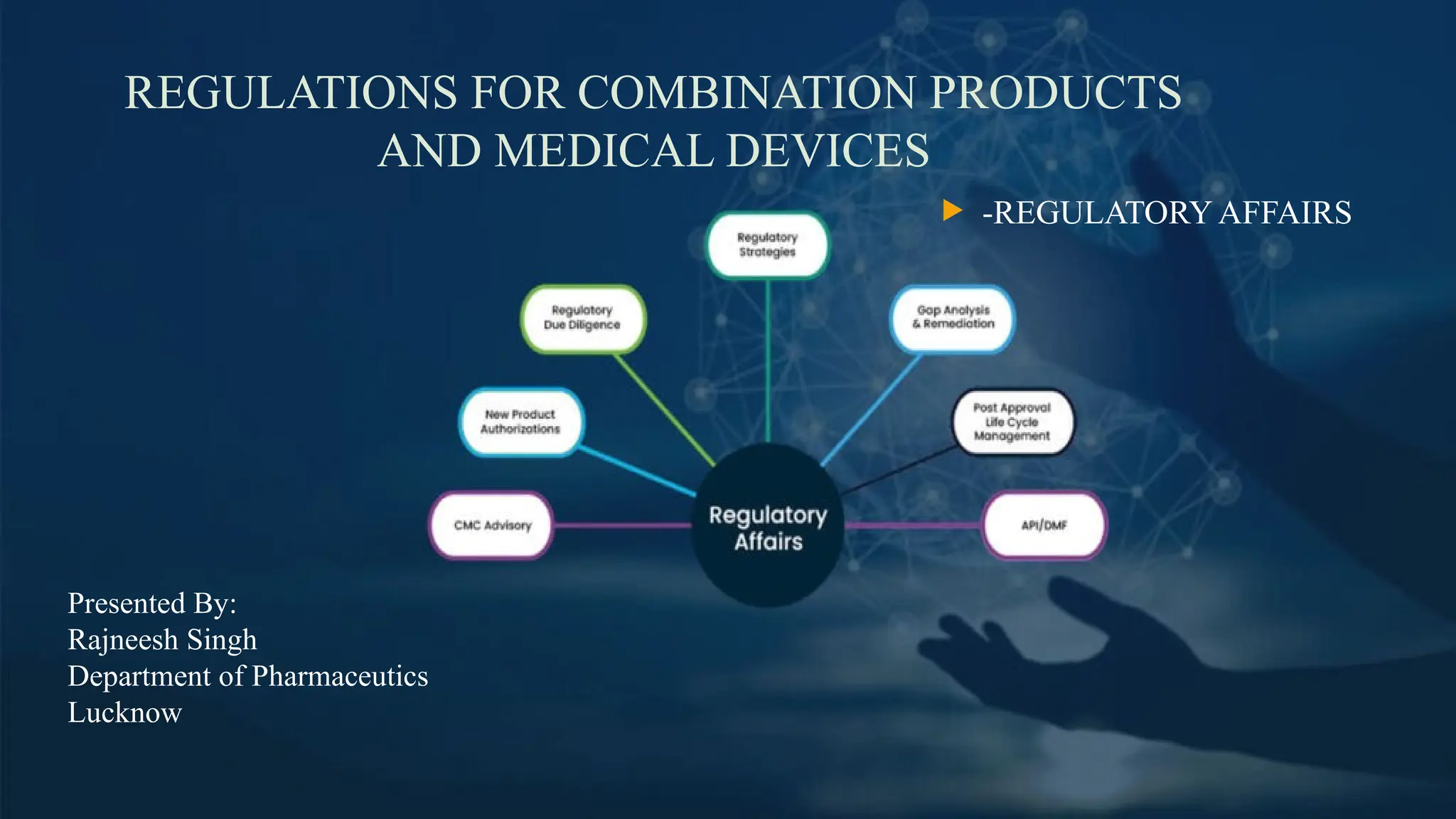
REGULATIONS FOR COMBINATION PRODUCTS
AND MEDICAL DEVICES
 -REGULATORY AFFAIRS
Presented By:
Rajneesh Singh
Department of Pharmaceutics
Lucknow
Content
 Combination Product
 Medical Devices
 Regulatory Authorities
 Who Regulates Medical devices ?
 Regulation in India
 Conclusion
 References
Combination Product
Two or More separate products packed together in a single package or as a
unit comprised of a drug and devices products, devices and biological
products or biological and Drug products.
Example: -
 Monoclonal antibody combined with a chemotherapeutic drug.
 Prefilled drug delivery system (syringes, insulin injector pen).
 Devices coated or impregnated with a drug.
Medical Devices
 According Therapeutics Goods Act 1989, it is defined as any instrument
apparatus, appliances, material or other article (whether used alone or in
combination and including the software necessary for its proper application)
intended to be used for human being.
 Diagnosis, prevention, monitoring, treatment or alleviation of Diseases.
 Investigation, replacement or modification of the anatomy or of physiological
process.
Regulatory Authorities
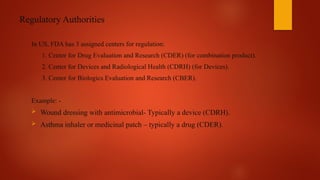
In US, FDA has 3 assigned centers for regulation:
1. Center for Drug Evaluation and Research (CDER) (for combination product).
2. Center for Devices and Radiological Health (CDRH) (for Devices).
3. Center for Biologics Evaluation and Research (CBER).
Example: -
 Wound dressing with antimicrobial- Typically a device (CDRH).
 Asthma inhaler or medicinal patch – typically a drug (CDER).
Who Regulates Medical devices ?
Australia Therapeutic Goods Administration (TGA).
Europe Certification is obtained from a Notified Body.
USA Food And Drug Administration (FDA).
Canada Health Canada.
China The State Food and Drug Administration (SFDA).
Japan Ministry of Health Labour and Welfare (MHLW).
Brazil ANVISA.
Who regulates medical devices in India ?
Drug Controller General of India
Medical Devices and IVDs are regulated by the Drug Controlled General of India (DCGI)
within the Central Drugs Standard Control Organization (CDSCO), part of Ministry of
Health and Family Welfare. The regulatory frame work for medical devices is based on the
Medical device Rules, 2017.
Device Regulation:
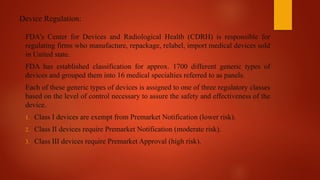
FDA’s Center for Devices and Radiological Health (CDRH) is responsible for
regulating firms who manufacture, repackage, relabel, import medical devices sold
in United state.
FDA has established classification for approx. 1700 different generic types of
devices and grouped them into 16 medical specialties referred to as panels.
Each of these generic types of devices is assigned to one of three regulatory classes
based on the level of control necessary to assure the safety and effectiveness of the
device.
1. Class I devices are exempt from Premarket Notification (lower risk).
2. Class II devices require Premarket Notification (moderate risk).
3. Class III devices require Premarket Approval (high risk).
Regulation in India:
 In India medical devices are governed by CDSCO (Central Drug Standard Control
Organization) which is regulated by Directorate General of Health Services,
Ministry of Health and Family Welfare, Govt. of India.
 CDSCO is the only government body which regulates the medical devices.
 Many committees had been set up and given their opinion and recommendation, like
the Mahelkar committee – Central Drug Standard Control Organization.
 All these are now being taken into to form the Indian Medical Device Regulatory
Act. (IMRDA).
Regulatory Requirements of Medical Devices Distribution in
US
The basic regulatory requirements that manufactures of medical devices distributed
in the U.S. must comply with are:
1.Establishment Registration:
Manufacture / imports must register their established mint with FDA. Information
verified annually between 1st
October – 31st
December.
Medical device listing
Manufacturers must list their device with the FDA with information about
manufacture, distributor, specification, accessories / component, remanufacture,
US manufacture of ‘export only’ devices.
Premarket notification:
Letter of substantial equivalence from FDA required before
commercial distribution
Premarket approval(PMA):
Class III devices are high risk device so that include the submission of clinical
data to support claims made for the device.
Investigational device exemption (IDE):
Allow the investigational device to be used in a clinical study in order to collect
safety and effectiveness data required to support a premarket.
Clinical studies with devices of significant risk must be approval by FDA and by an
Institutional review board (IRB) before the study can being.
Quality system regulation (QC)/Good manufacturing practices (GMP):
Includes methods, facilities and control used for: designing, purchasing,
manufacturing, packing, labelling, storing, installing and service of medical
devices to compliance.
Labeling:
Includes level on the device as well as descriptive and information literature that a
companies the device.
Us FDA uses 3 key components in the regulation of combination products:
Constituent parts retain regulatory status and duties.
Combination product are a distinct regulatory classes..
 The conformity Assessment is done by the US FDA centres:
 1. Best dance safety and effectiveness - constituent parts and
interaction of constituent parts.
 Combined / coordinated analysis and decision making by centers,
with OCP input as needed.
Conclusion
 The goal of the regulatory review of combination products is to evaluate and ensure their
safety and efficacy. A systematic approach of regulatory review of combination products
should focus on their design rationale, PMOA, preclinical evaluation and clinical
evaluation.
References:
 https://www.fda.gov/combination-products/about-combination-products/fr
equently-asked-questions-about-combination-products#examples
 https://www.slideshare.net
 https://www.fda.gov/combination-products
 https://www.fda.gov/medical-devices/devices-advices-comrehencive-regul
atory-assistance/overview-devices-regulation

regulation and combination products.pptx

  • 1.
    REGULATIONS FOR COMBINATIONPRODUCTS AND MEDICAL DEVICES  -REGULATORY AFFAIRS Presented By: Rajneesh Singh Department of Pharmaceutics Lucknow
  • 2.
    Content  Combination Product Medical Devices  Regulatory Authorities  Who Regulates Medical devices ?  Regulation in India  Conclusion  References
  • 3.
    Combination Product Two orMore separate products packed together in a single package or as a unit comprised of a drug and devices products, devices and biological products or biological and Drug products. Example: -  Monoclonal antibody combined with a chemotherapeutic drug.  Prefilled drug delivery system (syringes, insulin injector pen).  Devices coated or impregnated with a drug.
  • 4.
    Medical Devices  AccordingTherapeutics Goods Act 1989, it is defined as any instrument apparatus, appliances, material or other article (whether used alone or in combination and including the software necessary for its proper application) intended to be used for human being.  Diagnosis, prevention, monitoring, treatment or alleviation of Diseases.  Investigation, replacement or modification of the anatomy or of physiological process.
  • 5.
    Regulatory Authorities In US,FDA has 3 assigned centers for regulation: 1. Center for Drug Evaluation and Research (CDER) (for combination product). 2. Center for Devices and Radiological Health (CDRH) (for Devices). 3. Center for Biologics Evaluation and Research (CBER). Example: -  Wound dressing with antimicrobial- Typically a device (CDRH).  Asthma inhaler or medicinal patch – typically a drug (CDER).
  • 6.
    Who Regulates Medicaldevices ? Australia Therapeutic Goods Administration (TGA). Europe Certification is obtained from a Notified Body. USA Food And Drug Administration (FDA). Canada Health Canada. China The State Food and Drug Administration (SFDA). Japan Ministry of Health Labour and Welfare (MHLW). Brazil ANVISA. Who regulates medical devices in India ? Drug Controller General of India Medical Devices and IVDs are regulated by the Drug Controlled General of India (DCGI) within the Central Drugs Standard Control Organization (CDSCO), part of Ministry of Health and Family Welfare. The regulatory frame work for medical devices is based on the Medical device Rules, 2017.
  • 7.
    Device Regulation: FDA’s Centerfor Devices and Radiological Health (CDRH) is responsible for regulating firms who manufacture, repackage, relabel, import medical devices sold in United state. FDA has established classification for approx. 1700 different generic types of devices and grouped them into 16 medical specialties referred to as panels. Each of these generic types of devices is assigned to one of three regulatory classes based on the level of control necessary to assure the safety and effectiveness of the device. 1. Class I devices are exempt from Premarket Notification (lower risk). 2. Class II devices require Premarket Notification (moderate risk). 3. Class III devices require Premarket Approval (high risk).
  • 8.
    Regulation in India: In India medical devices are governed by CDSCO (Central Drug Standard Control Organization) which is regulated by Directorate General of Health Services, Ministry of Health and Family Welfare, Govt. of India.  CDSCO is the only government body which regulates the medical devices.  Many committees had been set up and given their opinion and recommendation, like the Mahelkar committee – Central Drug Standard Control Organization.  All these are now being taken into to form the Indian Medical Device Regulatory Act. (IMRDA).
  • 9.
    Regulatory Requirements ofMedical Devices Distribution in US The basic regulatory requirements that manufactures of medical devices distributed in the U.S. must comply with are: 1.Establishment Registration: Manufacture / imports must register their established mint with FDA. Information verified annually between 1st October – 31st December. Medical device listing Manufacturers must list their device with the FDA with information about manufacture, distributor, specification, accessories / component, remanufacture, US manufacture of ‘export only’ devices. Premarket notification: Letter of substantial equivalence from FDA required before commercial distribution
  • 10.
    Premarket approval(PMA): Class IIIdevices are high risk device so that include the submission of clinical data to support claims made for the device. Investigational device exemption (IDE): Allow the investigational device to be used in a clinical study in order to collect safety and effectiveness data required to support a premarket. Clinical studies with devices of significant risk must be approval by FDA and by an Institutional review board (IRB) before the study can being. Quality system regulation (QC)/Good manufacturing practices (GMP): Includes methods, facilities and control used for: designing, purchasing, manufacturing, packing, labelling, storing, installing and service of medical devices to compliance. Labeling: Includes level on the device as well as descriptive and information literature that a companies the device.
  • 11.
    Us FDA uses3 key components in the regulation of combination products: Constituent parts retain regulatory status and duties. Combination product are a distinct regulatory classes..  The conformity Assessment is done by the US FDA centres:  1. Best dance safety and effectiveness - constituent parts and interaction of constituent parts.  Combined / coordinated analysis and decision making by centers, with OCP input as needed.
  • 12.
    Conclusion  The goalof the regulatory review of combination products is to evaluate and ensure their safety and efficacy. A systematic approach of regulatory review of combination products should focus on their design rationale, PMOA, preclinical evaluation and clinical evaluation.
  • 13.
    References:  https://www.fda.gov/combination-products/about-combination-products/fr equently-asked-questions-about-combination-products#examples  https://www.slideshare.net https://www.fda.gov/combination-products  https://www.fda.gov/medical-devices/devices-advices-comrehencive-regul atory-assistance/overview-devices-regulation