REGRESSION ANALYSIS
M.Ravishankar
[ And it’s application in Business ]
Introduction. . .
• Father of Regression Analysis
Carl F. Gauss (1777-1855).
• contributions to physics, Mathematics &
astronomy.
• The term “Regression” was first used in
1877 by Francis Galton.
Regression Analysis. . .
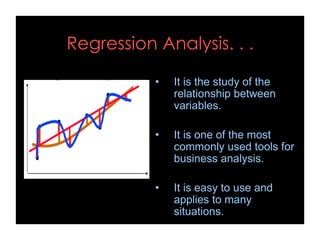
• It is the study of the
relationship between
variables.
• It is one of the most
commonly used tools for
business analysis.
• It is easy to use and
applies to many
situations.
Regression types. . .
• Simple Regression: single explanatory
variable
• Multiple Regression: includes any number of
explanatory variables.
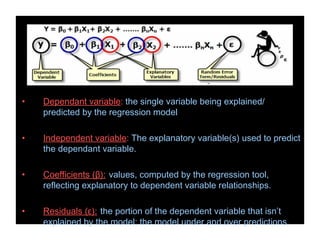
• Dependant variable: the single variable being explained/
predicted by the regression model
• Independent variable: The explanatory variable(s) used to predict
the dependant variable.
• Coefficients (β): values, computed by the regression tool,
reflecting explanatory to dependent variable relationships.
• Residuals (ε): the portion of the dependent variable that isn’t
explained by the model; the model under and over predictions.
Regression Analysis. . .
• Linear Regression: straight-line relationship
– Form: y=mx+b
• Non-linear: implies curved relationships
– logarithmic relationships
Regression Analysis. . .
• Cross Sectional: data gathered from the
same time period
• Time Series: Involves data observed over
equally spaced points in time.
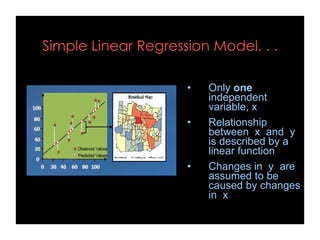
Simple Linear Regression Model. . .
• Only one
independent
variable, x
• Relationship
between x and y
is described by a
linear function
• Changes in y are
assumed to be
caused by changes
in x
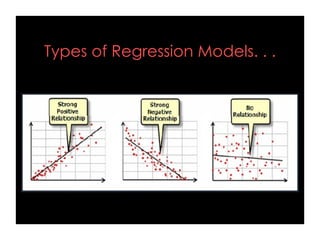
Types of Regression Models. . .
x
b
b
ŷ 1
0
i +
=
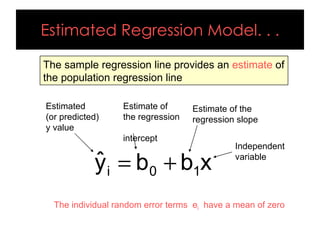
The sample regression line provides an estimate of
the population regression line
Estimated Regression Model. . .
Estimate of
the regression
intercept
Estimate of the
regression slope
Estimated
(or predicted)
y value
Independent
variable
The individual random error terms ei have a mean of zero
Simple Linear Regression Example. . .
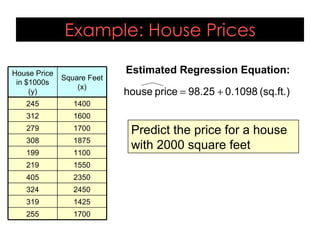
• A real estate agent wishes to examine
the relationship between the selling price
of a home and its size (measured in
square feet)
• A random sample of 10 houses is
selected
– Dependent variable (y) = house price in
$1000s
– Independent variable (x) = square feet
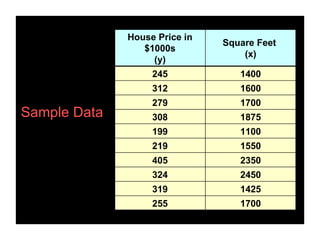
Sample Data
House Price in
$1000s
(y)
Square Feet
(x)
245 1400
312 1600
279 1700
308 1875
199 1100
219 1550
405 2350
324 2450
319 1425
255 1700
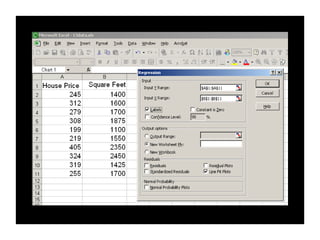
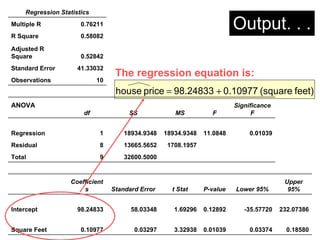
Output. . .
Regression Statistics
Multiple R 0.76211
R Square 0.58082
Adjusted R
Square 0.52842
Standard Error 41.33032
Observations 10
ANOVA
df SS MS F
Significance
F
Regression 1 18934.9348 18934.9348 11.0848 0.01039
Residual 8 13665.5652 1708.1957
Total 9 32600.5000
Coefficient
s Standard Error t Stat P-value Lower 95%
Upper
95%
Intercept 98.24833 58.03348 1.69296 0.12892 -35.57720 232.07386
Square Feet 0.10977 0.03297 3.32938 0.01039 0.03374 0.18580
The regression equation is:
feet)
(square
0.10977
98.24833
price
house +
=
0
50
100
150
200
250
300
350
400
450
0 500 1000 1500 2000 2500 3000
Square Feet
House
Price
($1000s)
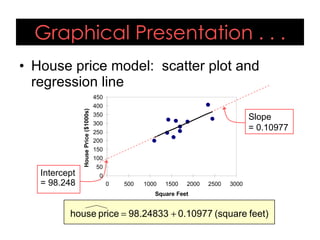
Graphical Presentation . . .
• House price model: scatter plot and
regression line
feet)
(square
0.10977
98.24833
price
house +
=
Slope
= 0.10977
Intercept
= 98.248
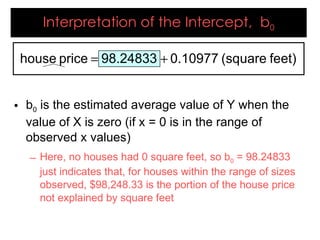
Interpretation of the Intercept, b0
• b0 is the estimated average value of Y when the
value of X is zero (if x = 0 is in the range of
observed x values)
– Here, no houses had 0 square feet, so b0 = 98.24833
just indicates that, for houses within the range of sizes
observed, $98,248.33 is the portion of the house price
not explained by square feet
feet)
(square
0.10977
98.24833
price
house +
=
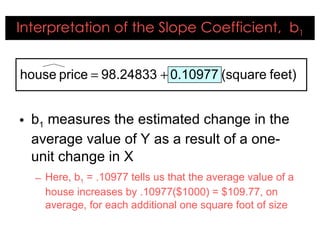
Interpretation of the Slope Coefficient, b1
• b1 measures the estimated change in the
average value of Y as a result of a one-
unit change in X
– Here, b1 = .10977 tells us that the average value of a
house increases by .10977($1000) = $109.77, on
average, for each additional one square foot of size
feet)
(square
0.10977
98.24833
price
house +
=
House Price
in $1000s
(y)
Square Feet
(x)
245 1400
312 1600
279 1700
308 1875
199 1100
219 1550
405 2350
324 2450
319 1425
255 1700
(sq.ft.)
0.1098
98.25
price
house +
=
Estimated Regression Equation:
Example: House Prices
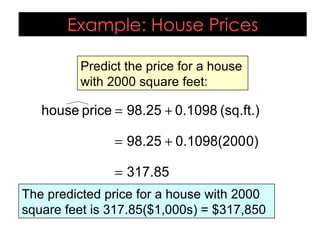
Predict the price for a house
with 2000 square feet
317.85
0)
0.1098(200
98.25
(sq.ft.)
0.1098
98.25
price
house
=
+
=
+
=
Example: House Prices
Predict the price for a house
with 2000 square feet:
The predicted price for a house with 2000
square feet is 317.85($1,000s) = $317,850
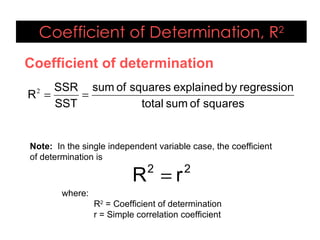
Coefficient of determination
Coefficient of Determination, R2
squares
of
sum
total
regression
by
explained
squares
of
sum
SST
SSR
R =
=
2
Note: In the single independent variable case, the coefficient
of determination is
where:
R2
= Coefficient of determination
r = Simple correlation coefficient
2
2
r
R =
R2
= +1
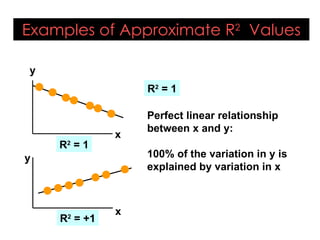
Examples of Approximate R2
Values
y
x
y
x
R2
= 1
R2
= 1
Perfect linear relationship
between x and y:
100% of the variation in y is
explained by variation in x
Examples of Approximate R2
Values
y
x
y
x
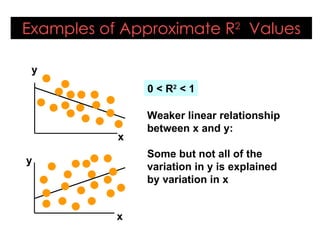
0 < R2
< 1
Weaker linear relationship
between x and y:
Some but not all of the
variation in y is explained
by variation in x
Examples of Approximate R2
Values
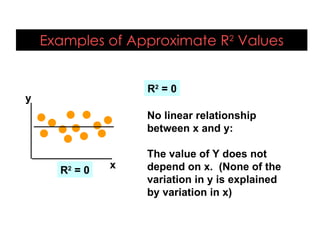
R2
= 0
No linear relationship
between x and y:
The value of Y does not
depend on x. (None of the
variation in y is explained
by variation in x)
y
x
R2
= 0
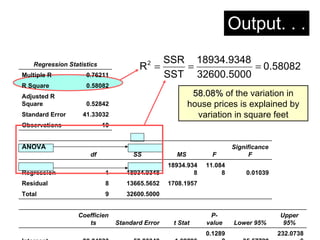
Output. . .
Regression Statistics
Multiple R 0.76211
R Square 0.58082
Adjusted R
Square 0.52842
Standard Error 41.33032
Observations 10
ANOVA
df SS MS F
Significance
F
Regression 1 18934.9348
18934.934
8
11.084
8 0.01039
Residual 8 13665.5652 1708.1957
Total 9 32600.5000
Coefficien
ts Standard Error t Stat
P-
value Lower 95%
Upper
95%
0.1289 232.0738
58.08%
58.08% of the variation in
house prices is explained by
variation in square feet
0.58082
32600.5000
18934.9348
SST
SSR
R2
=
=
=
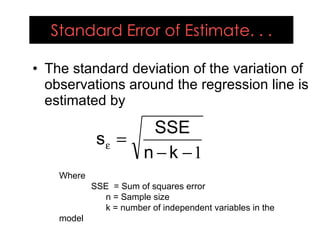
Standard Error of Estimate. . .
• The standard deviation of the variation of
observations around the regression line is
estimated by
1
−
−
=
ε
k
n
SSE
s
Where
SSE = Sum of squares error
n = Sample size
k = number of independent variables in the
model
The Standard Deviation of the
Regression Slope
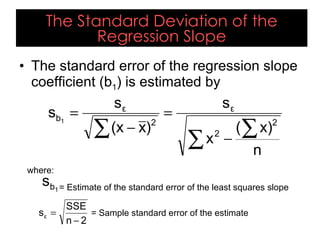
• The standard error of the regression slope
coefficient (b1) is estimated by
∑ ∑
∑ −
=
−
=
n
x)
(
x
s
)
x
(x
s
s
2
2
ε
2
ε
b1
where:
= Estimate of the standard error of the least squares slope
= Sample standard error of the estimate
1
b
s
2
n
SSE
sε
−
=
Output. . .
Regression Statistics
Multiple R 0.76211
R Square 0.58082
Adjusted R
Square 0.52842
Standard Error 41.33032
Observations 10
ANOVA
df SS MS F
Significance
F
Regression 1 18934.9348
18934.934
8
11.084
8 0.01039
Residual 8 13665.5652 1708.1957
Total 9 32600.5000
Coefficien
ts Standard Error t Stat
P-
value Lower 95%
Upper
95%
0.1289 232.0738
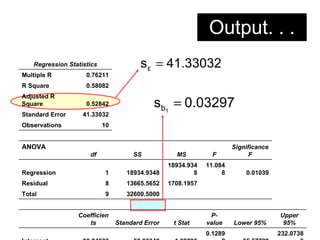
41.33032
sε =
0.03297
s 1
b =
Reference. . .
• Business
Business statistics by S.P.Gupta & M.P.Gupta
Sources retrieved from Internet…
• www.humboldt.edu
• www.cs.usask.ca
• www.cab.latech.edu
• www.quickmba.com
• www.wikipedia.com
• www.youtube.com
M.RAVISHANKAR
MBA(AB) 2008-2010 Batch
NIFTTEA KNITWEAR FASHION
INSTITUTE
TIRUPUR
OXYGEN024@GMAIL.COM
regressionanalysis-110723130213-phpapp02.pdf

regressionanalysis-110723130213-phpapp02.pdf

  • 1.
    REGRESSION ANALYSIS M.Ravishankar [ Andit’s application in Business ]
  • 2.
    Introduction. . . •Father of Regression Analysis Carl F. Gauss (1777-1855). • contributions to physics, Mathematics & astronomy. • The term “Regression” was first used in 1877 by Francis Galton.
  • 3.
    Regression Analysis. .. • It is the study of the relationship between variables. • It is one of the most commonly used tools for business analysis. • It is easy to use and applies to many situations.
  • 4.
    Regression types. .. • Simple Regression: single explanatory variable • Multiple Regression: includes any number of explanatory variables.
  • 5.
    • Dependant variable:the single variable being explained/ predicted by the regression model • Independent variable: The explanatory variable(s) used to predict the dependant variable. • Coefficients (β): values, computed by the regression tool, reflecting explanatory to dependent variable relationships. • Residuals (ε): the portion of the dependent variable that isn’t explained by the model; the model under and over predictions.
  • 6.
    Regression Analysis. .. • Linear Regression: straight-line relationship – Form: y=mx+b • Non-linear: implies curved relationships – logarithmic relationships
  • 7.
    Regression Analysis. .. • Cross Sectional: data gathered from the same time period • Time Series: Involves data observed over equally spaced points in time.
  • 8.
    Simple Linear RegressionModel. . . • Only one independent variable, x • Relationship between x and y is described by a linear function • Changes in y are assumed to be caused by changes in x
  • 9.
  • 10.
    x b b ŷ 1 0 i + = Thesample regression line provides an estimate of the population regression line Estimated Regression Model. . . Estimate of the regression intercept Estimate of the regression slope Estimated (or predicted) y value Independent variable The individual random error terms ei have a mean of zero
  • 11.
    Simple Linear RegressionExample. . . • A real estate agent wishes to examine the relationship between the selling price of a home and its size (measured in square feet) • A random sample of 10 houses is selected – Dependent variable (y) = house price in $1000s – Independent variable (x) = square feet
  • 12.
    Sample Data House Pricein $1000s (y) Square Feet (x) 245 1400 312 1600 279 1700 308 1875 199 1100 219 1550 405 2350 324 2450 319 1425 255 1700
  • 14.
    Output. . . RegressionStatistics Multiple R 0.76211 R Square 0.58082 Adjusted R Square 0.52842 Standard Error 41.33032 Observations 10 ANOVA df SS MS F Significance F Regression 1 18934.9348 18934.9348 11.0848 0.01039 Residual 8 13665.5652 1708.1957 Total 9 32600.5000 Coefficient s Standard Error t Stat P-value Lower 95% Upper 95% Intercept 98.24833 58.03348 1.69296 0.12892 -35.57720 232.07386 Square Feet 0.10977 0.03297 3.32938 0.01039 0.03374 0.18580 The regression equation is: feet) (square 0.10977 98.24833 price house + =
  • 15.
    0 50 100 150 200 250 300 350 400 450 0 500 10001500 2000 2500 3000 Square Feet House Price ($1000s) Graphical Presentation . . . • House price model: scatter plot and regression line feet) (square 0.10977 98.24833 price house + = Slope = 0.10977 Intercept = 98.248
  • 16.
    Interpretation of theIntercept, b0 • b0 is the estimated average value of Y when the value of X is zero (if x = 0 is in the range of observed x values) – Here, no houses had 0 square feet, so b0 = 98.24833 just indicates that, for houses within the range of sizes observed, $98,248.33 is the portion of the house price not explained by square feet feet) (square 0.10977 98.24833 price house + =
  • 17.
    Interpretation of theSlope Coefficient, b1 • b1 measures the estimated change in the average value of Y as a result of a one- unit change in X – Here, b1 = .10977 tells us that the average value of a house increases by .10977($1000) = $109.77, on average, for each additional one square foot of size feet) (square 0.10977 98.24833 price house + =
  • 18.
    House Price in $1000s (y) SquareFeet (x) 245 1400 312 1600 279 1700 308 1875 199 1100 219 1550 405 2350 324 2450 319 1425 255 1700 (sq.ft.) 0.1098 98.25 price house + = Estimated Regression Equation: Example: House Prices Predict the price for a house with 2000 square feet
  • 19.
    317.85 0) 0.1098(200 98.25 (sq.ft.) 0.1098 98.25 price house = + = + = Example: House Prices Predictthe price for a house with 2000 square feet: The predicted price for a house with 2000 square feet is 317.85($1,000s) = $317,850
  • 20.
    Coefficient of determination Coefficientof Determination, R2 squares of sum total regression by explained squares of sum SST SSR R = = 2 Note: In the single independent variable case, the coefficient of determination is where: R2 = Coefficient of determination r = Simple correlation coefficient 2 2 r R =
  • 21.
    R2 = +1 Examples ofApproximate R2 Values y x y x R2 = 1 R2 = 1 Perfect linear relationship between x and y: 100% of the variation in y is explained by variation in x
  • 22.
    Examples of ApproximateR2 Values y x y x 0 < R2 < 1 Weaker linear relationship between x and y: Some but not all of the variation in y is explained by variation in x
  • 23.
    Examples of ApproximateR2 Values R2 = 0 No linear relationship between x and y: The value of Y does not depend on x. (None of the variation in y is explained by variation in x) y x R2 = 0
  • 24.
    Output. . . RegressionStatistics Multiple R 0.76211 R Square 0.58082 Adjusted R Square 0.52842 Standard Error 41.33032 Observations 10 ANOVA df SS MS F Significance F Regression 1 18934.9348 18934.934 8 11.084 8 0.01039 Residual 8 13665.5652 1708.1957 Total 9 32600.5000 Coefficien ts Standard Error t Stat P- value Lower 95% Upper 95% 0.1289 232.0738 58.08% 58.08% of the variation in house prices is explained by variation in square feet 0.58082 32600.5000 18934.9348 SST SSR R2 = = =
  • 25.
    Standard Error ofEstimate. . . • The standard deviation of the variation of observations around the regression line is estimated by 1 − − = ε k n SSE s Where SSE = Sum of squares error n = Sample size k = number of independent variables in the model
  • 26.
    The Standard Deviationof the Regression Slope • The standard error of the regression slope coefficient (b1) is estimated by ∑ ∑ ∑ − = − = n x) ( x s ) x (x s s 2 2 ε 2 ε b1 where: = Estimate of the standard error of the least squares slope = Sample standard error of the estimate 1 b s 2 n SSE sε − =
  • 27.
    Output. . . RegressionStatistics Multiple R 0.76211 R Square 0.58082 Adjusted R Square 0.52842 Standard Error 41.33032 Observations 10 ANOVA df SS MS F Significance F Regression 1 18934.9348 18934.934 8 11.084 8 0.01039 Residual 8 13665.5652 1708.1957 Total 9 32600.5000 Coefficien ts Standard Error t Stat P- value Lower 95% Upper 95% 0.1289 232.0738 41.33032 sε = 0.03297 s 1 b =
  • 28.
    Reference. . . •Business Business statistics by S.P.Gupta & M.P.Gupta Sources retrieved from Internet… • www.humboldt.edu • www.cs.usask.ca • www.cab.latech.edu • www.quickmba.com • www.wikipedia.com • www.youtube.com
  • 29.
    M.RAVISHANKAR MBA(AB) 2008-2010 Batch NIFTTEAKNITWEAR FASHION INSTITUTE TIRUPUR OXYGEN024@GMAIL.COM