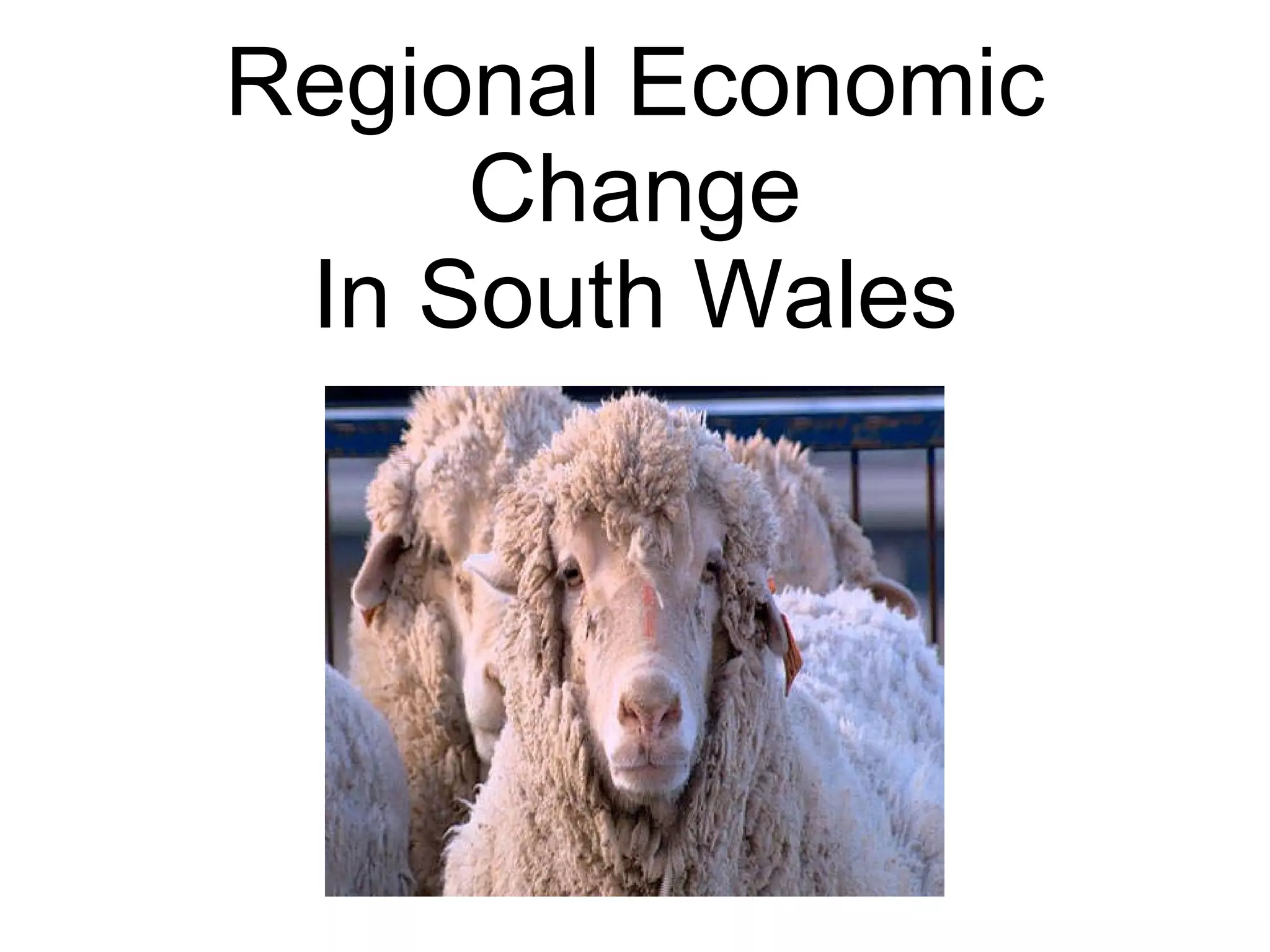
Regional Economic Change In South Wales
What is regional economic change?
Regional economic change is when a regions economy moves on or develops
Examples of regional economic change…
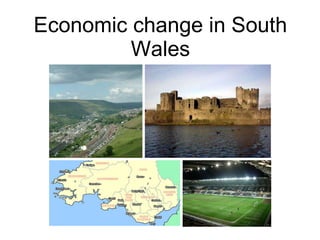
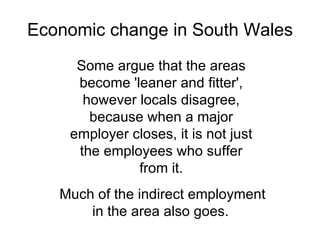
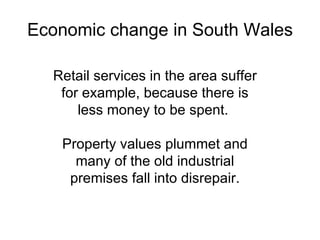
Economic change in South Wales
Economic change in South Wales Areas suffered from decline of the old heavy  'sunset'  industries, e.g.  coal, steel and shipbuilding , and these changes had a significant impact on the socio-economic and natural environments of these areas.
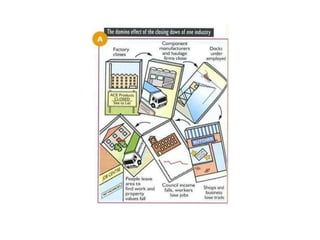
Economic change in South Wales Some argue that the areas become 'leaner and fitter', however locals disagree, because when a major employer closes, it is not just the employees who suffer from it. Much of the indirect employment in the area also goes.
Economic change in South Wales Retail services in the area suffer for example, because there is less money to be spent.  Property values plummet and many of the old industrial premises fall into disrepair.
Domino Effect
 
 
Attracting new industry… Many battered industrial estates have now become thriving areas. E.g. South Wales, Central Scotland and North East England have all attracted new industries thanks to government financial aid. This financial aid is nothing new, and has existed since 1934.
Attracting new industry… However in the 1970's when the UK went into recession, the government renewed attempts to combat the problems of economic decline and unemployment.
They decided to… Redistribute industries… Set up ‘Enterprise zones’ and ‘Assisted areas’ Create ‘Urban development corporations’ (UDCs) Attract overseas investment
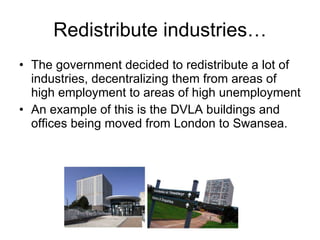
Redistribute industries… The government decided to redistribute a lot of industries, decentralizing them from areas of high employment to areas of high unemployment An example of this is the DVLA buildings and offices being moved from London to Swansea.
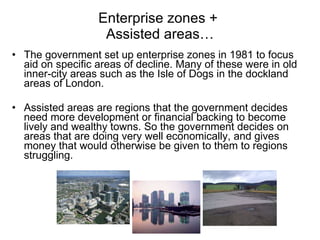
Enterprise zones +  Assisted areas… The government set up enterprise zones in 1981 to focus aid on specific areas of decline. Many of these were in old inner-city areas such as the Isle of Dogs in the dockland areas of London. Assisted areas are regions that the government decides need more development or financial backing to become lively and wealthy towns. So the government decides on areas that are doing very well economically, and gives money that would otherwise be given to them to regions struggling.
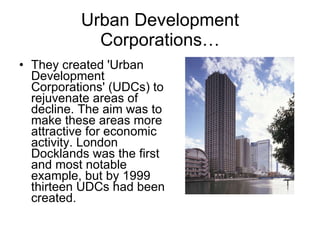
Urban Development Corporations… They created 'Urban Development Corporations' (UDCs) to rejuvenate areas of decline. The aim was to make these areas more attractive for economic activity. London Docklands was the first and most notable example, but by 1999 thirteen UDCs had been created.
Attract overseas investment… Attract investment from overseas. In 1998, 20 per cent of industry in the UK was owned by large foreign multinational companies.
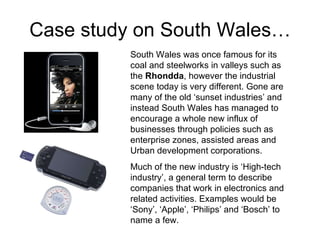
Case study on South Wales… South Wales was once famous for its coal and steelworks in valleys such as the  Rhondda , however the industrial scene today is very different. Gone are many of the old ‘sunset industries’ and instead South Wales has managed to encourage a whole new influx of businesses through policies such as enterprise zones, assisted areas and Urban development corporations.  Much of the new industry is ‘High-tech industry’, a general term to describe companies that work in electronics and related activities. Examples would be ‘Sony’, ‘Apple’, ‘Philips’ and ‘Bosch’ to name a few.
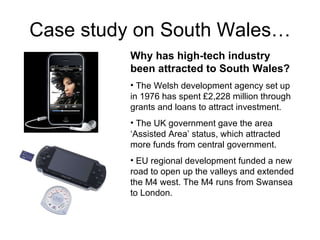
Case study on South Wales… Why has high-tech industry been attracted to South Wales? The Welsh development agency set up in 1976 has spent £2,228 million through grants and loans to attract investment. The UK government gave the area ‘Assisted Area’ status, which attracted more funds from central government. EU regional development funded a new road to open up the valleys and extended the M4 west. The M4 runs from Swansea to London.
 

Regional Economic Change

  • 1.
  • 2.
    What is regionaleconomic change?
  • 3.
    Regional economic changeis when a regions economy moves on or develops
  • 4.
    Examples of regionaleconomic change…
  • 5.
    Economic change inSouth Wales
  • 6.
    Economic change inSouth Wales Areas suffered from decline of the old heavy 'sunset' industries, e.g. coal, steel and shipbuilding , and these changes had a significant impact on the socio-economic and natural environments of these areas.
  • 7.
    Economic change inSouth Wales Some argue that the areas become 'leaner and fitter', however locals disagree, because when a major employer closes, it is not just the employees who suffer from it. Much of the indirect employment in the area also goes.
  • 8.
    Economic change inSouth Wales Retail services in the area suffer for example, because there is less money to be spent. Property values plummet and many of the old industrial premises fall into disrepair.
  • 9.
  • 10.
  • 11.
  • 12.
    Attracting new industry…Many battered industrial estates have now become thriving areas. E.g. South Wales, Central Scotland and North East England have all attracted new industries thanks to government financial aid. This financial aid is nothing new, and has existed since 1934.
  • 13.
    Attracting new industry…However in the 1970's when the UK went into recession, the government renewed attempts to combat the problems of economic decline and unemployment.
  • 14.
    They decided to…Redistribute industries… Set up ‘Enterprise zones’ and ‘Assisted areas’ Create ‘Urban development corporations’ (UDCs) Attract overseas investment
  • 15.
    Redistribute industries… Thegovernment decided to redistribute a lot of industries, decentralizing them from areas of high employment to areas of high unemployment An example of this is the DVLA buildings and offices being moved from London to Swansea.
  • 16.
    Enterprise zones + Assisted areas… The government set up enterprise zones in 1981 to focus aid on specific areas of decline. Many of these were in old inner-city areas such as the Isle of Dogs in the dockland areas of London. Assisted areas are regions that the government decides need more development or financial backing to become lively and wealthy towns. So the government decides on areas that are doing very well economically, and gives money that would otherwise be given to them to regions struggling.
  • 17.
    Urban Development Corporations…They created 'Urban Development Corporations' (UDCs) to rejuvenate areas of decline. The aim was to make these areas more attractive for economic activity. London Docklands was the first and most notable example, but by 1999 thirteen UDCs had been created.
  • 18.
    Attract overseas investment…Attract investment from overseas. In 1998, 20 per cent of industry in the UK was owned by large foreign multinational companies.
  • 19.
    Case study onSouth Wales… South Wales was once famous for its coal and steelworks in valleys such as the Rhondda , however the industrial scene today is very different. Gone are many of the old ‘sunset industries’ and instead South Wales has managed to encourage a whole new influx of businesses through policies such as enterprise zones, assisted areas and Urban development corporations. Much of the new industry is ‘High-tech industry’, a general term to describe companies that work in electronics and related activities. Examples would be ‘Sony’, ‘Apple’, ‘Philips’ and ‘Bosch’ to name a few.
  • 20.
    Case study onSouth Wales… Why has high-tech industry been attracted to South Wales? The Welsh development agency set up in 1976 has spent £2,228 million through grants and loans to attract investment. The UK government gave the area ‘Assisted Area’ status, which attracted more funds from central government. EU regional development funded a new road to open up the valleys and extended the M4 west. The M4 runs from Swansea to London.
  • 21.