REFRACTION, LENSES, & SIGHT
REFRACTION
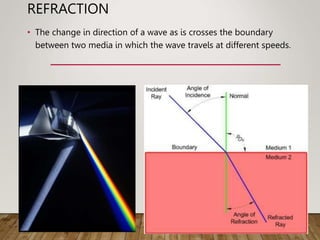
• The change in direction of a wave as is crosses the boundary
between two media in which the wave travels at different speeds.
INDEX OF REFRACTION
• The ratio of the speed of light in a vacuum to the
speed of light in a medium under consideration.
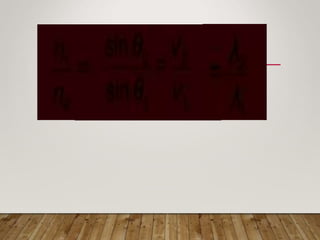
INDEX OF REFRACTION
material
in
light
of
speed
vacuum
in
light
of
speed
n
• C < V air < V liquid < V solid
• C is the speed of light in Vacuum
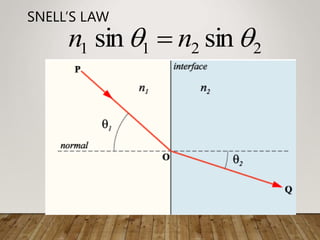
SNELL’S LAW
2
2
1
1 sin
sin 
 n
n 
TOTAL INTERNAL REFLECTION
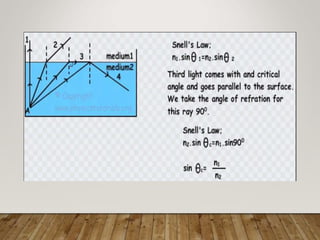
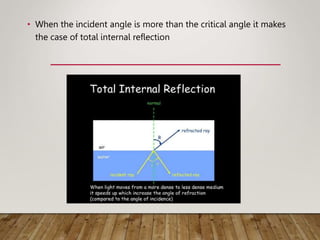
• When the light goes from a medium that has more
dense to a medium that has less dense the refracted
ray goes far from the normal and makes an angle of
refraction =90
• The angle that makes this case is called the
critical angle
TOTAL INTERNAL REFLECTION
• When the incident angle is more than the critical angle it makes
the case of total internal reflection
INDEX OF REFRACTION
Material Index of Refraction
Vacuum 1.0000
Air 1.0003
Ice 1.3100
Water 1.3330
Ethyl Alcohol 1.3600
Plexiglas 1.5100
Crown Glass 1.5200
Light Flint Glass 1.5800
Dense Flint Glass 1.6600
Zircon 1.9230
Diamond 2.4170
Rutile 2.9070
Gallium phosphide 3.5000
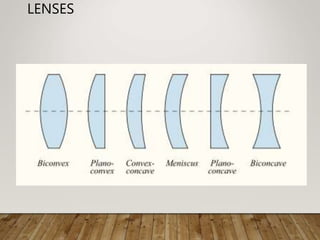
LENSES
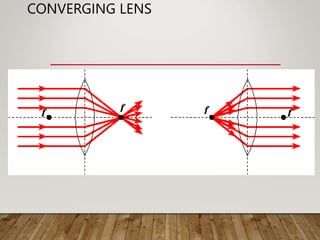
CONVERGING LENS
RULES FOR CONVERGING LENSES
1) Any incident ray traveling parallel to the
principal axis of a converging lens will refract
through the lens and travel through the focal
point on the opposite side of the lens.
2) Any incident ray traveling through the focal
point on the way to the lens will refract through
the lens and travel parallel to the principal axis.
3) An incident ray which passes through the center
of the lens will in effect continue in the same
direction that it had when it entered the lens.
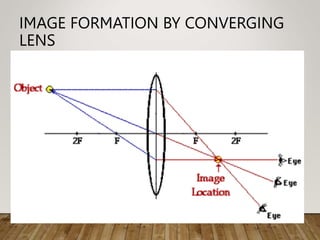
IMAGE FORMATION BY CONVERGING
LENS
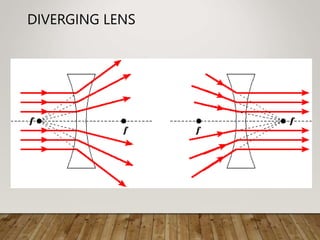
DIVERGING LENS
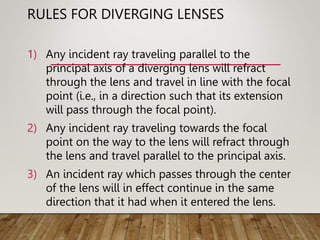
RULES FOR DIVERGING LENSES
1) Any incident ray traveling parallel to the
principal axis of a diverging lens will refract
through the lens and travel in line with the focal
point (i.e., in a direction such that its extension
will pass through the focal point).
2) Any incident ray traveling towards the focal
point on the way to the lens will refract through
the lens and travel parallel to the principal axis.
3) An incident ray which passes through the center
of the lens will in effect continue in the same
direction that it had when it entered the lens.
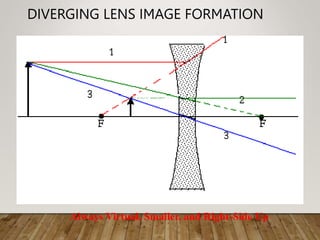
DIVERGING LENS IMAGE FORMATION
Always Virtual, Smaller, and Right-Side Up
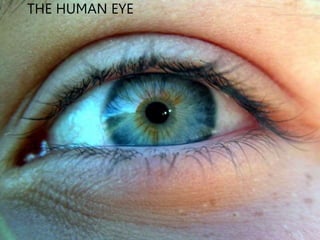
THE HUMAN EYE

refraction.ppt

  • 1.
  • 2.
    REFRACTION • The changein direction of a wave as is crosses the boundary between two media in which the wave travels at different speeds.
  • 3.
    INDEX OF REFRACTION •The ratio of the speed of light in a vacuum to the speed of light in a medium under consideration.
  • 4.
  • 5.
    • C <V air < V liquid < V solid • C is the speed of light in Vacuum
  • 6.
  • 9.
    TOTAL INTERNAL REFLECTION •When the light goes from a medium that has more dense to a medium that has less dense the refracted ray goes far from the normal and makes an angle of refraction =90 • The angle that makes this case is called the critical angle
  • 10.
  • 11.
    • When theincident angle is more than the critical angle it makes the case of total internal reflection
  • 12.
    INDEX OF REFRACTION MaterialIndex of Refraction Vacuum 1.0000 Air 1.0003 Ice 1.3100 Water 1.3330 Ethyl Alcohol 1.3600 Plexiglas 1.5100 Crown Glass 1.5200 Light Flint Glass 1.5800 Dense Flint Glass 1.6600 Zircon 1.9230 Diamond 2.4170 Rutile 2.9070 Gallium phosphide 3.5000
  • 14.
  • 15.
  • 16.
    RULES FOR CONVERGINGLENSES 1) Any incident ray traveling parallel to the principal axis of a converging lens will refract through the lens and travel through the focal point on the opposite side of the lens. 2) Any incident ray traveling through the focal point on the way to the lens will refract through the lens and travel parallel to the principal axis. 3) An incident ray which passes through the center of the lens will in effect continue in the same direction that it had when it entered the lens.
  • 17.
    IMAGE FORMATION BYCONVERGING LENS
  • 18.
  • 19.
    RULES FOR DIVERGINGLENSES 1) Any incident ray traveling parallel to the principal axis of a diverging lens will refract through the lens and travel in line with the focal point (i.e., in a direction such that its extension will pass through the focal point). 2) Any incident ray traveling towards the focal point on the way to the lens will refract through the lens and travel parallel to the principal axis. 3) An incident ray which passes through the center of the lens will in effect continue in the same direction that it had when it entered the lens.
  • 20.
    DIVERGING LENS IMAGEFORMATION Always Virtual, Smaller, and Right-Side Up
  • 21.