Reflect –is an innovative approach to adult
learning and social change, which fuses the
theories of Paulo Freire with the methodologies
of participatory rural appraisal.
Paulo Freire–Paulo Reglus Neves Freire, Ph. D.
Brazilian Educator and Philosopher who was
leading advocate of critical pedagogy.
Pedagogy of the Oppressed – considered as
one of the foundational texts of the critical
pedagogy movement.
5.
Participatory Rural Appraisal(PRA)
describes a growing family of approaches and
methods to enable local people to share,
enhance and analyze their knowledge of life
and conditions, to plan and to act.
6.
Reflect –Freire believes that literacy is directly
related to poverty. With his concern, he wanted
to encourage poor and disadvantaged
members of the society to educate themselves,
take part in planning and employ appropriate
actions to improve not only their own
social/economic status but also for community
development.
7.
Freire criticizedexisting literacy teaching which
was based on primer: “There is an implicit
concept of man in the primer’s method and
content, whether it is recognized by the
authors or not … it is the teacher who chooses
the words and proposes them to the learners …
the students are to be filled with words the
teachers have chosen.
8.
- mostnon-literate people were unable to assert
themselves. As a result of oppression they were
immersed in a ‘culture of silence’: “In the culture
of silence, to exist is only to live. The body carries
out orders from above. Thinking is difficult.
Speaking is forbidden.”
- illiteracy is one of the concrete expressions of an
unjust social reality. It is political…it is a process
of search and creation…(which must) develop
students/learners consciousness of their rights
9.
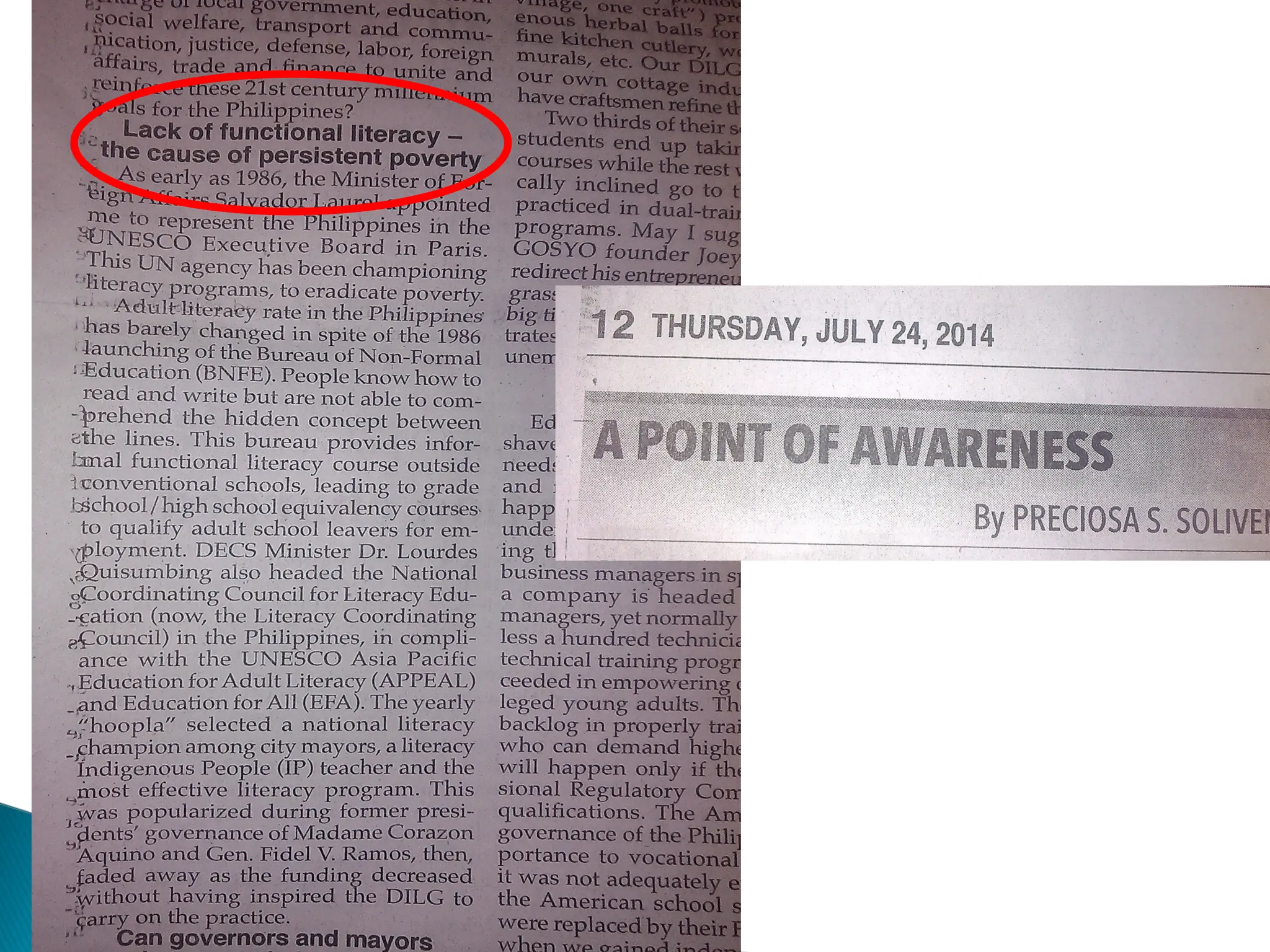
What isthe purpose of Literacy?
Literacy is a way of:
◦ n remembering
◦ n recording
◦ n representing reality;
◦ n communicating across space and time.
10.
To acquirestatus/be represented by other
people. To learn new skills
To take positions of responsibility in
organization
To take basic accounts
To start up a small business
To read and write personal or official letters
To help children with their homework
To have access to information e.g. about
agriculture or health
11.
To readinstructions of medicines/
prescriptions.
To read directions, signposts and posters
To understand labels on fertilizers/pesticides.
To keep records e.g. of children’s vaccinations
To avoid being cheated
To read newspapers
To get a new job
To read religious texts.
To read for diversion/entertainment.
12.
In hisfamous work ‘the pedagogy of the
oppressed’ the students would ‘perceive the
reality of oppression, not as a closed world
from which there is no exit but as a limiting
situation which they can transform.
13.
Conscientization –the process of learning to perceive
social, political and economic contradictions and of taking
action against the oppressive elements of reality it also
involves critical consciousness.
The formation of critical conciousness allows people to
question the nature of their historical and social situation
to read their world with the goal of acting as subjects in
the creation of democratic society (which was new for
Brazil at that time). His pedagogy of literacy education
involves not only reading the word, but also reading the
world. For education, he implies a dialogic exchange
between teachers and students, where both learn, both
question, both reflect and both participate in meaning-
making.
.
14.
The learnersreflect upon these images, first of
all describing them and then through
problematising, analyze their deep structure,
until they come face to face with their own
lives. The codification is thus an “instrument
for this abstraction” – being able to see reality
clearer by taking one step away from it. And
the process of analyzing a codification is called
a ‘decodification’ and involves dialogue.
15.
Freire sawdialogue as fundamental. He
construed this as coming together of the
teacher and learners/students. Dialogue is not
only a discussion but rather it is a discussion
where people, in a trusting environment reach
beyond everyday life, open up, and come face
to face with new understanding and
awareness. “Learners must see the need for
writing one’s life and reading one’s reality.”
16.
But howcould adult literacy work be linked to
conscientization? Freire recognized that
learners needed to “gain a distance from”
their everyday lives so that they could see
their situation in a new way. And the means
of doing this is called codification.
17.
Codifications arepictures or photographs
produced after extensive research in a local
area which, in their images, capture essential
problems or contradictions in the lives of the
learners.
- he believed that literacy alone is of no use if
there is no other process of change which can
help to lift the culture of silence
18.
- havingengaged in dialogue over a
codification, the next step for the literacy class
is the introduction of the word. Not just any
word is chosen, but a carefully selected
‘generative word’ which is arrived at after
‘investigating the vocabulary universe’ (or
‘minimal linguistic universe’) of the learners.
The word itself is the focus of further dialogue.
19.
- Oncea generative word has been introduced,
Freire advocated breaking the generative work
into component syllables and syllabic families –
but always asking questions of the learners, not
doing it for them (only “having prepared the
learners critically for the information” so it “is
not a mere gift.”) Having done this the facilitator
should ask the learners something like: “do you
think we can create something with these
pieces.? For Friere, “this is the decisive moment
for learning” as the learners discover the words
20.
of theirlanguage by putting them together in a
variety of combinations”. This ends the
mystique of written language. For Freire, the
process outlined ( in the previous slides) would
lead to conscientization, giving students a
sense of purpose so that they would really be
able to ‘know’ the world: “The act of knowing
involves a dialectical movement that goes from
action to reflection and from reflection upon
action to a new action”
21.
This process iscalled ‘praxis’
“Action of men without objectives is not praxis –
it is action ignorant of its own process and of
its aim.”
In summary – If learning to read and write is to
constitute an act of knowing the learners must
assume from the beginning the role creative
subjects.
22.
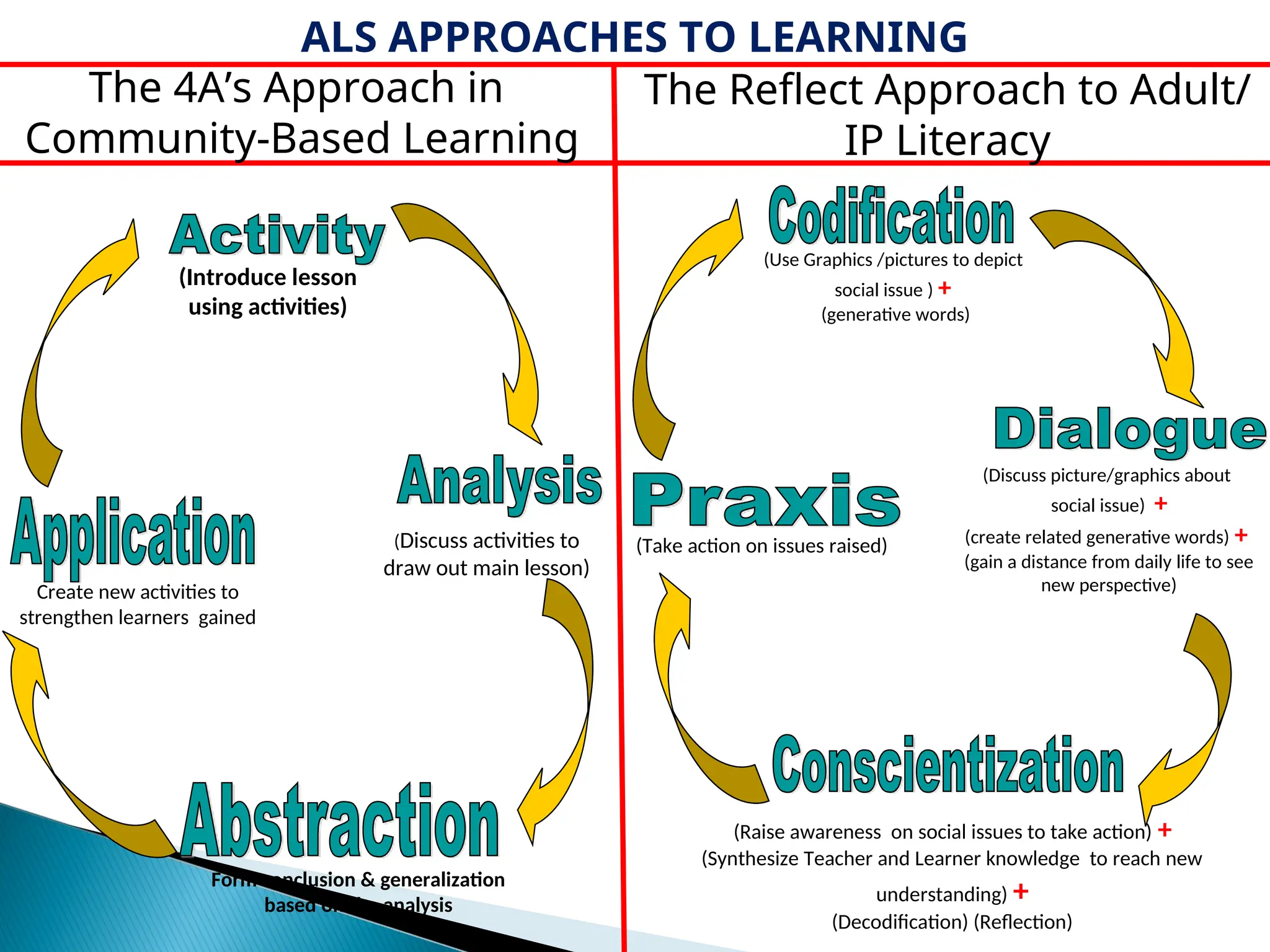
(Introduce lesson
using activities)
(Discussactivities to
draw out main lesson)
Form conclusion & generalization
based on the analysis
Create new activities to
strengthen learners gained
ALS APPROACHES TO LEARNING
The Reflect Approach to Adult/
IP Literacy
The 4A’s Approach in
Community-Based Learning
(Use Graphics /pictures to depict
social issue ) +
(generative words)
(Discuss picture/graphics about
social issue) +
(create related generative words) +
(gain a distance from daily life to see
new perspective)
(Raise awareness on social issues to take action) +
(Synthesize Teacher and Learner knowledge to reach new
understanding) +
(Decodification) (Reflection)
(Take action on issues raised)
23.
It is nota matter of memorizing and repeating
given syllables, words and phrases but rather,
reflecting critically on the process of reading
and writing itself and on the profound
significance of language.
25.
Reflect approach– no textbook-no literacy
“primer” – pre-printed materials except a
manual for the literacy facilitators
- literacy circles develops its own learning
materials through the construction of maps,
matrices, calendars and diagrams that
represent local reality, systematize the existing
knowledge of participants and promote the
detailed analysis of local issues.
26.
Reflect approach– a graphic is initially
constructed on the ground (using whatever
materials are locally available) promoting
everyone’s active participation. These graphics
include:
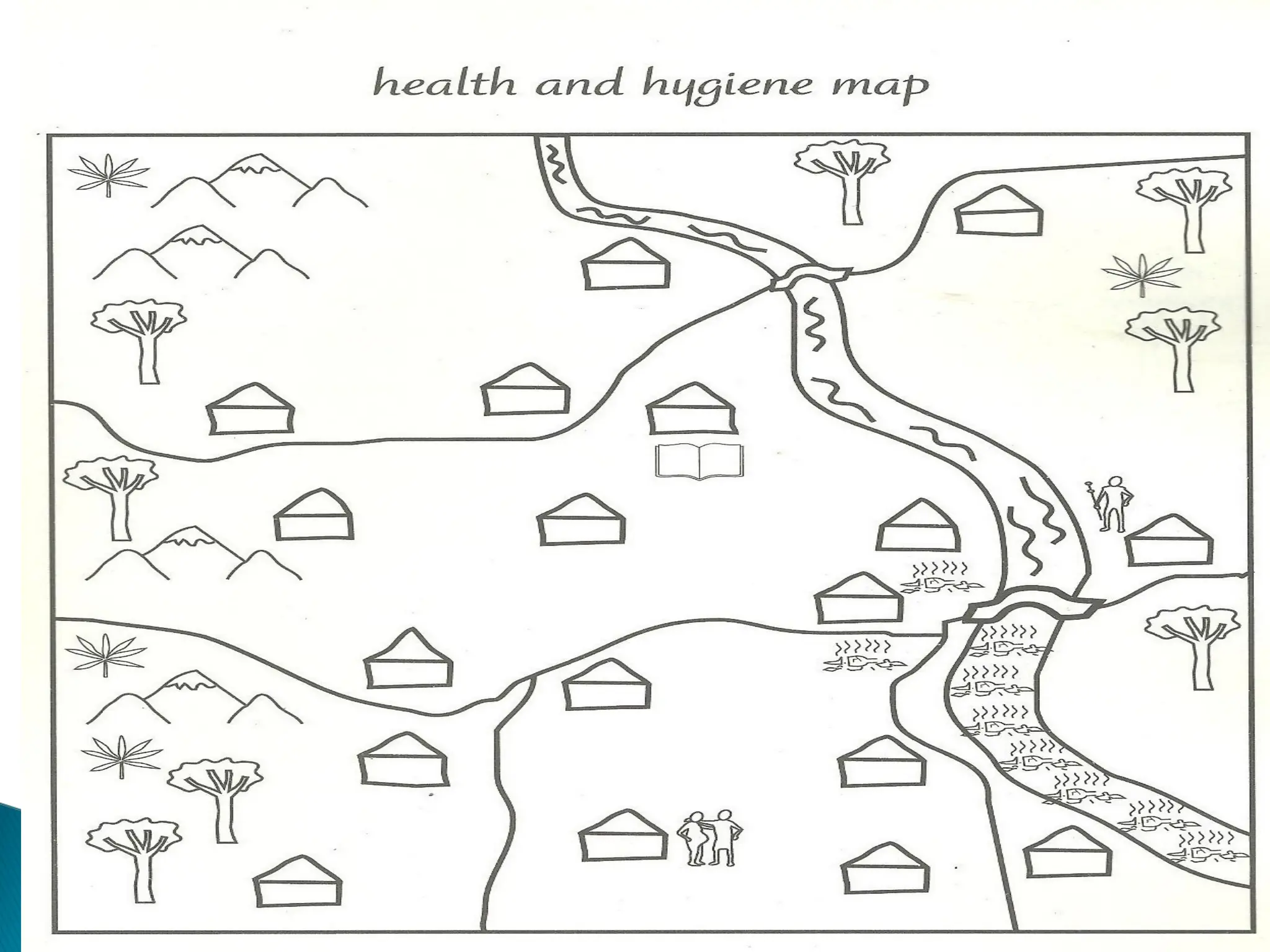
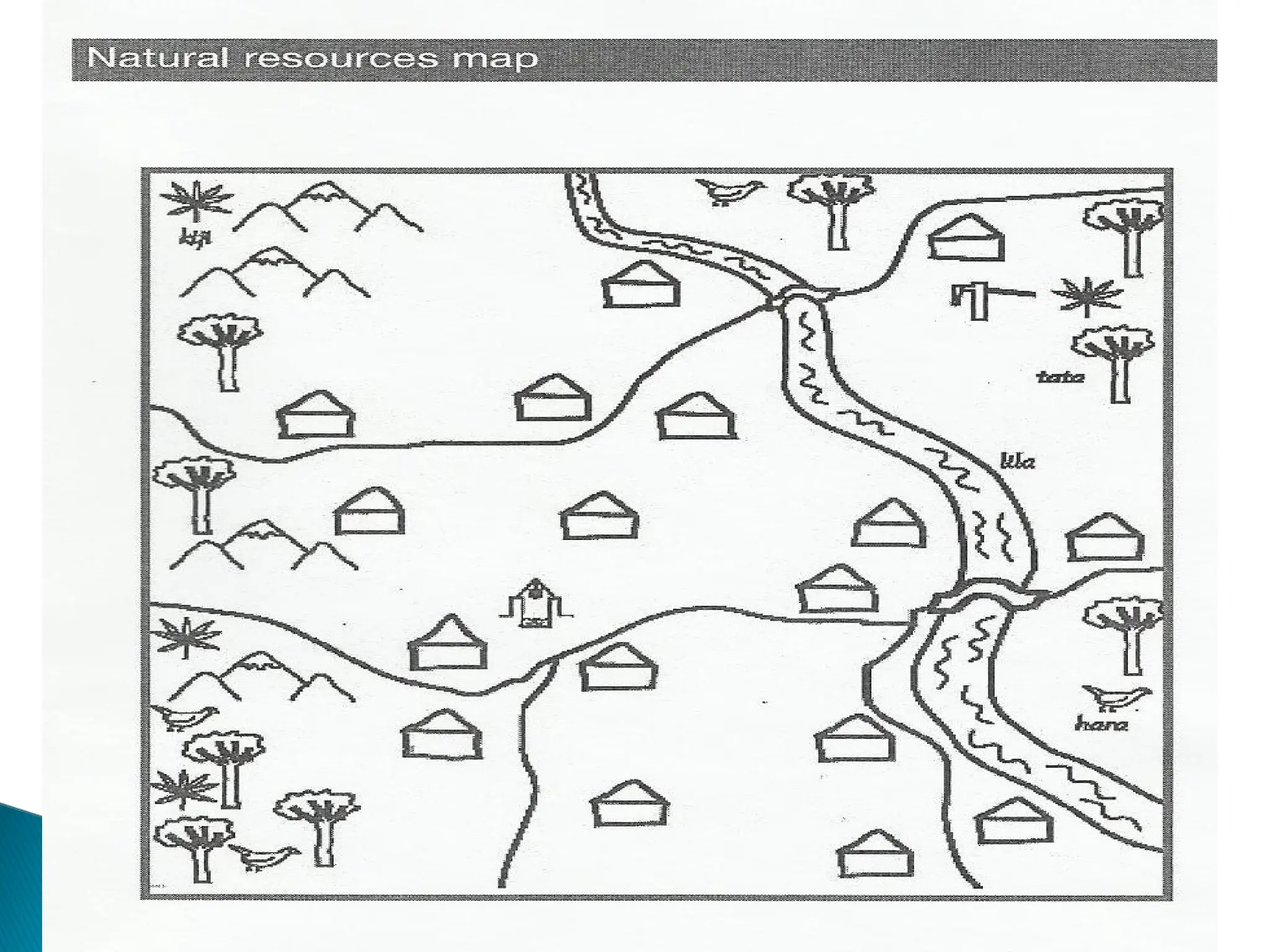
◦ Maps: Household, Agricultural, Natural Resources
Maps, Land Tenure Maps
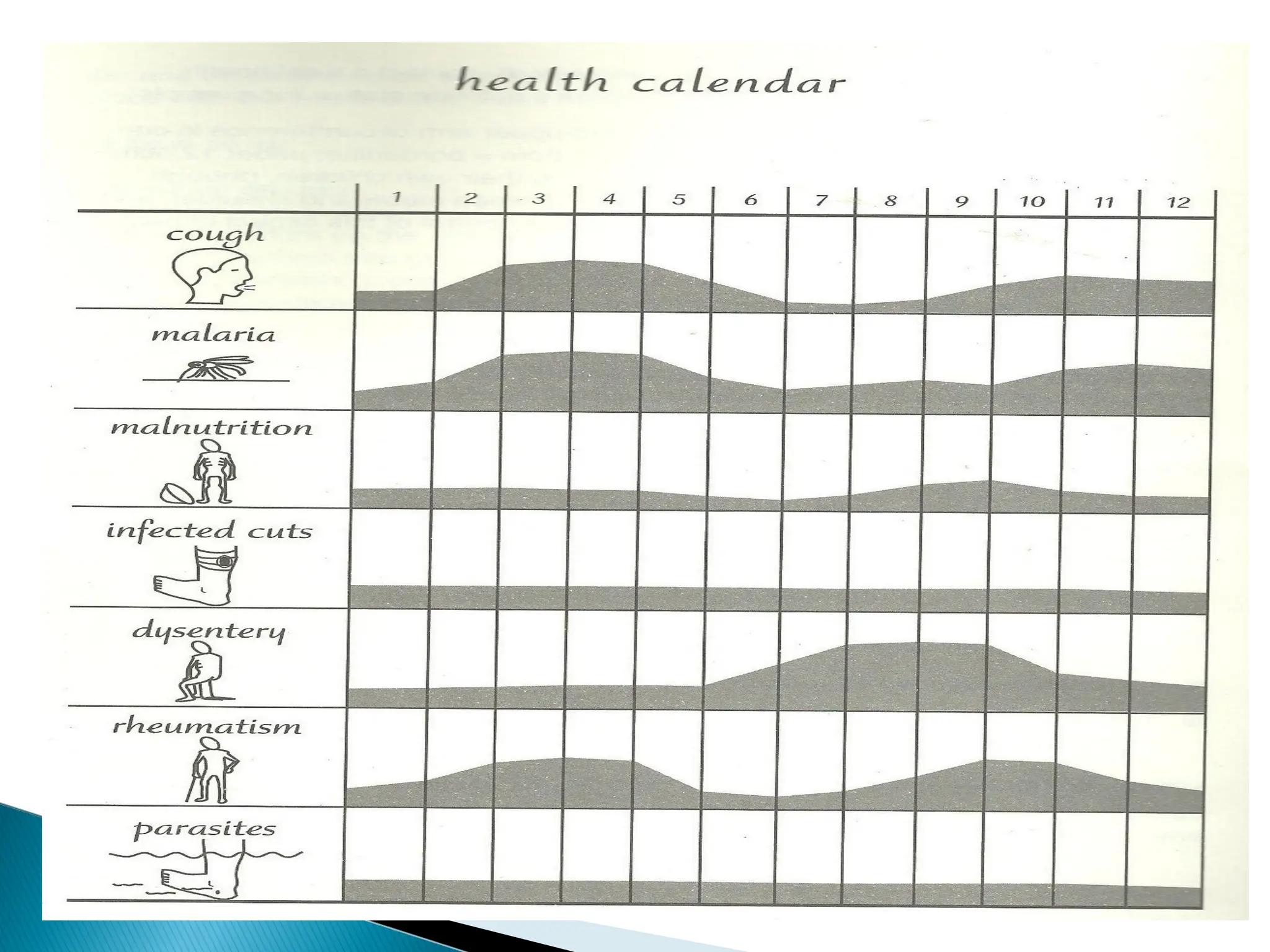
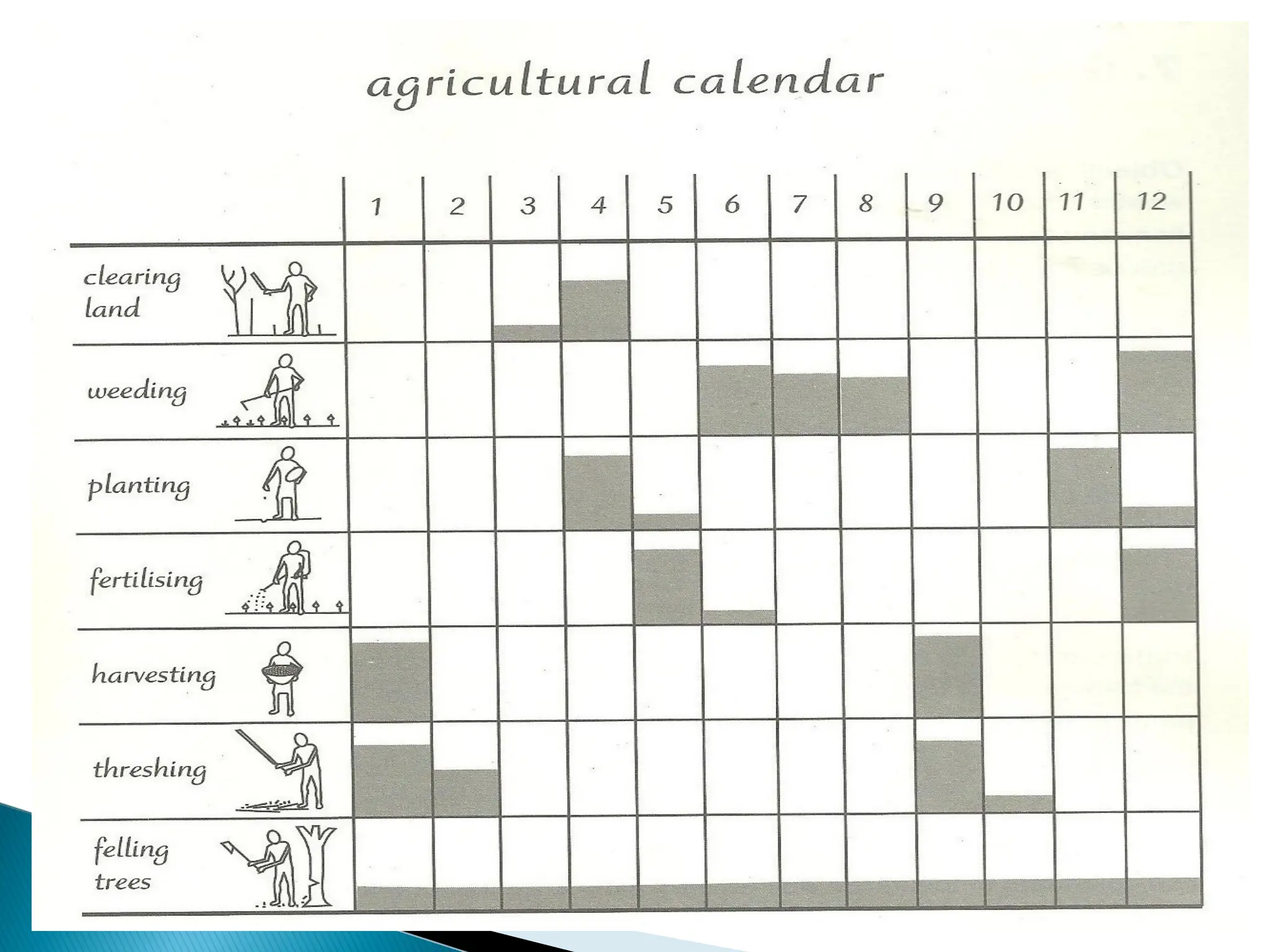
◦ Calendars: Rainfall, Gender Workload, Health
◦ Matrices/charts – Crop, Health, Credit and Household
Decisions
◦ Diagrams – Chapati diagram of organization and
Informal Power Relations
27.
Reflect approach– uses different
community/social issues as starting platform to
encourage sharing of experiences and ideas
among learners.
- the facilitator always put major
consideration the integration of reading,
writing, and numeracy (RWN) for literacy
development among the learners.
#13 it also involves critical consciousness. The formation of critical conciousness allows people to question the nature of their historical and social situation to read their world with the goal of acting as subjects in the creation of democratic society (which was new for Brazil at that time). His pedagogy of literacy education involves not only reading the word, but also reading the world. For education, he implies a dialogic exchange between teachers and students, where both learn, both question, both reflect and both participate in meaning-making.
.
#17 How will you know if someone learn a language if he does not use it?
#25 Freire criticized existing literacy teaching which was based on primer: “There is an implicit concept of man in the primer’s method and content, whether it is recognized by the authors or not … it is the teacher who chooses the words and proposes them to the learners … the students are to be filled with words the teachers have chosen
#26 Maps: Household Maps, Agricultural Maps, Natural Resource Maps, Land Tenure Maps – Maps are the central part of literacy. Literacy partly originated in such design and layout, and is still embedded in it. In china, for example, one of the earliest uses of writing was for the construction of maps.
The use of calendars – of the earliest form of literacy (pre-columbian america) uses of writing was in Egypt where considerations were economic but also “involved the development of calendar for predicting the floods,


![Emancipatory education[6012] (4)](https://cdn.slidesharecdn.com/ss_thumbnails/emancipatoryeducation60124-200816184318-thumbnail.jpg?width=640&height=640&fit=bounds)


