Radio surgical treatment of cranial
lesions; Refining the art
Mohamed Abdulla M.D.
Prof. of Clinical Oncology
Kasr Al-Aini School of Medicine
Cairo University.
Current View in 2015:
• Basic Definition by Leksell:
“The delivery of a single high dose of irradiation to a small and
critically located intracranial volume through the intact skull”
• Improvements of Pre-requisites of Application:
1. Neuroimaging.
2. Neuroanatomy.
3. Reliable radiation therapy delivery system.
• Achievements:
1. Better understanding of radiobiological considerations.
2. Introduction of more reliable radiation therapy devices.
3. Extension to fractionated treatment (Extra-cranial targets).
4. Dose/Volume constraints for normal tissues (OAR).
New Insights of SRS
Radiobiology:
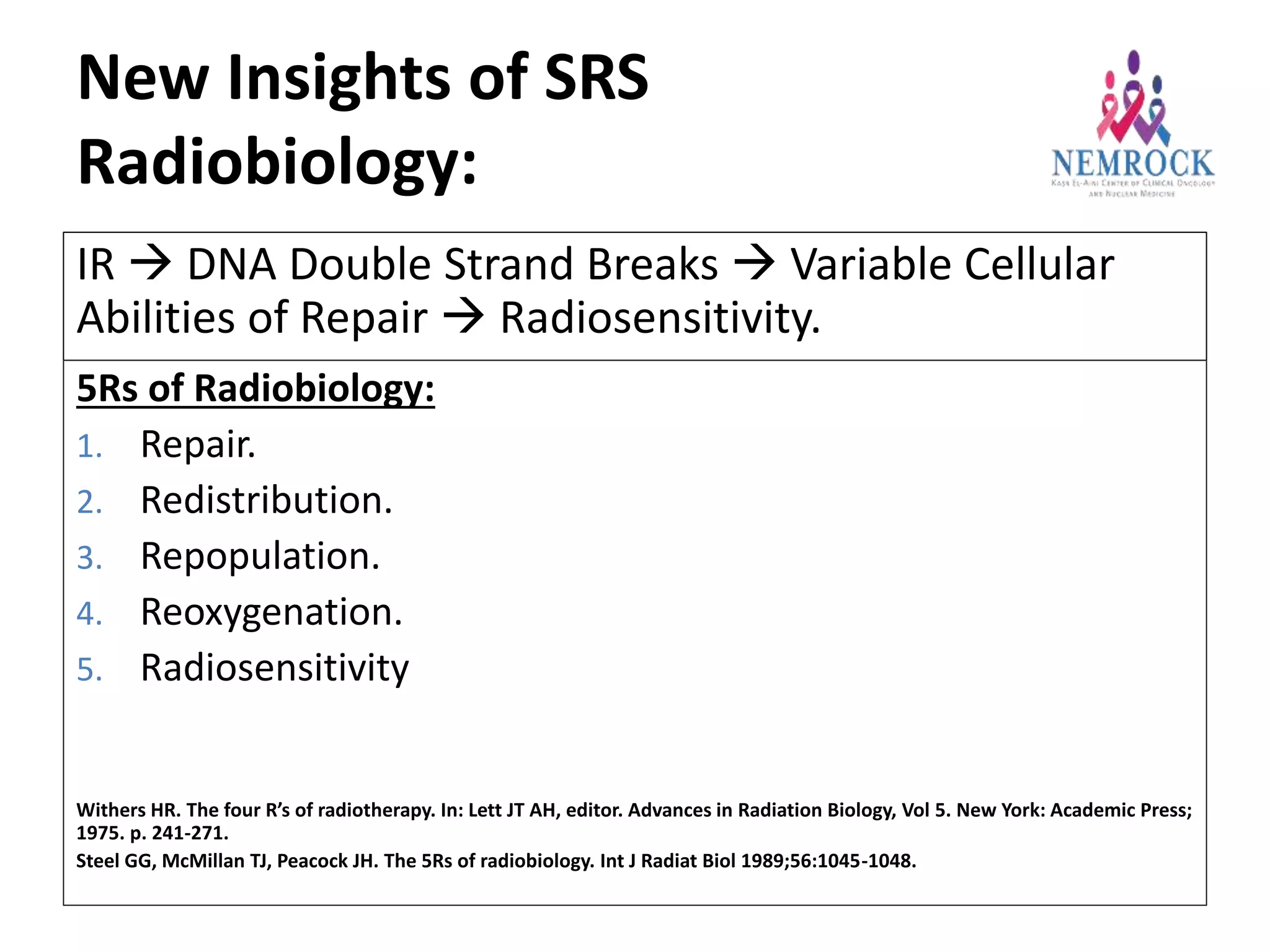
IR  DNA Double Strand Breaks  Variable Cellular
Abilities of Repair  Radiosensitivity.
5Rs of Radiobiology:
1. Repair.
2. Redistribution.
3. Repopulation.
4. Reoxygenation.
5. Radiosensitivity
Withers HR. The four R’s of radiotherapy. In: Lett JT AH, editor. Advances in Radiation Biology, Vol 5. New York: Academic Press;
1975. p. 241-271.
Steel GG, McMillan TJ, Peacock JH. The 5Rs of radiobiology. Int J Radiat Biol 1989;56:1045-1048.
New Insights of SRS
Radiobiology:
Radiobiological Effect of Single Fraction (> 10 Gy):
1. Endothelial cell Damage  Cytotoxicity & Apoptosis.
2. Vascular Damage at High Doses  ++ 2nd Cell Killing.
3. Enhanced Anti-Tumor Immunity after Tumor Irradiation.
4. Tumor Hypoxia is of Less Importance.
Fuks Z, Kolesnick R. Engaging the vascular component of the tumor response. Cancer Cell 2005;8:89-91.
Clement JJ, Tanaka N, Song CW. Tumor reoxygenation and post- irradiation vascular changes. Radiology
1978;127:799-803.
Hiniker SM, Chen DS, Knox SJ. Abscopal effect in a patient with melanoma. N Engl J Med 2012;366:2035. author reply
2035-2036.
• Brain is a late responding tissue; @/β = 2.
• Radiobiological Classification of Cranial Targets:
1. Late responding target embedded in late responding
tissues: AVM.
2. Late Responding target surrounded by late
responding tissues: AN.
3. Early responding target embedded in late
responding tissue: Low Grade Glioma.
4. Early responding target surrounded by late
responding tissue: GBM and High Grade Glioma.
New Insights of SRS
Radiobiological Complexity of
Cranial Targets:
International Journal of Radiation Oncology Biology Physics, vol. 25, no. 3, pp. 557–561, 1993.
New Insights of SRS
Radiobiological Complexity of Cranial
Targets:
Cancer Treatment Reviews 37 (2011) 567–578
Gamma-Knife
LAbased SRS Systems
BrainLAB
Novalis
Trilogy
Tomotherapy
CyberKnife
Radiosurgery Tools:
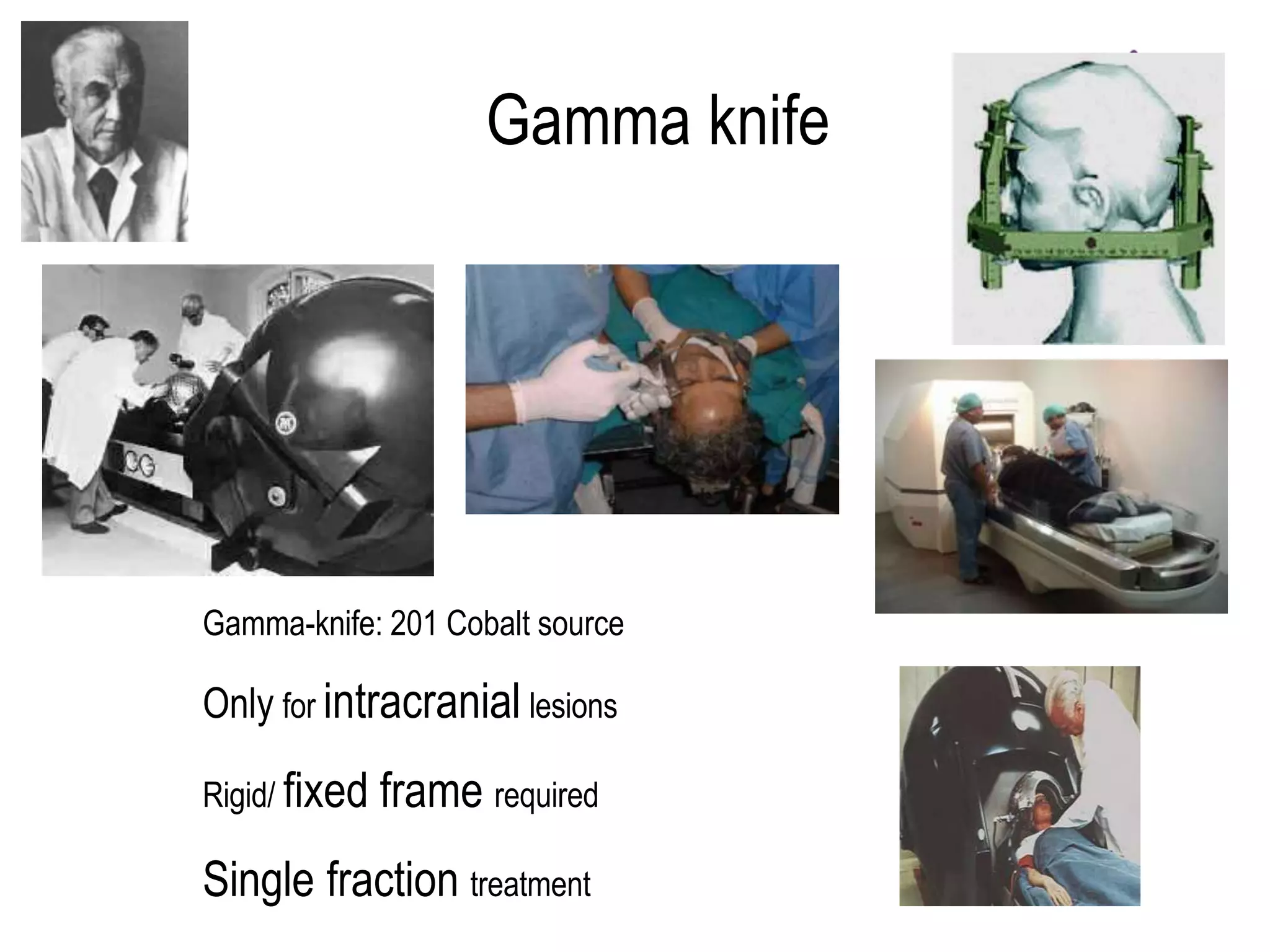
Gamma knife
• Gamma-knife: 201 Cobalt source
• Only for intracranial lesions
• Rigid/ fixed frame required
• Single fraction treatment
Gamma-knife
Indications
- Small Meningiomas (<3 cm)
- Small acuastic schwannoma (<3 cm)
- Solitary / oligo brain metastasis with controlled primary (RPAClass I)
- Small residual LGG
- AVMs (<3 cm)
- Trigeminal neuralgia (Functional disorder)
More than 40 years experience / results with Gamma-Knife
CyberKnife: Unique properties
Highly precise treatment delivery
Motion management
method Tumour tracking
‘Dose painting’
Excellent dose distribution
Fractionation
schedule No rigid
fixation
‘CyberKnife is an extension of Gamma-
Knife’ CK & GK: Similarity
- Principles of ‘field arrangement’
- Dose distribution pattern
- Multiple isocentre
-Treatment principles
- Treatment delivery accuracy similar
- Delivered dose in single fractions
- Intra-cranial indications
Hence, all the indications of GK are indications of CK also
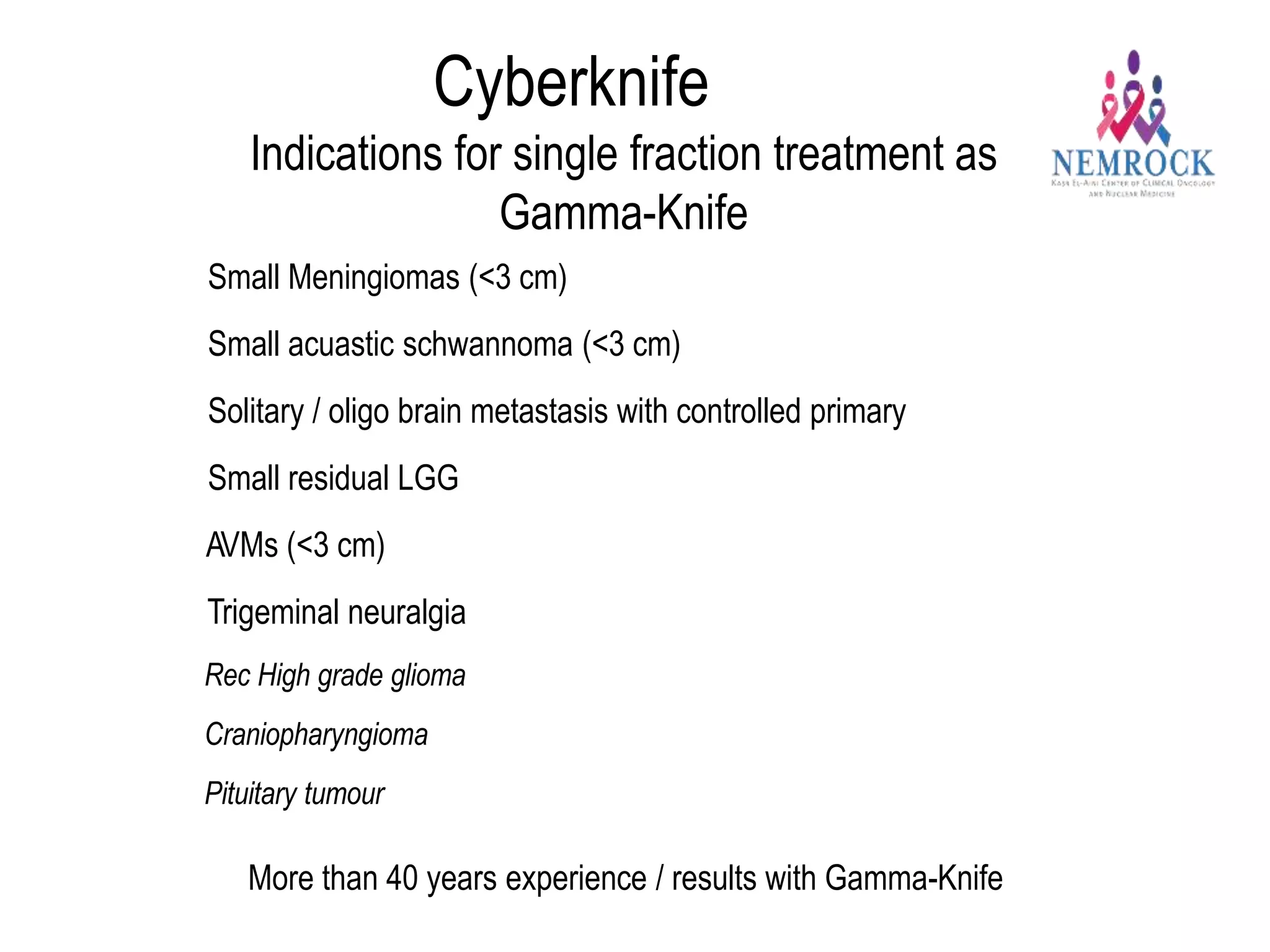
Cyberknife
Indications for single fraction treatment as
Gamma-Knife
- Small Meningiomas (<3 cm)
- Small acuastic schwannoma (<3 cm)
- Solitary / oligo brain metastasis with controlled primary
- Small residual LGG
- AVMs (<3 cm)
- Trigeminal neuralgia
- Rec High grade glioma
- Craniopharyngioma
- Pituitary tumour
More than 40 years experience / results with Gamma-Knife
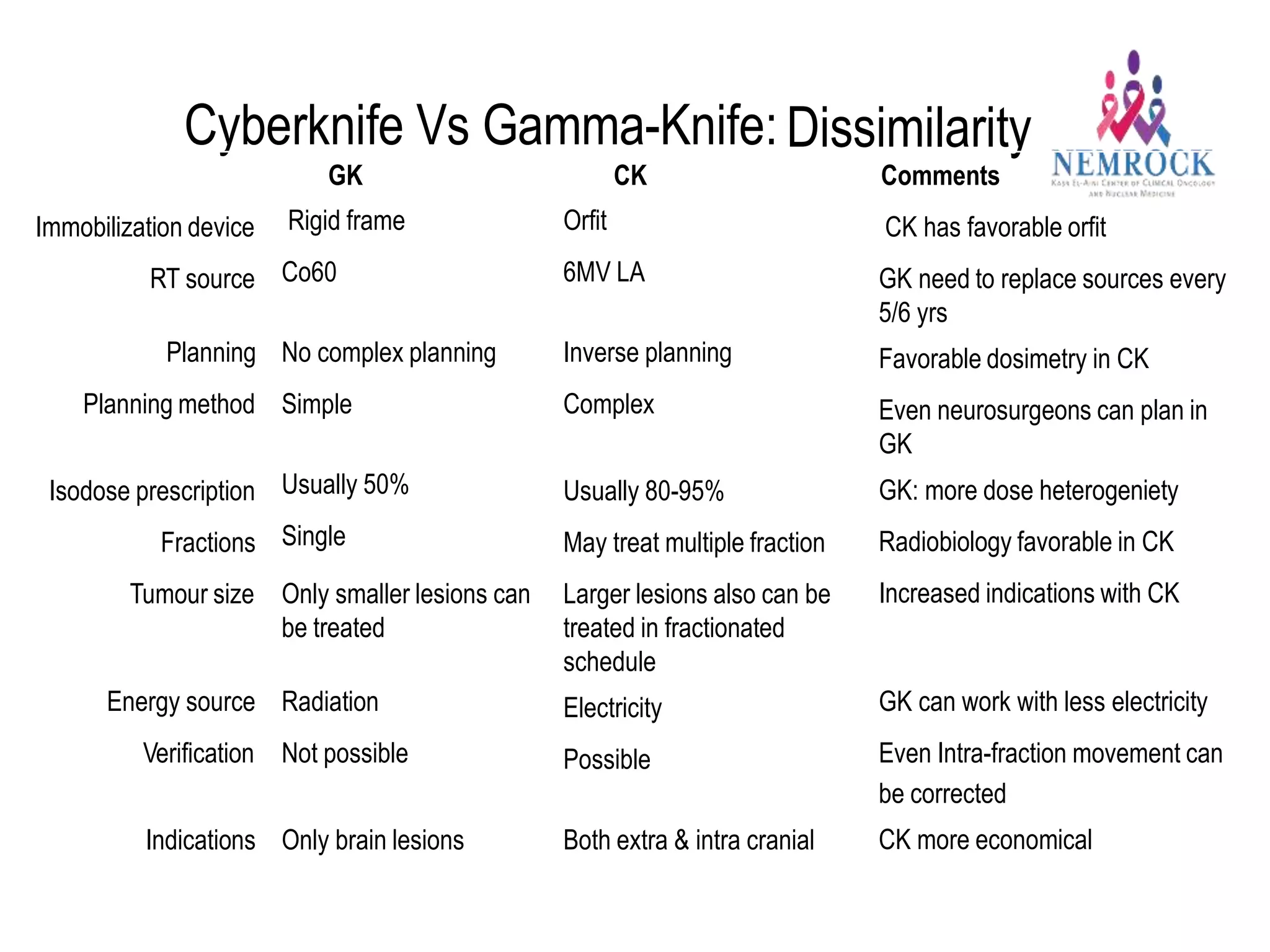
Cyberknife Vs Gamma-Knife: Dissimilarity
GK CK Comments
Immobilization device
RT source
Rigid frame
Co60
Orfit
6MV LA
CK has favorable orfit
GK need to replace sources every
5/6 yrs
Favorable dosimetry in CK
Even neurosurgeons can plan in
GK
GK: more dose heterogeniety
Radiobiology favorable in CK
Increased indications with CK
Planning
Planning method
No complex planning
Simple
Inverse planning
Complex
Isodose prescription
Fractions
Tumour size
Usually 50%
Single
Only smaller lesions can
be treated
Usually 80-95%
May treat multiple fraction
Larger lesions also can be
treated in fractionated
schedule
Electricity
Possible
Energy source
Verification
Radiation
Not possible
GK can work with less electricity
Even Intra-fraction movement can
be corrected
CK more economicalIndications Only brain lesions Both extra & intra cranial
Cyberknife Vs Gamma-Knife: Dissimilarity
Advantage of Inverse planning
GK planning
CK planning
Dose to mesial temporal lobe & Choclea is higher with GK
Mean dose to mesial temporal lobe >6 Gy with SRS: IQ
decline
Cyberknife Vs Gamma-Knife Vs X-Knife:
CK:Accuracy similar with Gamma-Knife
Treatment delivery accuracy:
GK: ~1 mm
CK : ~1 mm
LAbased SRS: 1-2 mm (iso-centric inacurracy; LUTZ test)
PTV margin:
CK: <1 mm
GK: <1 mm
LAbased SRS: 1-2 mm
GK/CK LA based SRS
CK has the accuracy of GK and flexibility of LAbased SRS
fSRS
Extended Indications for multiple fraction treatment
- Larger meningiomas (>3 cm)
- Larger acuastic schwannoma (>3 cm)
- Large solitary / oligo brain metastasis with controlled
primary
- Larger residual LGG
- AVMs (>3 cm)
- Chordomas
- Rec HCC
- Craniopharyngioma
- Pituitary tumour
Short term data with robotic radiosurgery
Volumetric Modulated Arc
Therapy
• Rotational IMRT Technique.
• Highly conformal dose distribution with better
sparing of OAR.
• Dose Modulation: Gantry movements, dose
rate, beam aperture.
• Shorter treatment time and MU.
• SRS & SBRT for cranial and body lesions.
Medical Dosimetry 40 (2015) 3–8
SRS and Brain Metastases:
Current Status:
• SRS is highly effective in local control of single
and multiple metastatic lesions.
• Even for radioresistant tumors (melanoma &
Kidney).
• No technical superiority.
• Doses usually > 18 Gy in single sessions.
• Lesions > 8 – 10 cc  Resection first.
• GK is equally effective as surgery for smaller
lesions.
• Re-irradiation is possible.
B. Lippitz et al. / Cancer Treatment Reviews 40 (2014) 48–59
SRS and Brain Metastases:
Current Status:
Int J Radiation Oncol Biol Phys, Vol. 91, No. 4, pp. 710e717, 2015
Patients < 50 Years
and 1 – 4 lesions 
Survival advantage
for SRS alone, with no
effect on distant brain
relapse.
SRS and Brain Metastases:
Current Status:
Int J Radiation Oncol Biol Phys, Vol. 91, No. 4, pp. 710e717, 2015
Take Home Message:
• The art of RS is continuously evolving.
• Better understanding of radiobiology.
• Better technologies of radiation therapy
delivery.
• The conventional approach for management
of metastatic brain disease has been changed
dramatically in the past 2 years  WBRT can
be omitted in selected patients.
Thank You

Refining the art of cranial radiosurgery

  • 1.
    Radio surgical treatmentof cranial lesions; Refining the art Mohamed Abdulla M.D. Prof. of Clinical Oncology Kasr Al-Aini School of Medicine Cairo University.
  • 2.
    Current View in2015: • Basic Definition by Leksell: “The delivery of a single high dose of irradiation to a small and critically located intracranial volume through the intact skull” • Improvements of Pre-requisites of Application: 1. Neuroimaging. 2. Neuroanatomy. 3. Reliable radiation therapy delivery system. • Achievements: 1. Better understanding of radiobiological considerations. 2. Introduction of more reliable radiation therapy devices. 3. Extension to fractionated treatment (Extra-cranial targets). 4. Dose/Volume constraints for normal tissues (OAR).
  • 3.
    New Insights ofSRS Radiobiology: IR  DNA Double Strand Breaks  Variable Cellular Abilities of Repair  Radiosensitivity. 5Rs of Radiobiology: 1. Repair. 2. Redistribution. 3. Repopulation. 4. Reoxygenation. 5. Radiosensitivity Withers HR. The four R’s of radiotherapy. In: Lett JT AH, editor. Advances in Radiation Biology, Vol 5. New York: Academic Press; 1975. p. 241-271. Steel GG, McMillan TJ, Peacock JH. The 5Rs of radiobiology. Int J Radiat Biol 1989;56:1045-1048.
  • 4.
    New Insights ofSRS Radiobiology: Radiobiological Effect of Single Fraction (> 10 Gy): 1. Endothelial cell Damage  Cytotoxicity & Apoptosis. 2. Vascular Damage at High Doses  ++ 2nd Cell Killing. 3. Enhanced Anti-Tumor Immunity after Tumor Irradiation. 4. Tumor Hypoxia is of Less Importance. Fuks Z, Kolesnick R. Engaging the vascular component of the tumor response. Cancer Cell 2005;8:89-91. Clement JJ, Tanaka N, Song CW. Tumor reoxygenation and post- irradiation vascular changes. Radiology 1978;127:799-803. Hiniker SM, Chen DS, Knox SJ. Abscopal effect in a patient with melanoma. N Engl J Med 2012;366:2035. author reply 2035-2036.
  • 5.
    • Brain isa late responding tissue; @/β = 2. • Radiobiological Classification of Cranial Targets: 1. Late responding target embedded in late responding tissues: AVM. 2. Late Responding target surrounded by late responding tissues: AN. 3. Early responding target embedded in late responding tissue: Low Grade Glioma. 4. Early responding target surrounded by late responding tissue: GBM and High Grade Glioma. New Insights of SRS Radiobiological Complexity of Cranial Targets: International Journal of Radiation Oncology Biology Physics, vol. 25, no. 3, pp. 557–561, 1993.
  • 6.
    New Insights ofSRS Radiobiological Complexity of Cranial Targets: Cancer Treatment Reviews 37 (2011) 567–578
  • 7.
  • 8.
    Gamma knife • Gamma-knife:201 Cobalt source • Only for intracranial lesions • Rigid/ fixed frame required • Single fraction treatment
  • 9.
    Gamma-knife Indications - Small Meningiomas(<3 cm) - Small acuastic schwannoma (<3 cm) - Solitary / oligo brain metastasis with controlled primary (RPAClass I) - Small residual LGG - AVMs (<3 cm) - Trigeminal neuralgia (Functional disorder) More than 40 years experience / results with Gamma-Knife
  • 10.
    CyberKnife: Unique properties Highlyprecise treatment delivery Motion management method Tumour tracking ‘Dose painting’ Excellent dose distribution Fractionation schedule No rigid fixation
  • 11.
    ‘CyberKnife is anextension of Gamma- Knife’ CK & GK: Similarity - Principles of ‘field arrangement’ - Dose distribution pattern - Multiple isocentre -Treatment principles - Treatment delivery accuracy similar - Delivered dose in single fractions - Intra-cranial indications Hence, all the indications of GK are indications of CK also
  • 12.
    Cyberknife Indications for singlefraction treatment as Gamma-Knife - Small Meningiomas (<3 cm) - Small acuastic schwannoma (<3 cm) - Solitary / oligo brain metastasis with controlled primary - Small residual LGG - AVMs (<3 cm) - Trigeminal neuralgia - Rec High grade glioma - Craniopharyngioma - Pituitary tumour More than 40 years experience / results with Gamma-Knife
  • 13.
    Cyberknife Vs Gamma-Knife:Dissimilarity GK CK Comments Immobilization device RT source Rigid frame Co60 Orfit 6MV LA CK has favorable orfit GK need to replace sources every 5/6 yrs Favorable dosimetry in CK Even neurosurgeons can plan in GK GK: more dose heterogeniety Radiobiology favorable in CK Increased indications with CK Planning Planning method No complex planning Simple Inverse planning Complex Isodose prescription Fractions Tumour size Usually 50% Single Only smaller lesions can be treated Usually 80-95% May treat multiple fraction Larger lesions also can be treated in fractionated schedule Electricity Possible Energy source Verification Radiation Not possible GK can work with less electricity Even Intra-fraction movement can be corrected CK more economicalIndications Only brain lesions Both extra & intra cranial
  • 14.
    Cyberknife Vs Gamma-Knife:Dissimilarity Advantage of Inverse planning GK planning CK planning Dose to mesial temporal lobe & Choclea is higher with GK Mean dose to mesial temporal lobe >6 Gy with SRS: IQ decline
  • 15.
    Cyberknife Vs Gamma-KnifeVs X-Knife: CK:Accuracy similar with Gamma-Knife Treatment delivery accuracy: GK: ~1 mm CK : ~1 mm LAbased SRS: 1-2 mm (iso-centric inacurracy; LUTZ test) PTV margin: CK: <1 mm GK: <1 mm LAbased SRS: 1-2 mm GK/CK LA based SRS CK has the accuracy of GK and flexibility of LAbased SRS
  • 16.
    fSRS Extended Indications formultiple fraction treatment - Larger meningiomas (>3 cm) - Larger acuastic schwannoma (>3 cm) - Large solitary / oligo brain metastasis with controlled primary - Larger residual LGG - AVMs (>3 cm) - Chordomas - Rec HCC - Craniopharyngioma - Pituitary tumour Short term data with robotic radiosurgery
  • 17.
    Volumetric Modulated Arc Therapy •Rotational IMRT Technique. • Highly conformal dose distribution with better sparing of OAR. • Dose Modulation: Gantry movements, dose rate, beam aperture. • Shorter treatment time and MU. • SRS & SBRT for cranial and body lesions. Medical Dosimetry 40 (2015) 3–8
  • 18.
    SRS and BrainMetastases: Current Status: • SRS is highly effective in local control of single and multiple metastatic lesions. • Even for radioresistant tumors (melanoma & Kidney). • No technical superiority. • Doses usually > 18 Gy in single sessions. • Lesions > 8 – 10 cc  Resection first. • GK is equally effective as surgery for smaller lesions. • Re-irradiation is possible. B. Lippitz et al. / Cancer Treatment Reviews 40 (2014) 48–59
  • 19.
    SRS and BrainMetastases: Current Status: Int J Radiation Oncol Biol Phys, Vol. 91, No. 4, pp. 710e717, 2015
  • 20.
    Patients < 50Years and 1 – 4 lesions  Survival advantage for SRS alone, with no effect on distant brain relapse. SRS and Brain Metastases: Current Status: Int J Radiation Oncol Biol Phys, Vol. 91, No. 4, pp. 710e717, 2015
  • 21.
    Take Home Message: •The art of RS is continuously evolving. • Better understanding of radiobiology. • Better technologies of radiation therapy delivery. • The conventional approach for management of metastatic brain disease has been changed dramatically in the past 2 years  WBRT can be omitted in selected patients.
  • 22.