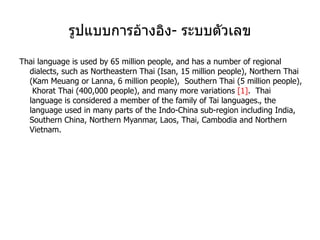
รูปแบบการอ้างอิง- ระบบตัวเลข Thailanguage is used by 65 million people, and has a number of regional dialects, such as Northeastern Thai (Isan, 15 million people), Northern Thai (Kam Meuang or Lanna, 6 million people), Southern Thai (5 million people), Khorat Thai (400,000 people), and many more variations [1] . Thai language is considered a member of the family of Tai languages., the language used in many parts of the Indo-China sub-region including India, Southern China, Northern Myanmar, Laos, Thai, Cambodia and Northern Vietnam.
18.
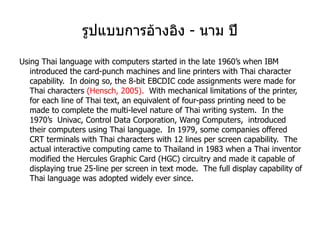
รูปแบบการอ้างอิง - นามปี Using Thai language with computers started in the late 1960’s when IBM introduced the card-punch machines and line printers with Thai character capability. In doing so, the 8-bit EBCDIC code assignments were made for Thai characters (Hensch, 2005). With mechanical limitations of the printer, for each line of Thai text, an equivalent of four-pass printing need to be made to complete the multi-level nature of Thai writing system. In the 1970’s Univac, Control Data Corporation, Wang Computers, introduced their computers using Thai language. In 1979, some companies offered CRT terminals with Thai characters with 12 lines per screen capability. The actual interactive computing came to Thailand in 1983 when a Thai inventor modified the Hercules Graphic Card (HGC) circuitry and made it capable of displaying true 25-line per screen in text mode. The full display capability of Thai language was adopted widely ever since.
19.
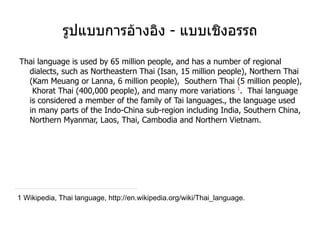
รูปแบบการอ้างอิง - แบบเชิงอรรถThai language is used by 65 million people, and has a number of regional dialects, such as Northeastern Thai (Isan, 15 million people), Northern Thai (Kam Meuang or Lanna, 6 million people), Southern Thai (5 million people), Khorat Thai (400,000 people), and many more variations 1 . Thai language is considered a member of the family of Tai languages., the language used in many parts of the Indo-China sub-region including India, Southern China, Northern Myanmar, Laos, Thai, Cambodia and Northern Vietnam. 1 Wikipedia, Thai language, http://en.wikipedia.org/wiki/Thai_language.
20.
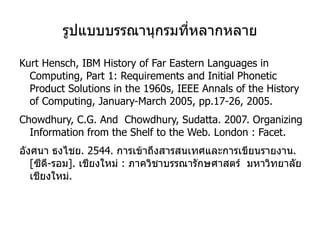
รูปแบบบรรณานุกรมที่หลากหลาย Kurt Hensch,IBM History of Far Eastern Languages in Computing, Part 1: Requirements and Initial Phonetic Product Solutions in the 1960s, IEEE Annals of the History of Computing, January-March 2005, pp.17-26, 2005.
21.
Chowdhury, C.G. And Chowdhury, Sudatta. 2007. Organizing Information from the Shelf to the Web. London : Facet.
รูปแบบบรรณานุกรมที่หลากหลาย บุญเลิศ อรุณพิบูลย์(boonlert@nstda.or.th). 2552. “Twitter for Libraries.” จดหมายอิเล็กทรอนิกส์ถึง สุภาพร ชัยธัมมะปกรณ์ (supapornc@nstda.or.th) 19 มิถุนายน. MacKenzie, Smith and others. 2003. “DSpace : An Open Source Dynamic Digital Repository.” D-Lib Magazine. [Online] Available http: http://www.dlib.org/dlib/january03/smith/01smith.html (19 June 2009).
![บริหารจัดการบรรณานุกรมยุคใหม่ ด้วย Reference Manager สุภาพร ชัยธัมมะปกรณ์ บุญเลิศ อรุณพิบูลย์ ศูนย์บริการความรู้ทางวิทยาศาสตร์และเทคโนโลยี สำนักงานพัฒนาวิทยาศาสตร์และเทคโนโลยีแห่งชาติ http://stks.or.th/ [email_address]](https://image.slidesharecdn.com/20090619-reference-090626000300-phpapp01/85/Reference-Manager-1-320.jpg)
![บริหารจัดการบรรณานุกรมยุคใหม่ ด้วย Reference Manager สุภาพร ชัยธัมมะปกรณ์ บุญเลิศ อรุณพิบูลย์ ศูนย์บริการความรู้ทางวิทยาศาสตร์และเทคโนโลยี สำนักงานพัฒนาวิทยาศาสตร์และเทคโนโลยีแห่งชาติ http://stks.or.th/ [email_address]](https://image.slidesharecdn.com/20090619-reference-090626000300-phpapp01/75/Reference-Manager-1-2048.jpg)
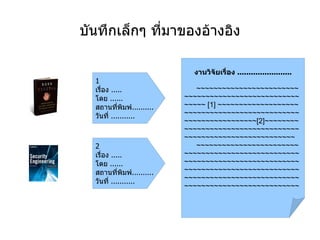
![บันทึกเล็กๆ ที่มาของอ้างอิง งานวิจัยเรื่อง ........................ ~~~~~~~~~~~~~~~~~~~~~~~~ ~~~~~~~~~~~~~~~~~~~~~~~~~~~ ~~~~~ [1] ~~~~~~~~~~~~~~~~~~~ ~~~~~~~~~~~~~~~~~~~~~~~~~~~ ~~~~~~~~~~~~~~~~~[2]~~~~~~~~ ~~~~~~~~~~~~~~~~~~~~~~~~~~~ ~~~~~~~~~~~~~~~~~~~~~~~~~~ ~~~~~~~~~~~~~~~~~~~~~~~~ ~~~~~~~~~~~~~~~~~~~~~~~~~~~ ~~~~~~~~~~~~~~~~~~~~~~~~~~~ ~~~~~~~~~~~~~~~~~~~~~~~~~~~ ~~~~~~~~~~~~~~~~~~~~~~~~~~~ ~~~~~~~~~~~~~~~~~~~~~~~~~~~ 1 เรื่อง ..... โดย ...... สถานที่พิมพ์ .......... วันที่ ........... 1 เรื่อง ..... โดย ...... สถานที่พิมพ์ .......... วันที่ ........... 2 เรื่อง ..... โดย ...... สถานที่พิมพ์ .......... วันที่ ...........](https://image.slidesharecdn.com/20090619-reference-090626000300-phpapp01/85/Reference-Manager-15-320.jpg)
![รูปแบบการอ้างอิง- ระบบตัวเลข Thai language is used by 65 million people, and has a number of regional dialects, such as Northeastern Thai (Isan, 15 million people), Northern Thai (Kam Meuang or Lanna, 6 million people), Southern Thai (5 million people), Khorat Thai (400,000 people), and many more variations [1] . Thai language is considered a member of the family of Tai languages., the language used in many parts of the Indo-China sub-region including India, Southern China, Northern Myanmar, Laos, Thai, Cambodia and Northern Vietnam.](https://image.slidesharecdn.com/20090619-reference-090626000300-phpapp01/85/Reference-Manager-17-320.jpg)
![อังศนา ธงไชย. 2544. การเข้าถึงสารสนเทศและการเขียนรายงาน. [ซีดี-รอม]. เชียงใหม่ : ภาควิชาบรรณารักษศาสตร์ มหาวิทยาลัยเชียงใหม่.](https://image.slidesharecdn.com/20090619-reference-090626000300-phpapp01/85/Reference-Manager-22-320.jpg)
![รูปแบบบรรณานุกรมที่หลากหลาย บุญเลิศ อรุณพิบูลย์ (boonlert@nstda.or.th). 2552. “Twitter for Libraries.” จดหมายอิเล็กทรอนิกส์ถึง สุภาพร ชัยธัมมะปกรณ์ (supapornc@nstda.or.th) 19 มิถุนายน. MacKenzie, Smith and others. 2003. “DSpace : An Open Source Dynamic Digital Repository.” D-Lib Magazine. [Online] Available http: http://www.dlib.org/dlib/january03/smith/01smith.html (19 June 2009).](https://image.slidesharecdn.com/20090619-reference-090626000300-phpapp01/85/Reference-Manager-23-320.jpg)


