Anatomy & Physiology I
Unit 8:
Muscular System Review
Did you know that ?
- more than 50% of
body weight is
muscle !
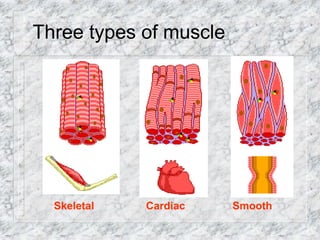
Three types of muscle
Skeletal Cardiac Smooth
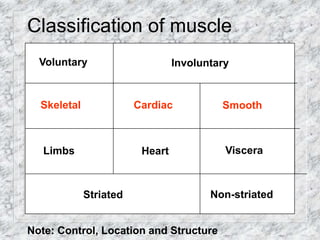
Classification of muscle
Voluntary Involuntary
Limbs Heart Viscera
Striated Non-striated
Skeletal Cardiac Smooth
Note: Control, Location and Structure
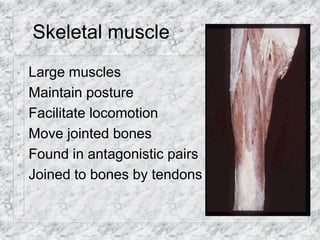
Skeletal muscle
• Large muscles
• Maintain posture
• Facilitate locomotion
• Move jointed bones
• Found in antagonistic pairs
• Joined to bones by tendons
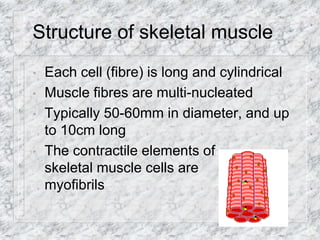
Structure of skeletal muscle
• Each cell (fibre) is long and cylindrical
• Muscle fibres are multi-nucleated
• Typically 50-60mm in diameter, and up
to 10cm long
• The contractile elements of
skeletal muscle cells are
myofibrils
Skeletal muscle - Summary
• Voluntary movement
of skeletal parts
• Spans joints and
attached to skeleton
• Multi-nucleated,
striated, cylindrical
fibres
Cardiac muscle
• Main muscle of heart
• Pumping mass of heart
• Critical in humans
• Heart muscle cells
behave as one unit
• Heart always contracts
to it’s full extent
Structure of cardiac muscle
• Cardiac muscle cells (fibres) are short,
branched and interconnected
• Cells are striated & multi-nucleated
• Adjacent cardiac cells joined via
electrical synapses (gap junctions)
• These gap junctions appear as dark
lines when viewed under LM, and are
called intercalated discs
Cardiac muscle - Summary
• Found in the heart
• Involuntary rhythmic
contraction
• Branched, striated
fibre with single
nucleus and
intercalated discs
Smooth muscle
• Lines walls of viscera
• Found in longitudinal or
circular arrangement
• Alternate contraction of
circular & longitudinal
muscle in the intestine
leads to peristalsis
Structure of smooth muscle
• Spindle shaped uni-nucleated cells
• Striations not observed
• Actin and myosin filaments are present
• Ratio of thin-to-thick filaments is 16:1 (in
striated muscle this is 2:1)
• Myosin filaments are attached to
dense bodies at the end of each
cell
Smooth muscle - Summary
• Found in walls of
hollow internal
organs
• Involuntary
movement of
internal organs
• Elongated, spindle
shaped fibre with
single nucleus
Muscle Control
Type of
muscle
Nervous
control
Type of
control
Example
Skeletal
Skeletal Controlled
by CNS
Voluntary Lifting a
glass
Cardiac Regulated
by ANS
Involuntary Heart
beating
Smooth Controlled
by ANS
Involuntary Peristalsis

REFERENCE 11-MUSCULAR SYSTEM.pptx

  • 1.
    Anatomy & PhysiologyI Unit 8: Muscular System Review
  • 2.
    Did you knowthat ? - more than 50% of body weight is muscle !
  • 3.
    Three types ofmuscle Skeletal Cardiac Smooth
  • 4.
    Classification of muscle VoluntaryInvoluntary Limbs Heart Viscera Striated Non-striated Skeletal Cardiac Smooth Note: Control, Location and Structure
  • 5.
    Skeletal muscle • Largemuscles • Maintain posture • Facilitate locomotion • Move jointed bones • Found in antagonistic pairs • Joined to bones by tendons
  • 6.
    Structure of skeletalmuscle • Each cell (fibre) is long and cylindrical • Muscle fibres are multi-nucleated • Typically 50-60mm in diameter, and up to 10cm long • The contractile elements of skeletal muscle cells are myofibrils
  • 7.
    Skeletal muscle -Summary • Voluntary movement of skeletal parts • Spans joints and attached to skeleton • Multi-nucleated, striated, cylindrical fibres
  • 8.
    Cardiac muscle • Mainmuscle of heart • Pumping mass of heart • Critical in humans • Heart muscle cells behave as one unit • Heart always contracts to it’s full extent
  • 9.
    Structure of cardiacmuscle • Cardiac muscle cells (fibres) are short, branched and interconnected • Cells are striated & multi-nucleated • Adjacent cardiac cells joined via electrical synapses (gap junctions) • These gap junctions appear as dark lines when viewed under LM, and are called intercalated discs
  • 10.
    Cardiac muscle -Summary • Found in the heart • Involuntary rhythmic contraction • Branched, striated fibre with single nucleus and intercalated discs
  • 11.
    Smooth muscle • Lineswalls of viscera • Found in longitudinal or circular arrangement • Alternate contraction of circular & longitudinal muscle in the intestine leads to peristalsis
  • 12.
    Structure of smoothmuscle • Spindle shaped uni-nucleated cells • Striations not observed • Actin and myosin filaments are present • Ratio of thin-to-thick filaments is 16:1 (in striated muscle this is 2:1) • Myosin filaments are attached to dense bodies at the end of each cell
  • 13.
    Smooth muscle -Summary • Found in walls of hollow internal organs • Involuntary movement of internal organs • Elongated, spindle shaped fibre with single nucleus
  • 14.
    Muscle Control Type of muscle Nervous control Typeof control Example Skeletal Skeletal Controlled by CNS Voluntary Lifting a glass Cardiac Regulated by ANS Involuntary Heart beating Smooth Controlled by ANS Involuntary Peristalsis