Refactoring Into Microservices
Breaking the Monolith
Given by Derek C. Ashmore
June 26, 2017
©2017 Derek C. Ashmore, All Rights Reserved 1
Who am I?
• Professional Geek
since 1987
• Java/J2EE/Java EE
since 1999
• AWS since 2010
• Specialties
• Refactoring
• Performance
Tuning
• Yes – I still code!
©2017 Derek C. Ashmore, All Rights Reserved 2
Discussion Resources
• This slide deck
– http://www.slideshare.net/derekashmore
• This resource page
– http://breakthemonolith.guru/resources.html
• Slide deck has hyper-links!
– Don’t bother writing down URLs
©2017 Derek C. Ashmore, All Rights Reserved 3
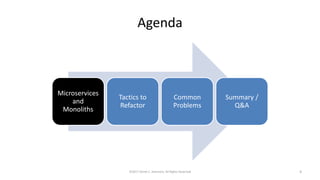
Agenda
Microservices
and
Monoliths
Tactics to
Refactor
Common
Problems
Summary /
Q&A
©2017 Derek C. Ashmore, All Rights Reserved 4
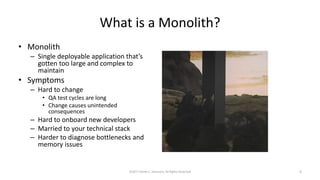
What is a Monolith?
• Monolith
– Single deployable application that’s
gotten too large and complex to
maintain
• Symptoms
– Hard to change
• QA test cycles are long
• Change causes unintended
consequences
– Hard to onboard new developers
– Married to your technical stack
– Harder to diagnose bottlenecks and
memory issues
©2017 Derek C. Ashmore, All Rights Reserved 5
What’s the cure?
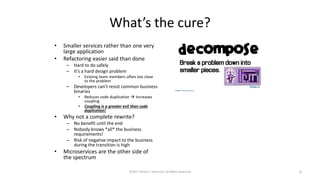
• Smaller services rather than one very
large application
• Refactoring easier said than done
– Hard to do safely
– It’s a hard design problem
• Existing team members often too close
to the problem
– Developers can’t resist common business
binaries
• Reduces code duplication  Increases
coupling
• Coupling is a greater evil than code
duplication!
• Why not a complete rewrite?
– No benefit until the end
– Nobody knows *all* the business
requirements!
– Risk of negative impact to the business
during the transition is high
• Microservices are the other side of
the spectrum
©2017 Derek C. Ashmore, All Rights Reserved 6
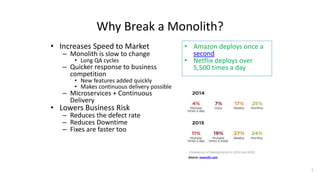
Why Break a Monolith?
• Increases Speed to Market
– Monolith is slow to change
• Long QA cycles
– Quicker response to business
competition
• New features added quickly
• Makes continuous delivery possible
– Microservices + Continuous
Delivery
• Lowers Business Risk
– Reduces the defect rate
– Reduces Downtime
– Fixes are faster too
7
• Amazon deploys once a
second
• Netflix deploys over
5,500 times a day
Source: newrelic.com
What are Microservices?
• No concrete definition
• Common microservice traits
– Single functional purpose
• Most/all changes only impact one service
• Not dependent on execution context
– “loosely coupled”
– Independent process/jvm
– Stateless
– Standard Interface (typically Web Service/REST)
– Analogy: Stereo system, Linux utilities
©2017 Derek C. Ashmore, All Rights Reserved 8
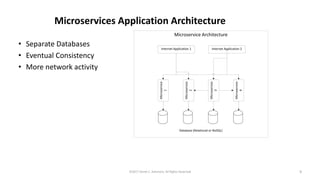
Microservices Application Architecture
• Separate Databases
• Eventual Consistency
• More network activity
©2017 Derek C. Ashmore, All Rights Reserved 9
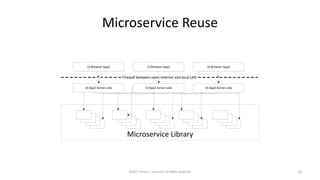
Microservice Reuse
©2017 Derek C. Ashmore, All Rights Reserved 10
Agenda
Microservices
and
Monoliths
Tactics to
Refactor
Common
Problems
Summary /
Q&A
©2017 Derek C. Ashmore, All Rights Reserved 11
Microservices / Monolith Mixture
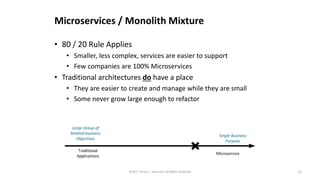
• 80 / 20 Rule Applies
• Smaller, less complex, services are easier to support
• Few companies are 100% Microservices
• Traditional architectures do have a place
• They are easier to create and manage while they are small
• Some never grow large enough to refactor
©2017 Derek C. Ashmore, All Rights Reserved 12
Do NOT attempt a complete rewrite
• It’s too big and complex
– Usually no documentation of all implemented business rules
• Not written down
• Nobody has it in their head
– Will negatively impact your business
• The new won’t ‘identically’ match behavior
– Business won’t benefit until the very end
• It’s a large project  Compelte rewrite will take a long time to realize
– Often has no safeguards beyond manual testing
– It’s a *very* big problem to handle all at once.
• Refactor iteratively
– Yes; this will take a longer time
– It’s safer
– It gives staff a chance to learn how to manage microservice libraries before they have too many
to manage manually
– It gives staff a chance to address non-functionals while not also being burdened with a
complete redesign/rewrite
©2017 Derek C. Ashmore, All Rights Reserved 13
Stick with the same technical stack for the
refactoring
• Corollary: Do not rewrite and refactor at the same time.
–Rewrite after automated contract testing is in place
• New technical stacks have learning curves
–Refactoring is hard enough
©2017 Derek C. Ashmore, All Rights Reserved 14
Preperation Steps
• Establish a base automated test harness for the application
–At an integration level, not unit test level
–We want a chance of catching defects refactoring introduces
–This will *not* be 100% comprehensive
• The monolith is too complex for that
• 80 / 20 rule applies
• Establish Continuous Integration if it doesn’t exist
–Jenkins CI Builds and Tests
–Run Frequently (at least nightly)
–Fix it immediately when somebody breaks the build
©2017 Derek C. Ashmore, All Rights Reserved 15
Types of Monoliths
• Monoliths are not created equal
• Types of Monoliths
– Feature-Bloated Web Application
– Data Store Strangle
– Over-engineered Tarball
– Distributed Monolith
• Tactics differ per Monolith type
©2017 Derek C. Ashmore, All Rights Reserved 16
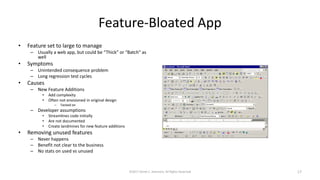
Feature-Bloated App
• Feature set to large to manage
– Usually a web app, but could be “Thick” or “Batch” as
well
• Symptoms
– Unintended consequence problem
– Long regression test cycles
• Causes
– New Feature Additions
• Add complexity
• Often not envisioned in original design
– Tacked on
– Developer assumptions
• Streamlines code initially
• Are not documented
• Create landmines for new feature additions
• Removing unused features
– Never happens
– Benefit not clear to the business
– No stats on used vs unused
©2017 Derek C. Ashmore, All Rights Reserved 17
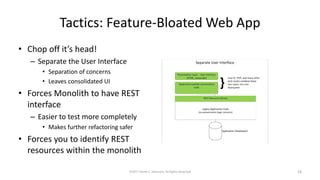
Tactics: Feature-Bloated Web App
• Chop off it’s head!
– Separate the User Interface
• Separation of concerns
• Leaves consolidated UI
• Forces Monolith to have REST
interface
– Easier to test more completely
• Makes further refactoring safer
• Forces you to identify REST
resources within the monolith
©2017 Derek C. Ashmore, All Rights Reserved 18
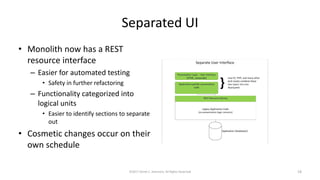
Separated UI
• Monolith now has a REST
resource interface
– Easier for automated testing
• Safety in further refactoring
– Functionality categorized into
logical units
• Easier to identify sections to separate
out
• Cosmetic changes occur on their
own schedule
©2017 Derek C. Ashmore, All Rights Reserved 19
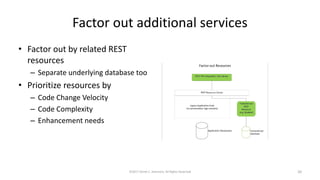
Factor out additional services
• Factor out by related REST
resources
– Separate underlying database too
• Prioritize resources by
– Code Change Velocity
– Code Complexity
– Enhancement needs
©2017 Derek C. Ashmore, All Rights Reserved 20
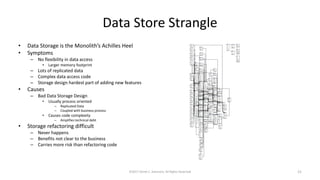
Data Store Strangle
• Data Storage is the Monolith’s Achilles Heel
• Symptoms
– No flexibility in data access
• Larger memory footprint
– Lots of replicated data
– Complex data access code
– Storage design hardest part of adding new features
• Causes
– Bad Data Storage Design
• Usually process oriented
– Replicated Data
– Coupled with business process
• Causes code complexity
– Amplifies technical debt
• Storage refactoring difficult
– Never happens
– Benefits not clear to the business
– Carries more risk than refactoring code
©2017 Derek C. Ashmore, All Rights Reserved 21
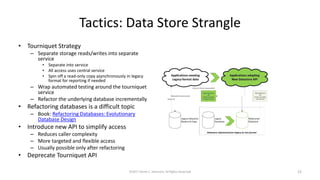
Tactics: Data Store Strangle
• Tourniquet Strategy
– Separate storage reads/writes into separate
service
• Separate into service
• All access uses central service
• Spin off a read-only copy asynchronously in legacy
format for reporting if needed
– Wrap automated testing around the tourniquet
service
– Refactor the underlying database incrementally
• Refactoring databases is a difficult topic
– Book: Refactoring Databases: Evolutionary
Database Design
• Introduce new API to simplify access
– Reduces caller complexity
– More targeted and flexible access
– Usually possible only after refactoring
• Deprecate Tourniquet API
©2017 Derek C. Ashmore, All Rights Reserved 22
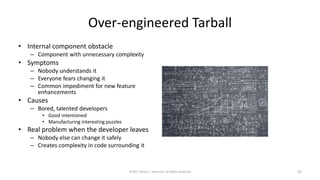
Over-engineered Tarball
• Internal component obstacle
– Component with unnecessary complexity
• Symptoms
– Nobody understands it
– Everyone fears changing it
– Common impediment for new feature
enhancements
• Causes
– Bored, talented developers
• Good intentioned
• Manufacturing interesting puzzles
• Real problem when the developer leaves
– Nobody else can change it safely
– Creates complexity in code surrounding it
©2017 Derek C. Ashmore, All Rights Reserved 23
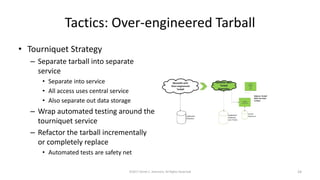
Tactics: Over-engineered Tarball
• Tourniquet Strategy
– Separate tarball into separate
service
• Separate into service
• All access uses central service
• Also separate out data storage
– Wrap automated testing around the
tourniquet service
– Refactor the tarball incrementally
or completely replace
• Automated tests are safety net
©2017 Derek C. Ashmore, All Rights Reserved 24
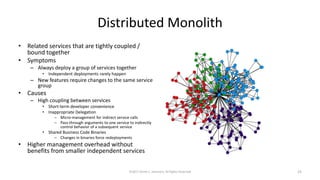
Distributed Monolith
• Related services that are tightly coupled /
bound together
• Symptoms
– Always deploy a group of services together
• Independent deployments rarely happen
– New features require changes to the same service
group
• Causes
– High coupling between services
• Short-term developer convenience
• Inappropriate Delegation
– Micro-management for indirect service calls
– Pass-through arguments to one service to indirectly
control behavior of a subsequent service
• Shared Business Code Binaries
– Changes in binaries force redeployments
• Higher management overhead without
benefits from smaller independent services
©2017 Derek C. Ashmore, All Rights Reserved 25
Tactics: Distributed Monolith
• Solving shared business code problem
– Factor into separate service(s)
• Deployed once and commonly called
• Don’t deploy as library
– Reduces forced deployments
– Performance mitigations
• Expiring Cache
• Make asynchronous
– Coupling worse evil than Code Duplication
©2017 Derek C. Ashmore, All Rights Reserved 26
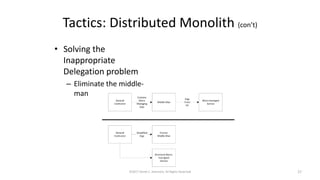
Tactics: Distributed Monolith (con’t)
• Solving the
Inappropriate
Delegation problem
– Eliminate the middle-
man
©2017 Derek C. Ashmore, All Rights Reserved 27
Agenda
Microservices
and
Monoliths
Tactics to
Refactor
Common
Problems
Summary /
Q&A
©2017 Derek C. Ashmore, All Rights Reserved 28
Common code between services?
• Yes, but….
– Version it
• Services make decision as to when to upgrade
– Changes to common code can’t require the deployment of multiple
services
©2017 Derek C. Ashmore, All Rights Reserved 29
Real-World Problems
• Corporate-Level Reporting
–Reporting for data across the enterprise
–Many read underlying databases for applications that house the
data
–Refactoring will impact this type of reporting
• Database Refactoring
–Much more expensive
–Can’t simply rollback
–Book Recommendation
• Database Factoring: Evolutionary Database Design
©2017 Derek C. Ashmore, All Rights Reserved 30
When is your refactoring complete?
• You can stop at any point
–If what remains of your monolith is supportable, you can stop
–80 / 20 rule applies
• That’s why services are prioritized by volatility
• You can resume at any point
–Guided by code volatility and defect rates
–Change produces refactoring needs
©2017 Derek C. Ashmore, All Rights Reserved 31
Further Reading
• This slide deck
– http://www.slideshare.net/derekashmore
• This resource page
– http://breakthemonolith.guru/resources.html
©2017 Derek C. Ashmore, All Rights Reserved 32
Questions?
• Derek Ashmore:
– Blog: www.derekashmore.com
– LinkedIn: www.linkedin.com/in/derekashmore
• Connect Invites from attendees welcome
– Twitter: https://twitter.com/Derek_Ashmore
– GitHub: https://github.com/Derek-Ashmore
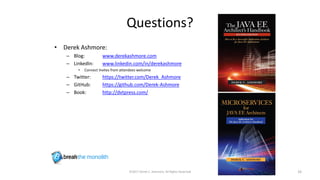
– Book: http://dvtpress.com/
©2017 Derek C. Ashmore, All Rights Reserved 33

Refactoring Into Microservices. Chicago Coders Conference 2017-06-26

  • 1.
    Refactoring Into Microservices Breakingthe Monolith Given by Derek C. Ashmore June 26, 2017 ©2017 Derek C. Ashmore, All Rights Reserved 1
  • 2.
    Who am I? •Professional Geek since 1987 • Java/J2EE/Java EE since 1999 • AWS since 2010 • Specialties • Refactoring • Performance Tuning • Yes – I still code! ©2017 Derek C. Ashmore, All Rights Reserved 2
  • 3.
    Discussion Resources • Thisslide deck – http://www.slideshare.net/derekashmore • This resource page – http://breakthemonolith.guru/resources.html • Slide deck has hyper-links! – Don’t bother writing down URLs ©2017 Derek C. Ashmore, All Rights Reserved 3
  • 4.
  • 5.
    What is aMonolith? • Monolith – Single deployable application that’s gotten too large and complex to maintain • Symptoms – Hard to change • QA test cycles are long • Change causes unintended consequences – Hard to onboard new developers – Married to your technical stack – Harder to diagnose bottlenecks and memory issues ©2017 Derek C. Ashmore, All Rights Reserved 5
  • 6.
    What’s the cure? •Smaller services rather than one very large application • Refactoring easier said than done – Hard to do safely – It’s a hard design problem • Existing team members often too close to the problem – Developers can’t resist common business binaries • Reduces code duplication  Increases coupling • Coupling is a greater evil than code duplication! • Why not a complete rewrite? – No benefit until the end – Nobody knows *all* the business requirements! – Risk of negative impact to the business during the transition is high • Microservices are the other side of the spectrum ©2017 Derek C. Ashmore, All Rights Reserved 6
  • 7.
    Why Break aMonolith? • Increases Speed to Market – Monolith is slow to change • Long QA cycles – Quicker response to business competition • New features added quickly • Makes continuous delivery possible – Microservices + Continuous Delivery • Lowers Business Risk – Reduces the defect rate – Reduces Downtime – Fixes are faster too 7 • Amazon deploys once a second • Netflix deploys over 5,500 times a day Source: newrelic.com
  • 8.
    What are Microservices? •No concrete definition • Common microservice traits – Single functional purpose • Most/all changes only impact one service • Not dependent on execution context – “loosely coupled” – Independent process/jvm – Stateless – Standard Interface (typically Web Service/REST) – Analogy: Stereo system, Linux utilities ©2017 Derek C. Ashmore, All Rights Reserved 8
  • 9.
    Microservices Application Architecture •Separate Databases • Eventual Consistency • More network activity ©2017 Derek C. Ashmore, All Rights Reserved 9
  • 10.
    Microservice Reuse ©2017 DerekC. Ashmore, All Rights Reserved 10
  • 11.
  • 12.
    Microservices / MonolithMixture • 80 / 20 Rule Applies • Smaller, less complex, services are easier to support • Few companies are 100% Microservices • Traditional architectures do have a place • They are easier to create and manage while they are small • Some never grow large enough to refactor ©2017 Derek C. Ashmore, All Rights Reserved 12
  • 13.
    Do NOT attempta complete rewrite • It’s too big and complex – Usually no documentation of all implemented business rules • Not written down • Nobody has it in their head – Will negatively impact your business • The new won’t ‘identically’ match behavior – Business won’t benefit until the very end • It’s a large project  Compelte rewrite will take a long time to realize – Often has no safeguards beyond manual testing – It’s a *very* big problem to handle all at once. • Refactor iteratively – Yes; this will take a longer time – It’s safer – It gives staff a chance to learn how to manage microservice libraries before they have too many to manage manually – It gives staff a chance to address non-functionals while not also being burdened with a complete redesign/rewrite ©2017 Derek C. Ashmore, All Rights Reserved 13
  • 14.
    Stick with thesame technical stack for the refactoring • Corollary: Do not rewrite and refactor at the same time. –Rewrite after automated contract testing is in place • New technical stacks have learning curves –Refactoring is hard enough ©2017 Derek C. Ashmore, All Rights Reserved 14
  • 15.
    Preperation Steps • Establisha base automated test harness for the application –At an integration level, not unit test level –We want a chance of catching defects refactoring introduces –This will *not* be 100% comprehensive • The monolith is too complex for that • 80 / 20 rule applies • Establish Continuous Integration if it doesn’t exist –Jenkins CI Builds and Tests –Run Frequently (at least nightly) –Fix it immediately when somebody breaks the build ©2017 Derek C. Ashmore, All Rights Reserved 15
  • 16.
    Types of Monoliths •Monoliths are not created equal • Types of Monoliths – Feature-Bloated Web Application – Data Store Strangle – Over-engineered Tarball – Distributed Monolith • Tactics differ per Monolith type ©2017 Derek C. Ashmore, All Rights Reserved 16
  • 17.
    Feature-Bloated App • Featureset to large to manage – Usually a web app, but could be “Thick” or “Batch” as well • Symptoms – Unintended consequence problem – Long regression test cycles • Causes – New Feature Additions • Add complexity • Often not envisioned in original design – Tacked on – Developer assumptions • Streamlines code initially • Are not documented • Create landmines for new feature additions • Removing unused features – Never happens – Benefit not clear to the business – No stats on used vs unused ©2017 Derek C. Ashmore, All Rights Reserved 17
  • 18.
    Tactics: Feature-Bloated WebApp • Chop off it’s head! – Separate the User Interface • Separation of concerns • Leaves consolidated UI • Forces Monolith to have REST interface – Easier to test more completely • Makes further refactoring safer • Forces you to identify REST resources within the monolith ©2017 Derek C. Ashmore, All Rights Reserved 18
  • 19.
    Separated UI • Monolithnow has a REST resource interface – Easier for automated testing • Safety in further refactoring – Functionality categorized into logical units • Easier to identify sections to separate out • Cosmetic changes occur on their own schedule ©2017 Derek C. Ashmore, All Rights Reserved 19
  • 20.
    Factor out additionalservices • Factor out by related REST resources – Separate underlying database too • Prioritize resources by – Code Change Velocity – Code Complexity – Enhancement needs ©2017 Derek C. Ashmore, All Rights Reserved 20
  • 21.
    Data Store Strangle •Data Storage is the Monolith’s Achilles Heel • Symptoms – No flexibility in data access • Larger memory footprint – Lots of replicated data – Complex data access code – Storage design hardest part of adding new features • Causes – Bad Data Storage Design • Usually process oriented – Replicated Data – Coupled with business process • Causes code complexity – Amplifies technical debt • Storage refactoring difficult – Never happens – Benefits not clear to the business – Carries more risk than refactoring code ©2017 Derek C. Ashmore, All Rights Reserved 21
  • 22.
    Tactics: Data StoreStrangle • Tourniquet Strategy – Separate storage reads/writes into separate service • Separate into service • All access uses central service • Spin off a read-only copy asynchronously in legacy format for reporting if needed – Wrap automated testing around the tourniquet service – Refactor the underlying database incrementally • Refactoring databases is a difficult topic – Book: Refactoring Databases: Evolutionary Database Design • Introduce new API to simplify access – Reduces caller complexity – More targeted and flexible access – Usually possible only after refactoring • Deprecate Tourniquet API ©2017 Derek C. Ashmore, All Rights Reserved 22
  • 23.
    Over-engineered Tarball • Internalcomponent obstacle – Component with unnecessary complexity • Symptoms – Nobody understands it – Everyone fears changing it – Common impediment for new feature enhancements • Causes – Bored, talented developers • Good intentioned • Manufacturing interesting puzzles • Real problem when the developer leaves – Nobody else can change it safely – Creates complexity in code surrounding it ©2017 Derek C. Ashmore, All Rights Reserved 23
  • 24.
    Tactics: Over-engineered Tarball •Tourniquet Strategy – Separate tarball into separate service • Separate into service • All access uses central service • Also separate out data storage – Wrap automated testing around the tourniquet service – Refactor the tarball incrementally or completely replace • Automated tests are safety net ©2017 Derek C. Ashmore, All Rights Reserved 24
  • 25.
    Distributed Monolith • Relatedservices that are tightly coupled / bound together • Symptoms – Always deploy a group of services together • Independent deployments rarely happen – New features require changes to the same service group • Causes – High coupling between services • Short-term developer convenience • Inappropriate Delegation – Micro-management for indirect service calls – Pass-through arguments to one service to indirectly control behavior of a subsequent service • Shared Business Code Binaries – Changes in binaries force redeployments • Higher management overhead without benefits from smaller independent services ©2017 Derek C. Ashmore, All Rights Reserved 25
  • 26.
    Tactics: Distributed Monolith •Solving shared business code problem – Factor into separate service(s) • Deployed once and commonly called • Don’t deploy as library – Reduces forced deployments – Performance mitigations • Expiring Cache • Make asynchronous – Coupling worse evil than Code Duplication ©2017 Derek C. Ashmore, All Rights Reserved 26
  • 27.
    Tactics: Distributed Monolith(con’t) • Solving the Inappropriate Delegation problem – Eliminate the middle- man ©2017 Derek C. Ashmore, All Rights Reserved 27
  • 28.
  • 29.
    Common code betweenservices? • Yes, but…. – Version it • Services make decision as to when to upgrade – Changes to common code can’t require the deployment of multiple services ©2017 Derek C. Ashmore, All Rights Reserved 29
  • 30.
    Real-World Problems • Corporate-LevelReporting –Reporting for data across the enterprise –Many read underlying databases for applications that house the data –Refactoring will impact this type of reporting • Database Refactoring –Much more expensive –Can’t simply rollback –Book Recommendation • Database Factoring: Evolutionary Database Design ©2017 Derek C. Ashmore, All Rights Reserved 30
  • 31.
    When is yourrefactoring complete? • You can stop at any point –If what remains of your monolith is supportable, you can stop –80 / 20 rule applies • That’s why services are prioritized by volatility • You can resume at any point –Guided by code volatility and defect rates –Change produces refactoring needs ©2017 Derek C. Ashmore, All Rights Reserved 31
  • 32.
    Further Reading • Thisslide deck – http://www.slideshare.net/derekashmore • This resource page – http://breakthemonolith.guru/resources.html ©2017 Derek C. Ashmore, All Rights Reserved 32
  • 33.
    Questions? • Derek Ashmore: –Blog: www.derekashmore.com – LinkedIn: www.linkedin.com/in/derekashmore • Connect Invites from attendees welcome – Twitter: https://twitter.com/Derek_Ashmore – GitHub: https://github.com/Derek-Ashmore – Book: http://dvtpress.com/ ©2017 Derek C. Ashmore, All Rights Reserved 33