

Refactoring for Software Design Smells
Ganesh Samarthyam
ganesh@codeops.tech
#XPIndia2016	
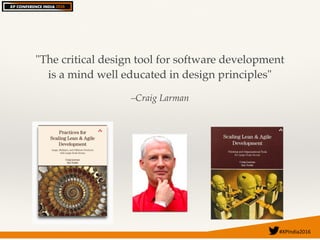
–Craig Larman
"The critical design tool for software development
is a mind well educated in design principles"
#XPIndia2016	
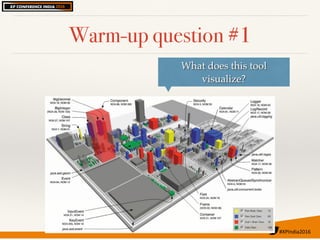
Warm-up question #1
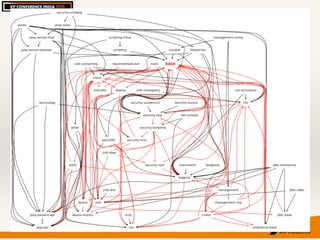
What does this tool
visualize?
#XPIndia2016	
Warm-up question #2
Who coined
the term
“code smell”?
Hint: He also
originated the
terms TDD
and XP
#XPIndia2016	
Warm-up question #3
Who wrote the foreword for
our book?
#XPIndia2016	
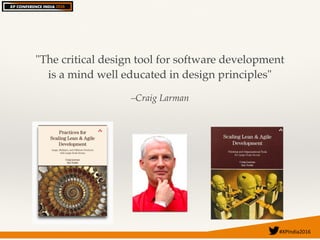
–Craig Larman
"The critical design tool for software development
is a mind well educated in design principles"
#XPIndia2016	
Why care about design quality and design principles?
‹#›
#XPIndia2016	
Why care about design quality and design principles?
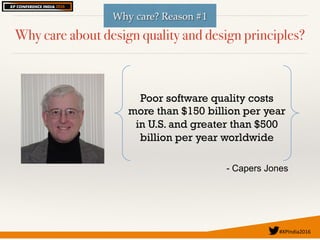
Poor software quality costs
more than $150 billion per year
in U.S. and greater than $500
billion per year worldwide
- Capers Jones
Why care? Reason #1
#XPIndia2016	
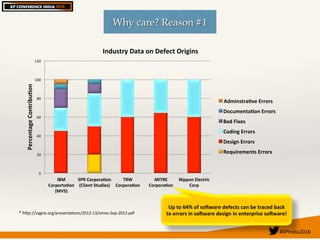
*	h$p://sqgne.org/presenta2ons/2012-13/Jones-Sep-2012.pdf	
0	
20	
40	
60	
80	
100	
120	
IBM	
Corporta+on	
(MVS)	
SPR	Corpora+on	
(Client	Studies)	
TRW	
Corpora+on	
MITRE	
Corpora+on	
Nippon	Electric	
Corp	
Percentage	Contribu+on	
Industry	Data	on	Defect	Origins	
Adminstra+ve	Errors	
Documenta+on	Errors	
Bad	Fixes	
Coding	Errors	
Design	Errors	
Requirements	Errors	
Up	to	64%	of	soNware	defects	can	be	traced	back	
to	errors	in	soNware	design	in	enterprise	soNware!		
Why care? Reason #1
#XPIndia2016	
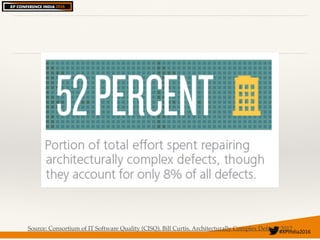
Source: Consortium of IT Software Quality (CISQ), Bill Curtis, Architecturally Complex Defects, 2012
“The problem with quick and dirty...is that dirty
remains long after quick has been forgotten”
Steve C McConnell
#XPIndia2016	
Why care? Reason #3
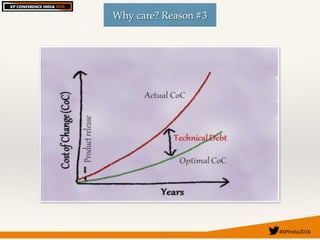
“Technical debt is the debt that accrues
when you knowingly or unknowingly make
wrong or non-optimal design decisions”
#XPIndia2016	
Why care? Reason #3
#XPIndia2016	
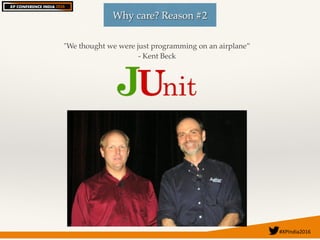
"We thought we were just programming on an airplane”
- Kent Beck
Why care? Reason #2
#XPIndia2016	
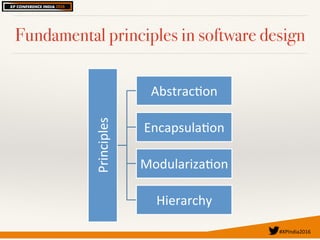
Fundamental principles in software design
Principles*
Abstrac/on*
Encapsula/on*
Modulariza/on*
Hierarchy*
#XPIndia2016	
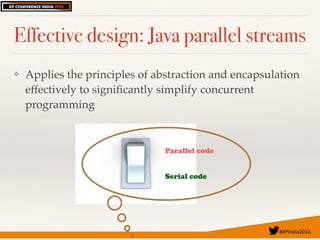
Effective design: Java parallel streams
❖ Applies the principles of abstraction and encapsulation
effectively to significantly simplify concurrent
programming
Parallel code
Serial code
#XPIndia2016	
Parallel streams: example
import java.util.stream.LongStream;
class PrimeNumbers {
private static boolean isPrime(long val) {
for(long i = 2; i <= val/2; i++) {
if((val % i) == 0) {
return false;
}
}
return true;
}
public static void main(String []args) {
long numOfPrimes = LongStream.rangeClosed(2, 50_000)
.parallel()
.filter(PrimeNumbers::isPrime)
.count();
System.out.println(numOfPrimes);
}
}
#XPIndia2016	
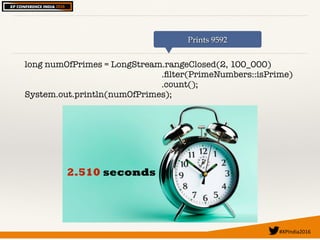
long numOfPrimes = LongStream.rangeClosed(2, 100_000)
.filter(PrimeNumbers::isPrime)
.count();
System.out.println(numOfPrimes);
Prints 9592
2.510 seconds
#XPIndia2016	
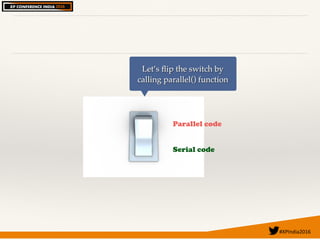
Parallel code
Serial code
Let’s flip the switch by
calling parallel() function
#XPIndia2016	
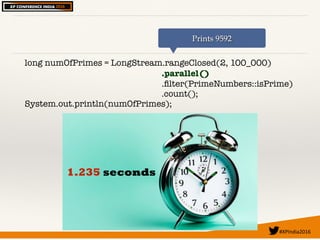
long numOfPrimes = LongStream.rangeClosed(2, 100_000)
.parallel()
.filter(PrimeNumbers::isPrime)
.count();
System.out.println(numOfPrimes);
Prints 9592
1.235 seconds
#XPIndia2016	
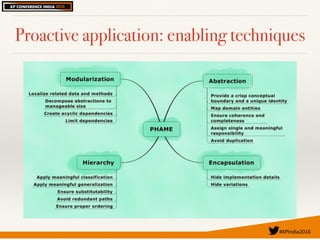
Proactive application: enabling techniques
#XPIndia2016	
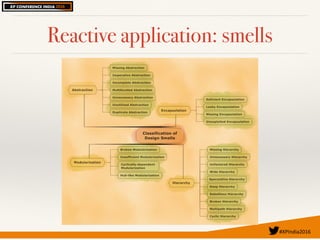
Reactive application: smells
#XPIndia2016	
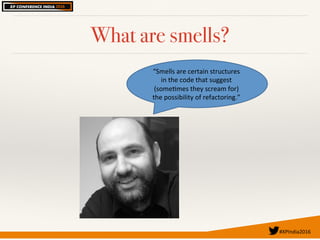
What are smells?
“Smells'are'certain'structures'
in'the'code'that'suggest'
(some4mes'they'scream'for)'
the'possibility'of'refactoring.”''
#XPIndia2016	
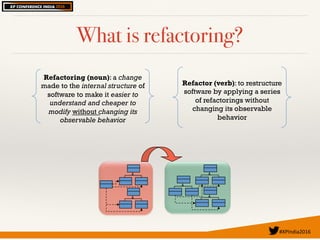
What is refactoring?
Refactoring (noun): a change
made to the internal structure of
software to make it easier to
understand and cheaper to
modify without changing its
observable behavior
Refactor (verb): to restructure
software by applying a series
of refactorings without
changing its observable
behavior
#XPIndia2016	
Should this be “refactored”?
abstract class Printer {
private Integer portNumber = getPortNumber();
abstract Integer getPortNumber();
public static void main(String[]s) {
Printer p = new LPDPrinter();
System.out.println(p.portNumber);
}
}
class LPDPrinter extends Printer {
/* Line Printer Deamon port no is 515 */
private Integer defaultPortNumber = 515;
Integer getPortNumber() {
return defaultPortNumber;
}
}
#XPIndia2016	
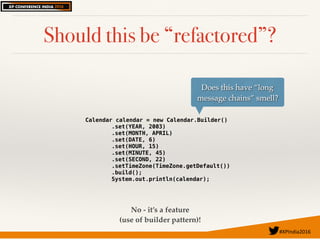
Should this be “refactored”?
Calendar calendar = new Calendar.Builder()
.set(YEAR, 2003)
.set(MONTH, APRIL)
.set(DATE, 6)
.set(HOUR, 15)
.set(MINUTE, 45)
.set(SECOND, 22)
.setTimeZone(TimeZone.getDefault())
.build();
System.out.println(calendar);
Does this have “long
message chains” smell?
No - it’s a feature
(use of builder pattern)!
#XPIndia2016	
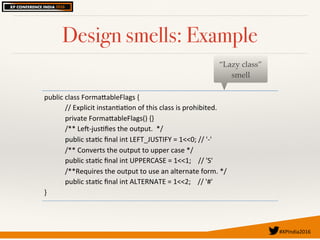
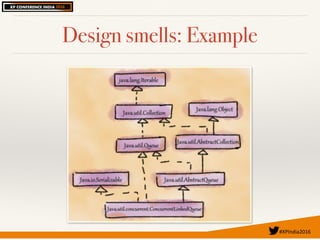
Design smells: Example
public'class'Forma.ableFlags'{'
''''//'Explicit'instan7a7on'of'this'class'is'prohibited.'
''''private'Forma.ableFlags()'{}'
''''/**'LeBCjus7fies'the'output.''*/'
''''public'sta7c'final'int'LEFT_JUSTIFY'='1<<0;'//''C''
''''/**'Converts'the'output'to'upper'case'*/''
''''public'sta7c'final'int'UPPERCASE'='1<<1;''''//''S''
''''/**Requires'the'output'to'use'an'alternate'form.'*/'
''''public'sta7c'final'int'ALTERNATE'='1<<2;''''//''#''
}'
“Lazy class”
smell
#XPIndia2016	
Duplicated Code
#XPIndia2016	
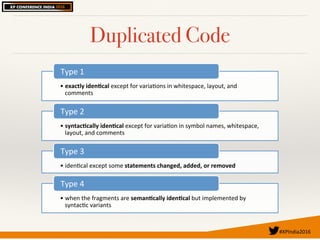
Duplicated Code
• exactly(iden,cal(except'for'varia.ons'in'whitespace,'layout,'and'
comments'
Type'1'
• syntac,cally(iden,cal(except'for'varia.on'in'symbol'names,'whitespace,'
layout,'and'comments'
Type'2'
• iden.cal'except'some'statements(changed,(added,(or(removed(
Type'3'
• when'the'fragments'are'seman,cally(iden,cal(but'implemented'by'
syntac.c'variants'
Type'4'
#XPIndia2016	
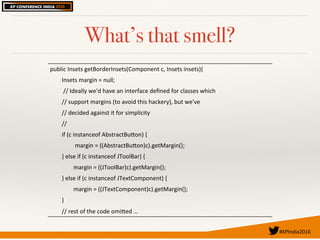
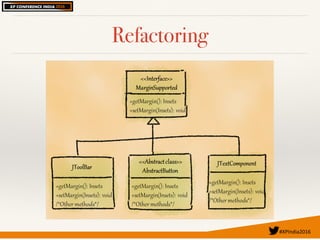
What’s that smell?
public'Insets'getBorderInsets(Component'c,'Insets'insets){'
''''''''Insets'margin'='null;'
'''''''''//'Ideally'we'd'have'an'interface'defined'for'classes'which'
''''''''//'support'margins'(to'avoid'this'hackery),'but'we've'
''''''''//'decided'against'it'for'simplicity'
''''''''//'
''''''''if'(c'instanceof'AbstractBuEon)'{'
'''''''''''''''''margin'='((AbstractBuEon)c).getMargin();'
''''''''}'else'if'(c'instanceof'JToolBar)'{'
''''''''''''''''margin'='((JToolBar)c).getMargin();'
''''''''}'else'if'(c'instanceof'JTextComponent)'{'
''''''''''''''''margin'='((JTextComponent)c).getMargin();'
''''''''}'
''''''''//'rest'of'the'code'omiEed'…'
#XPIndia2016	
Refactoring
#XPIndia2016	
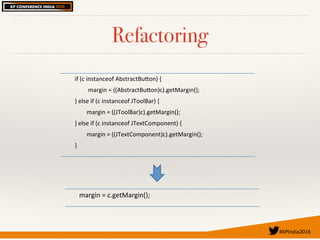
Refactoring
!!!!!!!margin!=!c.getMargin();
!!!!!!!!if!(c!instanceof!AbstractBu8on)!{!
!!!!!!!!!!!!!!!!!margin!=!((AbstractBu8on)c).getMargin();!
!!!!!!!!}!else!if!(c!instanceof!JToolBar)!{!
!!!!!!!!!!!!!!!!margin!=!((JToolBar)c).getMargin();!
!!!!!!!!}!else!if!(c!instanceof!JTextComponent)!{!
!!!!!!!!!!!!!!!!margin!=!((JTextComponent)c).getMargin();!
!!!!!!!!}
#XPIndia2016	
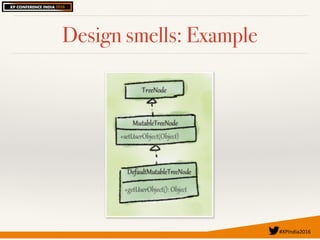
Design smells: Example
#XPIndia2016	
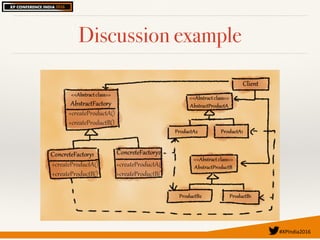
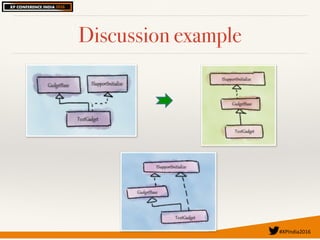
Discussion example
#XPIndia2016	
Design smells: Example
#XPIndia2016	
Discussion example
#XPIndia2016	
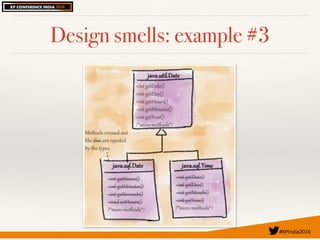
Design smells: example #3
#XPIndia2016	
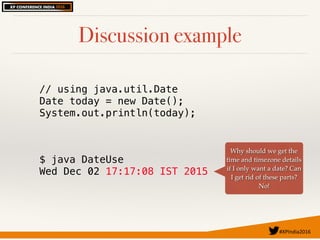
Discussion example
// using java.util.Date
Date today = new Date();
System.out.println(today);
$ java DateUse
Wed Dec 02 17:17:08 IST 2015
Why should we get the
time and timezone details
if I only want a date? Can
I get rid of these parts?
No!
#XPIndia2016	
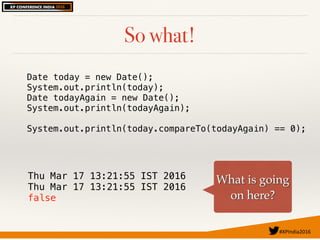
So what!
Date today = new Date();
System.out.println(today);
Date todayAgain = new Date();
System.out.println(todayAgain);
System.out.println(today.compareTo(todayAgain) == 0);
Thu Mar 17 13:21:55 IST 2016
false
What is going
on here?
#XPIndia2016	
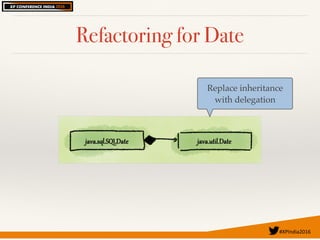
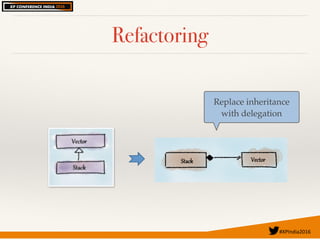
Refactoring for Date
Replace inheritance
with delegation
#XPIndia2016	
Joda API
Stephen Colebourne
#XPIndia2016	
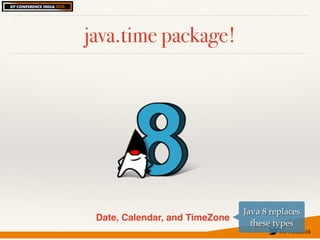
java.time package!
Date, Calendar, and TimeZone
Java 8 replaces
these types
#XPIndia2016	
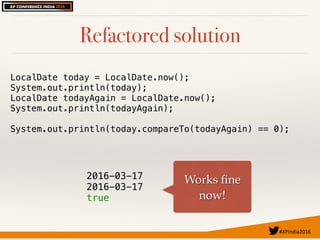
Refactored solution
LocalDate today = LocalDate.now();
System.out.println(today);
LocalDate todayAgain = LocalDate.now();
System.out.println(todayAgain);
System.out.println(today.compareTo(todayAgain) == 0);
2016-03-17
2016-03-17
true
Works fine
now!
#XPIndia2016	
Refactored example …
You can use only date,
time, or even timezone,
and combine them as
needed!
LocalDate today = LocalDate.now();
System.out.println(today);
LocalTime now = LocalTime.now();
System.out.println(now);
ZoneId id = ZoneId.of("Asia/Tokyo");
System.out.println(id);
LocalDateTime todayAndNow = LocalDateTime.now();
System.out.println(todayAndNow);
ZonedDateTime todayAndNowInTokyo = ZonedDateTime.now(ZoneId.of("Asia/Tokyo"));
System.out.println(todayAndNowInTokyo);
2016-03-17
13:28:06.927
Asia/Tokyo
2016-03-17T13:28:06.928
2016-03-17T16:58:06.929+09:00[Asia/Tokyo]
#XPIndia2016	
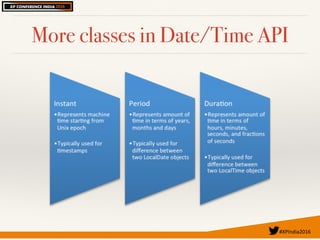
More classes in Date/Time API
#XPIndia2016	
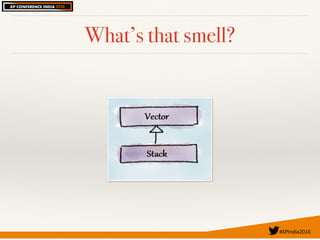
What’s that smell?
#XPIndia2016	
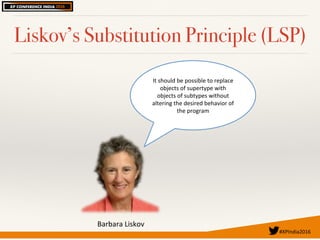
Liskov’s Substitution Principle (LSP)
It#should#be#possible#to#replace#
objects#of#supertype#with#
objects#of#subtypes#without#
altering#the#desired#behavior#of#
the#program#
Barbara#Liskov#
#XPIndia2016	
Refactoring
Replace inheritance
with delegation
#XPIndia2016	
What’s that smell?
switch'(transferType)'{'
case'DataBuffer.TYPE_BYTE:'
byte'bdata[]'='(byte[])inData;'
pixel'='bdata[0]'&'0xff;'
length'='bdata.length;'
break;'
case'DataBuffer.TYPE_USHORT:'
short'sdata[]'='(short[])inData;'
pixel'='sdata[0]'&'0xffff;'
length'='sdata.length;'
break;'
case'DataBuffer.TYPE_INT:'
int'idata[]'='(int[])inData;'
pixel'='idata[0];'
length'='idata.length;'
break;'
default:'
throw' new' UnsupportedOperaQonExcepQon("This' method' has' not' been' "+' "implemented'
for'transferType'"'+'transferType);'
}'
#XPIndia2016	
Replace conditional with polymorphism
protected(int(transferType;! protected(DataBuffer(dataBuffer;!
pixel(=(dataBuffer.getPixel();(
length(=(dataBuffer.getSize();!
switch((transferType)({(
case(DataBuffer.TYPE_BYTE:(
byte(bdata[](=((byte[])inData;(
pixel(=(bdata[0](&(0xff;(
length(=(bdata.length;(
break;(
case(DataBuffer.TYPE_USHORT:(
short(sdata[](=((short[])inData;(
pixel(=(sdata[0](&(0xffff;(
length(=(sdata.length;(
break;(
case(DataBuffer.TYPE_INT:(
int(idata[](=((int[])inData;(
pixel(=(idata[0];(
length(=(idata.length;(
break;(
default:(
throw( new( UnsupportedOperaRonExcepRon("This( method(
has( not( been( "+( "implemented( for( transferType( "( +(
transferType);(
}!
#XPIndia2016	
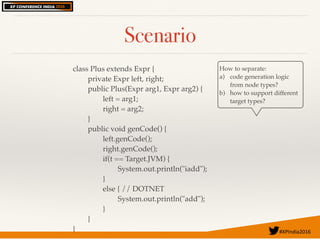
Scenario
How to separate:
a) code generation logic
from node types?
b) how to support different
target types?
class Plus extends Expr {
private Expr left, right;
public Plus(Expr arg1, Expr arg2) {
left = arg1;
right = arg2;
}
public void genCode() {
left.genCode();
right.genCode();
if(t == Target.JVM) {
System.out.println("iadd");
}
else { // DOTNET
System.out.println("add");
}
}
}
#XPIndia2016	
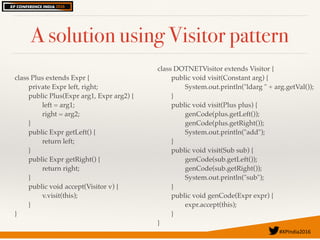
A solution using Visitor pattern
class Plus extends Expr {
private Expr left, right;
public Plus(Expr arg1, Expr arg2) {
left = arg1;
right = arg2;
}
public Expr getLeft() {
return left;
}
public Expr getRight() {
return right;
}
public void accept(Visitor v) {
v.visit(this);
}
}
class DOTNETVisitor extends Visitor {
public void visit(Constant arg) {
System.out.println("ldarg " + arg.getVal());
}
public void visit(Plus plus) {
genCode(plus.getLeft());
genCode(plus.getRight());
System.out.println("add");
}
public void visit(Sub sub) {
genCode(sub.getLeft());
genCode(sub.getRight());
System.out.println("sub");
}
public void genCode(Expr expr) {
expr.accept(this);
}
}
#XPIndia2016	
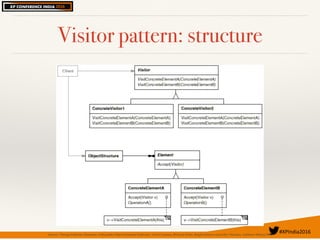
Visitor pattern: structure
Source: “Design Patterns: Elements of Reusable Object-Oriented Software”, Erich Gamma, Richard Helm, Ralph Johnson and John Vlissides, Addison-Wesley,1994
#XPIndia2016	
Visitor pattern: call sequence
Source: “Design Patterns: Elements of Reusable Object-Oriented Software”, Erich Gamma, Richard Helm, Ralph Johnson and John Vlissides, Addison-Wesley,1994
#XPIndia2016	
Visitor pattern: Discussion
Represent an operation to be performed on the elements of an object structure.
Visitor lets you define a new operation without changing the classes of the
elements on which it operations
❖ Create two class
hierarchies:
❖ One for the elements
being operated on
❖ One for the visitors that
define operations on the
elements
#XPIndia2016	
Refactoring with Lambdas
File[] files = new File(".").listFiles(
new FileFilter() {
public boolean accept(File f) { return f.isFile(); }
}
);
for(File file: files) {
System.out.println(file);
}
Arrays.stream(new File(“.”)
.listFiles(file -> file.isFile()))
.forEach(System.out::println);
#XPIndia2016	
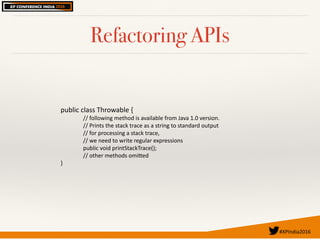
Refactoring APIs
public	class	Throwable	{	
//	following	method	is	available	from	Java	1.0	version.		
//	Prints	the	stack	trace	as	a	string	to	standard	output		
//	for	processing	a	stack	trace,		
//	we	need	to	write	regular	expressions		
public	void	printStackTrace();						
//	other	methods	omiEed		
}
#XPIndia2016	
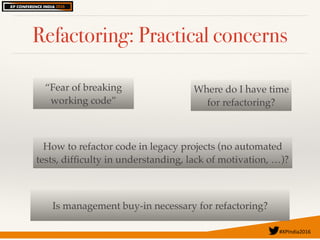
Refactoring: Practical concerns
“Fear of breaking
working code”
Is management buy-in necessary for refactoring?
How to refactor code in legacy projects (no automated
tests, difficulty in understanding, lack of motivation, …)?
Where do I have time
for refactoring?
#XPIndia2016	
Tool driven approach for design quality
#XPIndia2016	
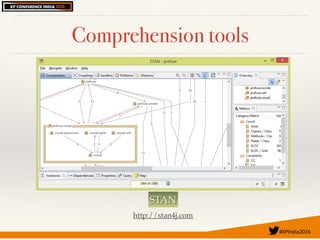
Comprehension tools
STAN
http://stan4j.com
#XPIndia2016	
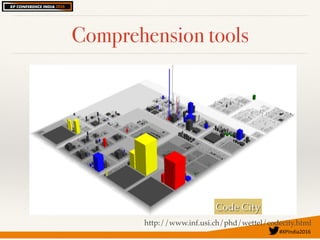
Comprehension tools
Code City
http://www.inf.usi.ch/phd/wettel/codecity.html
#XPIndia2016	
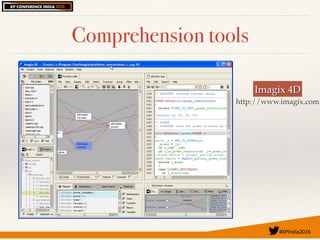
Comprehension tools
Imagix 4D
http://www.imagix.com
#XPIndia2016	
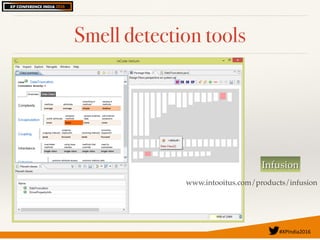
Smell detection tools
Infusion
www.intooitus.com/products/infusion
#XPIndia2016	
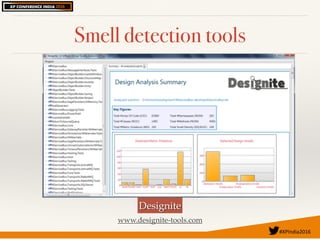
Smell detection tools
Designite
www.designite-tools.com
#XPIndia2016	
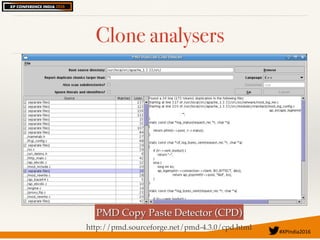
Clone analysers
PMD Copy Paste Detector (CPD)
http://pmd.sourceforge.net/pmd-4.3.0/cpd.html
#XPIndia2016	
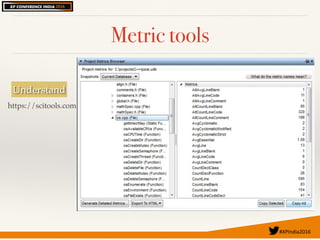
Metric tools
Understand
https://scitools.com
#XPIndia2016	
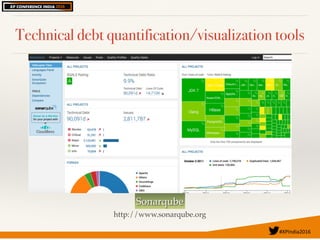
Technical debt quantification/visualization tools
Sonarqube
http://www.sonarqube.org
#XPIndia2016	
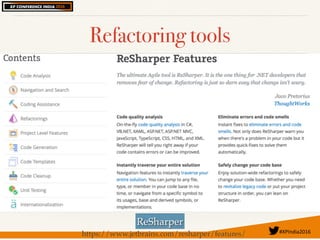
Refactoring tools
ReSharper
https://www.jetbrains.com/resharper/features/
#XPIndia2016	
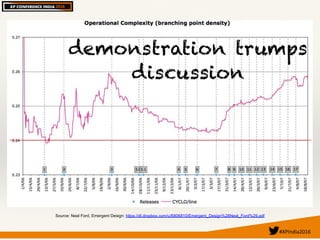
Source: Neal Ford, Emergent Design: https://dl.dropbox.com/u/6806810/Emergent_Design%28Neal_Ford%29.pdf
#XPIndia2016	
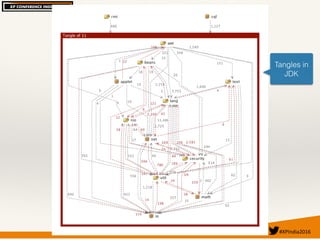
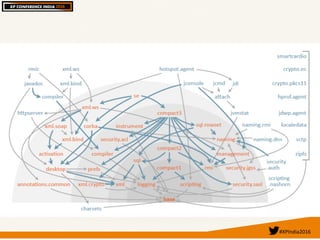
Tangles in
JDK
#XPIndia2016
#XPIndia2016
#XPIndia2016	
Refactoring for Software Architecture Smells
Ganesh Samarthyam, Tushar Sharma and Girish Suryanarayana
http://www.softrefactoring.com/
#XPIndia2016	
ganesh@codeops.tech @GSamarthyam
www.codeops.tech slideshare.net/sgganesh
+91 98801 64463 bit.ly/ganeshsg

Refactoring for software design smells XP Conference 2016 Ganesh Samarthyam