
Redlining
Professor Davia Downey
Definition
What is Redlining?
Redlining is an unethical practice that puts services
(financial and otherwise) out of reach for residents of
certain areas based on race or ethnicity.
It can be seen in the systematic denial of mortgages,
insurance, loans, and other financial services based on
location (and that area’s mortgage default history) rather
than an individual’s qualifications and creditworthiness.
Housing Policy in the
United States: A Primer
1930’s
The creation of the Home Owners
Loan Corporation (HOLC) by the
federal government was meant to
stem the dramatic increases in home
foreclosures during the Great
Depression.
The HOLC was responsible for:
● Making new, low-interest loans to
homeowners affected by the Great
Depression.
● From the years 1933-1936, the
HOLC issued 1 million home loans.
● In 1935, the Federal Home Bank
Board (the parent organization of
the HOLC) directed the agency to do
an assessment of high risk loans in
239 cities across the US.
1930s, continued
The HOLC created a series of
maps of these 239 cities which
were color-coded and ranked. 1
the highest rank and 4 the lowest
rank.
HOLC examiners systematically graded
neighborhoods based on criteria related
to:
● The age and condition of housing,
● Transportation access,
● Closeness to amenities such as
parks or disamenities like
polluting industries,
● The economic class and
employment status of residents,
● And ethnic and racial composition.
>150More than 150 of these original HOLC Maps still exist.
Redlining in
Michigan
Grand Rapids, Michigan
“Homeownership is the number-one method of accumulating
wealth, but the effect of these policies that create more hurdles for
the poor is a permanent underclass that’s disproportionately
minority,”
-John Taylor, president and chief executive of the National Community Reinvestment
Coalition
The Federal Housing Administration
The HOLC maps were used as guidance
for lending decisions by the FHA, banks
and other lending institutions in the
United States.
These lenders systematically denied
people of color and other ethnicities
access to the capital needed to buy
homes throughout the US.
The Federal Housing Administration
(FHA) is a United States government
agency founded by President Franklin
Delano Roosevelt, created in part by the
National Housing Act of 1934.
The FHA sets standards for construction
and underwriting and insures loans
made by banks and other private lenders
for home building.
Where did the term redlining
come from?
Community groups in Chicago’s Austin neighborhood
coined the word redlining in the late 1960s, referring
literally to red lines lenders and insurance providers
admitted drawing around areas they would not service.
But in the 1930s and 1940s, there were virtually no legal
obstacles to lending discrimination. Redlining—not yet
given a name—was simply considered to be good
business.
Lenders and Realtors
Lenders and realtors were involved in perpetuating the
segregation of neighborhoods via the HOLC maps. They
used REVERSE REDLINING and GREENLINING to steer
prospective homebuyers to certain neighborhoods.
Reverse redlining is marketing inferior credit and other
products to those same neighborhoods.
Greenlining is incenting investment in previously redlined
neighborhoods.
National Association of Real Estate
Boards (NAREB), now the National
Association of Realtors (NAR)
“A REALTOR® should never be
instrumental in introducing into a
neighborhood ... members of any race or
nationality ... whose presence will clearly
be detrimental to property values in that
neighborhood.” --from the association’s
1924 code of ethics.
The reference to “race or nationality” was
not removed until 1950.
The National Association of Real Estate
Associations was formed in 1908, later
becoming the National Association of Real
Estate Boards (NAREB). In 1913, NAREB
adopted a Code of Ethics.
The discriminatory
practices captured by the
HOLC maps continued until
1968, when the Fair
Housing Act banned racial
discrimination in housing.
Fair Housing Act of 1968
The Fair Housing Act of 1968 prohibited discrimination concerning the sale, rental and
financing of housing based on race, religion, national origin or sex.
NAR fought the Fair Housing Act
Many factors played into NAR’s
resistance:
● Historic prejudice in the
United States,
● The belief that property
values were more stable if
neighborhoods were
occupied by the same
racial/social classes
● and the argument that
people should be free to
refuse to sell or rent a
home to anyone for any
reason — even if the
decision was based on
race.
Despite Supreme Court decisions such
as Shelley v. Kraemer (1948) and Jones
v. Mayer Co. (1968), which outlawed the
exclusion of African Americans or other
minorities from certain sections of
cities, race-based housing patterns
were still in force by the late 1960s.
Those who challenged them often met
with resistance, hostility and even
violence.
The GI Bill also impacted African-Americans access to housing
opportunities after the war.
Impact of Redlining Today
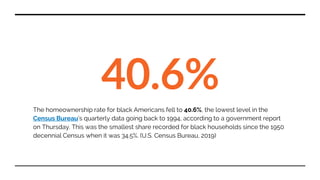
40.6%
The homeownership rate for black Americans fell to 40.6%, the lowest level in the
Census Bureau’s quarterly data going back to 1994, according to a government report
on Thursday. This was the smallest share recorded for black households since the 1950
decennial Census when it was 34.5%. (U.S. Census Bureau, 2019)
Mapping Black
Homeownership
Gap 2019
Not one of the 100 cities with the
largest black populations has a black
homeownership rate close to the white
homeownership rate.
Even in places where black households
are the majority, like Atlanta,, Georgia,
the gap persists.
(https://www.urban.org/urban-
wire/mapping-black-homeownership-gap)
Mortgage Bias
Still Exists
A recent analysis of nearly 7 million 30-year mortgages by University of California at
Berkeley researchers found that black and Latino applicants were charged higher
interest — an average of nearly 0.08% — and heavier refinance fees when
compared with white borrowers. That was in face-to-face transactions. When
applying online or through an app, minorities still ended up paying more, though
terms were slightly better than when borrowing in person.
The upshot: Long-standing discrimination faced by people of color in getting a
home loan can be reproduced in software-based lending, technology that
advocates say is supposed to prevent bias. (https://www.cbsnews.com/news/mortgage-discrimination-
black-and-latino-paying-millions-more-in-interest-study-shows/)
Racial Segregation 50 years after the Fair
Housing Act
Southside of Chicago HOLC Map
Source:
https://www.washingtonpost.com/graphics/2018/national/segregation-us-
cities/
Discussion Questions
How can planning interventions reduce the impact of
redlining?
How do cities best address the legacies of redlining in
their communities?
Will redlining effects continue to persist in the United
States? Why or Why not?
Class Activity
● Get in groups of 2 or 3
● Complete activities 1.1 and 1.2 of the Redlining Activity
● Send to Dr. Reese upon completion.

Redlining Presentation

  • 1.
  • 2.
  • 3.
    What is Redlining? Redliningis an unethical practice that puts services (financial and otherwise) out of reach for residents of certain areas based on race or ethnicity. It can be seen in the systematic denial of mortgages, insurance, loans, and other financial services based on location (and that area’s mortgage default history) rather than an individual’s qualifications and creditworthiness.
  • 4.
    Housing Policy inthe United States: A Primer
  • 5.
    1930’s The creation ofthe Home Owners Loan Corporation (HOLC) by the federal government was meant to stem the dramatic increases in home foreclosures during the Great Depression. The HOLC was responsible for: ● Making new, low-interest loans to homeowners affected by the Great Depression. ● From the years 1933-1936, the HOLC issued 1 million home loans. ● In 1935, the Federal Home Bank Board (the parent organization of the HOLC) directed the agency to do an assessment of high risk loans in 239 cities across the US.
  • 6.
    1930s, continued The HOLCcreated a series of maps of these 239 cities which were color-coded and ranked. 1 the highest rank and 4 the lowest rank. HOLC examiners systematically graded neighborhoods based on criteria related to: ● The age and condition of housing, ● Transportation access, ● Closeness to amenities such as parks or disamenities like polluting industries, ● The economic class and employment status of residents, ● And ethnic and racial composition.
  • 7.
    >150More than 150of these original HOLC Maps still exist.
  • 8.
  • 9.
    “Homeownership is thenumber-one method of accumulating wealth, but the effect of these policies that create more hurdles for the poor is a permanent underclass that’s disproportionately minority,” -John Taylor, president and chief executive of the National Community Reinvestment Coalition
  • 10.
    The Federal HousingAdministration The HOLC maps were used as guidance for lending decisions by the FHA, banks and other lending institutions in the United States. These lenders systematically denied people of color and other ethnicities access to the capital needed to buy homes throughout the US. The Federal Housing Administration (FHA) is a United States government agency founded by President Franklin Delano Roosevelt, created in part by the National Housing Act of 1934. The FHA sets standards for construction and underwriting and insures loans made by banks and other private lenders for home building.
  • 11.
    Where did theterm redlining come from? Community groups in Chicago’s Austin neighborhood coined the word redlining in the late 1960s, referring literally to red lines lenders and insurance providers admitted drawing around areas they would not service. But in the 1930s and 1940s, there were virtually no legal obstacles to lending discrimination. Redlining—not yet given a name—was simply considered to be good business.
  • 12.
    Lenders and Realtors Lendersand realtors were involved in perpetuating the segregation of neighborhoods via the HOLC maps. They used REVERSE REDLINING and GREENLINING to steer prospective homebuyers to certain neighborhoods. Reverse redlining is marketing inferior credit and other products to those same neighborhoods. Greenlining is incenting investment in previously redlined neighborhoods.
  • 13.
    National Association ofReal Estate Boards (NAREB), now the National Association of Realtors (NAR) “A REALTOR® should never be instrumental in introducing into a neighborhood ... members of any race or nationality ... whose presence will clearly be detrimental to property values in that neighborhood.” --from the association’s 1924 code of ethics. The reference to “race or nationality” was not removed until 1950. The National Association of Real Estate Associations was formed in 1908, later becoming the National Association of Real Estate Boards (NAREB). In 1913, NAREB adopted a Code of Ethics.
  • 14.
    The discriminatory practices capturedby the HOLC maps continued until 1968, when the Fair Housing Act banned racial discrimination in housing.
  • 15.
    Fair Housing Actof 1968 The Fair Housing Act of 1968 prohibited discrimination concerning the sale, rental and financing of housing based on race, religion, national origin or sex.
  • 16.
    NAR fought theFair Housing Act Many factors played into NAR’s resistance: ● Historic prejudice in the United States, ● The belief that property values were more stable if neighborhoods were occupied by the same racial/social classes ● and the argument that people should be free to refuse to sell or rent a home to anyone for any reason — even if the decision was based on race.
  • 17.
    Despite Supreme Courtdecisions such as Shelley v. Kraemer (1948) and Jones v. Mayer Co. (1968), which outlawed the exclusion of African Americans or other minorities from certain sections of cities, race-based housing patterns were still in force by the late 1960s. Those who challenged them often met with resistance, hostility and even violence.
  • 18.
    The GI Billalso impacted African-Americans access to housing opportunities after the war.
  • 19.
  • 20.
    40.6% The homeownership ratefor black Americans fell to 40.6%, the lowest level in the Census Bureau’s quarterly data going back to 1994, according to a government report on Thursday. This was the smallest share recorded for black households since the 1950 decennial Census when it was 34.5%. (U.S. Census Bureau, 2019)
  • 21.
    Mapping Black Homeownership Gap 2019 Notone of the 100 cities with the largest black populations has a black homeownership rate close to the white homeownership rate. Even in places where black households are the majority, like Atlanta,, Georgia, the gap persists. (https://www.urban.org/urban- wire/mapping-black-homeownership-gap)
  • 22.
    Mortgage Bias Still Exists Arecent analysis of nearly 7 million 30-year mortgages by University of California at Berkeley researchers found that black and Latino applicants were charged higher interest — an average of nearly 0.08% — and heavier refinance fees when compared with white borrowers. That was in face-to-face transactions. When applying online or through an app, minorities still ended up paying more, though terms were slightly better than when borrowing in person. The upshot: Long-standing discrimination faced by people of color in getting a home loan can be reproduced in software-based lending, technology that advocates say is supposed to prevent bias. (https://www.cbsnews.com/news/mortgage-discrimination- black-and-latino-paying-millions-more-in-interest-study-shows/)
  • 23.
    Racial Segregation 50years after the Fair Housing Act Southside of Chicago HOLC Map Source: https://www.washingtonpost.com/graphics/2018/national/segregation-us- cities/
  • 24.
    Discussion Questions How canplanning interventions reduce the impact of redlining? How do cities best address the legacies of redlining in their communities? Will redlining effects continue to persist in the United States? Why or Why not?
  • 25.
    Class Activity ● Getin groups of 2 or 3 ● Complete activities 1.1 and 1.2 of the Redlining Activity ● Send to Dr. Reese upon completion.