Redis Data-Structure and
Performance Optimization
Presented By: Shivam Rai
Lack of etiquette and manners is a huge turn off.
KnolX Etiquettes
 Punctuality
Join the session 5 minutes prior to the session start time. We start on
time and conclude on time!
 Feedback
Make sure to submit a constructive feedback for all sessions as it is very
helpful for the presenter.
 Silent Mode
Keep your mobile devices in silent mode, feel free to move out of session
in case you need to attend an urgent call.
 Avoid Disturbance
Avoid unwanted chit chat during the session.
Agenda
 Introduction to Redis
 Common Use Cases
 Redis Data Structures
 Performance Optimization Strategies
 Demo
What is Redis
 Redis, short for REmote DIctionary Server, is an open-source, in-memory data store. It's
often referred to as a "data structure server" because it provides various data
structures like strings, lists, sets, hashes, sorted sets, bitmaps, and more.
 Redis is designed for high-performance and low-latency data storage and retrieval. It
keeps all its data in memory, which makes it extremely fast, and it supports persistence
options to ensure data durability.
 Redis is often used as a caching layer to speed up data access or as a message broker
for real-time applications. It is widely adopted in modern web development, gaming,
analytics, and other use cases that require fast and scalable data storage.
 A key-value store is a basic type of database where data is stored as a collection of key-value pairs.
Each piece of data is associated with a unique key, and you can retrieve the data by providing the
corresponding key.
 Redis is a specialized type of key-value store that goes beyond the basics. While traditional key-value
stores often provide basic data types like strings, Redis extends this concept by offering a rich set of
data structures (lists, sets, hashes, etc.) that can be manipulated in various ways.
 Unlike many traditional key-value stores, Redis is in-memory, which means that data is stored in RAM
(Random Access Memory) for rapid access, making it incredibly fast. It also provides durability options,
so you can choose how often data is persisted to disk.
Key-Value Store vs. Redis
Use Cases of Redis
Redis is versatile and can be used in a wide range of applications. Some common use cases include:
 Caching: Redis is often used as a cache to store frequently accessed data in memory. This reduces the load
on slower backend databases and speeds up data retrieval.
 Real-time Analytics: Redis's fast data structures make it suitable for real-time analytics and counting
operations. For example, it can be used to track user activity on a website or in a game.
 Session Store: Redis is used to store user sessions in web applications, ensuring fast and reliable session
management.
 Pub/Sub Messaging: Redis provides publish/subscribe messaging patterns, making it ideal for building real-
time chat applications, notification systems, and IoT applications.
 Geospatial Indexing: Redis has geospatial data structures that allow you to perform spatial queries, making
it useful for location-based services.
 Queues: Redis can be used as a message broker in distributed systems for implementing task queues and
background job processing.
 Leaderboards and Rankings: Redis's sorted sets make it easy to implement leaderboards, rankings, and
scoring systems in games and applications.
Redis Data Structures Overview
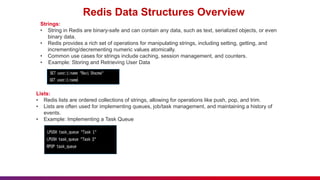
Strings:
• String in Redis are binary-safe and can contain any data, such as text, serialized objects, or even
binary data.
• Redis provides a rich set of operations for manipulating strings, including setting, getting, and
incrementing/decrementing numeric values atomically.
• Common use cases for strings include caching, session management, and counters.
• Example: Storing and Retrieving User Data
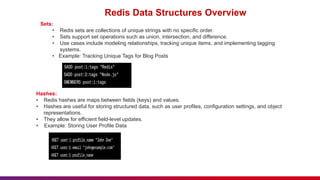
Lists:
• Redis lists are ordered collections of strings, allowing for operations like push, pop, and trim.
• Lists are often used for implementing queues, job/task management, and maintaining a history of
events.
• Example: Implementing a Task Queue
Redis Data Structures Overview
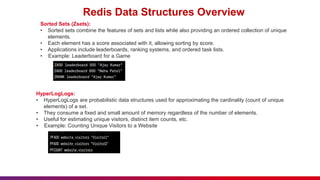
Sets:
• Redis sets are collections of unique strings with no specific order.
• Sets support set operations such as union, intersection, and difference.
• Use cases include modeling relationships, tracking unique items, and implementing tagging
systems.
• Example: Tracking Unique Tags for Blog Posts
Hashes:
• Redis hashes are maps between fields (keys) and values.
• Hashes are useful for storing structured data, such as user profiles, configuration settings, and object
representations.
• They allow for efficient field-level updates.
• Example: Storing User Profile Data
Redis Data Structures Overview
Sorted Sets (Zsets):
• Sorted sets combine the features of sets and lists while also providing an ordered collection of unique
elements.
• Each element has a score associated with it, allowing sorting by score.
• Applications include leaderboards, ranking systems, and ordered task lists.
• Example: Leaderboard for a Game
HyperLogLogs:
• HyperLogLogs are probabilistic data structures used for approximating the cardinality (count of unique
elements) of a set.
• They consume a fixed and small amount of memory regardless of the number of elements.
• Useful for estimating unique visitors, distinct item counts, etc.
• Example: Counting Unique Visitors to a Website
Redis Data Structures Overview
Bitmaps:
• Redis bitmaps are arrays of bits that can be manipulated using various bitwise operations.
• Bitmaps are memory-efficient for tracking binary states (e.g., user preferences, online status) or
implementing bloom filters.
• Example: Tracking User Activity (e.g., login status)
Geospatial Indexes:
• Redis supports geospatial data with sorted sets to represent locations as coordinates.
• It provides commands to add, query, and calculate distances between points.
• Commonly used in location-based services, maps, and geo-targeting.
• Example: Storing and Querying Locations
Redis Data Structures Overview
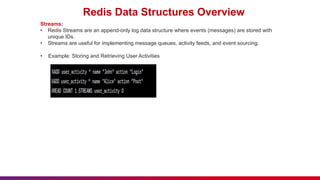
Streams:
• Redis Streams are an append-only log data structure where events (messages) are stored with
unique IDs.
• Streams are useful for implementing message queues, activity feeds, and event sourcing.
• Example: Storing and Retrieving User Activities
Performance Optimization Strategies
RDB Snapshots:
• RDB snapshots create a point-in-time backup of the dataset by periodically saving it to disk.
• Useful for full backups and disaster recovery but may lose some recent data in case of failure.
AOF Logs (Append-Only Files):
• AOF logs record every write operation, making Redis replay these operations to reconstruct the dataset.
• Ensures data integrity and durability but can be larger and slower than RDB snapshots.
In-Memory Storage:
• Redis stores data entirely in memory, which provides ultra-fast read and write operations.
• Suitable for caching and real-time applications but may require sufficient RAM.
Redis Data Persistence: Redis offers data persistence mechanisms to ensure that data is not lost even after server
restarts. It provides two main options: RDB snapshots and AOF lo
Sharding and Partitioning:
• Sharding involves splitting data across multiple Redis instances to distribute the load and improve scalability.
• Allows horizontal scaling and efficient resource utilization.
Performance Optimization Strategies
Redis Cluster:
• Redis Cluster is a built-in feature for distributed Redis setups, providing automatic sharding and high availability.
• Ensures data availability and fault tolerance.
. Connection Pooling:
• Connection pooling optimizes client connections to Redis, reducing overhead and improving performance.
• Minimizes connection establishment and teardown.
Pipelining:
• Pipelining allows multiple Redis commands to be sent to the server in a single batch, reducing round-trip time.
• Enhances throughput for scenarios with multiple sequential commands.
Lua Scripting:
• Redis supports Lua scripting, enabling users to execute complex operations atomically on the server.
• Useful for custom operations, transactions, and complex data manipulations.
Pub/Sub Mechanism (Publish/Subscribe): Redis Pub/Sub allows real-time messaging between clients. - Publishers send
messages to channels, and subscribers receive messages from channels. - Ideal for building chat applications, notifications,
and event-driven systems.
Redis data structure and Performance Optimization

Redis data structure and Performance Optimization

  • 1.
    Redis Data-Structure and PerformanceOptimization Presented By: Shivam Rai
  • 2.
    Lack of etiquetteand manners is a huge turn off. KnolX Etiquettes  Punctuality Join the session 5 minutes prior to the session start time. We start on time and conclude on time!  Feedback Make sure to submit a constructive feedback for all sessions as it is very helpful for the presenter.  Silent Mode Keep your mobile devices in silent mode, feel free to move out of session in case you need to attend an urgent call.  Avoid Disturbance Avoid unwanted chit chat during the session.
  • 3.
    Agenda  Introduction toRedis  Common Use Cases  Redis Data Structures  Performance Optimization Strategies  Demo
  • 4.
    What is Redis Redis, short for REmote DIctionary Server, is an open-source, in-memory data store. It's often referred to as a "data structure server" because it provides various data structures like strings, lists, sets, hashes, sorted sets, bitmaps, and more.  Redis is designed for high-performance and low-latency data storage and retrieval. It keeps all its data in memory, which makes it extremely fast, and it supports persistence options to ensure data durability.  Redis is often used as a caching layer to speed up data access or as a message broker for real-time applications. It is widely adopted in modern web development, gaming, analytics, and other use cases that require fast and scalable data storage.
  • 5.
     A key-valuestore is a basic type of database where data is stored as a collection of key-value pairs. Each piece of data is associated with a unique key, and you can retrieve the data by providing the corresponding key.  Redis is a specialized type of key-value store that goes beyond the basics. While traditional key-value stores often provide basic data types like strings, Redis extends this concept by offering a rich set of data structures (lists, sets, hashes, etc.) that can be manipulated in various ways.  Unlike many traditional key-value stores, Redis is in-memory, which means that data is stored in RAM (Random Access Memory) for rapid access, making it incredibly fast. It also provides durability options, so you can choose how often data is persisted to disk. Key-Value Store vs. Redis
  • 6.
    Use Cases ofRedis Redis is versatile and can be used in a wide range of applications. Some common use cases include:  Caching: Redis is often used as a cache to store frequently accessed data in memory. This reduces the load on slower backend databases and speeds up data retrieval.  Real-time Analytics: Redis's fast data structures make it suitable for real-time analytics and counting operations. For example, it can be used to track user activity on a website or in a game.  Session Store: Redis is used to store user sessions in web applications, ensuring fast and reliable session management.  Pub/Sub Messaging: Redis provides publish/subscribe messaging patterns, making it ideal for building real- time chat applications, notification systems, and IoT applications.  Geospatial Indexing: Redis has geospatial data structures that allow you to perform spatial queries, making it useful for location-based services.  Queues: Redis can be used as a message broker in distributed systems for implementing task queues and background job processing.  Leaderboards and Rankings: Redis's sorted sets make it easy to implement leaderboards, rankings, and scoring systems in games and applications.
  • 7.
    Redis Data StructuresOverview Strings: • String in Redis are binary-safe and can contain any data, such as text, serialized objects, or even binary data. • Redis provides a rich set of operations for manipulating strings, including setting, getting, and incrementing/decrementing numeric values atomically. • Common use cases for strings include caching, session management, and counters. • Example: Storing and Retrieving User Data Lists: • Redis lists are ordered collections of strings, allowing for operations like push, pop, and trim. • Lists are often used for implementing queues, job/task management, and maintaining a history of events. • Example: Implementing a Task Queue
  • 8.
    Redis Data StructuresOverview Sets: • Redis sets are collections of unique strings with no specific order. • Sets support set operations such as union, intersection, and difference. • Use cases include modeling relationships, tracking unique items, and implementing tagging systems. • Example: Tracking Unique Tags for Blog Posts Hashes: • Redis hashes are maps between fields (keys) and values. • Hashes are useful for storing structured data, such as user profiles, configuration settings, and object representations. • They allow for efficient field-level updates. • Example: Storing User Profile Data
  • 9.
    Redis Data StructuresOverview Sorted Sets (Zsets): • Sorted sets combine the features of sets and lists while also providing an ordered collection of unique elements. • Each element has a score associated with it, allowing sorting by score. • Applications include leaderboards, ranking systems, and ordered task lists. • Example: Leaderboard for a Game HyperLogLogs: • HyperLogLogs are probabilistic data structures used for approximating the cardinality (count of unique elements) of a set. • They consume a fixed and small amount of memory regardless of the number of elements. • Useful for estimating unique visitors, distinct item counts, etc. • Example: Counting Unique Visitors to a Website
  • 10.
    Redis Data StructuresOverview Bitmaps: • Redis bitmaps are arrays of bits that can be manipulated using various bitwise operations. • Bitmaps are memory-efficient for tracking binary states (e.g., user preferences, online status) or implementing bloom filters. • Example: Tracking User Activity (e.g., login status) Geospatial Indexes: • Redis supports geospatial data with sorted sets to represent locations as coordinates. • It provides commands to add, query, and calculate distances between points. • Commonly used in location-based services, maps, and geo-targeting. • Example: Storing and Querying Locations
  • 11.
    Redis Data StructuresOverview Streams: • Redis Streams are an append-only log data structure where events (messages) are stored with unique IDs. • Streams are useful for implementing message queues, activity feeds, and event sourcing. • Example: Storing and Retrieving User Activities
  • 12.
    Performance Optimization Strategies RDBSnapshots: • RDB snapshots create a point-in-time backup of the dataset by periodically saving it to disk. • Useful for full backups and disaster recovery but may lose some recent data in case of failure. AOF Logs (Append-Only Files): • AOF logs record every write operation, making Redis replay these operations to reconstruct the dataset. • Ensures data integrity and durability but can be larger and slower than RDB snapshots. In-Memory Storage: • Redis stores data entirely in memory, which provides ultra-fast read and write operations. • Suitable for caching and real-time applications but may require sufficient RAM. Redis Data Persistence: Redis offers data persistence mechanisms to ensure that data is not lost even after server restarts. It provides two main options: RDB snapshots and AOF lo Sharding and Partitioning: • Sharding involves splitting data across multiple Redis instances to distribute the load and improve scalability. • Allows horizontal scaling and efficient resource utilization.
  • 13.
    Performance Optimization Strategies RedisCluster: • Redis Cluster is a built-in feature for distributed Redis setups, providing automatic sharding and high availability. • Ensures data availability and fault tolerance. . Connection Pooling: • Connection pooling optimizes client connections to Redis, reducing overhead and improving performance. • Minimizes connection establishment and teardown. Pipelining: • Pipelining allows multiple Redis commands to be sent to the server in a single batch, reducing round-trip time. • Enhances throughput for scenarios with multiple sequential commands. Lua Scripting: • Redis supports Lua scripting, enabling users to execute complex operations atomically on the server. • Useful for custom operations, transactions, and complex data manipulations. Pub/Sub Mechanism (Publish/Subscribe): Redis Pub/Sub allows real-time messaging between clients. - Publishers send messages to channels, and subscribers receive messages from channels. - Ideal for building chat applications, notifications, and event-driven systems.