RECYCLING
BY THE NUMBERS
RECYCLING
RECYCLING is a process to
change materials (waste) into new
products to prevent waste of potentially
useful materials.
RECYCLING is a process to
change materials (waste) into new
products to prevent waste of potentially
useful materials.
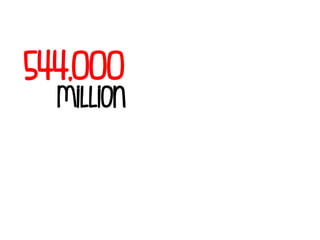
544,000
544,000
million
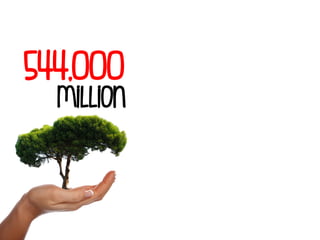
544,000
million
544,000
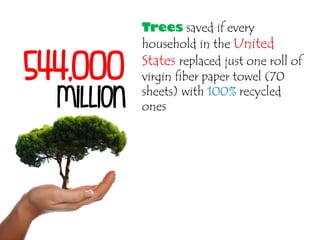
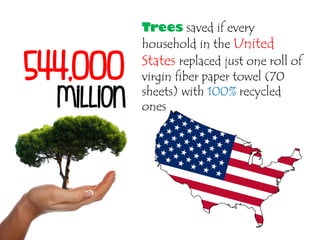
Trees saved if every
household in the United
States replaced just one roll of
virgin fiber paper towel (70
sheets) with 100% recycled
onesmillion
544,000
Trees saved if every
household in the United
States replaced just one roll of
virgin fiber paper towel (70
sheets) with 100% recycled
onesmillion
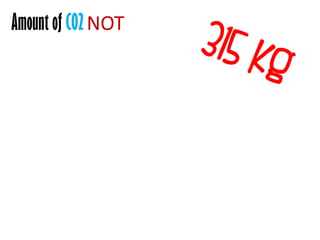
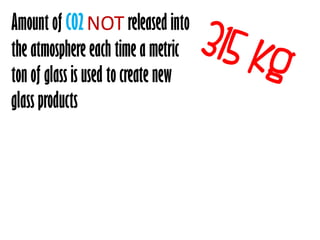
Amount of C02 NOT
Amount of C02 NOT released into
the atmosphere each time a metric
ton of glass is used to create new
glass products
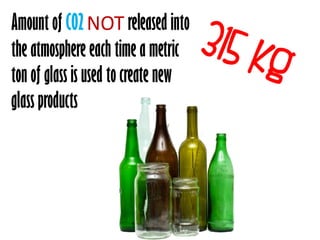
Amount of C02 NOT released into
the atmosphere each time a metric
ton of glass is used to create new
glass products
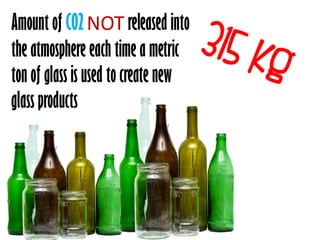
Amount of C02 NOT released into
the atmosphere each time a metric
ton of glass is used to create new
glass products
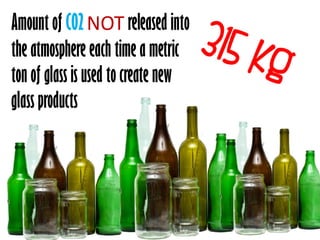
Amount of C02 NOT released into
the atmosphere each time a metric
ton of glass is used to create new
glass products
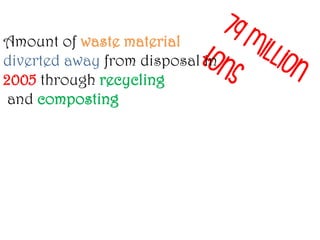
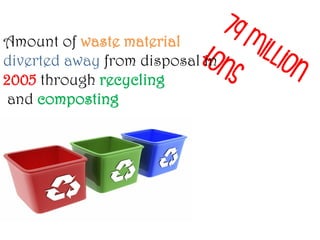
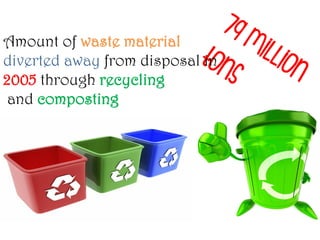
Amount of waste material
diverted away from disposal in
2005 through recycling
and composting
Amount of waste material
diverted away from disposal in
2005 through recycling
and composting
Amount of waste material
diverted away from disposal in
2005 through recycling
and composting
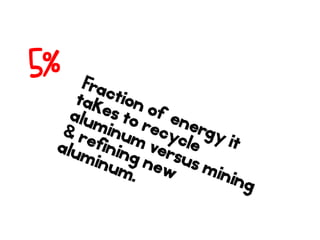
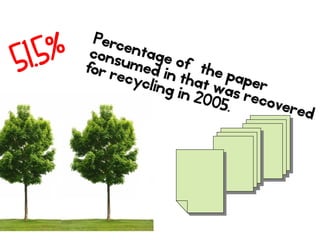
5%
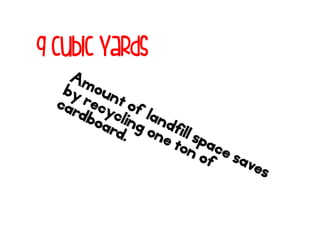
9 cubic yards
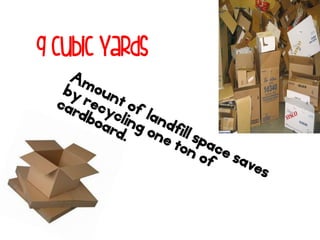
9 cubic yards
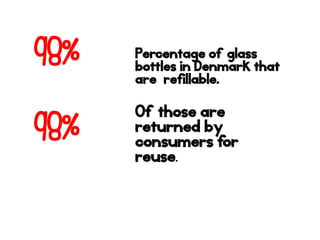
98%
98%
Percentage of glass
bottles in Denmark that
are refillable.
Of those are
returned by
consumers for
reuse.
Top
Top 5
Top 5 Recycling
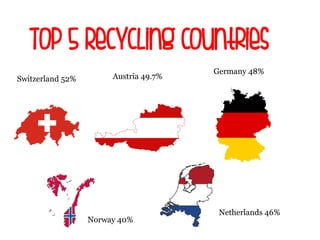
Top 5 Recycling Countries
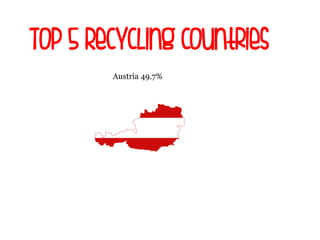
Austria 49.7%
Top 5 Recycling Countries
Austria 49.7%
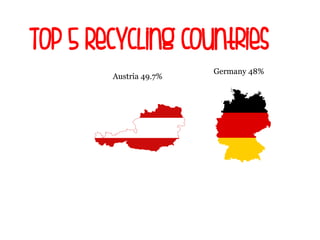
Germany 48%
Top 5 Recycling Countries
Austria 49.7%
Germany 48%
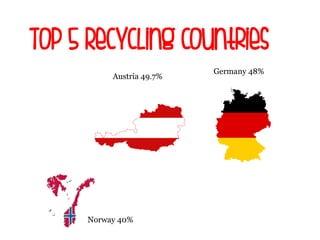
Norway 40%
Top 5 Recycling Countries
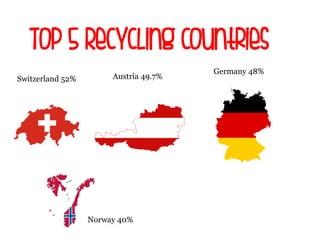
Switzerland 52% Austria 49.7%
Germany 48%
Norway 40%
Top 5 Recycling Countries
Switzerland 52% Austria 49.7%
Germany 48%
Norway 40%
Netherlands 46%
The Global Face of
Recycling
India
India
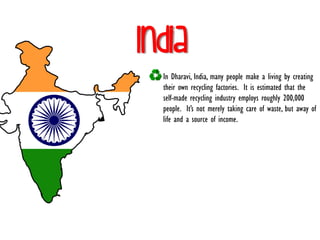
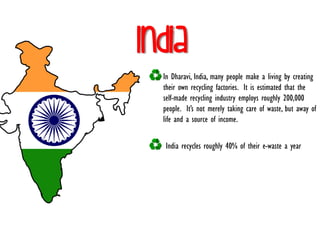
In Dharavi, India, many people make a living by creating
their own recycling factories. It is estimated that the
self-made recycling industry employs roughly 200,000
people. It’s not merely taking care of waste, but away of
life and a source of income.
India
In Dharavi, India, many people make a living by creating
their own recycling factories. It is estimated that the
self-made recycling industry employs roughly 200,000
people. It’s not merely taking care of waste, but away of
life and a source of income.
India recycles roughly 40% of their e-waste a year
Europe
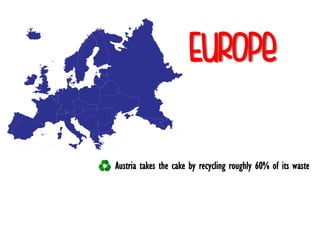
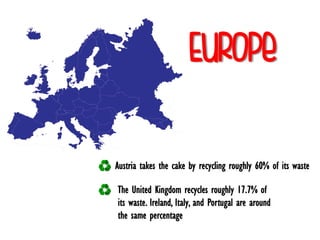
Austria takes the cake by recycling roughly 60% of its waste
Europe
Austria takes the cake by recycling roughly 60% of its waste
The United Kingdom recycles roughly 17.7% of
its waste. Ireland, Italy, and Portugal are around
the same percentage
Africa
Africa
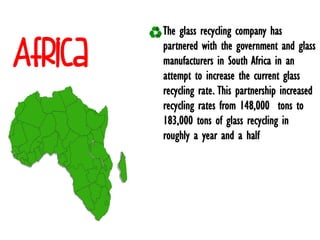
The glass recycling company has
partnered with the government and glass
manufacturers in South Africa in an
attempt to increase the current glass
recycling rate. This partnership increased
recycling rates from 148,000 tons to
183,000 tons of glass recycling in
roughly a year and a half
South America
South America
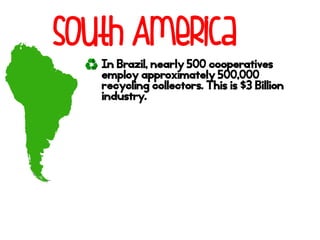
In Brazil, nearly 500 cooperatives
employ approximately 500,000
recycling collectors. This is $3 Billion
industry.
South America
In Brazil, nearly 500 cooperatives
employ approximately 500,000
recycling collectors. This is $3 Billion
industry.
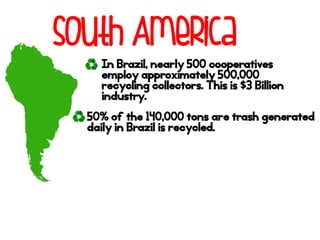
50% of the 140,000 tons are trash generated
daily in Brazil is recycled.
South America
In Brazil, nearly 500 cooperatives
employ approximately 500,000
recycling collectors. This is $3 Billion
industry.
50% of the 140,000 tons are trash generated
daily in Brazil is recycled.
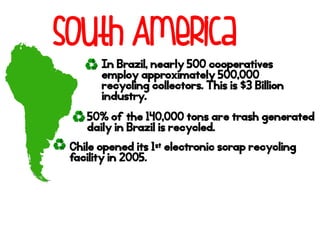
Chile opened its 1st electronic scrap recycling
facility in 2005.
South America
In Brazil, nearly 500 cooperatives
employ approximately 500,000
recycling collectors. This is $3 Billion
industry.
50% of the 140,000 tons are trash generated
daily in Brazil is recycled.
Chile opened its 1st electronic scrap recycling
facility in 2005.
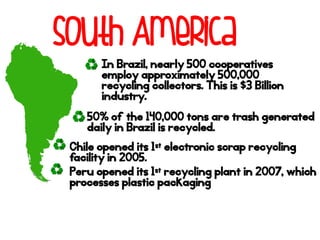
Peru opened its 1st recycling plant in 2007, which
processes plastic packaging
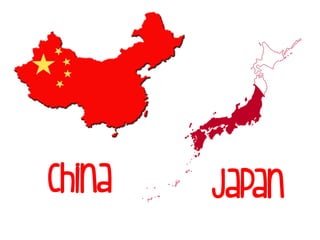
china Japan
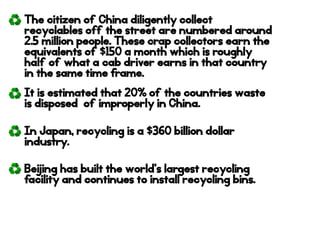
The citizen of China diligently collect
recyclables off the street are numbered around
2.5 million people. These crap collectors earn the
equivalents of $150 a month which is roughly
half of what a cab driver earns in that country
in the same time frame.
The citizen of China diligently collect
recyclables off the street are numbered around
2.5 million people. These crap collectors earn the
equivalents of $150 a month which is roughly
half of what a cab driver earns in that country
in the same time frame.
It is estimated that 20% of the countries waste
is disposed of improperly in China.
The citizen of China diligently collect
recyclables off the street are numbered around
2.5 million people. These crap collectors earn the
equivalents of $150 a month which is roughly
half of what a cab driver earns in that country
in the same time frame.
It is estimated that 20% of the countries waste
is disposed of improperly in China.
In Japan, recycling is a $360 billion dollar
industry.
The citizen of China diligently collect
recyclables off the street are numbered around
2.5 million people. These crap collectors earn the
equivalents of $150 a month which is roughly
half of what a cab driver earns in that country
in the same time frame.
It is estimated that 20% of the countries waste
is disposed of improperly in China.
In Japan, recycling is a $360 billion dollar
industry.
Beijing has built the world’s largest recycling
facility and continues to install recycling bins.
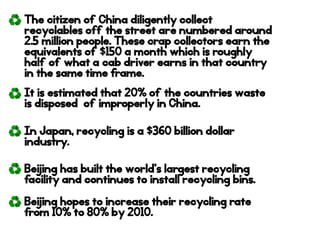
The citizen of China diligently collect
recyclables off the street are numbered around
2.5 million people. These crap collectors earn the
equivalents of $150 a month which is roughly
half of what a cab driver earns in that country
in the same time frame.
It is estimated that 20% of the countries waste
is disposed of improperly in China.
In Japan, recycling is a $360 billion dollar
industry.
Beijing has built the world’s largest recycling
facility and continues to install recycling bins.
Beijing hopes to increase their recycling rate
from 10% to 80% by 2010.
Charlotte Guillan(27, February 2008), " Reusing and
Recycling (Help the Environment)
Nuria Roca and Rosa M. Curto (Feb 1, 2007),
Backpack Jack and Hard Hat Harry (Feb 12, 2008),
Reference
The Three R's: Reuse, Reduce, Recycle
All About Garbage & Recycling
CONCLUSION
THINK ABOUT NATURE.
REDUCE , REUSE , AND RECYCLE.
IT’S IN OUR HANDS TO ASSURE A BETTER
FUTURE FOR OUR CHILDREN AND LEAVE THE
WORLD AS IT WAS BEFORE ARRIVED.
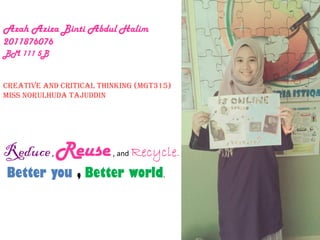
Azah Aziza Binti Abdul Halim
2011876076
BM 111 5B
Creative And Critical Thinking (MGT315)
Miss NorulHuda Tajuddin
Reduce, Reuse, and Recycle.
Better you , Better world.

Recycling by numbers

  • 1.
  • 2.
  • 3.
    RECYCLING is aprocess to
  • 4.
    RECYCLING is aprocess to change materials (waste) into new products to prevent waste of potentially useful materials.
  • 5.
    RECYCLING is aprocess to change materials (waste) into new products to prevent waste of potentially useful materials.
  • 6.
  • 7.
  • 8.
  • 9.
    544,000 Trees saved ifevery household in the United States replaced just one roll of virgin fiber paper towel (70 sheets) with 100% recycled onesmillion
  • 10.
    544,000 Trees saved ifevery household in the United States replaced just one roll of virgin fiber paper towel (70 sheets) with 100% recycled onesmillion
  • 19.
  • 20.
    Amount of C02NOT released into the atmosphere each time a metric ton of glass is used to create new glass products
  • 21.
    Amount of C02NOT released into the atmosphere each time a metric ton of glass is used to create new glass products
  • 22.
    Amount of C02NOT released into the atmosphere each time a metric ton of glass is used to create new glass products
  • 23.
    Amount of C02NOT released into the atmosphere each time a metric ton of glass is used to create new glass products
  • 30.
    Amount of wastematerial diverted away from disposal in 2005 through recycling and composting
  • 31.
    Amount of wastematerial diverted away from disposal in 2005 through recycling and composting
  • 32.
    Amount of wastematerial diverted away from disposal in 2005 through recycling and composting
  • 33.
  • 34.
  • 35.
  • 41.
    98% 98% Percentage of glass bottlesin Denmark that are refillable. Of those are returned by consumers for reuse.
  • 42.
  • 43.
  • 44.
  • 45.
    Top 5 RecyclingCountries
  • 46.
    Top 5 RecyclingCountries Austria 49.7%
  • 47.
    Top 5 RecyclingCountries Austria 49.7% Germany 48%
  • 48.
    Top 5 RecyclingCountries Austria 49.7% Germany 48% Norway 40%
  • 49.
    Top 5 RecyclingCountries Switzerland 52% Austria 49.7% Germany 48% Norway 40%
  • 50.
    Top 5 RecyclingCountries Switzerland 52% Austria 49.7% Germany 48% Norway 40% Netherlands 46%
  • 51.
    The Global Faceof Recycling
  • 52.
  • 53.
    India In Dharavi, India,many people make a living by creating their own recycling factories. It is estimated that the self-made recycling industry employs roughly 200,000 people. It’s not merely taking care of waste, but away of life and a source of income.
  • 54.
    India In Dharavi, India,many people make a living by creating their own recycling factories. It is estimated that the self-made recycling industry employs roughly 200,000 people. It’s not merely taking care of waste, but away of life and a source of income. India recycles roughly 40% of their e-waste a year
  • 55.
    Europe Austria takes thecake by recycling roughly 60% of its waste
  • 56.
    Europe Austria takes thecake by recycling roughly 60% of its waste The United Kingdom recycles roughly 17.7% of its waste. Ireland, Italy, and Portugal are around the same percentage
  • 57.
  • 58.
    Africa The glass recyclingcompany has partnered with the government and glass manufacturers in South Africa in an attempt to increase the current glass recycling rate. This partnership increased recycling rates from 148,000 tons to 183,000 tons of glass recycling in roughly a year and a half
  • 59.
  • 60.
    South America In Brazil,nearly 500 cooperatives employ approximately 500,000 recycling collectors. This is $3 Billion industry.
  • 61.
    South America In Brazil,nearly 500 cooperatives employ approximately 500,000 recycling collectors. This is $3 Billion industry. 50% of the 140,000 tons are trash generated daily in Brazil is recycled.
  • 62.
    South America In Brazil,nearly 500 cooperatives employ approximately 500,000 recycling collectors. This is $3 Billion industry. 50% of the 140,000 tons are trash generated daily in Brazil is recycled. Chile opened its 1st electronic scrap recycling facility in 2005.
  • 63.
    South America In Brazil,nearly 500 cooperatives employ approximately 500,000 recycling collectors. This is $3 Billion industry. 50% of the 140,000 tons are trash generated daily in Brazil is recycled. Chile opened its 1st electronic scrap recycling facility in 2005. Peru opened its 1st recycling plant in 2007, which processes plastic packaging
  • 64.
  • 65.
    The citizen ofChina diligently collect recyclables off the street are numbered around 2.5 million people. These crap collectors earn the equivalents of $150 a month which is roughly half of what a cab driver earns in that country in the same time frame.
  • 66.
    The citizen ofChina diligently collect recyclables off the street are numbered around 2.5 million people. These crap collectors earn the equivalents of $150 a month which is roughly half of what a cab driver earns in that country in the same time frame. It is estimated that 20% of the countries waste is disposed of improperly in China.
  • 67.
    The citizen ofChina diligently collect recyclables off the street are numbered around 2.5 million people. These crap collectors earn the equivalents of $150 a month which is roughly half of what a cab driver earns in that country in the same time frame. It is estimated that 20% of the countries waste is disposed of improperly in China. In Japan, recycling is a $360 billion dollar industry.
  • 68.
    The citizen ofChina diligently collect recyclables off the street are numbered around 2.5 million people. These crap collectors earn the equivalents of $150 a month which is roughly half of what a cab driver earns in that country in the same time frame. It is estimated that 20% of the countries waste is disposed of improperly in China. In Japan, recycling is a $360 billion dollar industry. Beijing has built the world’s largest recycling facility and continues to install recycling bins.
  • 69.
    The citizen ofChina diligently collect recyclables off the street are numbered around 2.5 million people. These crap collectors earn the equivalents of $150 a month which is roughly half of what a cab driver earns in that country in the same time frame. It is estimated that 20% of the countries waste is disposed of improperly in China. In Japan, recycling is a $360 billion dollar industry. Beijing has built the world’s largest recycling facility and continues to install recycling bins. Beijing hopes to increase their recycling rate from 10% to 80% by 2010.
  • 70.
    Charlotte Guillan(27, February2008), " Reusing and Recycling (Help the Environment) Nuria Roca and Rosa M. Curto (Feb 1, 2007), Backpack Jack and Hard Hat Harry (Feb 12, 2008), Reference The Three R's: Reuse, Reduce, Recycle All About Garbage & Recycling
  • 71.
    CONCLUSION THINK ABOUT NATURE. REDUCE, REUSE , AND RECYCLE. IT’S IN OUR HANDS TO ASSURE A BETTER FUTURE FOR OUR CHILDREN AND LEAVE THE WORLD AS IT WAS BEFORE ARRIVED.
  • 72.
    Azah Aziza BintiAbdul Halim 2011876076 BM 111 5B Creative And Critical Thinking (MGT315) Miss NorulHuda Tajuddin Reduce, Reuse, and Recycle. Better you , Better world.