The consequences  of recycling
Decisions: What would YOU recycle? Some A4 paper, in your ICT suite A shampoo bottle, in your bathroom A drinks can, in the park A tin, in the kitchen A glass drinks bottle, on the way to school Recycle Bin
Landfill Covered with soil or clay Thrown in the bin Collected and taken to landfill Emptied into a cell Compacted into the ground
What happens in a landfill? Waste arrives each day by lorry Waste is compacted into cells and covered in soil or clay Liner and drainage system stops chemicals leaking into soil Methane is piped away
Steel Click for more information Example country: Australia
Aluminium Click for more information Example country: Brazil
Glass Click for more information Example country: UK
Plastics Click for more information Example country: Saudi Arabia
Paper Click for more information Example country: Sweden
Recycling Recycled Collected, sorted and taken to a recycling facility Melted Made into plastic flakes Moulded into new items
Landfill or Recycling Which is which and which is better? Adds greenhouse gasses to the atmosphere Uses space and land Requires more raw materials for new goods and products Reduces the space and land required Reduces greenhouse gas emissions Reduces raw material use Landfill Recycling
End of presentation
Steel Steel is made from iron ore which is found in some naturally occurring rocks. These rocks are mined and transported to factories to be melted in large furnaces to extract the metal. CLOSE
Aluminium Aluminium occurs in the earth’s crust as bauxite. Bauxite is a clay like rock which is mined and then refined; first into aluminium oxide and then into aluminium by electrolysis. CLOSE
Glass CLOSE Glass is made from the minerals sand, soda ash and limestone. These materials are extracted and transported to factories and melted together at very high temperatures.
Plastics CLOSE Plastics are made from crude oil which is formed by decaying plants and animals in seas that existed millions of years ago and is found under the ground. This crude oil is drilled out of the ground, transported to oil refineries for processing and taken on to factories to made into plastics. Example country: Saudi Arabia
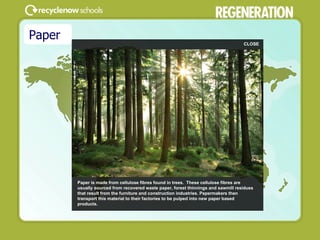
Paper CLOSE Paper is made from cellulose fibres found in trees.  These cellulose fibres are usually sourced from recovered waste paper, forest thinnings and sawmill residues that result from the furniture and construction industries. Papermakers then transport this material to their factories to be pulped into new paper based products.

Recycling

  • 1.
    The consequences of recycling
  • 2.
    Decisions: What wouldYOU recycle? Some A4 paper, in your ICT suite A shampoo bottle, in your bathroom A drinks can, in the park A tin, in the kitchen A glass drinks bottle, on the way to school Recycle Bin
  • 3.
    Landfill Covered withsoil or clay Thrown in the bin Collected and taken to landfill Emptied into a cell Compacted into the ground
  • 4.
    What happens ina landfill? Waste arrives each day by lorry Waste is compacted into cells and covered in soil or clay Liner and drainage system stops chemicals leaking into soil Methane is piped away
  • 5.
    Steel Click formore information Example country: Australia
  • 6.
    Aluminium Click formore information Example country: Brazil
  • 7.
    Glass Click formore information Example country: UK
  • 8.
    Plastics Click formore information Example country: Saudi Arabia
  • 9.
    Paper Click formore information Example country: Sweden
  • 10.
    Recycling Recycled Collected,sorted and taken to a recycling facility Melted Made into plastic flakes Moulded into new items
  • 11.
    Landfill or RecyclingWhich is which and which is better? Adds greenhouse gasses to the atmosphere Uses space and land Requires more raw materials for new goods and products Reduces the space and land required Reduces greenhouse gas emissions Reduces raw material use Landfill Recycling
  • 12.
  • 13.
    Steel Steel ismade from iron ore which is found in some naturally occurring rocks. These rocks are mined and transported to factories to be melted in large furnaces to extract the metal. CLOSE
  • 14.
    Aluminium Aluminium occursin the earth’s crust as bauxite. Bauxite is a clay like rock which is mined and then refined; first into aluminium oxide and then into aluminium by electrolysis. CLOSE
  • 15.
    Glass CLOSE Glassis made from the minerals sand, soda ash and limestone. These materials are extracted and transported to factories and melted together at very high temperatures.
  • 16.
    Plastics CLOSE Plasticsare made from crude oil which is formed by decaying plants and animals in seas that existed millions of years ago and is found under the ground. This crude oil is drilled out of the ground, transported to oil refineries for processing and taken on to factories to made into plastics. Example country: Saudi Arabia
  • 17.
    Paper CLOSE Paperis made from cellulose fibres found in trees.  These cellulose fibres are usually sourced from recovered waste paper, forest thinnings and sawmill residues that result from the furniture and construction industries. Papermakers then transport this material to their factories to be pulped into new paper based products.

Editor's Notes

  • #6 Go to full screen and click on the blue country button to bring up a pop up image.
  • #7 Go to full screen and click on the blue country button to bring up a pop up image.
  • #8 Go to full screen and click on the blue country button to bring up a pop up image.
  • #9 Go to full screen and click on the blue country button to bring up a pop up image.
  • #10 Go to full screen and click on the blue country button to bring up a pop up image.