Clement Tam David Ricardo
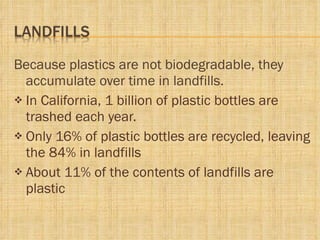
Because plastics are not biodegradable, they accumulate over time in landfills.  In California, 1 billion of plastic bottles are trashed each year. Only 16% of plastic bottles are recycled, leaving the 84% in landfills About 11% of the contents of landfills are plastic
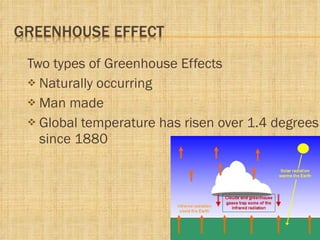
Two types of Greenhouse Effects Naturally occurring Man made Global temperature has risen over 1.4 degrees since 1880
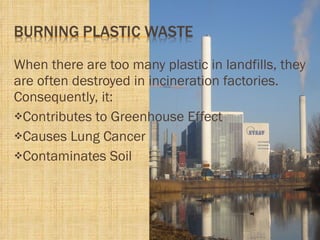
When there are too many plastic in landfills, they are often destroyed in incineration factories. Consequently, it: Contributes to Greenhouse Effect Causes Lung Cancer Contaminates Soil
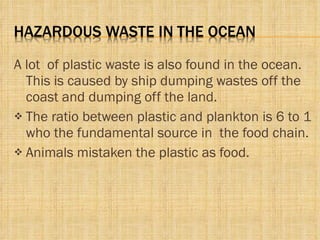
A lot  of plastic waste is also found in the ocean. This is caused by ship dumping wastes off the coast and dumping off the land. The ratio between plastic and plankton is 6 to 1 who the fundamental source in  the food chain. Animals mistaken the plastic as food.


WHAT CAN YOU DO? Reduce- Limit the use of plastic materials Reuse- Try to find ways to make plastic reusable Recycle- Throw plastic materials into the recycling bin
REDUCE Buy things that are in bulk or economy sized. Do not buy over packaged goods  No disposable goods Buy durable products
REUSE Reuse products until it no longer functions. Do not throw away old clothes and appliances Use containers instead of plastic wrap
RECYCLE Buy recycled products Check collection centers Recycle Plastic Bottles (CRV)
 
Bibliography Briney, Amanda. “Trash Islands”. Accessed July 11, 2011.  http://geography.about.com/od/globalproblemsandissues/a/trashislands.htm l Environmental Protection Agency. “Reduce, Reuse, Recycle”. Accessed July 12, 2011.  http://www.epa.gov/osw/conserve/rrr/ Marine Research Foundation. “Research North Pacific Gyre Plankton Sample Analysis ‘07-08’”. Accessed July 12, 2011 http://www.algalita.org/research/np_gyre_sample07-08.html Missouri Department of Natural Resources. “ The Three R’s: Reduce, Reduce, Recycle”. Accessed July 12, 2011.  http://www.dnr.mo.gov/env/swmp/pubs-reports/threers.htm   Moore, Shelly. “What are the Dangers of Burning Plastic Bottles”. Accessed July 10,2011.  http://www.ehow.com/list_5926080_dangers-burning-plastic-bottles.html Project Greenbag. “How does Plastic get into the Ocean? Accessed July 12, 2011.  http://www.projectgreenbag.com/how-does-plastic-get-into-the-ocean./ Weather Street. “What is Greenhouse Effect?. Accessed July 9, 2011.  http://www.weatherquestions.com/What_is_the_greenhouse_effect.htm l Wilson, Ed. “Plastic Water bottles Not being Recycled”. Accessed July 10, 2011.  http://www.consrv.ca.gov/index/news/2003%20News%20Releases/Pages/NR2003-13_Water_Bottle_Crisis.aspx
Photo Sources Landfill:  http://bitemewhitworth.files.wordpress.com/2010/10/landfill.jpg Greenhouse Effect:  http://www.weatherquestions.com/greenhouse_effect.jpg Incineration factory: http://upload.wikimedia.org/wikipedia/commons/7/73/Sopf%C3%B6rbr%C3%A4nningsanl%C3%A4ggningen_p%C3%A5_Spillepengen%2C_Malm%C3%B6.jpg Heron caught in plastic ring http://3.bp.blogspot.com/_r74vxoo9V2U/TBeo6s8T79I/AAAAAAAAA50/gnGe2baBhyk/s1600/Great-Blue-Heron_plastic_001.jpg Plastic attached to turtle:  http://3.bp.blogspot.com/_aP4lcWPQwz8/TPxtfZrTFZI/AAAAAAAAAYg/JovkGhZ_ICA/s1600/turtle-plastic-bag-photo.jpg Bird Trapped by Bag:  http://www.citizenscampaign.org/images/bag_and_bird.jpg Turtle Caught in Plastic: http://www.sail-world.com/photos/std_Gyre%20turtle%20caught%20in%20plastic.jpg Turtle Caught in Net: http://www.dotheblue.org/blog/wp-content/uploads/2009/09/Turtle-caught-in-net1.jpg Garbage Patch:  http://www.mnn.com/sites/default/files/user-59/gyre.jpg
Reduce Reuse Recycle:  http://www.greenschoolsinitiative.com/img/RRR.jpg Reduce:  http://meetthegreens.pbskids.org/episode3/images/reduce.gif Reuse:  http://4.bp.blogspot.com/_ZLd457r0yo4/S9TY0_1y91I/AAAAAAAAAHs/ETmiO-d5OvQ/s1600/242Reuse00.jpg Recycle:  http://sustainableperalta.org/wp/wp-content/uploads/2009/01/recycle.png Earth and recycle logo: http://www.sierraclubgreenhome.com/cms/wp-content/uploads/2008/09/recycle-earth.jpg Other photos: http://urbancanteen.com/blog/wp-content/uploads/2009/11/plastic-water-bottle.jpg http://www.krittersinthemailbox.com/animals/dolphins/repl157t.jpg http://gigaom2.files.wordpress.com/2011/02/landfill.jpg

Recycle final ppt

  • 1.
  • 2.
    Because plastics arenot biodegradable, they accumulate over time in landfills. In California, 1 billion of plastic bottles are trashed each year. Only 16% of plastic bottles are recycled, leaving the 84% in landfills About 11% of the contents of landfills are plastic
  • 3.
    Two types ofGreenhouse Effects Naturally occurring Man made Global temperature has risen over 1.4 degrees since 1880
  • 4.
    When there aretoo many plastic in landfills, they are often destroyed in incineration factories. Consequently, it: Contributes to Greenhouse Effect Causes Lung Cancer Contaminates Soil
  • 5.
    A lot of plastic waste is also found in the ocean. This is caused by ship dumping wastes off the coast and dumping off the land. The ratio between plastic and plankton is 6 to 1 who the fundamental source in the food chain. Animals mistaken the plastic as food.
  • 6.
  • 7.
  • 8.
  • 9.
  • 10.
    WHAT CAN YOUDO? Reduce- Limit the use of plastic materials Reuse- Try to find ways to make plastic reusable Recycle- Throw plastic materials into the recycling bin
  • 11.
    REDUCE Buy thingsthat are in bulk or economy sized. Do not buy over packaged goods No disposable goods Buy durable products
  • 12.
    REUSE Reuse productsuntil it no longer functions. Do not throw away old clothes and appliances Use containers instead of plastic wrap
  • 13.
    RECYCLE Buy recycledproducts Check collection centers Recycle Plastic Bottles (CRV)
  • 14.
  • 15.
    Bibliography Briney, Amanda.“Trash Islands”. Accessed July 11, 2011. http://geography.about.com/od/globalproblemsandissues/a/trashislands.htm l Environmental Protection Agency. “Reduce, Reuse, Recycle”. Accessed July 12, 2011. http://www.epa.gov/osw/conserve/rrr/ Marine Research Foundation. “Research North Pacific Gyre Plankton Sample Analysis ‘07-08’”. Accessed July 12, 2011 http://www.algalita.org/research/np_gyre_sample07-08.html Missouri Department of Natural Resources. “ The Three R’s: Reduce, Reduce, Recycle”. Accessed July 12, 2011. http://www.dnr.mo.gov/env/swmp/pubs-reports/threers.htm Moore, Shelly. “What are the Dangers of Burning Plastic Bottles”. Accessed July 10,2011. http://www.ehow.com/list_5926080_dangers-burning-plastic-bottles.html Project Greenbag. “How does Plastic get into the Ocean? Accessed July 12, 2011. http://www.projectgreenbag.com/how-does-plastic-get-into-the-ocean./ Weather Street. “What is Greenhouse Effect?. Accessed July 9, 2011. http://www.weatherquestions.com/What_is_the_greenhouse_effect.htm l Wilson, Ed. “Plastic Water bottles Not being Recycled”. Accessed July 10, 2011. http://www.consrv.ca.gov/index/news/2003%20News%20Releases/Pages/NR2003-13_Water_Bottle_Crisis.aspx
  • 16.
    Photo Sources Landfill: http://bitemewhitworth.files.wordpress.com/2010/10/landfill.jpg Greenhouse Effect: http://www.weatherquestions.com/greenhouse_effect.jpg Incineration factory: http://upload.wikimedia.org/wikipedia/commons/7/73/Sopf%C3%B6rbr%C3%A4nningsanl%C3%A4ggningen_p%C3%A5_Spillepengen%2C_Malm%C3%B6.jpg Heron caught in plastic ring http://3.bp.blogspot.com/_r74vxoo9V2U/TBeo6s8T79I/AAAAAAAAA50/gnGe2baBhyk/s1600/Great-Blue-Heron_plastic_001.jpg Plastic attached to turtle: http://3.bp.blogspot.com/_aP4lcWPQwz8/TPxtfZrTFZI/AAAAAAAAAYg/JovkGhZ_ICA/s1600/turtle-plastic-bag-photo.jpg Bird Trapped by Bag: http://www.citizenscampaign.org/images/bag_and_bird.jpg Turtle Caught in Plastic: http://www.sail-world.com/photos/std_Gyre%20turtle%20caught%20in%20plastic.jpg Turtle Caught in Net: http://www.dotheblue.org/blog/wp-content/uploads/2009/09/Turtle-caught-in-net1.jpg Garbage Patch: http://www.mnn.com/sites/default/files/user-59/gyre.jpg
  • 17.
    Reduce Reuse Recycle: http://www.greenschoolsinitiative.com/img/RRR.jpg Reduce: http://meetthegreens.pbskids.org/episode3/images/reduce.gif Reuse: http://4.bp.blogspot.com/_ZLd457r0yo4/S9TY0_1y91I/AAAAAAAAAHs/ETmiO-d5OvQ/s1600/242Reuse00.jpg Recycle: http://sustainableperalta.org/wp/wp-content/uploads/2009/01/recycle.png Earth and recycle logo: http://www.sierraclubgreenhome.com/cms/wp-content/uploads/2008/09/recycle-earth.jpg Other photos: http://urbancanteen.com/blog/wp-content/uploads/2009/11/plastic-water-bottle.jpg http://www.krittersinthemailbox.com/animals/dolphins/repl157t.jpg http://gigaom2.files.wordpress.com/2011/02/landfill.jpg

Editor's Notes

  • #3 Plastics are not biodegradable. Researchers believe that they do not break down and will accumulate over time According to the California Department of Conservation, 1 billion of plastics are placed in trash cans in California. As a result, there is 26 million dollars of unclaimed CRV funds. In addition, studies show that 16% of plastic bottles are recycled, leaving the rest in accumulating in landfills and in the Ocean.
  • #4 Greenhouse effect is essential for human life because it traps heat that is necessary for our survival. There are two types of greenhouse effects. One is a naturally occurring phenomena which is caused by water vapor and makes 80-90% of the earth’s greenhouse effect. The rest is a “man made” greenhouse effect which is due to carbon dioxide, methane, and a few other gases. This over accumulation of the gas from man made equipment results in an increased temperature. Since 1880, the global temperature has risen 1.4 degrees worldwide. This may seem like a small, but it actually a dramatic change to the environment. Ice melts and sea levels begin to rise.
  • #5 Plastics are often destroyed in incineration factories When plastic products over accumulated in landfill. As a result, chemical fumes and the required fossil fuels required to destroy the plastics are released into the air, contributing to the greenhouse effect. The fumes also release a dioxin, TCCD which causes cancer. Some of the toxins from the plastic eventually contaminates the soil and water which dramatically effects farmland and rural areas.
  • #6 Because plastics that aren’t biodegradable, plastic in the ocean accumulate over time. This is caused by ships dumping off the coast and dumping off the land. As a result, ocean wildlife is in peril. In a recent study, there are 6 times more plastic than plankton, the foundation of the food chain in the ocean. Animals mistakenly believe that the plastic are planktons ingest it. The plastic lacks nutrition and toxic which is unable to decompose in the animal’s body. Consequently, either the animal dies of malnutrition or the toxins from the plastic.
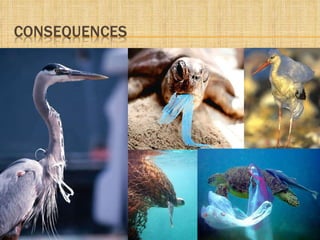
  • #7 Millions of seabirds and 100,000 mammals are killed every year by ingestion or entanglement. That numbers of wildlife death won’t improve as plastic are accumulating over time.
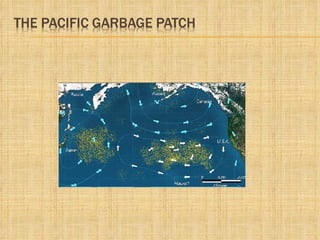
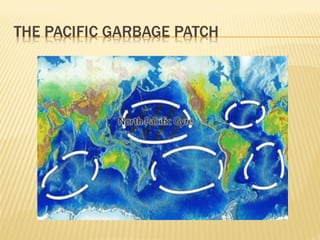
  • #8 http://geography.about.com/od/globalproblemsandissues/a/trashislands.htm As plastics accumulate, they form an artificial land due to the ocean’s current. Reports show that 80% is caused by land sources and 20% comes from ships. The largest patch is in the pacific coast which contains 3 million tons of plastic.
  • #10 http://www.youtube.com/watch?v=Jqe6tOE9oHY&NR=1
  • #11 Although the world is severely damaged by man made pollution, we can fix this solution with three easy principles. REDUCE, REUSE, AND RECYCLE.
  • #12 We should reduce the amount of plastics things we use Buy things in bulk. They have less packaging which means there is less plastics being used Over packaged goods are not only costly, they are harder to recycle. These included materials such as foil, paper, and plastic Disposable goods like paper plates or plastic cups cost more because they have to be replaced over and over Durable goods will save money over time and is more eco friendlier than disposable goods. This includes reusable water bottles and ceramic plates.
  • #13 We need to reuse everything we have Save products that can be reused for its purpose over and over again until it breaks or no longer functions. This includes paper bags, boxes, plastic bottles and home appliances. Give away your clothes and home furniture. Like the old saying, “One man’s trash is another man’s treasure”. Use containers instead of plastic wrap. Plastic wraps aren’t ecofriendly compared to containers that can be used again and again.
  • #14 Recycling is the most overlooked principle, but it is very easy to do. It only requires a few seconds of your time to sort out your trash. 1. Buy recycled materials because they are easier to break down. Look the recycling symbol. The numbers represent the type of plastic used and how easy it is to recycle. The number ranges from 1 to 7. One being the easiest and 7 being the hardest. 2. Check your local collection centers and see what they accept 3. You should also recycle plastic bottles at collection centers because they give you refund for each.
  • #15 We should all play a role in recycling. It is cost efficient and saves wildlife and human beings. Next time you decide to throw things in the trash… STOP, and take a few seconds of your life to sort out the trash and recycle.
  • #16 http://www.consrv.ca.gov/index/news/2003%20News%20Releases/Pages/NR2003-13_Water_Bottle_Crisis.html http://www.weatherquestions.com/What_is_the_greenhouse_effect.htm http://www.ehow.com/list_5926080_dangers-burning-plastic-bottles_.html http://www.algalita.org/research/np_gyre_sample07-08.html http://www.projectgreenbag.com/how-does-plastic-get-into-the-ocean/ http://geography.about.com/od/globalproblemsandissues/a/trashislands.htm http://www.epa.gov/osw/conserve/rrr/ http://www.dnr.mo.gov/env/swmp/pubs-reports/threers.htm