Recursion
Recursion
• In mathematics, we often say that a recursive solution is a solution such that f(xk) depends on
some of f(xk-1), f(xk-2),...f(x1), and f(x0)
• A usable recursive solution usually has the following characteristics
• –A base case. This is one which is easily calculated. It also prevents infinite loops!
• –A recursive case. This is the case in which the function “calls itself” in order to reduce the
calculations to the base case.
Simple problems solved recursively
• In math class we learned that 1+2+3+...+n = n*(n+1)/2
• For example, 1+2+...+10 = 10*11/2 = 55
• It is also easy to find the sum iteratively by an O(n) algorithm
int sum=0;
for i = 1 to n
sum=sum + i
• We can also solve this problem by recursion.
• Recursion to find 1 + 2 + + … + n
public sum(n)
if n == 1, sum =1
if n > 1, sum = n +sum(n-1)
Identify the base case
Identify the recursive case
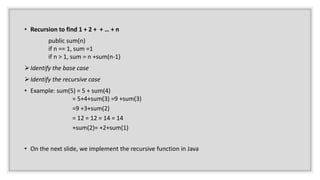
• Example: sum(5) = 5 + sum(4)
= 5+4+sum(3) =9 +sum(3)
=9 +3+sum(2)
= 12 = 12 = 14 = 14
+sum(2)= +2+sum(1)
• On the next slide, we implement the recursive function in Java
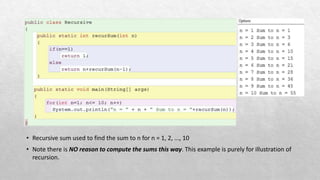
• Recursive sum used to find the sum to n for n = 1, 2, ..., 10
• Note there is NO reason to compute the sums this way. This example is purely for illustration of
recursion.
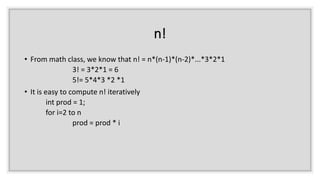
n!
• From math class, we know that n! = n*(n-1)*(n-2)*...*3*2*1
3! = 3*2*1 = 6
5!= 5*4*3 *2 *1
• It is easy to compute n! iteratively
int prod = 1;
for i=2 to n
prod = prod * i
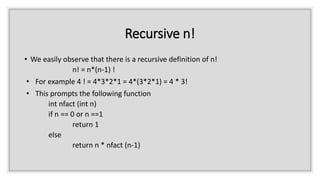
Recursive n!
• We easily observe that there is a recursive definition of n!
n! = n*(n-1) !
• For example 4 ! = 4*3*2*1 = 4*(3*2*1) = 4 * 3!
• This prompts the following function
int nfact (int n)
if n == 0 or n ==1
return 1
else
return n * nfact (n-1)
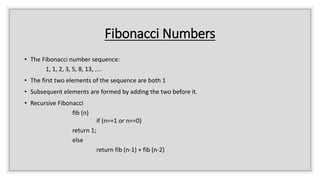
Fibonacci Numbers
• The Fibonacci number sequence:
1, 1, 2, 3, 5, 8, 13, ....
• The first two elements of the sequence are both 1
• Subsequent elements are formed by adding the two before it.
• Recursive Fibonacci
fib (n)
if (n==1 or n==0)
return 1;
else
return fib (n-1) + fib (n-2)
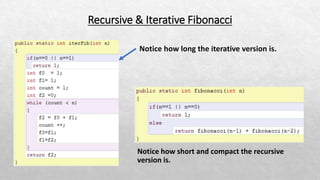
Recursive & Iterative Fibonacci
Notice how short and compact the recursive
version is.
Remarks about recursion
• In general
• A recursive solution is simpler to code than an iterative solution
• Some problems are so difficult that recursion may be the best solution
• Iterative solutions are often faster than recursive solutions
Recursive search
• It is very simple to write an iterative search to determine if a given value (toFind) is in an array
for i = 0 to the array length -1
if array[i] = to_find
return true
End i loop
Return false
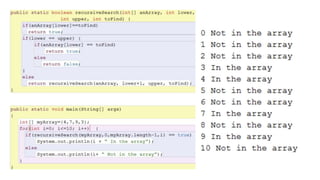
• When we do it recursively
• If the array has length 1, we return true if the single element and toFind are the same
• If not
• we check the first element and return true if it and toFind are equal
• Otherwise, we repeat the search on the remainder of the array
Recursion

Recursion

  • 1.
  • 2.
    Recursion • In mathematics,we often say that a recursive solution is a solution such that f(xk) depends on some of f(xk-1), f(xk-2),...f(x1), and f(x0) • A usable recursive solution usually has the following characteristics • –A base case. This is one which is easily calculated. It also prevents infinite loops! • –A recursive case. This is the case in which the function “calls itself” in order to reduce the calculations to the base case.
  • 3.
    Simple problems solvedrecursively • In math class we learned that 1+2+3+...+n = n*(n+1)/2 • For example, 1+2+...+10 = 10*11/2 = 55 • It is also easy to find the sum iteratively by an O(n) algorithm int sum=0; for i = 1 to n sum=sum + i • We can also solve this problem by recursion.
  • 4.
    • Recursion tofind 1 + 2 + + … + n public sum(n) if n == 1, sum =1 if n > 1, sum = n +sum(n-1) Identify the base case Identify the recursive case • Example: sum(5) = 5 + sum(4) = 5+4+sum(3) =9 +sum(3) =9 +3+sum(2) = 12 = 12 = 14 = 14 +sum(2)= +2+sum(1) • On the next slide, we implement the recursive function in Java
  • 5.
    • Recursive sumused to find the sum to n for n = 1, 2, ..., 10 • Note there is NO reason to compute the sums this way. This example is purely for illustration of recursion.
  • 6.
    n! • From mathclass, we know that n! = n*(n-1)*(n-2)*...*3*2*1 3! = 3*2*1 = 6 5!= 5*4*3 *2 *1 • It is easy to compute n! iteratively int prod = 1; for i=2 to n prod = prod * i
  • 7.
    Recursive n! • Weeasily observe that there is a recursive definition of n! n! = n*(n-1) ! • For example 4 ! = 4*3*2*1 = 4*(3*2*1) = 4 * 3! • This prompts the following function int nfact (int n) if n == 0 or n ==1 return 1 else return n * nfact (n-1)
  • 8.
    Fibonacci Numbers • TheFibonacci number sequence: 1, 1, 2, 3, 5, 8, 13, .... • The first two elements of the sequence are both 1 • Subsequent elements are formed by adding the two before it. • Recursive Fibonacci fib (n) if (n==1 or n==0) return 1; else return fib (n-1) + fib (n-2)
  • 9.
    Recursive & IterativeFibonacci Notice how short and compact the recursive version is.
  • 10.
    Remarks about recursion •In general • A recursive solution is simpler to code than an iterative solution • Some problems are so difficult that recursion may be the best solution • Iterative solutions are often faster than recursive solutions
  • 11.
    Recursive search • Itis very simple to write an iterative search to determine if a given value (toFind) is in an array for i = 0 to the array length -1 if array[i] = to_find return true End i loop Return false • When we do it recursively • If the array has length 1, we return true if the single element and toFind are the same • If not • we check the first element and return true if it and toFind are equal • Otherwise, we repeat the search on the remainder of the array