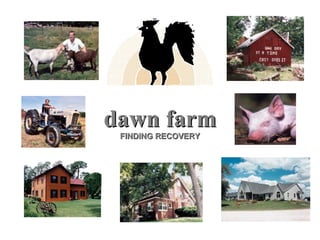
dawn farm FINDING RECOVERY
What we’ll try to accomplish today “ What it was like, what happened, and what it’s like now” Tell stories Importance of telling yourself the truth Working in faith and not fear Issues of trust with the community A radical transformation Small, simple actions
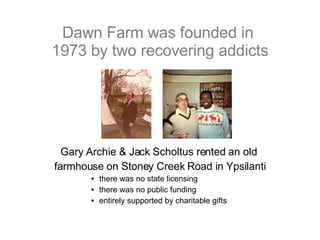
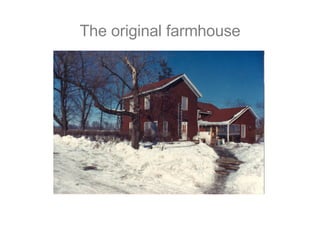
Dawn Farm was founded in  1973 by two recovering addicts Gary Archie & Jack Scholtus rented an old  farmhouse on Stoney Creek Road in Ypsilanti there was no state licensing there was no public funding entirely supported by charitable gifts
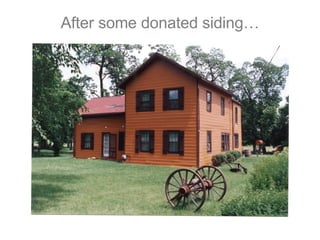
The original farmhouse
After some donated siding…
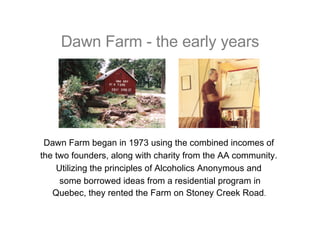
Dawn Farm - the early years Dawn Farm began in 1973 using the combined incomes of  the two founders, along with charity from the AA community.  Utilizing the principles of Alcoholics Anonymous and  some borrowed ideas from a residential program in Quebec, they rented the Farm on Stoney Creek Road .
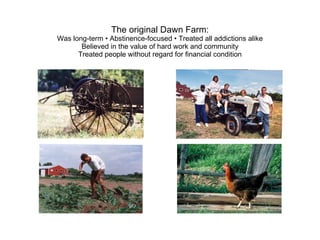
The original Dawn Farm: Was long-term • Abstinence-focused • Treated all addictions alike Believed in the value of hard work and community Treated people without regard for financial condition
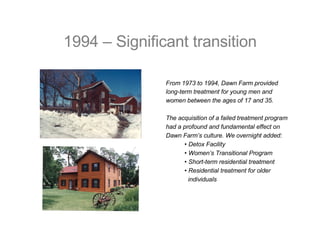
1994 – Significant transition From 1973 to 1994, Dawn Farm provided  long-term treatment for young men and  women between the ages of 17 and 35. The acquisition of a failed treatment program  had a profound and fundamental effect on Dawn Farm’s culture. We overnight added: •  Detox Facility  •  Women’s Transitional Program •  Short-term residential treatment •  Residential treatment for older  individuals
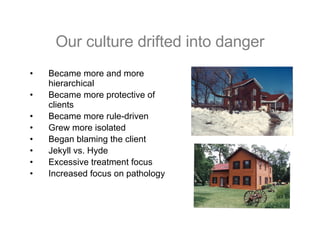
Our culture drifted into danger Became more and more hierarchical Became more protective of clients Became more rule-driven Grew more isolated Began blaming the client Jekyll vs. Hyde Excessive treatment focus Increased focus on pathology
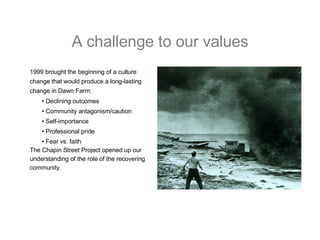
A challenge to our values 1999 brought the beginning of a culture  change that would produce a long-lasting  change in Dawn Farm: •  Declining outcomes •  Community antagonism/caution •  Self-importance •  Professional pride •  Fear vs. faith The Chapin Street Project opened up our  understanding of the role of the recovering  community.
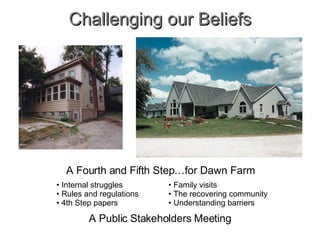
Challenging our Beliefs Internal struggles Rules and regulations 4th Step papers •  Family visits •  The recovering community •  Understanding barriers A Fourth and Fifth Step…for Dawn Farm A Public Stakeholders Meeting
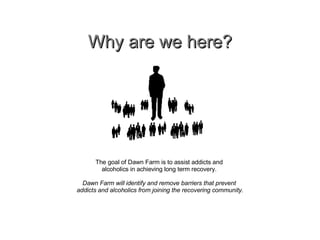
Why are we here? The goal of Dawn Farm is to assist addicts and  alcoholics in achieving long term recovery.  Dawn Farm will identify and remove barriers that prevent  addicts and alcoholics from joining the recovering community.
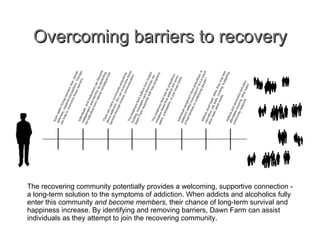
Overcoming barriers to recovery The recovering community potentially provides a welcoming, supportive connection  - a  long-term solution to the symptoms of addiction. When addicts and alcoholics fully enter this community  and become members,  their chance of long-term survival and happiness increase. By identifying and removing barriers, Dawn Farm can assist individuals as they attempt to join the recovering community.
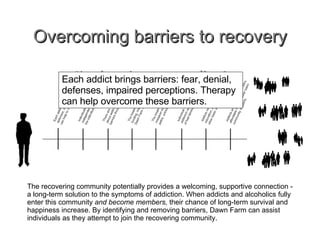
Overcoming barriers to recovery Each addict brings barriers: fear, denial, defenses, impaired perceptions. Therapy can help overcome these barriers. The recovering community potentially provides a welcoming, supportive connection  - a  long-term solution to the symptoms of addiction. When addicts and alcoholics fully enter this community  and become members,  their chance of long-term survival and happiness increase. By identifying and removing barriers, Dawn Farm can assist individuals as they attempt to join the recovering community.
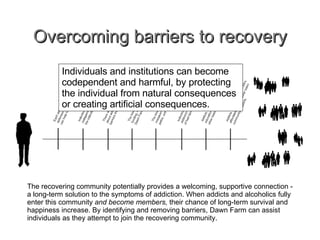
Overcoming barriers to recovery Individuals and institutions can become codependent and harmful, by protecting the individual from natural consequences or creating artificial consequences. The recovering community potentially provides a welcoming, supportive connection  - a  long-term solution to the symptoms of addiction. When addicts and alcoholics fully enter this community  and become members,  their chance of long-term survival and happiness increase. By identifying and removing barriers, Dawn Farm can assist individuals as they attempt to join the recovering community.
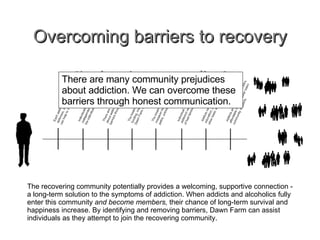
Overcoming barriers to recovery There are many community prejudices about addiction. We can overcome these barriers through honest communication. The recovering community potentially provides a welcoming, supportive connection  - a  long-term solution to the symptoms of addiction. When addicts and alcoholics fully enter this community  and become members,  their chance of long-term survival and happiness increase. By identifying and removing barriers, Dawn Farm can assist individuals as they attempt to join the recovering community.
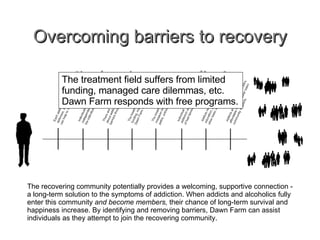
Overcoming barriers to recovery The treatment field suffers from limited funding, managed care dilemmas, etc. Dawn Farm responds with free programs. The recovering community potentially provides a welcoming, supportive connection  - a  long-term solution to the symptoms of addiction. When addicts and alcoholics fully enter this community  and become members,  their chance of long-term survival and happiness increase. By identifying and removing barriers, Dawn Farm can assist individuals as they attempt to join the recovering community.
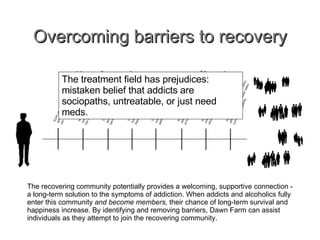
Overcoming barriers to recovery The treatment field has prejudices: mistaken belief that addicts are sociopaths, untreatable, or just need meds. The recovering community potentially provides a welcoming, supportive connection  - a  long-term solution to the symptoms of addiction. When addicts and alcoholics fully enter this community  and become members,  their chance of long-term survival and happiness increase. By identifying and removing barriers, Dawn Farm can assist individuals as they attempt to join the recovering community.
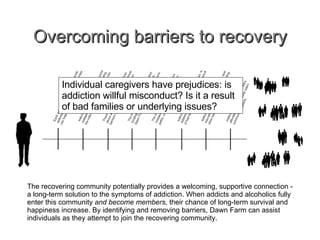
Overcoming barriers to recovery Individual caregivers have prejudices: is addiction willful misconduct? Is it a result of bad families or underlying issues? The recovering community potentially provides a welcoming, supportive connection  - a  long-term solution to the symptoms of addiction. When addicts and alcoholics fully enter this community  and become members,  their chance of long-term survival and happiness increase. By identifying and removing barriers, Dawn Farm can assist individuals as they attempt to join the recovering community.
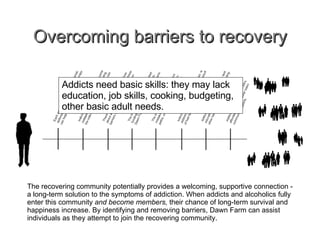
Overcoming barriers to recovery Addicts need basic skills: they may lack education, job skills, cooking, budgeting, other basic adult needs. The recovering community potentially provides a welcoming, supportive connection  - a  long-term solution to the symptoms of addiction. When addicts and alcoholics fully enter this community  and become members,  their chance of long-term survival and happiness increase. By identifying and removing barriers, Dawn Farm can assist individuals as they attempt to join the recovering community.
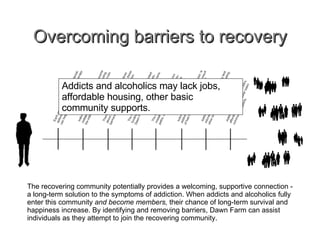
Overcoming barriers to recovery Addicts and alcoholics may lack jobs, affordable housing, other basic community supports. The recovering community potentially provides a welcoming, supportive connection  - a  long-term solution to the symptoms of addiction. When addicts and alcoholics fully enter this community  and become members,  their chance of long-term survival and happiness increase. By identifying and removing barriers, Dawn Farm can assist individuals as they attempt to join the recovering community.
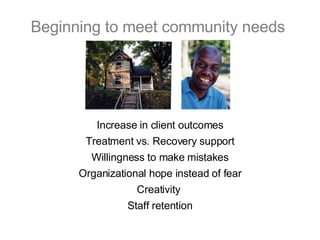
Beginning to meet community needs  Increase in client outcomes Treatment vs. Recovery support Willingness to make mistakes Organizational hope instead of fear Creativity  Staff retention
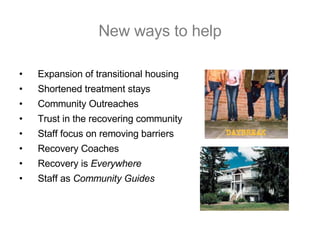
New ways to help Expansion of transitional housing Shortened treatment stays Community Outreaches Trust in the recovering community Staff focus on removing barriers Recovery Coaches Recovery is  Everywhere Staff as  Community Guides
Community Guide Principles Community guides have a capacity to  see possibilities and potential where  others see problems. They focus on  strengths – not on trying to “fix” people . .
Community Community guides are themselves well-connected to what might be called the "communities within the community."  Their strength is associational; their capacity  to help grows stronger as a result of their ongoing contribution to community life.
Trust Community guides can make things happen because they are trusted within the community rather than because they have letters or titles linked to their names. Trust is derived from the basic  connectedness  of the guide.
Hospitality Community guides believe that the  community is a "reservoir of hospitality"  that needs only to be tapped. They understand that the community is ready and willing to  care for each individual, if the individual wants to join. The guide introduces the excluded person to community life, confident  of the hospitality they will receive.
Letting Go Community guides know that a person’s  real engagement with the community doesn't begin until the guide disengages.  The guide knows how to say good-bye.
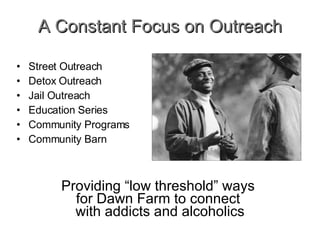
A Constant Focus on Outreach Street Outreach Detox Outreach Jail Outreach Education Series Community Programs Community Barn Providing “low threshold” ways  for Dawn Farm to connect  with addicts and alcoholics
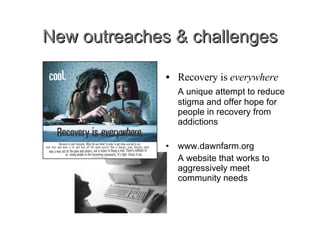
New outreaches & challenges Recovery is  everywhere A unique attempt to reduce stigma and offer hope for people in recovery from addictions www.dawnfarm.org A website that works to aggressively meet community needs
How are we different today? • We have a strong sense of mission - driving all levels of the organization. We are enthusiastic and maintain a commitment to our clients. We are barrier removers: staff see themselves as problem solvers. We are values-driven, and make decisions based upon shared beliefs. We talk with one another and share our ideas and concerns.
How are we different today? • We are committed to doing the best we can - as helpers and as an organization. We don’t settle for the bare minimum. We encourage creativity and new ideas. We are proactive, not reactive. We look for new opportunities to solve problems and try new things. We are not afraid of making mistakes. We embrace the idea of living in faith instead of fear.
You are in the right place. You are with others like yourself. We understand you and the world you come from. We accept who you are and who you can become. This is a place where magic (change) can happen. William White Pathways from the Culture of Addiction  to the Culture of Recovery

recovery management

  • 1.
  • 2.
    What we’ll tryto accomplish today “ What it was like, what happened, and what it’s like now” Tell stories Importance of telling yourself the truth Working in faith and not fear Issues of trust with the community A radical transformation Small, simple actions
  • 3.
    Dawn Farm wasfounded in 1973 by two recovering addicts Gary Archie & Jack Scholtus rented an old farmhouse on Stoney Creek Road in Ypsilanti there was no state licensing there was no public funding entirely supported by charitable gifts
  • 4.
  • 5.
  • 6.
    Dawn Farm -the early years Dawn Farm began in 1973 using the combined incomes of the two founders, along with charity from the AA community. Utilizing the principles of Alcoholics Anonymous and some borrowed ideas from a residential program in Quebec, they rented the Farm on Stoney Creek Road .
  • 7.
    The original DawnFarm: Was long-term • Abstinence-focused • Treated all addictions alike Believed in the value of hard work and community Treated people without regard for financial condition
  • 8.
    1994 – Significanttransition From 1973 to 1994, Dawn Farm provided long-term treatment for young men and women between the ages of 17 and 35. The acquisition of a failed treatment program had a profound and fundamental effect on Dawn Farm’s culture. We overnight added: • Detox Facility • Women’s Transitional Program • Short-term residential treatment • Residential treatment for older individuals
  • 9.
    Our culture driftedinto danger Became more and more hierarchical Became more protective of clients Became more rule-driven Grew more isolated Began blaming the client Jekyll vs. Hyde Excessive treatment focus Increased focus on pathology
  • 10.
    A challenge toour values 1999 brought the beginning of a culture change that would produce a long-lasting change in Dawn Farm: • Declining outcomes • Community antagonism/caution • Self-importance • Professional pride • Fear vs. faith The Chapin Street Project opened up our understanding of the role of the recovering community.
  • 11.
    Challenging our BeliefsInternal struggles Rules and regulations 4th Step papers • Family visits • The recovering community • Understanding barriers A Fourth and Fifth Step…for Dawn Farm A Public Stakeholders Meeting
  • 12.
    Why are wehere? The goal of Dawn Farm is to assist addicts and alcoholics in achieving long term recovery. Dawn Farm will identify and remove barriers that prevent addicts and alcoholics from joining the recovering community.
  • 13.
    Overcoming barriers torecovery The recovering community potentially provides a welcoming, supportive connection - a long-term solution to the symptoms of addiction. When addicts and alcoholics fully enter this community and become members, their chance of long-term survival and happiness increase. By identifying and removing barriers, Dawn Farm can assist individuals as they attempt to join the recovering community.
  • 14.
    Overcoming barriers torecovery Each addict brings barriers: fear, denial, defenses, impaired perceptions. Therapy can help overcome these barriers. The recovering community potentially provides a welcoming, supportive connection - a long-term solution to the symptoms of addiction. When addicts and alcoholics fully enter this community and become members, their chance of long-term survival and happiness increase. By identifying and removing barriers, Dawn Farm can assist individuals as they attempt to join the recovering community.
  • 15.
    Overcoming barriers torecovery Individuals and institutions can become codependent and harmful, by protecting the individual from natural consequences or creating artificial consequences. The recovering community potentially provides a welcoming, supportive connection - a long-term solution to the symptoms of addiction. When addicts and alcoholics fully enter this community and become members, their chance of long-term survival and happiness increase. By identifying and removing barriers, Dawn Farm can assist individuals as they attempt to join the recovering community.
  • 16.
    Overcoming barriers torecovery There are many community prejudices about addiction. We can overcome these barriers through honest communication. The recovering community potentially provides a welcoming, supportive connection - a long-term solution to the symptoms of addiction. When addicts and alcoholics fully enter this community and become members, their chance of long-term survival and happiness increase. By identifying and removing barriers, Dawn Farm can assist individuals as they attempt to join the recovering community.
  • 17.
    Overcoming barriers torecovery The treatment field suffers from limited funding, managed care dilemmas, etc. Dawn Farm responds with free programs. The recovering community potentially provides a welcoming, supportive connection - a long-term solution to the symptoms of addiction. When addicts and alcoholics fully enter this community and become members, their chance of long-term survival and happiness increase. By identifying and removing barriers, Dawn Farm can assist individuals as they attempt to join the recovering community.
  • 18.
    Overcoming barriers torecovery The treatment field has prejudices: mistaken belief that addicts are sociopaths, untreatable, or just need meds. The recovering community potentially provides a welcoming, supportive connection - a long-term solution to the symptoms of addiction. When addicts and alcoholics fully enter this community and become members, their chance of long-term survival and happiness increase. By identifying and removing barriers, Dawn Farm can assist individuals as they attempt to join the recovering community.
  • 19.
    Overcoming barriers torecovery Individual caregivers have prejudices: is addiction willful misconduct? Is it a result of bad families or underlying issues? The recovering community potentially provides a welcoming, supportive connection - a long-term solution to the symptoms of addiction. When addicts and alcoholics fully enter this community and become members, their chance of long-term survival and happiness increase. By identifying and removing barriers, Dawn Farm can assist individuals as they attempt to join the recovering community.
  • 20.
    Overcoming barriers torecovery Addicts need basic skills: they may lack education, job skills, cooking, budgeting, other basic adult needs. The recovering community potentially provides a welcoming, supportive connection - a long-term solution to the symptoms of addiction. When addicts and alcoholics fully enter this community and become members, their chance of long-term survival and happiness increase. By identifying and removing barriers, Dawn Farm can assist individuals as they attempt to join the recovering community.
  • 21.
    Overcoming barriers torecovery Addicts and alcoholics may lack jobs, affordable housing, other basic community supports. The recovering community potentially provides a welcoming, supportive connection - a long-term solution to the symptoms of addiction. When addicts and alcoholics fully enter this community and become members, their chance of long-term survival and happiness increase. By identifying and removing barriers, Dawn Farm can assist individuals as they attempt to join the recovering community.
  • 22.
    Beginning to meetcommunity needs Increase in client outcomes Treatment vs. Recovery support Willingness to make mistakes Organizational hope instead of fear Creativity Staff retention
  • 23.
    New ways tohelp Expansion of transitional housing Shortened treatment stays Community Outreaches Trust in the recovering community Staff focus on removing barriers Recovery Coaches Recovery is Everywhere Staff as Community Guides
  • 24.
    Community Guide PrinciplesCommunity guides have a capacity to see possibilities and potential where others see problems. They focus on strengths – not on trying to “fix” people . .
  • 25.
    Community Community guidesare themselves well-connected to what might be called the "communities within the community." Their strength is associational; their capacity to help grows stronger as a result of their ongoing contribution to community life.
  • 26.
    Trust Community guidescan make things happen because they are trusted within the community rather than because they have letters or titles linked to their names. Trust is derived from the basic connectedness of the guide.
  • 27.
    Hospitality Community guidesbelieve that the community is a "reservoir of hospitality" that needs only to be tapped. They understand that the community is ready and willing to care for each individual, if the individual wants to join. The guide introduces the excluded person to community life, confident of the hospitality they will receive.
  • 28.
    Letting Go Communityguides know that a person’s real engagement with the community doesn't begin until the guide disengages. The guide knows how to say good-bye.
  • 29.
    A Constant Focuson Outreach Street Outreach Detox Outreach Jail Outreach Education Series Community Programs Community Barn Providing “low threshold” ways for Dawn Farm to connect with addicts and alcoholics
  • 30.
    New outreaches &challenges Recovery is everywhere A unique attempt to reduce stigma and offer hope for people in recovery from addictions www.dawnfarm.org A website that works to aggressively meet community needs
  • 31.
    How are wedifferent today? • We have a strong sense of mission - driving all levels of the organization. We are enthusiastic and maintain a commitment to our clients. We are barrier removers: staff see themselves as problem solvers. We are values-driven, and make decisions based upon shared beliefs. We talk with one another and share our ideas and concerns.
  • 32.
    How are wedifferent today? • We are committed to doing the best we can - as helpers and as an organization. We don’t settle for the bare minimum. We encourage creativity and new ideas. We are proactive, not reactive. We look for new opportunities to solve problems and try new things. We are not afraid of making mistakes. We embrace the idea of living in faith instead of fear.
  • 33.
    You are inthe right place. You are with others like yourself. We understand you and the world you come from. We accept who you are and who you can become. This is a place where magic (change) can happen. William White Pathways from the Culture of Addiction to the Culture of Recovery