Recognizing Special
Needs at Home and in
School
PRESENTED BY:
RICHARD C. SO, OTRP
Objectives of the discussion
1. To provide teachers as to what to look out for to know if a
child is at risk for having a developmental disability.
2. To provide a discussion as to the common developmental
disabilities that can be seen at home, in school, and in the
community.
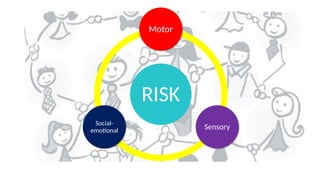
RISK
Motor
Sensory
Social-
emotional
Motor
Overly soft or stiff
muscles
The mother experienced
stress or disease during
pregnancy
The child showed
minimal or no movement
upon delivery
Noticeable delays in
motor skills compared to
peers
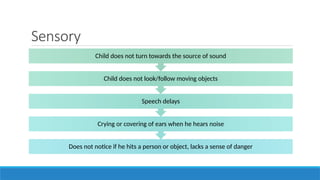
Sensory
Does not notice if he hits a person or object, lacks a sense of danger
Crying or covering of ears when he hears noise
Speech delays
Child does not look/follow moving objects
Child does not turn towards the source of sound
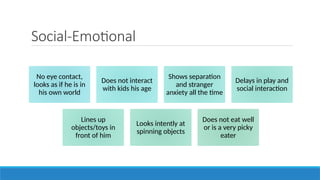
Social-Emotional
No eye contact,
looks as if he is in
his own world
Does not interact
with kids his age
Shows separation
and stranger
anxiety all the time
Delays in play and
social interaction
Lines up
objects/toys in
front of him
Looks intently at
spinning objects
Does not eat well
or is a very picky
eater
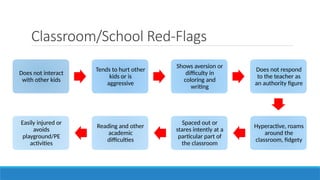
Classroom/School Red-Flags
Does not interact
with other kids
Tends to hurt other
kids or is
aggressive
Shows aversion or
difficulty in
coloring and
writing
Does not respond
to the teacher as
an authority figure
Hyperactive, roams
around the
classroom, fidgety
Spaced out or
stares intently at a
particular part of
the classroom
Reading and other
academic
difficulties
Easily injured or
avoids
playground/PE
activities
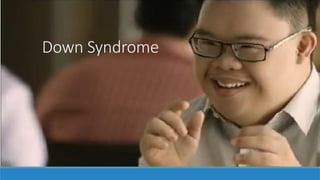
Down Syndrome
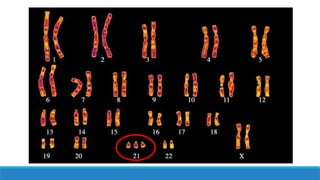
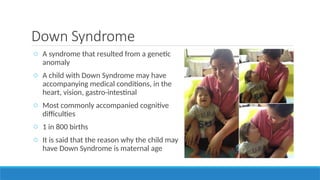
Down Syndrome
o A syndrome that resulted from a genetic
anomaly
o A child with Down Syndrome may have
accompanying medical conditions, in the
heart, vision, gastro-intestinal
o Most commonly accompanied cognitive
difficulties
o 1 in 800 births
o It is said that the reason why the child may
have Down Syndrome is maternal age
Down Syndrome
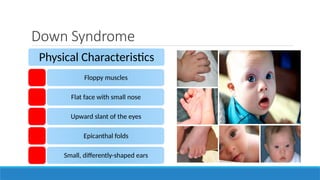
Physical Characteristics
Floppy muscles
Flat face with small nose
Upward slant of the eyes
Epicanthal folds
Small, differently-shaped ears
Down Syndrome
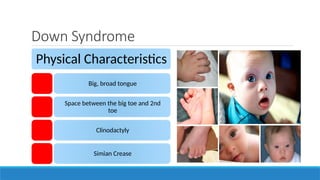
Physical Characteristics
Big, broad tongue
Space between the big toe and 2nd
toe
Clinodactyly
Simian Crease
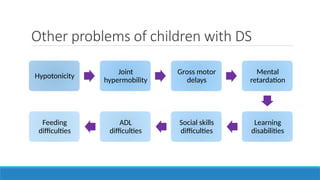
Other problems of children with DS
Hypotonicity
Joint
hypermobility
Gross motor
delays
Mental
retardation
Learning
disabilities
Social skills
difficulties
ADL
difficulties
Feeding
difficulties
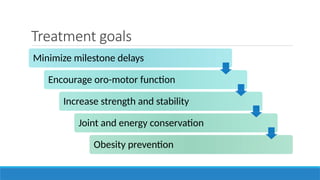
Treatment goals
Minimize milestone delays
Encourage oro-motor function
Increase strength and stability
Joint and energy conservation
Obesity prevention
Attention Deficit
Hyperactivity
Disorder
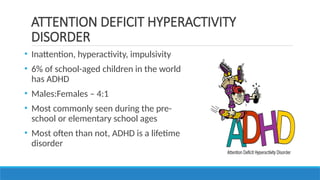
• Inattention, hyperactivity, impulsivity
• 6% of school-aged children in the world
has ADHD
• Males:Females – 4:1
• Most commonly seen during the pre-
school or elementary school ages
• Most often than not, ADHD is a lifetime
disorder
ATTENTION DEFICIT HYPERACTIVITY
DISORDER
ATTENTION DEFICIT HYPERACTIVITY
DISORDER
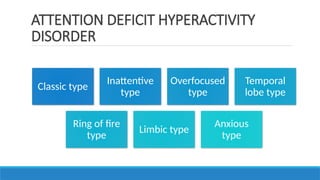
Classic type
Inattentive
type
Overfocused
type
Temporal
lobe type
Ring of fire
type
Limbic type
Anxious
type
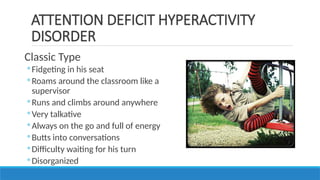
Classic Type
◦ Fidgeting in his seat
◦ Roams around the classroom like a
supervisor
◦ Runs and climbs around anywhere
◦ Very talkative
◦ Always on the go and full of energy
◦ Butts into conversations
◦ Difficulty waiting for his turn
◦ Disorganized
ATTENTION DEFICIT HYPERACTIVITY
DISORDER
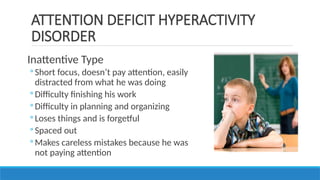
Inattentive Type
◦ Short focus, doesn’t pay attention, easily
distracted from what he was doing
◦ Difficulty finishing his work
◦ Difficulty in planning and organizing
◦ Loses things and is forgetful
◦ Spaced out
◦ Makes careless mistakes because he was
not paying attention
ATTENTION DEFICIT HYPERACTIVITY
DISORDER
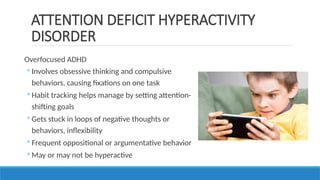
Overfocused ADHD
◦ Involves obsessive thinking and compulsive
behaviors, causing fixations on one task
◦ Habit tracking helps manage by setting attention-
shifting goals
◦ Gets stuck in loops of negative thoughts or
behaviors, inflexibility
◦ Frequent oppositional or argumentative behavior
◦ May or may not be hyperactive
ATTENTION DEFICIT HYPERACTIVITY
DISORDER
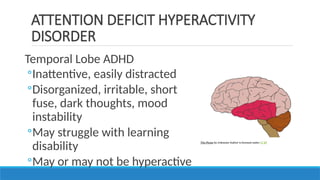
Temporal Lobe ADHD
◦Inattentive, easily distracted
◦Disorganized, irritable, short
fuse, dark thoughts, mood
instability
◦May struggle with learning
disability
◦May or may not be hyperactive
ATTENTION DEFICIT HYPERACTIVITY
DISORDER
This Photo by Unknown Author is licensed under CC BY
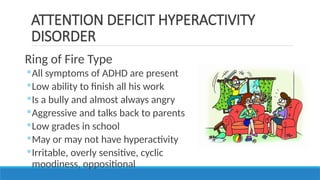
Ring of Fire Type
◦All symptoms of ADHD are present
◦Low ability to finish all his work
◦Is a bully and almost always angry
◦Aggressive and talks back to parents
◦Low grades in school
◦May or may not have hyperactivity
◦Irritable, overly sensitive, cyclic
moodiness, oppositional
ATTENTION DEFICIT HYPERACTIVITY
DISORDER
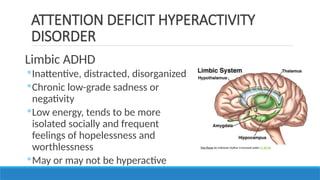
Limbic ADHD
◦Inattentive, distracted, disorganized
◦Chronic low-grade sadness or
negativity
◦Low energy, tends to be more
isolated socially and frequent
feelings of hopelessness and
worthlessness
◦May or may not be hyperactive
ATTENTION DEFICIT HYPERACTIVITY
DISORDER
This Photo by Unknown Author is licensed under CC BY-NC
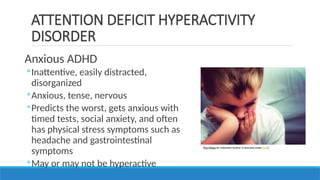
Anxious ADHD
◦Inattentive, easily distracted,
disorganized
◦Anxious, tense, nervous
◦Predicts the worst, gets anxious with
timed tests, social anxiety, and often
has physical stress symptoms such as
headache and gastrointestinal
symptoms
◦May or may not be hyperactive
ATTENTION DEFICIT HYPERACTIVITY
DISORDER
This Photo by Unknown Author is licensed under CC BY
Is it ADHD or normal childhood activity
◦ DSM = presence of 6 or more symptoms for each type of ADHD
◦ Symptoms should be persistent for more than 6 months
◦ Symptoms should be present before the child is 12 years old
◦ Symptoms should be present in 2 or more aspects (house, school,
community, etc.)
◦ Symptoms interfere with the child’s social, academic and
occupational functions
ATTENTION DEFICIT HYPERACTIVITY
DISORDER
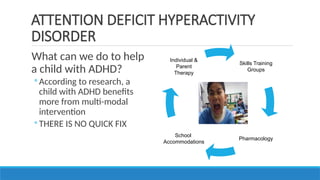
What can we do to help
a child with ADHD?
◦ According to research, a
child with ADHD benefits
more from multi-modal
intervention
◦ THERE IS NO QUICK FIX
ATTENTION DEFICIT HYPERACTIVITY
DISORDER
Skills Training
Groups
Pharmacology
School
Accommodations
Individual &
Parent
Therapy
Autism
Spectrum
Disorder
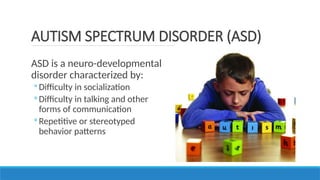
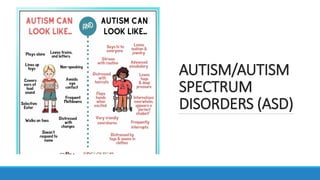
ASD is a neuro-developmental
disorder characterized by:
◦ Difficulty in socialization
◦ Difficulty in talking and other
forms of communication
◦ Repetitive or stereotyped
behavior patterns
AUTISM SPECTRUM DISORDER (ASD)
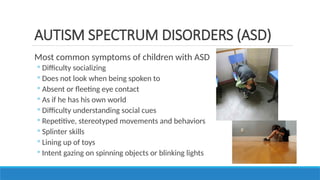
Most common symptoms of children with ASD
◦ Difficulty socializing
◦ Does not look when being spoken to
◦ Absent or fleeting eye contact
◦ As if he has his own world
◦ Difficulty understanding social cues
◦ Repetitive, stereotyped movements and behaviors
◦ Splinter skills
◦ Lining up of toys
◦ Intent gazing on spinning objects or blinking lights
AUTISM SPECTRUM DISORDERS (ASD)
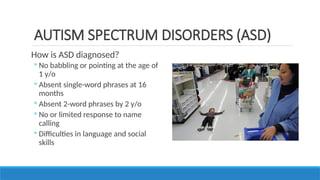
How is ASD diagnosed?
◦ No babbling or pointing at the age of
1 y/o
◦ Absent single-word phrases at 16
months
◦ Absent 2-word phrases by 2 y/o
◦ No or limited response to name
calling
◦ Difficulties in language and social
skills
AUTISM SPECTRUM DISORDERS (ASD)
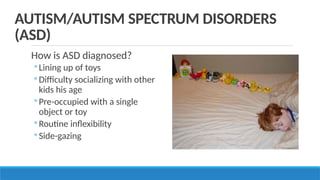
How is ASD diagnosed?
◦ Lining up of toys
◦ Difficulty socializing with other
kids his age
◦ Pre-occupied with a single
object or toy
◦ Routine inflexibility
◦ Side-gazing
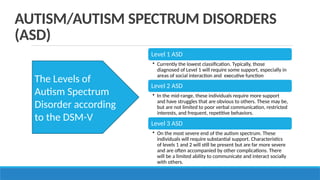
AUTISM/AUTISM SPECTRUM DISORDERS
(ASD)
Level 1 ASD
• Currently the lowest classification. Typically, those
diagnosed of Level 1 will require some support, especially in
areas of social interaction and executive function
Level 2 ASD
• In the mid-range, these individuals require more support
and have struggles that are obvious to others. These may be,
but are not limited to poor verbal communication, restricted
interests, and frequent, repetitive behaviors.
Level 3 ASD
• On the most severe end of the autism spectrum. These
individuals will require substantial support. Characteristics
of levels 1 and 2 will still be present but are far more severe
and are often accompanied by other complications. There
will be a limited ability to communicate and interact socially
with others.
AUTISM/AUTISM SPECTRUM DISORDERS
(ASD)
The Levels of
Autism Spectrum
Disorder according
to the DSM-V
AUTISM/AUTISM
SPECTRUM
DISORDERS (ASD)
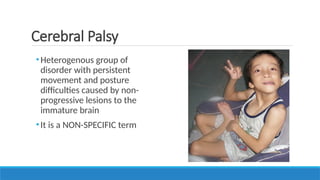
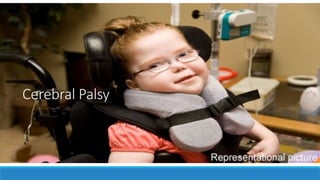
Cerebral Palsy
•Heterogenous group of
disorder with persistent
movement and posture
difficulties caused by non-
progressive lesions to the
immature brain
•It is a NON-SPECIFIC term
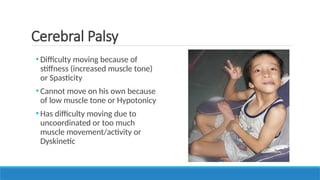
Cerebral Palsy
• Difficulty moving because of
stiffness (increased muscle tone)
or Spasticity
• Cannot move on his own because
of low muscle tone or Hypotonicy
• Has difficulty moving due to
uncoordinated or too much
muscle movement/activity or
Dyskinetic
Cerebral Palsy
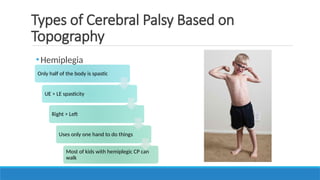
•Hemiplegia
Types of Cerebral Palsy Based on
Topography
Only half of the body is spastic
UE > LE spasticity
Right > Left
Uses only one hand to do things
Most of kids with hemiplegic CP can
walk
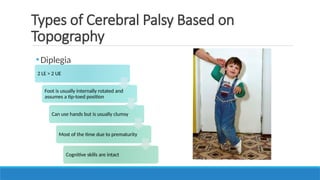
•Diplegia
Types of Cerebral Palsy Based on
Topography
2 LE > 2 UE
Foot is usually internally rotated and
assumes a tip-toed position
Can use hands but is usually clumsy
Most of the time due to prematurity
Cognitive skills are intact
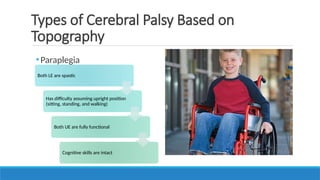
•Paraplegia
Types of Cerebral Palsy Based on
Topography
Both LE are spastic
Has difficulty assuming upright position
(sitting, standing, and walking)
Both UE are fully functional
Cognitive skills are intact
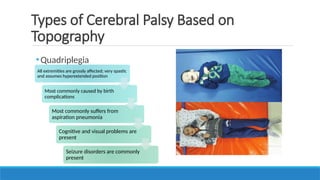
•Quadriplegia
Types of Cerebral Palsy Based on
Topography
All extremities are grossly affected; very spastic
and assumes hyperextended position
Most commonly caused by birth
complications
Most commonly suffers from
aspiration pneumonia
Cognitive and visual problems are
present
Seizure disorders are commonly
present
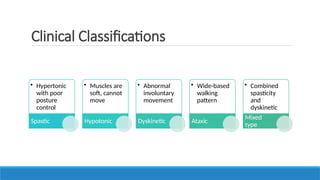
Clinical Classifications
• Hypertonic
with poor
posture
control
Spastic
• Muscles are
soft, cannot
move
Hypotonic
• Abnormal
involuntary
movement
Dyskinetic
• Wide-based
walking
pattern
Ataxic
• Combined
spasticity
and
dyskinetic
Mixed
type
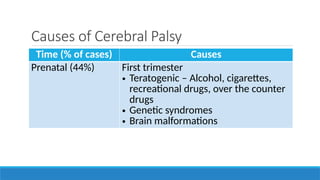
Causes of Cerebral Palsy
Time (% of cases) Causes
Prenatal (44%) First trimester
• Teratogenic – Alcohol, cigarettes,
recreational drugs, over the counter
drugs
• Genetic syndromes
• Brain malformations
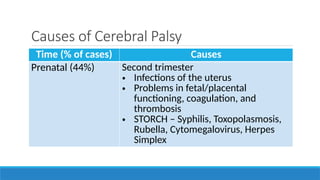
Causes of Cerebral Palsy
Time (% of cases) Causes
Prenatal (44%) Second trimester
• Infections of the uterus
• Problems in fetal/placental
functioning, coagulation, and
thrombosis
• STORCH – Syphilis, Toxopolasmosis,
Rubella, Cytomegalovirus, Herpes
Simplex
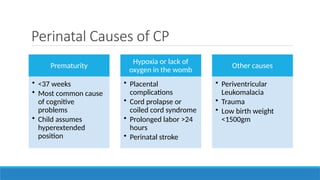
Perinatal Causes of CP
Prematurity
• <37 weeks
• Most common cause
of cognitive
problems
• Child assumes
hyperextended
position
Hypoxia or lack of
oxygen in the womb
• Placental
complications
• Cord prolapse or
coiled cord syndrome
• Prolonged labor >24
hours
• Perinatal stroke
Other causes
• Periventricular
Leukomalacia
• Trauma
• Low birth weight
<1500gm
Postnatal Causes of CP
Head trauma
Infection/meningitis
Interruption of blood supply to the brain
Other Concerns to Note
Teeth are brittle Speech delays Vision problems
Seizures Cognitive delays
Sensory processing
problems
Behavior concerns
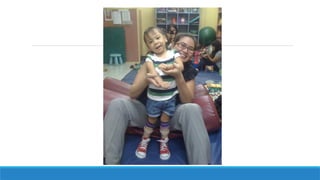
What can we do?
Exercises and stretching (either to decrease spasticity or improve
muscle tone)
Medical management (Botox injection, surgery) to spastic muscles
or dorsal rhizotomy
Splints and other support and positioning devices
Learning
Disability
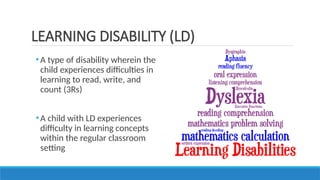
•A type of disability wherein the
child experiences difficulties in
learning to read, write, and
count (3Rs)
•A child with LD experiences
difficulty in learning concepts
within the regular classroom
setting
LEARNING DISABILITY (LD)
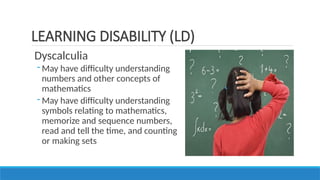
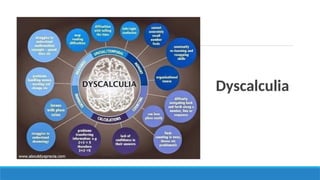
Dyscalculia
- May have difficulty understanding
numbers and other concepts of
mathematics
- May have difficulty understanding
symbols relating to mathematics,
memorize and sequence numbers,
read and tell the time, and counting
or making sets
LEARNING DISABILITY (LD)
Dyscalculia
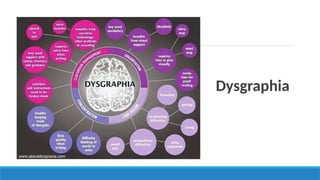
Dysgraphia
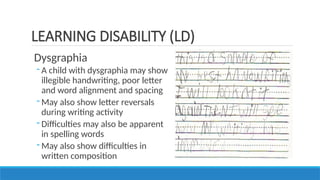
- A child with dysgraphia may show
illegible handwriting, poor letter
and word alignment and spacing
- May also show letter reversals
during writing activity
- Difficulties may also be apparent
in spelling words
- May also show difficulties in
written composition
LEARNING DISABILITY (LD)
Dysgraphia
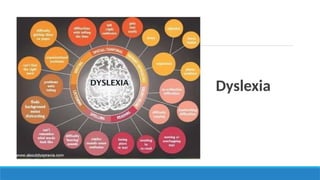
Dyslexia
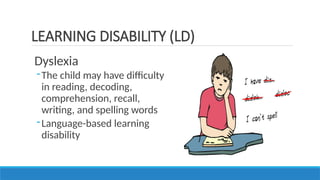
-The child may have difficulty
in reading, decoding,
comprehension, recall,
writing, and spelling words
-Language-based learning
disability
LEARNING DISABILITY (LD)
Dyslexia
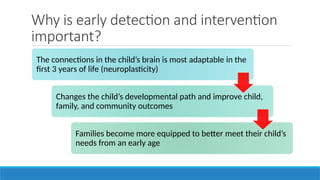
Why is early detection and intervention
important?
The connections in the child’s brain is most adaptable in the
first 3 years of life (neuroplasticity)
Changes the child’s developmental path and improve child,
family, and community outcomes
Families become more equipped to better meet their child’s
needs from an early age
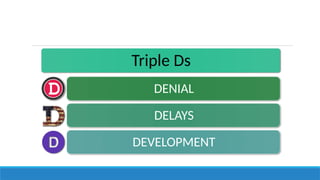
Triple Ds
DENIAL
DELAYS
DEVELOPMENT
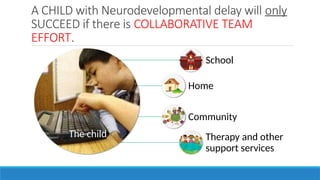
A CHILD with Neurodevelopmental delay will only
SUCCEED if there is COLLABORATIVE TEAM
EFFORT.
The child
School
Home
Community
Therapy and other
support services
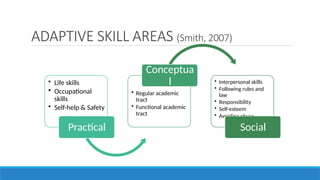
ADAPTIVE SKILL AREAS (Smith, 2007)
• Life skills
• Occupational
skills
• Self-help & Safety
Practical
• Regular academic
tract
• Functional academic
tract
Conceptua
l • Interpersonal skills
• Following rules and
law
• Responsibility
• Self-esteem
• Avoiding abuse
Social
If development is to be
continuous and sure, a
carefully conceived,
progressive, and integrated
program that promotes
MASTERY of COMPETENCIES
must be in effect.
- Jangra, 2005
PRACTICE! PRACTICE! PRACTICE!
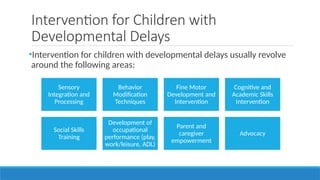
Intervention for Children with
Developmental Delays
•Intervention for children with developmental delays usually revolve
around the following areas:
Sensory
Integration and
Processing
Behavior
Modification
Techniques
Fine Motor
Development and
Intervention
Cognitive and
Academic Skills
Intervention
Social Skills
Training
Development of
occupational
performance (play,
work/leisure, ADL)
Parent and
caregiver
empowerment
Advocacy
Recognizing Special Needs at Home and in School.pptx

Recognizing Special Needs at Home and in School.pptx

  • 1.
    Recognizing Special Needs atHome and in School PRESENTED BY: RICHARD C. SO, OTRP
  • 2.
    Objectives of thediscussion 1. To provide teachers as to what to look out for to know if a child is at risk for having a developmental disability. 2. To provide a discussion as to the common developmental disabilities that can be seen at home, in school, and in the community.
  • 3.
  • 4.
    Motor Overly soft orstiff muscles The mother experienced stress or disease during pregnancy The child showed minimal or no movement upon delivery Noticeable delays in motor skills compared to peers
  • 5.
    Sensory Does not noticeif he hits a person or object, lacks a sense of danger Crying or covering of ears when he hears noise Speech delays Child does not look/follow moving objects Child does not turn towards the source of sound
  • 6.
    Social-Emotional No eye contact, looksas if he is in his own world Does not interact with kids his age Shows separation and stranger anxiety all the time Delays in play and social interaction Lines up objects/toys in front of him Looks intently at spinning objects Does not eat well or is a very picky eater
  • 9.
    Classroom/School Red-Flags Does notinteract with other kids Tends to hurt other kids or is aggressive Shows aversion or difficulty in coloring and writing Does not respond to the teacher as an authority figure Hyperactive, roams around the classroom, fidgety Spaced out or stares intently at a particular part of the classroom Reading and other academic difficulties Easily injured or avoids playground/PE activities
  • 10.
  • 12.
    Down Syndrome o Asyndrome that resulted from a genetic anomaly o A child with Down Syndrome may have accompanying medical conditions, in the heart, vision, gastro-intestinal o Most commonly accompanied cognitive difficulties o 1 in 800 births o It is said that the reason why the child may have Down Syndrome is maternal age
  • 13.
    Down Syndrome Physical Characteristics Floppymuscles Flat face with small nose Upward slant of the eyes Epicanthal folds Small, differently-shaped ears
  • 14.
    Down Syndrome Physical Characteristics Big,broad tongue Space between the big toe and 2nd toe Clinodactyly Simian Crease
  • 15.
    Other problems ofchildren with DS Hypotonicity Joint hypermobility Gross motor delays Mental retardation Learning disabilities Social skills difficulties ADL difficulties Feeding difficulties
  • 16.
    Treatment goals Minimize milestonedelays Encourage oro-motor function Increase strength and stability Joint and energy conservation Obesity prevention
  • 17.
  • 18.
    • Inattention, hyperactivity,impulsivity • 6% of school-aged children in the world has ADHD • Males:Females – 4:1 • Most commonly seen during the pre- school or elementary school ages • Most often than not, ADHD is a lifetime disorder ATTENTION DEFICIT HYPERACTIVITY DISORDER
  • 19.
    ATTENTION DEFICIT HYPERACTIVITY DISORDER Classictype Inattentive type Overfocused type Temporal lobe type Ring of fire type Limbic type Anxious type
  • 20.
    Classic Type ◦ Fidgetingin his seat ◦ Roams around the classroom like a supervisor ◦ Runs and climbs around anywhere ◦ Very talkative ◦ Always on the go and full of energy ◦ Butts into conversations ◦ Difficulty waiting for his turn ◦ Disorganized ATTENTION DEFICIT HYPERACTIVITY DISORDER
  • 21.
    Inattentive Type ◦ Shortfocus, doesn’t pay attention, easily distracted from what he was doing ◦ Difficulty finishing his work ◦ Difficulty in planning and organizing ◦ Loses things and is forgetful ◦ Spaced out ◦ Makes careless mistakes because he was not paying attention ATTENTION DEFICIT HYPERACTIVITY DISORDER
  • 22.
    Overfocused ADHD ◦ Involvesobsessive thinking and compulsive behaviors, causing fixations on one task ◦ Habit tracking helps manage by setting attention- shifting goals ◦ Gets stuck in loops of negative thoughts or behaviors, inflexibility ◦ Frequent oppositional or argumentative behavior ◦ May or may not be hyperactive ATTENTION DEFICIT HYPERACTIVITY DISORDER
  • 23.
    Temporal Lobe ADHD ◦Inattentive,easily distracted ◦Disorganized, irritable, short fuse, dark thoughts, mood instability ◦May struggle with learning disability ◦May or may not be hyperactive ATTENTION DEFICIT HYPERACTIVITY DISORDER This Photo by Unknown Author is licensed under CC BY
  • 24.
    Ring of FireType ◦All symptoms of ADHD are present ◦Low ability to finish all his work ◦Is a bully and almost always angry ◦Aggressive and talks back to parents ◦Low grades in school ◦May or may not have hyperactivity ◦Irritable, overly sensitive, cyclic moodiness, oppositional ATTENTION DEFICIT HYPERACTIVITY DISORDER
  • 25.
    Limbic ADHD ◦Inattentive, distracted,disorganized ◦Chronic low-grade sadness or negativity ◦Low energy, tends to be more isolated socially and frequent feelings of hopelessness and worthlessness ◦May or may not be hyperactive ATTENTION DEFICIT HYPERACTIVITY DISORDER This Photo by Unknown Author is licensed under CC BY-NC
  • 26.
    Anxious ADHD ◦Inattentive, easilydistracted, disorganized ◦Anxious, tense, nervous ◦Predicts the worst, gets anxious with timed tests, social anxiety, and often has physical stress symptoms such as headache and gastrointestinal symptoms ◦May or may not be hyperactive ATTENTION DEFICIT HYPERACTIVITY DISORDER This Photo by Unknown Author is licensed under CC BY
  • 27.
    Is it ADHDor normal childhood activity ◦ DSM = presence of 6 or more symptoms for each type of ADHD ◦ Symptoms should be persistent for more than 6 months ◦ Symptoms should be present before the child is 12 years old ◦ Symptoms should be present in 2 or more aspects (house, school, community, etc.) ◦ Symptoms interfere with the child’s social, academic and occupational functions ATTENTION DEFICIT HYPERACTIVITY DISORDER
  • 28.
    What can wedo to help a child with ADHD? ◦ According to research, a child with ADHD benefits more from multi-modal intervention ◦ THERE IS NO QUICK FIX ATTENTION DEFICIT HYPERACTIVITY DISORDER Skills Training Groups Pharmacology School Accommodations Individual & Parent Therapy
  • 29.
  • 30.
    ASD is aneuro-developmental disorder characterized by: ◦ Difficulty in socialization ◦ Difficulty in talking and other forms of communication ◦ Repetitive or stereotyped behavior patterns AUTISM SPECTRUM DISORDER (ASD)
  • 31.
    Most common symptomsof children with ASD ◦ Difficulty socializing ◦ Does not look when being spoken to ◦ Absent or fleeting eye contact ◦ As if he has his own world ◦ Difficulty understanding social cues ◦ Repetitive, stereotyped movements and behaviors ◦ Splinter skills ◦ Lining up of toys ◦ Intent gazing on spinning objects or blinking lights AUTISM SPECTRUM DISORDERS (ASD)
  • 32.
    How is ASDdiagnosed? ◦ No babbling or pointing at the age of 1 y/o ◦ Absent single-word phrases at 16 months ◦ Absent 2-word phrases by 2 y/o ◦ No or limited response to name calling ◦ Difficulties in language and social skills AUTISM SPECTRUM DISORDERS (ASD)
  • 33.
    How is ASDdiagnosed? ◦ Lining up of toys ◦ Difficulty socializing with other kids his age ◦ Pre-occupied with a single object or toy ◦ Routine inflexibility ◦ Side-gazing AUTISM/AUTISM SPECTRUM DISORDERS (ASD)
  • 34.
    Level 1 ASD •Currently the lowest classification. Typically, those diagnosed of Level 1 will require some support, especially in areas of social interaction and executive function Level 2 ASD • In the mid-range, these individuals require more support and have struggles that are obvious to others. These may be, but are not limited to poor verbal communication, restricted interests, and frequent, repetitive behaviors. Level 3 ASD • On the most severe end of the autism spectrum. These individuals will require substantial support. Characteristics of levels 1 and 2 will still be present but are far more severe and are often accompanied by other complications. There will be a limited ability to communicate and interact socially with others. AUTISM/AUTISM SPECTRUM DISORDERS (ASD) The Levels of Autism Spectrum Disorder according to the DSM-V
  • 35.
  • 36.
  • 37.
    •Heterogenous group of disorderwith persistent movement and posture difficulties caused by non- progressive lesions to the immature brain •It is a NON-SPECIFIC term Cerebral Palsy
  • 38.
    • Difficulty movingbecause of stiffness (increased muscle tone) or Spasticity • Cannot move on his own because of low muscle tone or Hypotonicy • Has difficulty moving due to uncoordinated or too much muscle movement/activity or Dyskinetic Cerebral Palsy
  • 39.
    •Hemiplegia Types of CerebralPalsy Based on Topography Only half of the body is spastic UE > LE spasticity Right > Left Uses only one hand to do things Most of kids with hemiplegic CP can walk
  • 40.
    •Diplegia Types of CerebralPalsy Based on Topography 2 LE > 2 UE Foot is usually internally rotated and assumes a tip-toed position Can use hands but is usually clumsy Most of the time due to prematurity Cognitive skills are intact
  • 41.
    •Paraplegia Types of CerebralPalsy Based on Topography Both LE are spastic Has difficulty assuming upright position (sitting, standing, and walking) Both UE are fully functional Cognitive skills are intact
  • 42.
    •Quadriplegia Types of CerebralPalsy Based on Topography All extremities are grossly affected; very spastic and assumes hyperextended position Most commonly caused by birth complications Most commonly suffers from aspiration pneumonia Cognitive and visual problems are present Seizure disorders are commonly present
  • 43.
    Clinical Classifications • Hypertonic withpoor posture control Spastic • Muscles are soft, cannot move Hypotonic • Abnormal involuntary movement Dyskinetic • Wide-based walking pattern Ataxic • Combined spasticity and dyskinetic Mixed type
  • 44.
    Causes of CerebralPalsy Time (% of cases) Causes Prenatal (44%) First trimester • Teratogenic – Alcohol, cigarettes, recreational drugs, over the counter drugs • Genetic syndromes • Brain malformations
  • 45.
    Causes of CerebralPalsy Time (% of cases) Causes Prenatal (44%) Second trimester • Infections of the uterus • Problems in fetal/placental functioning, coagulation, and thrombosis • STORCH – Syphilis, Toxopolasmosis, Rubella, Cytomegalovirus, Herpes Simplex
  • 46.
    Perinatal Causes ofCP Prematurity • <37 weeks • Most common cause of cognitive problems • Child assumes hyperextended position Hypoxia or lack of oxygen in the womb • Placental complications • Cord prolapse or coiled cord syndrome • Prolonged labor >24 hours • Perinatal stroke Other causes • Periventricular Leukomalacia • Trauma • Low birth weight <1500gm
  • 47.
    Postnatal Causes ofCP Head trauma Infection/meningitis Interruption of blood supply to the brain
  • 48.
    Other Concerns toNote Teeth are brittle Speech delays Vision problems Seizures Cognitive delays Sensory processing problems Behavior concerns
  • 49.
    What can wedo? Exercises and stretching (either to decrease spasticity or improve muscle tone) Medical management (Botox injection, surgery) to spastic muscles or dorsal rhizotomy Splints and other support and positioning devices
  • 53.
  • 54.
    •A type ofdisability wherein the child experiences difficulties in learning to read, write, and count (3Rs) •A child with LD experiences difficulty in learning concepts within the regular classroom setting LEARNING DISABILITY (LD)
  • 55.
    Dyscalculia - May havedifficulty understanding numbers and other concepts of mathematics - May have difficulty understanding symbols relating to mathematics, memorize and sequence numbers, read and tell the time, and counting or making sets LEARNING DISABILITY (LD)
  • 56.
  • 57.
    Dysgraphia - A childwith dysgraphia may show illegible handwriting, poor letter and word alignment and spacing - May also show letter reversals during writing activity - Difficulties may also be apparent in spelling words - May also show difficulties in written composition LEARNING DISABILITY (LD)
  • 58.
  • 59.
    Dyslexia -The child mayhave difficulty in reading, decoding, comprehension, recall, writing, and spelling words -Language-based learning disability LEARNING DISABILITY (LD)
  • 60.
  • 61.
    Why is earlydetection and intervention important? The connections in the child’s brain is most adaptable in the first 3 years of life (neuroplasticity) Changes the child’s developmental path and improve child, family, and community outcomes Families become more equipped to better meet their child’s needs from an early age
  • 62.
  • 63.
    A CHILD withNeurodevelopmental delay will only SUCCEED if there is COLLABORATIVE TEAM EFFORT. The child School Home Community Therapy and other support services
  • 64.
    ADAPTIVE SKILL AREAS(Smith, 2007) • Life skills • Occupational skills • Self-help & Safety Practical • Regular academic tract • Functional academic tract Conceptua l • Interpersonal skills • Following rules and law • Responsibility • Self-esteem • Avoiding abuse Social
  • 65.
    If development isto be continuous and sure, a carefully conceived, progressive, and integrated program that promotes MASTERY of COMPETENCIES must be in effect. - Jangra, 2005 PRACTICE! PRACTICE! PRACTICE!
  • 66.
    Intervention for Childrenwith Developmental Delays •Intervention for children with developmental delays usually revolve around the following areas: Sensory Integration and Processing Behavior Modification Techniques Fine Motor Development and Intervention Cognitive and Academic Skills Intervention Social Skills Training Development of occupational performance (play, work/leisure, ADL) Parent and caregiver empowerment Advocacy

Editor's Notes

  • #44 Fetal alcohol syndrome - Problems may include an abnormal appearance, short height, low body weight, small head, poor coordination, low intelligence, behavior problems, and problems with hearing or seeing Untreated thyroid diseases in pregnancy may lead to premature birth, preeclampsia (a severe increase in blood pressure), miscarriage, and low birth weight among other problems History of 2 or more fetal deaths If a developing fetus is infected by a TORCH agent, the outcome of the pregnancy may be miscarriage, stillbirth, delayed fetal growth and maturation (intrauterine growth retardation), or early delivery. In addition, newborns infected by any one of the TORCH agents may develop a spectrum of similar symptoms and findings. These may include listlessness (lethargy), fever, difficulties feeding, enlargement of the liver and spleen (hepatomegaly), and decreased levels of the oxygen-carrying pigment (hemoglobin) in the blood (anemia).  Toxoplasmosis is usually spread by eating poorly cooked food that contains cysts, exposure to infected cat feces, and from a mother to a child during pregnancy if the mother becomes infected.  Prevention is by properly preparing and cooking food. It is also recommended that pregnant women not clean cat litter boxes Syphilis is a sexually transmitted infection caused by the spirochete bacterium Treponema pallidum subspecies pallidum. The primary route of transmission is throughsexual contact; it may also be transmitted from mother to fetus during pregnancy or at birth, resulting in congenital syphilis.  Common symptoms that develop over the first couple of years of life include enlargement of the liver and spleen (70%), rash (70%), fever (40%), neurosyphilis (20%), and lung inflammation (20%).  Rubella, also known as German measles or three-day measles,[1] is an infection caused by the rubella virus. The syndrome (CRS) follows intrauterine infection by the rubella virus and comprises cardiac, cerebral, ophthalmic and auditory defects.[17] It may also cause prematurity, low birth weight, and neonatal thrombocytopenia, anemia and hepatitis. The risk of major defects or organogenesis is highest for infection in the first trimester. If the baby survives the infection, it can be born with severe heart disorders (Patent ductus arteriosus being the most common), blindness, deafness, or other life-threatening organ disorders. The skin manifestations are called "blueberry muffin lesions" Cytomegalovirus  (from the Greek cyto-, "cell", and megalo-, "large")  Although they may be found throughout the body, CMV infections are frequently associated with the salivary glands in humans and other mammals Diseases associated with HHV-5 include mononucleosis, and pneumonias Herpes simplex virus 1 and 2 (HSV-1 and HSV-2), also known as human herpesvirus 1 and 2 (HHV-1 and HHV-2), are two members of the herpesvirus family,Herpesviridae, that infect humans. Symptoms of herpes simplex virus infection include watery blisters in the skin or mucous membranes of the mouth, lips or genitals Fetal wastage - Loss of an embryo or fetus through spontaneous abortion or stillbirth; usually expressed as a rate per 1000 pregnancies with respect to a particular cause, such as maternalinfection or drug addiction. Placental abnormalities – abnormal shape, implantation, abnormal coverings – associated with hemorrhage, preterm delivery, fetal malformations Severe proteinuria – preeclampsia 3rd trimester bleeding – may indicate placenta issues, miscarriage, vasa previa -  the developing baby's blood vessels in the umbilical cord or placenta cross the opening to the birth canal. Vasa previa can be very dangerous to the baby because the blood vessels can tear open, causing the baby to bleed severely and lose oxygen. Breech presentation Twin or multiple pregnancies
  • #45 Fetal alcohol syndrome - Problems may include an abnormal appearance, short height, low body weight, small head, poor coordination, low intelligence, behavior problems, and problems with hearing or seeing Untreated thyroid diseases in pregnancy may lead to premature birth, preeclampsia (a severe increase in blood pressure), miscarriage, and low birth weight among other problems History of 2 or more fetal deaths If a developing fetus is infected by a TORCH agent, the outcome of the pregnancy may be miscarriage, stillbirth, delayed fetal growth and maturation (intrauterine growth retardation), or early delivery. In addition, newborns infected by any one of the TORCH agents may develop a spectrum of similar symptoms and findings. These may include listlessness (lethargy), fever, difficulties feeding, enlargement of the liver and spleen (hepatomegaly), and decreased levels of the oxygen-carrying pigment (hemoglobin) in the blood (anemia).  Toxoplasmosis is usually spread by eating poorly cooked food that contains cysts, exposure to infected cat feces, and from a mother to a child during pregnancy if the mother becomes infected.  Prevention is by properly preparing and cooking food. It is also recommended that pregnant women not clean cat litter boxes Syphilis is a sexually transmitted infection caused by the spirochete bacterium Treponema pallidum subspecies pallidum. The primary route of transmission is throughsexual contact; it may also be transmitted from mother to fetus during pregnancy or at birth, resulting in congenital syphilis.  Common symptoms that develop over the first couple of years of life include enlargement of the liver and spleen (70%), rash (70%), fever (40%), neurosyphilis (20%), and lung inflammation (20%).  Rubella, also known as German measles or three-day measles,[1] is an infection caused by the rubella virus. The syndrome (CRS) follows intrauterine infection by the rubella virus and comprises cardiac, cerebral, ophthalmic and auditory defects.[17] It may also cause prematurity, low birth weight, and neonatal thrombocytopenia, anemia and hepatitis. The risk of major defects or organogenesis is highest for infection in the first trimester. If the baby survives the infection, it can be born with severe heart disorders (Patent ductus arteriosus being the most common), blindness, deafness, or other life-threatening organ disorders. The skin manifestations are called "blueberry muffin lesions" Cytomegalovirus  (from the Greek cyto-, "cell", and megalo-, "large")  Although they may be found throughout the body, CMV infections are frequently associated with the salivary glands in humans and other mammals Diseases associated with HHV-5 include mononucleosis, and pneumonias Herpes simplex virus 1 and 2 (HSV-1 and HSV-2), also known as human herpesvirus 1 and 2 (HHV-1 and HHV-2), are two members of the herpesvirus family,Herpesviridae, that infect humans. Symptoms of herpes simplex virus infection include watery blisters in the skin or mucous membranes of the mouth, lips or genitals Fetal wastage - Loss of an embryo or fetus through spontaneous abortion or stillbirth; usually expressed as a rate per 1000 pregnancies with respect to a particular cause, such as maternalinfection or drug addiction. Placental abnormalities – abnormal shape, implantation, abnormal coverings – associated with hemorrhage, preterm delivery, fetal malformations Severe proteinuria – preeclampsia 3rd trimester bleeding – may indicate placenta issues, miscarriage, vasa previa -  the developing baby's blood vessels in the umbilical cord or placenta cross the opening to the birth canal. Vasa previa can be very dangerous to the baby because the blood vessels can tear open, causing the baby to bleed severely and lose oxygen. Breech presentation Twin or multiple pregnancies