SARDAR PATEL UNIVERSITY OF POLICE
SECURITY AND CRIMINAL JUSTICE,
JODHPUR
PROJECT REPORT ON
RECENT TRENDS IN JUVENILE DELINQUENCY:
A SPECIAL STUDY WITH REFERENCE TO
BIKANER
Submitted By: Rahul Budania Submitted To: Dr. Mithilesh Narayan Bhatt
Roll. No: 1108 ( Asst. Prof. Dept. of Law )
Enrolment: 15/IN/028
INTRODUCTION
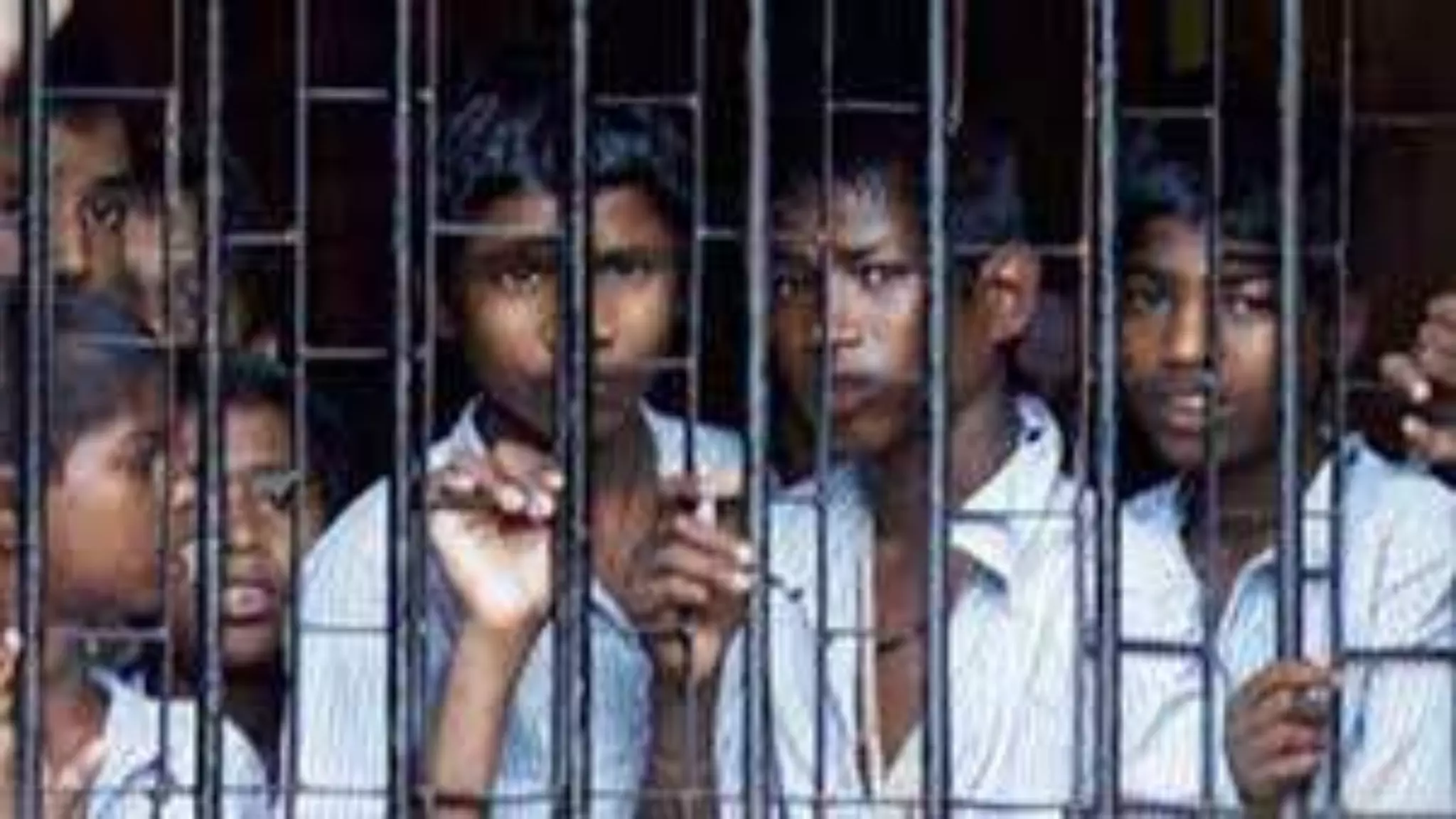
Juvenile delinquency- what it means?
According to the FBI, a juvenile is anyone under
the age of 18 regardless of how each individual
state defines a juvenile. A delinquent is an
individual who fails to obey the laws. Juvenile
delinquency is defined as an individual under the
age of 18 who fails to abide by the laws.
JUVENILE JUSTICE LEGISLATION IN
INDIA
 Juvenile Justice Act 1986
 The Juvenile Justice (Care and Protection of Children) Act 2000
 Juvenile Justice Act 2015
CAUSES OF JUVENILE
DELINQUENCY
SOCIAL FACTORS FAVOURING JUVENILE DELINQUENCY:
 Broken Homes
 Poverty
 Delinquency Areas
 Companions and Gangs
 Need of Luxury
ENVIRONMENTAL FACTORS:
 School Dissatisfaction
 Absence of punishment in school life
 Internet and Cinema
 Selection of subject due family pressure
 PERSONAL FACTORS:
 Mental Deficiency
 Emotional Problems
 Substance Abuse
CLAIM OF AGE IN JUVENILITY
 PROCEDURE TO BE FOLLOWED IN DETERMINATION OF AGE:
(1) In every case concerning a child or a juvenile in conflict with law, the court or the
Board or as the case may be the Committee referred to in rule 19 of these rules
shall determine the age of such juvenile or child or a juvenile in conflict with law
within a period of thirty days from the date of making of the application for that
purpose.
(2) The court or the Board or as the case may be the Committee shall decide the
juvenility or otherwise of the juvenile or the child or as the case may be the
juvenile in conflict with law, prima facie on the basis of physical appearance or
documents, if available, and send him to the observation home or in jail.
(3) In every case concerning a child or juvenile in conflict with law, the age determination
inquiry shall be conducted by the court or the Board or, as the case may be, the Committee
by seeking evidence by obtaining :-
(a) (i) the matriculation or equivalent certificates, if available; and in the absence whereof;
(ii) the date of birth certificate from the school (other than a play school) first
attended; and in the absence whereof;
(iii) the birth certificate given by a corporation or a municipal authority or a panchayat;
(b) and only in the absence of either (i), (ii) or (iii) of clause (a) above, the medical opinion
will be sought from a duly constituted Medical Board, which will declare the age of the
juvenile or child.
(4) If the age of a juvenile or child or the juvenile in conflict with law is found to be below 18 years on the date
of offence, on the basis of any of the conclusive proof specified in sub-rule (3), the court or the Board or as the
case may be the Committee shall in writing pass an order stating the age and declaring the status of juvenility or
otherwise, for the purpose of the Act and these rules and a copy of the order shall be given to such juvenile or the
person concerned.
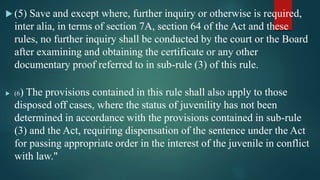
 (5) Save and except where, further inquiry or otherwise is required,
inter alia, in terms of section 7A, section 64 of the Act and these
rules, no further inquiry shall be conducted by the court or the Board
after examining and obtaining the certificate or any other
documentary proof referred to in sub-rule (3) of this rule.
 (6) The provisions contained in this rule shall also apply to those
disposed off cases, where the status of juvenility has not been
determined in accordance with the provisions contained in sub-rule
(3) and the Act, requiring dispensation of the sentence under the Act
for passing appropriate order in the interest of the juvenile in conflict
with law."
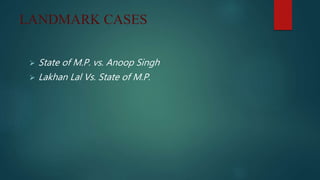
LANDMARK CASES
 State of M.P. vs. Anoop Singh
 Lakhan Lal Vs. State of M.P.
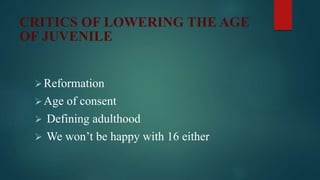
CRITICS OF LOWERING THE AGE
OF JUVENILE
Reformation
Age of consent
 Defining adulthood
 We won’t be happy with 16 either
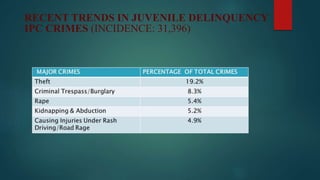
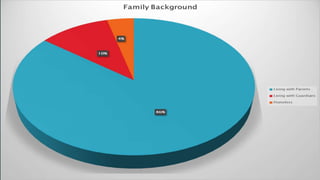
RECENT TRENDS IN JUVENILE DELINQUENCY
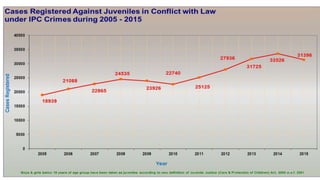
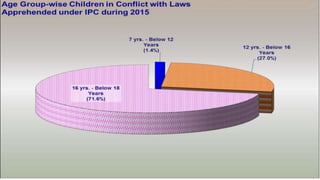
IPC CRIMES (INCIDENCE: 31,396)
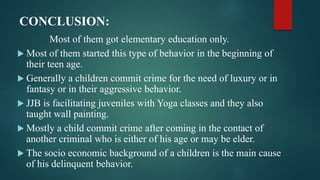
CONCLUSION:
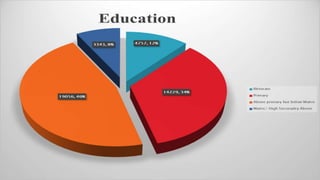
Most of them got elementary education only.
 Most of them started this type of behavior in the beginning of
their teen age.
 Generally a children commit crime for the need of luxury or in
fantasy or in their aggressive behavior.
 JJB is facilitating juveniles with Yoga classes and they also
taught wall painting.
 Mostly a child commit crime after coming in the contact of
another criminal who is either of his age or may be elder.
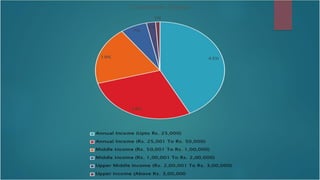
 The socio economic background of a children is the main cause
of his delinquent behavior.
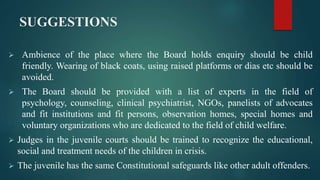
SUGGESTIONS
 Ambience of the place where the Board holds enquiry should be child
friendly. Wearing of black coats, using raised platforms or dias etc should be
avoided.
 The Board should be provided with a list of experts in the field of
psychology, counseling, clinical psychiatrist, NGOs, panelists of advocates
and fit institutions and fit persons, observation homes, special homes and
voluntary organizations who are dedicated to the field of child welfare.
 Judges in the juvenile courts should be trained to recognize the educational,
social and treatment needs of the children in crisis.
 The juvenile has the same Constitutional safeguards like other adult offenders.
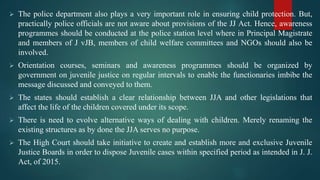
 The police department also plays a very important role in ensuring child protection. But,
practically police officials are not aware about provisions of the JJ Act. Hence, awareness
programmes should be conducted at the police station level where in Principal Magistrate
and members of J vJB, members of child welfare committees and NGOs should also be
involved.
 Orientation courses, seminars and awareness programmes should be organized by
government on juvenile justice on regular intervals to enable the functionaries imbibe the
message discussed and conveyed to them.
 The states should establish a clear relationship between JJA and other legislations that
affect the life of the children covered under its scope.
 There is need to evolve alternative ways of dealing with children. Merely renaming the
existing structures as by done the JJA serves no purpose.
 The High Court should take initiative to create and establish more and exclusive Juvenile
Justice Boards in order to dispose Juvenile cases within specified period as intended in J. J.
Act, of 2015.
THANK YOU

Recent Trends in Juvenile Delinquency

  • 2.
    SARDAR PATEL UNIVERSITYOF POLICE SECURITY AND CRIMINAL JUSTICE, JODHPUR PROJECT REPORT ON RECENT TRENDS IN JUVENILE DELINQUENCY: A SPECIAL STUDY WITH REFERENCE TO BIKANER Submitted By: Rahul Budania Submitted To: Dr. Mithilesh Narayan Bhatt Roll. No: 1108 ( Asst. Prof. Dept. of Law ) Enrolment: 15/IN/028
  • 3.
    INTRODUCTION Juvenile delinquency- whatit means? According to the FBI, a juvenile is anyone under the age of 18 regardless of how each individual state defines a juvenile. A delinquent is an individual who fails to obey the laws. Juvenile delinquency is defined as an individual under the age of 18 who fails to abide by the laws.
  • 4.
    JUVENILE JUSTICE LEGISLATIONIN INDIA  Juvenile Justice Act 1986  The Juvenile Justice (Care and Protection of Children) Act 2000  Juvenile Justice Act 2015
  • 5.
    CAUSES OF JUVENILE DELINQUENCY SOCIALFACTORS FAVOURING JUVENILE DELINQUENCY:  Broken Homes  Poverty  Delinquency Areas  Companions and Gangs  Need of Luxury
  • 6.
    ENVIRONMENTAL FACTORS:  SchoolDissatisfaction  Absence of punishment in school life  Internet and Cinema  Selection of subject due family pressure  PERSONAL FACTORS:  Mental Deficiency  Emotional Problems  Substance Abuse
  • 7.
    CLAIM OF AGEIN JUVENILITY  PROCEDURE TO BE FOLLOWED IN DETERMINATION OF AGE: (1) In every case concerning a child or a juvenile in conflict with law, the court or the Board or as the case may be the Committee referred to in rule 19 of these rules shall determine the age of such juvenile or child or a juvenile in conflict with law within a period of thirty days from the date of making of the application for that purpose. (2) The court or the Board or as the case may be the Committee shall decide the juvenility or otherwise of the juvenile or the child or as the case may be the juvenile in conflict with law, prima facie on the basis of physical appearance or documents, if available, and send him to the observation home or in jail.
  • 8.
    (3) In everycase concerning a child or juvenile in conflict with law, the age determination inquiry shall be conducted by the court or the Board or, as the case may be, the Committee by seeking evidence by obtaining :- (a) (i) the matriculation or equivalent certificates, if available; and in the absence whereof; (ii) the date of birth certificate from the school (other than a play school) first attended; and in the absence whereof; (iii) the birth certificate given by a corporation or a municipal authority or a panchayat; (b) and only in the absence of either (i), (ii) or (iii) of clause (a) above, the medical opinion will be sought from a duly constituted Medical Board, which will declare the age of the juvenile or child. (4) If the age of a juvenile or child or the juvenile in conflict with law is found to be below 18 years on the date of offence, on the basis of any of the conclusive proof specified in sub-rule (3), the court or the Board or as the case may be the Committee shall in writing pass an order stating the age and declaring the status of juvenility or otherwise, for the purpose of the Act and these rules and a copy of the order shall be given to such juvenile or the person concerned.
  • 9.
     (5) Saveand except where, further inquiry or otherwise is required, inter alia, in terms of section 7A, section 64 of the Act and these rules, no further inquiry shall be conducted by the court or the Board after examining and obtaining the certificate or any other documentary proof referred to in sub-rule (3) of this rule.  (6) The provisions contained in this rule shall also apply to those disposed off cases, where the status of juvenility has not been determined in accordance with the provisions contained in sub-rule (3) and the Act, requiring dispensation of the sentence under the Act for passing appropriate order in the interest of the juvenile in conflict with law."
  • 10.
    LANDMARK CASES  Stateof M.P. vs. Anoop Singh  Lakhan Lal Vs. State of M.P.
  • 11.
    CRITICS OF LOWERINGTHE AGE OF JUVENILE Reformation Age of consent  Defining adulthood  We won’t be happy with 16 either
  • 12.
    RECENT TRENDS INJUVENILE DELINQUENCY IPC CRIMES (INCIDENCE: 31,396)
  • 18.
    CONCLUSION: Most of themgot elementary education only.  Most of them started this type of behavior in the beginning of their teen age.  Generally a children commit crime for the need of luxury or in fantasy or in their aggressive behavior.  JJB is facilitating juveniles with Yoga classes and they also taught wall painting.  Mostly a child commit crime after coming in the contact of another criminal who is either of his age or may be elder.  The socio economic background of a children is the main cause of his delinquent behavior.
  • 19.
    SUGGESTIONS  Ambience ofthe place where the Board holds enquiry should be child friendly. Wearing of black coats, using raised platforms or dias etc should be avoided.  The Board should be provided with a list of experts in the field of psychology, counseling, clinical psychiatrist, NGOs, panelists of advocates and fit institutions and fit persons, observation homes, special homes and voluntary organizations who are dedicated to the field of child welfare.  Judges in the juvenile courts should be trained to recognize the educational, social and treatment needs of the children in crisis.  The juvenile has the same Constitutional safeguards like other adult offenders.
  • 20.
     The policedepartment also plays a very important role in ensuring child protection. But, practically police officials are not aware about provisions of the JJ Act. Hence, awareness programmes should be conducted at the police station level where in Principal Magistrate and members of J vJB, members of child welfare committees and NGOs should also be involved.  Orientation courses, seminars and awareness programmes should be organized by government on juvenile justice on regular intervals to enable the functionaries imbibe the message discussed and conveyed to them.  The states should establish a clear relationship between JJA and other legislations that affect the life of the children covered under its scope.  There is need to evolve alternative ways of dealing with children. Merely renaming the existing structures as by done the JJA serves no purpose.  The High Court should take initiative to create and establish more and exclusive Juvenile Justice Boards in order to dispose Juvenile cases within specified period as intended in J. J. Act, of 2015.
  • 21.