page 1 of 32
JPAC PDF Generated
31/07/2023 22:34
Joint United Kingdom (UK) Blood Transfusion and Tissue
Transplantation Services Professional Advisory Committee
Guidelines for the Blood Transfusion Services
Chapter 11: Reagent manufacture
http://www.transfusionguidelines.org/red-book/chapter-11-reagent-manufacture
Chapter 11: Reagent manufacture
11.1: Guidelines for reagent manufacture
11.1.1: Introduction
All reagents used to determine the group of human red cells and to detect red cell antibodies must comply
with Directive 98/79/EC of the European Parliament and of the Council of 27 October 1998 on in vitro
diagnostic medical devices and all associated standards.
1
General guidelines for reagent manufacture are presented in this section. In other sections additional
guidelines are given for particular reagents.
This document uses Fisher’s notation to describe the presumed Rh genotype of red cell samples to be
used. Where R r or r red cells samples are to be used, the probable genotype should be confirmed, for
z ry
example by extended Rh phenotyping.
Where specific reference to British Standard European Standard (BS EN) documents is given this is the
most recent version. It is intended that these guidelines refer to the current requirements contained in the
applicable documents so the phrase ‘and subsequent revisions’ should be assumed whenever a specific
reference is given.
11.1.2: Reference preparations
The following reference preparations are available for use with these guidelines. Further details of these
preparations can be found on the National Institute for Biological Standards and Control (NIBSC) website at
:
www.nibsc.ac.uk
WHO International Standard for Minimum Potency of anti-A Blood Grouping Reagents
WHO International Standard for Minimum Potency of anti-B Blood Grouping Reagents
WHO International Standard for Minimum Potency of anti-D Blood Grouping Reagents
ICSH/ISBT anti-Human Globulin Standard
ICSH/ISBT Papain Reference Preparation
ICSH/ISBT anti-D (for use with Papain Reference Preparation).
See section 11.3 for further information.
Guidelines for the Blood Transfusion Services / Chapter 11: Reagent manufacture
page 2 of 32
11.1.3: Definitions
Antibody identification is a test or combination of tests designed to determine the specificity of irregular
antibodies.
Antibody screening is a test or combination of tests designed to detect irregular antibodies.
A of reagent is a defined quantity of material or of bulk, intermediate or finished product that is
batch
intended or purported to be uniform in character and quality, and which has been produced during a defined
cycle of manufacture. A batch may be divided into sub-batches. A batch is sometimes described as a ‘lot’.
A is defined as a number of tests set up at the same time, under the same conditions and
batch of tests
processed in a similar manner.
A comprises a set of blood grouping components (reagents or materials) and
blood grouping kit
‘instructions for use’, packaged together, intended by the manufacturer to be used together for determining
one or more blood groups.
A is a reagent, used alone or in combination with other materials, intended by the
blood grouping reagent
manufacturer for the determination of a blood group of an individual.
A blood grouping reagent recommended by the manufacturer for the detection of A (i.e. subgroups A1
and A ) A and B should be named .
2 x anti-A,B blood grouping reagent
A reagent recommended by the manufacturer for the detection of A (i.e. subgroups A1 and A2) and B
but not of A , should be named .
x anti-A+B blood grouping reagent
A is an diagnostic medical device intended by the manufacturer to be used
blood grouping system in vitro
for determining one or more blood groups.
Clinically important or clinically significant antibody is a red cell antibody which will produce
significantly accelerated red cell destruction when combined in vivo with its corresponding antigen.
Expiry date is the date beyond which performance of the reagent cannot be assured and is based upon the
stability of the reagent.
Fresh serum for complement activity stored in the liquid state should be used within 8 hours of donation.
When used after storage at –70°C or below, the 8-hour liquid storage period refers to the time both before
and after frozen storage. Unless validated, the maximum period of frozen storage shall be 6 months at this
temperature.
An is a medium adequate to protect the content(s) from contamination and/or
immediate container
physical damage. For example, a sealed vial, ampoule or bottle, a foiled pouch or a sealed plastic bag. The
European Standard BS EN 375 requires a label on the immediate container and the outer container that is
the material used in the packaging of the immediate container(s) of a product. It is a valid interpretation of
that Standard that a microplate presented within a sealed pouch or foiled pouch does not require any label.
It is considered by the Standing Advisory Committee for Immunohaematology that this interpretation will
contribute to errors in identifying microplates in use within the laboratory. Therefore, in addition, the body of
microplates presented in sealed bags or foiled pouches should be marked with a unique identifier to enable
identification and traceability. Vials, ampoules, bottles and micro-well plates used as containers for a
reagent for blood group serology should be transparent to permit visual inspection of the contents and
consist of a material which does not cause deterioration of the reagent over the period recommended for
use by the manufacturer.
Guidelines for the Blood Transfusion Services / Chapter 11: Reagent manufacture
page 3 of 32
Irregular blood group antibodies are those of specificity other than anti-A or anti-B.
The is the natural or legal person with the responsibility for placing the device on the market
manufacturer
under his or her own name, regardless of whether he or she has designed, manufactured, packaged, or
labelled the device.
The name for a blood grouping reagent derived from monoclonal materials should include the word
.
monoclonal
A is one containing an antibody or blend of antibodies specific for
monospecific blood grouping reagent
one antigen, e.g. anti-A, anti-IgG.
A is one containing a blend of antibodies specific for more than one
polyspecific blood grouping reagent
antigen.
Polyspecific anti-human globulin reagent should be the name for a reagent which contains anti-human
IgG and anti-human complement (C3d) activity, and is recommended by the manufacturer for use in both
the direct and indirect anti-human globulin techniques, i.e. for the detection of red cell bound human IgG,
and C3 complement in the form EiC3b and EC3d irrespective of the presence of other human
immunoglobulin or human complement specificities.
Potency titre is a term used to describe the highest dilution of a reagent that effects a grade 2 endpoint
reaction.
Prozone is the term used to denote the absence or weakening of agglutination with excess of antibody.
A is a reagent made to the same formulation as a blood grouping reagent but
reagent control without the
the reagent control
specific blood group antibody reactivity. If the reagent control contains serum or plasma,
should be shown to be free from specific blood group antibody reactivity.
A is prepared nationally or locally and contains a known or agreed concentration of
reference preparation
the activity being measured. It should be assayed to establish the sensitivity or calibration of a test
procedure or reagent.
Sensitivity in relation to these guidelines is a term defining the limit of detectable specific reactions using
reagents or test systems. These guidelines specify levels of sensitivity that should be achieved.
Shelf life is the period until expiry date.
Specificity in relation to these guidelines is a term defining the ability of a reagent or test system to react
selectively. In particular terms, it represents the absence of unwanted or false-positive reactions.
Test monitors are a series of samples included as part of each batch of tests, which provide part of the
release algorithm for a batch of tests.
Validation is the confirmation, through the provision of objective evidence, that the requirements for a
specific or intended use have been fulfilled. Validation of a manufacturing method is to ensure that the
product will be of the quality required for its intended use and that tests used in monitoring will accurately
reflect the quality of the product.
Verification is the confirmation, through the provision of objective evidence, that specific requirements
have been fulfilled.
Undiluted in these guidelines means the reagent as intended for use by the manufacturer. This term
includes a diluted reagent if the reagent is supplied in a form requiring dilution by the user prior to use, as
specified in the manufacturer’s ‘instructions for use’.
Guidelines for the Blood Transfusion Services / Chapter 11: Reagent manufacture
page 4 of 32
An reaction in a test system is a reaction that is unambiguous. In the manual tube
unequivocal test, this is
defined as a reaction of grade 3 or greater. In column tests this is defined as a 2+ reaction.
11.1.4: General manufacturing considerations
11.1.4.1: Good manufacturing practice
Reagents for blood group serology must be manufactured in accordance with Directive 98/79/EC of the
European Parliament and of the Council of 27 October 1998 on diagnostic medical devices and all
in vitro
associated documents.
Guidance on the principles of good manufacturing practice can be obtained from Rules and Guidance for
.
Pharmaceutical Manufacturers and Distributors 2007 2
The method of manufacture should result in a product within an immediate container that is
homogeneous and free of properties which adversely affect its intended use throughout its
recommended shelf life. The reagent should have no precipitate, particles or fibrin gel.
Each batch or sub-batch should be specifically identified by a distinctive combination of numbers and
/or letters (batch reference) which permits its history to be traced.
Reagents should be produced by a validated process that is shown to be suitable for the intended
purpose, including any methods for preserving red cells prior to their preparation as reagent red cells.
The manufacturer should monitor the batch-to-batch performance of the blood grouping reagent (e.g.
by the reaction against some internal reference material) in order to provide consistency of
performance. This is particularly important when the blood grouping reagent is provided as a test
system, kit or kit component, when the performance may be dependent on the characteristics of
other system variables or kit components.
11.1.4.2: Risk management
Risk management should be performed in accordance with:
BS EN ISO 14971:2012 Medical Devices – Application of Risk Management to Medical Devices
BS EN 13641:2002 Elimination or Reduction of Risk of Infection Related to in vitro
Diagnostic Reagents.
11.1.4.3: Performance evaluation
Performance evaluation should be undertaken in accordance with:
BS EN 13612:2002 Performance Evaluation of Diagnostic Medical Devices
in vitro
Reagents listed in Annex II, List A, of the EU Diagnostic Medical Devices Directive must also
In Vitro
comply with the Common Technical Specifications for Diagnostic Medical Devices (2009/108
In Vitro
/EC).
11.1.4.4: Stability data
Stability testing should be performed in accordance with:
BS EN 13640:2002 Stability Testing of Diagnostic Reagents.
in vitro
Guidelines for the Blood Transfusion Services / Chapter 11: Reagent manufacture
page 5 of 32
11.1.4.5: Date of manufacture
For blood grouping reagents the date of manufacture is the date of commencement of the last
potency test on the batch or sub-batch that indicates attainment of the required specification.
For reagent red cells the date of manufacture is the date of collection from the donor. Where reagent
red cells are prepared from more than one donor, the date of collection of the oldest donation should
be recorded as the date of manufacture.
Where a freezing process is used to preserve red cells before their preparation for issue as reagent
red cells, the date of manufacture is the date of recovery from the frozen state.
11.1.4.6: Colour coding of reagents
No colouring agent should be added to reagents for blood group serology except that:
Polyspecific anti-human globulin reagents may be coloured green, anti-A may be coloured blue, anti-
B may be coloured yellow.
The colorant should not interfere with the observation of the test result.
‘Bespoke’ antisera for use on automation may be coloured providing the information contained in the
barcode on each bottle contains sufficient identifiers (specificity and lot number) to provide
assurance that the intended test has been performed. The colours used for other specificities should
not be coloured blue or yellow to avoid confusion with those for anti-A and anti-B reagents.
11.1.4.7: Freedom from microbial contaminants
Reagents should be prepared using validated processes to produce a final product free from
microbial contaminants that adversely affect the unopened product during storage at the
recommended temperature. The manufacturer should routinely monitor the efficacy of the process
used in the manufacture of the reagent.
A preservative may be included in the reagent to minimise the effects of contamination during use if
the preservative has been shown not to adversely affect the product during storage or use.
Other than reagent red cells, all reagents for blood group serology recommended by the
manufacturer for storage in the liquid state, should be filtered through a sterile filter of pore size not
exceeding 0.22 m. All reagents should be dispensed into the immediate container under aseptic
conditions.
Tests for contamination do not give absolute assurance of freedom from microbial contaminants.
Bactericidal agents in common use for blood grouping reagents do not guarantee the absence of
microbial agents after opening of the container.
11.1.4.8: Retained samples
A minimum of 1% or three immediate containers, whichever is less, of each batch of reagents other
than reagent red cells should be retained and stored as recommended by the manufacturer to
enable analysis of reported defects. Such samples should be retained for at least 6 months beyond
the expiry date.
Guidelines for the Blood Transfusion Services / Chapter 11: Reagent manufacture
page 6 of 32
A minimum of two final containers of each batch of reagent red cells should be retained and stored
as recommended by the manufacturer to enable analysis of reported defects. Such samples should
be retained for at least 10 days beyond the expiry date.
11.1.4.9: Tests required
The manufacturer should test, as described in these guidelines, each lot of a reagent obtained from the
immediate container to be supplied for use (see section 11.2.1).
11.1.4.10: Human source material
Existing procedures in the UK Blood Transfusion Services for consent to donate are sufficient to allow
cellular and plasma materials collected as part of the donation process to be used as reagents without
further explicit consent.
Samples/donations that are obtained specifically for reagent purposes will require additional consenting of
the donor, and must have appropriate ethical approval. Donor materials that are obtained and retained for
genomic or nucleic acid testing must comply with the regulations laid down by The Human Tissue Act 2004
(except Scotland).3
Residual samples retained from patient testing laboratories may be used without further explicit consent, if
anonymised. Additional samples taken from patients specifically for reagent use will require ethical
4
approval and explicit consent. All patient samples acquired and retained must comply with the regulations
laid down by the Human Tissue Act (2004).
Each individual donation or sample of human material in a reagent for blood group serology shall be tested
and found negative for mandatory microbiological tests required by the UK Blood Transfusion Services for
blood donations (see Chapter 9). A statement is required in the ‘instructions for use’ to this effect.
To ensure retrospective microbiological testing, an appropriate sample, collected at the same time as the
donation used in the formulation of a particular reagent, should be archived until at least 6 months after the
expiry date of the last batch of the reagent made from that material.
11.1.4.11: Label requirements
The label must conform to the requirements of:
BS EN 18113:2011 Information Supplied by the Manufacturer with Diagnostic Reagents for
in vitro
Professional Use.
In addition, the instructions for use should meet the following criteria:
The label fixed to the immediate container of a reagent should leave uncovered sufficient area of the
full length or circumference of the container to allow ready visual inspection of the contents.
The specificity of the reagent for blood group serology should be of a print size which is clearly
legible. The print size of other information on the label should not exceed that used for the specificity
of the reagent.
The typeface used should clearly differentiate between antigens and related antibody specificities
represented by upper and lower-case characters, e.g. C/c, S/s and K/k.
For products needing to be prepared in the final form by the user following the instructions of the
manufacturer and to be retained in the manufacturer’s immediate container, a space should be
available on the container label for the user to write the expiry date of the prepared product when
Guidelines for the Blood Transfusion Services / Chapter 11: Reagent manufacture
page 7 of 32
stored as recommended by the manufacturer.
The main panel of labels of enzyme-treated reagent red cells may be coloured pink in order to be
distinguishable from non-enzyme-treated reagent red cells. Pantone colour reference 223
is recommended.
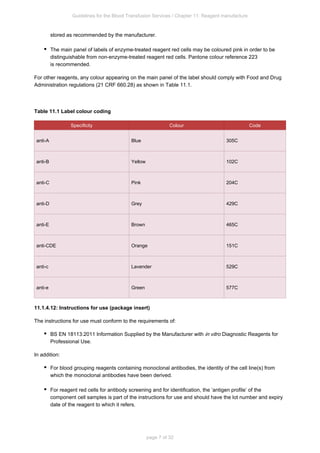
For other reagents, any colour appearing on the main panel of the label should comply with Food and Drug
Administration regulations (21 CRF 660.28) as shown in Table 11.1.
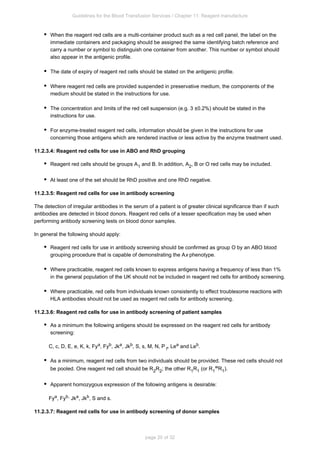
Table 11.1 Label colour coding
Specificity Colour Code
anti-A Blue 305C
anti-B Yellow 102C
anti-C Pink 204C
anti-D Grey 429C
anti-E Brown 465C
anti-CDE Orange 151C
anti-c Lavender 529C
anti-e Green 577C
11.1.4.12: Instructions for use (package insert)
The instructions for use must conform to the requirements of:
BS EN 18113:2011 Information Supplied by the Manufacturer with Diagnostic Reagents for
in vitro
Professional Use.
In addition:
For blood grouping reagents containing monoclonal antibodies, the identity of the cell line(s) from
which the monoclonal antibodies have been derived.
For reagent red cells for antibody screening and for identification, the ‘antigen profile’ of the
component cell samples is part of the instructions for use and should have the lot number and expiry
date of the reagent to which it refers.
Guidelines for the Blood Transfusion Services / Chapter 11: Reagent manufacture
page 8 of 32
A statement that loss of reactivity may occur during the stated shelf life of the red cells and that since
this loss is partly determined by characteristics of individual blood donations or donors, which cannot
be predicted or controlled, the conditions of storage and use recommended by the manufacturer
should be rigidly applied.
For enzyme-treated reagent red cells, information should be given concerning those antigens which
are rendered inactive or less active by the enzyme treatment used.
Update notice: Section 11.2.3.2 - General guidelines for reagent red cell manufacture has been
updated following the the issue of Change Notification 01 - 2017.
11.2: Specifications, performance evaluation and quality control of blood
grouping reagents
11.2.1: Blood typing antisera
11.2.1.1: General requirements
It is essential that blood grouping reagents are prepared using reliable manufacturing procedures
that are consistently capable of producing safe and efficacious products. The products must comply
with requirements of the EU Directive (98/79/EC) on diagnostic medical devices and other
in vitro
relevant international standards detailed in section 11.3.
The term weak D is used in these guidelines to indicate a weakened expression of a normal D
antigen. The term partial D is used in these recommendations to indicate the expression of only a
part of the normal D antigen. The reactivity of RhD blood grouping reagents against partial D red
cells is determined by the nature of the D variant, the anti-D reagent and the technique used.
The blood grouping reagent is satisfactory if an unequivocal positive result is obtained with all the
red cell samples having the antigen corresponding to the blood grouping reagent being assessed, by
all the methods recommended for use by the manufacturer.
If reactivity is claimed by the manufacturer against weak variants or subgroups of a particular
antigen, red cells from at least two confirmed/reference samples should be tested (see Table 11.3).
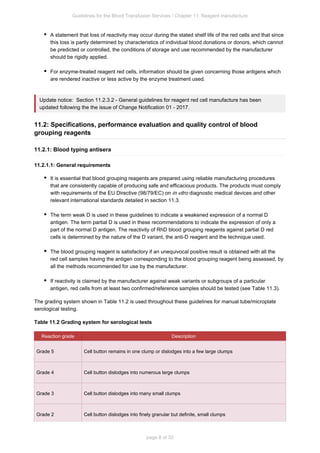
The grading system shown in Table 11.2 is used throughout these guidelines for manual tube/microplate
serological testing.
Table 11.2 Grading system for serological tests
Reaction grade Description
Grade 5 Cell button remains in one clump or dislodges into a few large clumps
Grade 4 Cell button dislodges into numerous large clumps
Grade 3 Cell button dislodges into many small clumps
Grade 2 Cell button dislodges into finely granular but definite, small clumps
Guidelines for the Blood Transfusion Services / Chapter 11: Reagent manufacture
page 9 of 32
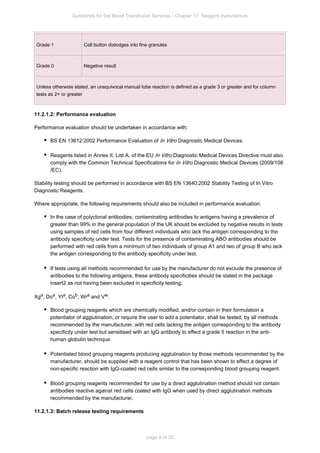
Grade 1 Cell button dislodges into fine granules
Grade 0 Negative result
Unless otherwise stated, an unequivocal manual tube reaction is defined as a grade 3 or greater and for column
tests as 2+ or greater
11.2.1.2: Performance evaluation
Performance evaluation should be undertaken in accordance with:
BS EN 13612:2002 Performance Evaluation of Diagnostic Medical Devices.
In Vitro
Reagents listed in Annex II, List A, of the EU Diagnostic Medical Devices Directive must also
In Vitro
comply with the Common Technical Specifications for Diagnostic Medical Devices (2009/108
In Vitro
/EC).
Stability testing should be performed in accordance with BS EN 13640:2002 Stability Testing of In Vitro
Diagnostic Reagents.
Where appropriate, the following requirements should also be included in performance evaluation:
In the case of polyclonal antibodies, contaminating antibodies to antigens having a prevalence of
greater than 99% in the general population of the UK should be excluded by negative results in tests
using samples of red cells from four different individuals who lack the antigen corresponding to the
antibody specificity under test. Tests for the presence of contaminating ABO antibodies should be
performed with red cells from a minimum of two individuals of group A1 and two of group B who lack
the antigen corresponding to the antibody specificity under test.
If tests using all methods recommended for use by the manufacturer do not exclude the presence of
antibodies to the following antigens, these antibody specificities should be stated in the package
insert as not having been excluded in specificity testing:
2
Xg , Do , Y , Co , W and .
a a ta b ra Vw
Blood grouping reagents which are chemically modified, and/or contain in their formulation a
potentiator of agglutination, or require the user to add a potentiator, shall be tested, by all methods
recommended by the manufacturer, with red cells lacking the antigen corresponding to the antibody
specificity under test but sensitised with an IgG antibody to effect a grade 5 reaction in the anti-
human globulin technique.
Potentiated blood grouping reagents producing agglutination by those methods recommended by the
manufacturer, should be supplied with a reagent control that has been shown to effect a degree of
non-specific reaction with IgG-coated red cells similar to the corresponding blood grouping reagent.
Blood grouping reagents recommended for use by a direct agglutination method should not contain
antibodies reactive against red cells coated with IgG when used by direct agglutination methods
recommended by the manufacturer.
11.2.1.3: Batch release testing requirements
Guidelines for the Blood Transfusion Services / Chapter 11: Reagent manufacture
page 10 of 32
Specificity tests
The manufacturer should test the blood grouping reagent as a final product, by all methods
recommended by the manufacturer for the specificity and reactivity claimed. Specificity should be
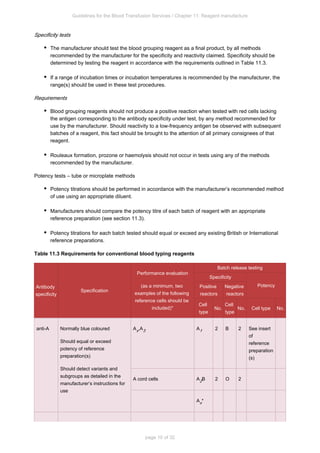
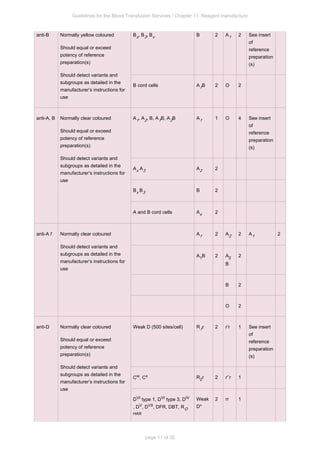
determined by testing the reagent in accordance with the requirements outlined in Table 11.3.
If a range of incubation times or incubation temperatures is recommended by the manufacturer, the
range(s) should be used in these test procedures.
Requirements
Blood grouping reagents should not produce a positive reaction when tested with red cells lacking
the antigen corresponding to the antibody specificity under test, by any method recommended for
use by the manufacturer. Should reactivity to a low-frequency antigen be observed with subsequent
batches of a reagent, this fact should be brought to the attention of all primary consignees of that
reagent.
Rouleaux formation, prozone or haemolysis should not occur in tests using any of the methods
recommended by the manufacturer.
Potency tests – tube or microplate methods
Potency titrations should be performed in accordance with the manufacturer’s recommended method
of use using an appropriate diluent.
Manufacturers should compare the potency titre of each batch of reagent with an appropriate
reference preparation (see section 11.3).
Potency titrations for each batch tested should equal or exceed any existing British or International
reference preparations.
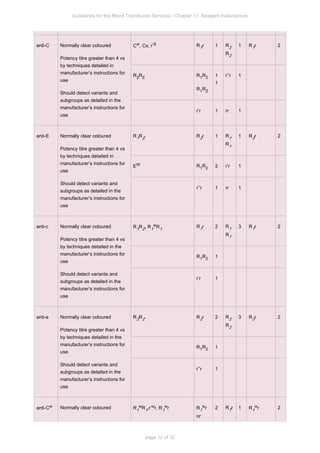
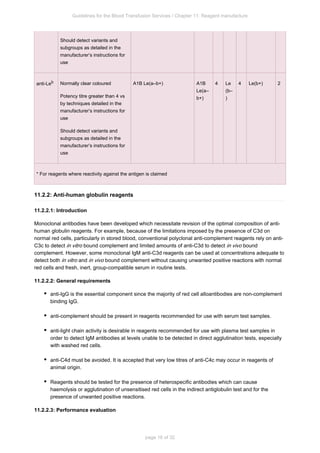
Table 11.3 Requirements for conventional blood typing reagents
Antibody
specificity
Specification
Performance evaluation
(as a minimum, two
examples of the following
reference cells should be
included)*
Batch release testing
Specificity
Potency
Positive
reactors
Negative
reactors
Cell
type
No.
Cell
type
No. Cell type No.
anti-A Normally blue coloured
Should equal or exceed
potency of reference
preparation(s)
Should detect variants and
subgroups as detailed in the
manufacturer’s instructions for
use
A ,A
x 3 A1 2 B 2 See insert
of
reference
preparation
(s)
A cord cells A B
2 2 O 2
A *
x
Guidelines for the Blood Transfusion Services / Chapter 11: Reagent manufacture
page 11 of 32
anti-B Normally yellow coloured
Should equal or exceed
potency of reference
preparation(s)
Should detect variants and
subgroups as detailed in the
manufacturer’s instructions for
use
B , B , B
x 3 v B 2 A1 2 See insert
of
reference
preparation
(s)
B cord cells A B
1 2 O 2
anti-A, B Normally clear coloured
Should equal or exceed
potency of reference
preparation(s)
Should detect variants and
subgroups as detailed in the
manufacturer’s instructions for
use
A , A , B, A B, A B
1 2 1 2 A1 1 O 4 See insert
of
reference
preparation
(s)
A A
x 3 A2 2
B B
x 3 B 2
A and B cord cells Ax 2
anti-A1 Normally clear coloured
Should detect variants and
subgroups as detailed in the
manufacturer’s instructions for
use
A1 2 A2 2 A1 2
A B
1 2 A2
B
2
B 2
O 2
anti-D Normally clear coloured
Should equal or exceed
potency of reference
preparation(s)
Should detect variants and
subgroups as detailed in the
manufacturer’s instructions for
use
Weak D (500 sites/cell) R r
1 2 r’r 1 See insert
of
reference
preparation
(s)
C , C
w x R r
2 2 r’’r 1
D type 1, D type 3, D
VI VI IV
, D , D , DFR, DBT, R
V VII
O
HAR
Weak
D*
2 rr 1
Guidelines for the Blood Transfusion Services / Chapter 11: Reagent manufacture
page 12 of 32
anti-C Normally clear coloured
Potency titre greater than 4 vs
by techniques detailed in
manufacturer’s instructions for
use
Should detect variants and
subgroups as detailed in the
manufacturer’s instructions for
use
C , Cx, r’
w S R r
1 1 R2
R2
1 R r
1 2
R2RZ R R
1 2
R R
1 Z
1
1
r’’r 1
r’r 1 rr 1
anti-E Normally clear coloured
Potency titre greater than 4 vs
by techniques detailed in
manufacturer’s instructions for
use
Should detect variants and
subgroups as detailed in the
manufacturer’s instructions for
use
R R
1 Z R r
2 1 R1
R1
1 R r
2 2
EW R R
1 2 2 r’r 1
r’’r 1 rr 1
anti-c Normally clear coloured
Potency titre greater than 4 vs
by techniques detailed in the
manufacturer’s instructions for
use
Should detect variants and
subgroups as detailed in the
manufacturer’s instructions for
use
R R , R R
1 Z 1
w
1
R r
1 2 R1
R1
3 R r
1 2
R R
1 2 1
r’r 1
anti-e Normally clear coloured
Potency titre greater than 4 vs
by techniques detailed in the
manufacturer’s instructions for
use
Should detect variants and
subgroups as detailed in the
manufacturer’s instructions for
use
R R
2 Z R r
2 2 R2
R2
3 R r
2 2
R R
1 2 1
r’’r 1
anti-Cw Normally clear coloured R R ,r’ r, R r
1
w
1
w
1
w R r
1
w
or
2 R r
1 1 R r
1
w 2
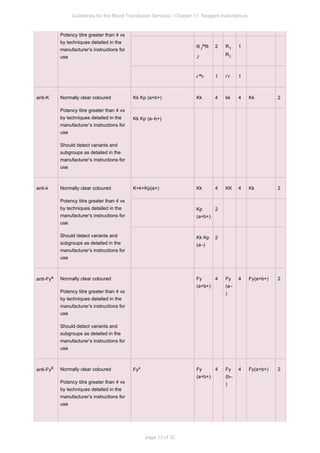
Guidelines for the Blood Transfusion Services / Chapter 11: Reagent manufacture
page 13 of 32
Potency titre greater than 4 vs
by techniques detailed in the
manufacturer’s instructions for
use
R R
1
w
2
2 R1
R1
1
r’ r
w 1 r’r 1
anti-K Normally clear coloured
Potency titre greater than 4 vs
by techniques detailed in the
manufacturer’s instructions for
use
Should detect variants and
subgroups as detailed in the
manufacturer’s instructions for
use
Kk Kp (a+b+) Kk 4 kk 4 Kk 2
Kk Kp (a–b+)
anti-k Normally clear coloured
Potency titre greater than 4 vs
by techniques detailed in the
manufacturer’s instructions for
use
Should detect variants and
subgroups as detailed in the
manufacturer’s instructions for
use
K+k+Kp(a+) Kk 4 KK 4 Kk 2
Kp
(a+b+)
2
Kk Kp
(a–)
2
anti-Fya Normally clear coloured
Potency titre greater than 4 vs
by techniques detailed in the
manufacturer’s instructions for
use
Should detect variants and
subgroups as detailed in the
manufacturer’s instructions for
use
Fy
(a+b+)
4 Fy
(a–
)
4 Fy(a+b+) 2
anti-Fyb Normally clear coloured
Potency titre greater than 4 vs
by techniques detailed in the
manufacturer’s instructions for
use
Fyx Fy
(a+b+)
4 Fy
(b–
)
4 Fy(a+b+) 2
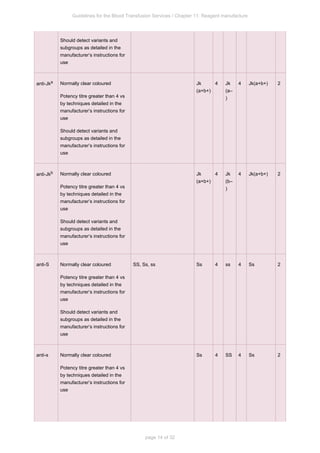
Guidelines for the Blood Transfusion Services / Chapter 11: Reagent manufacture
page 14 of 32
Should detect variants and
subgroups as detailed in the
manufacturer’s instructions for
use
anti-Jka Normally clear coloured
Potency titre greater than 4 vs
by techniques detailed in the
manufacturer’s instructions for
use
Should detect variants and
subgroups as detailed in the
manufacturer’s instructions for
use
Jk
(a+b+)
4 Jk
(a–
)
4 Jk(a+b+) 2
anti-Jkb Normally clear coloured
Potency titre greater than 4 vs
by techniques detailed in the
manufacturer’s instructions for
use
Should detect variants and
subgroups as detailed in the
manufacturer’s instructions for
use
Jk
(a+b+)
4 Jk
(b–
)
4 Jk(a+b+) 2
anti-S Normally clear coloured
Potency titre greater than 4 vs
by techniques detailed in the
manufacturer’s instructions for
use
Should detect variants and
subgroups as detailed in the
manufacturer’s instructions for
use
SS, Ss, ss Ss 4 ss 4 Ss 2
anti-s Normally clear coloured
Potency titre greater than 4 vs
by techniques detailed in the
manufacturer’s instructions for
use
Ss 4 SS 4 Ss 2
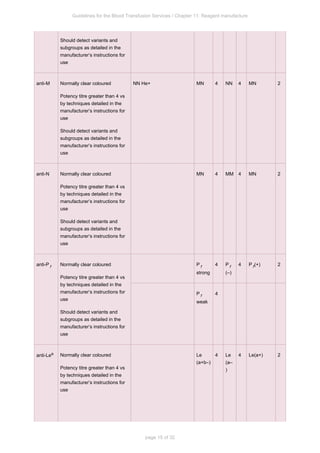
Guidelines for the Blood Transfusion Services / Chapter 11: Reagent manufacture
page 15 of 32
Should detect variants and
subgroups as detailed in the
manufacturer’s instructions for
use
anti-M Normally clear coloured
Potency titre greater than 4 vs
by techniques detailed in the
manufacturer’s instructions for
use
Should detect variants and
subgroups as detailed in the
manufacturer’s instructions for
use
NN He+ MN 4 NN 4 MN 2
anti-N Normally clear coloured
Potency titre greater than 4 vs
by techniques detailed in the
manufacturer’s instructions for
use
Should detect variants and
subgroups as detailed in the
manufacturer’s instructions for
use
MN 4 MM 4 MN 2
anti-P1 Normally clear coloured
Potency titre greater than 4 vs
by techniques detailed in the
manufacturer’s instructions for
use
Should detect variants and
subgroups as detailed in the
manufacturer’s instructions for
use
P1
strong
4 P1
(–)
4 P (+)
1 2
P1
weak
4
anti-Lea Normally clear coloured
Potency titre greater than 4 vs
by techniques detailed in the
manufacturer’s instructions for
use
Le
(a+b–)
4 Le
(a–
)
4 Le(a+) 2
Guidelines for the Blood Transfusion Services / Chapter 11: Reagent manufacture
page 16 of 32
Should detect variants and
subgroups as detailed in the
manufacturer’s instructions for
use
anti-Leb Normally clear coloured
Potency titre greater than 4 vs
by techniques detailed in the
manufacturer’s instructions for
use
Should detect variants and
subgroups as detailed in the
manufacturer’s instructions for
use
A1B Le(a–b+) A1B
Le(a–
b+)
4 Le
(b–
)
4 Le(b+) 2
* For reagents where reactivity against the antigen is claimed
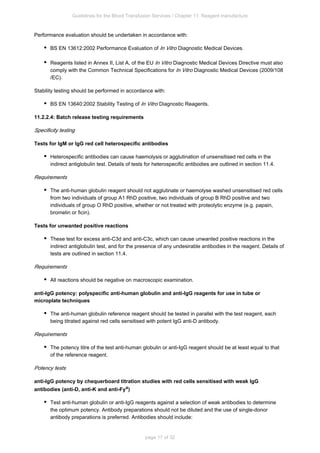
11.2.2: Anti-human globulin reagents
11.2.2.1: Introduction
Monoclonal antibodies have been developed which necessitate revision of the optimal composition of anti-
human globulin reagents. For example, because of the limitations imposed by the presence of C3d on
normal red cells, particularly in stored blood, conventional polyclonal anti-complement reagents rely on anti-
C3c to detect bound complement and limited amounts of anti-C3d to detect bound
in vitro in vivo
complement. However, some monoclonal IgM anti-C3d reagents can be used at concentrations adequate to
detect both and bound complement without causing unwanted positive reactions with normal
in vitro in vivo
red cells and fresh, inert, group-compatible serum in routine tests.
11.2.2.2: General requirements
anti-IgG is the essential component since the majority of red cell alloantibodies are non-complement
binding IgG.
anti-complement should be present in reagents recommended for use with serum test samples.
anti-light chain activity is desirable in reagents recommended for use with plasma test samples in
order to detect IgM antibodies at levels unable to be detected in direct agglutination tests, especially
with washed red cells.
anti-C4d must be avoided. It is accepted that very low titres of anti-C4c may occur in reagents of
animal origin.
Reagents should be tested for the presence of heterospecific antibodies which can cause
haemolysis or agglutination of unsensitised red cells in the indirect antiglobulin test and for the
presence of unwanted positive reactions.
11.2.2.3: Performance evaluation
Guidelines for the Blood Transfusion Services / Chapter 11: Reagent manufacture
page 17 of 32
Performance evaluation should be undertaken in accordance with:
BS EN 13612:2002 Performance Evaluation of Diagnostic Medical Devices.
In Vitro
Reagents listed in Annex II, List A, of the EU Diagnostic Medical Devices Directive must also
In Vitro
comply with the Common Technical Specifications for Diagnostic Medical Devices (2009/108
In Vitro
/EC).
Stability testing should be performed in accordance with:
BS EN 13640:2002 Stability Testing of Diagnostic Reagents.
In Vitro
11.2.2.4: Batch release testing requirements
Specificity testing
Tests for IgM or IgG red cell heterospecific antibodies
Heterospecific antibodies can cause haemolysis or agglutination of unsensitised red cells in the
indirect antiglobulin test. Details of tests for heterospecific antibodies are outlined in section 11.4.
Requirements
The anti-human globulin reagent should not agglutinate or haemolyse washed unsensitised red cells
from two individuals of group A RhD positive, two individuals of group B RhD positive and two
1
individuals of group O RhD positive, whether or not treated with proteolytic enzyme (e.g. papain,
bromelin or ficin).
Tests for unwanted positive reactions
These test for excess anti-C3d and anti-C3c, which can cause unwanted positive reactions in the
indirect antiglobulin test, and for the presence of any undesirable antibodies in the reagent. Details of
tests are outlined in section 11.4.
Requirements
All reactions should be negative on macroscopic examination.
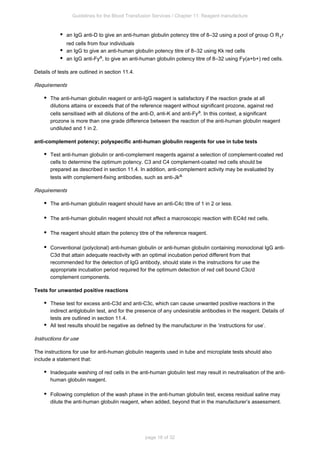
anti-IgG potency: polyspecific anti-human globulin and anti-IgG reagents for use in tube or
microplate techniques
The anti-human globulin reference reagent should be tested in parallel with the test reagent, each
being titrated against red cells sensitised with potent IgG anti-D antibody.
Requirements
The potency titre of the test anti-human globulin or anti-IgG reagent should be at least equal to that
of the reference reagent.
Potency tests
anti-IgG potency by chequerboard titration studies with red cells sensitised with weak IgG
antibodies (anti-D, anti-K and anti-Fya)
Test anti-human globulin or anti-IgG reagents against a selection of weak antibodies to determine
the optimum potency. Antibody preparations should not be diluted and the use of single-donor
antibody preparations is preferred. Antibodies should include:
Guidelines for the Blood Transfusion Services / Chapter 11: Reagent manufacture
page 18 of 32
an IgG anti-D to give an anti-human globulin potency titre of 8–32 using a pool of group O R r
1
red cells from four individuals
an IgG to give an anti-human globulin potency titre of 8–32 using Kk red cells
an IgG anti-Fya, to give an anti-human globulin potency titre of 8–32 using Fy(a+b+) red cells.
Details of tests are outlined in section 11.4.
Requirements
The anti-human globulin reagent or anti-IgG reagent is satisfactory if the reaction grade at all
dilutions attains or exceeds that of the reference reagent without significant prozone, against red
cells sensitised with all dilutions of the anti-D, anti-K and anti-Fy . In this context, a significant
a
prozone is more than one grade difference between the reaction of the anti-human globulin reagent
undiluted and 1 in 2.
anti-complement potency; polyspecific anti-human globulin reagents for use in tube tests
Test anti-human globulin or anti-complement reagents against a selection of complement-coated red
cells to determine the optimum potency. C3 and C4 complement-coated red cells should be
prepared as described in section 11.4. In addition, anti-complement activity may be evaluated by
tests with complement-fixing antibodies, such as anti-Jk .
a
Requirements
The anti-human globulin reagent should have an anti-C4c titre of 1 in 2 or less.
The anti-human globulin reagent should not affect a macroscopic reaction with EC4d red cells.
The reagent should attain the potency titre of the reference reagent.
Conventional (polyclonal) anti-human globulin or anti-human globulin containing monoclonal IgG anti-
C3d that attain adequate reactivity with an optimal incubation period different from that
recommended for the detection of IgG antibody, should state in the instructions for use the
appropriate incubation period required for the optimum detection of red cell bound C3c/d
complement components.
Tests for unwanted positive reactions
These test for excess anti-C3d and anti-C3c, which can cause unwanted positive reactions in the
indirect antiglobulin test, and for the presence of any undesirable antibodies in the reagent. Details of
tests are outlined in section 11.4.
All test results should be negative as defined by the manufacturer in the ‘instructions for use’.
Instructions for use
The instructions for use for anti-human globulin reagents used in tube and microplate tests should also
include a statement that:
Inadequate washing of red cells in the anti-human globulin test may result in neutralisation of the anti-
human globulin reagent.
Following completion of the wash phase in the anti-human globulin test, excess residual saline may
dilute the anti-human globulin reagent, when added, beyond that in the manufacturer’s assessment.
Guidelines for the Blood Transfusion Services / Chapter 11: Reagent manufacture
page 19 of 32
No single test is capable of detecting all clinically significant antibodies.
For each batch of antibody screening being undertaken by an anti-human globulin test, a positive
and negative control should be included. The positive control should be a weak anti-D (not more
than 0.1 IU/mL); the negative control an inert serum, tested against the antibody screening cells
being used.
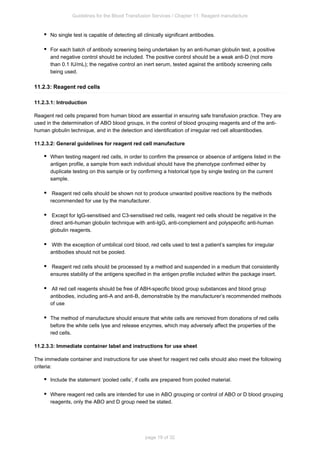
11.2.3: Reagent red cells
11.2.3.1: Introduction
Reagent red cells prepared from human blood are essential in ensuring safe transfusion practice. They are
used in the determination of ABO blood groups, in the control of blood grouping reagents and of the anti-
human globulin technique, and in the detection and identification of irregular red cell alloantibodies.
11.2.3.2: General guidelines for reagent red cell manufacture
When testing reagent red cells, in order to confirm the presence or absence of antigens listed in the
antigen profile, a sample from each individual should have the phenotype confirmed either by
duplicate testing on this sample or by confirming a historical type by single testing on the current
sample.
Reagent red cells should be shown not to produce unwanted positive reactions by the methods
recommended for use by the manufacturer.
Except for IgG-sensitised and C3-sensitised red cells, reagent red cells should be negative in the
direct anti-human globulin technique with anti-IgG, anti-complement and polyspecific anti-human
globulin reagents.
With the exception of umbilical cord blood, red cells used to test a patient’s samples for irregular
antibodies should not be pooled.
Reagent red cells should be processed by a method and suspended in a medium that consistently
ensures stability of the antigens specified in the antigen profile included within the package insert.
All red cell reagents should be free of ABH-specific blood group substances and blood group
antibodies, including anti-A and anti-B, demonstrable by the manufacturer’s recommended methods
of use
The method of manufacture should ensure that white cells are removed from donations of red cells
before the white cells lyse and release enzymes, which may adversely affect the properties of the
red cells.
11.2.3.3: Immediate container label and instructions for use sheet
The immediate container and instructions for use sheet for reagent red cells should also meet the following
criteria:
Include the statement ‘pooled cells’, if cells are prepared from pooled material.
Where reagent red cells are intended for use in ABO grouping or control of ABO or D blood grouping
reagents, only the ABO and D group need be stated.
Guidelines for the Blood Transfusion Services / Chapter 11: Reagent manufacture
page 20 of 32
When the reagent red cells are a multi-container product such as a red cell panel, the label on the
immediate containers and packaging should be assigned the same identifying batch reference and
carry a number or symbol to distinguish one container from another. This number or symbol should
also appear in the antigenic profile.
The date of expiry of reagent red cells should be stated on the antigenic profile.
Where reagent red cells are provided suspended in preservative medium, the components of the
medium should be stated in the instructions for use.
The concentration and limits of the red cell suspension (e.g. 3 ±0.2%) should be stated in the
instructions for use.
For enzyme-treated reagent red cells, information should be given in the instructions for use
concerning those antigens which are rendered inactive or less active by the enzyme treatment used.
11.2.3.4: Reagent red cells for use in ABO and RhD grouping
Reagent red cells should be groups A and B. In addition, A , B or O red cells may be included.
1 2
At least one of the set should be RhD positive and one RhD negative.
11.2.3.5: Reagent red cells for use in antibody screening
The detection of irregular antibodies in the serum of a patient is of greater clinical significance than if such
antibodies are detected in blood donors. Reagent red cells of a lesser specification may be used when
performing antibody screening tests on blood donor samples.
In general the following should apply:
Reagent red cells for use in antibody screening should be confirmed as group O by an ABO blood
grouping procedure that is capable of demonstrating the A phenotype.
x
Where practicable, reagent red cells known to express antigens having a frequency of less than 1%
in the general population of the UK should not be included in reagent red cells for antibody screening.
Where practicable, red cells from individuals known consistently to effect troublesome reactions with
HLA antibodies should not be used as reagent red cells for antibody screening.
11.2.3.6: Reagent red cells for use in antibody screening of patient samples
As a minimum the following antigens should be expressed on the reagent red cells for antibody
screening:
C, c, D, E, e, K, k, Fy , Fy , Jk , Jk , S, s, M, N, P , Le and Le .
a b a b
1
a b
As a minimum, reagent red cells from two individuals should be provided. These red cells should not
be pooled. One reagent red cell should be R R ; the other R R (or R R ).
2 2 1 1 1
w
1
Apparent homozygous expression of the following antigens is desirable:
Fy , Fy Jk , Jk , S and s.
a ,
b a b
11.2.3.7: Reagent red cells for use in antibody screening of donor samples
Guidelines for the Blood Transfusion Services / Chapter 11: Reagent manufacture
page 21 of 32
Reagent red cells may be:
provided unpooled from a minimum of two individuals OR
as a pool of red cells in equal proportions from no more than two donors OR
red cells from a single donor.
Pooled reagent red cells for antibody screening should be used only for testing samples from blood
donors, not samples from patients.
As a minimum the following antigens should be expressed:
D, C, c, E, e and K.
11.2.3.8: Reagent red cells for use in antibody identification
Reagent red cells for use in the identification of irregular antibodies should be confirmed as group O
by an ABO blood grouping procedure which is capable of demonstrating the A phenotype.
x
Where practicable, red cells from individuals known consistently to effect troublesome reactions with
HLA antibodies should not be used in reagent red cells for antibody identification.
The antigen profile of reagent red cells for antibody identification should permit the identification of
frequently encountered antibodies (e.g. anti-D, anti-E, anti-K and anti-Fya), and of commonly
encountered alloantibody mixtures (e.g. anti-D+K).
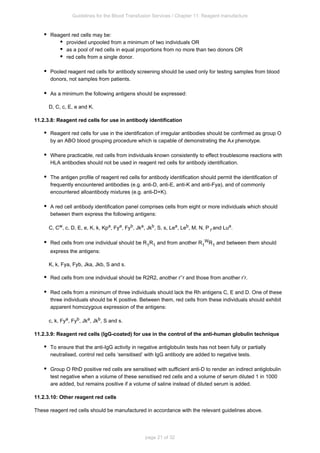
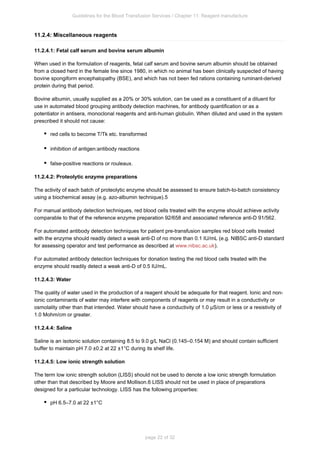
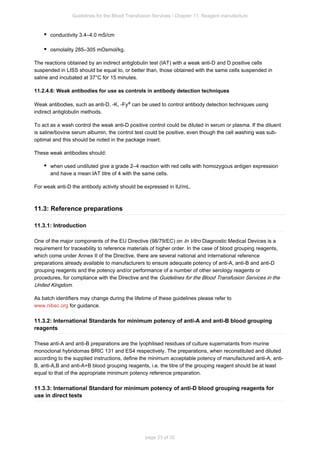
A red cell antibody identification panel comprises cells from eight or more individuals which should
between them express the following antigens:
C, C , c, D, E, e, K, k, Kp , Fy , Fy , Jk , Jk , S, s, Le , Le , M, N, P and Lu .
w a a b a b a b
1
a
Red cells from one individual should be R R and from another R R and between them should
1 1 1
W
1
express the antigens:
K, k, Fy , Fy , Jk , Jk , S and s.
a b a b
Red cells from one individual should be R R , another r’’r and those from another r’r.
2 2
Red cells from a minimum of three individuals should lack the Rh antigens C, E and D. One of these
three individuals should be K positive. Between them, red cells from these individuals should exhibit
apparent homozygous expression of the antigens:
c, k, Fy , Fy , Jk , Jk , S and s.
a b a b
11.2.3.9: Reagent red cells (IgG-coated) for use in the control of the anti-human globulin technique
To ensure that the anti-IgG activity in negative antiglobulin tests has not been fully or partially
neutralised, control red cells ‘sensitised’ with IgG antibody are added to negative tests.
Group O RhD positive red cells are sensitised with sufficient anti-D to render an indirect antiglobulin
test negative when a volume of these sensitised red cells and a volume of serum diluted 1 in 1000
are added, but remains positive if a volume of saline instead of diluted serum is added.
11.2.3.10: Other reagent red cells
These reagent red cells should be manufactured in accordance with the relevant guidelines above.
Guidelines for the Blood Transfusion Services / Chapter 11: Reagent manufacture
page 22 of 32
11.2.4: Miscellaneous reagents
11.2.4.1: Fetal calf serum and bovine serum albumin
When used in the formulation of reagents, fetal calf serum and bovine serum albumin should be obtained
from a closed herd in the female line since 1980, in which no animal has been clinically suspected of having
bovine spongiform encephalopathy (BSE), and which has not been fed rations containing ruminant-derived
protein during that period.
Bovine albumin, usually supplied as a 20% or 30% solution, can be used as a constituent of a diluent for
use in automated blood grouping antibody detection machines, for antibody quantification or as a
potentiator in antisera, monoclonal reagents and anti-human globulin. When diluted and used in the system
prescribed it should not cause:
red cells to become T/Tk etc. transformed
inhibition of antigen:antibody reactions
false-positive reactions or rouleaux.
11.2.4.2: Proteolytic enzyme preparations
The activity of each batch of proteolytic enzyme should be assessed to ensure batch-to-batch consistency
using a biochemical assay (e.g. azo-albumin technique).5
For manual antibody detection techniques, red blood cells treated with the enzyme should achieve activity
comparable to that of the reference enzyme preparation 92/658 and associated reference anti-D 91/562.
For automated antibody detection techniques for patient pre-transfusion samples red blood cells treated
with the enzyme should readily detect a weak anti-D of no more than 0.1 IU/mL (e.g. NIBSC anti-D standard
for assessing operator and test performance as described at ).
www.nibsc.ac.uk
For automated antibody detection techniques for donation testing the red blood cells treated with the
enzyme should readily detect a weak anti-D of 0.5 IU/mL.
11.2.4.3: Water
The quality of water used in the production of a reagent should be adequate for that reagent. Ionic and non-
ionic contaminants of water may interfere with components of reagents or may result in a conductivity or
osmolality other than that intended. Water should have a conductivity of 1.0 µS/cm or less or a resistivity of
1.0 Mohm/cm or greater.
11.2.4.4: Saline
Saline is an isotonic solution containing 8.5 to 9.0 g/L NaCl (0.145–0.154 M) and should contain sufficient
buffer to maintain pH 7.0 ±0.2 at 22 ±1°C during its shelf life.
11.2.4.5: Low ionic strength solution
The term low ionic strength solution (LISS) should not be used to denote a low ionic strength formulation
other than that described by Moore and Mollison. LISS should not be used in place of preparations
6
designed for a particular technology. LISS has the following properties:
pH 6.5–7.0 at 22 ±1°C
Guidelines for the Blood Transfusion Services / Chapter 11: Reagent manufacture
page 23 of 32
conductivity 3.4–4.0 mS/cm
osmolality 285–305 mOsmol/kg.
The reactions obtained by an indirect antiglobulin test (IAT) with a weak anti-D and D positive cells
suspended in LISS should be equal to, or better than, those obtained with the same cells suspended in
saline and incubated at 37°C for 15 minutes.
11.2.4.6: Weak antibodies for use as controls in antibody detection techniques
Weak antibodies, such as anti-D, -K, -Fy can be used to control antibody detection techniques using
a
indirect antiglobulin methods.
To act as a wash control the weak anti-D positive control could be diluted in serum or plasma. If the diluent
is saline/bovine serum albumin, the control test could be positive, even though the cell washing was sub-
optimal and this should be noted in the package insert.
These weak antibodies should:
when used undiluted give a grade 2–4 reaction with red cells with homozygous antigen expression
and have a mean IAT titre of 4 with the same cells.
For weak anti-D the antibody activity should be expressed in IU/mL.
11.3: Reference preparations
11.3.1: Introduction
One of the major components of the EU Directive (98/79/EC) on Diagnostic Medical Devices is a
In Vitro
requirement for traceability to reference materials of higher order. In the case of blood grouping reagents,
which come under Annex II of the Directive, there are several national and international reference
preparations already available to manufacturers to ensure adequate potency of anti-A, anti-B and anti-D
grouping reagents and the potency and/or performance of a number of other serology reagents or
procedures, for compliance with the Directive and the Guidelines for the Blood Transfusion Services in the
.
United Kingdom
As batch identifiers may change during the lifetime of these guidelines please refer to
for guidance.
www.nibsc.org
11.3.2: International Standards for minimum potency of anti-A and anti-B blood grouping
reagents
These anti-A and anti-B preparations are the lyophilised residues of culture supernatants from murine
monoclonal hybridomas BRIC 131 and ES4 respectively. The preparations, when reconstituted and diluted
according to the supplied instructions, define the minimum acceptable potency of manufactured anti-A, anti-
B, anti-A,B and anti-A+B blood grouping reagents, i.e. the titre of the grouping reagent should be at least
equal to that of the appropriate minimum potency reference preparation.
11.3.3: International Standard for minimum potency of anti-D blood grouping reagents for
use in direct tests
Guidelines for the Blood Transfusion Services / Chapter 11: Reagent manufacture
page 24 of 32
This preparation is the lyophilised residue of culture supernatant from a human-murine monoclonal
heterohybridoma secreting an IgM anti-D (RUM-1). When reconstituted and diluted according to the
supplied instructions, this material defines the minimum acceptable potency of anti-D grouping reagents in
direct tube tests, i.e. the titre of the grouping reagent should be at least equal to that of the minimum
potency reference preparation in tube tests using unmodified red cells and without additional agents.
11.3.4: International Council for Standardization in Hematology/International Society of
Blood Transfusion (ICSH/ISBT) reference preparations for papain and anti-D
The intended use of these preparations is to ensure adequate sensitivity combined with freedom from false-
positive reactions associated with some manufacturers’ enzyme preparations and techniques. The
recommended procedure is to test the papain reference material in conjunction with the anti-D ‘for use with
papain standard’ using a titration series for sensitivity, and a series of inert sera for false-positive reactions,
according to the specified two-stage reference method in the product insert and to compare the titration
scores with those obtained from testing the manufacturer’s enzyme preparation in its recommended
technique with the anti-D reference preparation and the inert sera.
11.3.5: ICSH/ISBT standard for anti-human globulin
This preparation consists of lyophilised rabbit antisera against human IgG blended with murine monoclonal
anti-C3d. This is intended for use in the evaluation of anti-human globulin reagents containing either of
these components, or polyspecific reagents containing them both.
11.3.6: UKBTS/NIBSC anti-D reference preparation for assuring operator and
test performance
The current preparation (07/304) consists of lyophilised human plasma with a reconstituted anti-D potency
of 1.0 IU/mL. At 1 in 10 dilution, it is intended to be used to assure the efficacy of red cell washing prior to
the addition of an antiglobulin reagent. At 1 in 20 dilution, it is intended to be used in intra-laboratory
monitoring to assess test operator variability in the detection of weak, macroscopic agglutination in the spin-
tube antiglobulin test.
11.4: Recommended serological techniques for reagent testing
11.4.1: Potency titrations
11.4.1.1: Introduction
The use of a semi-automatic pipette is recommended; one volume being in the order of 40 µL.
A separate pipette tip should be used for each reagent.
If the reagent is formulated with a medium to enhance its reactivity then the diluent for the determination of
the potency titre should be a formulation identical to the reagent but with antibody protein replaced by non-
antibody protein, e.g. fetal calf serum or bovine serum albumin. Otherwise, dilutions may be prepared in
saline containing a final concentration of 20 g/L bovine serum albumin that has not been deliberately
polymerised or otherwise potentiated.
Guidelines for the Blood Transfusion Services / Chapter 11: Reagent manufacture
page 25 of 32
Beginning with the undiluted blood grouping reagent, doubling dilutions (1 in 2, 1 in 4, 1 in 8 etc.) should be
prepared. When preparing doubling dilutions, after the addition of the reagent or diluted reagent to an equal
volume of the diluent, the tip of the pipette is emptied and blotted before the dilution is mixed and a volume
transferred to prepare the subsequent dilution.
The potency titre is the reciprocal of the highest dilution of the reagent that effects a grade 2 reaction using
the required technique.
The dilution caused by the addition of the cell suspension should not be considered in determining the
potency titre.
11.4.1.2: Potency test methods for manual and microplate blood grouping reagents
Manual method – direct test
Add one volume of each dilution of the reagent to a separate tube.
Add one volume of 2–3% test red cell suspension to each tube.
Mix thoroughly and incubate for the appropriate temperature and duration.
Centrifuge and determine the reaction grade.
Manual method – indirect anti-human globulin test
Add two volumes of each dilution of the reagent to a separate tube.
Add one volume of 2–3% test red cell suspension in saline, or two volumes of 1.5–2% test red cell
suspension in LISS.
Mix thoroughly and incubate at 37°C for 45 minutes if the red cells are suspended in saline, or for 15
minutes if suspended in LISS.
Wash the red cells four times.
Add two volumes of anti-human globulin reagent to the button of test red cells. Mix. Centrifuge and
determine the reaction grade.
Microplate method
Equipment
Rigid polystyrene microplates with ‘U’-shaped wells.
Centrifuge with microplate carriers having a radius of at least 10 cm.
Microplate shaker.
Concave microplate reading mirror or automated plate reader.
Red cells for microplate use, bromelin-treated if required.
Method
Guidelines for the Blood Transfusion Services / Chapter 11: Reagent manufacture
page 26 of 32
Using a microplate, add one volume (25–50 µL) of each dilution of the reagent to one volume of 2–
3% test red cells.
Mix the contents of the wells using a microplate shaker. Incubate at 19–25°C for 15 minutes.
Centrifuge the microplate at 100g for 40 seconds. Gently dislodge the red cells from the bottom of
the wells using a microplate shaker.
Determine the reaction grade using a concave mirror or automatic plate reader.
11.4.1.3: Avidity determination
Mix over an oval area of approximately 20 mm × 40 mm on a glass slide, one volume of the
undiluted reagent and one volume of a 30–45% red cell suspension in allogeneic serum or ABO
group-compatible plasma.
Maintain the slide at the recommended temperature for a slide test. If a range of incubation
temperatures is given, for those blood grouping reagents where the antibody-antigen reaction is
favoured by a colder temperature, the higher temperature should be used; for other blood grouping
reagents, the lower temperature should be used.
Determine the time from mixing at which macroscopic agglutination first appears and record the
reaction grade at 1 minute.
11.4.1.4: Test used in performance evaluation and batch release testing of anti-human globulin
Tests for IgM and IgG red cell heterospecific antibodies
These test for heterospecific antibodies which can cause haemolysis or agglutination of unsensitised
red cells in the indirect antiglobulin test.
Method
Divide 12 test tubes into two sets of six.
Into each of the first set of tubes, add one volume of washed 2–3% untreated red cells in saline from
two group A RhD positive, two group B RhD positive and two group O RhD positive individuals.
1
Into each of the second set of tubes add one volume of washed 2–3% enzyme-treated red cells
(papain, bromelin or ficin) in saline from the same group A RhD positive, group B RhD positive and
1
group O RhD positive individuals.
Add two volumes of the anti-human globulin reagent, as intended to be supplied for use, to each test
tube. Mix thoroughly. Incubate the reactants for five minutes at 19–25°C.
Centrifuge the tubes.
Determine the reaction grade.
Control of enzyme treatment
Weak IgG anti-D known to be reactive with enzyme-treated red cells should effect a positive reaction with
each washed, enzyme-treated, red cell sample by the following method:
Guidelines for the Blood Transfusion Services / Chapter 11: Reagent manufacture
page 27 of 32
To separate tubes, add one volume of the weak IgG anti-D to one volume of each of the washed, 2–
3% suspension of enzyme-treated, RhD positive red cell samples. Mix thoroughly. Incubate for five
minutes at 37°C. Centrifuge the tubes. Determine the reaction grade.
The weak anti-D used for this purpose must be absorbed to remove anti-A or anti-B.
Each of the enzyme-treated RhD positive red cell samples should be agglutinated by the weak IgG
anti-D.
Tests for unwanted positive reactions
These test for excess anti-C3d and anti-C3c, which can cause unwanted positive reactions in the indirect
antiglobulin test, and for the presence of any undesirable antibodies in the reagent.
Method for preparation of the red cell suspensions from segmented bleed line samples
Select integral segment lines from two packs of group A , two packs of group B and two packs of
1
group O blood stored at 2–6°C for at least 10 days.
Wash each of the red cell samples with saline sufficient to remove serologically reactive traces of
plasma.
Prepare suspensions of each red cell sample as 2–3% in saline and as 1.5–2% in LISS.
Incubation of red cells and fresh group-compatible serum
Each of the six red cell samples described above is tested as a saline and a LISS suspension with a
different, fresh, group-compatible serum.
For each anti-human globulin reagent to be assessed, prepare two sets of six tubes.
To the first tube of the first set of six tubes and the first tube of the second set of six tubes, add 1 mL
of a fresh, single-donor group-compatible serum. Add 1 mL of a second fresh, single-donor group-
compatible serum to the second tube of each set, and so on for the six different, fresh, group-
compatible sera.
To the first tube of the first set of six tubes, add 0.5 mL of a red cell sample as a 2–3% suspension in
saline. Add 1 mL of the same red cell sample as a 1.5–2% suspension in LISS to the first tube of the
second set of six tubes. Add 0.5 mL of the second red cell sample as a 2–3% suspension in saline to
the second tube of the first set of tubes and 1 mL of the same red cell sample as a 1.5–2%
suspension in LISS to the second tube of the second set of tubes, and so on for each of the six
different, red cell samples.
Incubate the first set of tubes (saline suspended red cell samples) for 45 minutes at 37°C. Incubate
the second set of tubes (LISS suspended red cell samples) for 15 minutes at 37°C.
Wash the red cell samples with saline sufficient to remove serologically reactive traces of serum.
Resuspend the red cells to 2–3% in saline.
Tests with anti-human globulin reagents
Guidelines for the Blood Transfusion Services / Chapter 11: Reagent manufacture
page 28 of 32
For each anti-human globulin reagent, prepare two sets of six tubes. To each of the first set of six
tubes, add in sequence one volume of the 2–3% suspension of washed red cells from the saline test
above.
To each of the second set of six tubes, add in sequence one volume of the washed 2–3%
suspension of washed red cells from the LISS tests above.
Add two volumes of undiluted anti-human globulin, as supplied for use, to each of the 12 tubes. Mix
thoroughly.
Centrifuge the tubes.
Determine the reaction grade.
anti-IgG potency: polyspecific anti-human globulin and anti-IgG reagents for use in tube or microplate
techniques
The anti-IgG reference reagent (see section 11.3.5) should be tested in parallel with the test reagent, each
being titrated against red cells sensitised with potent IgG anti-D antibody.
Method
Test cells
A 2–3% suspension in saline of washed pooled group O R r red cells is prepared from
1
four individuals.
anti-D
anti-D suitable for use in this application should have a potency titre of greater than 512.
To 4 mL of the potent IgG anti-D add 2 mL of the 2–3% suspension of pooled group O R1r red cells.
Mix and incubate at 37°C for 45 minutes.
Wash the red cell sample with saline sufficient to remove serologically reactive traces of serum.
Prepare suspensions of each red cell sample as 2–3% in saline.
Technique
Prepare 1 mL volumes of twofold serial dilutions of the test anti-human globulin reagent and anti-IgG
reference preparation from 1 in 8 to 1 in 4096 (ten tubes).
Prepare a set of ten tubes for each anti-human globulin reagent to be assessed.
Place two volumes of each dilution into each of the series of ten tubes.
Add one volume of the 2–3% suspension of pooled sensitised R r red cells to each tube, mix and
1
centrifuge.
Determine the potency titre.
Controls
The washed, strongly sensitised 2–3% suspension of R r red cells gives a negative result when centrifuged
1
and gives negative results using the direct anti-human globulin technique with anti-complement (anti-C3c,
anti-C3d, anti-C4c and anti-C4d) reagents and with anti-human globulin diluent in place of the anti-human
globulin reagent. (The anti-complement specificities may be present as mixtures in one or more reagents.)
Guidelines for the Blood Transfusion Services / Chapter 11: Reagent manufacture
page 29 of 32
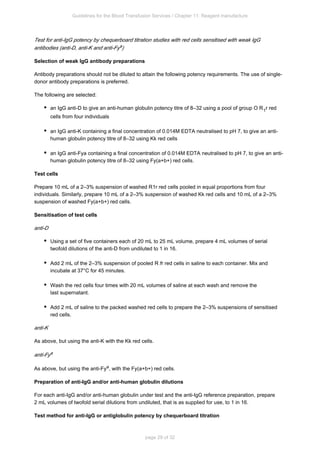
Test for anti-IgG potency by chequerboard titration studies with red cells sensitised with weak IgG
antibodies (anti-D, anti-K and anti-Fy )
a
Selection of weak IgG antibody preparations
Antibody preparations should not be diluted to attain the following potency requirements. The use of single-
donor antibody preparations is preferred.
The following are selected:
an IgG anti-D to give an anti-human globulin potency titre of 8–32 using a pool of group O R r red
1
cells from four individuals
an IgG anti-K containing a final concentration of 0.014M EDTA neutralised to pH 7, to give an anti-
human globulin potency titre of 8–32 using Kk red cells
an IgG anti-Fy containing a final concentration of 0.014M EDTA neutralised to pH 7, to give an anti-
a
human globulin potency titre of 8–32 using Fy(a+b+) red cells.
Test cells
Prepare 10 mL of a 2–3% suspension of washed R r red cells pooled in equal proportions from four
1
individuals. Similarly, prepare 10 mL of a 2–3% suspension of washed Kk red cells and 10 mL of a 2–3%
suspension of washed Fy(a+b+) red cells.
Sensitisation of test cells
anti-D
Using a set of five containers each of 20 mL to 25 mL volume, prepare 4 mL volumes of serial
twofold dilutions of the anti-D from undiluted to 1 in 16.
Add 2 mL of the 2–3% suspension of pooled R r red cells in saline to each container. Mix and
1
incubate at 37°C for 45 minutes.
Wash the red cells four times with 20 mL volumes of saline at each wash and remove the
last supernatant.
Add 2 mL of saline to the packed washed red cells to prepare the 2–3% suspensions of sensitised
red cells.
anti-K
As above, but using the anti-K with the Kk red cells.
anti-Fya
As above, but using the anti-Fy , with the Fy(a+b+) red cells.
a
Preparation of anti-IgG and/or anti-human globulin dilutions
For each anti-IgG and/or anti-human globulin under test and the anti-IgG reference preparation, prepare
2 mL volumes of twofold serial dilutions from undiluted, that is as supplied for use, to 1 in 16.
Test method for anti-IgG or antiglobulin potency by chequerboard titration
Guidelines for the Blood Transfusion Services / Chapter 11: Reagent manufacture
page 30 of 32
anti-D sensitised red cells
Prepare five sets of five tubes for each anti-human globulin reagent under test and the anti-IgG
reference reagent.
Place two volumes of the anti-human globulin reagent, undiluted to 1 in 16, in the appropriate tubes
for each of the five sets of five tubes.
Using the 2–3% suspension of red cells sensitised with the undiluted anti-D for the first set of five
tubes, the 2–3% suspension of red cells sensitised with the anti-D diluted 1 in 2 for the second set of
five tubes, and so on, finishing with the 2–3% suspension of red cells sensitised using the anti-D
diluted 1 in 16 for the fifth set of five tubes, add one volume of the washed red cells to each of the
sets of anti-human globulin dilutions (see Table 11.4).
Mix thoroughly. Centrifuge the tubes, appropriately.
Determine the reaction grade.
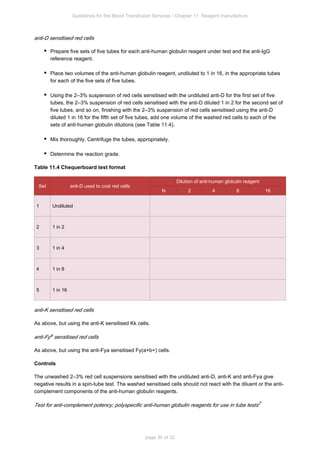
Table 11.4 Chequerboard test format
Set anti-D used to coat red cells
Dilution of anti-human globulin reagent
N 2 4 8 16
1 Undiluted
2 1 in 2
3 1 in 4
4 1 in 8
5 1 in 16
anti-K sensitised red cells
As above, but using the anti-K sensitised Kk cells.
anti-Fya sensitised red cells
As above, but using the anti-Fy sensitised Fy(a+b+) cells.
a
Controls
The unwashed 2–3% red cell suspensions sensitised with the undiluted anti-D, anti-K and anti-Fy give
a
negative results in a spin-tube test. The washed sensitised cells should not react with the diluent or the anti-
complement components of the anti-human globulin reagents.
Test for anti-complement potency; polyspecific anti-human globulin reagents for use in tube tests7
Guidelines for the Blood Transfusion Services / Chapter 11: Reagent manufacture
page 31 of 32
Preparation of the complement sensitised red cells
Various very low ionic strength medium techniques are used to prepare the iC3b, C4b, C3d and C4d
sensitised red cells that are necessary for the assessment of anti-complement activity.
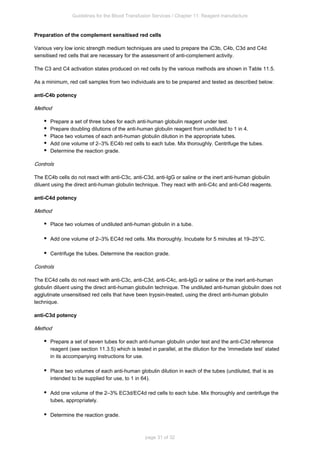
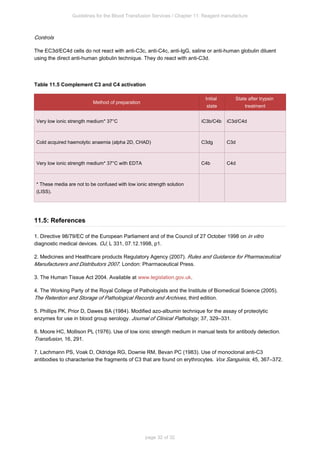
The C3 and C4 activation states produced on red cells by the various methods are shown in Table 11.5.
As a minimum, red cell samples from two individuals are to be prepared and tested as described below.
anti-C4b potency
Method
Prepare a set of three tubes for each anti-human globulin reagent under test.
Prepare doubling dilutions of the anti-human globulin reagent from undiluted to 1 in 4.
Place two volumes of each anti-human globulin dilution in the appropriate tubes.
Add one volume of 2–3% EC4b red cells to each tube. Mix thoroughly. Centrifuge the tubes.
Determine the reaction grade.
Controls
The EC4b cells do not react with anti-C3c, anti-C3d, anti-IgG or saline or the inert anti-human globulin
diluent using the direct anti-human globulin technique. They react with anti-C4c and anti-C4d reagents.
anti-C4d potency
Method
Place two volumes of undiluted anti-human globulin in a tube.
Add one volume of 2–3% EC4d red cells. Mix thoroughly. Incubate for 5 minutes at 19–25°C.
Centrifuge the tubes. Determine the reaction grade.
Controls
The EC4d cells do not react with anti-C3c, anti-C3d, anti-C4c, anti-IgG or saline or the inert anti-human
globulin does not
globulin diluent using the direct anti-human globulin technique. The undiluted anti-human
agglutinate unsensitised red cells that have been trypsin-treated, using the direct anti-human globulin
technique.
anti-C3d potency
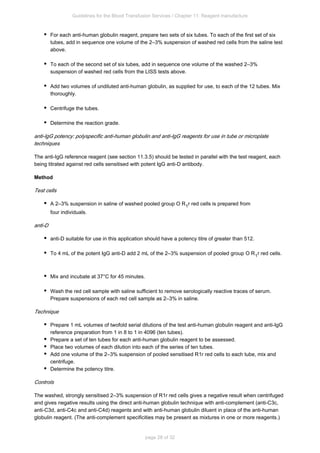
Method
Prepare a set of seven tubes for each anti-human globulin under test and the anti-C3d reference
reagent (see section 11.3.5) which is tested in parallel, at the dilution for the ‘immediate test’ stated
in its accompanying instructions for use.
Place two volumes of each anti-human globulin dilution in each of the tubes (undiluted, that is as
intended to be supplied for use, to 1 in 64).
Add one volume of the 2–3% EC3d/EC4d red cells to each tube. Mix thoroughly and centrifuge the
tubes, appropriately.
Determine the reaction grade.
Guidelines for the Blood Transfusion Services / Chapter 11: Reagent manufacture
page 32 of 32
Controls
The EC3d/EC4d cells do not react with anti-C3c, anti-C4c, anti-IgG, saline or anti-human globulin diluent
using the direct anti-human globulin technique. They do react with anti-C3d.
Table 11.5 Complement C3 and C4 activation
Method of preparation
Initial
state
State after trypsin
treatment
Very low ionic strength medium* 37°C iC3b/C4b iC3d/C4d
Cold acquired haemolytic anaemia (alpha 2D, CHAD) C3dg C3d
Very low ionic strength medium* 37°C with EDTA C4b C4d
* These media are not to be confused with low ionic strength solution
(LISS).
11.5: References
1. Directive 98/79/EC of the European Parliament and of the Council of 27 October 1998 on in vitro
diagnostic medical devices. , L 331, 07.12.1998, p1.
OJ
2. Medicines and Healthcare products Regulatory Agency (2007). Rules and Guidance for Pharmaceutical
. London: Pharmaceutical Press.
Manufacturers and Distributors 2007
3. The Human Tissue Act 2004. Available at .
www.legislation.gov.uk
4. The Working Party of the Royal College of Pathologists and the Institute of Biomedical Science (2005).
, third edition.
The Retention and Storage of Pathological Records and Archives
5. Phillips PK, Prior D, Dawes BA (1984). Modified azo-albumin technique for the assay of proteolytic
enzymes for use in blood group serology. 37, 329–331.
,
Journal of Clinical Pathology
6. Moore HC, Mollison PL (1976). Use of low ionic strength medium in manual tests for antibody detection.
, 16, 291.
Transfusion
7. Lachmann PS, Voak D, Oldridge RG, Downie RM, Bevan PC (1983). Use of monoclonal anti-C3
antibodies to characterise the fragments of C3 that are found on erythrocytes. 45, 367–372.
,
Vox Sanguinis

Reagent Manufacture Procedure.pdf

  • 1.
    page 1 of32 JPAC PDF Generated 31/07/2023 22:34 Joint United Kingdom (UK) Blood Transfusion and Tissue Transplantation Services Professional Advisory Committee Guidelines for the Blood Transfusion Services Chapter 11: Reagent manufacture http://www.transfusionguidelines.org/red-book/chapter-11-reagent-manufacture Chapter 11: Reagent manufacture 11.1: Guidelines for reagent manufacture 11.1.1: Introduction All reagents used to determine the group of human red cells and to detect red cell antibodies must comply with Directive 98/79/EC of the European Parliament and of the Council of 27 October 1998 on in vitro diagnostic medical devices and all associated standards. 1 General guidelines for reagent manufacture are presented in this section. In other sections additional guidelines are given for particular reagents. This document uses Fisher’s notation to describe the presumed Rh genotype of red cell samples to be used. Where R r or r red cells samples are to be used, the probable genotype should be confirmed, for z ry example by extended Rh phenotyping. Where specific reference to British Standard European Standard (BS EN) documents is given this is the most recent version. It is intended that these guidelines refer to the current requirements contained in the applicable documents so the phrase ‘and subsequent revisions’ should be assumed whenever a specific reference is given. 11.1.2: Reference preparations The following reference preparations are available for use with these guidelines. Further details of these preparations can be found on the National Institute for Biological Standards and Control (NIBSC) website at : www.nibsc.ac.uk WHO International Standard for Minimum Potency of anti-A Blood Grouping Reagents WHO International Standard for Minimum Potency of anti-B Blood Grouping Reagents WHO International Standard for Minimum Potency of anti-D Blood Grouping Reagents ICSH/ISBT anti-Human Globulin Standard ICSH/ISBT Papain Reference Preparation ICSH/ISBT anti-D (for use with Papain Reference Preparation). See section 11.3 for further information.
  • 2.
    Guidelines for theBlood Transfusion Services / Chapter 11: Reagent manufacture page 2 of 32 11.1.3: Definitions Antibody identification is a test or combination of tests designed to determine the specificity of irregular antibodies. Antibody screening is a test or combination of tests designed to detect irregular antibodies. A of reagent is a defined quantity of material or of bulk, intermediate or finished product that is batch intended or purported to be uniform in character and quality, and which has been produced during a defined cycle of manufacture. A batch may be divided into sub-batches. A batch is sometimes described as a ‘lot’. A is defined as a number of tests set up at the same time, under the same conditions and batch of tests processed in a similar manner. A comprises a set of blood grouping components (reagents or materials) and blood grouping kit ‘instructions for use’, packaged together, intended by the manufacturer to be used together for determining one or more blood groups. A is a reagent, used alone or in combination with other materials, intended by the blood grouping reagent manufacturer for the determination of a blood group of an individual. A blood grouping reagent recommended by the manufacturer for the detection of A (i.e. subgroups A1 and A ) A and B should be named . 2 x anti-A,B blood grouping reagent A reagent recommended by the manufacturer for the detection of A (i.e. subgroups A1 and A2) and B but not of A , should be named . x anti-A+B blood grouping reagent A is an diagnostic medical device intended by the manufacturer to be used blood grouping system in vitro for determining one or more blood groups. Clinically important or clinically significant antibody is a red cell antibody which will produce significantly accelerated red cell destruction when combined in vivo with its corresponding antigen. Expiry date is the date beyond which performance of the reagent cannot be assured and is based upon the stability of the reagent. Fresh serum for complement activity stored in the liquid state should be used within 8 hours of donation. When used after storage at –70°C or below, the 8-hour liquid storage period refers to the time both before and after frozen storage. Unless validated, the maximum period of frozen storage shall be 6 months at this temperature. An is a medium adequate to protect the content(s) from contamination and/or immediate container physical damage. For example, a sealed vial, ampoule or bottle, a foiled pouch or a sealed plastic bag. The European Standard BS EN 375 requires a label on the immediate container and the outer container that is the material used in the packaging of the immediate container(s) of a product. It is a valid interpretation of that Standard that a microplate presented within a sealed pouch or foiled pouch does not require any label. It is considered by the Standing Advisory Committee for Immunohaematology that this interpretation will contribute to errors in identifying microplates in use within the laboratory. Therefore, in addition, the body of microplates presented in sealed bags or foiled pouches should be marked with a unique identifier to enable identification and traceability. Vials, ampoules, bottles and micro-well plates used as containers for a reagent for blood group serology should be transparent to permit visual inspection of the contents and consist of a material which does not cause deterioration of the reagent over the period recommended for use by the manufacturer.
  • 3.
    Guidelines for theBlood Transfusion Services / Chapter 11: Reagent manufacture page 3 of 32 Irregular blood group antibodies are those of specificity other than anti-A or anti-B. The is the natural or legal person with the responsibility for placing the device on the market manufacturer under his or her own name, regardless of whether he or she has designed, manufactured, packaged, or labelled the device. The name for a blood grouping reagent derived from monoclonal materials should include the word . monoclonal A is one containing an antibody or blend of antibodies specific for monospecific blood grouping reagent one antigen, e.g. anti-A, anti-IgG. A is one containing a blend of antibodies specific for more than one polyspecific blood grouping reagent antigen. Polyspecific anti-human globulin reagent should be the name for a reagent which contains anti-human IgG and anti-human complement (C3d) activity, and is recommended by the manufacturer for use in both the direct and indirect anti-human globulin techniques, i.e. for the detection of red cell bound human IgG, and C3 complement in the form EiC3b and EC3d irrespective of the presence of other human immunoglobulin or human complement specificities. Potency titre is a term used to describe the highest dilution of a reagent that effects a grade 2 endpoint reaction. Prozone is the term used to denote the absence or weakening of agglutination with excess of antibody. A is a reagent made to the same formulation as a blood grouping reagent but reagent control without the the reagent control specific blood group antibody reactivity. If the reagent control contains serum or plasma, should be shown to be free from specific blood group antibody reactivity. A is prepared nationally or locally and contains a known or agreed concentration of reference preparation the activity being measured. It should be assayed to establish the sensitivity or calibration of a test procedure or reagent. Sensitivity in relation to these guidelines is a term defining the limit of detectable specific reactions using reagents or test systems. These guidelines specify levels of sensitivity that should be achieved. Shelf life is the period until expiry date. Specificity in relation to these guidelines is a term defining the ability of a reagent or test system to react selectively. In particular terms, it represents the absence of unwanted or false-positive reactions. Test monitors are a series of samples included as part of each batch of tests, which provide part of the release algorithm for a batch of tests. Validation is the confirmation, through the provision of objective evidence, that the requirements for a specific or intended use have been fulfilled. Validation of a manufacturing method is to ensure that the product will be of the quality required for its intended use and that tests used in monitoring will accurately reflect the quality of the product. Verification is the confirmation, through the provision of objective evidence, that specific requirements have been fulfilled. Undiluted in these guidelines means the reagent as intended for use by the manufacturer. This term includes a diluted reagent if the reagent is supplied in a form requiring dilution by the user prior to use, as specified in the manufacturer’s ‘instructions for use’.
  • 4.
    Guidelines for theBlood Transfusion Services / Chapter 11: Reagent manufacture page 4 of 32 An reaction in a test system is a reaction that is unambiguous. In the manual tube unequivocal test, this is defined as a reaction of grade 3 or greater. In column tests this is defined as a 2+ reaction. 11.1.4: General manufacturing considerations 11.1.4.1: Good manufacturing practice Reagents for blood group serology must be manufactured in accordance with Directive 98/79/EC of the European Parliament and of the Council of 27 October 1998 on diagnostic medical devices and all in vitro associated documents. Guidance on the principles of good manufacturing practice can be obtained from Rules and Guidance for . Pharmaceutical Manufacturers and Distributors 2007 2 The method of manufacture should result in a product within an immediate container that is homogeneous and free of properties which adversely affect its intended use throughout its recommended shelf life. The reagent should have no precipitate, particles or fibrin gel. Each batch or sub-batch should be specifically identified by a distinctive combination of numbers and /or letters (batch reference) which permits its history to be traced. Reagents should be produced by a validated process that is shown to be suitable for the intended purpose, including any methods for preserving red cells prior to their preparation as reagent red cells. The manufacturer should monitor the batch-to-batch performance of the blood grouping reagent (e.g. by the reaction against some internal reference material) in order to provide consistency of performance. This is particularly important when the blood grouping reagent is provided as a test system, kit or kit component, when the performance may be dependent on the characteristics of other system variables or kit components. 11.1.4.2: Risk management Risk management should be performed in accordance with: BS EN ISO 14971:2012 Medical Devices – Application of Risk Management to Medical Devices BS EN 13641:2002 Elimination or Reduction of Risk of Infection Related to in vitro Diagnostic Reagents. 11.1.4.3: Performance evaluation Performance evaluation should be undertaken in accordance with: BS EN 13612:2002 Performance Evaluation of Diagnostic Medical Devices in vitro Reagents listed in Annex II, List A, of the EU Diagnostic Medical Devices Directive must also In Vitro comply with the Common Technical Specifications for Diagnostic Medical Devices (2009/108 In Vitro /EC). 11.1.4.4: Stability data Stability testing should be performed in accordance with: BS EN 13640:2002 Stability Testing of Diagnostic Reagents. in vitro
  • 5.
    Guidelines for theBlood Transfusion Services / Chapter 11: Reagent manufacture page 5 of 32 11.1.4.5: Date of manufacture For blood grouping reagents the date of manufacture is the date of commencement of the last potency test on the batch or sub-batch that indicates attainment of the required specification. For reagent red cells the date of manufacture is the date of collection from the donor. Where reagent red cells are prepared from more than one donor, the date of collection of the oldest donation should be recorded as the date of manufacture. Where a freezing process is used to preserve red cells before their preparation for issue as reagent red cells, the date of manufacture is the date of recovery from the frozen state. 11.1.4.6: Colour coding of reagents No colouring agent should be added to reagents for blood group serology except that: Polyspecific anti-human globulin reagents may be coloured green, anti-A may be coloured blue, anti- B may be coloured yellow. The colorant should not interfere with the observation of the test result. ‘Bespoke’ antisera for use on automation may be coloured providing the information contained in the barcode on each bottle contains sufficient identifiers (specificity and lot number) to provide assurance that the intended test has been performed. The colours used for other specificities should not be coloured blue or yellow to avoid confusion with those for anti-A and anti-B reagents. 11.1.4.7: Freedom from microbial contaminants Reagents should be prepared using validated processes to produce a final product free from microbial contaminants that adversely affect the unopened product during storage at the recommended temperature. The manufacturer should routinely monitor the efficacy of the process used in the manufacture of the reagent. A preservative may be included in the reagent to minimise the effects of contamination during use if the preservative has been shown not to adversely affect the product during storage or use. Other than reagent red cells, all reagents for blood group serology recommended by the manufacturer for storage in the liquid state, should be filtered through a sterile filter of pore size not exceeding 0.22 m. All reagents should be dispensed into the immediate container under aseptic conditions. Tests for contamination do not give absolute assurance of freedom from microbial contaminants. Bactericidal agents in common use for blood grouping reagents do not guarantee the absence of microbial agents after opening of the container. 11.1.4.8: Retained samples A minimum of 1% or three immediate containers, whichever is less, of each batch of reagents other than reagent red cells should be retained and stored as recommended by the manufacturer to enable analysis of reported defects. Such samples should be retained for at least 6 months beyond the expiry date.
  • 6.
    Guidelines for theBlood Transfusion Services / Chapter 11: Reagent manufacture page 6 of 32 A minimum of two final containers of each batch of reagent red cells should be retained and stored as recommended by the manufacturer to enable analysis of reported defects. Such samples should be retained for at least 10 days beyond the expiry date. 11.1.4.9: Tests required The manufacturer should test, as described in these guidelines, each lot of a reagent obtained from the immediate container to be supplied for use (see section 11.2.1). 11.1.4.10: Human source material Existing procedures in the UK Blood Transfusion Services for consent to donate are sufficient to allow cellular and plasma materials collected as part of the donation process to be used as reagents without further explicit consent. Samples/donations that are obtained specifically for reagent purposes will require additional consenting of the donor, and must have appropriate ethical approval. Donor materials that are obtained and retained for genomic or nucleic acid testing must comply with the regulations laid down by The Human Tissue Act 2004 (except Scotland).3 Residual samples retained from patient testing laboratories may be used without further explicit consent, if anonymised. Additional samples taken from patients specifically for reagent use will require ethical 4 approval and explicit consent. All patient samples acquired and retained must comply with the regulations laid down by the Human Tissue Act (2004). Each individual donation or sample of human material in a reagent for blood group serology shall be tested and found negative for mandatory microbiological tests required by the UK Blood Transfusion Services for blood donations (see Chapter 9). A statement is required in the ‘instructions for use’ to this effect. To ensure retrospective microbiological testing, an appropriate sample, collected at the same time as the donation used in the formulation of a particular reagent, should be archived until at least 6 months after the expiry date of the last batch of the reagent made from that material. 11.1.4.11: Label requirements The label must conform to the requirements of: BS EN 18113:2011 Information Supplied by the Manufacturer with Diagnostic Reagents for in vitro Professional Use. In addition, the instructions for use should meet the following criteria: The label fixed to the immediate container of a reagent should leave uncovered sufficient area of the full length or circumference of the container to allow ready visual inspection of the contents. The specificity of the reagent for blood group serology should be of a print size which is clearly legible. The print size of other information on the label should not exceed that used for the specificity of the reagent. The typeface used should clearly differentiate between antigens and related antibody specificities represented by upper and lower-case characters, e.g. C/c, S/s and K/k. For products needing to be prepared in the final form by the user following the instructions of the manufacturer and to be retained in the manufacturer’s immediate container, a space should be available on the container label for the user to write the expiry date of the prepared product when
  • 7.
    Guidelines for theBlood Transfusion Services / Chapter 11: Reagent manufacture page 7 of 32 stored as recommended by the manufacturer. The main panel of labels of enzyme-treated reagent red cells may be coloured pink in order to be distinguishable from non-enzyme-treated reagent red cells. Pantone colour reference 223 is recommended. For other reagents, any colour appearing on the main panel of the label should comply with Food and Drug Administration regulations (21 CRF 660.28) as shown in Table 11.1. Table 11.1 Label colour coding Specificity Colour Code anti-A Blue 305C anti-B Yellow 102C anti-C Pink 204C anti-D Grey 429C anti-E Brown 465C anti-CDE Orange 151C anti-c Lavender 529C anti-e Green 577C 11.1.4.12: Instructions for use (package insert) The instructions for use must conform to the requirements of: BS EN 18113:2011 Information Supplied by the Manufacturer with Diagnostic Reagents for in vitro Professional Use. In addition: For blood grouping reagents containing monoclonal antibodies, the identity of the cell line(s) from which the monoclonal antibodies have been derived. For reagent red cells for antibody screening and for identification, the ‘antigen profile’ of the component cell samples is part of the instructions for use and should have the lot number and expiry date of the reagent to which it refers.
  • 8.
    Guidelines for theBlood Transfusion Services / Chapter 11: Reagent manufacture page 8 of 32 A statement that loss of reactivity may occur during the stated shelf life of the red cells and that since this loss is partly determined by characteristics of individual blood donations or donors, which cannot be predicted or controlled, the conditions of storage and use recommended by the manufacturer should be rigidly applied. For enzyme-treated reagent red cells, information should be given concerning those antigens which are rendered inactive or less active by the enzyme treatment used. Update notice: Section 11.2.3.2 - General guidelines for reagent red cell manufacture has been updated following the the issue of Change Notification 01 - 2017. 11.2: Specifications, performance evaluation and quality control of blood grouping reagents 11.2.1: Blood typing antisera 11.2.1.1: General requirements It is essential that blood grouping reagents are prepared using reliable manufacturing procedures that are consistently capable of producing safe and efficacious products. The products must comply with requirements of the EU Directive (98/79/EC) on diagnostic medical devices and other in vitro relevant international standards detailed in section 11.3. The term weak D is used in these guidelines to indicate a weakened expression of a normal D antigen. The term partial D is used in these recommendations to indicate the expression of only a part of the normal D antigen. The reactivity of RhD blood grouping reagents against partial D red cells is determined by the nature of the D variant, the anti-D reagent and the technique used. The blood grouping reagent is satisfactory if an unequivocal positive result is obtained with all the red cell samples having the antigen corresponding to the blood grouping reagent being assessed, by all the methods recommended for use by the manufacturer. If reactivity is claimed by the manufacturer against weak variants or subgroups of a particular antigen, red cells from at least two confirmed/reference samples should be tested (see Table 11.3). The grading system shown in Table 11.2 is used throughout these guidelines for manual tube/microplate serological testing. Table 11.2 Grading system for serological tests Reaction grade Description Grade 5 Cell button remains in one clump or dislodges into a few large clumps Grade 4 Cell button dislodges into numerous large clumps Grade 3 Cell button dislodges into many small clumps Grade 2 Cell button dislodges into finely granular but definite, small clumps
  • 9.
    Guidelines for theBlood Transfusion Services / Chapter 11: Reagent manufacture page 9 of 32 Grade 1 Cell button dislodges into fine granules Grade 0 Negative result Unless otherwise stated, an unequivocal manual tube reaction is defined as a grade 3 or greater and for column tests as 2+ or greater 11.2.1.2: Performance evaluation Performance evaluation should be undertaken in accordance with: BS EN 13612:2002 Performance Evaluation of Diagnostic Medical Devices. In Vitro Reagents listed in Annex II, List A, of the EU Diagnostic Medical Devices Directive must also In Vitro comply with the Common Technical Specifications for Diagnostic Medical Devices (2009/108 In Vitro /EC). Stability testing should be performed in accordance with BS EN 13640:2002 Stability Testing of In Vitro Diagnostic Reagents. Where appropriate, the following requirements should also be included in performance evaluation: In the case of polyclonal antibodies, contaminating antibodies to antigens having a prevalence of greater than 99% in the general population of the UK should be excluded by negative results in tests using samples of red cells from four different individuals who lack the antigen corresponding to the antibody specificity under test. Tests for the presence of contaminating ABO antibodies should be performed with red cells from a minimum of two individuals of group A1 and two of group B who lack the antigen corresponding to the antibody specificity under test. If tests using all methods recommended for use by the manufacturer do not exclude the presence of antibodies to the following antigens, these antibody specificities should be stated in the package insert as not having been excluded in specificity testing: 2 Xg , Do , Y , Co , W and . a a ta b ra Vw Blood grouping reagents which are chemically modified, and/or contain in their formulation a potentiator of agglutination, or require the user to add a potentiator, shall be tested, by all methods recommended by the manufacturer, with red cells lacking the antigen corresponding to the antibody specificity under test but sensitised with an IgG antibody to effect a grade 5 reaction in the anti- human globulin technique. Potentiated blood grouping reagents producing agglutination by those methods recommended by the manufacturer, should be supplied with a reagent control that has been shown to effect a degree of non-specific reaction with IgG-coated red cells similar to the corresponding blood grouping reagent. Blood grouping reagents recommended for use by a direct agglutination method should not contain antibodies reactive against red cells coated with IgG when used by direct agglutination methods recommended by the manufacturer. 11.2.1.3: Batch release testing requirements
  • 10.
    Guidelines for theBlood Transfusion Services / Chapter 11: Reagent manufacture page 10 of 32 Specificity tests The manufacturer should test the blood grouping reagent as a final product, by all methods recommended by the manufacturer for the specificity and reactivity claimed. Specificity should be determined by testing the reagent in accordance with the requirements outlined in Table 11.3. If a range of incubation times or incubation temperatures is recommended by the manufacturer, the range(s) should be used in these test procedures. Requirements Blood grouping reagents should not produce a positive reaction when tested with red cells lacking the antigen corresponding to the antibody specificity under test, by any method recommended for use by the manufacturer. Should reactivity to a low-frequency antigen be observed with subsequent batches of a reagent, this fact should be brought to the attention of all primary consignees of that reagent. Rouleaux formation, prozone or haemolysis should not occur in tests using any of the methods recommended by the manufacturer. Potency tests – tube or microplate methods Potency titrations should be performed in accordance with the manufacturer’s recommended method of use using an appropriate diluent. Manufacturers should compare the potency titre of each batch of reagent with an appropriate reference preparation (see section 11.3). Potency titrations for each batch tested should equal or exceed any existing British or International reference preparations. Table 11.3 Requirements for conventional blood typing reagents Antibody specificity Specification Performance evaluation (as a minimum, two examples of the following reference cells should be included)* Batch release testing Specificity Potency Positive reactors Negative reactors Cell type No. Cell type No. Cell type No. anti-A Normally blue coloured Should equal or exceed potency of reference preparation(s) Should detect variants and subgroups as detailed in the manufacturer’s instructions for use A ,A x 3 A1 2 B 2 See insert of reference preparation (s) A cord cells A B 2 2 O 2 A * x
  • 11.
    Guidelines for theBlood Transfusion Services / Chapter 11: Reagent manufacture page 11 of 32 anti-B Normally yellow coloured Should equal or exceed potency of reference preparation(s) Should detect variants and subgroups as detailed in the manufacturer’s instructions for use B , B , B x 3 v B 2 A1 2 See insert of reference preparation (s) B cord cells A B 1 2 O 2 anti-A, B Normally clear coloured Should equal or exceed potency of reference preparation(s) Should detect variants and subgroups as detailed in the manufacturer’s instructions for use A , A , B, A B, A B 1 2 1 2 A1 1 O 4 See insert of reference preparation (s) A A x 3 A2 2 B B x 3 B 2 A and B cord cells Ax 2 anti-A1 Normally clear coloured Should detect variants and subgroups as detailed in the manufacturer’s instructions for use A1 2 A2 2 A1 2 A B 1 2 A2 B 2 B 2 O 2 anti-D Normally clear coloured Should equal or exceed potency of reference preparation(s) Should detect variants and subgroups as detailed in the manufacturer’s instructions for use Weak D (500 sites/cell) R r 1 2 r’r 1 See insert of reference preparation (s) C , C w x R r 2 2 r’’r 1 D type 1, D type 3, D VI VI IV , D , D , DFR, DBT, R V VII O HAR Weak D* 2 rr 1
  • 12.
    Guidelines for theBlood Transfusion Services / Chapter 11: Reagent manufacture page 12 of 32 anti-C Normally clear coloured Potency titre greater than 4 vs by techniques detailed in manufacturer’s instructions for use Should detect variants and subgroups as detailed in the manufacturer’s instructions for use C , Cx, r’ w S R r 1 1 R2 R2 1 R r 1 2 R2RZ R R 1 2 R R 1 Z 1 1 r’’r 1 r’r 1 rr 1 anti-E Normally clear coloured Potency titre greater than 4 vs by techniques detailed in manufacturer’s instructions for use Should detect variants and subgroups as detailed in the manufacturer’s instructions for use R R 1 Z R r 2 1 R1 R1 1 R r 2 2 EW R R 1 2 2 r’r 1 r’’r 1 rr 1 anti-c Normally clear coloured Potency titre greater than 4 vs by techniques detailed in the manufacturer’s instructions for use Should detect variants and subgroups as detailed in the manufacturer’s instructions for use R R , R R 1 Z 1 w 1 R r 1 2 R1 R1 3 R r 1 2 R R 1 2 1 r’r 1 anti-e Normally clear coloured Potency titre greater than 4 vs by techniques detailed in the manufacturer’s instructions for use Should detect variants and subgroups as detailed in the manufacturer’s instructions for use R R 2 Z R r 2 2 R2 R2 3 R r 2 2 R R 1 2 1 r’’r 1 anti-Cw Normally clear coloured R R ,r’ r, R r 1 w 1 w 1 w R r 1 w or 2 R r 1 1 R r 1 w 2
  • 13.
    Guidelines for theBlood Transfusion Services / Chapter 11: Reagent manufacture page 13 of 32 Potency titre greater than 4 vs by techniques detailed in the manufacturer’s instructions for use R R 1 w 2 2 R1 R1 1 r’ r w 1 r’r 1 anti-K Normally clear coloured Potency titre greater than 4 vs by techniques detailed in the manufacturer’s instructions for use Should detect variants and subgroups as detailed in the manufacturer’s instructions for use Kk Kp (a+b+) Kk 4 kk 4 Kk 2 Kk Kp (a–b+) anti-k Normally clear coloured Potency titre greater than 4 vs by techniques detailed in the manufacturer’s instructions for use Should detect variants and subgroups as detailed in the manufacturer’s instructions for use K+k+Kp(a+) Kk 4 KK 4 Kk 2 Kp (a+b+) 2 Kk Kp (a–) 2 anti-Fya Normally clear coloured Potency titre greater than 4 vs by techniques detailed in the manufacturer’s instructions for use Should detect variants and subgroups as detailed in the manufacturer’s instructions for use Fy (a+b+) 4 Fy (a– ) 4 Fy(a+b+) 2 anti-Fyb Normally clear coloured Potency titre greater than 4 vs by techniques detailed in the manufacturer’s instructions for use Fyx Fy (a+b+) 4 Fy (b– ) 4 Fy(a+b+) 2
  • 14.
    Guidelines for theBlood Transfusion Services / Chapter 11: Reagent manufacture page 14 of 32 Should detect variants and subgroups as detailed in the manufacturer’s instructions for use anti-Jka Normally clear coloured Potency titre greater than 4 vs by techniques detailed in the manufacturer’s instructions for use Should detect variants and subgroups as detailed in the manufacturer’s instructions for use Jk (a+b+) 4 Jk (a– ) 4 Jk(a+b+) 2 anti-Jkb Normally clear coloured Potency titre greater than 4 vs by techniques detailed in the manufacturer’s instructions for use Should detect variants and subgroups as detailed in the manufacturer’s instructions for use Jk (a+b+) 4 Jk (b– ) 4 Jk(a+b+) 2 anti-S Normally clear coloured Potency titre greater than 4 vs by techniques detailed in the manufacturer’s instructions for use Should detect variants and subgroups as detailed in the manufacturer’s instructions for use SS, Ss, ss Ss 4 ss 4 Ss 2 anti-s Normally clear coloured Potency titre greater than 4 vs by techniques detailed in the manufacturer’s instructions for use Ss 4 SS 4 Ss 2
  • 15.
    Guidelines for theBlood Transfusion Services / Chapter 11: Reagent manufacture page 15 of 32 Should detect variants and subgroups as detailed in the manufacturer’s instructions for use anti-M Normally clear coloured Potency titre greater than 4 vs by techniques detailed in the manufacturer’s instructions for use Should detect variants and subgroups as detailed in the manufacturer’s instructions for use NN He+ MN 4 NN 4 MN 2 anti-N Normally clear coloured Potency titre greater than 4 vs by techniques detailed in the manufacturer’s instructions for use Should detect variants and subgroups as detailed in the manufacturer’s instructions for use MN 4 MM 4 MN 2 anti-P1 Normally clear coloured Potency titre greater than 4 vs by techniques detailed in the manufacturer’s instructions for use Should detect variants and subgroups as detailed in the manufacturer’s instructions for use P1 strong 4 P1 (–) 4 P (+) 1 2 P1 weak 4 anti-Lea Normally clear coloured Potency titre greater than 4 vs by techniques detailed in the manufacturer’s instructions for use Le (a+b–) 4 Le (a– ) 4 Le(a+) 2
  • 16.
    Guidelines for theBlood Transfusion Services / Chapter 11: Reagent manufacture page 16 of 32 Should detect variants and subgroups as detailed in the manufacturer’s instructions for use anti-Leb Normally clear coloured Potency titre greater than 4 vs by techniques detailed in the manufacturer’s instructions for use Should detect variants and subgroups as detailed in the manufacturer’s instructions for use A1B Le(a–b+) A1B Le(a– b+) 4 Le (b– ) 4 Le(b+) 2 * For reagents where reactivity against the antigen is claimed 11.2.2: Anti-human globulin reagents 11.2.2.1: Introduction Monoclonal antibodies have been developed which necessitate revision of the optimal composition of anti- human globulin reagents. For example, because of the limitations imposed by the presence of C3d on normal red cells, particularly in stored blood, conventional polyclonal anti-complement reagents rely on anti- C3c to detect bound complement and limited amounts of anti-C3d to detect bound in vitro in vivo complement. However, some monoclonal IgM anti-C3d reagents can be used at concentrations adequate to detect both and bound complement without causing unwanted positive reactions with normal in vitro in vivo red cells and fresh, inert, group-compatible serum in routine tests. 11.2.2.2: General requirements anti-IgG is the essential component since the majority of red cell alloantibodies are non-complement binding IgG. anti-complement should be present in reagents recommended for use with serum test samples. anti-light chain activity is desirable in reagents recommended for use with plasma test samples in order to detect IgM antibodies at levels unable to be detected in direct agglutination tests, especially with washed red cells. anti-C4d must be avoided. It is accepted that very low titres of anti-C4c may occur in reagents of animal origin. Reagents should be tested for the presence of heterospecific antibodies which can cause haemolysis or agglutination of unsensitised red cells in the indirect antiglobulin test and for the presence of unwanted positive reactions. 11.2.2.3: Performance evaluation
  • 17.
    Guidelines for theBlood Transfusion Services / Chapter 11: Reagent manufacture page 17 of 32 Performance evaluation should be undertaken in accordance with: BS EN 13612:2002 Performance Evaluation of Diagnostic Medical Devices. In Vitro Reagents listed in Annex II, List A, of the EU Diagnostic Medical Devices Directive must also In Vitro comply with the Common Technical Specifications for Diagnostic Medical Devices (2009/108 In Vitro /EC). Stability testing should be performed in accordance with: BS EN 13640:2002 Stability Testing of Diagnostic Reagents. In Vitro 11.2.2.4: Batch release testing requirements Specificity testing Tests for IgM or IgG red cell heterospecific antibodies Heterospecific antibodies can cause haemolysis or agglutination of unsensitised red cells in the indirect antiglobulin test. Details of tests for heterospecific antibodies are outlined in section 11.4. Requirements The anti-human globulin reagent should not agglutinate or haemolyse washed unsensitised red cells from two individuals of group A RhD positive, two individuals of group B RhD positive and two 1 individuals of group O RhD positive, whether or not treated with proteolytic enzyme (e.g. papain, bromelin or ficin). Tests for unwanted positive reactions These test for excess anti-C3d and anti-C3c, which can cause unwanted positive reactions in the indirect antiglobulin test, and for the presence of any undesirable antibodies in the reagent. Details of tests are outlined in section 11.4. Requirements All reactions should be negative on macroscopic examination. anti-IgG potency: polyspecific anti-human globulin and anti-IgG reagents for use in tube or microplate techniques The anti-human globulin reference reagent should be tested in parallel with the test reagent, each being titrated against red cells sensitised with potent IgG anti-D antibody. Requirements The potency titre of the test anti-human globulin or anti-IgG reagent should be at least equal to that of the reference reagent. Potency tests anti-IgG potency by chequerboard titration studies with red cells sensitised with weak IgG antibodies (anti-D, anti-K and anti-Fya) Test anti-human globulin or anti-IgG reagents against a selection of weak antibodies to determine the optimum potency. Antibody preparations should not be diluted and the use of single-donor antibody preparations is preferred. Antibodies should include:
  • 18.
    Guidelines for theBlood Transfusion Services / Chapter 11: Reagent manufacture page 18 of 32 an IgG anti-D to give an anti-human globulin potency titre of 8–32 using a pool of group O R r 1 red cells from four individuals an IgG to give an anti-human globulin potency titre of 8–32 using Kk red cells an IgG anti-Fya, to give an anti-human globulin potency titre of 8–32 using Fy(a+b+) red cells. Details of tests are outlined in section 11.4. Requirements The anti-human globulin reagent or anti-IgG reagent is satisfactory if the reaction grade at all dilutions attains or exceeds that of the reference reagent without significant prozone, against red cells sensitised with all dilutions of the anti-D, anti-K and anti-Fy . In this context, a significant a prozone is more than one grade difference between the reaction of the anti-human globulin reagent undiluted and 1 in 2. anti-complement potency; polyspecific anti-human globulin reagents for use in tube tests Test anti-human globulin or anti-complement reagents against a selection of complement-coated red cells to determine the optimum potency. C3 and C4 complement-coated red cells should be prepared as described in section 11.4. In addition, anti-complement activity may be evaluated by tests with complement-fixing antibodies, such as anti-Jk . a Requirements The anti-human globulin reagent should have an anti-C4c titre of 1 in 2 or less. The anti-human globulin reagent should not affect a macroscopic reaction with EC4d red cells. The reagent should attain the potency titre of the reference reagent. Conventional (polyclonal) anti-human globulin or anti-human globulin containing monoclonal IgG anti- C3d that attain adequate reactivity with an optimal incubation period different from that recommended for the detection of IgG antibody, should state in the instructions for use the appropriate incubation period required for the optimum detection of red cell bound C3c/d complement components. Tests for unwanted positive reactions These test for excess anti-C3d and anti-C3c, which can cause unwanted positive reactions in the indirect antiglobulin test, and for the presence of any undesirable antibodies in the reagent. Details of tests are outlined in section 11.4. All test results should be negative as defined by the manufacturer in the ‘instructions for use’. Instructions for use The instructions for use for anti-human globulin reagents used in tube and microplate tests should also include a statement that: Inadequate washing of red cells in the anti-human globulin test may result in neutralisation of the anti- human globulin reagent. Following completion of the wash phase in the anti-human globulin test, excess residual saline may dilute the anti-human globulin reagent, when added, beyond that in the manufacturer’s assessment.
  • 19.
    Guidelines for theBlood Transfusion Services / Chapter 11: Reagent manufacture page 19 of 32 No single test is capable of detecting all clinically significant antibodies. For each batch of antibody screening being undertaken by an anti-human globulin test, a positive and negative control should be included. The positive control should be a weak anti-D (not more than 0.1 IU/mL); the negative control an inert serum, tested against the antibody screening cells being used. 11.2.3: Reagent red cells 11.2.3.1: Introduction Reagent red cells prepared from human blood are essential in ensuring safe transfusion practice. They are used in the determination of ABO blood groups, in the control of blood grouping reagents and of the anti- human globulin technique, and in the detection and identification of irregular red cell alloantibodies. 11.2.3.2: General guidelines for reagent red cell manufacture When testing reagent red cells, in order to confirm the presence or absence of antigens listed in the antigen profile, a sample from each individual should have the phenotype confirmed either by duplicate testing on this sample or by confirming a historical type by single testing on the current sample. Reagent red cells should be shown not to produce unwanted positive reactions by the methods recommended for use by the manufacturer. Except for IgG-sensitised and C3-sensitised red cells, reagent red cells should be negative in the direct anti-human globulin technique with anti-IgG, anti-complement and polyspecific anti-human globulin reagents. With the exception of umbilical cord blood, red cells used to test a patient’s samples for irregular antibodies should not be pooled. Reagent red cells should be processed by a method and suspended in a medium that consistently ensures stability of the antigens specified in the antigen profile included within the package insert. All red cell reagents should be free of ABH-specific blood group substances and blood group antibodies, including anti-A and anti-B, demonstrable by the manufacturer’s recommended methods of use The method of manufacture should ensure that white cells are removed from donations of red cells before the white cells lyse and release enzymes, which may adversely affect the properties of the red cells. 11.2.3.3: Immediate container label and instructions for use sheet The immediate container and instructions for use sheet for reagent red cells should also meet the following criteria: Include the statement ‘pooled cells’, if cells are prepared from pooled material. Where reagent red cells are intended for use in ABO grouping or control of ABO or D blood grouping reagents, only the ABO and D group need be stated.
  • 20.
    Guidelines for theBlood Transfusion Services / Chapter 11: Reagent manufacture page 20 of 32 When the reagent red cells are a multi-container product such as a red cell panel, the label on the immediate containers and packaging should be assigned the same identifying batch reference and carry a number or symbol to distinguish one container from another. This number or symbol should also appear in the antigenic profile. The date of expiry of reagent red cells should be stated on the antigenic profile. Where reagent red cells are provided suspended in preservative medium, the components of the medium should be stated in the instructions for use. The concentration and limits of the red cell suspension (e.g. 3 ±0.2%) should be stated in the instructions for use. For enzyme-treated reagent red cells, information should be given in the instructions for use concerning those antigens which are rendered inactive or less active by the enzyme treatment used. 11.2.3.4: Reagent red cells for use in ABO and RhD grouping Reagent red cells should be groups A and B. In addition, A , B or O red cells may be included. 1 2 At least one of the set should be RhD positive and one RhD negative. 11.2.3.5: Reagent red cells for use in antibody screening The detection of irregular antibodies in the serum of a patient is of greater clinical significance than if such antibodies are detected in blood donors. Reagent red cells of a lesser specification may be used when performing antibody screening tests on blood donor samples. In general the following should apply: Reagent red cells for use in antibody screening should be confirmed as group O by an ABO blood grouping procedure that is capable of demonstrating the A phenotype. x Where practicable, reagent red cells known to express antigens having a frequency of less than 1% in the general population of the UK should not be included in reagent red cells for antibody screening. Where practicable, red cells from individuals known consistently to effect troublesome reactions with HLA antibodies should not be used as reagent red cells for antibody screening. 11.2.3.6: Reagent red cells for use in antibody screening of patient samples As a minimum the following antigens should be expressed on the reagent red cells for antibody screening: C, c, D, E, e, K, k, Fy , Fy , Jk , Jk , S, s, M, N, P , Le and Le . a b a b 1 a b As a minimum, reagent red cells from two individuals should be provided. These red cells should not be pooled. One reagent red cell should be R R ; the other R R (or R R ). 2 2 1 1 1 w 1 Apparent homozygous expression of the following antigens is desirable: Fy , Fy Jk , Jk , S and s. a , b a b 11.2.3.7: Reagent red cells for use in antibody screening of donor samples
  • 21.
    Guidelines for theBlood Transfusion Services / Chapter 11: Reagent manufacture page 21 of 32 Reagent red cells may be: provided unpooled from a minimum of two individuals OR as a pool of red cells in equal proportions from no more than two donors OR red cells from a single donor. Pooled reagent red cells for antibody screening should be used only for testing samples from blood donors, not samples from patients. As a minimum the following antigens should be expressed: D, C, c, E, e and K. 11.2.3.8: Reagent red cells for use in antibody identification Reagent red cells for use in the identification of irregular antibodies should be confirmed as group O by an ABO blood grouping procedure which is capable of demonstrating the A phenotype. x Where practicable, red cells from individuals known consistently to effect troublesome reactions with HLA antibodies should not be used in reagent red cells for antibody identification. The antigen profile of reagent red cells for antibody identification should permit the identification of frequently encountered antibodies (e.g. anti-D, anti-E, anti-K and anti-Fya), and of commonly encountered alloantibody mixtures (e.g. anti-D+K). A red cell antibody identification panel comprises cells from eight or more individuals which should between them express the following antigens: C, C , c, D, E, e, K, k, Kp , Fy , Fy , Jk , Jk , S, s, Le , Le , M, N, P and Lu . w a a b a b a b 1 a Red cells from one individual should be R R and from another R R and between them should 1 1 1 W 1 express the antigens: K, k, Fy , Fy , Jk , Jk , S and s. a b a b Red cells from one individual should be R R , another r’’r and those from another r’r. 2 2 Red cells from a minimum of three individuals should lack the Rh antigens C, E and D. One of these three individuals should be K positive. Between them, red cells from these individuals should exhibit apparent homozygous expression of the antigens: c, k, Fy , Fy , Jk , Jk , S and s. a b a b 11.2.3.9: Reagent red cells (IgG-coated) for use in the control of the anti-human globulin technique To ensure that the anti-IgG activity in negative antiglobulin tests has not been fully or partially neutralised, control red cells ‘sensitised’ with IgG antibody are added to negative tests. Group O RhD positive red cells are sensitised with sufficient anti-D to render an indirect antiglobulin test negative when a volume of these sensitised red cells and a volume of serum diluted 1 in 1000 are added, but remains positive if a volume of saline instead of diluted serum is added. 11.2.3.10: Other reagent red cells These reagent red cells should be manufactured in accordance with the relevant guidelines above.
  • 22.
    Guidelines for theBlood Transfusion Services / Chapter 11: Reagent manufacture page 22 of 32 11.2.4: Miscellaneous reagents 11.2.4.1: Fetal calf serum and bovine serum albumin When used in the formulation of reagents, fetal calf serum and bovine serum albumin should be obtained from a closed herd in the female line since 1980, in which no animal has been clinically suspected of having bovine spongiform encephalopathy (BSE), and which has not been fed rations containing ruminant-derived protein during that period. Bovine albumin, usually supplied as a 20% or 30% solution, can be used as a constituent of a diluent for use in automated blood grouping antibody detection machines, for antibody quantification or as a potentiator in antisera, monoclonal reagents and anti-human globulin. When diluted and used in the system prescribed it should not cause: red cells to become T/Tk etc. transformed inhibition of antigen:antibody reactions false-positive reactions or rouleaux. 11.2.4.2: Proteolytic enzyme preparations The activity of each batch of proteolytic enzyme should be assessed to ensure batch-to-batch consistency using a biochemical assay (e.g. azo-albumin technique).5 For manual antibody detection techniques, red blood cells treated with the enzyme should achieve activity comparable to that of the reference enzyme preparation 92/658 and associated reference anti-D 91/562. For automated antibody detection techniques for patient pre-transfusion samples red blood cells treated with the enzyme should readily detect a weak anti-D of no more than 0.1 IU/mL (e.g. NIBSC anti-D standard for assessing operator and test performance as described at ). www.nibsc.ac.uk For automated antibody detection techniques for donation testing the red blood cells treated with the enzyme should readily detect a weak anti-D of 0.5 IU/mL. 11.2.4.3: Water The quality of water used in the production of a reagent should be adequate for that reagent. Ionic and non- ionic contaminants of water may interfere with components of reagents or may result in a conductivity or osmolality other than that intended. Water should have a conductivity of 1.0 µS/cm or less or a resistivity of 1.0 Mohm/cm or greater. 11.2.4.4: Saline Saline is an isotonic solution containing 8.5 to 9.0 g/L NaCl (0.145–0.154 M) and should contain sufficient buffer to maintain pH 7.0 ±0.2 at 22 ±1°C during its shelf life. 11.2.4.5: Low ionic strength solution The term low ionic strength solution (LISS) should not be used to denote a low ionic strength formulation other than that described by Moore and Mollison. LISS should not be used in place of preparations 6 designed for a particular technology. LISS has the following properties: pH 6.5–7.0 at 22 ±1°C
  • 23.
    Guidelines for theBlood Transfusion Services / Chapter 11: Reagent manufacture page 23 of 32 conductivity 3.4–4.0 mS/cm osmolality 285–305 mOsmol/kg. The reactions obtained by an indirect antiglobulin test (IAT) with a weak anti-D and D positive cells suspended in LISS should be equal to, or better than, those obtained with the same cells suspended in saline and incubated at 37°C for 15 minutes. 11.2.4.6: Weak antibodies for use as controls in antibody detection techniques Weak antibodies, such as anti-D, -K, -Fy can be used to control antibody detection techniques using a indirect antiglobulin methods. To act as a wash control the weak anti-D positive control could be diluted in serum or plasma. If the diluent is saline/bovine serum albumin, the control test could be positive, even though the cell washing was sub- optimal and this should be noted in the package insert. These weak antibodies should: when used undiluted give a grade 2–4 reaction with red cells with homozygous antigen expression and have a mean IAT titre of 4 with the same cells. For weak anti-D the antibody activity should be expressed in IU/mL. 11.3: Reference preparations 11.3.1: Introduction One of the major components of the EU Directive (98/79/EC) on Diagnostic Medical Devices is a In Vitro requirement for traceability to reference materials of higher order. In the case of blood grouping reagents, which come under Annex II of the Directive, there are several national and international reference preparations already available to manufacturers to ensure adequate potency of anti-A, anti-B and anti-D grouping reagents and the potency and/or performance of a number of other serology reagents or procedures, for compliance with the Directive and the Guidelines for the Blood Transfusion Services in the . United Kingdom As batch identifiers may change during the lifetime of these guidelines please refer to for guidance. www.nibsc.org 11.3.2: International Standards for minimum potency of anti-A and anti-B blood grouping reagents These anti-A and anti-B preparations are the lyophilised residues of culture supernatants from murine monoclonal hybridomas BRIC 131 and ES4 respectively. The preparations, when reconstituted and diluted according to the supplied instructions, define the minimum acceptable potency of manufactured anti-A, anti- B, anti-A,B and anti-A+B blood grouping reagents, i.e. the titre of the grouping reagent should be at least equal to that of the appropriate minimum potency reference preparation. 11.3.3: International Standard for minimum potency of anti-D blood grouping reagents for use in direct tests
  • 24.
    Guidelines for theBlood Transfusion Services / Chapter 11: Reagent manufacture page 24 of 32 This preparation is the lyophilised residue of culture supernatant from a human-murine monoclonal heterohybridoma secreting an IgM anti-D (RUM-1). When reconstituted and diluted according to the supplied instructions, this material defines the minimum acceptable potency of anti-D grouping reagents in direct tube tests, i.e. the titre of the grouping reagent should be at least equal to that of the minimum potency reference preparation in tube tests using unmodified red cells and without additional agents. 11.3.4: International Council for Standardization in Hematology/International Society of Blood Transfusion (ICSH/ISBT) reference preparations for papain and anti-D The intended use of these preparations is to ensure adequate sensitivity combined with freedom from false- positive reactions associated with some manufacturers’ enzyme preparations and techniques. The recommended procedure is to test the papain reference material in conjunction with the anti-D ‘for use with papain standard’ using a titration series for sensitivity, and a series of inert sera for false-positive reactions, according to the specified two-stage reference method in the product insert and to compare the titration scores with those obtained from testing the manufacturer’s enzyme preparation in its recommended technique with the anti-D reference preparation and the inert sera. 11.3.5: ICSH/ISBT standard for anti-human globulin This preparation consists of lyophilised rabbit antisera against human IgG blended with murine monoclonal anti-C3d. This is intended for use in the evaluation of anti-human globulin reagents containing either of these components, or polyspecific reagents containing them both. 11.3.6: UKBTS/NIBSC anti-D reference preparation for assuring operator and test performance The current preparation (07/304) consists of lyophilised human plasma with a reconstituted anti-D potency of 1.0 IU/mL. At 1 in 10 dilution, it is intended to be used to assure the efficacy of red cell washing prior to the addition of an antiglobulin reagent. At 1 in 20 dilution, it is intended to be used in intra-laboratory monitoring to assess test operator variability in the detection of weak, macroscopic agglutination in the spin- tube antiglobulin test. 11.4: Recommended serological techniques for reagent testing 11.4.1: Potency titrations 11.4.1.1: Introduction The use of a semi-automatic pipette is recommended; one volume being in the order of 40 µL. A separate pipette tip should be used for each reagent. If the reagent is formulated with a medium to enhance its reactivity then the diluent for the determination of the potency titre should be a formulation identical to the reagent but with antibody protein replaced by non- antibody protein, e.g. fetal calf serum or bovine serum albumin. Otherwise, dilutions may be prepared in saline containing a final concentration of 20 g/L bovine serum albumin that has not been deliberately polymerised or otherwise potentiated.
  • 25.
    Guidelines for theBlood Transfusion Services / Chapter 11: Reagent manufacture page 25 of 32 Beginning with the undiluted blood grouping reagent, doubling dilutions (1 in 2, 1 in 4, 1 in 8 etc.) should be prepared. When preparing doubling dilutions, after the addition of the reagent or diluted reagent to an equal volume of the diluent, the tip of the pipette is emptied and blotted before the dilution is mixed and a volume transferred to prepare the subsequent dilution. The potency titre is the reciprocal of the highest dilution of the reagent that effects a grade 2 reaction using the required technique. The dilution caused by the addition of the cell suspension should not be considered in determining the potency titre. 11.4.1.2: Potency test methods for manual and microplate blood grouping reagents Manual method – direct test Add one volume of each dilution of the reagent to a separate tube. Add one volume of 2–3% test red cell suspension to each tube. Mix thoroughly and incubate for the appropriate temperature and duration. Centrifuge and determine the reaction grade. Manual method – indirect anti-human globulin test Add two volumes of each dilution of the reagent to a separate tube. Add one volume of 2–3% test red cell suspension in saline, or two volumes of 1.5–2% test red cell suspension in LISS. Mix thoroughly and incubate at 37°C for 45 minutes if the red cells are suspended in saline, or for 15 minutes if suspended in LISS. Wash the red cells four times. Add two volumes of anti-human globulin reagent to the button of test red cells. Mix. Centrifuge and determine the reaction grade. Microplate method Equipment Rigid polystyrene microplates with ‘U’-shaped wells. Centrifuge with microplate carriers having a radius of at least 10 cm. Microplate shaker. Concave microplate reading mirror or automated plate reader. Red cells for microplate use, bromelin-treated if required. Method
  • 26.
    Guidelines for theBlood Transfusion Services / Chapter 11: Reagent manufacture page 26 of 32 Using a microplate, add one volume (25–50 µL) of each dilution of the reagent to one volume of 2– 3% test red cells. Mix the contents of the wells using a microplate shaker. Incubate at 19–25°C for 15 minutes. Centrifuge the microplate at 100g for 40 seconds. Gently dislodge the red cells from the bottom of the wells using a microplate shaker. Determine the reaction grade using a concave mirror or automatic plate reader. 11.4.1.3: Avidity determination Mix over an oval area of approximately 20 mm × 40 mm on a glass slide, one volume of the undiluted reagent and one volume of a 30–45% red cell suspension in allogeneic serum or ABO group-compatible plasma. Maintain the slide at the recommended temperature for a slide test. If a range of incubation temperatures is given, for those blood grouping reagents where the antibody-antigen reaction is favoured by a colder temperature, the higher temperature should be used; for other blood grouping reagents, the lower temperature should be used. Determine the time from mixing at which macroscopic agglutination first appears and record the reaction grade at 1 minute. 11.4.1.4: Test used in performance evaluation and batch release testing of anti-human globulin Tests for IgM and IgG red cell heterospecific antibodies These test for heterospecific antibodies which can cause haemolysis or agglutination of unsensitised red cells in the indirect antiglobulin test. Method Divide 12 test tubes into two sets of six. Into each of the first set of tubes, add one volume of washed 2–3% untreated red cells in saline from two group A RhD positive, two group B RhD positive and two group O RhD positive individuals. 1 Into each of the second set of tubes add one volume of washed 2–3% enzyme-treated red cells (papain, bromelin or ficin) in saline from the same group A RhD positive, group B RhD positive and 1 group O RhD positive individuals. Add two volumes of the anti-human globulin reagent, as intended to be supplied for use, to each test tube. Mix thoroughly. Incubate the reactants for five minutes at 19–25°C. Centrifuge the tubes. Determine the reaction grade. Control of enzyme treatment Weak IgG anti-D known to be reactive with enzyme-treated red cells should effect a positive reaction with each washed, enzyme-treated, red cell sample by the following method:
  • 27.
    Guidelines for theBlood Transfusion Services / Chapter 11: Reagent manufacture page 27 of 32 To separate tubes, add one volume of the weak IgG anti-D to one volume of each of the washed, 2– 3% suspension of enzyme-treated, RhD positive red cell samples. Mix thoroughly. Incubate for five minutes at 37°C. Centrifuge the tubes. Determine the reaction grade. The weak anti-D used for this purpose must be absorbed to remove anti-A or anti-B. Each of the enzyme-treated RhD positive red cell samples should be agglutinated by the weak IgG anti-D. Tests for unwanted positive reactions These test for excess anti-C3d and anti-C3c, which can cause unwanted positive reactions in the indirect antiglobulin test, and for the presence of any undesirable antibodies in the reagent. Method for preparation of the red cell suspensions from segmented bleed line samples Select integral segment lines from two packs of group A , two packs of group B and two packs of 1 group O blood stored at 2–6°C for at least 10 days. Wash each of the red cell samples with saline sufficient to remove serologically reactive traces of plasma. Prepare suspensions of each red cell sample as 2–3% in saline and as 1.5–2% in LISS. Incubation of red cells and fresh group-compatible serum Each of the six red cell samples described above is tested as a saline and a LISS suspension with a different, fresh, group-compatible serum. For each anti-human globulin reagent to be assessed, prepare two sets of six tubes. To the first tube of the first set of six tubes and the first tube of the second set of six tubes, add 1 mL of a fresh, single-donor group-compatible serum. Add 1 mL of a second fresh, single-donor group- compatible serum to the second tube of each set, and so on for the six different, fresh, group- compatible sera. To the first tube of the first set of six tubes, add 0.5 mL of a red cell sample as a 2–3% suspension in saline. Add 1 mL of the same red cell sample as a 1.5–2% suspension in LISS to the first tube of the second set of six tubes. Add 0.5 mL of the second red cell sample as a 2–3% suspension in saline to the second tube of the first set of tubes and 1 mL of the same red cell sample as a 1.5–2% suspension in LISS to the second tube of the second set of tubes, and so on for each of the six different, red cell samples. Incubate the first set of tubes (saline suspended red cell samples) for 45 minutes at 37°C. Incubate the second set of tubes (LISS suspended red cell samples) for 15 minutes at 37°C. Wash the red cell samples with saline sufficient to remove serologically reactive traces of serum. Resuspend the red cells to 2–3% in saline. Tests with anti-human globulin reagents
  • 28.
    Guidelines for theBlood Transfusion Services / Chapter 11: Reagent manufacture page 28 of 32 For each anti-human globulin reagent, prepare two sets of six tubes. To each of the first set of six tubes, add in sequence one volume of the 2–3% suspension of washed red cells from the saline test above. To each of the second set of six tubes, add in sequence one volume of the washed 2–3% suspension of washed red cells from the LISS tests above. Add two volumes of undiluted anti-human globulin, as supplied for use, to each of the 12 tubes. Mix thoroughly. Centrifuge the tubes. Determine the reaction grade. anti-IgG potency: polyspecific anti-human globulin and anti-IgG reagents for use in tube or microplate techniques The anti-IgG reference reagent (see section 11.3.5) should be tested in parallel with the test reagent, each being titrated against red cells sensitised with potent IgG anti-D antibody. Method Test cells A 2–3% suspension in saline of washed pooled group O R r red cells is prepared from 1 four individuals. anti-D anti-D suitable for use in this application should have a potency titre of greater than 512. To 4 mL of the potent IgG anti-D add 2 mL of the 2–3% suspension of pooled group O R1r red cells. Mix and incubate at 37°C for 45 minutes. Wash the red cell sample with saline sufficient to remove serologically reactive traces of serum. Prepare suspensions of each red cell sample as 2–3% in saline. Technique Prepare 1 mL volumes of twofold serial dilutions of the test anti-human globulin reagent and anti-IgG reference preparation from 1 in 8 to 1 in 4096 (ten tubes). Prepare a set of ten tubes for each anti-human globulin reagent to be assessed. Place two volumes of each dilution into each of the series of ten tubes. Add one volume of the 2–3% suspension of pooled sensitised R r red cells to each tube, mix and 1 centrifuge. Determine the potency titre. Controls The washed, strongly sensitised 2–3% suspension of R r red cells gives a negative result when centrifuged 1 and gives negative results using the direct anti-human globulin technique with anti-complement (anti-C3c, anti-C3d, anti-C4c and anti-C4d) reagents and with anti-human globulin diluent in place of the anti-human globulin reagent. (The anti-complement specificities may be present as mixtures in one or more reagents.)
  • 29.
    Guidelines for theBlood Transfusion Services / Chapter 11: Reagent manufacture page 29 of 32 Test for anti-IgG potency by chequerboard titration studies with red cells sensitised with weak IgG antibodies (anti-D, anti-K and anti-Fy ) a Selection of weak IgG antibody preparations Antibody preparations should not be diluted to attain the following potency requirements. The use of single- donor antibody preparations is preferred. The following are selected: an IgG anti-D to give an anti-human globulin potency titre of 8–32 using a pool of group O R r red 1 cells from four individuals an IgG anti-K containing a final concentration of 0.014M EDTA neutralised to pH 7, to give an anti- human globulin potency titre of 8–32 using Kk red cells an IgG anti-Fy containing a final concentration of 0.014M EDTA neutralised to pH 7, to give an anti- a human globulin potency titre of 8–32 using Fy(a+b+) red cells. Test cells Prepare 10 mL of a 2–3% suspension of washed R r red cells pooled in equal proportions from four 1 individuals. Similarly, prepare 10 mL of a 2–3% suspension of washed Kk red cells and 10 mL of a 2–3% suspension of washed Fy(a+b+) red cells. Sensitisation of test cells anti-D Using a set of five containers each of 20 mL to 25 mL volume, prepare 4 mL volumes of serial twofold dilutions of the anti-D from undiluted to 1 in 16. Add 2 mL of the 2–3% suspension of pooled R r red cells in saline to each container. Mix and 1 incubate at 37°C for 45 minutes. Wash the red cells four times with 20 mL volumes of saline at each wash and remove the last supernatant. Add 2 mL of saline to the packed washed red cells to prepare the 2–3% suspensions of sensitised red cells. anti-K As above, but using the anti-K with the Kk red cells. anti-Fya As above, but using the anti-Fy , with the Fy(a+b+) red cells. a Preparation of anti-IgG and/or anti-human globulin dilutions For each anti-IgG and/or anti-human globulin under test and the anti-IgG reference preparation, prepare 2 mL volumes of twofold serial dilutions from undiluted, that is as supplied for use, to 1 in 16. Test method for anti-IgG or antiglobulin potency by chequerboard titration
  • 30.
    Guidelines for theBlood Transfusion Services / Chapter 11: Reagent manufacture page 30 of 32 anti-D sensitised red cells Prepare five sets of five tubes for each anti-human globulin reagent under test and the anti-IgG reference reagent. Place two volumes of the anti-human globulin reagent, undiluted to 1 in 16, in the appropriate tubes for each of the five sets of five tubes. Using the 2–3% suspension of red cells sensitised with the undiluted anti-D for the first set of five tubes, the 2–3% suspension of red cells sensitised with the anti-D diluted 1 in 2 for the second set of five tubes, and so on, finishing with the 2–3% suspension of red cells sensitised using the anti-D diluted 1 in 16 for the fifth set of five tubes, add one volume of the washed red cells to each of the sets of anti-human globulin dilutions (see Table 11.4). Mix thoroughly. Centrifuge the tubes, appropriately. Determine the reaction grade. Table 11.4 Chequerboard test format Set anti-D used to coat red cells Dilution of anti-human globulin reagent N 2 4 8 16 1 Undiluted 2 1 in 2 3 1 in 4 4 1 in 8 5 1 in 16 anti-K sensitised red cells As above, but using the anti-K sensitised Kk cells. anti-Fya sensitised red cells As above, but using the anti-Fy sensitised Fy(a+b+) cells. a Controls The unwashed 2–3% red cell suspensions sensitised with the undiluted anti-D, anti-K and anti-Fy give a negative results in a spin-tube test. The washed sensitised cells should not react with the diluent or the anti- complement components of the anti-human globulin reagents. Test for anti-complement potency; polyspecific anti-human globulin reagents for use in tube tests7
  • 31.
    Guidelines for theBlood Transfusion Services / Chapter 11: Reagent manufacture page 31 of 32 Preparation of the complement sensitised red cells Various very low ionic strength medium techniques are used to prepare the iC3b, C4b, C3d and C4d sensitised red cells that are necessary for the assessment of anti-complement activity. The C3 and C4 activation states produced on red cells by the various methods are shown in Table 11.5. As a minimum, red cell samples from two individuals are to be prepared and tested as described below. anti-C4b potency Method Prepare a set of three tubes for each anti-human globulin reagent under test. Prepare doubling dilutions of the anti-human globulin reagent from undiluted to 1 in 4. Place two volumes of each anti-human globulin dilution in the appropriate tubes. Add one volume of 2–3% EC4b red cells to each tube. Mix thoroughly. Centrifuge the tubes. Determine the reaction grade. Controls The EC4b cells do not react with anti-C3c, anti-C3d, anti-IgG or saline or the inert anti-human globulin diluent using the direct anti-human globulin technique. They react with anti-C4c and anti-C4d reagents. anti-C4d potency Method Place two volumes of undiluted anti-human globulin in a tube. Add one volume of 2–3% EC4d red cells. Mix thoroughly. Incubate for 5 minutes at 19–25°C. Centrifuge the tubes. Determine the reaction grade. Controls The EC4d cells do not react with anti-C3c, anti-C3d, anti-C4c, anti-IgG or saline or the inert anti-human globulin does not globulin diluent using the direct anti-human globulin technique. The undiluted anti-human agglutinate unsensitised red cells that have been trypsin-treated, using the direct anti-human globulin technique. anti-C3d potency Method Prepare a set of seven tubes for each anti-human globulin under test and the anti-C3d reference reagent (see section 11.3.5) which is tested in parallel, at the dilution for the ‘immediate test’ stated in its accompanying instructions for use. Place two volumes of each anti-human globulin dilution in each of the tubes (undiluted, that is as intended to be supplied for use, to 1 in 64). Add one volume of the 2–3% EC3d/EC4d red cells to each tube. Mix thoroughly and centrifuge the tubes, appropriately. Determine the reaction grade.
  • 32.
    Guidelines for theBlood Transfusion Services / Chapter 11: Reagent manufacture page 32 of 32 Controls The EC3d/EC4d cells do not react with anti-C3c, anti-C4c, anti-IgG, saline or anti-human globulin diluent using the direct anti-human globulin technique. They do react with anti-C3d. Table 11.5 Complement C3 and C4 activation Method of preparation Initial state State after trypsin treatment Very low ionic strength medium* 37°C iC3b/C4b iC3d/C4d Cold acquired haemolytic anaemia (alpha 2D, CHAD) C3dg C3d Very low ionic strength medium* 37°C with EDTA C4b C4d * These media are not to be confused with low ionic strength solution (LISS). 11.5: References 1. Directive 98/79/EC of the European Parliament and of the Council of 27 October 1998 on in vitro diagnostic medical devices. , L 331, 07.12.1998, p1. OJ 2. Medicines and Healthcare products Regulatory Agency (2007). Rules and Guidance for Pharmaceutical . London: Pharmaceutical Press. Manufacturers and Distributors 2007 3. The Human Tissue Act 2004. Available at . www.legislation.gov.uk 4. The Working Party of the Royal College of Pathologists and the Institute of Biomedical Science (2005). , third edition. The Retention and Storage of Pathological Records and Archives 5. Phillips PK, Prior D, Dawes BA (1984). Modified azo-albumin technique for the assay of proteolytic enzymes for use in blood group serology. 37, 329–331. , Journal of Clinical Pathology 6. Moore HC, Mollison PL (1976). Use of low ionic strength medium in manual tests for antibody detection. , 16, 291. Transfusion 7. Lachmann PS, Voak D, Oldridge RG, Downie RM, Bevan PC (1983). Use of monoclonal anti-C3 antibodies to characterise the fragments of C3 that are found on erythrocytes. 45, 367–372. , Vox Sanguinis