I.OBJECTIVES
At the end of the lesson, the students
are expected to:
a. identify critical reading as a form
of reasoning;
b. differentiate Critical Thinking and
Critical Reading and,
c. defend each other’s judgment.
What is context?
-background of the text which it’s
related to other circumstances that
surrounds the text and from which
can be better understood and
evaluated.
What is the difference between linear and non-
linear text?
-Linear is a traditional text that
needs to read from beginning to end
while the Non-linear refers to text
that does not to be read from
beginning to end.
How can you identify Hypertext and
Intertext?
-Hypertext is beyond text that uses link
which you can click you can go to other
information and Intertext is in between
the text that is similar, imitation and
borrowing some elements that related
the text.
CRITICAL
READING AS A
FORM OF
REASONING
What is REASONING?
–an act of giving statements for
justification and explanation. It
is the ability of someone to
defend something by giving out
reasons.
Example
• Someone has coffee every morning
before work, Monday-Friday. It is safe
to say based on these facts this person
likes coffee.
• All dogs barks, this animal barks, so
therefore this animal is a dog.
• In winter it will snow, because it is
winter there will probably be snow.
–­
­
­
­
is a technique for discovering
information and ideas within a
text.
- Critical reading is engaging in analytic
activity which involves the reader by asking
questions about the text and the author’s
claim.
- Critical readers are doing the process of
evaluating, analyzing, and interpreting the
assertion of the hidden meaning of the whole.
- Therefore, when reading critically, it is
necessary to question the different
arguments used by the author, as any
problem can weaken the authenticity of
the conclusion.
- Remember that Critical reading is not
meant to criticize but to assess the
validity of textual evidence.
– The primary goal of critical reading is to
comprehend the text deeply, question
assumptions, and assess the reliability and
validity of the information presented.
Why critical reading is a form of reasoning?
Your critical reading of a text and thinking about
a text enables you to use it to make your own
arguments. As a critical thinker and writer,
you make judgments and interpretations of the
ideas, arguments, and claims of others presented
in the texts you read.
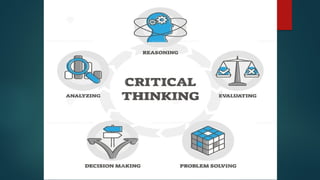
– Is a broader cognitive process that
involves analyzing, synthesizing, and
evaluating information or arguments.
– Encompasses skills such as logical
reasoning, problem-solving, decision-
making, and the ability to approach
situations with a discerning and
analytical mindset.
–The goal of critical thinking is to form
well-reasoned judgments and make
informed decisions. It involves
questioning assumptions, considering
multiple perspectives, and
understanding the implications of
one’s thought.
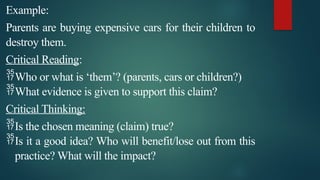
Example:
Parents are buying expensive cars for their children to
destroy them.
Critical Reading:
Who or what is ‘them’? (parents, cars or children?)
What evidence is given to support this claim?
Critical Thinking:
Is the chosen meaning (claim) true?
Is it a good idea? Who will benefit/lose out from this
practice? What will the impact?
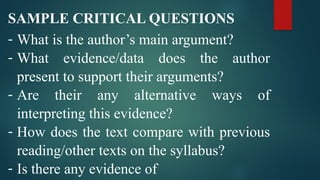
SAMPLE CRITICAL QUESTIONS
- What is the author’s main argument?
- What evidence/data does the author
present to support their arguments?
- Are their any alternative ways of
interpreting this evidence?
- How does the text compare with previous
reading/other texts on the syllabus?
- Is there any evidence of
ACTIVITY
TIME!
CONVINCE ME!
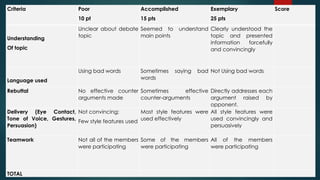
Criteria Poor
10 pt
Accomplished
15 pts
Exemplary
25 pts
Score
Understanding
Of topic
Unclear about debate
topic
Seemed to understand
main points
Clearly understood the
topic and presented
information forcefully
and convincingly
Language used
Using bad words Sometimes saying bad
words
Not Using bad words
Rebuttal No effective counter
arguments made
Sometimes effective
counter-arguments
Directly addresses each
argument raised by
opponent.
Delivery (Eye Contact, Tone
of Voice, Gestures,
Persuasion)
Not convincing;
Few style features used
Most style features were
used effectively
All style features were
used convincingly and
persuasively
Teamwork Not all of the members
were participating
Some of the members were
participating
All of the members were
participating
TOTAL
Criteria Poor
10 pt
Accomplished
15 pts
Exemplary
25 pts
Score
Understanding
Of topic
Unclear about debate
topic
Seemed to understand
main points
Clearly understood the
topic and presented
information forcefully
and convincingly
Language used
Using bad words Sometimes saying bad
words
Not Using bad words
Rebuttal No effective counter
arguments made
Sometimes effective
counter-arguments
Directly addresses each
argument raised by
opponent.
Delivery (Eye Contact,
Tone of Voice, Gestures,
Persuasion)
Not convincing;
Few style features used
Most style features were
used effectively
All style features were
used convincingly and
persuasively
Teamwork Not all of the members
were participating
Some of the members
were participating
All of the members
were participating
TOTAL
Process Questions
What did you feel while doing the activity?
How did you come with those kinds of
reasons?
For the judges:
How were you able to make sound judgment?
GENERALIZATION
1. Why do you need to read critically or
to be an active reader?
2. Explain critical reading as
reasoning.
3. How can you identify critical
reading as a form of reasoning?
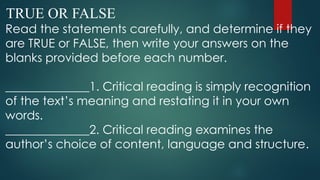
TRUE OR FALSE
Read the statements carefully, and determine if they
are TRUE or FALSE, then write your answers on the
blanks provided before each number.
______________1. Critical reading is simply recognition
of the text’s meaning and restating it in your own
words.
______________2. Critical reading examines the
author’s choice of content, language and structure.
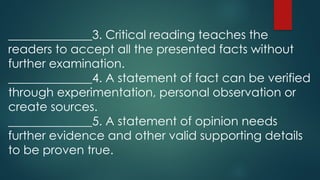
______________3. Critical reading teaches the
readers to accept all the presented facts without
further examination.
______________4. A statement of fact can be verified
through experimentation, personal observation or
create sources.
______________5. A statement of opinion needs
further evidence and other valid supporting details
to be proven true.
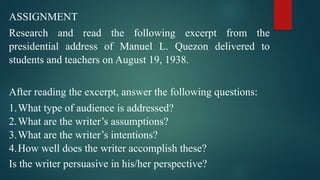
ASSIGNMENT
Research and read the following excerpt from the
presidential address of Manuel L. Quezon delivered to
students and teachers on August 19, 1938.
After reading the excerpt, answer the following questions:
1.What type of audience is addressed?
2.What are the writer’s assumptions?
3.What are the writer’s intentions?
4.How well does the writer accomplish these?
Is the writer persuasive in his/her perspective?
THANK YOU!

CRITICAL READING reading and writee.pptx

  • 1.
    I.OBJECTIVES At the endof the lesson, the students are expected to: a. identify critical reading as a form of reasoning; b. differentiate Critical Thinking and Critical Reading and, c. defend each other’s judgment.
  • 2.
    What is context? -backgroundof the text which it’s related to other circumstances that surrounds the text and from which can be better understood and evaluated.
  • 3.
    What is thedifference between linear and non- linear text? -Linear is a traditional text that needs to read from beginning to end while the Non-linear refers to text that does not to be read from beginning to end.
  • 4.
    How can youidentify Hypertext and Intertext? -Hypertext is beyond text that uses link which you can click you can go to other information and Intertext is in between the text that is similar, imitation and borrowing some elements that related the text.
  • 16.
  • 17.
    What is REASONING? –anact of giving statements for justification and explanation. It is the ability of someone to defend something by giving out reasons.
  • 18.
    Example • Someone hascoffee every morning before work, Monday-Friday. It is safe to say based on these facts this person likes coffee. • All dogs barks, this animal barks, so therefore this animal is a dog. • In winter it will snow, because it is winter there will probably be snow.
  • 20.
    –­ ­ ­ ­ is a techniquefor discovering information and ideas within a text. - Critical reading is engaging in analytic activity which involves the reader by asking questions about the text and the author’s claim. - Critical readers are doing the process of evaluating, analyzing, and interpreting the assertion of the hidden meaning of the whole.
  • 21.
    - Therefore, whenreading critically, it is necessary to question the different arguments used by the author, as any problem can weaken the authenticity of the conclusion. - Remember that Critical reading is not meant to criticize but to assess the validity of textual evidence.
  • 22.
    – The primarygoal of critical reading is to comprehend the text deeply, question assumptions, and assess the reliability and validity of the information presented.
  • 23.
    Why critical readingis a form of reasoning? Your critical reading of a text and thinking about a text enables you to use it to make your own arguments. As a critical thinker and writer, you make judgments and interpretations of the ideas, arguments, and claims of others presented in the texts you read.
  • 25.
    – Is abroader cognitive process that involves analyzing, synthesizing, and evaluating information or arguments. – Encompasses skills such as logical reasoning, problem-solving, decision- making, and the ability to approach situations with a discerning and analytical mindset.
  • 26.
    –The goal ofcritical thinking is to form well-reasoned judgments and make informed decisions. It involves questioning assumptions, considering multiple perspectives, and understanding the implications of one’s thought.
  • 27.
    Example: Parents are buyingexpensive cars for their children to destroy them. Critical Reading: Who or what is ‘them’? (parents, cars or children?) What evidence is given to support this claim? Critical Thinking: Is the chosen meaning (claim) true? Is it a good idea? Who will benefit/lose out from this practice? What will the impact?
  • 31.
    SAMPLE CRITICAL QUESTIONS -What is the author’s main argument? - What evidence/data does the author present to support their arguments? - Are their any alternative ways of interpreting this evidence? - How does the text compare with previous reading/other texts on the syllabus? - Is there any evidence of
  • 32.
  • 33.
  • 37.
    Criteria Poor 10 pt Accomplished 15pts Exemplary 25 pts Score Understanding Of topic Unclear about debate topic Seemed to understand main points Clearly understood the topic and presented information forcefully and convincingly Language used Using bad words Sometimes saying bad words Not Using bad words Rebuttal No effective counter arguments made Sometimes effective counter-arguments Directly addresses each argument raised by opponent. Delivery (Eye Contact, Tone of Voice, Gestures, Persuasion) Not convincing; Few style features used Most style features were used effectively All style features were used convincingly and persuasively Teamwork Not all of the members were participating Some of the members were participating All of the members were participating TOTAL
  • 39.
    Criteria Poor 10 pt Accomplished 15pts Exemplary 25 pts Score Understanding Of topic Unclear about debate topic Seemed to understand main points Clearly understood the topic and presented information forcefully and convincingly Language used Using bad words Sometimes saying bad words Not Using bad words Rebuttal No effective counter arguments made Sometimes effective counter-arguments Directly addresses each argument raised by opponent. Delivery (Eye Contact, Tone of Voice, Gestures, Persuasion) Not convincing; Few style features used Most style features were used effectively All style features were used convincingly and persuasively Teamwork Not all of the members were participating Some of the members were participating All of the members were participating TOTAL
  • 40.
    Process Questions What didyou feel while doing the activity? How did you come with those kinds of reasons? For the judges: How were you able to make sound judgment?
  • 41.
    GENERALIZATION 1. Why doyou need to read critically or to be an active reader? 2. Explain critical reading as reasoning.
  • 42.
    3. How canyou identify critical reading as a form of reasoning?
  • 43.
    TRUE OR FALSE Readthe statements carefully, and determine if they are TRUE or FALSE, then write your answers on the blanks provided before each number. ______________1. Critical reading is simply recognition of the text’s meaning and restating it in your own words. ______________2. Critical reading examines the author’s choice of content, language and structure.
  • 44.
    ______________3. Critical readingteaches the readers to accept all the presented facts without further examination. ______________4. A statement of fact can be verified through experimentation, personal observation or create sources. ______________5. A statement of opinion needs further evidence and other valid supporting details to be proven true.
  • 45.
    ASSIGNMENT Research and readthe following excerpt from the presidential address of Manuel L. Quezon delivered to students and teachers on August 19, 1938. After reading the excerpt, answer the following questions: 1.What type of audience is addressed? 2.What are the writer’s assumptions? 3.What are the writer’s intentions? 4.How well does the writer accomplish these? Is the writer persuasive in his/her perspective?
  • 46.