The Reader-Writer Problem
OPERATING SYSTEMS
INTRODUCTION
The Reader-Writer Problem is a fundamental challenge in concurrent
programming, where multiple threads or processes need to access
shared data simultaneously. It involves coordinating read and write
operations to ensure data integrity and maximize system throughput.
Defining the Reader-Writer Problem
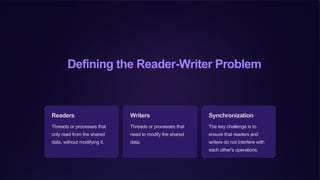
Readers
Threads or processes that
only read from the shared
data, without modifying it.
Writers
Threads or processes that
need to modify the shared
data.
Synchronization
The key challenge is to
ensure that readers and
writers do not interfere with
each other's operations.
Characteristics of the Reader-Writer
Problem
Concurrency
Multiple readers and writers
can access the shared data
simultaneously.
Data Integrity
Ensure the shared data
remains consistent and correct,
even with concurrent access.
Performance
Maximize the throughput of the
system by allowing as much
concurrent access as possible.
Synchronization Challenges
1 Mutual Exclusion
Ensure that only one
writer can access the
shared data at a time to
prevent data corruption.
2 Starvation
Avoid a situation where
readers or writers are
indefinitely denied access
to the shared data.
3 Deadlocks
Prevent a scenario where
two or more threads are
waiting for each other to
release resources,
leading to a system-wide
halt.
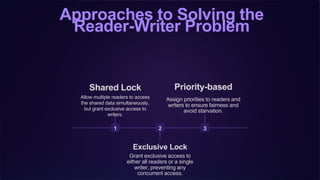
Approaches to Solving the
Reader-Writer Problem
1
Shared Lock
Allow multiple readers to access
the shared data simultaneously,
but grant exclusive access to
writers.
2
Exclusive Lock
Grant exclusive access to
either all readers or a single
writer, preventing any
concurrent access.
3
Priority-based
Assign priorities to readers and
writers to ensure fairness and
avoid starvation.
Shared Lock Approach
Multiple Readers
Readers can access the shared
data simultaneously, as long as
no writer is active.
Single Writer
Writers are granted exclusive
access to the shared data,
blocking all readers.
Fair Scheduling
The algorithm ensures that
readers and writers are
scheduled fairly, preventing
starvation.
Exclusive Lock Approach
Reader-Priority
Readers are granted access
as long as no writer is active,
ensuring low latency for read
operations.
Writer-Priority
Writers are given priority over
readers, ensuring that write
operations are completed in a
timely manner.
Hybrid Approach
A combination of reader and
writer priorities, balancing the
needs of both read and write
operations.
THANK YOU!

readers writers Problem in operating system

  • 1.
  • 2.
    INTRODUCTION The Reader-Writer Problemis a fundamental challenge in concurrent programming, where multiple threads or processes need to access shared data simultaneously. It involves coordinating read and write operations to ensure data integrity and maximize system throughput.
  • 3.
    Defining the Reader-WriterProblem Readers Threads or processes that only read from the shared data, without modifying it. Writers Threads or processes that need to modify the shared data. Synchronization The key challenge is to ensure that readers and writers do not interfere with each other's operations.
  • 4.
    Characteristics of theReader-Writer Problem Concurrency Multiple readers and writers can access the shared data simultaneously. Data Integrity Ensure the shared data remains consistent and correct, even with concurrent access. Performance Maximize the throughput of the system by allowing as much concurrent access as possible.
  • 5.
    Synchronization Challenges 1 MutualExclusion Ensure that only one writer can access the shared data at a time to prevent data corruption. 2 Starvation Avoid a situation where readers or writers are indefinitely denied access to the shared data. 3 Deadlocks Prevent a scenario where two or more threads are waiting for each other to release resources, leading to a system-wide halt.
  • 6.
    Approaches to Solvingthe Reader-Writer Problem 1 Shared Lock Allow multiple readers to access the shared data simultaneously, but grant exclusive access to writers. 2 Exclusive Lock Grant exclusive access to either all readers or a single writer, preventing any concurrent access. 3 Priority-based Assign priorities to readers and writers to ensure fairness and avoid starvation.
  • 7.
    Shared Lock Approach MultipleReaders Readers can access the shared data simultaneously, as long as no writer is active. Single Writer Writers are granted exclusive access to the shared data, blocking all readers. Fair Scheduling The algorithm ensures that readers and writers are scheduled fairly, preventing starvation.
  • 8.
    Exclusive Lock Approach Reader-Priority Readersare granted access as long as no writer is active, ensuring low latency for read operations. Writer-Priority Writers are given priority over readers, ensuring that write operations are completed in a timely manner. Hybrid Approach A combination of reader and writer priorities, balancing the needs of both read and write operations.
  • 9.